

Daycare and school cleaning leads come from two different buyers. Public school districts buy cleaning through formal bids and RFPs posted on their own purchasing pages, bid networks and purchasing cooperatives, and they screen you first on insurance, background checks and experience. Daycare owners and private schools buy direct, usually after a walkthrough, and they care most about who is alone in their building after hours and what chemicals touch surfaces children put in their mouths.
This page has two parts. Part 1 is for commercial cleaning companies that want daycare and school contracts: buyer counts, a real district RFP broken down line by line, the requirements checklist, bid-service prices and a capability statement you can copy. Part 2 is the daycare marketing playbook for center owners: enrollment math, the tour funnel, software prices, Google Business Profile categories, review rules, license-number rules for ads and COPPA.
Lead generation for daycare and school cleaning: who actually buys
Start by sizing the three buyer groups, because each one needs a different lead source. The counts below are the latest federal figures.
| Buyer | How many in the US | How they buy cleaning | Who decides | Where the lead comes from |
|---|---|---|---|---|
| Public school districts | 13,318 regular districts; 99,388 public schools (2022 to 2023) | Formal bid or RFP above a state dollar threshold, or a purchasing cooperative contract | Facilities director and purchasing office; the school board approves the award | District purchasing page, bid networks, cooperatives |
| Private schools | 29,727 (2021 to 2022) | Direct quote, sometimes a short RFP | Head of school or business manager | Direct outreach, referrals, walkthroughs |
| Child day care centers | 82,162 establishments with paid employees (2023) | Direct quote after a walkthrough | Owner or center director | Direct outreach, Google Maps, local referrals |
School counts are from NCES Digest table 214.10; the private school figure is the latest year in that table. Day care counts are NAICS 624410 (Child Day Care Services) from the Census Bureau’s 2023 County Business Patterns, released June 2025. The same file counts 67,799 janitorial establishments (NAICS 561720), so the country has more child day care establishments than janitorial ones.
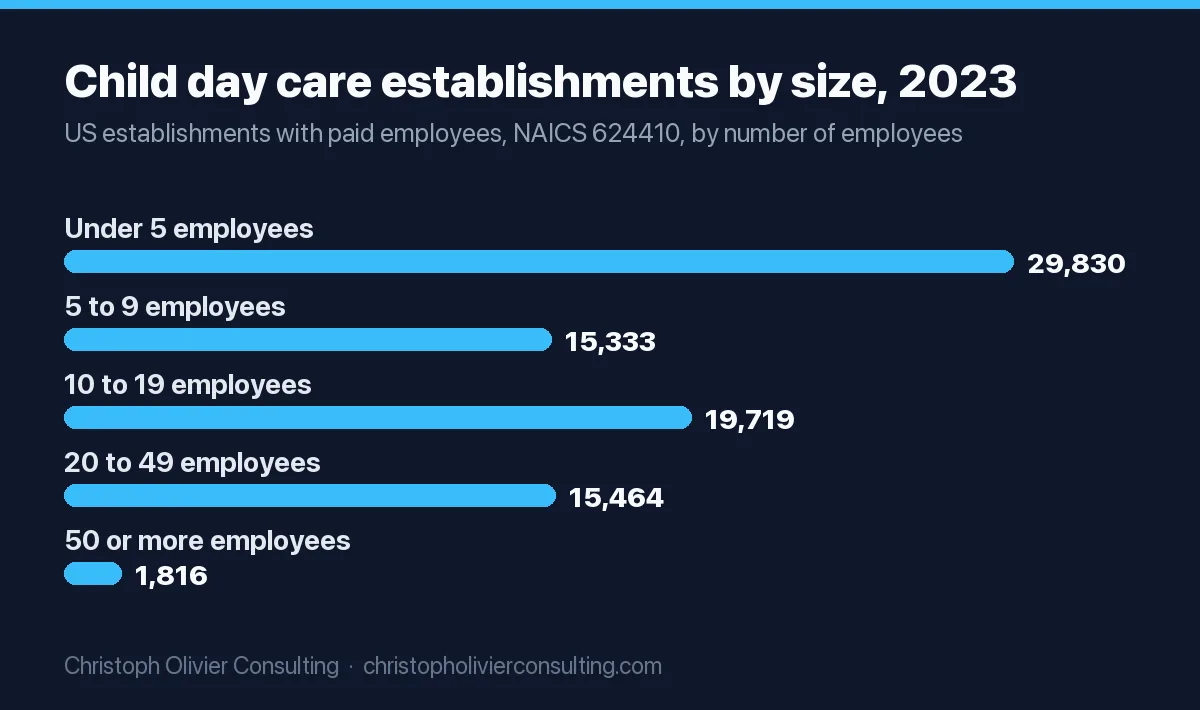
Size matters for your pitch. Of those 82,162 day care establishments, 29,830 have fewer than 5 employees and 15,464 have 20 to 49. A 20 to 49 employee center is usually a full commercial building with classrooms, a kitchen and diapering stations: a nightly contract, not a monthly tidy.
Where the child care centers are
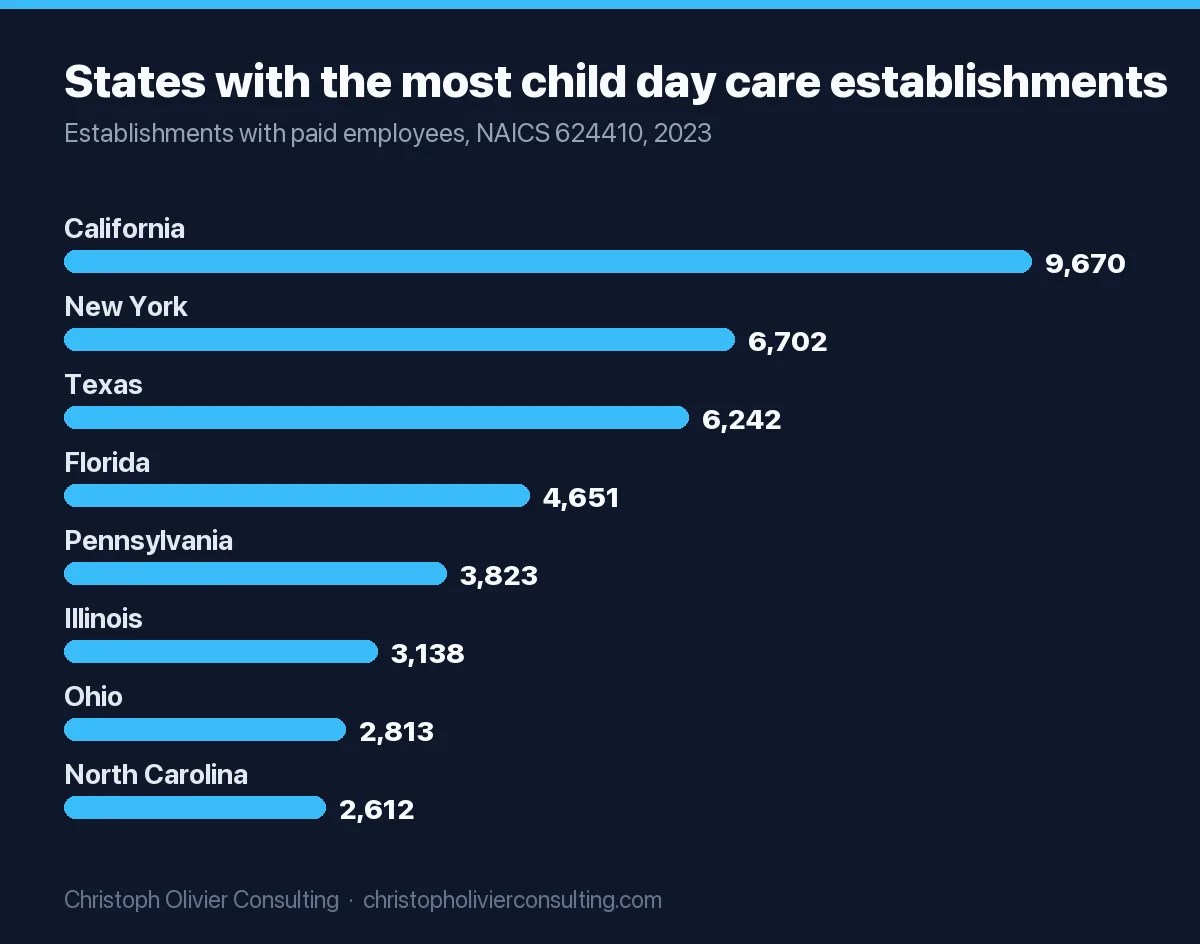
If you are choosing a state to build a daycare cleaning route in, these are the largest markets by establishment count. California alone has 9,670.
How school districts buy cleaning: a real RFP, line by line
Most “how to get school cleaning contracts” guides stay vague. Here is what one district actually asked for. Hamilton Southeastern Schools in Fishers, Indiana (about 21,000 students, 26 buildings) issued an RFP for custodial and related management services on March 31, 2025, under Indiana Code 5-22-9.
| RFP element | What the district required | What it means for your bid |
|---|---|---|
| Timeline | Published March 31, mandatory pre-bid meeting April 16, questions closed April 30, due May 6, board recommendation May 14, 2025 | Five weeks from notice to deadline. Put the mandatory meeting in your calendar the day you see the notice. |
| Term | 3 years plus two optional 1-year renewals | One win can be five years of revenue, so price for retention, not one year |
| Experience | Minimum 5 years cleaning schools; five K-12 public school references from the past five years | Newer firms start with private schools and daycares to build references |
| Local presence | Offerors without Indiana offices “will not be considered for scoring” | Read the qualifications page before anything else |
| Background checks | Local, state and national criminal checks, drug screens, expanded child protection index checks, sex offender registry checks and E-Verify for every employee, repeated annually, results given to the district before work starts | $2,500 owed to the district for each employee who enters a building without a completed check |
| Financials | Audited financial statements for the last two years; retention rates for the past five years; wages per employee | Without audited statements, this RFP is not for you yet |
| Bond | $250,000 performance bond at the start of the agreement | Talk to a surety before you bid |
| Scoring | Mandatory requirements pass/fail, then 60 points management and quality, 40 points cost | The low price does not win on its own; the staffing and quality plan is worth more |
Price the insurance exhibit first. These are the minimums from the same RFP:
| Coverage | Minimum limit | Required endorsements |
|---|---|---|
| Commercial general liability | $1,000,000 each occurrence, $2,000,000 aggregate | District as additional insured including completed operations, waiver of subrogation, primary and non-contributory, per project and per location aggregate |
| Business auto liability | $1,000,000 each accident | Owned, non-owned and hired autos |
| Workers’ compensation and employer’s liability | Statutory; employer’s liability $1,000,000 each accident, $1,000,000 disease each employee, $1,000,000 disease policy limit | Waiver of subrogation |
| Umbrella liability | $5,000,000 each occurrence, $5,000,000 aggregate | Follow form over general, auto and employer’s liability |
The certificate of insurance was due no later than 14 days after contract execution, with 30 days’ written notice before any cancellation. Send this table to your broker and ask for a quote before you chase school bids, not after you win one.
When a district must bid, and when it can skip the bid
Each state sets the dollar line. In Texas, Education Code Section 44.031 requires school district contracts for goods and services valued at $100,000 or more in the aggregate over each 12-month period to use the best-value method among competitive bidding, competitive sealed proposals, a request for proposals, an interlocal contract, a reverse auction and a few others. The award criteria in the statute start with purchase price but also include vendor reputation, quality, past relationship with the district and total long-term cost.
The “interlocal contract” option is why purchasing cooperatives matter. A cooperative runs one competitive solicitation and its member districts buy from the awarded vendors without running their own bid. Texas districts that buy through a cooperative contract worth $25,000 or more must document any fees, under Section 44.0331 of the same chapter. TIPS (The Interlocal Purchasing System), whose lead agency is Region 8 ESC in Pittsburg, Texas, is one example: it posts its own solicitations on its Ionwave portal. Winning a cooperative award puts you on a list that many districts can buy from directly.
Timing: in the Hamilton Southeastern example the RFP was published in March and awarded in May, ahead of a new school year. Bid-data vendor NationGraph says district fiscal years end June 30, with spring for planning and summer for RFP releases. Set your bid alerts by January.
What daycares and schools require from a cleaning company
Daycare owners rarely publish requirements, but their licensing rules and the CDC set them for you. Three areas decide whether you get the contract.
Background checks: federal rules can cover contract cleaners
Under the federal Child Care and Development Fund rule, states must require background checks for “child care staff members” of all licensed, regulated or registered child care providers. The definition in 45 CFR 98.43 includes “contract employees or self-employed individuals” whose activities involve “unsupervised access to children.” A cleaner who works while children are in the building, with unsupervised access to them, can fall inside that definition; a crew that only works after closing may not. The check includes:
- An FBI fingerprint check using Next Generation Identification.
- A search of the National Crime Information Center’s National Sex Offender Registry.
- State criminal, sex offender, and child abuse and neglect registry searches in the state where the person lives and every state they lived in during the preceding five years.
- A repeat at least once every 5 years for existing staff.
How your state applies this to an after-hours crew varies, so ask the center’s director what their licensing consultant expects, and offer fingerprint-cleared staff before they ask. This is a summary, not legal advice.
Green cleaning: Green Seal GS-42, Safer Choice and state school laws
Green Seal GS-42 (Commercial and Institutional Cleaning Services, Edition 2.3) certifies the cleaning service itself, not a product. It names children as a vulnerable population and requires the service to get a list of areas with vulnerable populations from building management and to schedule daily cleaning to avoid exposing them. For products, the EPA’s Safer Choice program certifies cleaners (all-purpose, floor, tub and tile) and keeps a separate list of Design for the Environment (DfE) certified disinfectants.
Two states make green cleaning products mandatory in schools:
- New York: Education Law Section 409-i requires green cleaning products in all public and non-public elementary and secondary schools, in effect since September 1, 2006, and only products on the OGS-approved list may be used, per the state’s OGS green cleaning program.
- Illinois: 105 ILCS 140/10 requires all public schools and non-public schools with 50 or more students to adopt a green cleaning policy and exclusively buy environmentally sensitive cleaning products, unless the school files an annual notice that it is not economically feasible.
CDC cleaning steps for child care settings
The CDC’s guidance on cleaning and disinfecting early care and education settings separates three jobs, and a daycare director will judge your proposal on whether you know the difference:
| Step | What it is for | CDC specifics |
|---|---|---|
| Clean | Remove dirt and most germs with soap, water and scrubbing | Visibly dirty and high-touch surfaces daily; always clean before you sanitize or disinfect |
| Sanitize | Items children put in their mouths, such as toys and infant feeding items | Weakened bleach solution (1 tablespoon unscented bleach per gallon of water), an EPA-registered sanitizing spray or a dishwasher; highchair trays just before and right after eating |
| Disinfect | Bathrooms, diaper changing tables, and surfaces when someone is sick | EPA-registered disinfectant or diluted bleach; keep the surface wet for the full label contact time; never mix bleach with ammonia cleaners |
The same page says to store chemicals out of children’s reach and ventilate when using products indoors. The CDC’s infection-prevention page for early care programs, last reviewed August 2026, repeats the routine: clean frequently touched objects, disinfect when someone is sick, follow diapering and feeding rules.
Bid/no-bid scorecard for a school or daycare cleaning opportunity
Run every opportunity through these gates before you spend a week writing. Any “fail” in the first five rows means do not bid yet. The gates come from the Hamilton Southeastern RFP and the rules above.
| Gate | Pass | Fail |
|---|---|---|
| 1. Insurance | You carry or have a broker quote for the limits in the RFP, including umbrella | Your umbrella is below the requirement and no quote exists |
| 2. Background checks | Every assigned employee can clear the checks the buyer lists, and you can pay for annual repeats | Any crew member would start before results arrive |
| 3. Experience and references | You meet the years and the number of school references required | You are short on either |
| 4. Location and registration | You meet any in-state office rule and are registered on the portal the buyer uses | Out-of-state with a local-presence clause |
| 5. Bond and financials | A surety will write the bond; audited statements exist if required | Neither |
| 6. Products | Your products meet the buyer’s green rules (OGS list in New York, environmentally sensitive in Illinois) | You would need to switch chemicals mid-contract |
| 7. Mandatory meeting | The pre-bid walkthrough is in your calendar | It already passed |
| 8. Labor fit | You can staff the required days (247 in the Indiana RFP) without overtime you did not price | Coverage depends on hires you have not made |
Where to find daycare and school cleaning leads, with prices
Prices below were checked on each vendor’s own page on November 1, 2026. Where a vendor publishes no price, the table says so.
| Lead source | Published price | What you get | Best for |
|---|---|---|---|
| District purchasing page and vendor registration | $0 | Bids from that one district; ask the purchasing office to add you to its custodial vendor list | Every district within your service radius |
| BidNet Direct Basic | $0 | Bids from BidNet member agencies, real-time matches by email | Starting out; BidNet runs regional purchasing groups such as the Rocky Mountain E-Purchasing System and the Kansas Purchasing Group |
| BidNet Direct Local | $599 a year (or $199 a month) | Aggregated bids from one state, saved searches, daily match summary | A single-state cleaner |
| BidNet Direct Regional | $1,199 a year, annual billing only | Aggregated bids from three states | Metro areas that cross state lines |
| BidNet Direct National | $1,999 a year, annual billing only | Aggregated bids from all states; federal bids are a separate $149 a year add-on | Multi-state operators |
| BidPrime | Quote only, “billed annually and quoted to your geographic coverage” | State, local and education bids plus federal; expiring-contract and incumbent data on higher tiers; 30-day free trial with no credit card | Seeing which school custodial contracts expire next year |
| GovSpend | Quote only (demo request) | Public sector spend and pre-RFP intelligence | Larger firms planning a multi-district push |
| DemandStar | Free and paid subscriptions; plan prices were not shown on the page we read | Government bid notices; free for agencies to post | Checking whether your local districts post there |
| Google search ads | Median cost per lead $93.69, cost per click $5.87 (Business Services) | Inbound calls from facility managers searching “commercial cleaning near me” | Private schools and daycares, not public districts |
The Google Ads figures are WordStream’s 2026 benchmarks (13,474 US search campaigns, April 2025 to March 2026, median figures). Matching commercial cleaning to “Business Services” is my judgment, not WordStream’s; our Google Ads CPC by industry page has every category.
Daycare cleaning leads: build the list yourself
Daycares do not post RFPs, so the lead list is yours to build. Search Google Maps in your service area for the categories centers actually use. These categories exist in the current Google Business Profile list compiled by Dalton Luka (updated May 9, 2026): Day care center, Child care agency, Preschool, Nursery school, Montessori preschool, Bilingual preschool, Kindergarten, After school program and Family day care service. Family day care services are home-based, so they rarely need a commercial contract.
Then run a short outbound sequence to the director, not a generic “do you need cleaning” email. Our outbound lead generation guide covers cadence and deliverability. A first email that works because it is specific:
Subject: After-hours cleaning for [Center name], fingerprint-cleared crew
Hi [Director first name], we clean [number] child care centers in [city] between 6 pm and 10 pm. Every crew member has cleared the same fingerprint and registry checks your staff go through. We sanitize toys and feeding items with the CDC bleach ratio or an EPA-registered sanitizer, disinfect diapering stations and restrooms nightly, and our all-purpose products are Safer Choice certified. Could I walk your building for 20 minutes next [day] and leave a written nightly scope with a fixed monthly price?
[Name], [Company], [Phone]
Only claim what is true for your company. If your products are not Safer Choice certified, cut that line instead of softening it.
For your own Google Business Profile, the same list has “Janitorial service” but no “Commercial cleaning service.” Google says to choose categories that complete the sentence “this business IS a,” so a commercial cleaner should pick Janitorial service, per Google’s category guidelines.
Capability statement template for daycare and school cleaning
A capability statement is the one-page document you attach to bids, leave after walkthroughs and send to purchasing offices when you ask to join their vendor list. Copy this and fill the brackets. Delete any line you cannot prove.
| Section | What to write |
|---|---|
| Header | [Company legal name], [city, state], [phone], [email], [website]. NAICS 561720 (Janitorial Services). [UEI and CAGE code, only if registered in SAM.gov]. [State vendor or HUB/MWBE certification number, if any]. |
| Core competencies | Nightly custodial service for K-12 schools and licensed child care centers; summer deep cleans and floor refinishing; diapering station and restroom disinfection; toy and feeding item sanitizing per CDC early care guidance; day porter coverage. |
| Child-safe staffing | All employees cleared through [FBI fingerprint check, state criminal, sex offender and child abuse and neglect registry checks], repeated [annually / every 5 years]. E-Verify enrolled. No employee works unsupervised before results are on file. |
| Insurance | General liability $[1,000,000] per occurrence / $[2,000,000] aggregate; auto $[1,000,000]; workers’ compensation statutory, employer’s liability $[1,000,000]; umbrella $[5,000,000]. Bonding capacity $[amount] through [surety]. |
| Green cleaning | [Green Seal GS-42 certified service, if true]. Products: [Safer Choice certified cleaners; DfE-certified disinfectants; New York OGS-approved list, if you serve NY schools]. |
| Past performance | Three named clients with square footage, scope, years served and a reference contact: [School or center], [sq ft], [nightly / 5 nights a week], [since year], [name, title, phone]. |
| Differentiators | Two or three facts a director can check: [retention rate of your crew], [response time to a call-back], [quality inspection frequency with written scores]. |
| Contact | [Owner name, title, direct phone]. Available for walkthroughs [days and times]. |
Daycare marketing: the enrollment math for a center
If you run a center, daycare marketing is a funnel from a “daycare near me” search to a signed enrollment, and the number that tells you whether it works is cost per enrolled child. Here is a worked example. The lead cost is WordStream’s 2026 median for Education and Instruction ($77.48 cost per lead, $4.81 cost per click). The conversion rates are assumptions to make the math easy; replace them with your last 90 days.
| Step | Value used | Where it comes from |
|---|---|---|
| Cost per inquiry (Google Ads) | $77.48 | WordStream 2026, Education and Instruction median |
| Inquiries that book and attend a tour | 50% | Assumption: replace with yours |
| Tours that enroll | 40% | Assumption: replace with yours |
| Inquiry to enrollment | 50% x 40% = 20% | Calculated |
| Cost per enrolled child | $77.48 / 0.20 = $387.40 | Calculated |
| Annual price of child care (national average, 2025) | $13,184 | Child Care Aware of America |
| Acquisition cost as share of one year’s price | $387.40 / $13,184 = 2.9% | Calculated |
Child Care Aware warns that its national average hides big state differences, so use your own tuition. The lesson holds anyway: if half your inquiries never tour, cost per enrolled child doubles, which is why the tour funnel below matters more than ad spend. Our small business lead generation guide shows how to set a monthly budget from a target cost per customer.
The tour booking funnel: scripts you can use tomorrow
Most enrollment is won or lost between the inquiry and the tour. These are house rules, not industry statistics; measure your own inquiry-to-tour rate before and after.
- Reply the same hour with two fixed times. Text: “Hi [Parent], thanks for asking about [infant/toddler/preschool] care for [Child]. I can show you the [room name] room on [Tue 9:30] or [Thu 4:15]. Which works? [Director name], [Center].”
- Collect three facts before the tour: child’s age, desired start date, days per week. Check room capacity before the parent arrives so you never tour a full room without a waitlist answer.
- Tour the child’s future room first, introduce the lead teacher by name and show one routine in progress: drop-off, lunch or nap.
- Answer the three questions parents ask: ratios in that room, how you communicate during the day, and your license status (show the license and inspection reports).
- End with a dated hold: “I can hold the [Monday/Wednesday/Friday] spot starting [date] until [date + 3 days] with the registration fee.”
- Follow up within 24 hours with the enrollment link, the held start date and the hold deadline. If the room is full, put the family on the waitlist the same day and tell them their position.
Waitlist and enrollment software: which prices are public
Most child care management platforms hide prices behind a demo. Here is what each vendor’s own pricing page showed on November 1, 2026:
| Software | Published US price | Waitlist and lead tools |
|---|---|---|
| Famly | $49 a month (up to 30 children), $79 (30 to 50), $99 (50 to 70), $119 (70 to 100), $139 (100 to 150), $159 (150 to 200), $179 (200+) | “Waitlists and lead management,” custom registration forms, occupancy report |
| Brightwheel | Quote only: “connect with our team directly for a personalized quote” | Ask on the demo |
| Procare | Quote only (pricing page is a request form) | Ask on the demo |
| Kangarootime | No pricing page; “Schedule a Call” | Ask on the call |
| Playground | Quote only (pricing link opens a demo request) | Ask on the demo |
| Lillio | Quote only (“Get a quote”) | Ask on the demo |
On every demo, ask the same three questions so you can compare: Does a web inquiry land in the waitlist automatically with the child’s age and start date? Can I see waitlist position by room and start month? Can I text a family when a spot opens, from the software?
Google Business Profile for a daycare: the categories that exist
Parents choose from the map, so the primary category matters. From the same category list, these exist for child care:
| Your business | Primary category | Add only if true |
|---|---|---|
| Licensed center serving infants to pre-K | Day care center | Preschool, After school program |
| Preschool-only program | Preschool | Montessori preschool or Bilingual preschool, if that is your method |
| Home-based licensed provider | Family day care service | Childminder |
| Montessori school with toddler and primary rooms | Montessori preschool | Day care center, if you offer full-day care |
This mapping is my judgment, applying Google’s rule to choose “the fewest number of categories it takes to describe your overall core business.” “Child care agency” also exists, but the name suggests a placement or referral service, so I would not use it as a center’s primary category. Our martial arts school marketing guide applies the same “IS a” test to kids programs.
Reviews: what Google and the FTC allow
Google’s rules are stricter than the FTC’s, so follow Google’s on Google. Google’s fake engagement policy bans offering “payment, discounts, free goods and/or services” in exchange for any review, selectively asking only happy families, and pressuring parents to review while on the premises. The FTC’s consumer reviews rule, in effect since October 21, 2024, bans incentives conditioned on a positive review and review suppression, and requires clear disclosure of insider reviews, such as one written by a staff member. A tuition credit for a review is a no on Google even if it is unconditional.
Ask every family the same way, at a natural moment such as the end of the first month or a classroom move-up:
“Hi [Parent], [Child] has been with us a month. If you have a minute, an honest Google review helps other families find us: [link]. Thank you. [Director name]”
Our reputation management guide covers how to respond to every review, including critical ones.
License numbers in daycare ads: California, Florida and Maryland
Some states require your license number in advertisements. Three verified examples:
| State | Rule | Source |
|---|---|---|
| California | Licensees “shall reveal each child care center license number in all advertisements”; correspondence counts as advertising if its intent is to attract clients | 22 CCR 101162 |
| Florida | No one may advertise a child care facility, family child care home or large family child care home without the state or local license or registration number; violation is a first-degree misdemeanor | Fla. Stat. 402.318 |
| Maryland | No advertising without a current license; ads must state the center is licensed and include the license number | COMAR 13A.16.03.09 |
The simple approach: put “License #[number]” in your website footer, in every ad’s description line and on printed materials. Check your own state’s licensing rules; other states have their own versions.
COPPA: what it does and does not cover for a daycare
Most daycare marketing does not trigger COPPA, because parents fill in the forms. The FTC’s COPPA FAQ says COPPA “only applies to personal information collected online from children,” not from parents. It covers operators of websites and online services directed to children under 13, or those with actual knowledge they collect a child’s data.
| What you do online | COPPA likely? | Why |
|---|---|---|
| Parent submits a tour request or waitlist form | No | Data comes from an adult |
| A kids’ page with games and a sign-up form for children | Yes | Directed to children and collecting from them |
| Children log in to a learning app or portal you run | Yes | Data collected online from children, including persistent identifiers |
| Children upload photos, videos or voice recordings | Yes | The FTC treats a child’s image or voice in these as personal information |
If you land in a “yes” row, the amended rule applies. The FTC finalized changes requiring separate verifiable parental consent before disclosing children’s data to third parties, including for targeted advertising, and barring indefinite retention. The rule was amended April 22, 2025, with one year to comply, so full compliance has applied since April 22, 2026. Penalties run up to $53,088 per violation. For a parent app your software vendor runs, ask the vendor in writing how it handles COPPA. This is a summary, not legal advice.
A 30-day plan for a center
- Week 1: Set the primary Google Business Profile category, add your license number to the website footer and ads, and upload real room photos (with signed photo releases).
- Week 2: Put the two-time tour reply script and the dated-hold close in writing for every staff member who answers the phone.
- Week 3: Start the one-month review request to every family, using the same wording for all.
- Week 4: Run a small Google Ads test for your highest-margin room and track cost per enrolled child, not cost per click.
If you want a second opinion on your enrollment numbers before spending more on ads, you can book a consultation.
Frequently asked questions
How do I get lead generation for daycare and school cleaning?
Split the work by buyer. For public schools, register on each district's purchasing page and a bid network such as BidNet Direct (free Basic plan, $599 a year for one state) and respond to RFPs. For daycares and private schools, build a list from Google Maps categories like Day care center and Preschool, then email the director offering a walkthrough with fingerprint-cleared staff and a fixed monthly price.
How do cleaning companies find school cleaning bids?
Districts post custodial bids on their own purchasing or business services pages, in local newspapers and on bid networks. Hamilton Southeastern Schools in Indiana, for example, published its 2025 custodial RFP in newspapers and on its website. Paid aggregators such as BidNet Direct, BidPrime and GovSpend collect bids from many agencies, and purchasing cooperatives like TIPS let districts buy from awarded vendors without a separate bid.
What insurance do I need for a school cleaning contract?
Each RFP sets its own limits, so read the insurance exhibit first. One 2025 Indiana district RFP required general liability of $1,000,000 per occurrence and $2,000,000 aggregate, $1,000,000 auto liability, statutory workers' compensation with $1,000,000 employer's liability, a $5,000,000 umbrella, the district as additional insured and a $250,000 performance bond.
Do daycare cleaning staff need background checks?
Often, yes. Federal rule 45 CFR 98.43 requires states to check child care staff members, a definition that includes contract employees with unsupervised access to children. The check covers an FBI fingerprint search, the national sex offender registry and state criminal, sex offender and child abuse registries, repeated at least every five years. School RFPs may ask for more, such as annual checks.
How much does BidNet Direct cost for cleaning bids?
On November 1, 2026, BidNet Direct listed a free Basic plan for its member agencies' bids, Local at $599 a year (or $199 a month) for one state, Regional at $1,199 a year for three states and National at $1,999 a year, with federal bids as a $149 a year add-on. Prices are in USD before tax.
How do I market a daycare to increase enrollment?
Track cost per enrolled child, then fix the tour funnel first. Reply to inquiries the same hour with two fixed tour times, tour the child's future room, answer ratio and license questions, and close with a dated hold. Choose Day care center as your Google Business Profile category and ask every family for an honest review without incentives.
Does a daycare have to put its license number in ads?
In some states, yes. California's 22 CCR 101162 requires the center license number in all advertisements, Florida statute 402.318 makes advertising without the license or registration number a first-degree misdemeanor, and Maryland's COMAR 13A.16.03.09 requires ads to state the center is licensed and show the number. Check your own state's licensing rules.
More Growth, Strategy & Sales guides
- Email List Building: A Practical Guide With Real Benchmarks
- How to Improve Free Trial Conversion: A Metrics-Backed Framework
- Guest Posting: How to Earn Links and Authority Without Breaking Google's Rules
- House Cleaning Marketing: The Recurring-Revenue Playbook
- Painting Company Marketing: Cost Per Booked Job by Channel
- Wedding Planner Marketing: How to Book More Weddings in 2026
- All Growth, Strategy & Sales guides →