
An interior design business owner usually earns somewhere between a small side income and a few hundred thousand dollars a year. Where you land depends on three things: how many hours you bill, what you charge per hour, and how much furniture you buy for clients and resell. The government data is clear about one thing: most design businesses are small. The average sole proprietorship in specialized design services reported $14,140 of net profit on its tax return for 2023 (IRS Statistics of Income, my calculation). Employed interior designers earned a median of $67,190 in May 2025 (BLS).
Short answer: My worked model is built from public data and labeled assumptions. A full-time solo designer billing 900 hours a year at $150 an hour keeps about $126,000 before tax. An owner with three employees and $840,000 in revenue keeps about $198,000. An owner of a $2 million firm with eight employees keeps about $287,000. Those are best cases for firms that stay fully booked. The typical owner earns far less. The average profitable sole proprietor in specialized design netted $28,369 in 2023, and 64.8% of design businesses without employees took in under $25,000 in 2022.
No government survey asks interior design owners what they pay themselves. What you can measure is revenue per firm, the wage you would earn as an employee, what tax returns show as profit, and how a fee plus markup model turns into owner pay. Each section below covers one of those, and the worksheet at the end lets you rerun the numbers with your own rate and hours.
How much does an interior design business owner make? What each source measures
Each source counts something different, so read the “what it measures” column before you compare any of the figures.
| Source and year | What it measures | Figure | How it was calculated |
|---|---|---|---|
| Census SUSB 2022, NAICS 541410 | Average revenue per interior design firm with employees | $1,135,586 | $18,324,956,000 receipts ÷ 16,137 firms (my calculation) |
| Census SUSB 2022, NAICS 541410 | Payroll as a share of revenue at employer firms | 19.0% | $3,478,984,000 payroll ÷ receipts (my calculation) |
| Census SUSB 2022, NAICS 541410 | Average pay per employee at design firms (all roles) | $64,949 | Payroll ÷ 53,565 employees (my calculation) |
| Census Nonemployer Statistics 2022, NAICS 5414 | Average revenue of a design business with no employees (interior, graphic, industrial and other design combined) | $46,466 | $12,939,116,000 ÷ 278,464 businesses (my calculation) |
| IRS SOI, sole proprietorships, tax year 2023 | Net profit per Schedule C return, specialized design services (all design types) | $14,140 all returns; $28,369 profitable returns | $4,340,075,000 ÷ 306,934 returns; $5,582,465,000 ÷ 196,778 returns (my calculation) |
| BLS Occupational Outlook Handbook, May 2025 | Median wage of employed interior designers (owners not counted) | $67,190 | Published. Bottom 10%: under $41,420. Top 10%: over $114,140 |
| Business of Home, January 2026, citing Bizminer | Average interior design firm revenue and net profit, 2024 | $1,396,358 revenue, 7% net profit | Third-party benchmark as reported; method not published in the article |
Three things to take from this table:
- Only the Census employer data is interior design alone. The nonemployer and IRS tables stop at the four-digit code 5414, which also includes graphic, industrial and fashion designers. Those figures show what small design businesses look like in general, not interior designers in particular.
- The $14,140 figure is not a full-time owner’s income. 35.9% of those returns showed no net income, and 92.9% of nonemployer design businesses are sole proprietors (my calculation). Many of them are part-time or just starting out.
- The 7% net margin comes after the owner’s salary. In an S corporation, the owner’s wage is an expense. An owner who takes a $100,000 salary and then earns 7% net profit on $1.4 million brings home about $198,000 before tax. That is my illustration, not a reported figure.
What a typical interior design firm brings in (the median is far below the average)
The $1.14 million average is pulled up by a few hundred large firms. Census also counts firms by annual revenue band. I worked out the share of firms in each band and their average revenue.
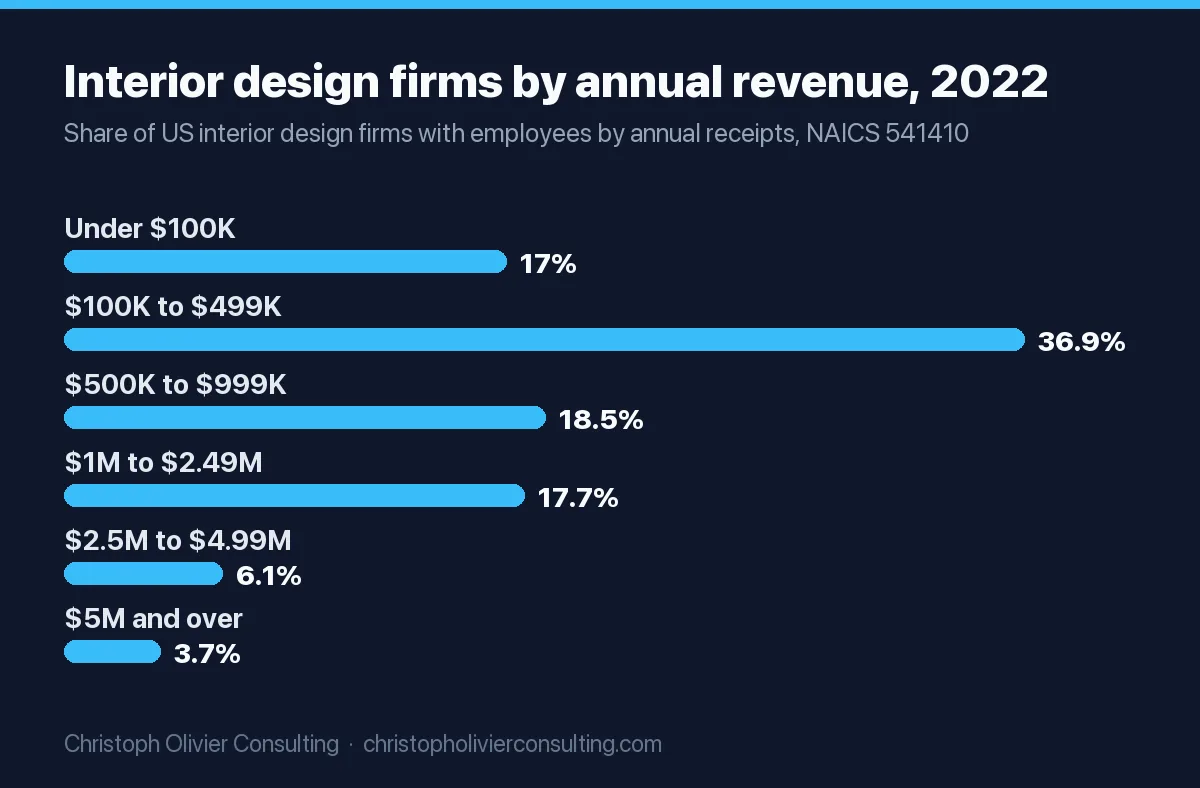
| Annual revenue band (2022) | Firms | Share of firms | Average revenue per firm | Employees per firm | Payroll as % of revenue |
|---|---|---|---|---|---|
| Under $100,000 | 2,746 | 17.0% | $50,570 | 0.8 | 29.8% |
| $100,000 to $499,999 | 5,952 | 36.9% | $265,280 | 1.5 | 21.7% |
| $500,000 to $999,999 | 2,989 | 18.5% | $717,605 | 2.6 | 18.9% |
| $1 million to $2.49 million | 2,861 | 17.7% | $1,550,969 | 4.4 | 17.5% |
| $2.5 million to $4.99 million | 992 | 6.1% | $3,384,137 | 7.5 | 16.8% |
| $5 million and over | 597 | 3.7% | $11,168,910 | not shown | not shown |
Source: Census SUSB 2022, NAICS 541410, employer firms only. Shares, averages and ratios are my calculations. The $5 million and over row is total minus the listed bands.
So 53.9% of design firms with employees took in under $500,000. The typical firm falls in the $100,000 to $499,999 band and has one or two employees. The 597 firms above $5 million make up 3.7% of firms but bring in 36.4% of the industry’s revenue.
Who pays interior designers, and for what
The 2022 Economic Census shows that households paid 65.6% of interior design receipts. Businesses paid 30.3%, and governments and nonprofits paid the remaining 4.1%. By service line (Economic Census products by industry), full-service residential design made up 58.5% of the industry’s $19.7 billion, full-service nonresidential design 20.0%, decorating-only work 14.6% and design services short of full service 2.6%. Census does not report design fees and furniture resale as separate lines, so nobody can tell you from federal data how much of a firm’s revenue comes from markup.
Interior design business owner pay is salary plus profit
The biggest mistake in owner salary articles is treating owner pay as one number. It is really two:
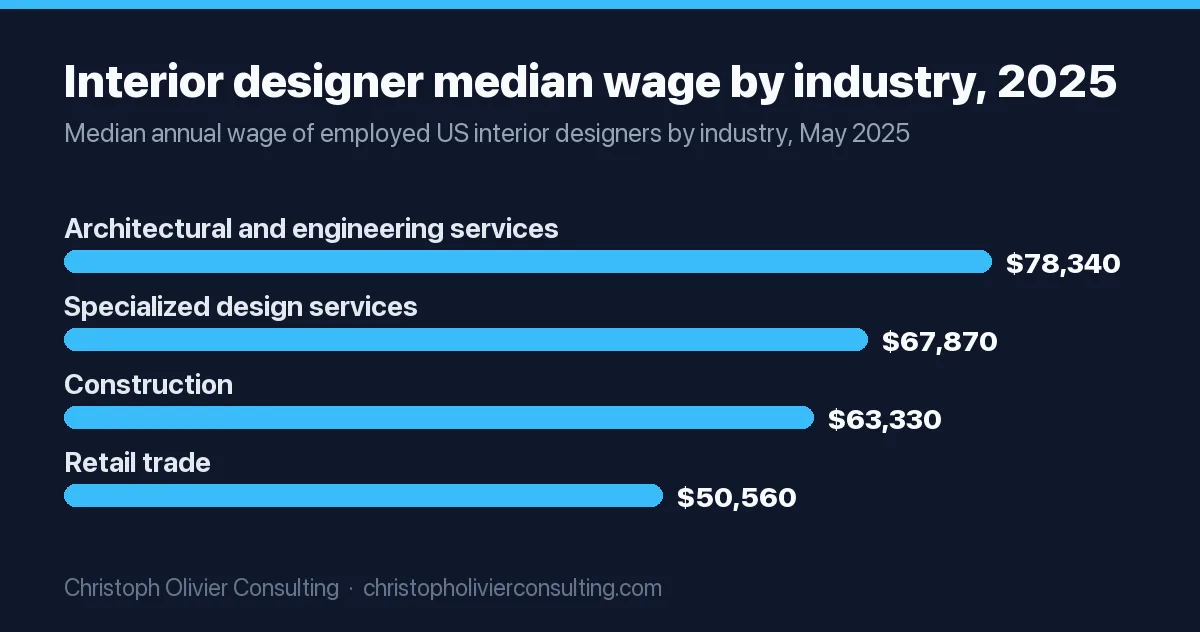
- A market wage for the design work you do yourself. If you are the lead designer, your benchmark is the BLS wage: $67,190 at the median, and $67,870 for designers employed by specialized design firms (May 2025). A senior lead designer is closer to the top 10% line, which is $114,140.
- The profit the business earns after everyone is paid, you included. That is the return on your clients, your vendor accounts, your brand and the risk you carry on purchase orders.
If you run an S corporation, the first part goes through payroll as your salary and the second part comes out as distributions. If you are a sole proprietor or single-member LLC, both land on Schedule C as one net profit line. That is why the IRS numbers above mix the two together. A practical test: if your business profit before your own pay is below the BLS median for designers, you are paying yourself less than an employer would pay you to do the same work.
Interior design business profit margin: three numbers people mix up
The SERP for “interior designer profit margin” mixes up three different measures. Blog posts quote “40 to 60%” next to “15 to 30%” without saying which margin they mean.
| Margin type | What it divides | Public figure | Source |
|---|---|---|---|
| Project gross margin on design time | (Fee minus cost of the designer’s time) ÷ fee | About 65% target for time, 80% for ideas | Business of Home advice column, March 2025 (an adviser’s target, not a measured average) |
| Net margin before owner pay, solo | Schedule C net profit ÷ receipts, profitable returns | 44.2% | IRS SOI 2023, specialized design (my calculation) |
| Net margin after owner salary, firm | Net profit ÷ revenue, average firm | 7% (2024) | Business of Home citing Bizminer |
The 44.2% looks high because it includes the owner’s own wage. Across all sole proprietor returns, profitable or not, the ratio is 30.3%. For a firm with staff, the useful number is the third one: what is left after a market salary for the owner. Profit margins in other service industries are collected on our profit margin by industry page.
Markup vs margin on furnishings
Most residential designers earn part of their income by buying furniture at a trade price and charging the client more. A markup is not a margin. Here is the plain math:
| Markup on your trade cost | Client pays for a $10,000 trade-cost order | Your gross profit | Gross margin on that sale |
|---|---|---|---|
| 15% | $11,500 | $1,500 | 13.0% |
| 20% | $12,000 | $2,000 | 16.7% |
| 25% | $12,500 | $2,500 | 20.0% |
| 30% | $13,000 | $3,000 | 23.1% |
| 35% | $13,500 | $3,500 | 25.9% |
| 50% | $15,000 | $5,000 | 33.3% |
Own calculation: margin = markup ÷ (1 + markup). Freight, receiving, damage claims and returns come out of the gross profit.
The same Business of Home column argues that a percentage fee on product is really an agency fee rather than a markup, because the designer does not own the goods. It suggests aiming for a margin near 50% on product to cover delivery risk. Whether your clients will accept that depends on how you present it. If you are rethinking the fee itself, start with our founder guide to pricing strategy.
Interior design owner income at three sizes (worked calculation)
This is my own model. The inputs come from the Census and BLS figures above, plus vendor prices and assumptions I have labeled. Change any assumption and owner pay changes, which is the point of laying it out.
| Line | Solo designer | Owner + 3 staff | Owner + 8 staff |
|---|---|---|---|
| Owner billable hours × rate (assumption) | 900 × $150 | 800 × $175 | 400 × $200 |
| Staff designers: hours × rate (assumption) | none | 2 × 1,200 × $125 | 5 × 1,200 × $135 |
| Design fee revenue | $135,000 | $440,000 | $890,000 |
| Furnishings billed to clients (assumption) | $100,000 | $400,000 | $1,100,000 |
| Trade cost of furnishings at a 30% markup | $76,923 | $307,692 | $846,154 |
| Total revenue | $235,000 | $840,000 | $1,990,000 |
| Gross profit | $158,077 | $532,308 | $1,143,846 |
| Staff payroll at $64,949 each (Census average) | $0 | $194,847 | $519,592 |
| Payroll taxes and benefits at 20% of payroll (assumption) | $0 | $38,969 | $103,918 |
| Studio rent (assumption) | $0 (home office) | $36,000 | $72,000 |
| Project software at $79 per user per month (Studio Designer, annual billing) | $948 | $3,792 | $8,532 |
| ASID practitioner dues (ASID) | $549 | $549 | $549 |
| Marketing (assumption) | $6,000 | $24,000 | $60,000 |
| Liability insurance (assumption) | $2,500 | $6,000 | $12,000 |
| Vehicle, samples, accounting, other (assumption) | $22,000 | $30,000 | $80,000 |
| Owner pay before tax (salary + profit) | $126,080 | $198,150 | $287,255 |
| Owner pay as % of revenue | 53.7% | 23.6% | 14.4% |
| Census revenue band it falls in | $100K to $499K | $500K to $999K | $1M to $2.49M |
What the model shows:
- The solo owner keeps the most per dollar but hits a ceiling. Owner pay can only grow by raising your rate or billing more hours, and 900 billable hours is already a full year once you count sales calls, site visits and admin that nobody pays for.
- Staff add dollars but squeeze margin. Moving from solo to three staff raises owner pay by about $72,000, but the owner’s share of revenue drops from 53.7% to 23.6%. Every employed designer has to bill about 630 hours at $125 just to cover their own pay, payroll load and software seat, before rent or marketing.
- Product revenue is mostly pass-through. In the $2 million firm, furnishings are 55% of revenue but only 22% of gross profit. Firms that grow by selling more product, without raising fees, grow revenue much faster than owner pay.
- The $2 million firm in this model leaves 14.4% for the owner. If you take out a $114,140 market salary for the owner’s role (the BLS top 10% line), the profit left is about $173,000, or 8.7% of revenue. That is close to the 7% Bizminer average, which suggests the model’s assumptions are not far off.
Solo designer sensitivity: billable hours and rate
The rate and hours below fall within the $100 to $200 an hour that HoneyBook says designers charge in many markets (a vendor’s guidance, not survey data). Each cell keeps the solo column’s product sales and overhead the same (own calculation).
| Billable hours per year | $100 per hour | $150 per hour | $200 per hour |
|---|---|---|---|
| 500 | $41,080 | $66,080 | $91,080 |
| 700 | $61,080 | $96,080 | $131,080 |
| 900 | $81,080 | $126,080 | $171,080 |
| 1,100 | $101,080 | $156,080 | $211,080 |
At 500 billable hours and $100 an hour, a solo owner earns $41,080, which is about the BLS bottom 10% wage of $41,420. At 700 hours you need about $109 an hour just to match the $67,190 median employee wage. Moving from $150 to $200 an hour is worth as much as adding 300 billable hours, so pricing is usually the cheaper lever to pull before hiring.
How much money do you need to start an interior design business?
A home-based residential practice is one of the cheaper professional businesses to start, because most of the inventory is ordered after the client pays a deposit. The only published, itemized startup estimate for this business comes from a franchise disclosure document. Franchise Direct reports that Decorating Den Interiors’ 2026 FDD estimates an initial investment of $51,755 to $73,400, including a $39,900 franchise fee. That is third-party reporting of Item 7; I could not open the FDD itself. The same listing shows a service fee of 9% of gross sales, which can fall to 7%, plus a 1% to 4% brand fund contribution.
The table below removes the franchise-only costs to estimate what an independent firm might need (my calculation).
| Startup line | Low | High | Source |
|---|---|---|---|
| Vehicle (first 3 months) | $0 | $1,800 | FDD Item 7 as reported |
| Computer, software, internet | $105 | $2,500 | FDD Item 7 as reported |
| Professional fees (accountant, lawyer) | $0 | $3,200 | FDD Item 7 as reported |
| Licenses | $0 | $600 | FDD Item 7 as reported |
| Opening inventory of business materials (samples) | $500 | $800 | FDD Item 7 as reported |
| Advertising and marketing (first 3 months) | $4,500 | $7,500 | FDD Item 7 as reported |
| General liability and vehicle insurance (first 3 months) | $450 | $1,200 | FDD Item 7 as reported |
| Additional funds (first 3 months) | $4,500 | $12,000 | FDD Item 7 as reported |
| Independent subtotal | $10,055 | $29,600 | My calculation: Item 7 minus franchise fee, $300 technology fee and training travel |
| Optional: ASID membership (first year) | $0 | $649 | ASID: $549 dues + $100 application fee |
| Optional: NCIDQ exam, all three sections | $0 | $1,375 | CIDQ handbook: $235 application + $305 IDFX + $470 IDIX + $365 IDPX |
Two costs this table leaves out are real. First, the months before your first full project closes: the “additional funds” line covers only three months. Second, a studio lease, if clients expect to visit you. If you plan to get your first clients from referrals and a portfolio site, our interior design marketing guide covers how to turn that portfolio into booked consultations.
Do you need a license to own an interior design business?
It depends on the state and on the work. BLS sorts states into three groups: some let only licensed designers do interior design work, some restrict only the title, and some do not regulate either. Florida shows how narrow these rules can be. Under Florida Statutes s. 481.223, only the title “registered interior designer” is protected, and the statute says it does not restrict the use of “interior designer” or “interior design firm.” Section 481.229(6)(a) exempts interior design and decorating for any residential application. Check your own state board before you print “registered” on anything, and expect commercial work to carry stricter rules than residential.
Is interior designing profitable?
For most owners, yes, but often only modestly. Of the 306,934 specialized design sole proprietorships that filed for 2023, 64.1% reported a net profit (IRS SOI, my calculation). Among nonemployer design businesses in 2022, 64.8% took in under $25,000 and 89.3% under $100,000 (Census, my calculation). The business pays like a professional practice only once you have full-time billable demand. That is a sales and pricing problem more than a design problem.
What is the highest paid interior design job?
Among employees, the industry you work in matters more than the job title. In May 2025, interior designers at architectural and engineering firms earned a median of $78,340, compared with $67,870 at specialized design firms, $63,330 in construction and $50,560 in retail (BLS). BLS does not break pay out by title. Principals who own a fully booked firm can earn well above the $114,140 top 10% employee line. Architecture firm principals face a similar salary plus profit split, covered on our architecture firm owner salary page.
Is AI replacing interior designers?
The federal projection does not show it. BLS projects interior designer jobs to grow 3% from 2025 to 2035, from 97,100 to 99,700, with about 7,700 openings a year. BLS ties that demand to renovation work and to accessibility and building code requirements. The software side is moving fast: Studio Designer now sells AI add-ons at $20 a month for 2,500 credits and $50 a month for 5,000 credits (pricing page). For an owner, the near-term effect is fewer hours per rendering or spec sheet, which makes per-hour billing worth less and flat or value-based fees worth more.
What is the 70/30 rule and the 15% rule in interior design?
Neither is a financial standard. No regulator or professional body publishes either one in the sources reviewed for this page. People usually use “70/30” as a decorating proportion: one dominant style or color covers about 70% of a room and an accent covers about 30%. People who say “15% rule” usually mean charging about 15% on product or on the total project cost. If you mean a 15% markup, the table above shows it leaves a 13.0% gross margin before freight and returns. That is thin for the risk you carry on orders.
Is a 75% profit margin good?
It depends which margin. A 75% gross margin on design time is realistic for a well-run project, and it is close to the adviser targets of 65% to 80% quoted above. A 75% net margin is possible only for a solo designer with almost no overhead and no product, and it still includes the owner’s wage. For a firm with staff, the realistic benchmark is net profit after paying the owner a market salary: 7% is the reported 2024 average, and my model lands at 8.7% to 10.0% after a $114,140 owner salary.
Copy-ready owner pay worksheet (pass/fail)
Run your last 12 months through these checks. Each one has a threshold taken from the data above.
| Check | Your number | Pass if | Where the threshold comes from |
|---|---|---|---|
| 1. Business profit before your own pay | $______ | At least $67,190 | BLS median wage for interior designers, May 2025 |
| 2. Your billable hours × your effective hourly rate | ______ × $______ | At least $67,190 from fees alone | Same benchmark; product margin should be extra |
| 3. Effective rate: fee revenue ÷ all hours you spent on paid projects | $______ | Within 15% of your quoted rate | A larger gap means unbilled revisions and site visits (my rule of thumb) |
| 4. Gross margin on furnishings: (client price minus trade cost minus freight) ÷ client price | ______% | At least 23% | A 30% markup gives 23.1% before freight (table above) |
| 5. Payroll ÷ revenue, if you have staff | ______% | At or below 22% | Census 2022: 17.5% to 21.7% for firms between $100K and $2.49M |
| 6. Profit after a market salary for your role ÷ revenue | ______% | At least 7% | Bizminer 2024 average, as reported by Business of Home |
| 7. Share of revenue from your top client | ______% | Under 30% | My rule of thumb for owner concentration risk, not a published benchmark |
If you fail check 1 or 2, the fix is almost always price or pipeline, not cost cutting. If you fail check 4, change how you handle product before you take on more projects. Two ways to do that are a flat procurement fee or tiered packages, laid out in our guide to good, better, best pricing. If you pass every check but still feel underpaid, the next step is usually a higher rate backed by a clear niche. If you want a second opinion on your numbers, you can book a consultation.
How these figures were compiled
- Census SUSB 2022 (released April 2025): employer firms in NAICS 541410 by annual receipts. Averages, shares and payroll ratios are my calculations.
- Census Nonemployer Statistics 2022: the national file publishes design businesses only at NAICS 5414. Revenue bands were decoded with the Census record layout.
- 2022 Economic Census: class of customer and products by industry for NAICS 541410. The Economic Census total ($19.70 billion, 16,844 establishments) differs from SUSB ($18.32 billion) because the two programs count businesses differently.
- IRS SOI Table 1, tax year 2023: nonfarm sole proprietorships, specialized design services. This covers Schedule C filers only; S corporations and partnerships are not broken out at this level.
- BLS OOH, May 2025 wages and 2025 to 2035 projections: these cover employees only. BLS says 26% of interior designers were self-employed in 2025, and their income is not in the wage figures.
- The three-size model and sensitivity grid are my calculations. Hours, rates, furnishings volume, the 30% markup, the 20% payroll load, rent, marketing, insurance and other overhead are labeled assumptions, not sourced market data.
Ready to scale your revenue?
Book a free 30-min consultation. We’ll diagnose your growth bottleneck and map out the 3 highest-leverage moves for your business.
Frequently asked questions
How much does an interior design business owner make?
No government survey reports owner income directly. In a model built from Census, BLS and vendor data, a full-time solo designer billing 900 hours at $150 keeps about $126,000 before tax, a three-employee firm owner about $198,000 and a $2 million firm owner about $287,000. The average profitable design sole proprietor netted just $28,369 on 2023 tax returns.
How much does an interior designer make with their own business?
Most make less than employed designers. IRS data for 2023 shows specialized design sole proprietors averaged $14,140 in net profit, and 64.8% of design businesses without employees took in under $25,000 in 2022. Full-time owners who bill 700 or more hours at $150 an hour or more can clear the $67,190 BLS median wage for employed interior designers.
What is a good interior design business profit margin?
Separate three numbers. Gross margin on design time is often targeted at 65% or higher. Profitable design sole proprietors kept 44.2% of receipts in 2023, but that includes the owner's own wage. For a firm with staff, Bizminer's 2024 average was 7% net profit after owner salary, as reported by Business of Home.
What is the profit margin on furniture an interior designer resells?
A markup is not a margin. A 30% markup on trade cost gives a 23.1% gross margin, a 20% markup gives 16.7% and a 50% markup gives 33.3%. Freight, receiving, damage and returns come out of that gross profit, so a low markup on product can leave very little once delivery problems are handled.
How much does it cost to start an interior design business?
Decorating Den Interiors' 2026 FDD, as reported by Franchise Direct, estimates $51,755 to $73,400 including a $39,900 franchise fee. Removing franchise-only costs leaves about $10,055 to $29,600 for an independent home-based start, before optional ASID dues of $549 plus a $100 application fee and NCIDQ exam fees totaling $1,375.
What is the highest paid interior design job?
BLS does not report pay by job title, but industry matters. In May 2025, interior designers at architectural and engineering firms earned a median of $78,340, compared with $67,870 at specialized design firms, $63,330 in construction and $50,560 in retail. The top 10% of all employed interior designers earned more than $114,140.
Small business owner income