
A wedding planner makes about $1,600 to $3,800 per wedding in fees at the national averages couples report, and keeps roughly $1,200 to $3,200 of that after a day-of assistant and marketing. The Knot 2026 Real Weddings Study puts the average planner spend at $2,100: $1,600 for a day-of coordinator and $3,800 for full-service planning, from 10,474 couples married in 2025. Across a year, salaried event planners earned a median of $61,160 in May 2025 (BLS), while a self-employed planner’s income is simply weddings booked times fee, minus costs.
Short answer: In my worked model built from public fee and cost data, a side-business planner doing 12 day-of weddings clears about $12,300 a year before income tax, a full-time solo planner with 26 weddings clears about $48,700, and an owner with one salaried associate and 40 weddings clears about $60,400. Owner income passes the $61,160 BLS median for employed planners only when you book about 20 full-service weddings at $3,800 or charge more per wedding. No government survey publishes wedding planner owner income directly.
Below: what couples actually pay by planner type, what each income source measures, a labeled P&L at three sizes, a weddings-times-fee grid, startup costs with real 2026 prices, and a worksheet you can rerun with your own numbers.
How much does a wedding planner make per wedding?
The cleanest per-wedding number is what couples report paying. The Knot breaks its 2026 study figures out by service level. Read these as fees paid to the planning business, not as the planner’s take-home pay.
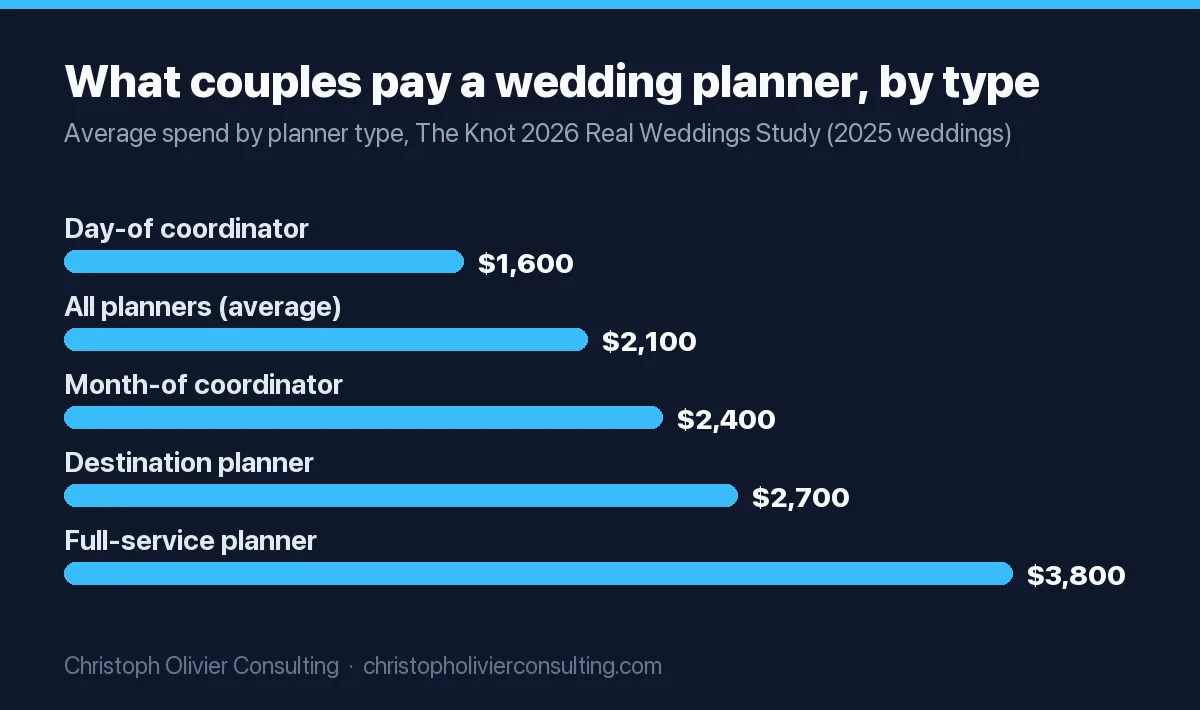
| Planner type (The Knot 2026 study, weddings in 2025) | Average couple spend | Share of couples who hired a planner choosing this type |
|---|---|---|
| Day-of coordinator | $1,600 | 37% |
| Month-of coordinator | $2,400 | 17% |
| Full-service planner | $3,800 | 33% |
| Destination wedding planner | $2,700 | 4% |
| All planner types, average | $2,100 | n/a |
| Lower quartile / median quartile / upper quartile | $700 / $1,400 / $3,300 | n/a |
| By guest count: 1 to 50 / 51 to 100 / 101+ | $1,700 / $1,900 / $2,300 | n/a |
Three things change how you should read that table:
- The median is lower than the average. The Knot’s median quartile is $1,400 against a $2,100 average, so a few expensive planners pull the average up.
- Another index runs higher. The Zola Wedding Cost Index (page updated February 2026) puts the national average at $4,047, with most couples paying $3,200 to $4,900 and Manhattan averaging $5,922. Zola and The Knot survey different couples and define planner services differently, so treat $2,100 to $4,047 as the range of published national averages.
- The planner is a small slice of the wedding. The average wedding cost $34,200 in the same Knot study, with 117 guests and $292 per guest. The $2,100 planner average is 6.1% of that (my calculation); Zola says planners typically take about 8% of the budget.
What a planner keeps from one wedding (my calculation)
Fee is not profit. Subtract a paid assistant for the wedding day and a marketing cost per booking. My assumptions: one assistant for 10 hours at $26.23 an hour, the average advertised pay in wedding planner job postings on Indeed (November 2026), which is $262 per wedding; and marketing at 8% of revenue, which is my assumption, not a published benchmark.
| Own calculation, per wedding | Day-of ($1,600) | Knot average ($2,100) | Full-service ($3,800) | Zola average ($4,047) |
|---|---|---|---|---|
| Fee | $1,600 | $2,100 | $3,800 | $4,047 |
| Assistant, 10 hours at $26.23 | $262 | $262 | $262 | $262 |
| Marketing at 8% of fee (assumption) | $128 | $168 | $304 | $324 |
| Contribution before fixed costs and tax | $1,210 | $1,670 | $3,234 | $3,461 |
The hours matter more than the fee. A planner quoted by The Knot says a full-service lead planner spends 150 to 250 hours on one wedding before assistant hours. At the $3,800 full-service average, that works out to $15.20 to $25.33 per hour of lead-planner time (my calculation), below the $29.41 median hourly wage of employed event planners (BLS, May 2025). Full-service planning only pays well when the fee is far above the national average.
How much does a wedding planner make a year?
Every published “wedding planner salary” measures something different. Most leave out owners entirely. Read the “what it measures” column before you compare.
| Source and year | What it measures | Figure |
|---|---|---|
| BLS Occupational Outlook Handbook, May 2025 | Median pay of employed meeting, convention and event planners (excludes the self-employed) | $61,160 a year, $29.41 an hour; bottom 10% under $36,830, top 10% over $101,700 |
| Indeed, updated November 15, 2026 | Average advertised pay in about 1,100 wedding planner job postings over 36 months | $26.23 an hour ($17.56 low, $39.20 high) |
| The Knot Real Weddings Study, 2026 (weddings in 2025) | Average fee couples paid a planner | $2,100 per wedding |
| Zola Wedding Cost Index, 2026 page | Average fee couples paid a planner | $4,047 per wedding |
| Census SUSB 2022, NAICS 812990 | Receipts per employer firm in “all other personal services,” the code that holds wedding planning | $601,664 per firm (my calculation); 81% of firms under $500,000 |
| IRS SOI sole proprietorships, tax year 2023 | Net income as a share of receipts, personal and laundry services sole proprietors | 24.4% all returns; 42.7% for returns with a profit (my calculation) |
What the table means for you:
- The BLS figure is a job, not a business. About 10% of event planners are self-employed, and BLS wage data leave them out. Use $61,160 as your opportunity cost: what the same skills earn on salary.
- The Census code is broad. The 2022 NAICS index puts wedding planning and party planning in 812990 next to dating services, personal trainers, personal chefs, concierges and bail bonding. It tells you the size pattern of small personal-service firms, not planner revenue. Of 22,082 employer firms, 35.0% took in under $100,000 and 46.0% took in $100,000 to $499,999.
- The IRS margin is a ceiling check. The IRS does not break out wedding planning. The broad personal and laundry services group (salons, dry cleaners, planners and more) kept 24.4 cents of profit per dollar of receipts in 2023. A service-only planner with no shop or inventory can keep more, as the model below shows.
Wedding planner income is fees minus costs, not a salary
If you own the business, there is no salary line unless you set one up. Your income is the profit left after every cost, plus any wage you pay yourself through an S corporation. The formula is short:
Owner income = (weddings booked × average fee) − per-wedding costs − fixed costs.
Then self-employment tax comes out. The IRS rate is 15.3% (12.4% Social Security plus 2.9% Medicare), applied to 92.35% of net earnings, and it applies once net self-employment earnings reach $400. That is why the model below shows income both before and after self-employment tax. Income tax is on top and depends on your household.
The same logic sets pay for other wedding vendors. If you are comparing paths, the photography business owner salary breakdown and the event venue owner salary model use the same revenue-minus-costs method.
Worked P&L: what a wedding planner owner makes at three sizes
This is my own calculation. Fees come from The Knot 2026 study, wages from BLS and Indeed, software and insurance from vendor pages checked in November 2026. Booking counts, the $6,000 and $2,500 fees in scenario 3, marketing at 8% and “other” costs are assumptions; change them to your numbers.
| Own calculation (annual) | 1. Side business | 2. Full-time solo | 3. Owner + 1 associate |
|---|---|---|---|
| Book of weddings | 12 day-of at $1,600 | 8 full-service at $3,800, 10 month-of at $2,400, 8 day-of at $1,600 | 20 full-service at $6,000, 20 partial or month-of at $2,500 |
| Revenue | $19,200 | $67,200 | $170,000 |
| Day-of assistants ($262 each) | $3,144 (1 per wedding) | $6,812 (1 per wedding) | $20,960 (2 per wedding) |
| Associate planner salary + 7.65% employer payroll tax | none | none | $65,839 ($61,160 BLS median; no benefits) |
| Client software | $348 (HoneyBook Starter, $29/mo billed annually) | $840 (Aisle Planner, $69.99/mo, up to 15 projects) | $1,308 (HoneyBook Premium, $109/mo billed yearly, unlimited team) |
| Insurance (Insureon median premiums) | $350 general liability | $1,456 (BOP $500, professional liability $500, commercial auto $456) | $1,906 (adds workers’ comp at $600) |
| Marketing at 8% of revenue (assumption) | $1,536 | $5,376 | $13,600 |
| Other: website, phone, mileage, bookkeeping (assumption) | $1,500 | $4,000 | $6,000 |
| Total costs | $6,878 | $18,484 | $109,613 |
| Owner income before tax | $12,322 | $48,716 | $60,387 |
| Owner margin | 64.2% | 72.5% | 35.5% |
| Self-employment tax (15.3% of 92.35%) | $1,741 | $6,883 | $8,532 |
| Owner income after SE tax, before income tax | $10,581 | $41,833 | $51,855 |
What the model shows:
- Solo margins are high, but the revenue is small. A planner with no shop keeps about 72 cents per dollar, far above the IRS personal-services average. The limit is how many weddings one person can run.
- Hiring at market pay barely moves owner income. In scenario 3 the business brings in 2.5 times the revenue of scenario 2 at higher fees, yet owner income rises only $11,671, because the associate costs $65,839. A team pays off only when each planner’s book is priced well above the national averages.
- Scenario 2 is already a full calendar. Eight full-service weddings at 150 to 250 lead hours each is 1,200 to 2,000 hours, before 18 month-of and day-of jobs.
How many weddings do you need? Income by bookings and fee
This grid uses the per-wedding contribution from the table above (fee minus a $262 assistant and 8% marketing) and the $6,296 of fixed costs from scenario 2. Figures are owner income before tax, my calculation.
| Average fee per wedding | 10 weddings | 20 weddings | 30 weddings | 40 weddings |
|---|---|---|---|---|
| $1,600 (Knot day-of average) | $5,804 | $17,904 | $30,004 | $42,104 |
| $2,100 (Knot all-planner average) | $10,404 | $27,104 | $43,804 | $60,504 |
| $3,800 (Knot full-service average) | $26,044 | $58,384 | $90,724 | $123,064 |
| $6,000 (assumed premium full-service) | $46,284 | $98,864 | $151,444 | $204,024 |
Before you trust any cell, run the capacity check. Thirty full-service weddings at 150 hours each is 4,500 lead-planner hours, more than two full-time people. Most weddings land on weekends, and one planner can lead only one wedding a day. So the high-fee, low-volume row is where solo owners reach six figures; the high-volume, low-fee cells need a team, which brings back the salary cost from scenario 3.
How do wedding planners charge? Flat fee, percentage or hourly
Pricing model changes income more than almost any other choice. Zola describes three models:
| Model | Published range | Worked example (my calculation) | Watch out for |
|---|---|---|---|
| Flat fee per package | Most common model (Zola). Knot averages: $1,600 day-of, $2,400 month-of, $3,800 full-service | A $3,800 full-service package at 200 hours is $19 an hour | Scope creep: cap meetings, revisions and vendor calls in the contract |
| Percentage of total budget | Usually 10% to 20%, mostly large or high-end weddings (Zola) | 10% to 20% of the $34,200 Knot average wedding is $3,420 to $6,840 | Define whether the percentage applies to the original estimate or the final spend, and which line items count |
| Hourly | $75 to over $200 an hour (Zola) | A 6-hour consult at $125 is $750 | Best for add-ons like contract review or timelines, not full planning |
A percentage fee on an average-budget wedding lands at or above the full-service flat average, which is why many planners use it once they move upmarket. If you sell tiered packages, structure them so the middle tier is the one most couples buy; this good, better, best pricing guide shows how to set the gaps between tiers, and the broader pricing strategy guide covers when to raise rates.
How much do event planner owners make?
Event planning outside weddings sits in a different Census code. Corporate meeting and event planning services fall under NAICS 561920, convention and trade show organizers, per the 2022 NAICS index. Those firms are much larger on average than wedding planners.
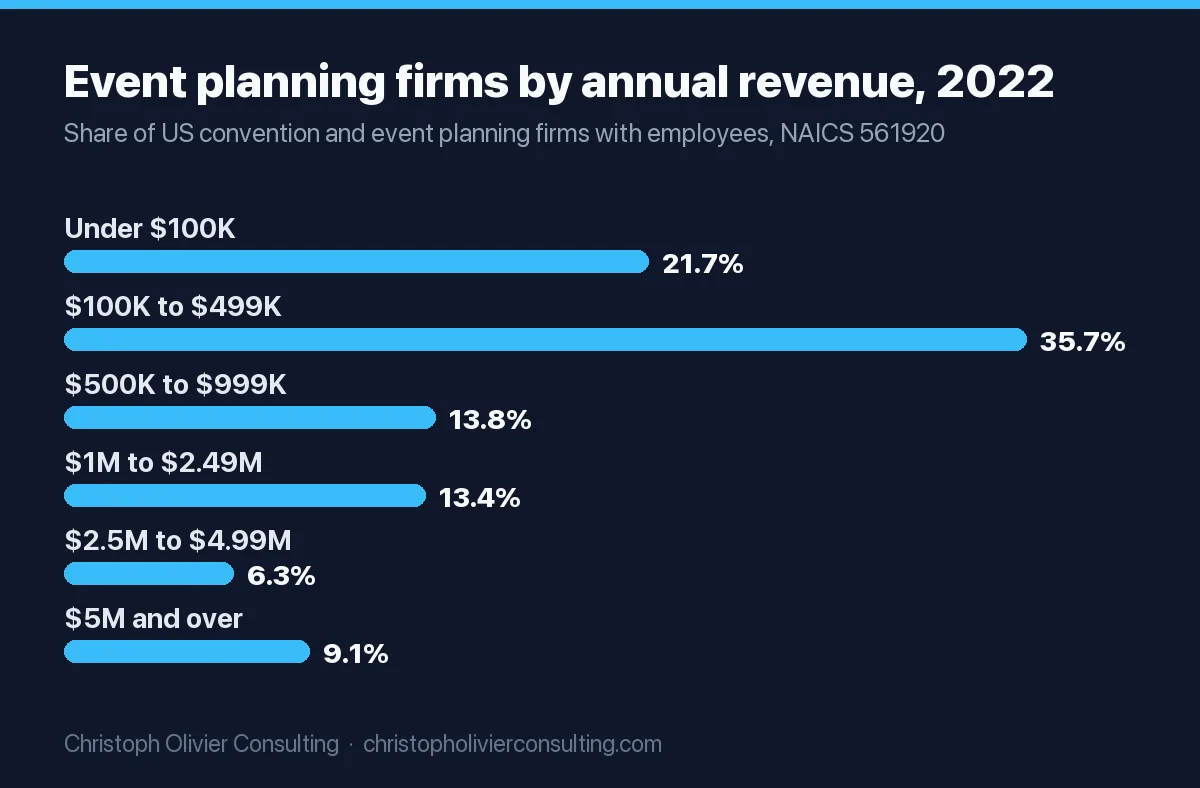
| Census SUSB 2022 | 561920 Convention and trade show organizers | 812990 All other personal services (includes wedding planning) |
|---|---|---|
| Employer firms | 5,830 | 22,082 |
| Receipts | $17.41 billion | $13.29 billion |
| Receipts per firm (my calculation) | $2,986,068 | $601,664 |
| Payroll per employee (my calculation) | $51,177 | $40,915 |
| Firms with receipts under $100,000 | 21.7% | 35.0% |
| Firms with receipts of $100,000 to $499,999 | 35.7% | 46.0% |
The average is pulled up by a few giants: 40 convention organizers with $100 million or more in receipts took in $6.15 billion, 35% of the code’s total. The typical event planning firm with employees still takes in under $500,000 a year (57.4% of 561920 firms). Census does not publish owner pay, so apply the same formula: revenue minus staff, venue deposits you carry, insurance and marketing.
What type of event planner makes the most money?
Among employed planners, the BLS May 2025 medians by industry are: administrative and support services $63,170, religious, grantmaking, civic and professional organizations $62,790, accommodation and food services $59,290, and arts, entertainment and recreation $51,220. For owners, the data point the other way from volume: the Census size table shows the money concentrated in corporate conventions and trade shows, where one contract can exceed a wedding planner’s annual revenue.
Wedding planning business startup costs
A wedding planning business has no inventory or storefront, so startup costs are mostly insurance, software and marketing. Here is what the fixed items cost in 2026 at published prices.
| Item | Published 2026 price | Source |
|---|---|---|
| General liability insurance ($1M per occurrence, $2M aggregate) | $29 a month, about $350 a year (median) | Insureon, median of quotes for event and wedding planners; venues often require it |
| Business owner’s policy | $42 a month, about $500 a year (median) | Insureon |
| Professional liability (errors and omissions) | $42 a month, about $500 a year (median) | Insureon |
| Workers’ compensation (once you hire) | $50 a month (median) | Insureon |
| Client CRM: proposals, contracts, invoices | HoneyBook Starter $29/mo billed annually; Essentials $49/mo; Premium $109/mo billed yearly | HoneyBook pricing |
| Wedding planning software: timelines, budgets, seating | Aisle Planner $49.99/mo (Sales Essentials), $69.99/mo (up to 15 projects), $109.99/mo (16 to 25 projects) | Aisle Planner pricing |
| LLC (example: California) | $800 annual tax every year, due by the 15th day of the 4th month | California Franchise Tax Board; other states charge far less |
| Website, portfolio, listings, styled shoots | Not published as a benchmark; varies with your choices | Budget it from real quotes |
My lean first-year estimate for a solo planner, from the table: $350 general liability + $348 HoneyBook Starter + $1,500 of assumed website, phone and bookkeeping comes to about $2,200, plus whatever you spend on marketing and any state LLC fee. A fully insured setup with a BOP, professional liability, commercial auto and Aisle Planner runs about $6,300 a year in fixed costs (scenario 2). Your first bookings matter more than the setup: the wedding planner marketing guide covers where couples actually find planners.
Do you need an LLC to be an event planner?
No federal rule requires one. If you work alone and do not form an entity, you are a sole proprietor by default and report profit on Schedule C, owing self-employment tax once net earnings reach $400 (IRS). An LLC separates business debts from personal assets, and it costs money every year in some states: California charges $800 a year regardless of income (FTB). Insurance, not the entity, is what venues ask for: general liability is often required to work on site (Insureon).
Is it hard to become a wedding planner, and is it stressful?
There is no license. The BLS says employers of event planners typically want a bachelor’s degree, often in business, communications or hospitality, plus related experience, and that certifications are voluntary. Owners need none of that formally, but couples hire on portfolio and reviews, so the first 10 to 20 weddings are the hard part.
On stress, BLS says most planners work full time, many work more than 40 hours a week, and hours run long as events approach, with weekend work during events. For a wedding planner that means your income is capped by the number of Saturdays in peak season, which is the same constraint the capacity check above runs into. Demand is large: the CDC counted 2,041,926 marriages in the US in 2023 (provisional), and BLS projects event planner jobs to grow 6% from 2025 to 2035.
Is event planning a good side hustle?
It can be, at modest income. The Census Nonemployer Statistics for 2022 count 753,478 businesses with no employees in NAICS 81299, the code that holds wedding and party planning, averaging $34,829 in receipts, and the 674,682 sole proprietors among them averaged $23,489 (my calculation). That code is dominated by other trades such as personal trainers, so use it only as a signal that most one-person businesses in this space are part time. Scenario 1 above lands in the same place: 12 day-of weddings bring about $12,300 before income tax. Day-of coordination fits a side business best because the work clusters on the wedding weekend and the final weeks.
Owner income worksheet: run your own numbers
- List your bookings by type for the next 12 months: day-of, month-of or partial, full-service. Use signed contracts, not inquiries.
- Multiply each by your actual fee and add them. Benchmark against the Knot averages ($1,600, $2,400, $3,800) and the Zola average ($4,047).
- Subtract per-wedding costs: assistants (hours × rate; $26.23 is the Indeed average), travel, rentals you carry, and payment processing.
- Subtract fixed costs: insurance, software, website, bookkeeping, state entity fees and marketing.
- Subtract self-employment tax: profit × 0.9235 × 0.153.
- Divide by your real hours for the year, including sales calls and site visits.
Then run these pass/fail checks:
| Check | Pass | Fail: what to change |
|---|---|---|
| Owner income before tax vs the $61,160 BLS median | At or above, if this is your full-time job | Raise fees or shift the mix toward full-service |
| Effective hourly rate vs $29.41 (BLS median hourly) | Above | Cap scope in contracts; stop unlimited meetings |
| Full-service hours per wedding × full-service bookings | Under about 2,000 hours per lead planner | Book fewer, priced higher, or hire |
| Margin after paying any associate | Above 35% (scenario 3 level) | An associate’s book must cover their $65,839 cost with room to spare |
| Largest-month revenue vs total | No single month above about a third of the year (my rule of thumb) | Add off-season work: corporate events, rehearsal dinners, consults |
If you want a second pair of eyes on your pricing and lead flow, you can book a consultation, and the event marketing plan template helps map out the off-season.
Ready to scale your revenue?
Book a free 30-min consultation. We’ll diagnose your growth bottleneck and map out the 3 highest-leverage moves for your business.
Frequently asked questions
How much does a wedding planner make per wedding?
Couples paid planners an average of $2,100 in The Knot 2026 Real Weddings Study: $1,600 for day-of coordination, $2,400 for month-of and $3,800 for full-service. Zola's index puts the average at $4,047. After a day-of assistant at about $262 and marketing at 8% of the fee, a planner keeps roughly $1,210 from a $1,600 wedding and $3,234 from a $3,800 wedding, before fixed costs and tax (my calculation).
How much does a wedding planner make a year?
Employed meeting, convention and event planners earned a median of $61,160 in May 2025, per BLS, which excludes the self-employed. For owners it depends on bookings: in my model, 12 day-of weddings clear about $12,300 before income tax, a full-time solo book of 26 weddings about $48,700, and an owner with one associate and 40 weddings about $60,400.
Can you make a lot of money as a wedding planner?
Yes, but mainly through higher fees, not volume. At the $3,800 full-service average, 30 weddings would clear about $90,700 before tax, but that is roughly 4,500 lead-planner hours if each wedding takes 150 hours. At an assumed $6,000 fee, 20 weddings clear about $98,900. One planner can lead only one wedding a day, so price drives income.
How much do event planner owners make?
No government source publishes event planner owner pay. Census counted 5,830 convention and event planning firms with employees in 2022 averaging about $2.99 million in receipts, but 57.4% took in under $500,000. Owner income is revenue minus staff, insurance, marketing and other costs. Employed event planners earned a $61,160 median in May 2025 (BLS).
What are wedding planning business startup costs?
Startup costs are mostly insurance and software. Insureon's median general liability premium for wedding planners is $29 a month (about $350 a year). HoneyBook Starter costs $29 a month billed annually and Aisle Planner starts at $49.99 a month. A lean first year runs about $2,200 plus marketing and any state LLC fee; California LLCs pay an $800 annual tax.
Do you need an LLC to be an event planner?
No. Working alone without an entity makes you a sole proprietor by default, reporting profit on Schedule C and paying 15.3% self-employment tax once net earnings reach $400. An LLC separates business and personal liability but can carry annual fees, such as California's $800 tax. Venues usually care more about general liability insurance than about your entity type.
Small business owner income