
A nail salon owner typically earns somewhere between a working nail tech’s wage and about $85,000 a year before tax. Owners of large, busy salons can clear well over $100,000 before loan payments. Most nail businesses are much smaller than people assume. The average U.S. nail salon with employees took in $346,111 in 2022 (Census SUSB 2022, my calculation). The average one-person nail business took in $41,549 (Census Nonemployer Statistics 2022, my calculation). Employed manicurists earned a median of $35,760 in May 2025, tips included (BLS).
Short answer: In my worked model built from Census, BLS and franchise disclosure data, a solo owner-tech doing 6 services a day at $55 keeps about $53,000 a year before income tax. An owner of a typical $350,000 salon keeps about $84,000 before loan payments and about $58,500 after them. An owner of a $750,000 franchised salon keeps about $122,000 after franchise fees, but only about $39,500 while repaying a full build-out loan. No government survey publishes nail salon owner income directly, so treat any single “average owner salary” online with caution.
Below are the primary numbers that do exist: Census revenue counts for NAICS 812113 (nail salons), BLS wages for manicurists, the IRS profit ratio for small personal-service businesses, the audited-style monthly P&L a franchisor printed in its disclosure document, and a public nail chain’s 2025 results. Then I turn them into a labeled P&L you can rerun with your own numbers.
How much does a nail salon owner make? What each source measures
No federal dataset reports income for nail salon owners. BLS wage data leaves out the self-employed. The IRS folds nail salons into “personal and laundry services,” together with hair salons, dry cleaners and pet groomers. What you can measure is how much revenue nail businesses bring in, what an owner would earn as an employee, and how much of each revenue dollar real salons keep. Read the “what it measures” column before you compare figures.
| Source and year | What it measures | Figure | How it was calculated |
|---|---|---|---|
| Census SUSB 2022, NAICS 812113 | Revenue per nail salon firm with paid employees | $346,111 | $11,647,669,000 receipts ÷ 33,653 firms (my calculation) |
| Census SUSB 2022, NAICS 812113 | Payroll as a share of revenue, employer nail salons | 31.6% | $3,676,927,000 payroll ÷ receipts (my calculation). Excludes owners and 1099 techs |
| Census Nonemployer Statistics 2022, NAICS 812113 | Revenue per nail business with no paid employees (mostly solo techs) | $41,549 | $11,669,937,000 ÷ 280,875 businesses (my calculation) |
| BLS OEWS, May 2025, SOC 39-5092 | Median annual wage of employed manicurists and pedicurists, tips included | $35,760 | Published. Mean $38,570; 90th percentile $50,140 |
| IRS SOI Table 1, tax year 2023 | Net income as a share of receipts, sole proprietors in personal and laundry services | 24.4% | $23.44 billion ÷ $95.93 billion (my calculation). 42.7% for those with a profit |
| PAINT Nail Bar FDD, 2024 (2023 data) | Median annual gross revenue, 22 franchised salons open all year | $742,444 | Sum of the 12 monthly figures in Item 19, Table 3, per salon (my calculation) |
| MiniLuxe FY2025 results | Average revenue per studio, 25 mostly company-owned studios | $1.3 million | Published. Gross margin 42% |
Three things to take from this table:
- Half the nail industry’s revenue is invisible in employer data. In 2022, one-person nail businesses took in $11.67 billion, slightly more than the $11.65 billion taken in by all employer salons combined (Census, my calculation). Many of those one-person businesses are techs renting a station or suite.
- The BLS wage is the floor an owner should beat. If you could earn $35,760 working for someone else, your salon has to pay you more than that for your hours, plus a return on the money you put in.
- The IRS 24.4% is not a salon margin. It covers sole proprietors in all personal and laundry services, and it is counted before the owner pays themselves, because a sole proprietor’s net income is their pay.
How much does a nail salon make a month?
Monthly revenue depends mostly on how many people do nails in the building. Here is what each data point works out to per month. The divisions are mine; the annual figures are from the sources above.
| Type of nail business | Annual revenue | Per month | Source |
|---|---|---|---|
| One-person nail business (average) | $41,549 | $3,462 | Census Nonemployer 2022 |
| Employer nail salon (average) | $346,111 | $28,843 | Census SUSB 2022 |
| Franchised salon, 2023 median of 22 | $742,444 | $61,870 | PAINT Nail Bar FDD 2024 |
| Corporate franchise salon, lower of two | $806,436 | $67,203 | PAINT Nail Bar FDD 2024, Item 19 |
| Corporate franchise salon, higher of two | $1,259,580 | $104,965 | PAINT Nail Bar FDD 2024, Item 19 |
| Premium chain studio (average) | $1.3 million | about $108,333 | MiniLuxe FY2025 |
Nail revenue is seasonal. Across the 22 PAINT franchised salons, December 2023 revenue was higher than January revenue at 19 of them (my count from Item 19). Plan your cash for the slow first quarter.
Nail salon revenue by size: where the typical salon sits
The $346,111 average is pulled up by a small number of large operators. Census also counts nail salon firms by annual revenue band. I added the shares, the per-firm averages and payroll as a share of revenue.
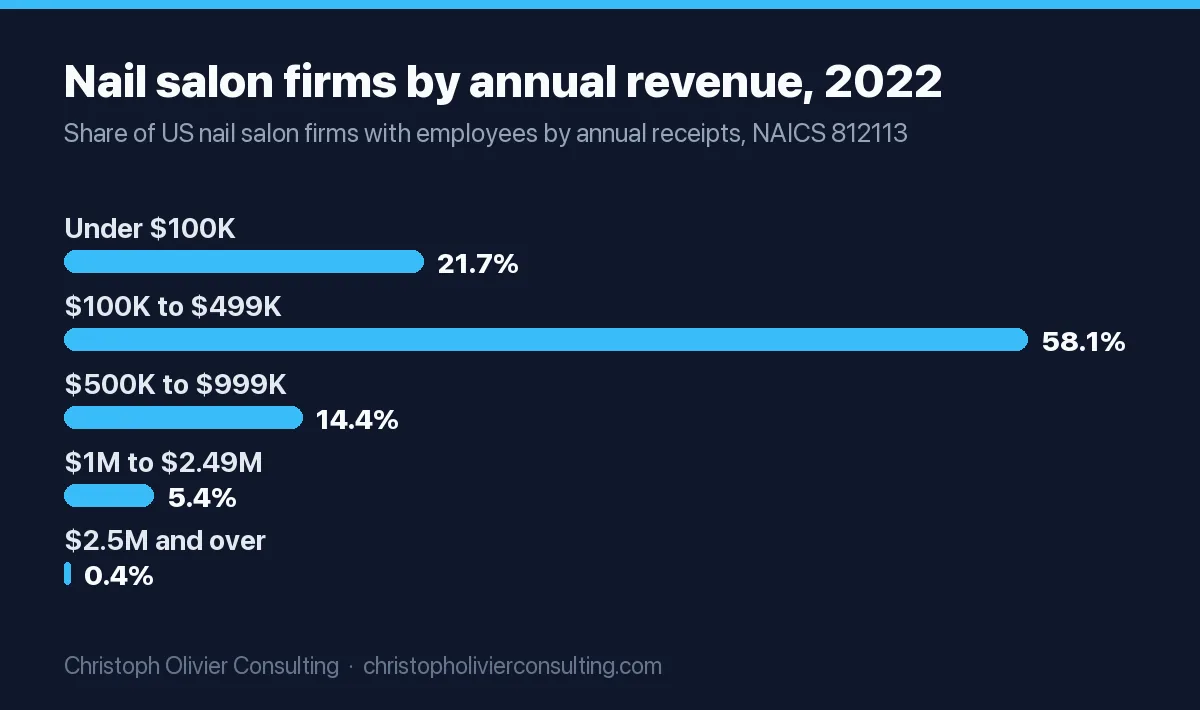
| Annual receipts of the firm | Firms | Share of firms | Cumulative share | Average receipts per firm | Employees per firm | Payroll as % of receipts |
|---|---|---|---|---|---|---|
| Under $100,000 | 7,292 | 21.7% | 21.7% | $55,579 | 1.5 | 36.3% |
| $100,000 to $499,999 | 19,553 | 58.1% | 79.8% | $250,201 | 3.8 | 33.6% |
| $500,000 to $999,999 | 4,850 | 14.4% | 94.2% | $679,679 | 7.3 | 31.1% |
| $1 million to $2.49 million | 1,811 | 5.4% | 99.6% | $1,398,702 | 11.5 | 28.4% |
| $2.5 million to $4.99 million | 129 | 0.4% | 99.9% | $3,161,233 | 21.5 | 25.2% |
| $5 million to $7.49 million | 14 | under 0.1% | 100% | $5,320,071 | 37.0 | 24.5% |
Source: Census SUSB 2022, NAICS 812113. Shares, averages and ratios are my calculation.
Four out of five employer nail salons take in less than $500,000 a year, and the median salon sits in the $100,000 to $499,999 band, with about 4 employees. A salon taking in more than $1 million is in the top 6%. Payroll’s share of revenue falls as salons grow, which is one reason bigger salons keep more of each dollar.
Average nail salon revenue by state
The seven states with the most nail salon firms, from the Census SUSB 2022 state file. Revenue per firm is my calculation.
| State | Employer nail salon firms | Total receipts | Average receipts per firm |
|---|---|---|---|
| California | 6,673 | $1.93 billion | $288,509 |
| New York | 4,285 | $1.12 billion | $261,002 |
| New Jersey | 2,110 | $583.8 million | $276,699 |
| Texas | 1,859 | $930.4 million | $500,473 |
| Pennsylvania | 1,805 | $497.8 million | $275,817 |
| Florida | 1,707 | $667.7 million | $391,162 |
| Washington | 1,224 | $415.2 million | $339,202 |
Texas salons average far more revenue per firm than California or New York salons. The Census file does not say why; a larger share of bigger multi-tech salons is one possible reason.
How much do self-owned nail techs make?
Most nail businesses in the U.S. have no employees at all. Census counted 280,875 nonemployer nail businesses in 2022, against 33,653 employer firms, and 96.6% of the nonemployers were sole proprietors. Here is how their annual revenue breaks down (shares are my calculation from the Nonemployer Statistics 2022 file).
| Annual receipts | Nail businesses | Share | Cumulative share |
|---|---|---|---|
| Under $5,000 | 24,262 | 8.6% | 8.6% |
| $5,000 to $9,999 | 29,453 | 10.5% | 19.1% |
| $10,000 to $24,999 | 90,355 | 32.2% | 51.3% |
| $25,000 to $49,999 | 90,089 | 32.1% | 83.4% |
| $50,000 to $99,999 | 29,692 | 10.6% | 93.9% |
| $100,000 to $249,999 | 10,612 | 3.8% | 97.7% |
| $250,000 and over | 6,412 | 2.3% | 100% |
Half of self-employed nail businesses took in less than $25,000, which fits part-time and side work. Only 6.1% took in $100,000 or more. Revenue is not take-home pay: the tech still pays station rent, supplies and card fees, and then self-employment tax of 15.3% on net earnings (IRS). BLS estimates 23% of manicurists and pedicurists are self-employed (BLS OOH). The 6,412 nonemployer businesses taking in $250,000 or more are likely salons that run on booth renters or 1099 techs instead of payroll; Census does not say.
Nail salon profit margin: what the disclosures actually show
Private salons do not publish profit. The best public window is the Item 19 table in the PAINT Nail Bar 2024 franchise disclosure document, which prints the average monthly revenue and expenses for its two corporate salons open all of 2023. Here it is with percentages I added.
| Average month, 2023 | Salon 1 | % of revenue | Salon 2 | % of revenue |
|---|---|---|---|---|
| Revenue | $104,965 | 100% | $67,203 | 100% |
| Technician payroll | $37,244 | 35.5% | $21,800 | 32.4% |
| Manager and front desk payroll | $11,500 | 11.0% | $7,500 | 11.2% |
| Cost of goods plus supplies | $9,839 | 9.4% | $7,423 | 11.0% |
| Bank charges | $3,729 | 3.6% | $2,875 | 4.3% |
| Rent | $6,200 | 5.9% | $7,375 | 11.0% |
| Insurance | $1,400 | 1.3% | $1,100 | 1.6% |
| Marketing, software, dues, repairs, utilities | $2,229 | 2.1% | $2,219 | 3.3% |
| Net operating income | $32,824 | 31.3% | $16,911 | 25.2% |
| Less franchise fees a franchisee would pay (6% royalty, 1% fund, 0.5% local, $650 tech fee) | $8,520 | 8.1% | $5,690 | 8.5% |
| Adjusted net operating income | $24,301 | 23.2% | $11,220 | 16.7% |
Source: PAINT Nail Bar Franchise Company FDD, issued 2024, Item 19 (copy hosted by a third party). Dollar figures as printed; percentages and the grouped rows are my calculation. Adjusted income is as printed, so rows can differ by a few dollars from rounding in the source. These are corporate salons, not franchisee results.
What the table leaves out matters. Net operating income here is before depreciation, interest, loan repayments and income tax, and the owner is not on the payroll. So a margin of 17% to 31% at the store level is the pool the owner’s pay and the build-out loan both come out of.
Two other public numbers bracket it:
- MiniLuxe, a Boston nail chain listed on the TSX Venture Exchange, reported a 42% gross margin for fiscal 2025 and said its most profitable studios “delivered average profit margins of 20%” on about 1,600 square feet. The company as a whole still posted a $6.2 million operating loss after $14.9 million of SG&A (MiniLuxe FY2025 release). Head office costs can erase store profit.
- IRS small-business data: sole proprietors in personal and laundry services kept 24.4% of receipts as net income in 2023, and 42.7% among those that made a profit (IRS SOI, my calculation). That figure includes the owner’s own labor, so it reads high next to a salon that pays a manager.
A fair working range: a well-run nail salon keeps about 15% to 30% of revenue before the owner’s pay and debt, and a salon paying franchise fees keeps 7 to 9 points less.
Owner pay = wage + profit: how nail salon owners actually get paid
“Owner salary” mixes two different things. Separate them before you compare yourself with anyone.
- A wage for the work you do. If you do nails, that is worth about the $35,760 BLS median for a manicurist. If you run the floor, the BLS median for first-line supervisors of personal service workers was $48,590 in May 2025 (BLS OEWS SOC 39-1022, all industries, via the BLS public data API).
- Profit on the money and risk you put in. What is left after every cost, including your own wage, the loan payment and the lease you personally guaranteed.
A sole proprietor or single-member LLC takes both as draws and pays 15.3% self-employment tax (IRS) on 92.35% of net earnings (IRS Topic 554). An S corporation owner usually takes a W-2 wage plus distributions. If your total is below the wage you could earn as an employee, the salon is costing you money, no matter what revenue says.
Worked P&L: what a nail salon owner keeps at three sizes
This is my own calculation. Cost ratios come from the PAINT corporate salon P&L above and the Census payroll ratios; rents, ticket size and loan terms are my labeled assumptions. Change them to yours.
| Line (annual) | A. Solo owner-tech studio | B. Independent salon, 6 to 7 techs | C. Franchised salon, 10 to 12 techs |
|---|---|---|---|
| Revenue | $79,200 (240 days × 6 services × $55) | $350,000 (about the Census average) | $750,000 (about the PAINT 2023 median) |
| Technician pay incl. payroll tax | $0 (owner does the nails) | $126,000 (36%) | $262,500 (35%) |
| Manager and front desk | $0 | $25,000 (part time) | $82,500 (11%) |
| Product and supplies | $4,752 (6%) | $35,000 (10%) | $71,250 (9.5%) |
| Card and bank fees (3.6%) | $2,851 | $12,600 | $27,000 |
| Rent | $14,400 ($1,200 a month) | $42,000 ($3,500 a month) | $78,000 ($6,500 a month) |
| Insurance | $900 | $8,400 | $15,000 |
| Utilities, repairs, software | $600 | $8,750 (2.5%) | $11,250 (1.5%) |
| Marketing (1.5%) | $1,188 | $5,250 | $11,250 |
| Accounting, licenses, other | $1,500 | $3,000 | $5,000 |
| Operating profit | $53,009 (66.9%) | $84,000 (24.0%) | $186,250 (24.8%) |
| Franchise fees (7.5% of revenue + $650 a month) | none | none | $64,050 |
| Owner pay before debt and income tax | $53,009 | $84,000 | $122,200 |
| Build-out loan payment (11%, 10 years) | none assumed | $25,470 on $150,000 | $82,655 on $486,775 |
| Owner cash while the loan is repaid | $53,009 | $58,530 | $39,545 |
How to read it:
- The solo studio beats the employed median ($53,009 against $35,760), but only while the owner is fully booked, and the owner still owes about $7,490 in self-employment tax on that profit (my calculation at 15.3% on 92.35%).
- The typical independent salon pays the owner like a manager. $84,000 is about $35,000 above the supervisor median, and that gap is the real return on owning.
- The franchised salon makes the most and pays the owner the least during payback. The $486,775 loan is the midpoint of PAINT’s $217,850 to $755,700 Item 7 range, fully financed. Owners who put in cash instead of borrowing keep the $122,200, but give up the return that cash could earn elsewhere.
Solo nail tech income at 4, 6, 8 and 10 services a day
Own calculation, using model A: $55 average service ticket, 240 working days, $17,400 a year of fixed costs (rent, insurance, software, accounting) and 11.1% variable costs (supplies, card fees, marketing). Tips are not included.
| Services per day | Annual service revenue | Owner profit before tax | Compared with BLS employed manicurists (May 2025) |
|---|---|---|---|
| 4 | $52,800 | $29,539 | Below the $34,010 25th percentile |
| 6 | $79,200 | $53,009 | Above the $50,140 90th percentile |
| 8 | $105,600 | $76,478 | Well above any published wage band |
| 10 | $132,000 | $99,948 | About $100,000 |
The formula: profit = (services per day × ticket × working days) × 0.889 minus fixed costs. Raising the ticket from $55 to $70 at 6 services a day adds about $19,200 of profit, close to the $23,470 that two extra services a day add. Price and service mix move a solo tech’s income as much as volume does.
Can a nail tech make $100K a year?
As an employee, it is rare. The 90th percentile wage for employed manicurists was $50,140 in May 2025, tips included (OEWS counts tips as wages). As a self-employed tech, it takes about $132,000 of service revenue in my model, which is 10 services a day at $55 or about 7 a day at $80. Census shows only 6.1% of nonemployer nail businesses took in $100,000 or more in 2022, and revenue is before costs. So $100,000 of take-home is a top-few-percent outcome, usually reached through high-ticket nail art or extensions, a full book of regulars, or owning a salon with several techs.
Do nail salon workers get paid well? Compared with the $50,980 median for all U.S. occupations in May 2025, no: the manicurist median is about 30% lower (BLS OOH). BLS projects 9% job growth from 2025 to 2035 and about 21,900 openings a year, so demand for techs is not the problem; pricing and booking are.
| Employed manicurists and pedicurists, May 2025 | Annual wage |
|---|---|
| 10th percentile | $28,920 |
| 25th percentile | $34,010 |
| Median | $35,760 ($17.19 an hour) |
| Mean | $38,570 ($18.54 an hour) |
| 75th percentile | $41,650 |
| 90th percentile | $50,140 |
Source: BLS Occupational Employment and Wage Statistics, SOC 39-5092, national, May 2025 (152,770 wage-and-salary jobs), via the BLS public data API. Self-employed techs are not included.
Franchise salon revenue: 22 real salons, 2023
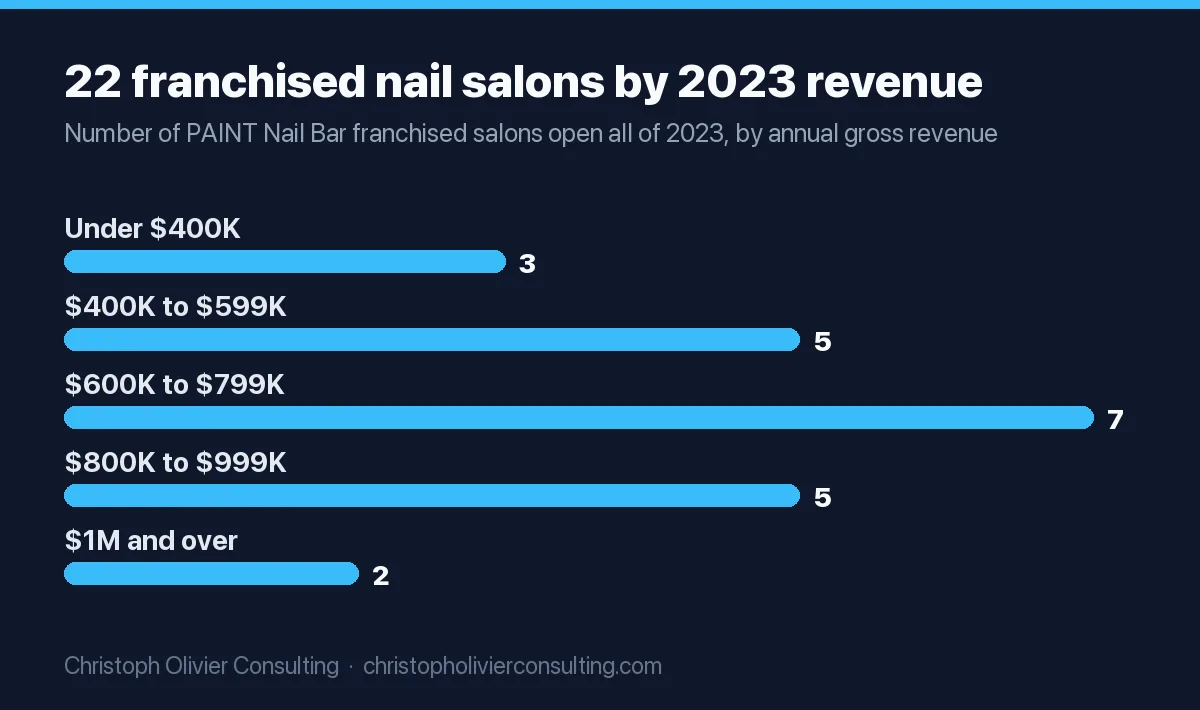
Item 19 of the same PAINT disclosure lists the monthly gross revenue of each of the 22 franchised salons open all of 2023. I added up each salon’s year and grouped them. Median: $742,444. Lowest: $275,672. Highest: $1,649,120. The franchisor’s own outlet count fell from 27 franchised salons at the start of 2023 to 23 at year end (Item 20), so the 22 salons shown are survivors.
Nail salon startup costs
There is no government survey of nail salon startup costs. The most detailed public breakdown is Item 7 of a franchise disclosure document, which franchisors must give buyers at least 14 days before signing under the FTC Franchise Rule. Here are the PAINT Nail Bar 2024 Item 7 lines for one salon.
| Item 7 line | Low | High |
|---|---|---|
| Initial franchise fee | $52,500 | $52,500 |
| Establishment package (manicure tables, pedicure chairs, basins, sterilization, furniture, POS hardware) | $60,000 | $220,000 |
| Construction and build-out not in the package | $75,000 | $262,500 |
| Initial inventory | $10,000 | $27,000 |
| Architect design and project management | $33,500 | $33,500 |
| Rent (three months) and security deposits | $7,000 | $27,000 |
| Opening marketing and social media consultant | $4,500 | $9,000 |
| Additional funds for the opening period | $20,000 | $95,500 |
| Everything else (site selection, training, utilities deposits, professional fees, office supplies, insurance, licenses, signage) | $7,850 | $28,700 |
| Total estimated initial investment | $217,850 | $755,700 |
Source: PAINT Nail Bar FDD 2024, Item 7. Grouping of lines is mine; totals as published. The published low total is below the sum of the low line items ($270,350, my calculation); the document does not explain the gap.
An independent salon skips the $52,500 fee, the architect and project manager, and usually spends less on build-out, so it can open for a fraction of the franchise range. Licensing itself is cheap. In Texas, a manicurist license costs $50 after a 600-hour course and written and practical exams, and a specialty establishment license costs $78 (TDLR). In California, an establishment license application is $50 (Board of Barbering and Cosmetology, form F-BBC-05). The real money goes into ventilation, plumbing for pedicure basins and the lease.
Commission, booth rent or suite: how the pay model changes owner income
The worked P&L assumes techs are employees. Many salons instead rent stations to independent techs. That turns the owner into a landlord: revenue is the rent roll, costs are rent, utilities and shared supplies, and income no longer rises with how busy the techs are. It also shifts tax risk. The IRS decides whether a worker is an employee or contractor on three groups of facts: behavioral control, financial control and the relationship of the parties, and “no single fact provides the answer” (IRS Publication 1779). A salon that sets the tech’s schedule, prices and products while issuing a 1099 is the classic misclassification case. If you are unsure, the IRS route is Form SS-8.
Booth-rent math is simple: owner income = (stations rented × weekly rent × 52) minus the full building cost. No primary source publishes typical nail station rents, so use quotes from your own market. Our hair salon owner salary breakdown works through the booth-rent and suite landlord math in detail, and the same structure applies to nails.
Is owning a nail salon profitable? A pass/fail check
Run your numbers, or your plan, through these tests before you sign a lease or a franchise agreement. The thresholds are my own, built from the data on this page.
| Test | Pass | Fail | Where the threshold comes from |
|---|---|---|---|
| Owner wage + profit vs. working for someone else | Above $48,590 (managing) or $35,760 (doing nails) | Below it | BLS medians, May 2025 |
| All payroll incl. manager and desk, % of revenue | Under 47% | Over 52% | PAINT corporate salons ran 43.6% and 46.5% |
| Rent, % of revenue | Under 11% | Over 14% | PAINT 5.9% and 11.0%; IRS personal services 8.9% |
| Product and supplies, % of revenue | Under 11% | Over 13% | PAINT 9.4% and 11.0% |
| Store-level operating margin before owner and debt | Over 20% | Under 12% | PAINT 25.2% to 31.3%; MiniLuxe best studios 20% |
| Loan payment, % of revenue | Under 8% | Over 12% | Model B 7.3% leaves $58,530; model C 11.0% leaves $39,545 |
| Solo tech: annual service revenue | Over $60,000 | Under $45,000 | At $60,000, model A profit is $35,940, about the employed median |
Fill-in worksheet: your nail salon owner income
- Revenue: services per day × average ticket × working days, plus retail = ______
- Technician pay incl. payroll tax at 7.65% = ______ (benchmark: 32% to 36% of revenue)
- Manager and front desk = ______ (benchmark: about 11%)
- Product and supplies = ______ (benchmark: 9% to 11%)
- Rent, utilities, insurance, card fees, software, marketing = ______ (benchmark: 12% to 22%)
- Franchise fees, if any = ______ (PAINT: 7.5% of revenue + $650 a month)
- Operating profit = line 1 minus lines 2 to 6 = ______
- Loan payment = ______
- Owner pay = line 7 minus line 8, plus any wage you pay yourself = ______. Compare with $35,760 and $48,590.
If line 7 is thin, the fastest fixes in a nail salon are usually price, rebooking and filling weekday gaps, not cheaper polish. Our salon marketing playbook covers rebooking and pricing, and getting more Google reviews is the cheapest way to win local searches. To compare nails with neighboring trades built from the same sources, see the barbershop owner salary and massage business owner income pages, or the profit margin by industry table. If you want a second set of eyes on a salon P&L or a growth plan, you can book a consultation.
How the numbers were built
- Census: SUSB 2022 (released April 2025) and Nonemployer Statistics 2022, NAICS 812113 Nail Salons. Per-firm averages and shares are my division of published totals. Census applies noise to protect confidentiality; the national nail salon cells used here are flagged low noise.
- BLS: OEWS May 2025 national estimates for SOC 39-5092 and 39-1022, and the Occupational Outlook Handbook. OEWS covers employees only and includes tips.
- IRS: SOI Sole Proprietorship Returns 2023, Table 1. Nail salons are not broken out; ratios cover all personal and laundry services.
- PAINT Nail Bar FDD (2024): Item 7, Item 19 and Item 20, read from a copy of the full document posted by a third-party site. Annual totals per salon are my sums of the printed monthly figures. Franchisee figures are unaudited, as the FDD states.
- MiniLuxe: FY2025 results release dated April 27, 2026, from the company’s investor site.
- Model assumptions (mine): $55 ticket, 6 services a day and 240 days for the solo tech; rents of $1,200, $3,500 and $6,500 a month; 11% interest over 10 years on the loans; full financing of the build-out. None of these is a published benchmark.
Ready to scale your revenue?
Book a free 30-min consultation. We’ll diagnose your growth bottleneck and map out the 3 highest-leverage moves for your business.
Frequently asked questions
How much does a nail salon owner make?
No government survey reports it. In a model built from Census, BLS and franchise disclosure data, a solo owner-tech doing 6 services a day at $55 keeps about $53,000 before income tax, a typical $350,000 salon pays its owner about $84,000 before loan payments, and a $750,000 franchised salon about $122,000 after franchise fees. Employed manicurists earned a median $35,760 in May 2025.
What is a typical nail salon profit margin?
Two corporate PAINT Nail Bar salons kept 25.2% and 31.3% of revenue as net operating income in 2023, before owner pay, depreciation and debt, and 16.7% to 23.2% after franchise fees. MiniLuxe said its most profitable studios averaged 20% in 2025. A working range for a well-run salon is about 15% to 30% before the owner's pay and loan payments.
How much does a nail salon make a month?
The average U.S. nail salon with employees took in $346,111 in 2022, about $28,843 a month (Census SUSB, my calculation). A one-person nail business averaged $41,549, about $3,462 a month. The median of 22 PAINT Nail Bar franchised salons was $742,444 in 2023, about $61,870 a month. December is usually the strongest month and January among the weakest.
How much does it cost to open a nail salon?
No government survey tracks it. PAINT Nail Bar's 2024 franchise disclosure puts one salon at $217,850 to $755,700, including a $52,500 franchise fee, $60,000 to $220,000 for furniture and equipment and $75,000 to $262,500 for build-out. Independent salons skip the fee and design charges. Licenses are cheap: Texas charges $50 for a manicurist license and $78 for a specialty salon license.
Can a nail tech make $100K a year?
As an employee it is rare: the 90th percentile wage for manicurists was $50,140 in May 2025, tips included. Self-employed, it takes about $132,000 of service revenue in my model, roughly 10 services a day at $55 or 7 a day at $80. Only 6.1% of one-person nail businesses took in $100,000 or more in 2022, and that is before costs.
How much do self-owned nail techs make?
Census counted 280,875 nail businesses without employees in 2022, averaging $41,549 in revenue. Half took in less than $25,000. A fully booked solo tech doing 6 services a day at $55 keeps about $53,000 before tax in my model after rent, supplies and card fees, then owes self-employment tax of 15.3% on 92.35% of that profit.
Is owning a nail salon profitable?
It can be, but the margin is the pool both your pay and your loan come out of. Pass marks from this page: total payroll under 47% of revenue, rent under 11%, products and supplies under 11%, store margin over 20%, and loan payments under 8% of revenue. If your wage plus profit is below the $35,760 employed manicurist median, the salon is costing you money.
Small business owner income