

A hair salon owner with staff typically makes about $36,000 to $90,000 a year in profit, on top of any wage they pay themselves for working behind the chair. That is my calculation from the Census Bureau’s 2022 count of beauty salons, where the typical salon with employees took in between $100,000 and $499,999 and spent about 40% of its revenue on payroll. Most salon “owners” are not employers at all: 9 out of 10 beauty salon businesses in the U.S. are one person with no staff, and they averaged $29,461 in gross receipts in 2022.
Short answer: The average U.S. beauty salon with employees brought in $318,332 per location in 2022 (Census), and the typical one between $100,000 and $499,999. At realistic cost ratios that leaves the owner roughly 6% to 16% of revenue as profit, about $36,000 at a $229,000 salon and about $91,000 at a $1.5 million salon (my calculation). Employed hairstylists earn a median $35,790 a year including tips (BLS, May 2025).
Every number below comes from a primary dataset I downloaded for this page: the Census Bureau’s Statistics of U.S. Businesses and Nonemployer Statistics for NAICS 812112 (Beauty Salons), IRS sole proprietorship tax data, the BLS wage survey for hairdressers, the latest Regis Corporation 10-K (the Supercuts and Cost Cutters franchisor, which also runs its own salons) and the Item 19 disclosure of a salon suite franchise. Where I divided one published total by another, I say so. Worked P&Ls for a commission salon, a booth-rent salon and a salon suite renter, plus a fill-in worksheet, are further down.
How much does a hair salon owner make? What each source measures
No government survey asks salon owners what they take home. You have to read four datasets side by side, and each one counts a different group of people.
| Source and year | Who it covers | Figure | How it was calculated |
|---|---|---|---|
| Census SUSB 2022, NAICS 812112 | Beauty salons with at least one paid employee: revenue per location | $318,332 | $26,410,089,000 receipts ÷ 82,964 establishments (my calculation) |
| Census SUSB 2022, NAICS 812112 | Same salons: revenue per firm (one firm can own several locations) | $362,886 | $26,410,089,000 ÷ 72,778 firms (my calculation) |
| Census Nonemployer Statistics 2022, NAICS 812112 | Beauty salon businesses with no employees (solo stylists, booth renters, suite renters) | $29,461 | $24,274,556,000 ÷ 823,967 businesses (my calculation) |
| IRS SOI Table 1, tax year 2023 | Sole proprietors in “personal and laundry services” (includes salons, but also dry cleaners, pet care and others) | $7,923 net income on $32,431 receipts | $23.44 billion net income less deficits ÷ 2,957,905 returns (my calculation) |
| BLS OEWS, May 2025, SOC 39-5012 | Employed hairdressers, hairstylists and cosmetologists (excludes the self-employed) | $35,790 median a year | Published; tips are included in the wage data |
| Regis Corp. 10-K, fiscal year ended June 30, 2026 | Company-owned Supercuts, Cost Cutters and similar value salons | 4.3% segment profit margin | $3,398,000 segment profit ÷ $78,322,000 revenue (my calculation) |
How to read the gap between these numbers:
- “Salon owner” means two different jobs. Census counted 82,964 beauty salon locations with employees and 823,967 beauty businesses with none. The no-employee group is 90.9% of all beauty salon businesses but collects only 47.9% of the revenue (my calculation across both Census files). Most people searching this question are, or want to become, one of those 823,967.
- Revenue is not income. The $318,332 average is what comes in the door before payroll, rent and color. The owner keeps a slice of it, covered below.
- BLS wages exclude owners. BLS says 48% of the roughly 595,000 hairdresser jobs in 2025 were held by self-employed workers, and its pay tables leave them out.
Hair salon revenue by size: where the typical salon sits
The $362,886 average per firm is pulled up by large chains. Census also publishes firms by annual revenue band, which shows the typical salon. I added the shares, averages and payroll ratios.
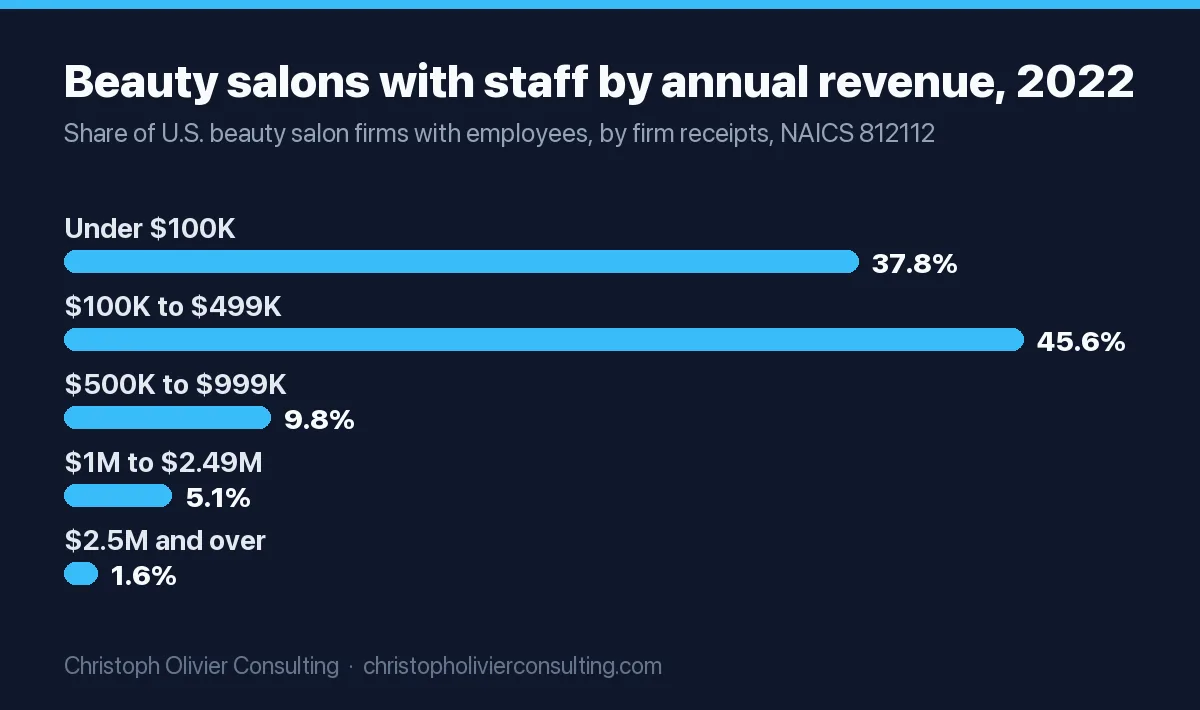
| Annual receipts of the salon firm | Beauty salon firms | Share of firms | Cumulative share | Average receipts per firm | Employees per firm | Payroll as % of receipts |
|---|---|---|---|---|---|---|
| Under $100,000 | 27,539 | 37.8% | 37.8% | $48,522 | 1.2 | 37.0% |
| $100,000 to $499,999 | 33,158 | 45.6% | 83.4% | $229,159 | 3.6 | 40.4% |
| $500,000 to $999,999 | 7,159 | 9.8% | 93.2% | $691,679 | 10.1 | 48.0% |
| $1 million to $2.49 million | 3,726 | 5.1% | 98.4% | $1,473,348 | 19.8 | 49.3% |
| $2.5 million and over | 1,196 | 1.6% | 100% | n/a (several bands combined) | n/a | n/a |
Source: U.S. Census Bureau, SUSB 2022, U.S. 6-digit NAICS by enterprise receipts size, NAICS 812112 Beauty Salons, released April 10, 2025. Employer firms only. Shares, averages and ratios are my calculations from the published firm, employment, payroll and receipts totals. The receipts band is the whole firm’s revenue.
What the table tells you:
- The median salon with staff takes in between $100,000 and $499,999. 37.8% of firms are below $100,000 and 83.4% are below $500,000, so the midpoint sits in that band, where the average firm collected $229,159 with 3.6 employees.
- $500,000 puts you in the top 17%. Only 16.6% of beauty salon firms with employees reach it, and 6.8% reach $1 million.
- Payroll share rises with size. It climbs from 37.0% of revenue in the smallest band to 49.3% in the $1 million band. In a small salon the owner does much of the cutting and coloring and is often not on payroll; in a large one, every chair is staffed.
Average salon revenue by state
Receipts per salon location vary by more than $200,000 between states. These come from the SUSB 2022 state file (receipts ÷ establishments, NAICS 812112, employer salons only, my calculation):
| State | Salons with employees | Average receipts per salon | Payroll as % of receipts |
|---|---|---|---|
| District of Columbia | 158 | $640,190 | 46.8% |
| Tennessee | 1,054 | $433,894 | 49.3% |
| Maryland | 1,466 | $376,567 | 50.9% |
| Arizona | 1,577 | $366,985 | 42.6% |
| Texas | 5,608 | $364,793 | 44.2% |
| California | 8,400 | $322,591 | 38.0% |
| United States | 82,964 | $318,332 | 44.5% |
| Florida | 7,315 | $297,099 | 37.7% |
| New York | 7,074 | $293,992 | 40.4% |
| Nebraska | 614 | $245,682 | 47.4% |
| Montana | 214 | $243,668 | 46.7% |
| Rhode Island | 392 | $225,625 | 43.8% |
| Wyoming | 133 | $177,774 | 44.7% |
Two things stand out. California, Florida and New York, the three largest salon markets, all sit near or below the national average per location, with low payroll shares (38% to 40%). That is consistent with more stylists working as booth or suite renters in those states, though the Census file does not measure it directly. And a high-revenue state is not automatically a high-profit state: the state files do not report rent or supply costs.
Owner pay = salary + profit: how salon owners actually get paid
Owner income in a salon comes from up to three places, and online “salon owner salary” figures usually mix them up:
- Your own chair. Most small-salon owners still take clients. In a sole proprietorship or LLC taxed as one, that work is not on payroll; it simply shows up as profit. In an S corporation you pay yourself a W-2 wage for it, which Census counts inside payroll.
- The margin on other stylists. In a commission salon you keep what is left of each stylist’s service revenue after their pay, payroll taxes, product and a share of overhead.
- Rent from renters. In a booth-rent or suite model you are a landlord: income is chair or suite rent minus the lease and the costs you cover.
So when you compare yourself to a benchmark, add your own wage and your profit together, and compare that total to what an employed stylist or salon manager earns. The BLS reference points for May 2025 from the OEWS national and industry tables:
| Employed role (BLS OEWS, May 2025) | Median annual wage | Top 10% earn more than |
|---|---|---|
| Hairdressers, hairstylists and cosmetologists, all industries | $35,790 | $71,190 |
| Same, working in personal care services (salons, NAICS 8121) | $36,170 | $72,430 |
| First-line supervisors of personal service workers, in personal care services (salon managers fall here) | $46,360 | $76,340 |
| General and operations managers, in personal care services | $72,230 | $149,190 |
Source: BLS Occupational Employment and Wage Statistics, May 2025, national cross-industry file and 4-digit industry file (NAICS 812100). Employees only; BLS states that tips are included in hairdresser wage data.
That gives you the honest test of whether ownership is paying off. If you own a small salon and your wage plus profit is below about $46,000, a salon manager job would pay you more for less risk. If it is below $36,000, the median employed stylist out-earns you.
Hair salon profit margin: what the data actually shows
Salon software blogs quote margins of 8% to 15% with no source. Here is what public data supports, by definition of “profit.”
| Definition of profit | Figure | Source and year | Use it to answer |
|---|---|---|---|
| Segment profit at company-owned value salons, after salon labor, product, rent, salon G&A and depreciation | 4.3% | Regis 10-K, FY2026, Note 15 (my calculation) | “What does a staffed, chain-style salon keep?” |
| Owner’s net income ÷ receipts, all personal and laundry services sole proprietors | 24.4% | IRS SOI Table 1, tax year 2023 (my calculation) | “What share does a solo operator keep?” (before paying themselves anything separately) |
| Same, only the returns that showed a profit | 42.7% | IRS SOI Table 1, tax year 2023 (my calculation) | “What does a profitable solo operator keep?” |
| Adjusted EBITDA ÷ gross revenue at salon suite franchise locations (the landlord, not the renter) | 36.7% | Phenix Salon Suites 2023 FDD Item 19, fiscal 2022, as summarized by Franchise Chatter (my calculation) | “Is owning a suite facility profitable?” (before debt service) |
The spread is not a contradiction. A solo stylist’s “margin” is mostly their own labor, so it looks high. A salon that pays every stylist keeps single digits, because labor is the product. Regis spells this out: for its 264 company-owned salons, “company-owned salon expense,” which covers the cost of service and product, ate 71.6% of revenue, rent 13.7%, salon-level G&A 6.1% and depreciation 4.2%, leaving 4.3%. Service is about 95% of company-owned salon revenue, per the same filing.
What a Supercuts-style salon makes
Regis does not disclose per-salon owner income, but its 10-K lets you rebuild the averages. Company-owned salons generated $78.3 million in fiscal 2026 while the count fell from 294 to 264. On an average of 279 salons that is about $280,700 in revenue, $38,500 in rent and $12,200 in segment profit per salon (my calculations). System-wide, the 3,712 Regis salons, 3,448 of them franchised, generated $1,066.3 million, or about $287,300 per location on the year-end count. A franchisee also pays royalties and advertising fund contributions out of that revenue, which the company-owned figures do not include. Value-price chains run thin margins and make money on volume and multiple units.
Worked P&L: what a commission salon owner keeps at three sizes
This is my own calculation, not a measured result. Revenue and payroll share for each size come from the Census revenue bands above. The other cost ratios come from the IRS tax year 2023 totals for personal and laundry services sole proprietors (Table 2), a broad category that includes salons; card fees use the Square in-person rate of 2.6% (the 15¢ per transaction is ignored); employer payroll tax is the 6.2% Social Security plus 1.45% Medicare rate from IRS Topic 751.
| Line (assumption) | Small salon | Mid-size salon | Large salon |
|---|---|---|---|
| Annual revenue (Census band average) | $229,159 | $691,679 | $1,473,348 |
| Staff (Census band average) | 3.6 | 10.1 | 19.8 |
| Payroll (40.4% / 48.0% / 49.3%, Census) | $92,579 | $332,184 | $726,192 |
| Employer payroll tax (7.65% of payroll) | $7,082 | $25,412 | $55,554 |
| Rent (8.92%, IRS) | $20,441 | $61,698 | $131,423 |
| Supplies (8.56%, IRS) | $19,616 | $59,208 | $126,119 |
| Cost of products sold, excluding labor (8.69%, IRS) | $19,914 | $60,107 | $128,034 |
| Utilities (4.48%, IRS) | $10,266 | $30,987 | $66,006 |
| Insurance (1.31%, IRS) | $3,002 | $9,061 | $19,301 |
| Advertising (1.61%, IRS) | $3,689 | $11,136 | $23,721 |
| Repairs (1.79%, IRS) | $4,102 | $12,381 | $26,373 |
| Legal, accounting and office (2.78%, IRS) | $6,371 | $19,229 | $40,959 |
| Card processing (2.6%, Square) | $5,958 | $17,984 | $38,307 |
| Owner’s profit before income tax | $36,139 (15.8%) | $52,293 (7.6%) | $91,360 (6.2%) |
How to read it:
- Small salon: $36,139 of profit, and in this size band the owner usually also works a full book. If that owner is a sole proprietor, the $36,139 is their whole income from the business before income and self-employment tax. That is about the BLS median for an employed stylist, which is why many small-salon owners say they “bought a job.”
- Mid-size salon: $52,293, with the owner more likely managing than cutting. Add a W-2 wage only if the owner is on payroll, in which case it is already inside the $332,184.
- Large salon: $91,360 on $1.47 million. If your rent share is lower than the IRS small-business ratio, profit rises; the Regis 4.3% chain margin shows the downside if labor and rent run high.
Booth-rent salon owner income: the landlord math
In a booth-rent salon the owner’s revenue is chair rent, and stylists keep their own service income. No federal dataset separates booth-rent salons, so the useful number is your breakeven. Regis’ company-owned value salons paid about $38,500 a year in rent each in fiscal 2026 (my calculation from the 10-K). If your lease costs the same:
| Chairs rented | Weekly chair rent needed just to cover a $38,500 lease |
|---|---|
| 6 | $123 |
| 8 | $93 |
| 10 | $74 |
Formula (my own): breakeven weekly chair rent = (annual lease + utilities + insurance + shared supplies + your booking software) ÷ chairs ÷ 52 ÷ expected occupancy. Your profit is everything you charge above that number, times chairs filled. You do not carry stylist payroll, but every empty chair comes straight out of your pay.
Salon suite owner income: the renter and the facility owner
“Salon suite owner” can mean the stylist renting a private suite or the investor who owns the building of suites. Both are covered here.
The stylist renting a suite
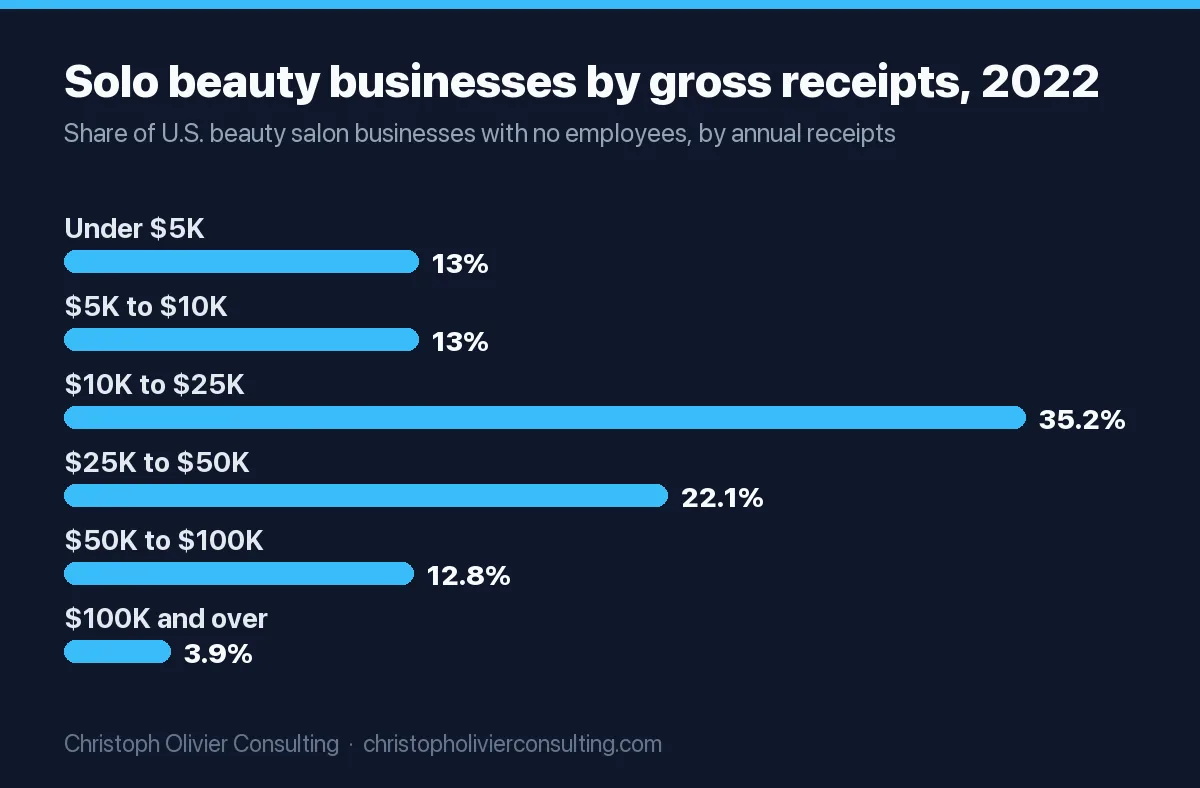
Census’ nonemployer file is the closest thing to a census of suite and booth renters, because most file as businesses with no employees. Their gross receipts are low.
| Annual gross receipts | Beauty salon businesses with no employees | Share | Cumulative share |
|---|---|---|---|
| Under $5,000 | 106,944 | 13.0% | 13.0% |
| $5,000 to $9,999 | 106,864 | 13.0% | 25.9% |
| $10,000 to $24,999 | 290,107 | 35.2% | 61.2% |
| $25,000 to $49,999 | 182,402 | 22.1% | 83.3% |
| $50,000 to $99,999 | 105,646 | 12.8% | 96.1% |
| $100,000 and over | 32,004 | 3.9% | 100% |
Source: U.S. Census Bureau, Nonemployer Statistics 2022, NAICS 812112, all legal forms. Size classes decoded with the Census record layout. Shares are my calculation. Many of these are part-time or side businesses, which pulls the distribution down.
The median solo beauty business grossed between $10,000 and $24,999. Only 16.7% grossed $50,000 or more, and only 3.9% (32,004 businesses) grossed $100,000 or more. A full-time suite renter with a full book is in the top fifth of this group, not the middle.
What a suite costs: Phenix Salon Suites’ Item 19 (2023 FDD, fiscal 2022, as summarized by Franchise Chatter) reported average gross revenue of $467,819 per location, an average of 33 suites per location and 92.9% average occupancy. That works out to roughly $273 a week per suite, or about $293 per occupied suite (my calculation; the revenue and suite figures come from different reporting subsets, 127 and 182 locations, so treat it as a rough anchor).
Worked suite renter P&L (my calculation; suite rent $293 a week, supplies at the IRS 8.56% ratio, card fees at Square’s 2.6%, self-employment tax at 15.3% on 92.35% of net per the IRS):
| Line | Part-time book | Full book | Top-tier book |
|---|---|---|---|
| Annual service and retail revenue | $50,000 | $100,000 | $150,000 |
| Where that sits (Census nonemployers) | Top 17% | Top 4% | Top 4% |
| Suite rent ($293 × 52) | $15,260 | $15,260 | $15,260 |
| Supplies and color (8.56%) | $4,280 | $8,560 | $12,840 |
| Card processing (2.6%) | $1,300 | $2,600 | $3,900 |
| Net self-employment income | $29,160 | $73,580 | $118,000 |
| Self-employment tax | $4,120 | $10,397 | $16,673 |
| Income after SE tax, before income tax | $25,040 | $63,183 | $101,327 |
Rent is fixed, so the suite model rewards a full book and punishes a thin one. At $50,000 of revenue the suite takes 31% of every dollar; at $150,000 it takes 10%. How many clients that takes depends on your ticket and rebooking rate; our breakdown of how many clients a hair stylist has gives the client math.
The investor who owns the suite facility
For the facility owner, the same Phenix disclosure reported average adjusted EBITDA of $171,885 and a median of $148,197 on the 127 reporting locations, a 36.7% margin on average revenue (my calculation). EBITDA is before loan payments on a build-out, and the franchisor notes that the data is franchisee-reported and that individual results may differ. Suite facility income is a real-estate return, not a stylist’s wage.
Can a hairstylist make $100K a year?
Yes, but few do. BLS says the top 10% of employed hairdressers earned more than $71,190 in May 2025, so $100,000 on a paycheck is rare. Among self-employed beauty businesses, 3.9% grossed $100,000 or more in 2022, and gross is before rent, supplies and tax. In the suite worksheet above, $100,000 of income after self-employment tax took about $150,000 of revenue. Paths that get there: a high-ticket color or extension specialty with a full book, owning a salon of 10 or more chairs, or several locations.
Is owning a hair salon worth it? A pass/fail check
Run your numbers (or your plan) through these tests before you sign a lease or a franchise agreement. The thresholds are my own, built from the data on this page.
| Test | Pass | Fail | Where the threshold comes from |
|---|---|---|---|
| Owner wage + profit vs. a salon manager job | Above $46,360 a year | Below it | BLS median for personal service supervisors in salons, May 2025 |
| Payroll + payroll tax as % of revenue (commission salon) | Under 50% | Over 55% | Census payroll share is 40% to 49% by size; above that, the worked P&L goes to zero profit |
| Rent as % of revenue | Under 10% | Over 14% | IRS small-business ratio 8.9%; Regis company-owned salons 13.7% |
| Supplies + product cost as % of revenue | Under 17% | Over 20% | IRS ratios 8.56% + 8.69% |
| Suite renter: annual revenue | Over $60,000 | Under $40,000 | At $40,000 fixed suite rent takes 38% of revenue |
| Booth-rent owner: chairs filled at your rent | Above breakeven + 2 chairs | At or below breakeven | Breakeven formula above |
Fill-in worksheet: your salon owner income
- Revenue: weekly service + retail sales × 50 working weeks = ______
- Payroll and commissions (include payroll tax at 7.65%) = ______ (benchmark: 40% to 49% of revenue)
- Rent and utilities = ______ (benchmark: about 13% of revenue)
- Supplies, color and retail product cost = ______ (benchmark: about 17%)
- Insurance, repairs, advertising, accounting, software, card fees = ______ (benchmark: about 10%)
- Profit = line 1 minus lines 2 to 5 = ______
- Owner pay = profit + any W-2 wage you pay yourself = ______. Compare to $36,170 (median salon stylist) and $46,360 (median salon supervisor).
If the profit line is thin, the fastest levers in a salon are usually rebooking rate, color and treatment mix, and price, not cutting supplies. Our salon marketing playbook covers rebooking and pricing, and the barbershop version covers the walk-in side. To see how salons compare with other service businesses, the profit margin by industry table and our med spa revenue and owner pay breakdown use the same sources. If you want a second set of eyes on a salon P&L or a growth plan, you can book a consultation.
How the numbers were built
- Census figures are 2022, the latest Economic Census year, released in 2025. NAICS 812112 Beauty Salons excludes barber shops (812111) and nail salons (812113), which Census reports separately.
- IRS cost ratios are for all “personal and laundry services” sole proprietors in tax year 2023. IRS does not publish a salon-only breakdown. Use them as a starting point, not a salon benchmark.
- Regis figures are from the 10-K for the fiscal year ended June 30, 2026. Per-salon averages divide segment totals by the average of the opening and closing company-owned salon counts.
- Phenix figures are fiscal 2022, franchisee-reported, read from a third-party summary of the FDD’s Item 19. I did not fetch the FDD itself.
- Every P&L on this page is an illustration with stated assumptions, not a measured salon.
Ready to scale your revenue?
Book a free 30-min consultation. We’ll diagnose your growth bottleneck and map out the 3 highest-leverage moves for your business.
Frequently asked questions
How much does a hair salon owner make a year?
It depends on salon type. The typical U.S. beauty salon with employees took in between $100,000 and $499,999 in 2022 (Census). At realistic cost ratios that leaves the owner about $36,000 of profit at a $229,000 salon and about $91,000 at a $1.5 million salon (my calculation). Solo beauty businesses with no staff averaged $29,461 in gross receipts.
What is the typical profit margin for a hair salon?
It depends on who does the work. Regis' company-owned value salons kept a 4.3% segment margin in fiscal 2026 (10-K). Worked P&Ls built from Census payroll shares and IRS cost ratios give about 6% to 16% for salons with staff. Solo operators in personal services kept 24.4% of receipts in tax year 2023, mostly their own labor (IRS).
How much profit does a hair salon make?
In dollars, an illustrative salon at the Census median-band average of $229,159 in revenue keeps about $36,000 before income tax, a mid-size $691,679 salon about $52,000, and a $1.47 million salon about $91,000. These are my calculations from Census 2022 payroll shares, IRS 2023 cost ratios, Square card fees and the 7.65% employer payroll tax.
How much does a salon suite owner make?
A stylist renting a suite at about $293 a week keeps roughly $25,000 after self-employment tax on $50,000 of revenue, $63,000 on $100,000 and $101,000 on $150,000 (my calculation). Only 3.9% of no-employee beauty businesses grossed $100,000 or more in 2022 (Census). Phenix suite facilities averaged $171,885 adjusted EBITDA in fiscal 2022 (FDD Item 19).
Can a hairstylist make 100k a year?
Yes, but it is rare. The top 10% of employed hairdressers earned more than $71,190 in May 2025 (BLS), and only 3.9% of self-employed beauty businesses grossed $100,000 or more in 2022 (Census), before rent and supplies. In a suite, about $150,000 of revenue is needed to clear $100,000 after rent, supplies, card fees and self-employment tax.
Is owning a hair salon worth it?
It is worth it when your wage plus profit beats what you could earn employed. Benchmarks: the median salon stylist earns $36,170 and the median salon supervisor $46,360 (BLS, May 2025). A small commission salon in the worked P&L leaves about $36,000, so ownership pays mainly at higher revenue, lower rent, or with a full personal book.
Practice economics benchmarks