

A hospice owner makes the agency’s profit plus whatever salary they pay themselves, and both depend almost entirely on patient census. Medicare paid the median US hospice about $2.03 million in fiscal 2024 for a Medicare census of about 30 patients a day, according to CMS provider-level hospice data (my calculation). MedPAC’s March 2026 report puts the 2023 Medicare margin at 8.0% for all hospices and 13.7% for for-profit hospices, but the median hospice earned only 6% and one in four lost 16% or more.
Short answer: No government source publishes hospice owner income directly. Built from CMS and MedPAC data, an owner who also works as administrator would clear roughly $0 to $300,000 a year at a census of 20 patients, about $470,000 to $580,000 at 50 patients and about $760,000 to $1.06 million at 100 patients, before income tax, debt service and any cap repayments (my calculation). Small hospices often lose money: MedPAC’s lowest-volume fifth of hospices had a -20.2% Medicare margin in 2023.
Below are the primary numbers: CMS payment data for 6,134 individual hospices, MedPAC’s margin analysis of Medicare cost reports, the FY 2027 Medicare payment rates, the hospice segments of three public companies’ 10-K filings and BLS wage data. Every average or share the sources do not print is labeled as my calculation. The owner-pay model at three census sizes and a pass/fail worksheet are further down.
How much does a hospice owner make? What each source actually measures
Owner income is not reported anywhere as a single number, so each “hospice owner salary” figure online is really one of the measures below. Check what it measures before you compare it with your agency.
| Source and period | What it measures | Key figure |
|---|---|---|
| CMS Post-Acute Care Utilization, Hospice, FY 2024 | Medicare payments to each hospice provider (revenue, not profit) | Median $2,031,868 per hospice; middle half between $868,688 and $4,737,749 (my calculation, 6,134 providers) |
| MedPAC March 2026, Chapter 10, 2023 cost reports | Medicare margin: Medicare payments minus Medicare-allowable costs, as a share of payments | 8.0% all hospices; 13.7% for profit; -1.3% nonprofit; median hospice 6% |
| Chemed 10-K, 2025 (VITAS segment) | Operating income of the largest public hospice operator | $1.63 billion revenue; 15.1% operating margin (my calculation) |
| Enhabit 10-K, 2025 (Hospice segment) | Segment adjusted EBITDA, before corporate overhead | $246.2 million revenue; 24.3% segment margin (my calculation) |
| Addus 10-K, 2025 (Hospice segment) | Segment operating income, before corporate overhead | $262.5 million revenue; 25.7% segment margin |
| BLS OEWS, May 2025, NAICS 621600 | Wages of employees (not owners) in home health care services, which include in-home hospice | Chief executives median $195,580; medical and health services managers median $101,830 |
Three things follow from the table. First, the public companies’ margins are not what a small owner should expect: they run large censuses and the segment figures exclude head-office costs. Second, MedPAC’s margin covers only Medicare, but Medicare was about 91% of all hospice days in 2023, so it is close to the whole business. Third, salary surveys for “hospice CEO” measure employees, not owners. An owner’s real income is the salary plus the profit.
How much do hospice companies make? Revenue by census size
Medicare spent $28.3 billion on hospice in 2024 across about 6,700 providers and 1.82 million beneficiaries, per MedPAC. That average hides a very uneven split. I grouped every hospice in the CMS FY 2024 provider file by its Medicare average daily census (ADC: Medicare days of care divided by 366, the days in the fiscal year).
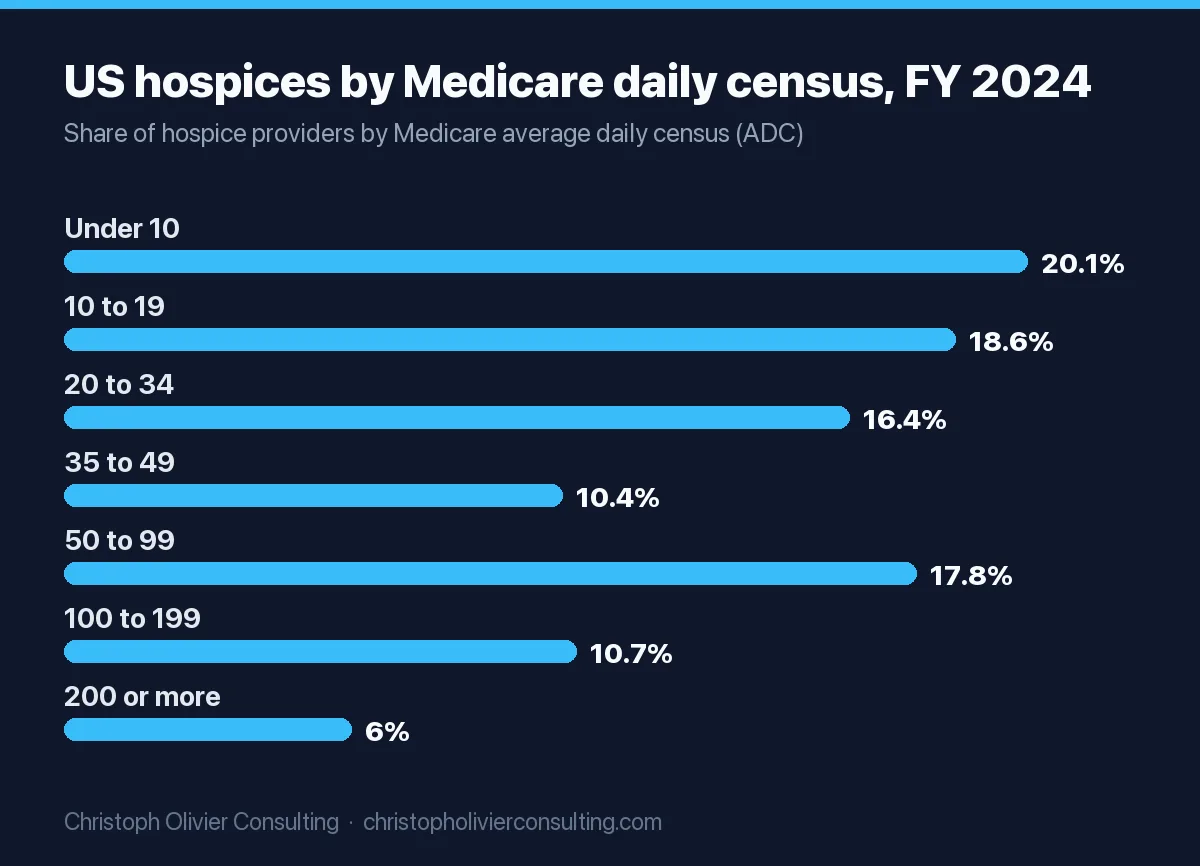
| Medicare average daily census | Hospices | Share of hospices | Median Medicare payments per hospice | Share of all Medicare hospice payments |
|---|---|---|---|---|
| Under 10 | 1,231 | 20.1% | $412,303 | 1.9% |
| 10 to 19 | 1,139 | 18.6% | $1,026,476 | 4.3% |
| 20 to 34 | 1,007 | 16.4% | $1,839,704 | 6.9% |
| 35 to 49 | 641 | 10.4% | $2,783,166 | 6.7% |
| 50 to 99 | 1,089 | 17.8% | $4,615,361 | 18.9% |
| 100 to 199 | 657 | 10.7% | $9,091,427 | 22.8% |
| 200 or more | 370 | 6.0% | $20,578,504 | 38.7% |
Source: CMS Medicare Post-Acute Care Utilization, Hospice by Geography and Provider, FY 2024 (October 2023 to September 2024). Medicare fee-for-service payments, which include hospice care for most Medicare Advantage members. Bands, medians and shares are my calculation.
The typical hospice is small: 38.7% of hospices had a Medicare census under 20, and 28.5% received less than $1 million from Medicare in the year. The 6% of hospices with a census of 200 or more collected 38.7% of all Medicare hospice dollars. Across all providers, Medicare paid about $190 per day of care.
Where you operate changes the typical size
State rules shape the market. In the same CMS file, California had 1,819 hospices with a median Medicare census of just 14.9. Texas had 829 hospices with a median census of 28.7. Florida, which limits new hospices through Certificate of Need rules (as Chemed’s 10-K notes), had only 55 hospices, and the median one had a Medicare census of 325 and $22.4 million in Medicare payments (my calculations). A license in a crowded market buys you far less census than the national averages suggest.
Hospice profit margins: what MedPAC found
MedPAC is the congressional agency that audits Medicare payment adequacy every year, and its hospice chapter is the most complete public source on hospice profitability. Its margins use Medicare-allowable costs from cost reports and exclude money that above-cap hospices must repay.
| Hospice group (2023) | Share of hospices | Medicare margin | Cost per day, 2024 |
|---|---|---|---|
| All hospices | 100% | 8.0% | $168 |
| For profit | 80% | 13.7% | $147 |
| Nonprofit | 18% | -1.3% | $214 |
| Freestanding | 88% | 10.2% | $162 |
| Home health based | 6% | 4.4% | $186 |
| Hospital based | 6% | -25.6% | $275 |
| Urban | 87% | 8.3% | $170 |
| Rural | 13% | 5.3% | $156 |
| Below the aggregate cap | 72% | 9.0% | n/a |
| Above the cap, after repaying overpayments | 28% | -1.4% | n/a |
Source: MedPAC, Report to the Congress, March 2026, Tables 10-8 and 10-9. Margins are for 2023; costs per day are for 2024 and cover all payers.
The aggregate margin was 9.8% in 2022 and 8.0% in 2023, and MedPAC projects about 9% for 2026. The spread between providers is wider than the averages: MedPAC reports a margin of -16% at the 25th percentile, 6% at the median and 21% at the 75th percentile. Two drivers explain most of it.
- Length of stay. Medicare pays a flat daily rate, while a hospice’s heaviest costs come at admission and in the last days of life. Longer stays spread those costs over more paid days. For-profit hospices averaged 120-day stays in 2024 versus 71 days for nonprofits, per MedPAC. Patients in nursing homes and assisted living also raise margins: the half of hospices with the most such patients earned 13.3%.
- Volume. Fixed costs like the on-call nurse, medical director, compliance and billing do not shrink with census, so small hospices lose money on Medicare as a group.
MedPAC also reports figures that matter if you plan to sell: three of the four publicly traded companies that report hospice margins saw them rise through mid to late 2025, but deal activity slowed from 2022 to 2025, which some analysts link to interest rates and the program-integrity crackdown in four states.
Is owning a hospice profitable? It depends on your census
MedPAC splits hospices into five equal groups by patient volume. Only the top three groups made money on Medicare in 2023.
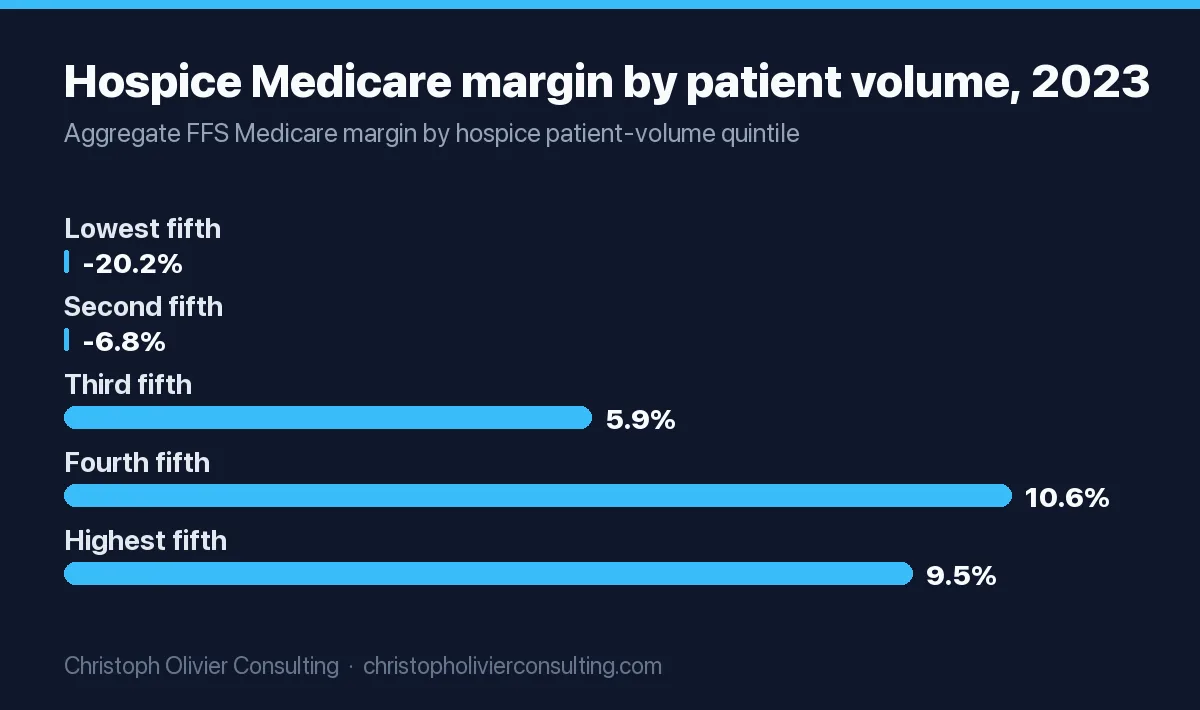
| Patient volume group (MedPAC) | Share of patients served | Medicare margin, 2022 | Medicare margin, 2023 | Approx. Medicare ADC range, FY 2024 CMS file |
|---|---|---|---|---|
| Lowest fifth | 2% | -12.3% | -20.2% | Under 10 |
| Second fifth | 4% | -6.4% | -6.8% | 10 to 21 |
| Third fifth | 9% | 5.5% | 5.9% | 21 to 41 |
| Fourth fifth | 18% | 12.2% | 10.6% | 41 to 86 |
| Highest fifth | 67% | 11.7% | 9.5% | Over 86 |
Margins: MedPAC March 2026, Table 10-9. ADC ranges: quintile cut points of Medicare days per provider in the CMS FY 2024 file, my calculation. MedPAC does not publish census cut points, so the right-hand column is an approximation for orientation.
So yes, owning a hospice is profitable on average, but not by default. A hospice with fewer than about 20 Medicare patients a day sits in the groups that lost money in 2023, and 28% of all hospices exceeded the aggregate cap and had to repay Medicare.
What Medicare pays a hospice in FY 2027
Revenue is mostly a per diem: Medicare pays a fixed amount for every day a patient is enrolled, whether or not staff visit that day. Routine home care was 98.8% of Medicare hospice days in 2024, per MedPAC. These are the national rates for October 1, 2026 to September 30, 2027, as corrected by CMS:
| Level of care (revenue code) | FY 2027 national rate | Revenue from one patient for a full year (my calculation) |
|---|---|---|
| Routine home care, days 1 to 60 (651) | $236.33 per day | $86,260 if every day were at this rate |
| Routine home care, day 61 onward (651) | $186.33 per day | $68,010 |
| Continuous home care (652) | $1,726.16 per 24 hours ($71.92 per hour) | Crisis periods only |
| Inpatient respite care (655) | $545.93 per day | Max 5 consecutive days at a time |
| General inpatient care (656) | $1,231.51 per day | Counts toward the 20% inpatient limit |
| Aggregate cap per Medicare beneficiary | $36,174.75 | Total payments above this, averaged over your patients, are repaid |
Sources: FY 2027 Hospice final rule correction (CMS-1851-CN), effective October 1, 2026; cap from CMS MLN Matters MM14557. Rates are for hospices that submit quality data; non-reporting hospices take a 4 percentage point lower update. Labor share (66% for routine home care) is adjusted by the local wage index.
The FY 2027 update was 2.3%, worth an estimated $755 million across all hospices, per the final rule. MedPAC had recommended that Congress give hospices no update at all for 2027 because margins were strong, so do not build a business plan on rate growth.
How the big public hospice operators make money
Public companies publish the unit economics private owners keep to themselves. Three of them break out hospice results in their 2025 10-K filings.
| 2025, hospice business | VITAS (Chemed) | Enhabit Hospice | Addus Hospice |
|---|---|---|---|
| Revenue | $1,630.1 million | $246.2 million | $262.5 million |
| Average daily census (all payers) | 22,338 | 3,985 | 3,760 |
| Revenue per patient day | $199.92 (my calculation) | $169.30 | $191.06 |
| Revenue per patient of census per year | $72,974 | $61,782 | $69,825 |
| Programs or locations | 59 programs | 117 locations | 39 locations |
| Census per program or location | 379 | 34 | 96 |
| Direct cost of service, % of revenue | 77.2% | 46.2% | 51.3% |
| Profit measure | Operating income 15.1% | Segment adjusted EBITDA 24.3% | Segment operating income 25.7% |
| Medicare share | Over 90% of revenue | 98.2% of revenue | Not broken out for hospice |
Sources: 2025 Form 10-K filings of Chemed, Enhabit and Addus. Per-census and per-location figures and VITAS ratios are my calculations. Companies classify costs differently (VITAS’s cost of service includes items others book as general and administrative), so compare the bottom lines, not the cost lines.
Two takeaways for a private owner. A full patient of census brings in roughly $62,000 to $73,000 a year at these operators, which is a useful sanity check for any pro forma. And the segment margins of 24% to 26% are before head-office costs: VITAS, which reports after its own overhead, earned 15.1%, close to MedPAC’s 13.7% for for-profit hospices. VITAS’s wages alone (in cost of service) were 58.1% of revenue, which tells you where an owner’s money goes.
Owner pay = salary + profit: a worked model at 20, 50 and 100 patients
Most small hospice owners also run the agency. Their income is a market salary for that job plus whatever profit remains. This model is my own calculation; the assumptions are listed under the table so you can replace each one with your numbers.
| Own calculation | ADC 20 | ADC 50 | ADC 100 |
|---|---|---|---|
| Patient days per year (ADC x 365) | 7,300 | 18,250 | 36,500 |
| Revenue at $191 per day | $1,394,300 | $3,485,750 | $6,971,500 |
| Base case margin (MedPAC volume group, 2023) | -6.8% | 10.6% | 9.5% |
| Base case profit | -$94,812 | $369,490 | $662,293 |
| Implied cost per patient day | $204 | $171 | $173 |
| Upside case margin (MedPAC for-profit average) | 13.7% | 13.7% | 13.7% |
| Upside case profit | $191,019 | $477,548 | $955,096 |
| Administrator salary already in costs (BLS median) | $101,830 | $101,830 | $101,830 |
| Owner-administrator pre-tax income, base case | $7,018 | $471,320 | $764,123 |
| Owner-administrator pre-tax income, upside case | $292,849 | $579,378 | $1,056,926 |
Assumptions behind the model:
- $191 per day is MedPAC’s average Medicare payment per day across all levels of care in 2024. FY 2027 rates are higher, but your wage index and day mix can move this number more than the annual update. Non-Medicare days are assumed to pay the same.
- Margins are MedPAC 2023 Medicare margins for the volume group each census falls into (see the volume table above), and the for-profit average as an upside. Margins are on Medicare-allowable costs, so they exclude the mandatory bereavement and volunteer programs; including them would cut the 2023 aggregate margin by up to 1.4 points, about $48,800 at ADC 50.
- Salary is the May 2025 BLS median for medical and health services managers in home health care services. If you hire an administrator instead, your income is the profit line only.
- Not included: income tax, loan payments on an acquisition, start-up losses before you reach census, cap repayments and claim denials during medical review.
The model makes one point clearly: at a census of 20 the base case pays the owner little more than nothing, while at 50 the same person can make four to five times an administrator’s salary. Census growth, not cost cutting, decides hospice owner pay.
Hospice owner pay worksheet: pass/fail checks before you trust your numbers
Copy these into a spreadsheet and run them on your trailing twelve months. Each line has a threshold taken from the sources above.
| Check | How to calculate | Pass if | Why it matters |
|---|---|---|---|
| 1. Census scale | Medicare patient days / 365 | ADC of 21 or more | Below that, MedPAC’s 2023 volume groups lost money on Medicare |
| 2. Revenue per day | Total revenue / total patient days | Within about 10% of $191 after wage index | Far below suggests billing or day-mix problems; far above suggests heavy inpatient or continuous care use |
| 3. Cost per day | Total costs / total patient days | Under your revenue per day by at least 8% | Matches the 2023 aggregate margin; for-profit hospices averaged $147 cost per day in 2024 |
| 4. Aggregate cap | Medicare payments / Medicare beneficiaries counted for the cap year | Under $36,174.75 (FY 2027) | Excess is repaid; 28% of hospices exceeded the cap in 2023 |
| 5. Inpatient limit | General inpatient plus respite days / total Medicare days | 20% or less | Inpatient days above 20% are paid at the routine home care rate (42 CFR 418.302(f)) |
| 6. Quality reporting | Did you submit all required quality data? | Yes | Missing data cuts the annual update by 4 points |
| 7. Owner pay split | Market salary for your role + profit | Profit positive after paying yourself a market salary | If profit only exists because you pay yourself nothing, the business is a job, not an asset |
Hospice rules that decide what an owner keeps
What is the 80/20 rule in hospice?
It is the inpatient cap. Under 42 CFR 418.302(f), general inpatient and respite days for Medicare patients may not exceed 20% of all Medicare hospice days in the cap year. Inpatient days above that limit are paid at the routine home care rate instead. In practice at least 80% of your days must be home-level care, which is why the inpatient rates above rarely move an owner’s income much.
What is the 36 month rule for hospice?
Under 42 CFR 424.550(b), if majority ownership of a hospice changes within 36 months of its initial Medicare enrollment or its last majority ownership change, the Medicare provider agreement and billing privileges do not transfer to the buyer. The buyer must enroll as a new hospice and pass a new state survey or accreditation. Exceptions include a hospice that has filed two consecutive years of full cost reports, internal corporate restructurings, changes of business structure with the same owners, and the death of an individual owner. For an owner, the rule means you generally cannot build a hospice and sell it with its Medicare number inside three years.
How does the hospice aggregate cap affect profit?
The cap limits total Medicare payments to a hospice to its number of Medicare patients times the cap amount, $36,174.75 for the cap year ending September 30, 2027 (42 CFR 418.309). MedPAC notes the FY 2026 cap ($35,361) equaled about 178 days of routine home care. Hospices with many very long stays exceed it: before repayment, above-cap hospices showed a 17.8% margin in 2023, but after repayment the figure was -1.4%. VITAS reported a Medicare cap liability of $30.9 million at the end of 2025, so even the largest operator manages this every year.
Enhanced oversight, revocations and the Special Focus Program
Hospice is one of the most closely watched Medicare benefits. Since July 13, 2023, CMS has placed newly enrolled hospices in Arizona, California, Nevada and Texas, and since December 30, 2025 in Georgia and Ohio, in a provisional period of enhanced oversight lasting 30 days to one year, with medical review of claims such as prepayment review. It also applies to qualifying changes of ownership, so it reaches buyers as well as start-ups. MedPAC reports that CMS reviewed claims for 668 hospices in the first four states and revoked 122 enrollments as of June 2025. In April 2026, CMS said the targeted oversight had led to more than 200 hospice enrollment revocations. The separate Hospice Special Focus Program, a CMS plan to single out poor-performing hospices for extra oversight, was halted on February 14, 2025, as reported by the American Hospital Association. For an owner in those six states, plan cash for months of slower payment while claims are reviewed.
How much do hospice CEOs make?
For employed executives, the cleanest public number is BLS. In May 2025, chief executives in home health care services (NAICS 621600, which includes in-home hospice) earned a mean of $230,530 and a median of $195,580, per the BLS Occupational Employment and Wage Statistics. Medical and health services managers, the job title most hospice administrators and directors hold, earned a mean of $115,670 and a median of $101,830. For context on the payroll an owner funds, registered nurses in the same industry had a median of $84,930 and healthcare social workers $70,680.
BLS excludes self-employed owners, so these figures are what you would pay to replace yourself, not what owners earn. Executives at large nonprofit hospices report their pay on IRS Form 990, which is public, but those figures describe salaried leaders of big systems, not owners of a for-profit agency.
Turning census into owner income
Every number on this page points to one lever: average daily census, built from steady referrals from physicians, hospitals, nursing homes and assisted living communities. Hospice referral work looks a lot like the playbook in our guide to home care agency referral sources, and the revenue math is close to what we found for home care agency average revenue. Assisted living partners matter twice, because MedPAC links facility-based patients to higher margins; our breakdown of assisted living facility owner salary covers the economics of the partner on the other side of those referrals. Channels beyond referrals are covered in our healthcare marketing guide.
In my view, the most useful exercise is to run the worksheet above on your own trailing twelve months before reading any “average owner salary” figure. If you want a second set of eyes on your census growth plan, you can book a consultation.
How these figures were compiled
- CMS provider data: Medicare Post-Acute Care Utilization, Hospice by Geography and Provider, FY 2024 file (released 2026), 6,134 provider rows covering $27.64 billion of the $27.69 billion national Medicare payment total. Medicare ADC = total service days / 366. Medians, bands and state figures are my calculations. Revenue from other payers is not in this file.
- MedPAC: Report to the Congress: Medicare Payment Policy, March 2026, Chapter 10, Hospice services. Margins for 2023 (the latest with cap data), cost per day for 2024.
- Payment rates: FY 2027 Hospice final rule (91 FR 49118, August 3, 2026) and its correction, which revised the routine home care rates to $236.33 and $186.33.
- Company data: 2025 Form 10-K filings of Chemed (VITAS), Enhabit and Addus HomeCare on SEC EDGAR.
- Wages: BLS OEWS May 2025, national industry-specific estimates for NAICS 621600, retrieved through the BLS public data API.
- Rules: eCFR text of 42 CFR 418.302, 418.309 and 424.550, current as of November 2026; CMS MLN7867599 (February 2026).
Ready to scale your revenue?
Book a free 30-min consultation. We’ll diagnose your growth bottleneck and map out the 3 highest-leverage moves for your business.
Frequently asked questions
How much does a hospice owner make?
No source reports hospice owner income directly. Using CMS and MedPAC data, an owner who also works as administrator would clear roughly $0 to $300,000 a year at a census of 20 patients, about $470,000 to $580,000 at 50 and about $760,000 to $1.06 million at 100, before income tax, debt service and cap repayments. These are my calculations, not reported incomes.
What are hospice profit margins?
MedPAC's March 2026 report puts the 2023 Medicare margin at 8.0% for all hospices, down from 9.8% in 2022, with about 9% projected for 2026. For-profit hospices earned 13.7%, nonprofits -1.3% and hospital-based hospices -25.6%. The median hospice earned 6%, and the hospice at the 25th percentile lost 16%.
Is hospice profitable?
On average, yes, but it depends on size. In MedPAC's 2023 data, the two lowest-volume fifths of hospices lost money on Medicare (-20.2% and -6.8%), while the top three fifths earned 5.9% to 10.6%. About 28% of hospices exceeded the Medicare aggregate cap and had to repay part of their payments.
How much do hospice companies make?
Medicare paid hospices $28.3 billion in 2024 across about 6,700 providers. In CMS FY 2024 provider data, the median hospice received $2.03 million from Medicare, while 28.5% received under $1 million. The largest public operator, VITAS, reported $1.63 billion in 2025 revenue from an average daily census of 22,338 patients.
How much do hospice CEOs make?
BLS data for May 2025 show chief executives in home health care services, which includes in-home hospice, earned a median of $195,580 and a mean of $230,530. Medical and health services managers, the usual title for hospice administrators, earned a median of $101,830. These are employee wages and exclude self-employed owners.
What is the 36 month rule for hospice?
Under 42 CFR 424.550(b), if majority ownership of a hospice changes within 36 months of its initial Medicare enrollment or last majority ownership change, the Medicare billing privileges do not pass to the buyer, who must enroll as a new hospice and get a new survey. Exceptions include two consecutive years of full cost reports and the death of an owner.
What is the 80/20 rule in hospice?
It is the Medicare inpatient cap in 42 CFR 418.302(f). General inpatient and respite days may not exceed 20% of a hospice's total Medicare days in the cap year. Inpatient days above that limit are paid at the routine home care rate, so at least 80% of days are effectively home-level care.
Practice economics benchmarks