
No government survey reports what assisted living owners pay themselves, so the honest answer is built from revenue, margins and the size of the home. The average assisted living facility with employees took in $1.91 million in 2022, according to the Census Bureau’s Statistics of U.S. Businesses (NAICS 623312, assisted living facilities for the elderly), yet more than half of all assisted living firms took in under $500,000. Large operators keep roughly 27 cents of each revenue dollar at the property level before rent, debt and corporate overhead, per the 2025 annual reports of Brookdale Senior Living and Welltower.
Short answer: It depends almost entirely on size. In my worked models below (labeled assumptions, 2025 wage and price data), a 6-bed residential home leaves the owner about $21,000 to $76,000 a year before tax, a 16-bed home about $231,000 when the owner also acts as administrator, and an 80-unit community about $1.4 million of property income before debt service. Large operators earn a 27% property margin; NIC reports the top quarter of assisted living properties above 40% and the bottom quarter below zero.
Below you will find what each primary source actually measures, how revenue splits by facility size and state, the margin benchmarks from public filings, three worked P&Ls (6 beds, 16 beds, 80 units) and a pass/fail worksheet to test your own numbers. Every average or share that the source does not print is my calculation from its published totals, and I say so.
What each source measures (and why the numbers disagree)
Top-ranking pages quote owner incomes such as “$100,000 to $150,000 in profit” with no source. The numbers that do exist come from different slices of the industry, so check the “what it measures” column before you compare yourself to any one figure.
| Source and year | What it measures | Figure | How it was calculated |
|---|---|---|---|
| Census SUSB 2022, NAICS 623312 | Revenue per assisted living facility with paid employees | $1,908,796 | $40,756,616,000 receipts ÷ 21,352 facilities (my calculation) |
| Census SUSB 2022, NAICS 623312 | Revenue per firm (one firm can run many facilities) | $2,718,195 | $40,756,616,000 ÷ 14,994 firms (my calculation) |
| Census SUSB 2022, NAICS 623312 | Payroll as a share of revenue (wages only, before benefits) | 40.2% | $16,393,135,000 payroll ÷ receipts; 23.3 employees per facility (my calculation) |
| IRS SOI Table 1, tax year 2023 | Sole proprietors in nursing and residential care (includes small care homes, not only assisted living) | $8,936 average net income on $59,874 receipts | $1,362,552,000 net income ÷ 152,472 returns; margin 14.9% (my calculation) |
| IRS SOI Table 1, tax year 2023 | Same, only returns that reported a profit (68.6% of them) | $20,161 average net income, 31.0% margin | $2,109,468,000 ÷ 104,632 returns (my calculation) |
| Brookdale 10-K, 2025 | Assisted living and memory care segment, 480 communities: resident fees minus facility operating expense | 26.8% | ($2,103,303,000 − $1,539,893,000) ÷ $2,103,303,000 (my calculation) |
| Welltower 10-K, 2025 | Seniors Housing Operating segment net operating income (NOI) margin, all senior housing types | 27.0% | $2,289,475,000 NOI ÷ $8,489,095,000 revenue (my calculation) |
| BLS OEWS, May 2025, NAICS 623300 | Annual mean wage, medical and health services managers (the administrator job an owner can fill) | $95,750 | Published; employees only, excludes owners |
Three things explain the spread:
- The Census average is pulled up by chains. The 235 firms with $100 million or more in revenue run 4,284 facilities, 20.1% of all assisted living locations, and take 46.0% of the industry’s revenue (my calculation from the same file).
- The IRS figure is mostly tiny operators. Schedule C filers in nursing and residential care average under $60,000 in receipts, which describes a single family care home or adult foster home, not a licensed community. Incorporated owners are not in this table.
- The public company margins stop at the property line. Brookdale’s facility operating expense excludes rent, corporate overhead, depreciation and interest. After those, Brookdale reported a net loss of $262.7 million in 2025. A 27% property margin is not what lands in an owner’s pocket.
How much an assisted living facility makes, by size
Census publishes assisted living firms by annual revenue band. This is the clearest picture of what a typical owner runs, because most firms are one small facility.
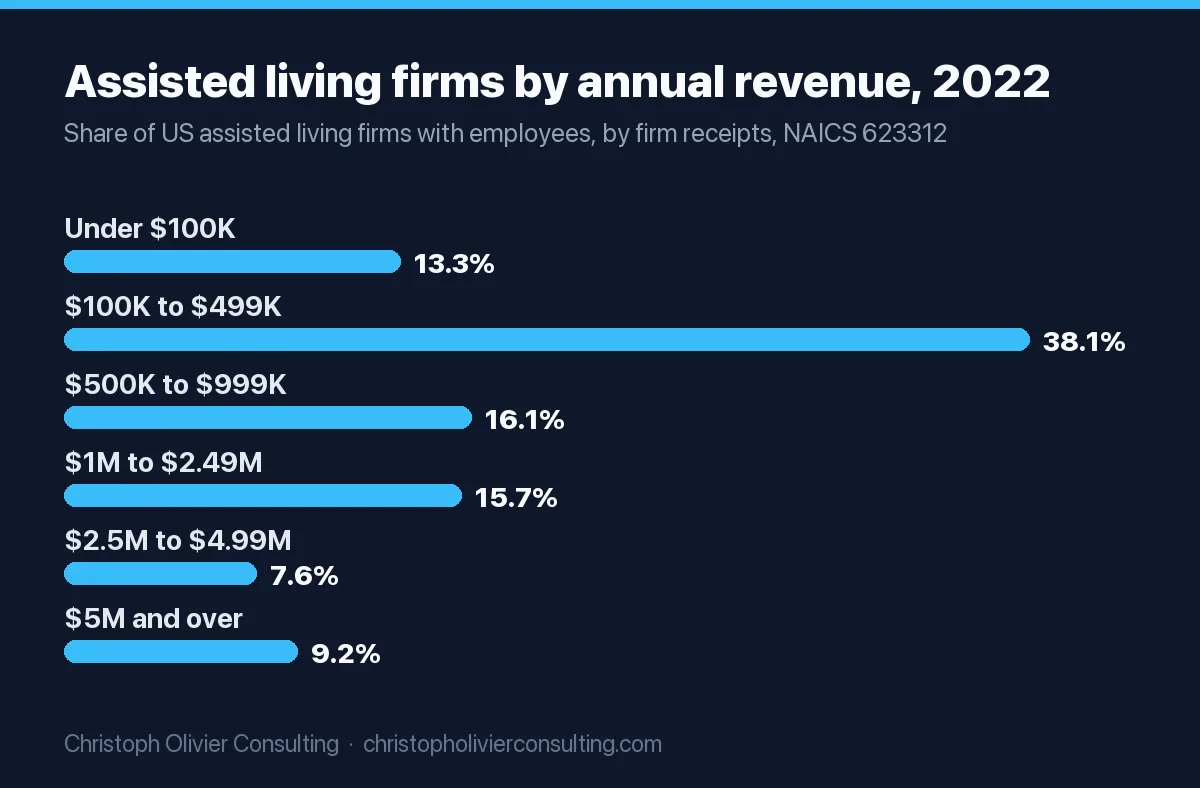
| Annual receipts of the firm | Firms | Share of firms | Cumulative share | Average receipts per firm | Employees per firm | Share of industry revenue |
|---|---|---|---|---|---|---|
| Under $100,000 | 1,989 | 13.3% | 13.3% | $45,967 | 1.5 | 0.2% |
| $100,000 to $499,999 | 5,707 | 38.1% | 51.3% | $278,996 | 4.3 | 3.9% |
| $500,000 to $999,999 | 2,416 | 16.1% | 67.4% | $707,332 | 10.9 | 4.2% |
| $1 million to $2.49 million | 2,361 | 15.7% | 83.2% | $1,586,139 | 23.7 | 9.2% |
| $2.5 million to $4.99 million | 1,147 | 7.6% | 90.8% | $3,447,769 | 45.4 | 9.7% |
| $5 million and over | 1,374 | 9.2% | 100% | n/a (several bands combined) | n/a | 72.8% |
Source: U.S. Census Bureau, SUSB 2022, U.S. 6-digit NAICS by enterprise receipts size, NAICS 623312, released April 10, 2025. Employer firms only. Shares, averages and employees per firm are my calculations from the published totals.
What the table tells an owner or a buyer:
- The median assisted living firm takes in just under $500,000. 51.3% of firms sit below that line. In the $100,000 to $499,999 band the average firm collected $278,996 with 4.3 employees: that is the small residential care home, usually 4 to 10 beds.
- Revenue tracks beds and staff, not effort. Firms in the $1 million to $2.49 million band average 23.7 employees, more than five times the median band. More income for the owner means more licensed beds.
- Nine percent of firms hold almost three quarters of the money. The 1,374 firms above $5 million collect 72.8% of industry revenue. When you read about large profits in senior housing, this is the segment being described.
How much does a residential assisted living home make?
A residential assisted living home (also called a board and care home, adult family home or RCFE in California) is a house licensed for a handful of residents. Its revenue is simple multiplication: residents × monthly rate × 12. Five residents paying $5,000 a month bring in $300,000 a year, close to the Census average of $278,996 for the $100,000 to $499,999 band. For context, the national median for assisted living was $6,200 a month ($74,400 a year) in the CareScout 2025 Cost of Care Survey, based on more than 25,000 provider rates collected July to November 2025. Each extra resident at $5,000 adds $60,000 of revenue, which is why one empty bed matters so much in a 6-bed house.
The state data show where small homes dominate. States with many adult family homes have far lower revenue per facility, because the average is diluted by houses with a few beds.
Assisted living facility revenue by state
Average receipts per assisted living facility vary more than sixfold between states. These come from the SUSB 2022 state file (receipts ÷ facilities, NAICS 623312, my calculation).
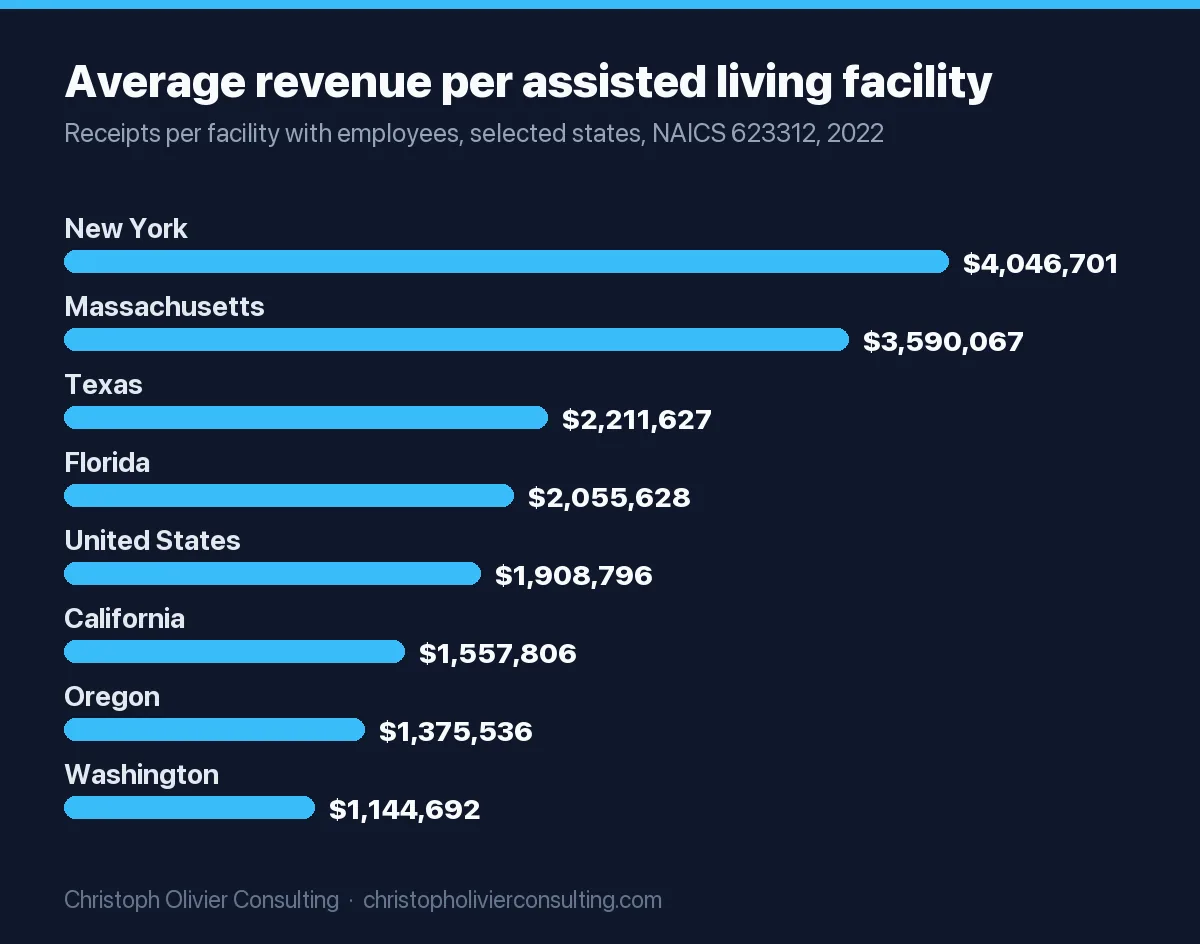
| State | Facilities with employees | Average receipts per facility | Payroll share of receipts |
|---|---|---|---|
| New York | 548 | $4,046,701 | 38.3% |
| Massachusetts | 282 | $3,590,067 | 45.9% |
| Illinois | 493 | $2,884,103 | 39.4% |
| Texas | 998 | $2,211,627 | 39.7% |
| Florida | 1,432 | $2,055,628 | 38.2% |
| United States | 21,352 | $1,908,796 | 40.2% |
| California | 3,764 | $1,557,806 | 39.1% |
| Oregon | 1,105 | $1,375,536 | 39.2% |
| Wisconsin | 1,042 | $1,283,587 | 41.9% |
| Washington | 1,767 | $1,144,692 | 38.0% |
| Alaska | 189 | $618,862 | 38.1% |
California, Washington, Oregon and Wisconsin together hold 7,678 facilities, 36% of the national count, but their averages are well below the U.S. figure. Those states license large numbers of small homes. A high state average is a revenue figure only: the state files do not report costs or profit.
Assisted living profit margins: what the filings and data show
“Assisted living profit margin” gets quoted from 10% to 40% online, usually with no definition. The margin you hear depends on where the line is drawn. Here are the benchmarks with a source and a definition attached.
| Benchmark | Year | Margin | What is subtracted |
|---|---|---|---|
| NIC, assisted living, upper quartile of properties | 2025 | Above 40% | Property operating costs (NIC cites EBITDAR, before rent, debt and depreciation) |
| Brookdale, assisted living and memory care, same-community (451 communities) | 2025 | 28.9% | Facility operating expense only (my calculation: $1,907,034,000 fees, $1,355,748,000 expense) |
| Welltower, Seniors Housing Operating NOI | 2025 / 2024 / 2023 | 27.0% / 25.0% / 23.3% | Property operating expenses (my calculation from the 10-K segment table) |
| Brookdale, assisted living and memory care, whole segment (480 communities) | 2025 | 26.8% | Facility operating expense only |
| IRS, profitable sole proprietors in nursing and residential care | 2023 | 31.0% | All business expenses; owner’s own labor is not a cost, so this is owner pay plus profit |
| IRS, all sole proprietors in nursing and residential care | 2023 | 14.9% | Same, including the 31.4% that reported a loss or zero |
| NIC, assisted living, lower quartile of properties | 2025 | Below 0% | Property operating costs |
Compiled from NIC (September 15, 2026), the 2025 Form 10-K filings of Brookdale Senior Living and Welltower, and IRS SOI Table 1 for tax year 2023. NIC publishes the quartile spread as text, not exact values.
What is a good profit margin for assisted living?
At the property level, about 27% is what the two largest public portfolios produced in 2025, and NIC reports that the assisted living median has recovered toward its 2018 level after a sharp fall in 2021. Above 40% puts a property in NIC’s top quarter. Below zero is the bottom quarter, which NIC says remains negative. Keep the definition straight: a property margin is before rent or mortgage, a management fee and income tax, so the owner’s net margin is lower.
Are assisted living facilities profitable?
Most are at the property level, but a large minority are not. Two IRS figures make the point: 68.6% of sole proprietors in nursing and residential care reported a profit in tax year 2023, and the rest reported zero or a loss. Occupancy decides which side you are on. NIC MAP data in the October 1, 2026 release put assisted living occupancy at 89.1% in the third quarter of 2026, up from 88.3% the prior quarter, in the 31 primary markets NIC tracks, while inventory grew only 0.4% year over year. Brookdale’s assisted living segment averaged 80.5% occupancy in 2025 and still made a 26.8% facility margin, because its average monthly revenue per occupied unit was $6,632.
Why do nursing home owners make so much money?
Nursing homes (skilled nursing) are a different business from assisted living, but the question shows up in this search for a reason: reported margins can understate what owners take out. Nursing homes reported a 0.58% margin on $126 billion of net revenue in 2019 Medicare cost reports; excluding disallowed costs and depreciation, the average was 8.84%, per an LTCCC analysis. Research summarized by UCLA Health Policy estimates that 63% of nursing home profits in 2019 were moved to related parties through inflated rent and management fees. The same structure exists in assisted living when one owner holds the real estate, the operating company and the management company: the owner’s income arrives as rent and fees, not only as profit.
How much do assisted living facility owners make? Three worked P&Ls
Owner pay in this business is two numbers added together: what you would otherwise pay someone to do your job (caregiver shifts in a small home, the administrator role in a larger one), plus the profit left after every cost, including rent or debt. The models below are my own calculations, not measured figures. Wages use BLS OEWS May 2025 data for NAICS 623300 (continuing care retirement communities and assisted living): home health and personal care aides averaged $18.15 an hour, institution cooks $39,930 a year and medical and health services managers $95,750. Rates and costs marked “assumption” are mine; change them to your market.
| Line (annual) | 6-bed home, 5 residents | 16-bed home, 14 residents | 80-unit community, 89.1% occupied |
|---|---|---|---|
| Monthly rate per resident | $5,000 (assumption) | $5,500 (assumption) | $6,200 (CareScout 2025 national median) |
| Revenue | $300,000 | $924,000 | $5,303,232 (71.3 occupied units) |
| Caregivers | $158,994 (one awake caregiver 24/7, 8,760 hours at $18.15) | $317,988 (two awake caregivers 24/7, 17,520 hours) | $3,881,966 facility operating expense at Brookdale’s 2025 assisted living ratio of 73.2%; wages alone at the Census 40.2% payroll share would be $2,131,899 |
| Cook and housekeeping | Done by the caregiver | $79,860 (2 FTE at $39,930) | |
| Payroll taxes, workers’ comp, benefits | $23,849 (15% of wages, assumption) | $59,677 (15%, assumption) | |
| Food and supplies | $24,000 ($400 per resident per month, assumption) | $67,200 (same) | |
| House lease or mortgage, utilities, insurance, license, repairs, marketing | $72,000 ($6,000 a month, assumption) | $168,000 ($14,000 a month, assumption) | |
| Pre-tax profit (property income for the 80 units) | $21,157 (7.1%) | $231,275 (25.0%) | $1,421,266 (26.8%), before rent or debt service, management fee and income tax |
| Owner works caregiver shifts or the administrator job | Owner covering 40 hours a week saves $43,415, so the owner takes about $64,572 | No administrator in the costs: the owner fills the role. $95,750 of the $231,275 is the market value of that job; $135,525 (13.1% after a paid administrator with 15% on-cost) is true profit | Owner usually pays an executive director; profit depends on the debt or lease on the building |
| If the home fills every bed | 6th resident adds $55,200 after food: $76,357 profit with no owner shifts (21.2%) | Each extra resident adds $61,200 after food | Each point of occupancy is worth about $59,520 of revenue |
| Break-even occupancy | 4.6 residents (77% of beds) | 10.2 residents (64% of beds) | Depends on the building’s debt or lease |
Own calculations. Sources for inputs: BLS OEWS May 2025, NAICS 623300; CareScout 2025 Cost of Care Survey; NIC MAP Q3 2026; Brookdale 2025 10-K. Staffing levels are illustrative; your state’s licensing rules set minimum staffing and may require an awake overnight caregiver, a licensed administrator or a nurse.
Read the 6-bed column carefully. A fully staffed small home with one empty bed earns the owner very little; most of what small-home owners call income is the value of their own shifts. The 16-bed home is where an owner-administrator can earn a six-figure salary plus a real profit. In the 80-unit community the owner’s income is mostly about the real estate: property income of $1.4 million has to cover the mortgage or lease first, and Brookdale’s 2025 net loss shows what happens when rent and interest take more than the property earns.
Owner pay worksheet: pass or fail your own numbers
Use this before you buy, build or renew a lease. Fill in your actual trailing 12 months. The thresholds are my rules of thumb, each anchored to the source shown.
| Check | How to calculate | Pass | Fail or investigate | Anchor |
|---|---|---|---|---|
| 1. Occupancy | Average occupied beds ÷ licensed beds | 89% or higher | Below 85% | NIC MAP assisted living 89.1%, Q3 2026 |
| 2. Rate | Average monthly fee per occupied bed | At or above your area’s CareScout median | More than 15% below it | CareScout national median $6,200, 2025 |
| 3. Wages share | Gross wages ÷ revenue (before benefits) | 44% or less | Above 46% | Census 2022 range by size band 37.7% to 44.0%, national 40.2% |
| 4. Property margin | (Revenue − operating costs before rent, debt, depreciation) ÷ revenue | 27% or higher | Below 15% | Brookdale and Welltower 2025, about 27% |
| 5. Rent or debt cover | Property income ÷ annual rent or debt payments | 1.3 times or more (assumption) | Below 1.0 | Below 1.0 the owner funds the shortfall, as Brookdale’s 2025 net loss shows |
| 6. Owner’s real profit | Pre-tax profit − market cost of the hours you work (aide $18.15 an hour, administrator $95,750 a year, plus 15%) | Positive | Zero or negative: you own a job, not a business | BLS OEWS May 2025 |
| 7. Break-even buffer | Fixed costs ÷ (rate × 12 − food per resident) compared with licensed beds | Break-even at 75% of beds or less | Above 85% | Own model: 6-bed 77%, 16-bed 64% |
If you are planning growth rather than buying, the occupancy check is where marketing earns its cost: in the 16-bed model each resident is worth $61,200 a year after food. My senior living marketing guide covers referral and inquiry systems, and these senior living event ideas are built for filling tours.
Other questions owners ask
How much do you need to start an assisted living facility?
No federal dataset tracks startup costs, and building or renovation costs depend on your state’s licensing code and local real estate. What the model above can tell you is the working capital you need while you fill beds. The 16-bed home carries about $52,127 a month of fixed costs (my calculation from the table, before food). If the home ran six months with almost no residents, that would burn roughly $312,763 of cash on top of the purchase or lease deposit, renovation and licensing (assumption; every early resident reduces it by about $5,100 a month). Budget the fill-up period, not only the build.
How much will Medicare pay for assisted living per month?
Nothing for room, board or personal care. Medicare.gov states that Medicare does not pay for long-term care, also called custodial care, and lists an assisted living facility as one place such care is received. For owners this means the business is private pay: Brookdale earned 93.9% of its 2025 resident fee revenue from private pay residents and 4.8% from government programs, primarily Medicaid and Medicare.
What happens when money runs out in assisted living?
The resident usually turns to Medicaid, if the state and the facility participate. According to Medicaid.gov, about 257 home and community based services waiver programs are active, nearly all states offer them, and they cover services such as personal care, homemaker help and case management. Whether a resident can stay depends on whether your facility accepts the waiver rate. For an owner, a resident converting to Medicaid typically means a lower monthly rate on that bed, which is worth modeling in check 2 above.
Who pays more, assisted living or a nursing home?
Nursing homes cost more. In the CareScout 2025 survey, a semi-private nursing home room was $315 a day, or $114,975 a year, and a private room $129,575, against $74,400 a year for assisted living. In-home care at 44 hours a week was $80,080 a year. The home care business has a different owner economy; compare it in our home care agency revenue breakdown, or see the hospice owner salary data for the Medicare-funded side of senior care.
Is working at an assisted living facility worth it?
Pay depends on the role. In NAICS 623300 (continuing care retirement communities and assisted living) in May 2025, BLS OEWS reports mean annual wages of $37,760 for home health and personal care aides ($18.15 an hour), $41,090 for nursing assistants, $67,820 for licensed practical nurses, $87,200 for registered nurses and $95,750 for medical and health services managers. The industry employed 1,013,180 people at a mean wage of $46,250 across all jobs.
Is investing in assisted living a good idea?
Demand is strong and new supply is thin: NIC reports 21 straight quarters of occupancy gains through the third quarter of 2026 and inventory growth of 0.4%. But the spread between operators is wide, with the top quarter above 40% margins and the bottom quarter negative in 2025. The outcome depends on purchase price, staffing costs and how fast you fill beds more than on the sector. For how this compares with other businesses, see the profit margins by industry data. If filling beds is your constraint, you can book a consultation to look at your referral and inquiry numbers.
Ready to scale your revenue?
Book a free 30-min consultation. We’ll diagnose your growth bottleneck and map out the 3 highest-leverage moves for your business.
Frequently asked questions
How much do assisted living facility owners make?
No government survey reports owner pay, so it is calculated from revenue and margins. In worked models using BLS 2025 wages and CareScout 2025 rates, a 6-bed home leaves the owner about $21,000 to $76,000 a year before tax, a 16-bed home about $231,000 when the owner is also the administrator, and an 80-unit community about $1.4 million of property income before debt service.
What is the average assisted living facility profit margin?
About 27% at the property level for large operators in 2025: Brookdale's assisted living and memory care segment kept 26.8% of resident fees after facility operating expense, and Welltower's senior housing operating portfolio had a 27.0% NOI margin. NIC reports the top quarter of assisted living properties above 40% and the bottom quarter below zero. Rent, debt and tax come out after that.
How much does a residential assisted living home make?
Revenue is residents times monthly rate times 12. Five residents at $5,000 a month bring in $300,000 a year, close to the $278,996 Census 2022 average for assisted living firms with $100,000 to $499,999 in receipts. After one awake caregiver around the clock, food, house and overhead, a 6-bed home in the worked model clears about $21,000 with one empty bed and $76,000 when full.
How much revenue does an assisted living facility make?
The average assisted living facility with employees took in $1,908,796 in 2022, from Census Statistics of U.S. Businesses data for NAICS 623312: $40.76 billion across 21,352 facilities. The typical firm is far smaller. 51.3% of assisted living firms took in under $500,000, while the 1,374 firms above $5 million collected 72.8% of industry revenue.
Are assisted living facilities profitable?
Most are at the property level, but not all. In IRS data for tax year 2023, 68.6% of sole proprietors in nursing and residential care reported a profit. NIC says the bottom quarter of assisted living properties had negative margins in 2025. Occupancy is the deciding factor: NIC MAP put assisted living occupancy at 89.1% in the third quarter of 2026.
How much will Medicare pay for assisted living per month?
Nothing for room, board or personal care. Medicare.gov states that Medicare does not pay for long-term care, also called custodial care, including care received in an assisted living facility. That is why the business is mostly private pay: Brookdale earned 93.9% of its 2025 resident fee revenue from private pay residents and 4.8% from government programs.
Practice economics benchmarks