

The senior living marketing events that pay back are small, targeted and built for one audience at a time: adult children who are researching care, seniors who are not yet ready, and the professionals who refer (discharge planners, elder law attorneys, home health and hospice teams). Pick the event by the goal you need this quarter (tours, deposits or referral relationships), capture every attendee in your CRM, and book the next appointment before they leave. Below are 12 event ideas mapped to audience, goal, cost drivers, staffing, lead capture, follow-up and compliance, plus a 12-month calendar and a worked ROI calculation. Events are one channel inside a full senior living marketing plan; start there if you have not set inquiry and move-in targets yet.
Short answer: The strongest assisted living marketing event ideas are a “Taste of [Community]” dining event for adult children, a paying-for-care seminar co-hosted with an elder law attorney or financial adviser, a dementia caregiver workshop, and an education lunch for hospital case managers. Cap guest lists at 20 to 25 (the size Judson Senior Living uses), book tours at the event, and judge each one on cost per move-in, not headcount.
Why events matter more when occupancy is above 90%
National senior housing occupancy reached 90.4% in the third quarter of 2026, the 21st straight quarterly gain, according to NIC MAP data released by NIC on October 1, 2026. Assisted living sat at 89.1% and independent living at 91.7%, and 16 of 31 primary markets were above 90%. Inventory grew only 0.4% year over year.
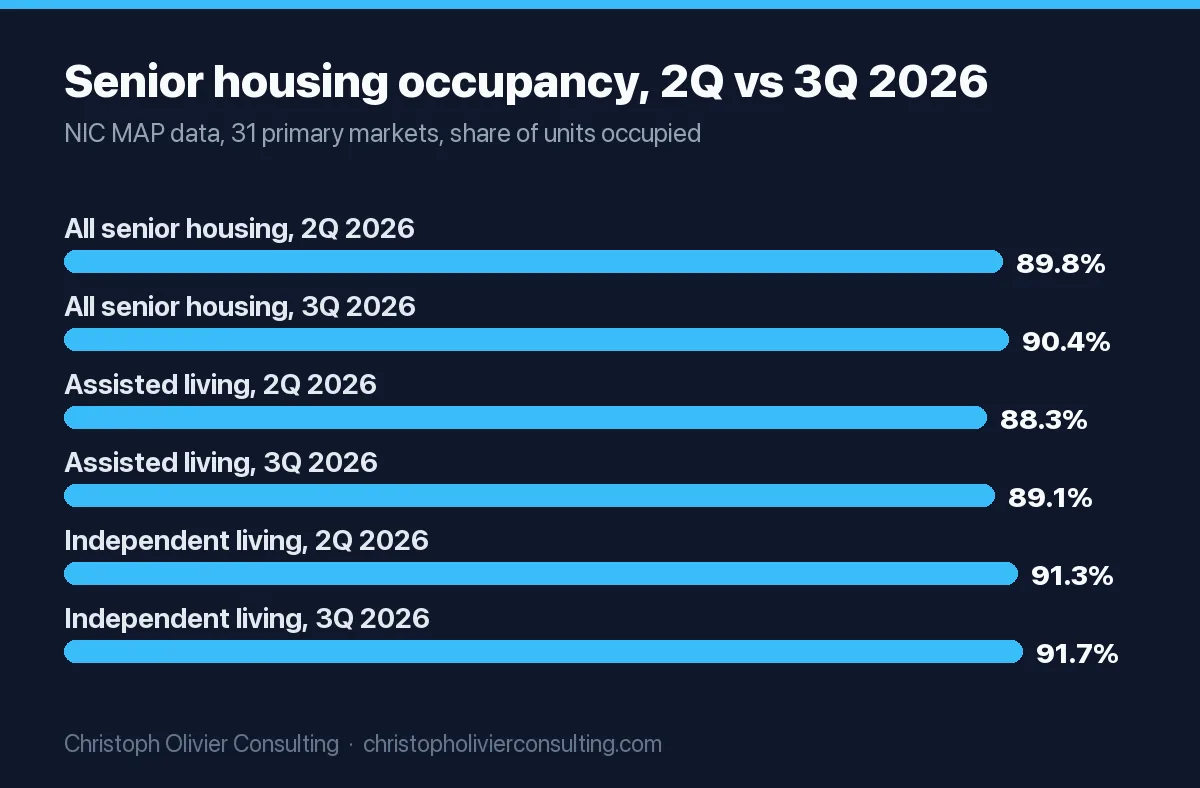
That changes what events are for. When a building is nearly full, a big open house mostly produces tire kickers you cannot house this quarter. What you need is a warm waitlist, deposits that do not cancel, and referral partners who think of you first when a unit opens. Operators have noticed: Senior Housing News reported in August 2026 that Atria, Beztak, Judson and Mather have moved from broad open houses to smaller events organized by where a prospect is in the decision. If your market is in the 86% to 88% band (Miami, Atlanta and Houston were the lowest primary markets in the NIC release), the balance tips back toward tour-generating events.
| Figure | Value | What it measures | Source |
|---|---|---|---|
| Senior housing occupancy | 90.4% (assisted living 89.1%) | Share of units occupied, 31 primary markets, 3Q 2026 | NIC, Oct 2026 |
| Residential care communities | 32,200 communities, 1,313,600 licensed beds, 988,800 residents | U.S. assisted living and similar, 2022 | CDC NCHS FastStats |
| Residents with dementia | “4 in 10” | Assisted living residents with Alzheimer’s or other dementias | AHCA/NCAL Facts and Figures |
| Medicaid reliance | 17% | Assisted living residents relying on Medicaid for daily services | AHCA/NCAL |
| Population 65+ | 64,617,088 (up 16.2% since April 2020) | U.S. residents 65 and older, July 1, 2025 | Census Bureau CB26-105 |
| Dementia caregivers | Nearly 13 million | Unpaid caregivers for people with Alzheimer’s or other dementias, 2026 report | Alzheimer’s Association |
| Assisted living cost | $6,200 a month, $74,400 a year | National median, 2025 survey, released March 2026 | Genworth Cost of Care |
Two of those rows drive event design. Four in ten assisted living residents live with dementia, and nearly 13 million people are unpaid dementia caregivers, so a caregiver education event reaches the actual decision maker. And at a $6,200 monthly median, a single move-in covers the cost of most local events many times over, which is why the real question is conversion, not attendance.
The senior living event planning matrix
Use this matrix to pick events by audience and goal. “Cost drivers” lists what moves the budget, because the dollar figure depends on your market and your own kitchen. Every lead capture method assumes a written opt-in for future contact.
| Event idea | Primary audience | Goal | Cost drivers | Staffing | Lead capture | Follow-up cadence |
|---|---|---|---|---|---|---|
| 1. “Taste of [Community]” dining event | Adult children plus parent | Tours | Food cost per head, chef time, invitations | Sales director, executive chef, 2 resident ambassadors | RSVP form with care need and timeline fields | Same-day text, call within 24 hours, tour within 7 days |
| 2. Adult-daughter weekend brunch | Adult daughters who influence the decision | Tours, inquiries | Brunch menu, take-home gift, weekend staff pay | Sales, dining, life enrichment | Name tag table check-in, take-home gift card with QR code | Thank-you email day 1, call day 2, invite to next event day 14 |
| 3. “Paying for care” seminar with an elder law attorney or financial adviser | Adult children, seniors 75+ | Qualified inquiries | Co-host time (usually unpaid, shared audience), room setup, refreshments | Sales director plus co-host | Registration page, question cards | Send slides day 1, personal call day 3, financial walk-through appointment |
| 4. Dementia caregiver workshop | Family caregivers | Memory care inquiries, trust | Speaker, respite care during session, materials | Memory care director, nurse, activity staff for respite | Registration, sign-up for monthly support group | Monthly support group invite, call only if requested |
| 5. Case manager education lunch | Hospital and SNF case managers, discharge planners | Referral relationships | Lunch value, speaker, CE approval if offered | Executive director, nurse leader, community relations | Sign-in sheet with work email | Unit availability update every 2 weeks, visit quarterly |
| 6. Referral partner breakfast | Elder law attorneys, home health, hospice, senior move managers | Referral relationships | Breakfast, staff time | Executive director, sales | Business cards into CRM as referral source records | Monthly partner email, quarterly breakfast |
| 7. Free community shred day | Local seniors and families | Awareness, list growth | Shredding truck rental, signage, parking staff | Sales, maintenance, volunteers | Opt-in raffle slip (check your state’s raffle rules) | Welcome email series, invite to a smaller event in 30 days |
| 8. Health fair or flu shot clinic with a partner | Seniors 65+ | Awareness, partner goodwill | Partner supplies clinicians, you supply space and promotion | Partner clinicians, your front desk | Separate marketing opt-in form, never the clinical form | Email newsletter, invite to dining event |
| 9. Downsizing and home-sale workshop | Seniors in their own homes, adult children | Overcome the “my house” objection | Speakers (move manager, real estate agent), handouts | Sales | Registration, free home-plan consult request | Call day 2, move-manager consult, tour |
| 10. Waitlist and depositor social | Depositors and waitlist members | Keep deposits, cut cancellations | Dining, entertainment | Sales, life enrichment, resident ambassadors | Already in CRM, log attendance | Personal call within 1 week, monthly touch until move-in |
| 11. Intergenerational event (school art show, recital) | Families, local community | Awareness, PR, social content | Low: space, refreshments, photo releases | Life enrichment | Guest book with opt-in | Newsletter, invite to Taste event |
| 12. Virtual caregiver webinar | Adult children who live far away | Inquiries | Webinar software, speaker | Sales director, one clinical speaker | Webinar registration | Replay link day 1, call day 2, virtual tour offer |
If you are building the wider plan around these events (budget, channels, inquiry targets), start with the senior living marketing plan template linked above, which covers the occupancy math, referral sources and channel budget that events sit inside.
Assisted living marketing event ideas for adult children and seniors
Taste of [Community]: the dining event that books tours
Food is the fastest way to show daily life. Atria runs a monthly “Taste of Atria” series alongside its “Social Series,” and both aim to attract prospects and secure waitlist deposits, per the Senior Housing News report. Atria’s sales teams personally invite a short list of families, pair them with residents or department leaders, and sometimes combine a tour with the event. Copy that structure: seat each family with a resident ambassador, then walk them to a model apartment between courses so the tour happens at the event, not “sometime next week.”
Adult-daughter brunch
Heritage Communities in Omaha targets adult daughters with weekend brunches and sends guests home with a small plant from a local nursery. CMO Lacy Jungman told Senior Housing News: “We focus on the adult daughter, because we know that’s a heavy influencer for us.” Weekend timing suits adult children who work weekdays. If you serve alcohol, check your state liquor license rules before you promote it.
Paying-for-care seminars co-hosted with professionals
Beztak’s “Demystifying Senior Living” event, co-hosted with a financial advisory firm, drew nearly 100 people, according to the same August 2026 report. In my view, an event that answers the cost question in public lets families ask what they may hold back on a first sales call, and it draws people who are further along. Good co-hosts are elder law attorneys (Medicaid and VA benefits), fee-only advisers and long-term care insurance specialists. Elder law firms want the same audience you do, so pitch a shared event: the playbook in how to market elder law and Medicaid planning shows what those firms want from a partner.
Dementia caregiver workshops and support groups
The Alzheimer’s Association 2026 Facts and Figures estimates 7.4 million Americans 65 and older live with Alzheimer’s and nearly 13 million people provide unpaid dementia care. A monthly workshop (behavior changes, safety at home, when to consider memory care) gives those caregivers a reason to come back. Offer supervised respite activities during the session so a caregiver can bring their loved one. Keep the sales ask soft: the follow-up is an invitation to next month’s group, and a call only when someone asks for one.
Downsizing workshops and community service events
Atria uses follow-up events to address the concerns that stall prospects, such as downsizing and selling a home. A workshop with a senior move manager and a real estate agent turns “I can’t leave my house” into a plan. For top-of-funnel awareness, a free shred day works: Discovery Senior Living had people “lining up down the block” for shredding events in Bonita Springs, Florida, per Senior Housing News. Most shred-day visitors are not buying this year, so treat it as list growth and measure it on opt-ins, not tours.
Waitlist and depositor events
Once someone has paid a deposit, the job is keeping it. Judson Senior Living limits gatherings to 20 to 25 guests with resident ambassadors, and Mather gives waitlist depositors experiential programming such as dining events and resident-led gatherings, while pre-deposit prospects get informational sessions. Mather confirms by text, email and phone; its SVP of Sales Gale Morgan said “The stronger the personal relationship with the lead, the lower the risk of cancellation or no-show” (Senior Housing News). Judson’s filter for every event is worth stealing: “We always ask ourselves if people would buy a ticket to attend the event.”
Referral source events: discharge planners, elder law attorneys, home health
Hospitals are required to give discharged patients a list of available home health agencies, skilled nursing facilities, inpatient rehab facilities and long-term care hospitals under 42 CFR 482.43(d). Assisted living is not on that mandated list. A case manager only mentions your community if they know you, trust your clinical team and know you have a unit open. Events are how that happens.
- Run education, not a sales pitch. Topics case managers actually need: what level of care your license allows, your admission criteria, how fast you can assess and admit, and which diagnoses you cannot accept. Bring your nurse leader, not only sales.
- Decide whether you offer CE credit. If your audience includes licensed social workers, a social work CE credit needs approval, for example through the ASWB ACE program, which offers either individual course approval or provider approval (new providers are approved for one year). If you do not have approval, call it an education session and do not promise credit.
- Host their meetings. Offering your space free to a local case management group, an elder law bar section or a hospice team meeting puts referral sources in your building every month at almost no cost.
- Follow up with availability. A short email every two weeks with current openings by care level is more useful to a case manager than another lunch.
Home care and home health agencies are both referral sources and competitors for the same family, so frame partner events around handoffs: when a client’s needs exceed what home care can safely provide. Our guide to home care marketing covers how those agencies generate their own leads, which helps you pitch the partnership.
Compliance checks before you promote an event
Events create three legal exposures: what your invitation says and shows, what you give referral sources, and what health information you collect. These are the rules to check. They are not legal advice, and state law varies, so run new event formats past counsel.
| Risk | Rule | What it means for an event | Pass test |
|---|---|---|---|
| Flyers, invitations, social posts | 24 CFR 100.75 (Fair Housing Act advertising) | Covers “flyers, brochures, deeds, signs, banners, posters, billboards” for the sale or rental of a dwelling. It bans words, photographs or illustrations that convey a dwelling is or is not available to a protected group, and selecting media or locations that deny segments of the market information. | Photos show a range of residents; the guest list and ad placements are not limited by race, religion, national origin, disability or other protected class. |
| 55+ communities claiming the age exemption | 24 CFR 100.306 | HUD looks at “any advertising designed to attract prospective residents.” Phrases such as “adult living” or “adult community” are “not consistent with the intent” to house persons 55 or older. | Event copy says “55 and older community” (or 62+ where that applies), not “adult community.” |
| Gifts and meals for referral sources | State anti-kickback rules, e.g. Florida 429.195 and 817.505 | Florida bars licensed assisted living facilities from paying or promising any commission, bonus, kickback or rebate for referrals. A violation is patient brokering, a third-degree felony with a $50,000 fine at the base level. Resident referral rewards are allowed. | No item of value is tied to referrals; meals are modest and educational; the hospital’s own gift policy is checked. |
| Health screenings and clinical data | 45 CFR 160.103 and 164.508(a)(3) (HIPAA) | HIPAA binds covered entities: health plans, clearinghouses and providers that transmit health information electronically in standard transactions. A covered entity needs written authorization to use protected health information for marketing, except face-to-face communication and promotional gifts of nominal value. | Screening results stay with the clinical partner; your sign-up form collects only contact details and interest, with its own opt-in. |
| Raffles, alcohol, photos | State gaming and liquor law; your photo release | Raffles and alcohol are regulated state by state. Residents and guests in photos need a signed release before you post. | State rules checked; releases on file before anything is published. |
The Florida example matters even outside Florida: 17% of assisted living residents rely on Medicaid for daily services (AHCA/NCAL), and Florida’s exception for paid referral services only applies when the referred consumers are not Medicaid recipients. Check your own state’s licensing statute for a similar section before you plan a referral partner event.
12-month senior living event calendar template
This calendar alternates tour-generating, referral and retention events so the sales team is never running two big events in one month. Dates in the “anchor” column are fixed observances you can hang an event on. Adapt the rest to your market and your own building’s calendar.
| Month | Anchor | Prospect event | Referral event | Retention or waitlist event |
|---|---|---|---|---|
| January | New year planning | Paying-for-care seminar with elder law attorney | Case manager lunch: admission criteria update | Depositor dinner |
| February | Valentine’s Day | Adult-daughter brunch | Host a local case management group meeting | Resident ambassador thank-you event |
| March | Spring | Downsizing and home-sale workshop | Referral partner breakfast | Waitlist social |
| April | National Healthcare Decisions Day, April 16 (The Conversation Project) | Advance care planning workshop with elder law attorney and hospice partner | Hospice team meeting hosted on site | Family council meeting |
| May | Mother’s Day | Taste of [Community] Mother’s Day brunch | Case manager lunch | Depositor garden party |
| June | Start of summer | Dementia caregiver workshop | Referral partner breakfast | Waitlist social |
| July | Summer | Intergenerational event with a local school or arts group | Host an elder law bar section meeting | Resident cookout with families |
| August | Back to school | Virtual caregiver webinar for out-of-town children | Case manager lunch | Depositor dinner |
| September | Flu vaccine season: CDC says September and October are good times, ideally by end of October (CDC) | Flu shot clinic with a pharmacy or home health partner | Referral partner breakfast | Waitlist social |
| October | Medicare Open Enrollment, October 15 to December 7 (Medicare.gov) | Medicare and benefits Q&A with an independent counselor | Case manager lunch | Family council meeting |
| November | Thanksgiving visits | Taste of [Community] holiday tasting | Partner appreciation open house | Depositor holiday dinner |
| December | Holidays | Holiday concert or intergenerational recital | Year-end thank-you notes and availability update | Resident and family holiday party |
Book the January and February events before the holidays, so every inquiry that comes in over the holiday season has a dated event to be invited to. For the mechanics of timelines, budgets and run-of-show, our event marketing plan template has the planning checklist.
Event ROI: attendees to tours to move-ins (worked example)
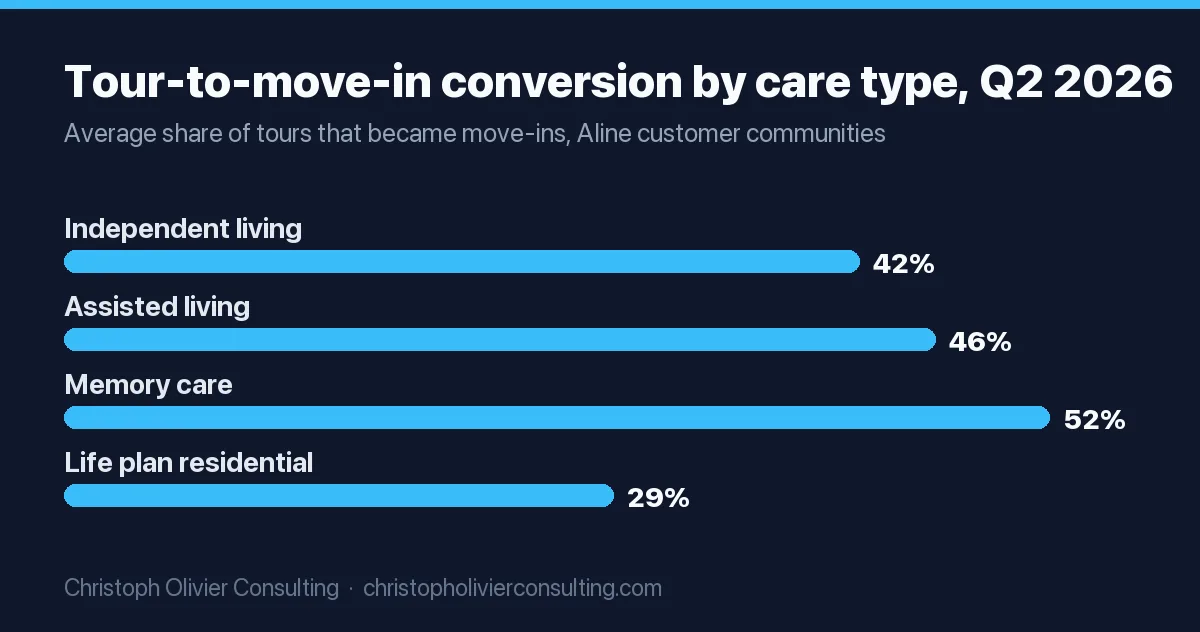
Judge every event on cost per move-in and first-year revenue, not on how full the room was. The only published benchmark here is from a vendor: Aline’s Q2 2026 Sales and Marketing Benchmark Snapshot, which reports assisted living tour-to-move-in conversion of 46% and memory care at 52%. My working assumption is that event tours come from earlier-stage prospects than inbound tours, so the example below uses lower rates in the low and base cases. Every input in the table is an example assumption, labelled as such. Replace each one with your own CRM numbers.
| Line | Low case | Base case | High case | Input type |
|---|---|---|---|---|
| A. All-in event cost (food, staff hours, invitations, gifts) | $3,000 | $3,000 | $3,000 | Example assumption |
| B. Attending households | 20 | 30 | 40 | Example assumption |
| C. Share who tour or book an assessment within 14 days | 20% | 30% | 35% | Example assumption |
| D. Tours (B x C) | 4 | 9 | 14 | Calculated |
| E. Tour-to-move-in rate | 25% | 30% | 46% | Example assumption (high case uses Aline’s assisted living Q2 2026 figure) |
| F. Expected move-ins within 90 days (D x E) | 1.0 | 2.7 | 6.44 | Calculated |
| G. Monthly rate | $6,200 | $6,200 | $6,200 | Example assumption (Genworth national median) |
| H. First-12-month revenue (F x G x 12) | $74,400 | $200,880 | $479,136 | Calculated, gross revenue, not profit |
| I. Event cost per move-in (A / F) | $3,000 | $1,111 | $466 | Calculated |
Read it like this. In the base case, a $3,000 event that brings 30 households and turns 9 of them into tours should produce about 2.7 move-ins, at $1,111 of event cost per move-in. Even the low case, one move-in, costs less than one month of the $6,200 median rate. For a reference point on whole-funnel cost, Discovery Senior Living estimated in Senior Housing News that acquiring a new resident costs about one month’s rent in many communities.
Two cautions. First, a move-in usually has several touches, so an event rarely deserves 100% of the credit. Tag each lead’s first source and every event they attended, then report both “first touch” and “influenced” move-ins. Second, a referral event pays off over months, so measure it on referrals received from attendees in the next two quarters, not on tours that week. Our guide to lead nurturing covers how to keep slow leads warm between events without spamming them.
The follow-up script that turns attendees into tours
Most event value is lost after the event. Use this sequence for prospect events, adjusted for referral events as shown in the matrix.
- At the event: the host asks one question at each table, “What made you come today?”, and the sales director writes the answer in the CRM that night.
- Same day, by text: “Thank you for joining us at [event], [name]. You mentioned [their reason]. Would [day] or [day] work for a private visit with our [nurse / memory care director]?”
- Within 24 hours, by phone: the sales director calls anyone who did not reply, references their reason, and offers one specific next step.
- Day 7: mail or email something useful tied to their reason (a cost worksheet, a caregiver checklist), not a brochure.
- Day 14 to 30: invite them to the next smaller event that fits their stage, as Mather and Judson do with pre-deposit and waitlist tracks.
- Every 30 days after: one personal touch until they tour, decline or ask you to stop.
A handwritten note or postcard is one more personal touch that does not land in a spam folder; our guide to direct mail best practices has current USPS costs and formats. If you want help building an event calendar and follow-up system for your community, you can book a consultation.
Event ideas to skip or rework
- The mass open house. Operators interviewed by Senior Housing News are replacing it with segmented events. Atria’s CMO Sanela Graziose: “We never want it to be a bunch of prospects coming together and presenting to them.”
- Events with no capture step. A street fair booth that hands out pens but collects no opt-ins cannot be measured, so it cannot be defended in next year’s budget.
- Clinical screenings run by your marketing team. Let the licensed partner own the clinical data, and keep your marketing list separate.
- Lunches that only feed referral sources. If the case managers leave without learning your admission criteria and current availability, the event did not do its job.
Ready to scale your revenue?
Book a free 30-min consultation. We’ll diagnose your growth bottleneck and map out the 3 highest-leverage moves for your business.
Frequently asked questions
What are good senior living marketing event ideas?
Strong options are a Taste of [Community] dining event for adult children, a paying-for-care seminar co-hosted with an elder law attorney or financial adviser, a dementia caregiver workshop, a downsizing workshop, and an education lunch for hospital case managers. Match each event to one audience and one goal, cap prospect events at 20 to 25 guests, and book the tour before guests leave.
What are the best assisted living marketing ideas for adult children?
Plan around the adult child's schedule and worries. Weekend brunches, evening webinars for children who live out of town, cost and benefits seminars, and dementia caregiver workshops all reach them. Heritage Communities in Omaha targets adult daughters with weekend brunches because, as its CMO told Senior Housing News, the adult daughter is a heavy influencer in the decision.
How do assisted living communities get referrals from discharge planners?
Hospitals must give patients a list of home health agencies, skilled nursing facilities, rehab facilities and long-term care hospitals under 42 CFR 482.43(d), but assisted living is not on that required list. Case managers refer to communities they know. Run education sessions on admission criteria, host their meetings, and send current unit availability every two weeks.
How do you measure ROI on a senior living event?
Track cost per move-in and first-year revenue. Multiply attending households by the share who tour within 14 days, then by your tour-to-move-in rate, to estimate move-ins. Divide event cost by move-ins. In a worked example with a $3,000 event, 30 households, 30% touring and a 30% close rate, cost per move-in is about $1,111. Use your own CRM rates.
Can a senior living community give gifts to referral sources at events?
Be careful. Many states restrict payments for referrals. Florida, for example, bars licensed assisted living facilities from paying any commission, bonus, kickback or rebate for referrals, and treats a violation as patient brokering, a third-degree felony with a $50,000 fine at the base level. Keep meals modest and educational, tie nothing to referrals, and check with counsel.
Do HIPAA rules apply to senior living health fairs?
HIPAA binds covered entities: health plans, clearinghouses and providers that transmit health information electronically in standard transactions. If a covered partner runs screenings, it needs written authorization to use that information for marketing, apart from face-to-face communication and nominal gifts. Let the clinical partner keep screening results and collect only contact details and interest on your own opt-in form.