

This direct mail advertising guide for 2026 starts with cost: a campaign costs $0.26 to $0.82 per piece in postage alone, depending on format and sort level, and the plan that works is the same every year: pick the list type first (EDDM, saturation, targeted or CRM), make one offer, choose the cheapest format that carries it, and give every piece a trackable response path. Below you get the current USPS prices from USPS Notice 123 (the price list now headed “Effective October 04, 2026”), the 2026 postage promotions, named list vendors with their published prices, worked cost-per-piece examples for a postcard, a letter and a catalog, the USPS design rules, a quality-control checklist and a six-week campaign timeline.
Direct mail in 2026: the numbers you plan with
Postage rose in July 2026. The Postal Regulatory Commission’s notice of the USPS filing gives July 12, 2026 as the effective date and an average increase of 4.803% for both First-Class Mail and USPS Marketing Mail. If your budget still uses 2025 rate cards, it is short. These are the figures that drive most planning decisions this year.
| Planning item | 2026 figure | Source |
|---|---|---|
| Cheapest way to reach every home on a route | EDDM Retail, $0.260 per flat up to 3.3 oz | USPS Notice 123 |
| Cheapest named (addressed) letter | Marketing Mail automation letter, 5-digit, $0.395 | USPS Notice 123 |
| Cheapest First-Class postcard | Presort automation 5-digit, $0.453 | USPS Notice 123 |
| Stamped one-ounce letter | $0.82 | USPS Notice 123 |
| EDDM Retail volume rule | 200 to 5,000 pieces per day per ZIP Code, no permit | USPS EDDM page |
| List hygiene rule for discounted postage | Addresses updated within 95 days before mailing | USPS Move Update |
| Postage promotions still open in late 2026 | 5% First-Class Mail Advertising (to Dec 31) and 5% Continuous Contact for Marketing Mail (to Dec 31), plus 1% add-ons | USPS 2026 promotions technical guide |
USPS postage rates for direct mail in 2026
Marketing Mail is the bulk class most campaigns use: cheaper, but it needs a permit (or a mail house’s permit), a minimum volume, and it has no delivery guarantee. The Domestic Mail Manual states plainly that “The USPS does not guarantee the delivery of USPS Marketing Mail within a specified time”. First-Class presort costs more, but it is faster and includes forwarding and return. Every figure in the chart and table below is from Notice 123.
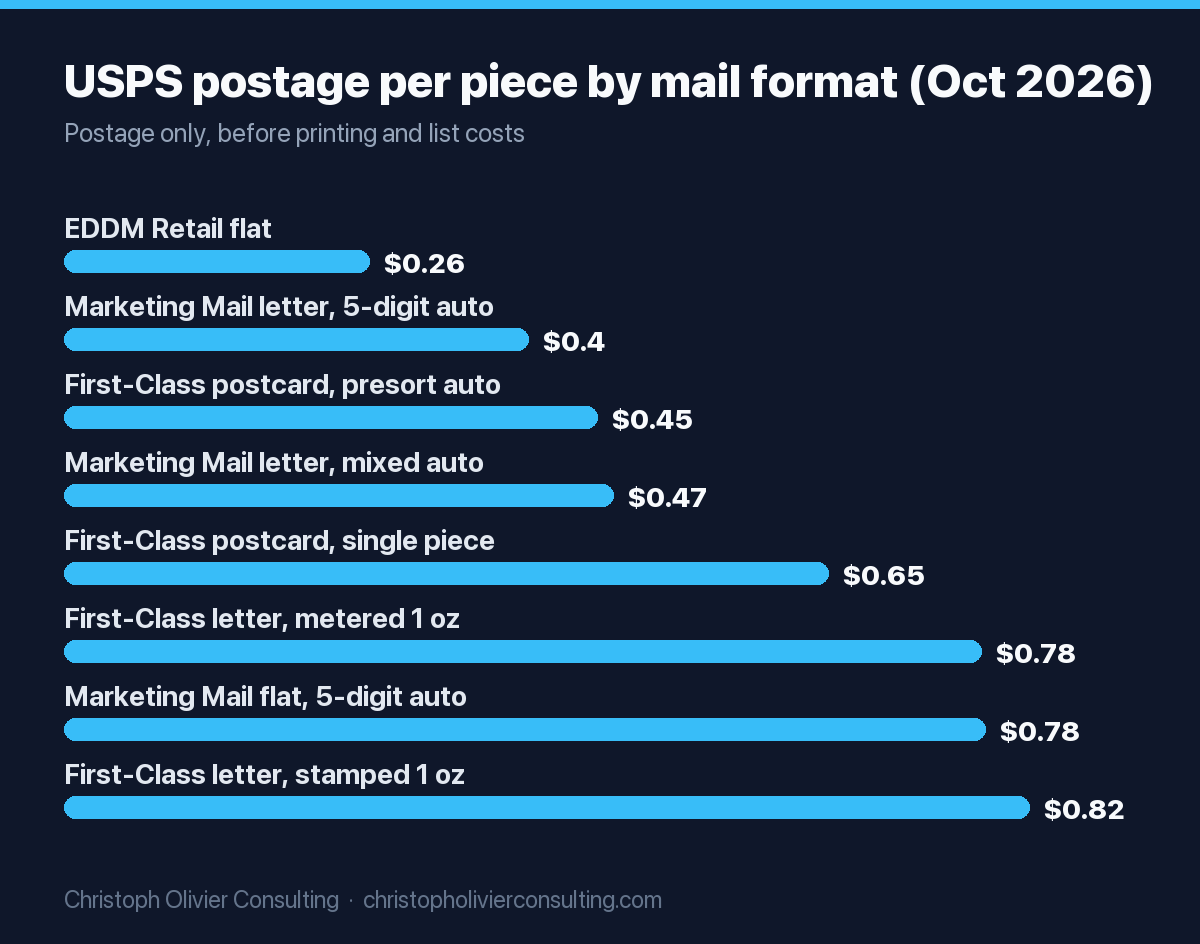
| Format and sort level | Postage per piece | When to use it |
|---|---|---|
| Marketing Mail letter, Saturation (carrier route) | $0.255 | Letters to nearly every address on a carrier route |
| Marketing Mail letter, High Density (carrier route) | $0.389 | Dense targeted lists sorted to the carrier route |
| Marketing Mail letter, automation 5-digit | $0.395 | Targeted letters concentrated in a few ZIP Codes |
| Marketing Mail letter, automation 3-digit/SCF | $0.435 | Regional lists |
| Marketing Mail letter, automation mixed | $0.467 | National or scattered lists |
| First-Class postcard, presort automation 5-digit / 3-digit / mixed | $0.453 / $0.478 / $0.495 | Reminders, event invitations, deadline offers |
| First-Class letter, presort automation 5-digit (up to 3.5 oz) | $0.621 | Time-sensitive letters to named prospects |
| EDDM Retail flat (up to 3.3 oz) | $0.260 | Small saturation drops you bring to the Post Office yourself |
| Marketing Mail flat, EDDM (BMEU), no destination entry / delivery unit entry | $0.309 / $0.259 | Larger saturation drops entered with a permit |
| Marketing Mail flat, carrier route Basic (4 oz or less) | $0.504 | Catalogs and brochures to a sorted list |
| Marketing Mail flat, automation 5-digit (4 oz or less) | $0.783 | Self-mailers and catalogs that cannot be carrier-route sorted |
| First-Class single-piece postcard / metered letter / stamped letter | $0.65 / $0.78 / $0.82 | Small runs, hand-addressed notes |
Small credits stack on top: Notice 123 lets you subtract $0.005 per automation piece that meets Full-Service Intelligent Mail requirements, plus $0.002 under USPS’s automated acceptance option. Your mail house claims these, so ask whether its quote passes them on.
How to get a USPS quote for direct mail
For an exact postage figure, enter the class, shape, weight and sort level into the USPS Business Price Calculator. For EDDM, the EDDM Online Tool shows the household count and cost for each carrier route as you select it, filtered by age, household size and income. Ask print vendors to quote print, mail prep and postage as separate lines, so you can see which part of the price is the USPS rate and which part is their margin.
USPS promotions for 2026, and what is proposed for 2027
USPS promotions are 1% to 10% off postage for mail that uses specific technology, materials or timing. You register in advance and your mail house claims them on the postage statement. These are the 2026 windows from the USPS 2026 Promotions Calendar and Technical Guide.
| 2026 promotion | Window | Discount | Eligible class |
|---|---|---|---|
| Integrated Technology | Six consecutive months from a start date you pick | 5% | First-Class and Marketing Mail |
| Tactile, Sensory and Interactive | January 1 to June 30 | 5% | First-Class and Marketing Mail |
| Continuous Contact | April 1 to December 31 | 5% | Marketing Mail |
| First-Class Mail Advertising | September 1 to December 31 | 5% | First-Class Mail |
| Catalog Insights | October 1, 2025 to June 30, 2026 | 10% | Marketing Mail |
| Sustainability add-on | All year | 1% | First-Class and Marketing Mail |
| Informed Delivery add-on | All year | 1% (plus 0.5% credit to the eDoc submitter) | First-Class and Marketing Mail |
Add-ons only apply when you also qualify for a base promotion. For 2027, the same Federal Register notice lists seven proposed promotions: Informed Delivery and Sustainability add-ons (all year), Tactile, Sensory and Interactive (January 1 to June 30), Integrated Technology (six months of your choice), First-Class Mail Advertising (April 1 to December 31), and two new ones, Impact Messaging (May 1 to September 30) and Direct Mail Discovery for Marketing Mail (April 1 to September 30). The notice does not give 2027 discount rates, so treat those dates as provisional until USPS publishes its 2027 guide.
Targeted direct mail vs EDDM vs saturation vs CRM mail: choosing the list
The list decides more of your result than the design does. Use EDDM or saturation mail when almost every household near you is a possible buyer (a restaurant, a lawn service, a roofer after a storm). Use a targeted list when the buyer is a specific person, such as a homeowner with a certain home value or a business owner. Use your CRM or site-visitor data when you want mail to act like retargeting.
| List type | Who receives it | Published price examples | Best for |
|---|---|---|---|
| EDDM Retail | Every address on the carrier routes you pick, addressed to “Postal Customer” | No list cost; postage $0.260 per piece | Local consumer services, restaurant menus, grand openings |
| Saturation or occupant list (permit mail) | Every address on a route, with “Occupant” or “Postal Customer” addressing | Click2Mail occupant list from $12.00 per thousand records; saturation letter postage $0.255 | Large local drops of letters, which EDDM Retail does not accept |
| Targeted consumer or property list | Named households filtered by age, income, home value, length of residence or recent move | Click2Mail consumer and real property lists from $33.66 per thousand; ListShack subscriptions from $50 per month | Home services by home age or value, financial and legal services by life stage |
| Targeted business list | Named businesses filtered by industry, size and location | Click2Mail business list from $45.00 per thousand | B2B services, accounting, IT and consulting firms |
| CRM and retargeting mail | Your own customers, lapsed clients, or site visitors matched to a postal address | PostPilot Growth $99 per month ($82.50 billed annually) with 4×6 cards at 68 cents, postage included | Reactivation, cross-sell, abandoned quotes, website visitors who did not convert |
Click2Mail’s figures come from its list FAQ, which also states a $20 minimum order, a 100-record minimum, and that its lists are rented, so you declare how many times you will mail them. Prices rise as you add demographic or behavioral selects. ListShack sells unlimited downloads on a subscription instead of per thousand records. The cheapest list is rarely the cheapest result: a $12 occupant list for a service only homeowners buy wastes every piece that lands at a rental.
Direct mail marketing retargeting: mail to site visitors and lapsed customers
Retargeting mail sends a postcard automatically when someone visits your site, abandons a cart or quote, or goes quiet. PostPilot lists MailMatch retargeting for lists, abandoned carts and checkouts on its Growth plan, and SiteMatch visitor matching with white-glove support on its Pro plan ($499 per month, or $419 billed annually, with 4×6 cards from 64 cents). Lob is the API option: its Startup plan is $260 per month with postcards from $0.645 and letters from $0.658, which Lob describes as all-in rates covering print, postage and envelopes. Both suit businesses with a CRM or ecommerce platform that can fire a trigger. For a small professional firm without that plumbing, a monthly batch upload of non-converted inquiries does most of the same job.
Direct mail cost per piece: worked examples for a postcard, letter and catalog
Postage is the only line you can check to the cent. Print, design, list and mail-house fees vary by quote, so the examples below use verified postage and vendor prices, and mark everything else as your own quote.
Example 1: EDDM postcard to 2,500 homes
- Format: 6.25 x 11 inch jumbo postcard (over 10.5 inches long, so it qualifies as an EDDM Retail flat).
- Postage: 2,500 x $0.260 = $650.
- Printing and design: your printer’s quote. Enter it as the second line, then divide the total by 2,500.
- Limit check: 2,500 pieces fits under the 5,000 per day per ZIP Code cap, so no permit is needed.
Example 2: Targeted 4×6 postcard to 1,000 named past customers
- PostPilot Growth, monthly billing: 1,000 x $0.68 = $680, plus $99 subscription = $779, or $0.78 per card all-in.
- Lob Startup: 1,000 x $0.645 = $645, plus $260 subscription = $905, or $0.91 per card. The subscription matters less as volume rises: at 5,000 cards, Lob’s $260 adds only about 5 cents per card.
- Do it yourself with a mail house: First-Class presort 5-digit postage of 1,000 x $0.453 = $453, plus print and prep at your quote.
Example 3: 2,000 targeted letters to prospects, with break-even
- Postage: 2,000 x $0.395 (Marketing Mail automation 5-digit) = $790.
- List: 2,000 consumer records at Click2Mail’s starting $33.66 per thousand = $67.32 (more with selects).
- Print, envelopes and mail prep: your quote. Say $1,400 for this illustration.
- Total: $2,257.32, about $1.13 per letter.
- Break-even: if one new client is worth $1,800 in first-year gross profit, you need $2,257.32 / $1,800 = 1.25, so 2 clients. If one in four consultations becomes a client, that is 8 consultations, a 0.4% booking rate from 2,000 letters.
The client value, close rate and print figure are placeholders: replace them with your own numbers. A required booking rate under 1% from a well-chosen list is a reasonable bet; a requirement of 3% or more says fix the list, the offer or the economics before you mail. To work backward from a revenue goal to the leads you need, use the method in how many leads a small business needs.
Example 4: 6 oz catalog to 10,000 names
Flats over 4 ounces pay a per-piece price plus a per-pound price. A 6 oz catalog weighs 0.375 lb.
- Marketing Mail automation 5-digit: $0.634 + (0.375 x $0.797) = $0.933 per catalog, or $9,329 for 10,000.
- Carrier route Basic: $0.377 + (0.375 x $0.750) = $0.658 per catalog, or $6,583 for 10,000.
Carrier route sorting saves about $2,750 on this drop, which is why catalog mailers pay for list density and co-mailing. The 10% Catalog Insights promotion ended June 30, 2026, so do not count it in a late-2026 budget.
Direct mail standards: USPS size rules, EDDM specs and indicia
A piece that misses a USPS dimension gets charged at a higher shape price or rejected at entry. These rules come from the USPS Quick Service Guide 201a, the DMM physical standards, the DMM EDDM-Retail section and the USPS EDDM page.
| Mailpiece | Rule |
|---|---|
| Postcard at card prices | 3.5 to 4.25 inches high, 5 to 6 inches long, 0.007 to 0.016 inch thick |
| Letter (automation) | Up to 6-1/8 x 11-1/2 inches and 1/4 inch thick; aspect ratio (length divided by height) 1.3 to 2.5; rectangular, corners no rounder than 1/8 inch radius |
| Flat | More than 11-1/2 inches long, or more than 6-1/8 inches high, or more than 1/4 inch thick; maximum 15 x 12 x 3/4 inches; must be flexible |
| EDDM Retail flat | No more than 3.3 oz, and longer than 10-1/2 inches, or higher than 6-1/8 inches, or thicker than 1/4 inch |
| EDDM addressing | “Postal Customer” simplified address; no personal information, no handwritten or typewritten matter, no bills or statements |
| EDDM Retail indicia | Above and right of the address block; larger than 0.5 x 0.5 inch; all caps, at least 4 point; within 1.625 inches of the right edge and 1.375 inches of the top; 1/8 inch clear space at top and right |
| EDDM bundles | 50 to 100 pieces, no taller than 6 inches, a facing slip on top of every bundle |
| Forwarding | None for EDDM Retail; undeliverable pieces are not returned |
The most common EDDM mistake is a 6 x 9 card. At 6 inches high and 9 inches long it fails every flat test, so it is not an EDDM Retail flat. Choose 6.25 x 9, 6.25 x 11 or 8.5 x 11 instead, and run the art through the Mailpiece Size Checker in the EDDM tool before you print.
Direct mail quality control process: a pass/fail checklist
Run every campaign through these checks before it goes to press, and again on the printed proof. Any fail stops the drop.
| Check | Pass if | Fail if |
|---|---|---|
| Move Update | NCOALink or another approved method run within 95 days of the mail date, with the processing report on file | No report, or older than 95 days on presort or Marketing Mail |
| Suppression | Opt-outs, current clients (if prospecting), duplicates and deceased records removed; EDDM opt-outs written on the facing slip’s “Do Not Deliver” column | Anyone who asked not to be mailed is still on the file |
| Size and shape | Final trimmed size sits inside the class you are paying for (table above) | A 6 x 9 card booked as EDDM, or a postcard over 4.25 x 6 booked at card price |
| Indicia and return address | Correct permit indicia for the class; EDDM indicia placed per USPS spec | Indicia from a different permit or class, or crowding the address block |
| Response path | QR code scanned on the printed proof from 12 inches; URL typed by hand works; tracking number rings the right line | Any one fails, or the QR goes to the home page instead of a campaign page |
| Offer terms | Expiry date, conditions and any required profession disclaimer present and readable | Deadline already passed by the in-home date, or terms only in fine print |
| Version control | Each test cell has its own code, URL or number, and the mail file shows which record got which version | Two versions share a tracking path |
| Seeds | 3 to 5 seed addresses (staff homes) in every version and every drop date | No way to confirm in-home dates |
| Counts | Printed quantity matches the mail file plus agreed overs | Count gap with no explanation from the printer |
Direct mail copywriting: one offer, three seconds
A reader decides in a glance whether to keep or bin a piece. Write one headline that names their problem or outcome, one offer with a deadline, one proof point you can verify, and one action. Repeat the action twice on a letter and once, large, on a postcard. These two templates are ready to adapt.
Postcard template for a home-services company (EDDM, 6.25 x 11):
Headline: “Furnace not checked since last winter?”
Offer: “$89 tune-up for [town] homes. Book by [date].”
Proof: “Licensed in [state], [number] years serving [county].”
Action: QR code to yoursite.com/tuneup plus a tracked phone number, side by side next to the offer.
Letter template for a professional firm (targeted list):
Opening line: “If you sold a business or a rental property in [year], you may have a tax question that is cheaper to answer now than in April.”
Offer: “A free 20-minute review. Pick a time at yourfirm.com/review.”
P.S.: “Appointments for [month] close on [date].”
Firms mailing seminar invitations follow the same rule, with the event date as the deadline: the line-by-line budget in our dinner seminar marketing guide shows how postage, venue and booking rate decide whether an invitation mailer pays. If you need offer ideas for a specific season or goal, our list of marketing campaign ideas for small business sorts them by objective.
Direct mail tracking: QR codes, unique URLs, call tracking and matchback
Use four response paths together, because each one misses people. Then measure lift against a holdout group, because promo codes and QR scans alone either overcount (people who would have bought anyway) or undercount (people who typed your name into Google).
- QR code: point it to a campaign landing page with UTM tags, for example
yoursite.com/tuneup?utm_source=usps&utm_medium=direct_mail&utm_campaign=fall26_eddm&utm_content=versionA. Ask your mail house whether your QR execution qualifies for the 5% Integrated Technology promotion; USPS sets the qualifying technologies in that promotion’s guidebook on PostalPro. - Unique URL: a short, typeable path (yoursite.com/fall) for people who will not scan. A personalized URL (yoursite.com/jsmith) identifies the responder on a named list.
- Call tracking: CallRail lists its Lead Tracking plan at $50 per month with 5 local numbers and 250 minutes, and $3 per extra number, enough for one number per test version. For service businesses where most responses are calls, this is the main channel; our guide to call tracking and attribution for HVAC companies covers the setup in detail.
- Matchback: 60 to 90 days after the drop, match new customers against the mail file by name and address. This catches responders who never used a tracked path.
When promo codes give direct mail all the credit
If customers saw your ads and emails first and then used the mail code, the code claims a sale other channels started. The fix is a holdout: hold back a random 10% of the list, mail the rest, and compare. In a hypothetical drop where the mailed group of 9,000 produces 108 customers (1.2%) and the 1,000-name holdout produces 6 (0.6%), mail’s incremental lift is 0.6 points, or 54 customers, not 108. Report the incremental number. The trade-offs between first-touch, last-touch and multi-touch credit are in our comparison of attribution models.
Add Informed Delivery
USPS Informed Delivery emails subscribers a preview of their incoming mail, and business mailers can attach a clickable ride-along image and link. USPS reports a 63.4% average daily open rate for those notifications and 37.4 billion campaign impressions in the past year. Campaigns run through the Mailer Campaign Portal in the Business Customer Gateway, and they can earn the 1% Informed Delivery add-on when the mailing also claims a base promotion.
Direct mail campaign timeline: six weeks from brief to matchback
- Week minus 6: Brief and list. Set one goal and one offer, choose the list type, order counts, and register for any USPS promotion.
- Week minus 5: Copy and design. Write two versions if you are testing; check sizes against the USPS rules.
- Week minus 4: Data prep. Run NCOALink and CASS, apply suppressions, split test cells and the holdout, and assign codes, URLs and numbers.
- Week minus 3: Proof and print. Run the QC checklist on the physical proof, then approve.
- Week minus 2: Digital setup. Build the landing page, upload the mail file as a customer-match audience for ads where match rates allow, and schedule Informed Delivery.
- Week 0: Drop. Use First-Class if the offer has a hard deadline, since Marketing Mail carries no delivery guarantee. Watch your seed addresses for in-home dates.
- Weeks 1 to 2: Follow-up. Email anyone you already have consent to email, and call your top-tier prospects.
- Week 3: Second touch. Mail non-responders a new headline with the same offer.
- Weeks 8 to 12: Matchback. Match new customers against the file, compare against the holdout, and decide on cost per acquired customer.
Direct mail response rates: what the ANA data says
The most-cited benchmark is the ANA Response Rate Report, which is sold to members, so its full tables are not public. ANA’s own press release on the 2021 edition (released January 2022) reported a 112% ROI for letter-sized envelopes mailed to prospect lists, the highest of all formats, and postcards as the best-ROI format to house lists at 92%. For the 2024 edition, a Printing Impressions summary reports house lists averaging 5% to 9% response and prospect lists 4% to 5%. That is a secondary summary, so treat it as a rough range. The pattern holds across editions: your own customers respond far better than strangers, which is why the house list goes first. Our roundup of direct mail statistics covers more of the checked figures, and our direct mail playbook for accounting firms applies them to a targeted professional-services list.
Direct mail compliance basics
- Bill-like mailers: under 39 U.S.C. 3001(d), a solicitation that looks like a bill or invoice must carry a conspicuous notice that it “is a solicitation for the order of goods or services, or both, and not a bill, invoice, or statement of account due.”
- Move Update: required for presort First-Class and all Marketing Mail prices. EDDM Retail is exempt, because it uses no names.
- Opt-outs: keep one suppression file and apply it to every list, rented ones included. Consumers can also register mail preferences through the ANA’s DMAchoice service.
- Regulated professions: lawyers, financial advisers, CPAs and health providers face extra rules on targeted solicitation, testimonials and disclosures. Check with your bar, regulator or compliance team before you mail, and keep a copy of each piece and its list source.
If you want a second opinion on a list, offer and break-even before you commit the print budget, you can book a consultation and we will go through the numbers.
Frequently asked questions
How much does direct mail cost per piece in 2026?
Postage alone runs from $0.26 for an EDDM Retail flat to $0.82 for a stamped one-ounce letter, per USPS Notice 123. A Marketing Mail 5-digit automation letter is $0.395 and a First-Class presort postcard is $0.453. All-in vendor prices include print: PostPilot lists 4×6 postcards at 68 cents on its Growth plan, and Lob's Startup plan starts at $0.645 per postcard plus a monthly fee.
What is the USPS rate for Every Door Direct Mail in 2026?
EDDM Retail costs $0.260 per piece for flats up to 3.3 ounces, with no permit needed, but you can only mail 200 to 5,000 pieces per day per ZIP Code. EDDM entered at a Business Mail Entry Unit with a permit has no volume cap and is listed as low as $0.259 per piece when entered at the delivery unit.
What size postcard can I send with EDDM?
An EDDM Retail piece must be a flat: longer than 10.5 inches, or higher than 6.125 inches, or thicker than a quarter inch, and no heavier than 3.3 ounces. The maximum is 15 by 12 inches. Common sizes that qualify are 6.25 x 9, 6.25 x 11 and 8.5 x 11. A 6 x 9 card does not qualify.
What USPS direct mail promotions are available in 2026?
The 2026 USPS promotions give 5% off postage for Integrated Technology (six months of your choice), Tactile, Sensory and Interactive mail (January 1 to June 30), Continuous Contact (April 1 to December 31) and First-Class Mail Advertising (September 1 to December 31). Catalog Insights gave 10% through June 30, 2026. Sustainability and Informed Delivery add-ons add 1% each when you claim a base promotion.
What is a good direct mail response rate?
The ANA Response Rate Report is the standard benchmark but is sold to members. A Printing Impressions summary of the 2024 edition puts house lists at 5% to 9% and prospect lists at 4% to 5%. Your own break-even rate matters more: divide total campaign cost by the profit from one customer to see how many responses you need.
How do you track direct mail marketing results?
Give every version its own QR code to a UTM-tagged landing page, a short typeable URL, and a call-tracking number. Hold back a random slice of the list that gets no mail, so you can measure true lift rather than trusting promo-code redemptions. Then match new customers against the mail file 60 to 90 days after the drop.
What is the best direct mail marketing strategy for a small business?
Mail your house list first, because past customers respond best. Add EDDM routes if nearly every nearby household could buy from you, or a targeted list if your buyer is a specific person. Make one dated offer, track every response path, send a second touch to non-responders about three weeks later, and judge the campaign on cost per new customer.
More Growth Consulting guides
- Press Release Distribution in 2026
- What Is Inbound Marketing? Modern Playbook
- Online Course Marketing: A Funnel-First Playbook
- Catering Business Marketing: The Channels That Actually Book Events
- Nonprofit Marketing: A Small-Budget Playbook That Wins Donors
- Water Damage Restoration Marketing: The 2026 Playbook for More Booked Jobs
- All Growth Consulting guides →