
Last reviewed: October 2026
B2B email marketing is the use of permission-based email to win, keep and grow business clients. Done well, it keeps your firm in front of every person on a buying committee across a decision that often takes the better part of a year, so you are on the shortlist before anyone books a call. It works when you segment by role and stage, send authenticated mail, and measure replies and pipeline rather than opens.
This guide is for owners, partners and marketing leads at professional-service firms and B2B service businesses. It covers strategy, list building and the law, segmentation for buying committees, the six campaign types worth running, a complete example sequence, the 2026 sender rules at Gmail, Yahoo and Outlook, benchmarks, and how to measure results now that open rates are unreliable.
What is B2B email marketing?
B2B email marketing is email sent by one business to people at other businesses to build trust, generate qualified leads and support sales. Unlike consumer email, it reaches several decision makers inside one account, runs over months rather than days, and is judged on meetings and revenue, not on one-click purchases.
The tools match B2C. The economics do not:
- The buyer is a group. A managing partner, a finance lead and an operations manager may all weigh in on the same purchase, and each needs a different argument.
- The cycle is long. You are not trying to sell in one email. You are trying to stay useful until the timing is right.
- Content has to be useful at work. Benchmarks, regulatory updates, checklists and frameworks earn attention. Discounts rarely do.
- The conversion is a conversation. Success is a reply, a booked call or a proposal request, not a cart checkout.
- Lists are smaller and each contact is worth more. A list of 2,000 of the right people can be worth more than 50,000 of the wrong ones.
Why email still works for B2B buyers
Email still works in B2B because it is one of the few channels buyers choose to receive while they research on their own. Most of a B2B purchase happens before a seller is contacted, and email is how your thinking reaches the committee during that quiet stretch, on their schedule, without a sales call.
The research on buyer behavior makes the case. The 6sense 2025 B2B Buyer Experience Report, based on nearly 4,000 buyer responses across North America, EMEA and APAC, found:
- The average buying cycle was 10.1 months in 2025, down from 11.3 months in 2024.
- Buyers first contacted a seller at about 61% of the way through their journey, earlier than the roughly 69% reported for 2024.
- Buyers chose one of the four vendors on their Day One shortlist 95% of the time, up from 85% the year before.
- Typical purchases involve 10 or more people.
Marketers use email accordingly. In the Content Marketing Institute’s B2B Content Marketing Benchmarks, Budgets, and Trends: Outlook for 2025 (980 B2B respondents, fielded June to August 2024), 71% of B2B marketers used email newsletters and 63% used other email to distribute content. Email was rated effective by 42%, behind in-person events (52%) and webinars (51%).
So the job of B2B email is to get onto the Day One shortlist and stay there: fewer pitches, more proof you understand the buyer’s problem.
B2B email marketing strategy: a 7-step plan
A B2B email marketing strategy has seven parts: a defined buying committee, a list source you can defend, segments by role and stage, a few sequences with one job each, content that is useful at work, sending infrastructure that passes authentication, and measurement tied to meetings and pipeline. Build them in that order.
- Define the account and the committee. Write down the firm types you serve and the three to five roles that influence a decision to hire you. Note what each role worries about.
- Pick a list source you can defend. Opt-in subscribers from content, webinars, events and existing clients come first. Cold outreach, where legal, stays small and separate.
- Segment by role and stage. Two fields, collected over time, do most of the work. More on this below.
- Start with three sequences. A welcome nurture, a newsletter and a re-engagement series. Add event, client onboarding and account-based sequences once those run smoothly.
- Build a content bank. List the 20 questions prospects ask before they hire you. Each answer becomes an email, a newsletter section or a short guide.
- Fix infrastructure before you send. Set up SPF, DKIM and DMARC, add one-click unsubscribe, and keep bounces and complaints low.
- Measure what sales cares about. Replies, meetings booked and pipeline from engaged contacts, reviewed monthly with whoever owns sales.
Email rarely closes a deal on its own. It works best as the connective tissue between the other B2B sales channels you already run, such as referrals, events, partnerships and outbound calls. I treat it as the way to keep every one of those conversations warm.
Building a B2B email list: opt-in vs cold outreach
Build your B2B email list from opt-in sources first: gated research, webinars, events, newsletter signups and existing clients. Cold outreach to business addresses can be legal in the US and, for companies, in the UK, but it carries more deliverability and reputation risk, so keep it small, researched and apart from your marketing list.
Opt-in sources that work for service firms
- A newsletter with a clear promise. “One practical idea a month for growing accounting firms” beats “Subscribe for updates.”
- Original research or benchmarks. A short survey of your market, published as a report, is one of the strongest list builders a small firm can produce.
- Webinars and workshops. Registrants give you a reason to email before, during and after the event.
- Clients and referral partners. Often your most valuable segment, and the most neglected.
- Progressive profiling. Ask for name and email first. Ask for role and company size later, in a second form or a one-question survey email.
What the law says in the US, UK and EU
B2B email is not exempt from marketing law. The rules differ by country, and the summary below is a starting point, not legal advice.
| Jurisdiction | Can you email business contacts without consent? | What every marketing email must do |
|---|---|---|
| United States (CAN-SPAM) | Yes, but the FTC says the law “makes no exception for business-to-business email.” | Accurate header and subject line, identify the message as an ad, include a valid postal address, offer a clear opt-out and honor it within 10 business days. Penalties reach $53,088 per violating email. |
| United Kingdom (PECR plus UK GDPR) | Yes for corporate bodies (companies, LLPs, Scottish partnerships, government bodies). Sole traders and some partnerships are treated as individuals and need consent or an existing customer relationship. | Do not disguise your identity, give a valid address for opting out, and keep a “do not email” list. Data protection rules may still apply to named employee addresses. |
| European Union (GDPR) | GDPR allows direct marketing on legitimate interest in some cases, but national ePrivacy rules for email vary by country, so check each market. | Tell people about their right to object at the latest in your first communication, and stop all marketing use of their data once they object. |
Sources: the FTC’s CAN-SPAM Act compliance guide, the ICO’s guidance on electronic mail marketing, GDPR Recital 47 (direct marketing “may be regarded as carried out for a legitimate interest”) and GDPR Article 21 on the right to object.
If you do cold outreach
Keep it one-to-one in tone and small in volume. Research each contact, write a reason specific to their firm, identify yourself accurately and make opting out easy. Do not add cold contacts to your newsletter until they reply or opt in. Never buy lists: those recipients never asked to hear from you, and the spam complaints that follow can damage the sender reputation your opt-in program depends on.
Segmentation for buying committees
Segment B2B email lists on two axes: the reader’s role in the buying committee and their stage in the journey. Role decides which argument they need, whether that is risk, cost or ease of use. Stage decides what you ask for, from reading an article to booking a call. Industry and company size come third.
Segment by role
- Economic buyer (owner, managing partner, CFO): outcomes, cost, risk and time to value. Short emails with numbers and clear next steps.
- Champion (marketing lead, practice manager, head of operations): how the work gets done and how to sell it internally. Give them material they can forward.
- Evaluator (IT, compliance, procurement): security, terms, process and references. Answer objections before they are raised.
Segment by stage
- Aware: subscribed or downloaded something. Send education, not offers.
- Researching: clicking on topic content repeatedly. Send frameworks, comparisons and case-style explainers.
- Evaluating: visiting pricing, service or booking pages. Send proof, process and a direct invitation to talk.
- Client: onboarding, results reporting, expansion and referral asks.
Collect role through a form field or a one-question email (“Which best describes your role?”), and infer stage from clicks. Stage-based tracks are the core of lead nurturing, and the same scoring logic applies here.
B2B email campaigns: six types worth running
Most B2B email programs need six campaign types: a welcome nurture, a regular newsletter, event and webinar sequences, onboarding emails for new clients, account-based sequences for named target accounts, and re-engagement for quiet contacts. Start with the first two, then add the rest as your list and content bank grow.
| Campaign type | Trigger | Typical length | Main goal | Measure it by |
|---|---|---|---|---|
| Welcome nurture | New subscriber or download | 4 to 6 emails over 3 to 6 weeks | Orient, build trust, start a conversation | Replies, clicks to service pages, calls booked |
| Newsletter | Scheduled, monthly or every two weeks | Ongoing | Stay on the shortlist between buying windows | Clicks, replies, unsubscribe trend |
| Event or webinar | Registration | 3 to 5 emails before, 1 to 3 after | Attendance, then follow-up conversations | Show-up rate, post-event meetings |
| Client onboarding | Signed engagement | 3 to 5 emails over the first month | Set expectations, reduce early churn | Response to kickoff tasks, satisfaction |
| Account-based (ABM) | Named target account shows intent or is chosen by sales | 3 to 6 role-specific emails | Engage multiple people at one account | Contacts engaged per account, meetings |
| Re-engagement | No clicks in 6 to 12 months | 2 to 3 emails | Win back interest or remove the contact | Reactivations, list hygiene |
Treat the lengths as starting points. For more patterns with copy, browse these email drip campaign examples.
Account-based email
Account-based sequences send role-specific messages to several people at one target firm at the same time, usually coordinated with sales outreach and ads. If you are building that program, start with a clear account-based marketing strategy before writing a single email.
B2B email examples: a 6-email nurture sequence you can copy
Here is a complete six-email nurture sequence for a professional-service firm, triggered when someone downloads a guide. Each email has one job and one call to action. The ask escalates slowly, from reading to replying to booking, and the sequence runs about five weeks before handing engaged readers to the newsletter.
| # | Day | Example subject line | What it does | Call to action |
|---|---|---|---|---|
| 1 | 0 | Your guide, plus the one page to read first | Delivers the download and points to the most useful section | Read the guide |
| 2 | 3 | The mistake we see in most [industry] firms | Names a common, costly problem and why it happens | Reply with your biggest challenge |
| 3 | 8 | A simple framework for [problem] | Teaches a short method the reader can use without you | Download the checklist |
| 4 | 15 | What [outcome] looks like at a firm your size | Shows a realistic example or anonymized scenario, with honest caveats | See how we approach it |
| 5 | 23 | Questions to ask before hiring help with [service] | Arms the champion to evaluate any provider, including you | Forward to your partners |
| 6 | 33 | Worth a 20-minute conversation? | Plain-text note from a named person with a direct offer to talk | Book a call or reply |
The subject lines are templates to adapt, not tested winners. Why this structure works:
- Early value, late ask. The first booking request comes in email 6, after five useful emails.
- Replies are invited early. Email 2 asks for a reply, which starts a conversation and shows you who is actively interested.
- Email 5 serves the committee. It gives your champion something to share internally, which is how you reach people who never signed up.
- Exit rules. Anyone who books or replies with intent leaves the sequence and goes to a person.
Anatomy of a B2B email that gets replies
- From a real person at your firm, not “Marketing Team.”
- A plain, specific subject line. Clarity beats clever.
- A first sentence that says why this email matters to the reader.
- One idea and one call to action.
- A signature with a real name, title and contact details, plus your postal address and unsubscribe link in the footer.
Deliverability: Gmail, Yahoo and Outlook sender rules
Since February 2024, Gmail and Yahoo have required authentication and low spam complaint rates from everyone who sends to their users, with stricter rules for bulk senders. Microsoft added similar rules for Outlook.com in May 2025. Meeting these rules is the minimum for reaching the inbox in 2026.
| Requirement | Gmail | Yahoo | Outlook.com |
|---|---|---|---|
| Applies to | Personal accounts ending in @gmail.com or @googlemail.com | Yahoo mailboxes | Consumer outlook.com, hotmail.com and live.com addresses |
| All senders | SPF or DKIM, valid forward and reverse DNS, TLS | SPF or DKIM at a minimum | Rules target high-volume senders |
| Bulk senders (5,000+ a day) | SPF and DKIM, plus DMARC (p=none is allowed), with the From domain aligned | SPF and DKIM, plus DMARC of at least p=none | SPF, DKIM and DMARC |
| Spam complaint rate | Below 0.3% in Postmaster Tools | Below 0.3% | No numeric threshold in the announcement |
| Unsubscribe | One-click unsubscribe for marketing mail, plus a visible link | One-click list-unsubscribe header; honor within 2 days | Functional unsubscribe link expected |
Sources: Google’s email sender guidelines, Yahoo Sender Hub best practices and Microsoft’s Outlook high-volume sender announcement.
One B2B nuance: these rules are written for consumer mailboxes. Many of your buyers sit on company domains hosted by Google Workspace or Microsoft 365, which apply their own filtering, and Google points Workspace senders to a separate spam and abuse policy. Treat the consumer rules as the floor. Authenticated mail with low complaints helps everywhere. The cost of ignoring them is real: Microsoft says non-compliant high-volume mail goes to Junk from May 5, 2025, and may eventually be rejected outright.
- Publish SPF for every service that sends as your domain, including your CRM and email platform.
- Turn on DKIM signing in each of those services.
- Publish DMARC at p=none, read the reports, then tighten to quarantine and later reject once all legitimate sources pass. Microsoft recommends moving gradually.
- Add a one-click list-unsubscribe header and a visible unsubscribe link to every marketing email.
- Remove hard bounces immediately and sunset contacts who have not clicked in a year.
- Watch your spam rate in Google Postmaster Tools and stay well under 0.3%.
- Consider a marketing subdomain so a bad campaign cannot hurt your client email domain.
B2B email marketing benchmarks
B2B email benchmarks are useful for spotting outliers, not for setting targets. MailerLite’s 2025 data puts consulting at a 45.96% open rate and a 2.41% click rate, and business and finance at 43.34% and 2.37%. Open rates are inflated by privacy features, so compare click and click-to-open rates instead.
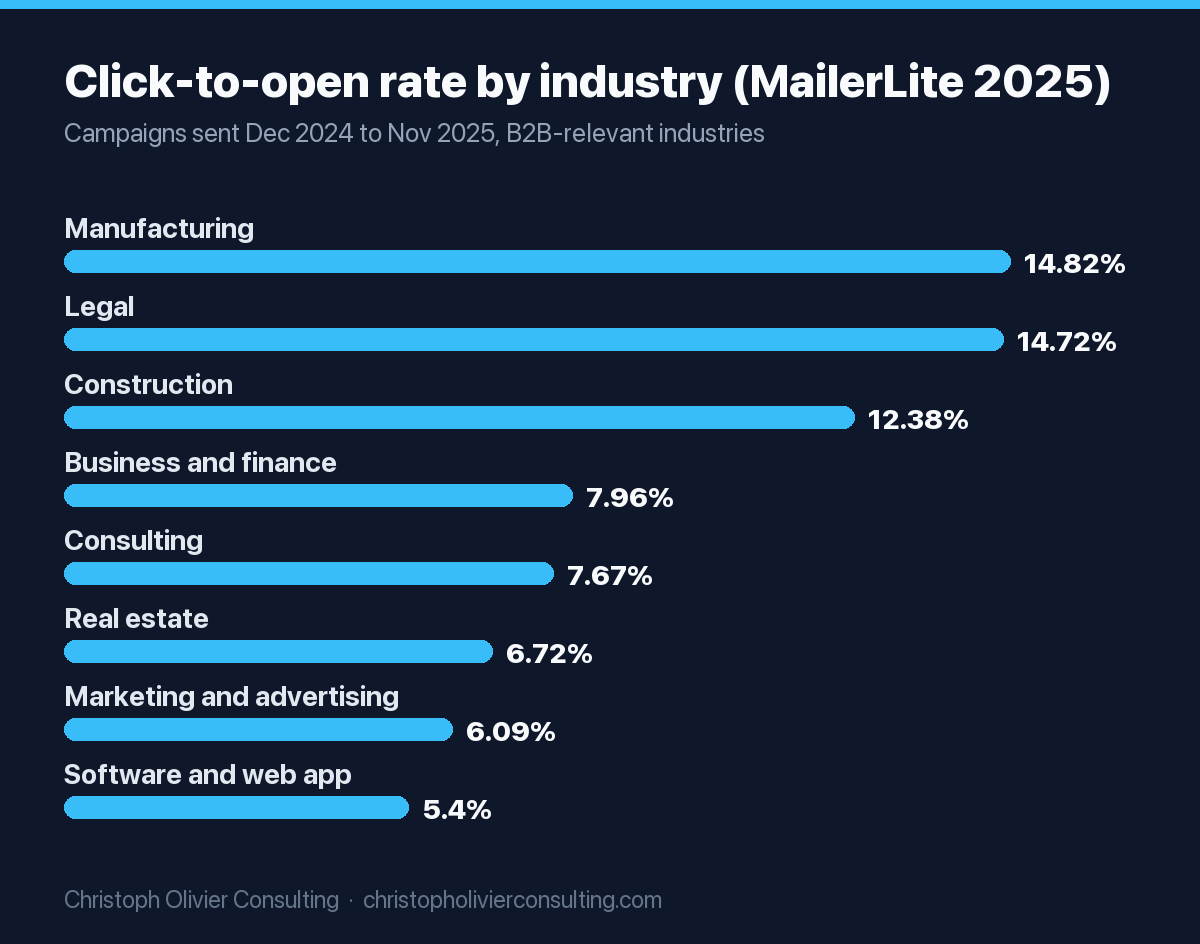
| Industry | Open rate | Click rate | Click-to-open | Unsubscribe |
|---|---|---|---|---|
| Legal | 42.58% | 4.90% | 14.72% | 0.09% |
| Consulting | 45.96% | 2.41% | 7.67% | 0.23% |
| Business and finance | 43.34% | 2.37% | 7.96% | 0.16% |
| Manufacturing | 37.36% | 4.22% | 14.82% | 0.30% |
| Construction | 39.95% | 3.53% | 12.38% | 0.27% |
| Software and web app | 39.31% | 1.15% | 5.40% | 0.20% |
| Marketing and advertising | 37.23% | 1.30% | 6.09% | 0.15% |
| Insurance | 44.40% | 1.36% | 3.19% | 0.27% |
| All industries | 43.46% | 2.09% | 6.81% | 0.22% |
Source: MailerLite email marketing benchmarks, covering more than 3.6 million campaigns from 181,000 accounts sent December 2024 to November 2025.
Platforms measure differently. Mailchimp’s benchmarks, last updated December 2023, show business and finance at a 31.35% open rate and 2.78% click rate, and warns that Apple Mail Privacy Protection may affect open data. The most useful benchmark is your own trend over time. For a wider breakdown by industry and metric, see our email marketing benchmarks page.
How to measure B2B email beyond open rates
Measure B2B email on actions a machine cannot fake: replies, clicks to high-intent pages, meetings booked and pipeline from contacts who engaged. Opens are unreliable because Apple Mail Privacy Protection downloads remote content in the background whether or not the reader engages, which can record opens that never happened.
Apple’s Mail Privacy Protection documentation says the feature loads remote content “regardless of whether you engage with the email,” which keeps senders from learning when and how often a message was opened. Use this measurement stack instead:
- Revenue: meetings and pipeline from contacts who engaged with email in the 90 days before the opportunity was created.
- Intent: replies, clicks to pricing, service or booking pages, and new contacts from the same company domain who sign up after a colleague engages.
- Account engagement: roll activity up by company. Three people engaging from one firm says more than one person clicking three times.
- List health: hard bounces, unsubscribes, spam complaints and net list growth each month.
- Opens: directional only, mainly to spot sudden deliverability drops.
Review these monthly. Clicks without replies usually mean the ask is wrong. No clicks at all usually means the segment is wrong.
Most underperforming programs fail on the basics: one message sent to every role, a pitch before any value, bought lists and no handoff when someone replies. If you want a second set of eyes on your B2B email program, from list strategy to the sequences themselves, you can book a consultation and we can walk through it together.
Frequently asked questions
What is B2B email marketing?
B2B email marketing is email sent by a business to people at other businesses to build trust, generate qualified leads and support sales. It differs from consumer email because it reaches several decision makers at one account, runs over months, and is judged on replies, meetings and pipeline rather than single purchases. Most programs combine a welcome nurture, a newsletter and event or account-based sequences.
How often should a B2B company send marketing emails?
Send as often as you can stay genuinely useful, and keep the rhythm steady. Many service firms run a monthly or twice-monthly newsletter plus automated sequences that send roughly weekly to new subscribers. Consistency matters more than volume. Watch unsubscribes and spam complaints after each send; if they climb, cut frequency or tighten your segments before adding more email.
Is cold email legal for B2B?
In the US, CAN-SPAM allows commercial email to business contacts without prior consent, but it makes no exception for B2B and requires accurate headers, a postal address and a working opt-out honored within 10 business days. In the UK you can email corporate bodies without consent, but sole traders and some partnerships need consent. EU rules vary by country. This is not legal advice.
What is a good open rate for B2B email?
Open rates are no longer a reliable measure because Apple Mail Privacy Protection loads email content in the background, which can record opens that never happened. MailerLite's 2025 benchmarks show consulting at 45.96% and business and finance at 43.34%, but compare click rate, click-to-open rate, replies and meetings booked instead, and track your own trend over time.
What are the main types of B2B email campaigns?
The six most useful types are a welcome nurture for new subscribers, a regular newsletter, event and webinar sequences, onboarding emails for new clients, account-based sequences aimed at several people inside a named target account, and re-engagement emails for contacts who have gone quiet. Most firms should start with the nurture and newsletter, then add the others once those run reliably.
Do I need DMARC to send B2B email?
If you send 5,000 or more messages a day to Gmail, Yahoo or Outlook.com consumer addresses, yes: all three require SPF, DKIM and a DMARC record, and a policy of p=none is accepted. Smaller senders still benefit, because authentication protects your domain from spoofing and helps corporate filters trust your mail. Start at p=none, read the reports, then tighten gradually.
More Funnels & Email guides
- Instagram Marketing in 2026: Reels & Conversion
- Funnel Management: The Weekly Operating System That Keeps a Funnel Healthy
- Landing Pages That Convert: 11 Patterns
- Full-Funnel Marketing: A B2B Framework for Every Stage
- AI-First Marketing Funnel That Books Calls
- Abandoned Cart Email: The 3-Email Sequence That Recovers Revenue
- All Funnels & Email guides →