
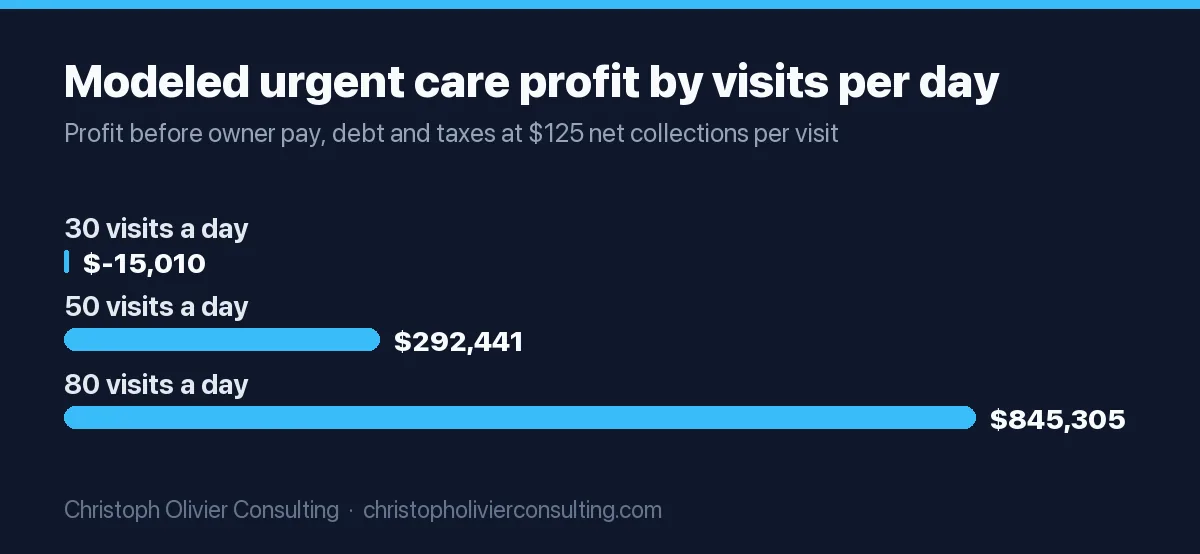
An urgent care owner who hires every clinician typically keeps somewhere between a small loss and several hundred thousand dollars a year per center. Visit volume decides which. In my own model built from 2026 Medicare rates and May 2025 BLS wages, a single-provider center at 30 visits a day roughly breaks even, a center at 50 visits a day earns about $292,000 before owner pay, and a center at 80 visits a day earns about $845,000. Large operators report operating margins of 7% to 25% (LBMC, 2025). The average U.S. center sees about 34 patients a day (Urgent Care Association, 2025).
Short answer: No government agency or trade group publishes “urgent care owner salary.” The data that does exist points to a range of roughly $0 to $850,000 a year in pre-tax profit per center, plus a salary if the owner works clinical shifts. The deciding factors are visits per day (the U.S. average is 33.96 in 2025, per UCA) and net collections per visit (about $85 to $148 in public company and franchisor disclosures). Below about 30 visits a day, a center with hired providers usually loses money.
This page compiles the primary sources that measure urgent care money: Census business data, the 2026 Medicare fee schedule, the Concentra Group Holdings 10-K, American Family Care’s franchise disclosures, Urgent Care Association benchmarks and BLS wage data. Where I calculated an average or a margin that the source does not print, I say so. The worked P&L at 30, 50 and 80 visits a day and a break-even checklist are further down.
How much does an urgent care owner make? What each source actually measures
Every source below counts something different. Read the “what it measures” column before you compare a single center to any of these numbers.
| Source and year | What it measures | Figure | Notes |
|---|---|---|---|
| Urgent Care Association, 2025 | Average patients per center per day | 33.96 | 33.13 in 2023, 33.27 in 2024 (Experity data, published by UCA) |
| UCA 2023 Industry White Paper | Median daily visits, 2022 Operations Benchmarking respondents | 56 (40 provider visits) | Survey respondents skew larger than the average center |
| Concentra 10-K, FY2025 | Revenue per visit, consumer health (urgent care) visits | $137.88 | Total across all visit types: $147.42; workers’ comp visits: $210.15 |
| Concentra 10-K, FY2025 | Operating margin, whole company | 15.4% | Adjusted EBITDA margin 20.0%; net income margin 8.0%. Mostly occupational health |
| AFC Urgent Care, 2025 | Net payments per center, 370 franchised centers in its Item 19 set | about $1.10 million | $408,333,468 ÷ 370 (my calculation). About $85 per visit on 4.79 million visits |
| AFC Urgent Care, 2025 | “Combined cash revenue,” same 370 centers | about $1.85 million | $685 million ÷ 370 (my calculation). The page does not define cash revenue vs net payments |
| LBMC (valuation firm), 2025 | Typical urgent care operating margins | 7.0% to 25.0% | As reported by LBMC; not a survey with a published sample |
| Census SUSB 2022, NAICS 621493 | Receipts per location, freestanding ambulatory surgical and emergency centers | $4.26 million | $43.40 billion ÷ 10,193 establishments (my calculation). Mixes urgent care with surgery centers |
Three things stand out:
- The owner’s income is the profit line, not a salary line. Most “urgent care salary” figures on salary websites are for employees. An owner gets a market wage only for the clinical or management hours they personally work, plus whatever profit is left after everyone else is paid.
- Revenue per visit varies more than most first-time buyers expect. AFC’s net payments work out to about $85 a visit, while Concentra’s consumer health visits brought in $137.88. Payer contracts, the share of self-pay patients and add-on services (x-ray, labs, procedures) account for the gap.
- Census does not publish an urgent-care-only industry. NAICS 621493 is the closest code, but it also contains ambulatory surgery centers, which bill far more per patient. Treat its $4.26 million average as an upper bound, not a typical urgent care.
Urgent care revenue by size: where a typical center sits
Census publishes firm counts by annual revenue band for NAICS 621493. Because the code includes surgery centers and multi-site groups, the middle of the distribution is more useful than the average. I calculated the shares and averages below from the published totals.
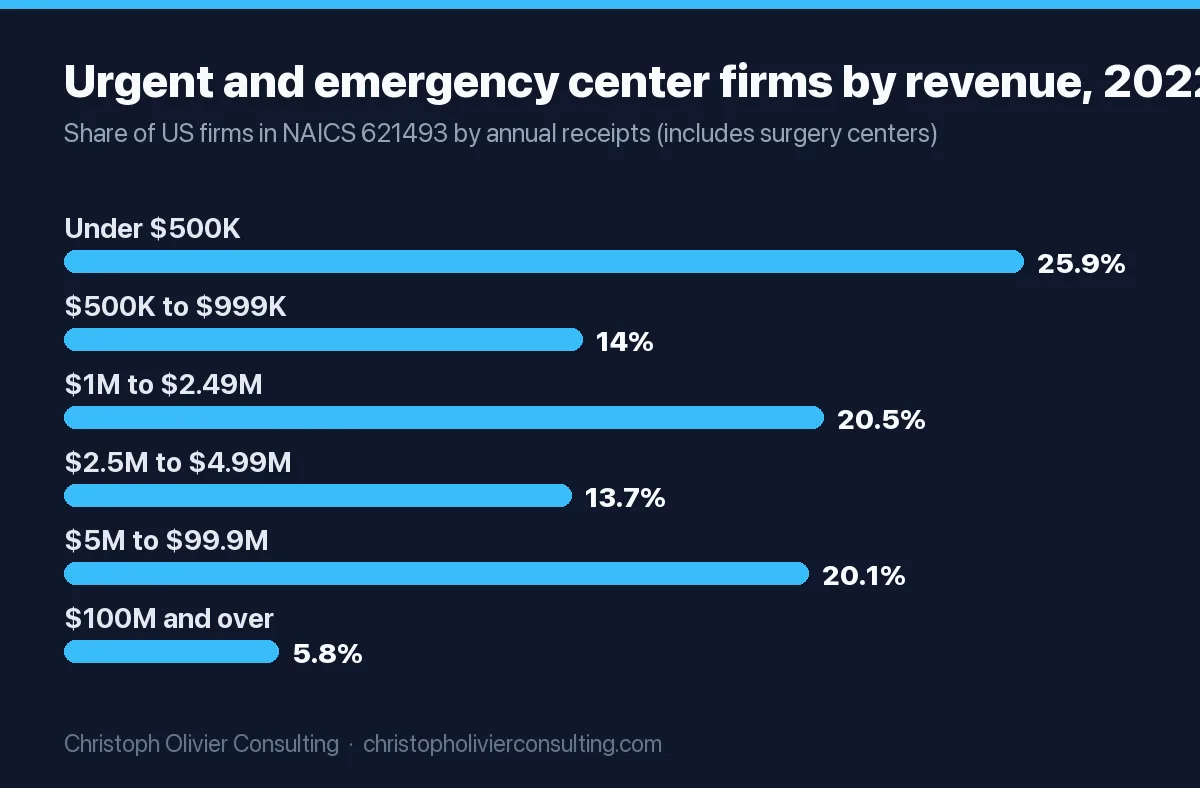
| Annual receipts of the firm | Firms | Share of firms | Average receipts per firm | Payroll as % of receipts |
|---|---|---|---|---|
| Under $500,000 | 1,602 | 25.9% | $234,500 | 42.3% |
| $500,000 to $999,999 | 867 | 14.0% | $724,728 | 34.8% |
| $1 million to $2.49 million | 1,265 | 20.5% | $1,648,133 | 32.4% |
| $2.5 million to $4.99 million | 845 | 13.7% | $3,602,647 | 27.0% |
| $5 million to $99.9 million | 1,244 | 20.1% | $12,118,715 | 25.8% |
| $100 million and over | 356 | 5.8% | $62,321,166 | 28.4% |
| All firms | 6,179 | 100% | $7,023,005 | 27.8% |
Source: Census Bureau, Statistics of U.S. Businesses 2022, NAICS 621493. Shares, averages and payroll percentages are my calculations. The two smallest bands are combined. Census payroll excludes benefits and payroll taxes.
The median firm falls in the $1 million to $2.49 million band: 40% of firms are below $1 million and 60% are below $2.5 million. That lines up with AFC’s franchised centers, which averaged about $1.10 million in net payments in 2025, and with a center seeing 25 to 50 patients a day at $100 to $150 per visit.
Revenue per visit: what Medicare pays an urgent care in 2026
Medicare is not the main payer at most centers (UCA notes that commercial payers are the primary group paying for urgent care), but the Medicare fee schedule is the benchmark many commercial contracts are priced against. The CMS 2026 physician fee schedule relative value file (October 2026 release) gives these national, non-facility amounts. I multiplied the total RVUs by the 2026 conversion factor of $33.4009 that applies to clinicians who are not qualifying APM participants.
| Code | Service | Total RVUs (non-facility) | Medicare national amount, 2026 | If billed by an NP at 85% |
|---|---|---|---|---|
| 99203 | New patient visit, low complexity | 3.52 | $117.57 | $99.93 |
| 99204 | New patient visit, moderate complexity | 5.31 | $177.36 | $150.76 |
| 99213 | Established patient visit, low complexity | 2.85 | $95.19 | $80.91 |
| 99214 | Established patient visit, moderate complexity | 4.06 | $135.61 | $115.27 |
| 99215 | Established patient visit, high complexity | 5.76 | $192.39 | $163.53 |
| 71046 | Chest x-ray, 2 views (global) | 0.99 | $33.07 | $28.11 |
| 12001 | Simple laceration repair, 2.5 cm or less | 3.41 | $113.90 | $96.81 |
Amounts before geographic adjustment and before patient coinsurance; your local Medicare amount will differ. The 85% column applies the rule on the CMS advanced practice registered nurse page, which says Medicare pays nurse practitioners 85% of the physician amount outside hospital and skilled nursing settings (my calculation).
Two practical points follow. First, most urgent care visits are staffed by nurse practitioners and physician assistants: UCA reports that the model with physicians, NPs and PAs as primary providers, with physicians not always on site, grew from 54.4% of centers in 2019 to 71.6% in 2022. That means a share of your Medicare visits pays at 85%. Second, UCA’s white paper says more centers are being paid a flat “global” S9083 rate per visit regardless of complexity, which caps the upside of an x-ray or a laceration repair under those contracts.
A $125 net collection per visit, which I use as the base case below, sits between AFC’s roughly $85 in net payments and Concentra’s $137.88 for consumer health visits. If you are evaluating a real center, replace it with the center’s collections divided by its visits for the last 12 months.
What it costs to run an urgent care: staffing is the biggest line
An urgent care is a fixed-cost business: the provider, assistants and front desk are paid whether 20 or 60 patients walk in. Here are the May 2025 national medians from the BLS Occupational Outlook Handbook. Where BLS publishes a median for outpatient care centers specifically, I used it.
| Role | Median annual wage, May 2025 | Where it comes from |
|---|---|---|
| Nurse practitioner | $132,300 (all industries) | BLS OOH. NP, CRNA and midwife group in outpatient care centers: $143,370 |
| Physician assistant | $153,500 (outpatient care centers) | BLS OOH. All industries: $135,880 |
| Family medicine physician | $244,180 | BLS OOH |
| Emergency medicine physician | $335,550 | BLS OOH |
| Medical assistant | $48,560 (outpatient care centers) | BLS OOH |
| Radiologic technologist | $84,720 (outpatient care centers) | BLS OOH |
| Receptionist | $38,010 (all industries) | BLS OOH |
| Medical and health services manager | $116,060 (outpatient care centers) | BLS OOH |
The second-largest pressure is supplies. UCA’s 2023 Finance Benchmarking Report, quoted in its 2023 white paper, found medical supplies rose from 5.4% of expenses in 2018 to 15.2% in 2023. Concentra, the largest operator of occupational health centers, put it bluntly in its FY2025 10-K: “Conventional urgent care faces significant challenges due to labor costs and declining economics.” Its cost of services, mostly clinical labor and center costs, was 71.7% of revenue.
Worked P&L: urgent care owner pay at 30, 50 and 80 visits a day
This is my own calculation, not survey data. It shows how the profit available to an owner changes with volume when every shift is staffed by hired clinicians. Assumptions, all labeled:
- Open 365 days a year, 12 hours a day. UCA’s white paper reports over 67% of centers are open every day of the week.
- Net collections of $125 per visit (base case, explained above).
- Providers are NPs or PAs at a blended $140,000 a year, between the BLS NP and outpatient PA medians. One full-time equivalent (FTE) equals 2,080 hours.
- Staffing per open hour: 30 visits a day = 1 provider, 2 medical assistants (one with a limited x-ray license), 1 front desk, half-time manager. 50 a day = 1.5 providers on average, 3 assistants, 1.5 front desk, full-time manager. 80 a day = 2 providers, 4 assistants, 2 front desk, 1 radiologic technologist, full-time manager.
- Benefits and payroll taxes at 22% of wages (my assumption).
- Medical supplies at 15.2% of total expenses, the UCA 2023 benchmark.
- Rent and occupancy $150,000 a year, billing and revenue cycle 7% of collections, and other fixed costs (malpractice and general insurance, software, utilities, marketing, accounting) of $150,000 to $200,000. These are placeholders: replace them with your lease and vendor quotes.
| Line (annual) | 30 visits a day | 50 visits a day | 80 visits a day |
|---|---|---|---|
| Annual visits | 10,950 | 18,250 | 29,200 |
| Net revenue at $125 a visit | $1,368,750 | $2,281,250 | $3,650,000 |
| Providers (NP/PA) | $294,808 (2.1 FTE) | $442,212 (3.2 FTE) | $589,615 (4.2 FTE) |
| Medical assistants | $204,512 (4.2 FTE) | $306,768 (6.3 FTE) | $409,025 (8.4 FTE) |
| Front desk | $80,040 | $120,060 | $160,081 |
| Radiologic technologist | $0 | $0 | $178,401 |
| Center manager | $58,030 | $116,060 | $116,060 |
| Benefits and payroll taxes (22%) | $140,226 | $216,722 | $319,700 |
| Medical supplies | $210,332 | $302,299 | $426,314 |
| Billing and revenue cycle (7%) | $95,813 | $159,688 | $255,500 |
| Rent and occupancy | $150,000 | $150,000 | $150,000 |
| Other fixed costs | $150,000 | $175,000 | $200,000 |
| Profit before owner pay, interest, depreciation and taxes | −$15,010 | $292,441 | $845,305 |
| Margin | −1.1% | 12.8% | 23.2% |
| Staff cost as % of revenue | 56.8% | 52.7% | 48.6% |
The 50 and 80 visit margins (12.8% and 23.2%) fall inside the 7% to 25% range LBMC reports. Concentra, with 628 centers at the end of 2025, earned 15.4% at the operating line. Note what the model leaves out: loan payments, equipment depreciation (x-ray, lab analyzers, build-out) and income tax. A center bought or built with debt pays its lender before its owner.
How sensitive owner profit is to revenue per visit
Same staffing and cost assumptions, only the net collection per visit changes (my calculation):
| Net collections per visit | 30 visits a day | 50 visits a day | 80 visits a day |
|---|---|---|---|
| $100 (close to AFC’s net payments per visit) | −$266,163 | −$126,147 | $175,565 |
| $125 (base case) | −$15,010 | $292,441 | $845,305 |
| $150 (close to Concentra’s total revenue per visit) | $236,143 | $711,029 | $1,515,046 |
A $25 change in collections per visit moves annual profit by roughly $250,000 at 30 visits a day and $670,000 at 80. In my view, this is why payer contracting matters as much as marketing at an urgent care: the same waiting room can be a loss or a strong business depending on what each visit pays.
Owner pay = salary for hours worked + profit
Owners usually fall into one of three setups, and each one reads the P&L differently:
| Owner type | What they take home | Example at 50 visits a day (my calculation) |
|---|---|---|
| Passive investor, all shifts hired | Profit only | $292,441 before debt service and taxes |
| NP, PA or physician who works one full-time provider schedule | The provider salary they would otherwise pay, plus profit | $140,000 + $292,441 = $432,441 |
| Same working owner at 30 visits a day | Salary plus a small loss | $140,000 − $15,010 = $124,990, less than the $132,300 BLS median for an employed NP |
The last row is the trap: a low-volume center can leave its working owner earning less than an employee doing the same shifts, while carrying the lease and the loan. In a corporate practice of medicine state, a non-clinician owner may also need a management agreement with a physician-owned professional corporation, which is how Concentra describes its own structure in its 10-K.
Urgent care startup cost
The most detailed public startup figures come from franchise disclosures, which include an estimated initial investment (Item 7). AFC Urgent Care, which says it had 407 centers at the end of 2025, publishes these ranges on its franchising site:
- New center: $948,250 to $1,514,000 total initial investment, including a $60,000 franchise fee.
- Converting an existing urgent care to the brand: $144,500 to $480,500, including a $45,000 initial fee.
- Ongoing: 6% royalty on gross sales. AFC asks for at least $1,200,000 in net worth and $500,000 in liquid cash.
Payback math, my calculation: at 50 visits a day and $125 a visit, a 6% royalty on $2,281,250 is $136,875, which leaves $155,566 of the modeled $292,441. Dividing the AFC investment range by that figure gives about 6 to 10 years to recover the investment before interest and taxes, assuming the center reaches 50 visits a day. Independent centers skip the royalty but pay for their own brand, billing setup and payer contracting.
How much is it to buy an urgent care?
Two reference points are public. LBMC reports that controlling multiples for urgent care locations range from 6.0x to 13.0x normalized EBITDA, depending on volume trends, payer mix, location and staffing, and warns against valuing a center on pandemic-era earnings. At the top of the market, Concentra’s 10-K discloses it paid $265.0 million in 2025 for Nova Medical Centers, which operated 67 occupational health centers in five states: about $3.96 million per center (my calculation). Nova contributed $102.5 million in revenue and $10.6 million in net income from March through December 2025.
Applied to the worked P&L, a 6x to 13x multiple puts a 50 visit a day center earning $292,441 at roughly $1.75 million to $3.80 million. That is arithmetic, not an appraisal: small single sites rarely command the multiples paid for multi-state platforms.
Urgent care break-even checklist
Use this before you buy, build or sign a franchise agreement. Each line has a pass/fail test you can check against the center’s last 12 months or your pro forma.
| Check | Pass | Fail | Why the line is here |
|---|---|---|---|
| Average visits per day, trailing 12 months | 35 or more with one provider on | Under 30 | The single-provider model breaks even near 30 at $125 a visit |
| Net collections ÷ total visits | $125 or more | Under $100 | At $100, even 50 visits a day lost money in the model |
| Total staff cost (with benefits) ÷ net revenue | Under 55% | Over 65% | Modeled staff cost ran 48.6% to 56.8% at the volumes that make money |
| Visits per provider hour | 2.5 or more | Under 2 | Provider pay is the largest single cost |
| Medical supplies ÷ total expenses | 15% or less | Well above 15% | UCA’s 2023 benchmark is 15.2% |
| Commercial contracts | Listed with rates and renewal dates | Unknown, or mostly flat global S9083 rates | Global rates cap revenue per visit regardless of complexity |
| Earnings base used for the price | 2024 and 2025 results | 2020 to 2022 COVID testing years | LBMC warns against pandemic-era earnings; UCA reported a 60% jump in per-center visits from 2019 to 2020 |
| Seasonal low month | Covers fixed costs | Loses money every summer | UCA notes volume spikes in late fall and winter respiratory season |
Patient volume is the line an owner controls most directly, which makes local search and referral marketing part of the P&L. These doctor office marketing ideas apply directly to walk-in clinics, and it helps to know the rules first: what doctors are allowed to advertise covers the claims to avoid.
Are urgent care centers profitable?
Many are, but not automatically. The public evidence points both ways. Concentra earned a 15.4% operating margin in 2025 and AFC reports 35 new centers opened that year. At the same time, Concentra’s own filing describes conventional urgent care economics as declining, and UCA’s 2023 white paper describes commercial payers holding rates flat while supply costs nearly tripled as a share of expenses. The model above shows why both are true: the same building is unprofitable at 30 visits a day and earns over 20% at 80.
Do urgent cares make good money?
At scale, yes: a center at 80 visits a day and $125 per visit leaves about $845,000 before debt and taxes in my model. The catch is that the national average is 33.96 patients a day (UCA, 2025), which is close to break-even for a center that pays for every clinical hour. Owners who make good money typically either run above-average volume, have strong commercial contracts, or work shifts themselves.
Is a 40% profit margin high?
For an urgent care, yes, unusually so. LBMC reports typical operating margins of 7% to 25%, and Concentra’s operating margin was 15.4% in 2025. A 40% margin usually means the owner’s own clinical hours are not being paid a market wage, the rent is below market (for example, the owner owns the building), or the year included unusual revenue such as COVID testing. Across all industries, a 40% margin is high; see the profit margin by industry comparison.
Do urgent care doctors make more than regular doctors?
BLS does not publish an urgent-care-only physician wage. It reports a May 2025 median of $244,180 for family medicine physicians and $335,550 for emergency medicine physicians, the two specialties UCA says dominate urgent care staffing (38% of centers say more than half their physicians are emergency physicians; 48% say more than half have a primary care background). UCA’s compensation benchmarks are sold to members, so no public urgent care physician median exists.
Who owns urgent care centers?
Ownership keeps shifting. UCA reports that in 2008, 54.1% of centers were physician owned and 24.8% hospital owned. In 2022, physician ownership was 27%, hospital owned or joint venture centers were 52.8%, and corporate entities (private equity, insurers, majority shareholders) were 14.6%. One year later, sole ownership was reported at 52% and hospital ownership at 33%. National brands named as competitors in Concentra’s 10-K include American Family Care, CareNow and GoHealth Urgent Care.
What is the most profitable medical business to start?
By margin, IRS data favors practices where the owner’s own labor is the main input. In tax year 2023, unincorporated offices of physicians kept 46.1% of receipts as net income, podiatrists 42.6%, chiropractors 33.4%, dentists 27.1% and optometrists 18.1% (IRS Statistics of Income, Table 1, my calculations). Those margins include the owner’s pay, because a sole proprietor does not deduct their own salary. An urgent care with hired providers will show a lower margin on more revenue. For comparable owner-income breakdowns, see physical therapy clinic owner salary and chiropractic practice revenue.
If you are planning a new location or trying to lift visits per day at an existing one, you can book a consultation to work through the patient acquisition side of the model.
Ready to scale your revenue?
Book a free 30-min consultation. We’ll diagnose your growth bottleneck and map out the 3 highest-leverage moves for your business.
Frequently asked questions
How much does an urgent care owner make?
No agency publishes an urgent care owner salary. In a model built from 2026 Medicare rates and May 2025 BLS wages, a center with hired providers earns about breakeven at 30 visits a day, about $292,000 at 50 and about $845,000 at 80, before debt and taxes, at $125 collected per visit. An owner who works provider shifts also keeps that salary.
What is the typical urgent care profit margin?
LBMC, a valuation firm, reports typical urgent care operating margins of 7% to 25% (2025). Concentra, the largest occupational health center operator, reported a 15.4% operating margin and a 20.0% adjusted EBITDA margin for 2025 in its 10-K. Margins rise steeply with visit volume because staffing and rent are largely fixed.
Is owning an urgent care profitable?
It can be, but volume and payer rates decide it. The average U.S. center saw 33.96 patients a day in 2025 (Urgent Care Association), close to breakeven for a single-provider center that pays for every clinical hour. Centers above about 50 visits a day with net collections near $125 per visit are solidly profitable in the worked model.
How much does it cost to start an urgent care?
AFC Urgent Care estimates a total initial investment of $948,250 to $1,514,000 for a new franchised center, including a $60,000 franchise fee, plus a 6% royalty on gross sales. Converting an existing urgent care to AFC is estimated at $144,500 to $480,500. AFC asks for $1.2 million net worth and $500,000 liquid cash.
How much is it to buy an urgent care?
LBMC reports controlling multiples of 6.0x to 13.0x normalized EBITDA for urgent care locations. At that range, a center earning $292,000 before owner pay would price at roughly $1.75 million to $3.8 million. Concentra paid $265.0 million for 67 Nova occupational health centers in 2025, about $3.96 million per center.
How many patients does an urgent care see per day?
The Urgent Care Association reports an average of 33.96 patients per center per day in 2025, up from 33.13 in 2023 and 33.27 in 2024, based on Experity data. Respondents to UCA's 2022 Operations Benchmarking Report had a median of 56 daily visits, of which 40 were provider visits.
Do urgent care doctors make more than regular doctors?
BLS has no urgent care physician category. Its May 2025 medians are $244,180 for family medicine physicians and $335,550 for emergency medicine physicians, the two backgrounds that dominate urgent care staffing according to UCA. Most urgent care visits are now handled by nurse practitioners (median $132,300) and physician assistants ($153,500 in outpatient centers).
Practice economics benchmarks