

The average chiropractic office with employees takes in about $409,600 a year: 40,179 chiropractic office locations reported $16.46 billion in receipts in 2022, according to the Census Bureau’s Statistics of U.S. Businesses (NAICS 621310, Offices of Chiropractors). The typical practice is smaller: three in four chiropractic firms took in less than $500,000. What the owner keeps depends on size, but unincorporated chiropractors kept 33.4% of their receipts as net profit in tax year 2023, per IRS Statistics of Income.
Short answer: A chiropractic office with staff averages about $409,600 in annual revenue (Census, 2022), while a chiropractor working alone with no employees averages about $70,500. The median chiropractor reports $125,000 in adjusted gross income from practice (NBCE survey, 2024), and employed chiropractors earn a median wage of $79,200 (BLS, May 2025). Unincorporated owners keep about a third of revenue as pre-tax profit.
Below I pulled the primary datasets that measure chiropractic money: Census receipts for offices with and without employees, IRS tax returns, the BLS wage survey, the National Board of Chiropractic Examiners practice survey and the Chiropractic Economics salary and expense survey. Where you see an average or a share that the source does not print, I calculated it from the published totals and say so. A copy-ready visit math table and P&L worksheet are near the end.
Chiropractic practice average revenue: what each primary source says
Each source counts a different slice of the profession, so check the “what it measures” column before you compare your practice to any single number.
| Source and year | What it measures | Average | How it was calculated |
|---|---|---|---|
| Census SUSB 2022, NAICS 621310 | Revenue per office location (establishment), offices with employees | $409,562 | $16,455,783,000 receipts ÷ 40,179 establishments (my calculation) |
| Census SUSB 2022, NAICS 621310 | Revenue per firm (one firm can run several offices) | $418,744 | $16,455,783,000 ÷ 39,298 firms (my calculation) |
| Census Nonemployer Statistics 2022, NAICS 62131 | Revenue per chiropractic business with no paid employees | $70,456 | $1,795,922,000 ÷ 25,490 businesses (my calculation) |
| IRS SOI Table 1, tax year 2023 | Business receipts per sole proprietorship return, offices of chiropractors | $166,153 | $3,644,566,000 ÷ 21,935 returns (my calculation) |
| IRS SOI Table 1, tax year 2023 | Same, only returns that reported a profit | $205,805 | $3,498,476,000 ÷ 16,999 returns (my calculation) |
| Chiropractic Economics Salary and Expense Survey 2025 | Average annual collections reported by surveyed DCs (billings averaged $723,024) | $450,425 | Published; 107 self-selected respondents. DC-only practices collected $269,303 |
Why these numbers differ so much:
- Census employer data is the best answer to “average chiropractic clinic revenue.” It covers every chiropractic office with a payroll, including multi-location groups, and reports receipts actually earned, not fees billed. The average office had 3.7 employees and brought in $110,018 per employee (my calculation from the same file).
- Solo chiropractors without staff are a separate, much smaller business. Census counted 25,490 of them in 2022. They are 39% of chiropractic business locations but collect only 9.8% of the revenue (my calculation across both Census files), and their median falls between $25,000 and $49,999 a year.
- The IRS figure sits in between because Schedule C filers include both solo chiropractors and unincorporated owners with staff. Incorporated practices (S corporations, partnerships, C corporations) are not in this table, and the IRS does not publish chiropractor-level detail for them.
What a typical chiropractic office brings in (the median is far below the average)
The $409,562 average is pulled up by a small number of large groups. Census also publishes firms by annual revenue band, which shows where the typical practice sits. I added the shares and averages.
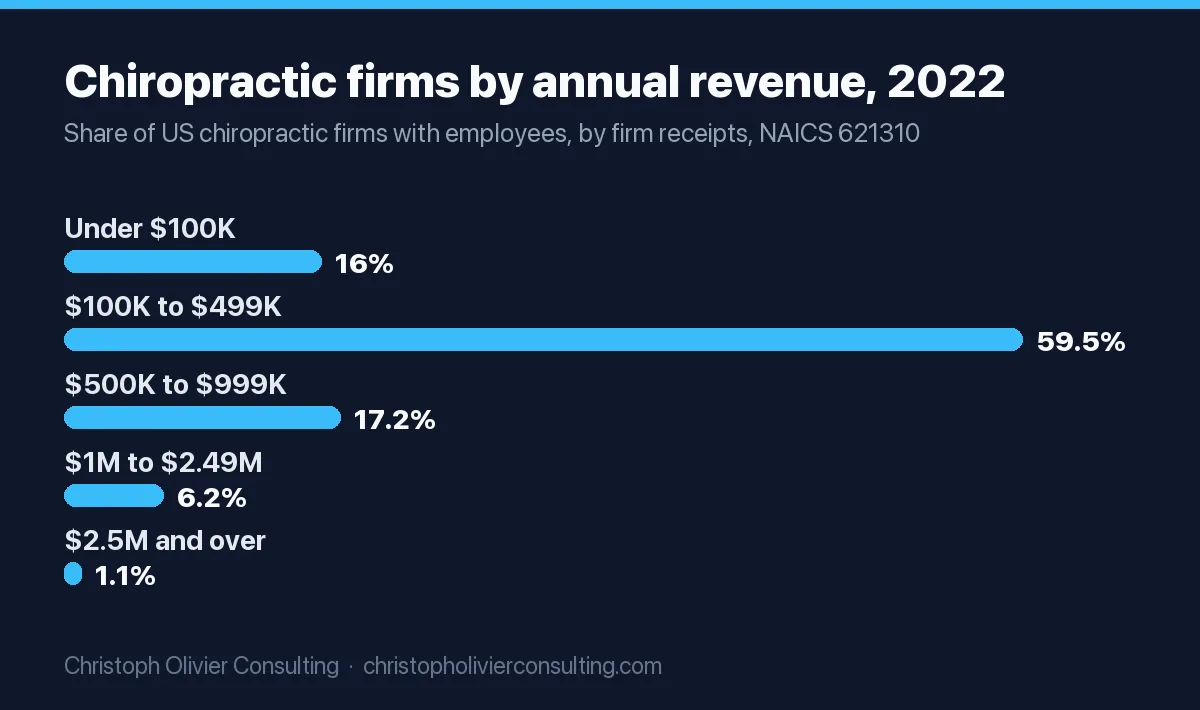
| Annual receipts of the firm | Chiropractic firms | Share of firms | Cumulative share | Average receipts per firm | Employees per firm | Share of all revenue |
|---|---|---|---|---|---|---|
| Under $100,000 | 6,287 | 16.0% | 16.0% | $54,362 | 1.2 | 2.1% |
| $100,000 to $499,999 | 23,371 | 59.5% | 75.5% | $257,649 | 2.7 | 36.6% |
| $500,000 to $999,999 | 6,774 | 17.2% | 92.7% | $683,436 | 6.0 | 28.1% |
| $1 million to $2.49 million | 2,443 | 6.2% | 98.9% | $1,415,722 | 10.5 | 21.0% |
| $2.5 million and over | 423 | 1.1% | 100% | n/a (several bands combined) | n/a | 12.2% |
Source: U.S. Census Bureau, SUSB 2022, U.S. 6-digit NAICS by enterprise receipts size, NAICS 621310, released April 10, 2025. Employer firms only. Averages, shares and cumulative shares are my calculations from the published firm, employment and receipts totals.
What the table tells you:
- The median chiropractic firm takes in between $100,000 and $499,999. 16.0% of firms are below $100,000 and 75.5% are below $500,000, so the 50% mark falls inside that band, where the average firm collected $257,649 with 2.7 employees.
- Crossing $500,000 puts you in the top quarter. Only 24.5% of chiropractic firms with employees reach it, and only 7.3% reach $1 million.
- Revenue tracks headcount. Firms in the $1 million to $2.49 million band average 10.5 employees, almost four times the staff of the median band. Bigger practices are mostly more providers and more treatment rooms, not one doctor working harder.
Average chiropractic office revenue by state
Average receipts per chiropractic office location vary by about $300,000 between states. These are the six highest and six lowest, computed from the SUSB 2022 state file (receipts ÷ establishments, NAICS 621310, employer offices only):
| State | Chiropractic offices with employees | Average receipts per office |
|---|---|---|
| Alaska | 156 | $602,955 |
| Louisiana | 401 | $557,107 |
| Delaware | 120 | $543,241 |
| Nevada | 340 | $525,382 |
| Texas | 2,562 | $516,702 |
| New Jersey | 1,155 | $502,546 |
| United States | 40,179 | $409,562 |
| Kansas | 587 | $312,572 |
| Hawaii | 111 | $312,207 |
| New Mexico | 200 | $307,660 |
| New Hampshire | 164 | $306,615 |
| District of Columbia | 18 | $299,944 |
| Iowa | 878 | $296,218 |
For the biggest markets: Florida offices averaged $495,146, California $375,175 and New York $354,001. Higher revenue per office is not the same as higher profit. These are revenue averages, and the state files do not report costs.
How much do chiropractic owners make?
No federal dataset reports income for incorporated practice owners, so the honest answer uses three sources side by side.
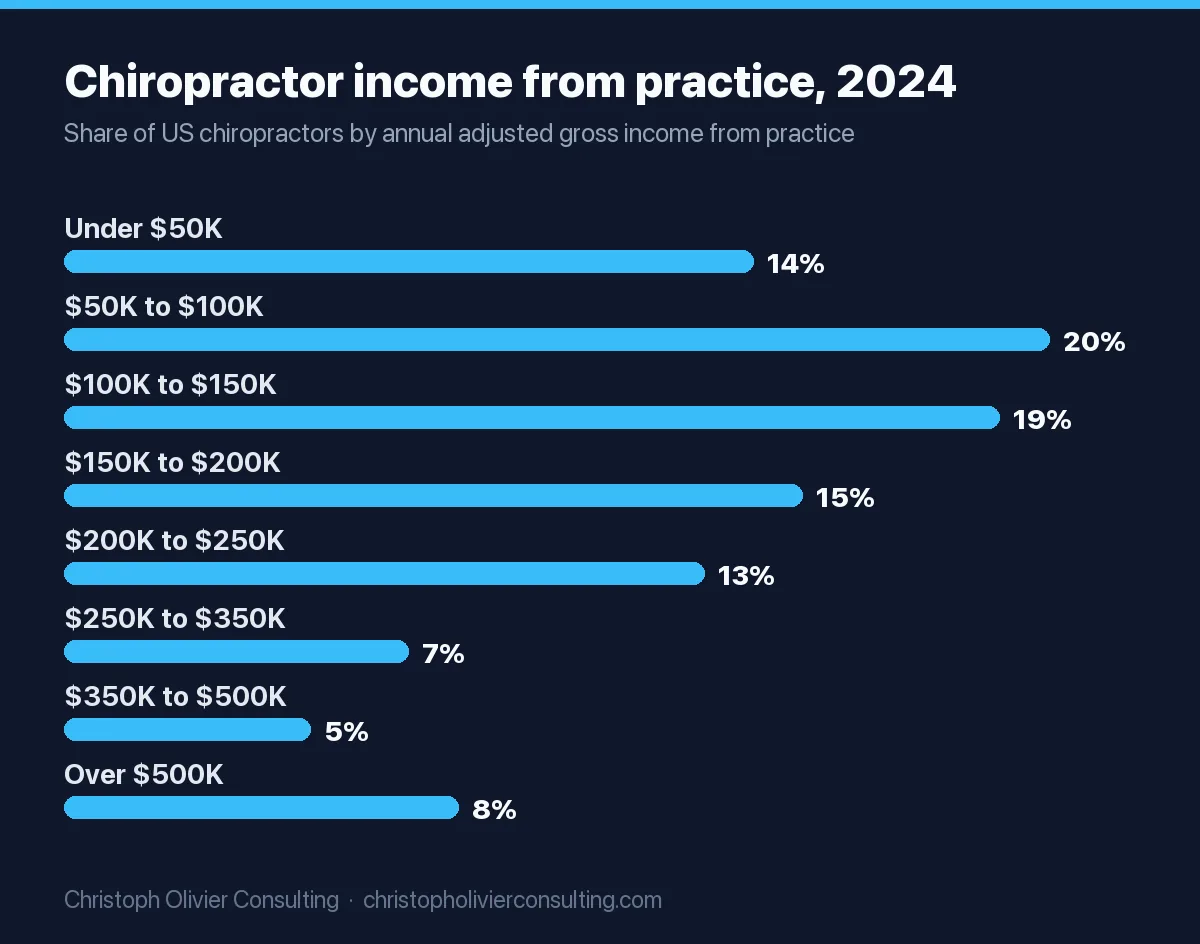
- NBCE practice survey (all chiropractors, most of them owners). In the Practice Analysis of Chiropractic 2025, based on a 2024 survey of 3,876 chiropractors, the median annual adjusted gross income from chiropractic practice was $125,000. In the same survey, 55% said they were sole proprietors, 11% business partners, 23% associates or employees and 5% contractors.
- IRS (unincorporated owners only). The 21,935 chiropractor Schedule C returns for tax year 2023 averaged $55,500 in net income. The 16,999 that reported a profit averaged $74,425 on $205,805 of receipts. These are my calculations from IRS SOI Table 1.
- BLS (employees only). The BLS Occupational Outlook Handbook puts the median wage for chiropractors at $79,200 in May 2025. BLS states that its wage data “do not cover self-employed workers or owners and partners of unincorporated businesses,” and 36% of chiropractors are self-employed.
- Chiropractic Economics survey (practicing DCs, mostly owners). The 2025 Salary and Expense Survey reports an average DC salary of $106,586 and average total compensation of $141,601. The sample is small (107 respondents) and 57% were solo practitioners, so read it as a profile of established owners, not a national average.
The NBCE income spread is the most useful picture of what owners actually take home, because it includes owners and reports the full distribution, not just a midpoint.
| Annual adjusted gross income from chiropractic practice | Share of chiropractors |
|---|---|
| Less than $50,000 | 14% |
| $50,000 to $100,000 | 20% |
| $100,001 to $150,000 | 19% |
| $150,001 to $200,000 | 15% |
| $200,001 to $250,000 | 13% |
| $250,001 to $350,000 | 7% |
| $350,001 to $500,000 | 5% |
| Over $500,000 | 8% |
Source: NBCE, Practice Analysis of Chiropractic 2025, section 4.10 and Figure 4.10. Self-reported, voluntary online survey; NBCE notes respondents may have interpreted the income question differently. Shares do not sum to exactly 100% because of rounding.
How much does a chiropractor make if he owns his own business?
About one in three chiropractors (34%) reported under $100,000, and one in three (33%) reported over $200,000. The 8% over $500,000 almost certainly own larger, multi-provider offices: from the Census table above, only 7.3% of chiropractic firms collect $1 million or more, and a $500,000 personal income is hard to reach below that level.
To translate revenue into owner income, apply the margin. As an illustration (my calculation, not a measured figure), an office at the Census average of $409,562 that kept the IRS sole proprietor margin of 33.4% would leave about $136,800 before tax for the owner. A practice in the median band ($257,649 average) at the same margin would leave about $86,100. Your actual figure depends on staff costs, rent and payer mix, which the worksheet below helps you check.
How much does a chiropractor make a year as an employee?
Employed chiropractors earn less and in a narrower range. BLS reports that the lowest 10% earned under $43,460 and the top 10% over $146,080 in May 2025, with a median of $78,460 for chiropractors working in chiropractic offices. Most associates sit well below the NBCE all-chiropractor median of $125,000, which is why ownership is still the main path to higher income in this profession. BLS itself notes that chiropractors “tend to earn more as they build a client base and become owners of, or partners in, a practice.”
Chiropractic clinic profit margin: what the data actually shows
“Profit margin” gets quoted anywhere from 15% to 40% online, usually with no source. Here is what the data supports, by definition.
| Definition of “profit” | Figure | Source and year | Use it to answer |
|---|---|---|---|
| Owner’s pre-tax net income ÷ receipts, unincorporated chiropractors (all filers) | 33.4% | IRS SOI, tax year 2023 (my calculation: $1.217 billion ÷ $3.645 billion) | “What share of revenue does the owner keep?” |
| Same, only filers that reported a profit | 36.2% | IRS SOI, tax year 2023 (my calculation) | “What does a healthy small practice keep?” |
| Payroll ÷ receipts, all chiropractic offices with employees | 35.5% | Census SUSB 2022 (my calculation: $5.85 billion ÷ $16.46 billion) | “How much goes to staff?” (includes incorporated owners paid via W-2) |
| Collections ÷ billings (“reimbursement rate”), not a profit measure | 62% (71% in 2024) | Chiropractic Economics 2025 survey (published) | “How much of what I bill do I actually collect?” |
| Share of chiropractor sole proprietors with no net profit | 22.5% | IRS SOI, tax year 2023 (4,936 of 21,935 returns, my calculation) | “Is chiropractic business profitable?” |
The IRS also publishes selected expense lines, which give you a partial overhead breakdown for unincorporated chiropractors (share of receipts, my calculations from the same table):
- Staff payroll: 13.2% (owners are not on payroll in a sole proprietorship)
- Rent on business property: 8.6%
- Depreciation: 2.2%
- Interest paid: 0.6%
- Equipment rent: 0.5%
The remaining expenses (supplies, insurance, billing, marketing, software, continuing education) are not broken out for chiropractors in this table. Compare these with offices that employ staff: across all employer chiropractic offices, payroll alone is 35.5% of receipts and averages $39,094 per employee (Census, my calculation). For context on how chiropractic compares with other industries, see our profit margin by industry table, which uses the same IRS and Census definitions.
Is chiropractic business profitable?
For most owners, yes, but not for all. About 77.5% of chiropractor sole proprietors reported a net profit in tax year 2023, and those that did kept 36.2 cents of every dollar of receipts. The other 22.5% reported zero or a loss. A third of a dollar per dollar of revenue is a high margin by small business standards, but on a small revenue base it is a modest income: 36.2% of the profitable filers’ average $205,805 is the $74,425 average net income above.
Where chiropractic revenue comes from
Payer mix drives both revenue per visit and collection effort. The NBCE 2025 practice analysis asked chiropractors which categories their reimbursements came from:
| Reimbursement category | Share reported |
|---|---|
| Private pay or cash | 41% |
| Private health insurance | 37% |
| Personal injury | 9% |
| Medicare | 9% |
| Workers’ compensation | 2% |
| Medicaid | 2% |
| Veterans Administration | 2% |
| Concierge or membership plan | 2% |
Source: NBCE, Practice Analysis of Chiropractic 2025, Figure 5.11 (2024 survey). Categories are not mutually exclusive, so they do not sum to 100%. NBCE reports Medicare and Medicaid together fell from 14% in 2019 to 11% in 2024.
Cash is the largest category, so revenue depends heavily on how many patients return and pay out of pocket.
Chiropractic practice revenue math: visits per week × collected per visit
Every chiropractic P&L starts with one formula:
Annual collections = patient visits per week × average amount collected per visit × weeks worked per year
NBCE gives you the volume side. The average chiropractor provided 100 patient visits per week in 2024. The distribution: 9% under 20 visits, 20% at 20 to 50, 32% at 51 to 100, 21% at 101 to 150, 10% at 151 to 200, 4% at 201 to 250 and 4% at 251 or more. Chiropractors spent an average of 37 hours a week on direct patient care, 10 on documentation and 7 on business management.
No government source publishes a national average collected per visit, because it depends on your cash prices and payer contracts. One rough anchor: Chiropractic Economics respondents averaged $450,425 in collections and 138 patient visits a week, which works out to about $68 collected per visit over 48 weeks (my calculation from two survey averages). The table below uses three illustrative values around that range (my inputs, replace them with your own) and 48 working weeks a year. It shows how many visits per week one practice needs to reach three revenue targets taken from the data above.
| Annual revenue target | At $40 collected per visit | At $55 collected per visit | At $70 collected per visit |
|---|---|---|---|
| $205,805 (average profitable sole proprietor, IRS 2023) | 107 visits/week | 78 visits/week | 61 visits/week |
| $409,562 (average office with employees, Census 2022) | 213 visits/week | 155 visits/week | 122 visits/week |
| $683,436 (average firm in the $500K to $999K band, Census 2022) | 356 visits/week | 259 visits/week | 203 visits/week |
My calculation: target ÷ 48 weeks ÷ collected per visit, rounded. Per-visit values are illustrative assumptions, not published averages.
Read it against the NBCE volume data. Only 18% of chiropractors provide more than 150 visits a week. So one doctor collecting $55 a visit can reach the IRS profitable-filer average at a normal 78 visits, but reaching the Census average office ($409,562) alone would put them in the top fifth by volume. That is why most practices above $500,000 add associates, extend hours or raise collected value per visit through cash plans, rehab services or better insurance contracts.
Chiropractic practice P&L worksheet (copy and fill in)
Fill in the “Your practice” column from your last 12 months of books, then divide each line by net collections (line C).
| Line | Your practice ($) | Your % of net collections | Benchmark (source) |
|---|---|---|---|
| A. Patient visits per week × weeks worked | n/a | 100 visits/week average per chiropractor (NBCE 2024) | |
| B. Average collected per visit (all payers) | n/a | Your own: C ÷ A | |
| C. Net collections | 100% | Office with staff $409,562 average; median firm $100K to $499K (Census 2022) | |
| D. Staff wages, payroll taxes, benefits (exclude owner) | D ÷ C | 13.2% unincorporated (IRS 2023); 35.5% all employer offices incl. W-2 owners (Census 2022); chiropractic assistant salary $41,192 (Chiropractic Economics 2025) | |
| E. Associate chiropractor pay | E ÷ C | Employed DC median wage $79,200 (BLS, May 2025) | |
| F. Rent | F ÷ C | 8.6% (IRS 2023); $30,819 a year average (Chiropractic Economics 2025) | |
| G. Equipment: depreciation, leases, loan interest | G ÷ C | Depreciation 2.2% + equipment rent 0.5% + interest 0.6% (IRS 2023) | |
| H. Billing, software, malpractice and other insurance | H ÷ C | Malpractice $3,129 a year average (Chiropractic Economics 2025); the rest not published | |
| I. Marketing | I ÷ C | $13,540 a year average; solo $8,154, groups $27,927 (Chiropractic Economics 2025) | |
| J. Supplies and everything else | J ÷ C | Not published; track year over year | |
| K. Owner pre-tax income (C minus D through J) | K ÷ C | 33.4% all; 36.2% profitable sole proprietors (IRS 2023) |
How to read the result:
- If K is below about 30%, sort lines D to J by share and start with the largest. In offices with staff, payroll is almost always first.
- If B is low, your fee schedule and payer mix are the constraint, not volume. Compare collected per visit by payer category.
- If A is 50 visits a week or fewer, you are in the bottom 29% of chiropractors by volume (NBCE). Fix schedule fill and patient retention before cutting costs.
What type of chiropractor makes the most money?
The data points to three factors, in this order:
- Ownership of a multi-provider office. Revenue rises with headcount: firms in the $1 million to $2.49 million band average 10.5 employees (Census 2022). Employed chiropractors top out near $146,080 at the 90th percentile (BLS), while 8% of NBCE respondents report over $500,000.
- Location. NBCE’s 2024 survey reports a median income of $225,000 in Michigan and $200,000 in New Jersey, and $175,000 in states including Alabama, North Dakota, South Dakota, Oklahoma, Tennessee, Virginia and Wyoming, versus $75,000 in South Carolina, Utah and Vermont. State medians in a voluntary survey rest on small samples, so treat them as directional.
- Practice model, with a catch. In the Chiropractic Economics 2025 survey, integrated practices (with MDs or DOs on staff) collected the most at $856,667, versus $650,286 for multidisciplinary and $269,303 for DC-only practices, yet integrated practices reported the lowest DC total compensation. DC-only practices averaged $140,640 in total compensation. More revenue does not automatically mean more pay for the chiropractor. The same survey reports a large gender gap: $156,451 average total compensation for male DCs versus $87,706 for female DCs, partly linked to fewer patient-care hours.
- Volume and collected value per visit. As the visit math shows, income scales directly with visits and collections. The 18% of chiropractors who provide more than 150 visits a week have the revenue base for top-quartile incomes.
Are chiropractors highly paid, and why do some make so much money?
Compared with the average worker, yes. Compared with other doctoral health professions, no. BLS reports a May 2025 median wage of $79,200 for chiropractors, against $50,980 for all occupations and $103,500 for healthcare diagnosing or treating practitioners as a group. The chiropractors who “make so much money” are mostly owners of larger offices: the NBCE survey’s median of $125,000 includes owners, and a third of respondents reported over $200,000. For a dentist comparison built from the same Census and IRS datasets, see our dental practice average revenue analysis.
Is it hard to make money as a chiropractor?
The spread is wide. 34% of NBCE respondents reported under $100,000, 22.5% of chiropractor sole proprietors reported no profit (IRS 2023), and the median business with no employees takes in less than $50,000 a year (Census 2022). NBCE also flags student debt: its report notes that students “must weigh the debt to potential income ratio” when entering the profession.
How much does the average chiropractic clinic sell for?
No government or association source publishes chiropractic practice sale prices, so any single “average sale price” you see online comes from a broker’s own deals. What you can do with primary data is size the earnings a buyer is paying for. A buyer prices a practice on the owner’s earnings that transfer with it. At the Census median band ($100,000 to $499,999 in receipts) and a 33.4% owner margin, the owner’s pre-tax earnings are roughly $33,000 to $167,000 a year (my calculation). For a real transaction, get a formal valuation based on your own books.
What age do most chiropractors retire?
BLS and NBCE do not publish an average retirement age for chiropractors. The workforce is older than many professions: the typical respondent in the Chiropractic Economics 2025 survey was 54 years old, with respondents ranging from 27 to over 80. NBCE reports that about 60% of current practitioners are either eligible for retirement or will be by 2035, based on its 2024 survey. BLS projects about 2,600 openings for chiropractors a year on average from 2025 to 2035 and 9% employment growth over the decade.
Using these benchmarks to grow practice revenue
The fastest revenue lever in the data is visits per week, which come from new patients plus how long patients stay in care. Start with the visit math above, then work backward to the new patients a month you need. Our chiropractic marketing playbook covers which channels produce those patients and what they cost. To decide how much to spend, the guide to setting a marketing budget shows how to size spend from revenue and patient value, and customer lifetime value explains how to value a returning patient.
In my view, the most useful number on this page is not the average but where your practice sits in the Census revenue bands and the NBCE visit distribution. If you want a second set of eyes on your numbers and growth plan, you can book a consultation.
How these figures were compiled
- Census SUSB: Statistics of U.S. Businesses 2022 (released April 10, 2025), built from the 2022 County Business Patterns and Economic Census, U.S. file by enterprise receipts size and state file, NAICS 621310 Offices of Chiropractors. Employer businesses only. Revenue bands are based on the whole firm (enterprise), not the single office. I divided published receipts by published establishments or firms.
- Census Nonemployer Statistics: 2022 U.S. file, NAICS 62131 (businesses with no paid employees, mostly self-employed individuals). Receipt-size bands from the Census record layout. Averages are my calculations.
- IRS: SOI Nonfarm Sole Proprietorships, Table 1, tax year 2023 (published March 2026), offices of chiropractors. Estimates based on samples of Schedule C returns. Averages and ratios are my calculations.
- BLS: Occupational Outlook Handbook, Chiropractors, May 2025 wage data and 2025 to 2035 projections. Wage data exclude self-employed workers and owners of unincorporated businesses.
- Chiropractic Economics: 28th Annual Salary and Expense Survey (published June 2025), anonymous web questionnaire, 107 respondents from 28 states. Arithmetic averages of self-reported figures; useful for line-item expenses, not representative of all chiropractors.
- NBCE: Practice Analysis of Chiropractic 2025, voluntary online survey conducted in 2024, 3,876 chiropractors in the final analysis. Self-reported; income results include part-time chiropractors.
Ready to scale your revenue?
Book a free 30-min consultation. We’ll diagnose your growth bottleneck and map out the 3 highest-leverage moves for your business.
Frequently asked questions
How much do chiropractic owners make?
In the NBCE Practice Analysis of Chiropractic 2025, the median chiropractor reported $125,000 in adjusted gross income from practice, and 55% of respondents were sole proprietors. Unincorporated owners who filed a Schedule C averaged $55,500 in net income in tax year 2023, or $74,425 among those with a profit (IRS data, my calculation). About 8% of NBCE respondents reported over $500,000.
What is the average revenue of a chiropractic practice?
About $409,600 per office with employees. Census Statistics of U.S. Businesses data for 2022 show 40,179 chiropractic offices (NAICS 621310) with $16.46 billion in receipts. The median firm is smaller, with receipts between $100,000 and $499,999. Chiropractors with no employees averaged about $70,500 (Census Nonemployer Statistics 2022).
What is the average chiropractic clinic profit margin?
Unincorporated chiropractors kept 33.4% of their receipts as net profit in tax year 2023, according to IRS Statistics of Income totals (my calculation). Those that reported a profit kept 36.2%. In offices with employees, payroll alone takes 35.5% of receipts (Census 2022), so margins are usually lower once you add staff.
How much does a chiropractor make a year?
The BLS median wage for employed chiropractors was $79,200 in May 2025, with the lowest 10% under $43,460 and the top 10% over $146,080. BLS excludes self-employed chiropractors, who are 36% of the profession. Including owners, the NBCE 2024 survey puts median income from chiropractic practice at $125,000.
Is a chiropractic business profitable?
Usually, but not always. IRS data for tax year 2023 show 77.5% of chiropractor sole proprietors reported a net profit, keeping about 36 cents of each revenue dollar, while 22.5% reported zero or a loss. Profit rises with size: only 24.5% of chiropractic firms with employees take in more than $500,000 a year (Census 2022).
How many patients does a chiropractor see per week?
The average chiropractor provided 100 patient visits per week in the NBCE 2024 survey. About 32% provided 51 to 100 visits, 21% provided 101 to 150, and only 18% provided more than 150. Chiropractors averaged 37 hours a week of direct patient care plus 10 hours of documentation.
Practice economics benchmarks