

An engineering firm owner makes anywhere from about $60,000 a year at the average profitable solo practice to $1 million or more at a 30-person firm, before tax. Firm size decides where you land. Profitable sole proprietors in engineering services netted an average of $59,877 in tax year 2023, per IRS Statistics of Income (my calculation from the published totals). In my worked model below, a full-time solo engineer clears about $153,000, the owner of an 8-person firm about $460,000, and the owner of a 30-person firm about $1 million. A 10-point swing in staff utilization moves those firm owners’ income by $167,000 to $636,000.
Short answer: A typical owner of a small U.S. engineering firm with staff takes home roughly $290,000 to $630,000 a year in salary plus profit (8-person model, labeled below). Solo practitioners average far less: $59,877 net for profitable engineering sole proprietors in 2023 (IRS). Listed engineering firms earn operating margins of 4.0% to 12.2% after paying their principals (latest 10-K filings), while the owner-inclusive margin of the 8-person model runs about 21% to 34%.
Every figure on this page comes from a primary source: IRS tax return statistics, the Census Bureau’s employer and nonemployer files for engineering services (NAICS 541330), Bureau of Labor Statistics wage data, and the annual 10-K reports of six listed engineering and consulting firms. Where I calculated an average or ratio that the source does not print, I say so. The owner-income model is mine, and every assumption is written out under it so you can replace it with your own numbers.
How much do engineering firm owners make? What each source measures
No government survey asks engineering firm owners what they pay themselves. Five datasets come close, and each measures something different. Mixing them up is how forum threads end up quoting “$80,000” and “$2 million” for the same question.
| Source and year | What it measures | Figure |
|---|---|---|
| IRS SOI, sole proprietorships, tax year 2023 | Average net income of profitable Schedule C filers in engineering services (66,279 returns) | $59,877 on average receipts of $122,317 (my calculation) |
| Same IRS table | Average net income across all 94,550 engineering sole proprietors, including those with losses | $38,300 (my calculation); 70.1% of returns showed a profit |
| Census Nonemployer Statistics, 2022 | Average receipts of engineering services businesses with no employees, NAICS 54133 (88,089 businesses) | $70,049 in receipts (my calculation); median band $10,000 to $24,999 |
| Census SUSB, 2022 | Average receipts of an engineering services employer firm, NAICS 541330 (45,692 firms) | $6.83 million average; $2.73 million excluding the 859 firms above $100 million (my calculation) |
| BLS Occupational Outlook Handbook, May 2025 | Median wage of employed architectural and engineering managers in architectural, engineering and related services | $168,410; top 10% of all A&E managers above $262,760 |
| BLS OEWS industry table, May 2023 | Wages of chief executives employed by architectural, engineering and related services firms, NAICS 541300 (3,010 jobs) | $244,500 mean; $95.95 median hourly (about $199,600 a year at 2,080 hours, my calculation) |
Two cautions before you use any of these. The IRS and nonemployer counts include part-time and side-practice engineers: anyone who files a Schedule C for engineering fees is counted, whether they stamped drawings for one weekend or worked a full year. And BLS wage data covers employees only. It excludes the self-employed, and it records a W-2 salary, not the profit distributions that make up most of a small-firm owner’s income. That gap is what the worked model further down fills.
What engineer makes $400,000 a year?
Almost never an employee at a small or mid-sized firm. The highest-paid 10% of all architectural and engineering managers earned more than $262,760 in May 2025, per the BLS Occupational Outlook Handbook, and the top 10% of civil engineers earned more than $163,220. Chief executives employed by A/E firms averaged $244,500 in May 2023 (OEWS). Engineers who clear $400,000 or $500,000 a year are mostly owners or partners whose income is salary plus a share of profit. In the 8-person model below, the owner reaches $460,506 at 70% staff utilization.
Can you make $250,000 or $500,000 as a civil engineer?
On salary alone, $250,000 is above the 90th percentile even for engineering managers, and civil engineers in engineering services had a median of $100,620 in May 2025, per the BLS civil engineers profile. Engineering services employed 51% of the 380,600 civil engineers counted in 2025. To earn $250,000 to $500,000 as a civil engineer, the realistic routes are a principal role with profit share, or owning a firm with roughly 5 to 15 billable staff, where the owner’s income comes from the margin on other people’s hours.
How much revenue does a small engineering firm make?
Most engineering businesses are tiny. In the 2022 Census nonemployer file, 51.1% of the 88,089 engineering services businesses with no employees took in under $25,000 a year, and only 19.4% reached $100,000. Sole proprietorships made up 87.2% of them and S corporations 7.4%. The S corporations averaged $121,323 in receipts and the partnerships $262,893, against $55,470 for sole proprietors (my calculations).
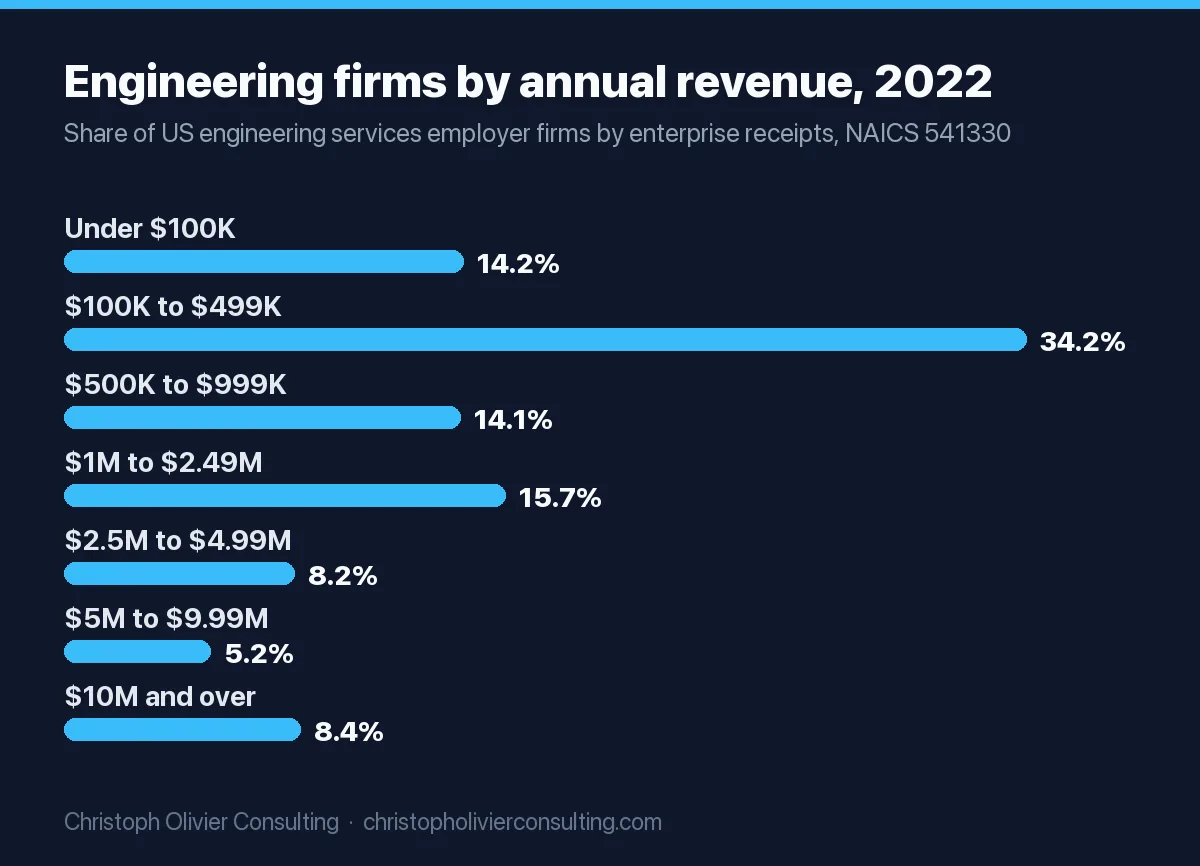
Employer firms are a different business. The table below is built from the Census SUSB 2022 file for NAICS 541330, engineering services. Averages, payroll share and receipts per employee are my calculations from the published totals.
| Firm receipts band (2022) | Share of firms | Cumulative | Average receipts | Employees per firm | Payroll as % of receipts | Receipts per employee |
|---|---|---|---|---|---|---|
| Under $100K | 14.2% | 14.2% | $49,148 | 1.2 | not meaningful | $41,293 |
| $100K to $499K | 34.2% | 48.4% | $256,139 | 1.7 | 44.2% | $152,692 |
| $500K to $999K | 14.1% | 62.5% | $714,840 | 4.0 | 41.7% | $178,668 |
| $1M to $2.49M | 15.7% | 78.2% | $1,609,938 | 8.1 | 41.6% | $198,410 |
| $2.5M to $4.99M | 8.2% | 86.4% | $3,508,807 | 16.7 | 43.5% | $210,588 |
| $5M to $7.49M | 3.3% | 89.7% | $6,041,403 | 26.0 | 41.5% | $232,261 |
| $7.5M to $9.99M | 1.9% | 91.6% | $8,379,602 | 35.5 | 41.8% | $236,271 |
| $10M and over | 8.4% | 100% | not combined | 49 and up | 38% to 42% | $237K to $285K |
Source: U.S. Census Bureau, SUSB 2022, NAICS 541330, 45,692 firms. Employment counts S corporation owners on payroll but not sole proprietors or partners. Receipts are gross, so they include subconsultant and reimbursable costs passed through to clients. In the smallest band, payroll exceeds receipts, which usually means owner salaries funded from other income or losses.
Three readings matter for an owner:
- The median employer engineering firm sits right at the $500,000 line. 48.4% of firms take in under $500,000. Crossing $1 million puts you in the top 38%, and $5 million in the top 14%.
- Payroll holds at about 38% to 44% of receipts from $100,000 all the way to $100 million, and between 41.5% and 44.2% in every band from $100,000 to $10 million. That is wages only, before benefits and payroll taxes. It is a useful ceiling: a small firm whose wage bill runs well above 45% of revenue is underpricing or under-billing.
- Receipts per employee climb with size, from $178,668 in the $500K band to $232,261 in the $5M band. Larger firms bill higher rates, carry more pass-through and keep more people billable.
Engineering firm profit margin: three numbers people mix up
“Profit margin” means three different things in engineering, and a benchmark quoted without saying which one is close to useless.
1. Owner-inclusive margin (solo and very small firms). When the owner does the work, profit and pay are the same money. Engineering sole proprietors kept 41.8% of receipts as net income in tax year 2023, and the profitable ones kept 49.0%, per the IRS SOI table (my calculation: $3.97 billion net income on $8.11 billion receipts). Payroll was 8.7% of their receipts.
2. Margin on net revenue. Engineering firms routinely pass subconsultant and reimbursable costs through to clients, which inflates gross revenue without adding profit. Firms therefore report a second revenue line. Tetra Tech’s “revenue, net of subcontractor costs” was $4.35 billion on $5.08 billion of revenue in fiscal 2026. Bowman Consulting reports “net service billing”, which was 88.7% of its gross contract revenue in 2025, inside its stated expected range of 85% to 90%.
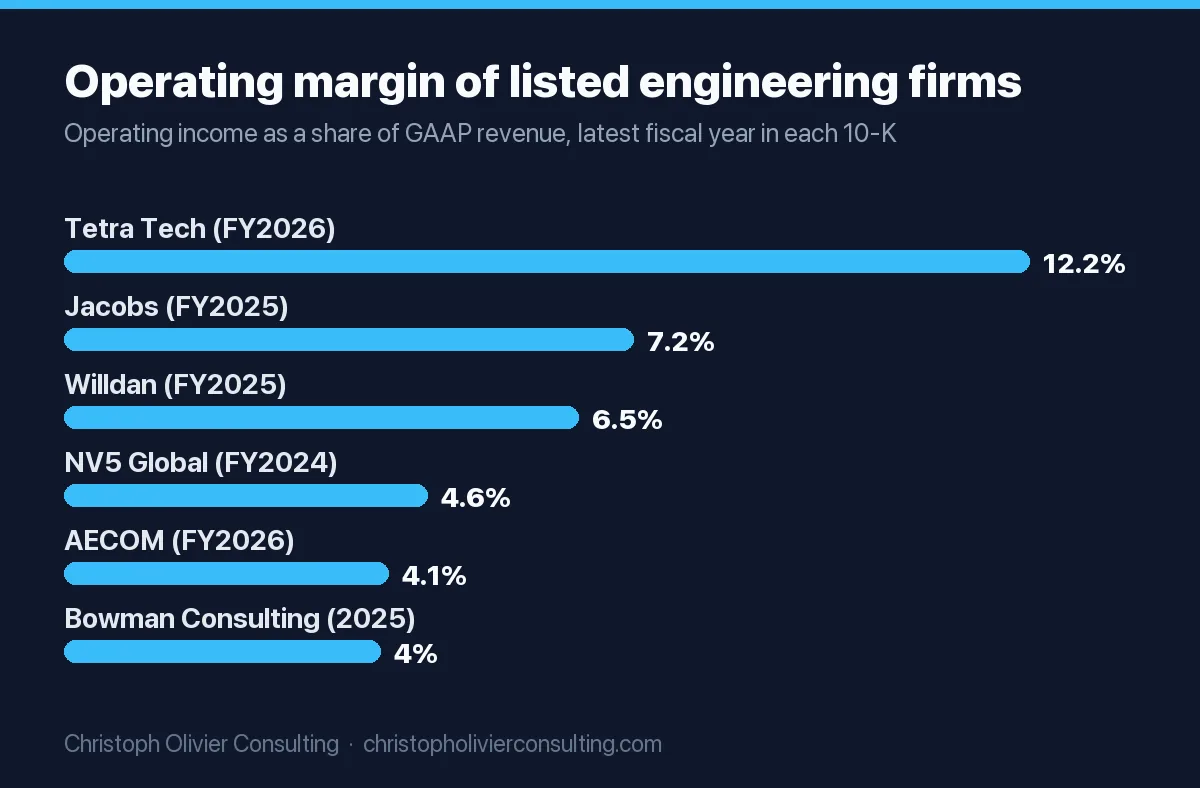
3. Operating margin after everyone is paid. Public firms pay their principals and engineers as employees, so the operating margin is profit after a market salary for every owner-equivalent. The latest filings show 4.0% to 12.2%.
| Firm (fiscal year) | Revenue | Operating income | Operating margin | Staff and other disclosures |
|---|---|---|---|---|
| Tetra Tech (FY2026, ended Sept. 27, 2026) | $5,076.7M | $618.9M | 12.2% (14.2% on net revenue) | More than 25,000 associates; subcontractor costs $728.4M |
| Jacobs (FY2025, ended Sept. 26, 2025) | $12,029.8M | $863.6M | 7.2% | About 43,000 people; gross margin 24.8% |
| Willdan (FY2025, ended Jan. 2, 2026) | $681.6M | $44.1M | 6.5% | 1,814 employees |
| NV5 Global (FY2024, last full-year 10-K) | $941.3M | $43.4M | 4.6% | 5,024 employees; gross margin 51.3% |
| AECOM (FY2026, ended Oct. 2, 2026) | $15,096.4M | $619.7M | 4.1% (6.4% in FY2025) | About 52,000 employees, 18,000 in the U.S. |
| Bowman Consulting (2025) | $490.0M | $19.7M | 4.0% | About 2,300 employees; net margin 2.6% |
Operating margin is operating income divided by total GAAP revenue, my calculation from each 10-K. NV5 filed a Form 15 in August 2025 and no later 10-K exists. AECOM and Willdan revenue includes large pass-through costs, which compresses their margins on gross revenue.
Revenue per person is the most portable number in the filings. Bowman took in about $213,000 per employee in 2025 ($490.0 million across about 2,300 employees, my calculation), and about $189,000 of net service billing per employee. NV5 took in about $187,000 per employee in 2024. Those sit right on the Census small-firm range of $178,000 to $232,000, which tells you the economics of a 10-person firm and a 2,000-person firm are closer than most owners assume. The difference is that the public firm pays its principals a salary before it reports profit.
Civil and structural engineering firm profit margin
No U.S. government dataset splits engineering services margins into civil versus structural. Census NAICS 541330 covers both, plus mechanical, electrical and geotechnical practices. Of the listed firms above, Bowman, which describes itself as delivering engineering, surveying, program management and related services for the built environment, is the closest public proxy for a civil practice, at a 4.0% operating margin in 2025 and an adjusted EBITDA margin on net service billing of 16.8%, a non-GAAP figure the company reports. No pure structural engineering firm files with the SEC, so any “structural engineering firm profit margin” quoted online is either a private survey or an estimate. For a small civil or structural firm, the better test is the payroll ratio and the owner-income math below, not a public company’s margin.
Is a 50% profit margin too much?
It depends on whose pay is already deducted. For a solo engineer, 50% is normal: profitable engineering sole proprietors kept 49.0% of receipts in the 2023 IRS data. For a firm with staff, a 50% margin before owner pay is high but possible at strong utilization. After a market salary for the owner, 50% would be about four times Tetra Tech’s 12.2%, the highest operating margin in the listed group. If your books show that, check whether the owner’s pay, a spouse’s work or rent on an owner-held building is missing from expenses.
Engineering firm owner income at 1, 8 and 30 people (worked calculation)
This is my own model, not survey data. It answers the question the datasets cannot: what an owner actually clears at a given size. Staff salaries are BLS May 2025 medians: $100,620 for civil engineers in engineering services and $168,410 for architectural and engineering managers in A/E services (used for project managers). Technician, drafter and office salaries are my assumptions. Billing rates are illustrative inputs, not sourced market rates.
| Line (own calculation) | Solo engineer | 8-person firm | 30-person firm |
|---|---|---|---|
| Team | Owner only | Owner + 1 PM + 4 engineers + 1 technician + 1 office manager | Owner + 3 PMs + 16 engineers + 5 technicians + 5 admin, accounting and marketing staff |
| Billable share of a 2,080-hour year | Owner 60% (1,248 hrs) | Engineers and technician 70%; PM 60%; owner 50% | Engineers and technicians 70%; PMs 60%; owner 30% |
| Billing rates (assumption) | $175/hr | Engineer $165; PM $210; technician $110; owner $230 | Engineer $165; PM $210; technician $110; owner $250 |
| Fee revenue | $218,400 | $1,622,400 | $5,586,880 |
| Staff wages | $0 | $695,890 | $2,750,150 |
| Payroll taxes and benefits (25% of wages, assumption) | $0 | $173,972 | $687,538 |
| Overhead: rent, professional liability insurance, CAD and software, licensing, marketing (assumption) | $65,520 (30%) | $292,032 (18%) | $1,117,376 (20%) |
| Owner income before tax | $152,880 | $460,506 | $1,031,816 |
| Owner income as % of revenue | 70.0% | 28.4% | 18.5% |
| If staff utilization falls 10 points | n/a | $293,357 | $396,168 |
| If staff utilization rises 10 points | n/a | $627,654 | $1,667,464 |
| Net multiplier (fee revenue / salary cost of billed hours) | n/a | 3.17 | 3.27 |
| Wages as % of revenue (Census benchmark: 41% to 44%) | 0% | 42.9% | 49.2% |
| Revenue per person (Census band benchmark) | $218,400 | $202,800 ($198,410) | $186,229 ($232,261) |
Assumptions, stated plainly. A 2,080-hour year (40 hours times 52 weeks). The 25% load for payroll taxes and benefits and the 18% to 30% overhead rates are my assumptions. Technicians are set at $65,000, the 8-person office manager at $60,000 and the 30-person support staff at $62,000 each, also assumptions. The owner’s billed hours are valued at the A&E manager median salary when computing the multiplier. Revenue excludes subconsultant pass-through. Overhead scales with revenue here; in a real firm rent and insurance are partly fixed, which makes the downside worse than shown. All income is before income tax, and for the solo case before self-employment tax.
What the model says, beyond the totals:
- The 8-person firm is the sweet spot on margin. It lands almost exactly on the Census $1M to $2.49M band: 8.1 employees, $198,410 per employee, payroll 41.6% of receipts. The owner clears about 2.7 times the median A&E manager salary.
- The 30-person firm earns more dollars on a thinner margin. At the same rates it brings in $186,229 per person against $232,261 for real firms in the $5M band, and its wage bill runs 49.2% of revenue. Firms that size in the Census data are billing higher rates, passing through more cost or carrying fewer non-billable staff. Five admin hires on 30 people is the drag.
- Utilization is the biggest lever. A 10-point drop cuts the 30-person owner’s income by 62%, from $1,031,816 to $396,168, because salaries do not fall when the backlog thins. NV5’s 10-K says it plainly: “Our profitability could suffer if we are not able to maintain adequate utilization of our workforce.” Willdan’s says time-and-materials profitability “is driven by billable headcount, staff utilization, and cost control.”
- The solo IRS check is sobering. At the IRS profitable-sole-proprietor ratio of 49.0%, the same $218,400 of solo revenue would net about $106,900, not $152,880. The difference is subconsultants, equipment and professional liability cover that many solo engineers carry above my 30% overhead assumption.
How much of that is salary and how much is profit?
Subtract what it would cost to replace you. If the 8-person owner hired a principal at the BLS median of $168,410 plus the same 25% load ($210,513), true profit after that hire is $249,993, or 15.4% of revenue. For the 30-person firm, replacing the owner with a chief executive at the OEWS A/E industry mean of $244,500 plus load ($305,625) leaves $726,191, or 13.0%. Both sit just above Tetra Tech’s 12.2% operating margin and well above Bowman’s 4.0%: a reasonable sign the model is not fantasy, and also a reminder that a small firm’s owner carries client concentration and liability risk the public firms spread across thousands of projects.
Break-even hours for each new engineer (own calculation)
A $100,620 engineer costs $125,775 a year with the 25% load. At $165 an hour they need about 762 billed hours, 37% of a 2,080-hour year, just to cover their own cost before any overhead. That is why the hire should follow signed backlog, not precede it. If the pipeline is the constraint, the engineering firm marketing playbook covers how firms get onto shortlists, and the rules on what licensed engineers may say in ads are covered in can engineers advertise.
Owner pay worksheet: check your firm in 10 minutes
Pull last year’s profit and loss statement and payroll report. Work through the rows below. Each benchmark comes from the Census SUSB 2022 file for NAICS 541330 or from the 10-K filings above; the pass lines are my reading of those benchmarks, not an industry standard.
| Check | How to calculate it | Benchmark and source | Pass if |
|---|---|---|---|
| 1. Revenue per person | Gross fee revenue / total headcount including you | $178,668 ($500K band) to $232,261 ($5M band), Census 2022 | At or above your Census band |
| 2. Wage ratio | Total W-2 wages (including your own salary if you are an S corporation) / gross revenue | 41.5% to 44.2% for firms from $100K to $10M, Census 2022 | 45% or lower |
| 3. Pass-through share | (Gross revenue minus subconsultants and reimbursables) / gross revenue | Bowman: 88.7% in 2025, expected range 85% to 90% | You know this number and price subs with a markup |
| 4. Net multiplier | Net revenue / salary cost of billed hours | 3.17 to 3.27 in the worked model above (assumption based) | At or above the multiplier your overhead requires; recalculate yearly |
| 5. Staff utilization | Billed hours / 2,080 for each billable person | Model uses 70% for engineers, 60% for PMs | Within 5 points of your target by role |
| 6. Owner pay vs market | Your salary vs BLS A&E manager median | $168,410, A/E services, May 2025 | Salary is near market; profit is reported separately |
| 7. True profit margin | (Owner income minus market replacement salary with 25% load) / revenue | Listed firms: 4.0% to 12.2% operating margin, latest 10-Ks | Positive; 10% or more is strong |
If checks 1 and 2 both fail, the problem is almost always price, not volume. The pricing strategy guide walks through moving from hourly rates to fixed or value-based fees, and the architecture firm owner salary breakdown runs the same tests for the firms that hire many engineering practices as subconsultants.
How engineering firm owners pay themselves: salary vs distributions
The legal structure decides what “salary” means and how owner income is taxed.
- Sole proprietors and single-member LLCs pay self-employment tax if net earnings from self-employment reach $400 or more. The rate is 12.4% for Social Security plus 2.9% for Medicare, generally on 92.35% of net earnings, per IRS Topic 554. Additional Medicare tax applies above $250,000 for married couples filing jointly and $200,000 for most other filers.
- S corporation owners must pay themselves reasonable compensation before taking distributions. The IRS says that to the extent gross receipts are generated by the shareholder’s personal services, payments “should be classified as wages.” Its reasonable compensation page lists the factors it weighs, including training and experience, duties, time devoted to the business, payments to non-shareholder employees and what comparable businesses pay for similar services. For a licensed engineer who stamps most of the firm’s drawings, a salary well below the BLS A&E manager median is hard to defend.
- Partnerships pass profit through to partners. Only 3.9% of nonemployer engineering businesses were partnerships in 2022 (Census), but they averaged $262,893 in receipts, the highest of any legal form.
The practical split for an S corporation owner is a W-2 salary near the market rate for the work you do, with the remainder taken as distributions after the firm sets aside working capital.
How much is a small engineering firm worth?
No public dataset reports sale multiples for small U.S. engineering firms, and anyone quoting a precise multiple is quoting a private broker survey or a guess. The public filings show deal size and structure, not price per dollar of earnings. Bowman Consulting, one of the most active public buyers, completed six smaller acquisitions in 2025 for total consideration of $14.1 million, an average of about $2.35 million each, and seven in 2024 for $36.3 million, about $5.2 million each (my averages from its 2025 10-K). Consideration combined cash, promissory notes at 5.00% to 6.75% interest, and common stock with a six-month lock-up. Bowman does not disclose the revenue or earnings of those firms, so no multiple can be calculated.
Two things follow for an owner thinking about value. First, buyers pay for earnings that survive your departure, so the true profit line in the worked model (after a replacement salary) matters more than your total take-home. Second, a meaningful share of the price is often deferred in notes or stock, which means part of your exit depends on the buyer’s performance after closing.
What moves an engineering owner’s income most
- Utilization by role. In the 8-person model, each 10 points of staff utilization is worth about $167,000 to the owner.
- Rate and multiplier. Raising the engineer rate from $165 to $180 in the 8-person model adds $87,360 of revenue and about $71,600 of owner income after the 18% overhead load (my calculation).
- Pass-through pricing. Subconsultant costs billed at cost add revenue and risk but no profit. Bowman’s 11.3% pass-through share shows how much of a gross number can be other people’s work.
- Non-billable headcount. The 30-person model’s five support hires cost $387,500 a year with load. Each one needs about 2,350 billed engineer hours at $165 just to pay for itself.
- A steady pipeline. Backlog is what lets you hire ahead of demand without the utilization drop above. If you want a second opinion on the business development side, you can book a consultation.
Ready to scale your revenue?
Book a free 30-min consultation. We’ll diagnose your growth bottleneck and map out the 3 highest-leverage moves for your business.
Frequently asked questions
How much do engineering firm owners make?
It depends on size. Profitable engineering sole proprietors netted an average of $59,877 in tax year 2023 (IRS). In my worked model, a full-time solo engineer clears about $153,000 before tax, the owner of an 8-person firm about $460,000 (range $293,000 to $628,000 with utilization) and the owner of a 30-person firm about $1 million. Staff utilization and billing rates drive most of the spread.
What is a typical engineering firm profit margin?
After paying every principal a salary, listed engineering firms earned operating margins of 4.0% (Bowman, 2025) to 12.2% (Tetra Tech, fiscal 2026) in their latest 10-K filings. Before owner pay, margins are much higher: profitable engineering sole proprietors kept 49.0% of receipts in 2023 (IRS), and the 8-person model in this article lands at 28.4%.
What is the profit margin of a civil or structural engineering firm?
No U.S. government dataset separates civil from structural engineering margins; Census NAICS 541330 covers both. Bowman Consulting, the closest public civil-heavy proxy, reported a 4.0% operating margin and a 16.8% adjusted EBITDA margin on net service billing in 2025. No pure structural firm files with the SEC, so structural margins quoted online come from private surveys or estimates.
How much revenue does a small engineering firm make?
Census data for 2022 show 48.4% of U.S. engineering services employer firms take in under $500,000 a year. Firms in the $1 million to $2.49 million band average $1.61 million with about 8 employees and $198,410 of receipts per employee. Engineering businesses with no employees averaged $70,049 in receipts, and half took in under $25,000.
Is a 50% profit margin too much for an engineering firm?
For a solo engineer, no: profitable engineering sole proprietors kept 49.0% of receipts in 2023 (IRS). For a firm with staff, 50% after a market owner salary would be about four times Tetra Tech's 12.2% operating margin, the highest in the listed group. If your books show it, check whether the owner's salary or other owner-paid costs are missing from expenses.
How much is a small engineering firm worth?
No public dataset reports sale multiples for small U.S. engineering firms. Public buyer Bowman Consulting completed six smaller acquisitions in 2025 for $14.1 million in total consideration, about $2.35 million each, paid in cash, promissory notes and lock-up stock. It does not disclose the acquired firms' earnings, so buyers' multiples are not public. Value follows profit that survives the owner leaving.
Can you make $500,000 as a civil engineer?
Not usually on salary. Civil engineers in engineering services had a median wage of $100,620 in May 2025, and the top 10% of all architectural and engineering managers earned more than $262,760 (BLS). Incomes of $500,000 come from ownership or partnership: in this article's model, the owner of an 8-person firm reaches about $628,000 when its engineers bill 80% of their hours.
Practice economics benchmarks