

Yes. Professional engineers in the United States can advertise, and no NSPE rule or federal law stops them. The National Society of Professional Engineers (NSPE) once limited engineers to small, uniform “professional cards,” but its code was forced open in two steps: the Supreme Court struck down its ban on competitive bidding in 1978, and a 1993 Federal Trade Commission order barred NSPE from restricting truthful, nondeceptive advertising. What limits engineers today is narrower: no misrepresentation, no unlicensed use of the word “engineer,” and, for public work, no price in the first round of selection.
Below are the exact rules with section numbers (NSPE Code, NCEES Model Rules, Texas, California, the Brooks Act), the ethics opinions that show where the lines fall, and a pass/fail checklist for your ads and website. This is general information, not legal advice; your state board’s current rules control.
Short answer: Engineers can run paid ads, publish prices to private clients, use superlatives they can back up and post project portfolios. The limits are truthfulness and licensure: NSPE Code II.5.a bars misrepresenting qualifications, NCEES Model Rule 240.15 C.1 says the same for state boards, and state laws such as Texas Occupations Code 1001.301 reserve the title “engineer” for license holders. Texas law even bars its board from restricting ad media, size or your appearance in an ad.
Can professional engineers advertise? What changed and when
The restriction was never a statute. It was the profession’s own ethics code. The 1946 Canons of Ethics for Engineers, which NSPE’s board approved that year according to NSPE’s history of the code, said in Section 2 that an engineer “will not advertise his work or merit in a self-laudatory manner.” In BER Case 59-1, the Board of Ethical Review (BER) called a phone directory ad promising to “save YOU future worries and needless expense” “boastful, self-laudatory.”
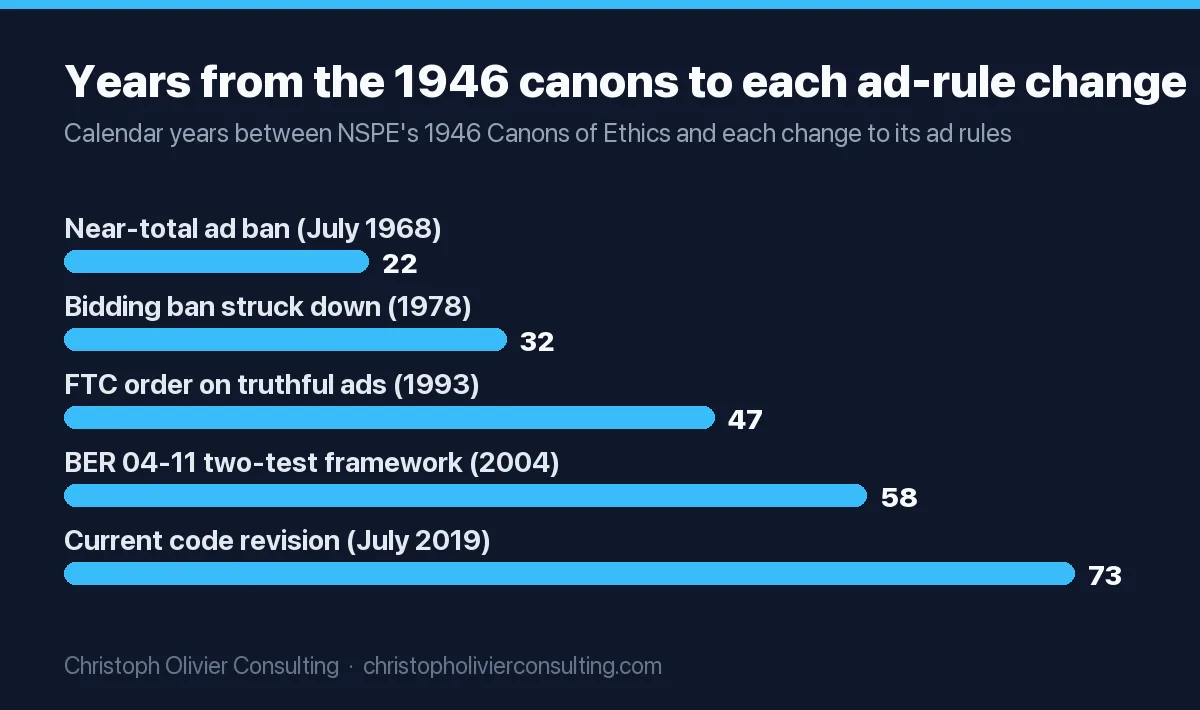
It then got stricter. After a July 1968 amendment, the board wrote in BER Case 68-9 that revised Section 3(a) “in effect, now prohibits all advertising of engineering services with the exception of professional cards.” Cards were capped at a quarter page with name, address, phone, principals and fields of practice. A larger card offering to “fly in to meet with your commission or council” was ruled unethical.
Two federal actions ended this:
- 1978, competitive bidding. In National Society of Professional Engineers v. United States, 435 U.S. 679 (April 25, 1978), the Supreme Court held that Code Section 11(c), “He shall not solicit or submit engineering proposals on the basis of competitive bidding,” violated Section 1 of the Sherman Act because it “operates as an absolute ban on competitive bidding.” The affirmed injunction also bars NSPE from any policy “stating or implying” that bidding is unethical.
- 1993, advertising. NSPE’s history records that it entered a consent agreement with the FTC in July 1993 and that “the FTC issued an order on August 6, 1993, that provides that NSPE may not prohibit or restrict its members from engaging in truthful, nondeceptive advertising.” NSPE’s 2026 article “Evolution of the NSPE Code of Ethics” says the deleted provisions had targeted “showmanship, puffery or self-laudation or the use of slogans, jingles or sensational language.”
The modern test came next. In BER Case 04-11 (2004), the board said advertising questions now turn on two considerations: advertising “must be conducted in a manner that is truthful and not misleading or deceptive,” and it “must conform to state registration laws and rules of practice.” By BER Case 12-8, the board was blunt: “There was nothing in the NSPE Code of Ethics that prohibited ‘self-laudatory’ advertising as may have been the case in the past.”
| Year | Event | Effect on engineering ads | Years after 1946 canons | Source |
|---|---|---|---|---|
| 1946 | Canons of Ethics for Engineers approved | No “self-laudatory” advertising (Section 2) | 0 | NSPE history; BER 59-1 |
| July 1968 | Code Section 3(a) amended | All advertising barred except uniform professional cards | 22 | BER 68-9 |
| 1978 | NSPE v. United States, 435 U.S. 679 | Ban on competitive bidding held unlawful; Section 11(c) deleted July 1978 | 32 | Supreme Court opinion |
| Aug 6, 1993 | FTC order after NSPE consent agreement | NSPE may not restrict truthful, nondeceptive advertising | 47 | NSPE history |
| 2004 | BER Case 04-11 | Two tests: truthful, and compliant with state licensure law | 58 | BER 04-11 |
| July 2019 | Current NSPE Code revision | Truthfulness and anti-deception rules remain; no ad ban | 73 | NSPE Code of Ethics |
What the NSPE Code of Ethics says about advertising
The current NSPE Code of Ethics for Engineers is marked “As Revised July 2019.” It does not contain the word “advertise” except to permit recruitment ads. Every limit comes from its rules on deception, credit and inducements. These are the sections that apply to marketing:
| Section | Exact text (excerpt) | What it means for your marketing |
|---|---|---|
| II.5.a | “Engineers shall not falsify their qualifications”; brochures “shall not misrepresent pertinent facts concerning… past accomplishments.” | Website, SOQ and portfolio must state your real role. |
| II.5.b | No gift “in order to secure work”; no commission or brokerage fee to secure work “except to a bona fide employee or bona fide established commercial or marketing agencies.” | Paying a marketing agency is fine; finder’s fees and contributions to influence public awards are not. |
| II.3.c | No technical statements “inspired or paid for by interested parties” unless they are identified. | Disclose sponsors. |
| III.1.e | “Engineers shall not promote their own interest at the expense of the dignity and integrity of the profession.” | The one surviving “dignity” rule. In BER 12-8 the board said it “may only offer opinions on advertising that is clearly deemed to be non-truthful or at the very least misleading and deceptive.” |
| III.3 and III.3.a | Avoid “statements containing a material misrepresentation of fact or omitting a material fact.” | Half-truths count, including omissions. |
| III.3.b and III.3.c | “engineers may advertise for recruitment of personnel”; articles “shall not imply credit to the author for work performed by others.” | Bylined articles and posts are fine; claiming a team’s work is not. |
| III.5.a | No “financial or other considerations… from material or equipment suppliers for specifying their product.” | Co-branded manufacturer ads: no perks for specifying. |
| III.6 and III.7 | No “untruthfully criticizing other engineers”; no attempt “to injure, maliciously or falsely” their reputation. | Comparisons must be provable. |
| III.9 and III.9.a | “give credit for engineering work to those to whom credit is due.” | Credit the engineer of record and partners. |
The code also carries a court-ordered note: “nothing contained in the NSPE Code of Ethics… prohibits the submission of price quotations or competitive bids for engineering services at any time or in any amount.” The NSPE Executive Committee statement printed below it adds that “State registration board rules of professional conduct, including rules prohibiting competitive bidding for engineering services, are not affected.” That sentence is why public-sector price rules still exist, covered below.
What is the NSPE Code of Ethics?
It is the ethics code of the National Society of Professional Engineers, a membership association. It binds NSPE members, not every licensed engineer. Its six Fundamental Canons say engineers shall hold paramount the safety, health and welfare of the public; perform services only in areas of their competence; issue public statements only in an objective and truthful manner; act for each employer or client as faithful agents or trustees; avoid deceptive acts; and conduct themselves honorably, responsibly, ethically and lawfully. Canons 3 and 5 are the ones that govern advertising. What can cost you your license is the state board’s rules, which is where the NCEES model comes in.
NCEES Model Rules: the template behind state board rules
NCEES writes model laws and rules for its member licensing boards. The NCEES Model Rules, revised August 2026, say in Section 240.15 that its rules of professional conduct “shall be binding upon every licensee and on all firms authorized to offer or perform engineering or surveying services” in a jurisdiction that adopts them. The marketing-relevant rules:
- 240.15 C.1: Licensees shall not “misrepresent or exaggerate their degree of responsibility in prior assignments nor the complexity of said assignments,” and solicitation materials “shall not misrepresent pertinent facts.”
- 240.15 C.2: Licensees shall not “offer, give, solicit, or receive, either directly or indirectly, any commission, or gift, or other valuable consideration in order to secure work.” Note the difference from NSPE: the model rule has no written exception for marketing agencies, so check your own state’s version before paying anyone a success fee.
- 240.15 C.3, A.6, A.10: no false attacks on other licensees, no undisclosed paid statements, and compliance with licensing laws “in each of the jurisdictions in which they practice.”
The rule that matters most for digital ads is Section 210.30. It says that for an engineer licensed in another jurisdiction, “Advertisements published in print or electronic media” are not an offer to practice “if professional services are not offered in jurisdictions where the individual or firm is not licensed.” But “Proposals may not be submitted, contracts signed, or work commenced until the individual or firm becomes licensed or authorized.” In practice: geotarget paid campaigns to states where you hold licenses, or say plainly which states you serve.
Engineering advertising rules by source
| Source | Who it binds | Advertising rule | Citation |
|---|---|---|---|
| NSPE Code of Ethics (2019) | NSPE members | No misrepresentation of qualifications or past work; no deception; credit others; no paid inducements except to bona fide marketing agencies | II.5.a, II.5.b, III.3, III.9 |
| NCEES Model Rules (Aug 2026) | Licensees and firms in states that adopt them | Same misrepresentation and inducement rules; out-of-state ads allowed if they do not offer services where unlicensed | 240.15 C.1 to C.3; 210.30 |
| Texas Engineering Practice Act | Everyone in Texas | Board may restrict ads only to stop “false, misleading, or deceptive practices”; title “engineer” and firm terms reserved | Occ. Code 1001.203, 1001.301, 1001.405 |
| Texas board rules | Texas licensees and firms | No soliciting “in any false or misleading advertising”; no price to public entities before selection | 22 TAC 137.63(c)(6); 137.53 |
| California PE Act and board rules | Everyone in California | “A licensee may advertise or solicit for any services for which he or she is authorized by licensure”; protected titles; license discipline shown for named people | 16 CCR 475(c); B&P 6738, 6787 |
| Brooks Act | Federal agencies buying A-E services | Selection on “demonstrated competence and qualification,” then price negotiation | 40 U.S.C. 1101, 1103, 1104 |
| FTC Act | All advertisers | Ads must be truthful and non-deceptive, backed by evidence, and not unfair | FTC Advertising FAQs |
State board examples: Texas and California
Texas: the legislature limits the board, not you
Texas is the clearest example of how far the pendulum swung. Texas Occupations Code 1001.203(b) says the board “may not adopt rules restricting advertising or competitive bidding by a person regulated by the board except to prohibit false, misleading, or deceptive practices.” Subsection (c) goes further: the board may not adopt a rule that restricts “the use of any medium for advertising,” restricts “the use of the person’s personal appearance or voice in an advertisement,” relates to “the size or duration of an advertisement,” or restricts advertising “under a trade name.”
The board’s matching rule, 22 TAC 137.63(c)(6), says an engineer shall not “solicit professional employment in any false or misleading advertising.” Section 137.63(c)(4) bars offering “any commission, gift, favor, gratuity, benefit, or reward as an inducement to secure any specific engineering work.”
The Texas restrictions with teeth are about names and titles:
- Section 1001.301(b) bars anyone without a Texas license from using “engineer,” “professional engineer,” “licensed engineer,” “registered engineer,” “registered professional engineer,” “licensed professional engineer” or “engineered” as a business identification or “means of advantage.” Subsection (f) lets certain exempt company employees use “engineer” on business cards and correspondence.
- Section 1001.405(e) bars a business from using “engineering,” “engineering services,” “engineering company” and similar terms in any “sign, directory, listing… advertisement, signature, or business name” unless it is registered with the board and actively practicing engineering.
- The board’s firm registration FAQ explains that “Firm registration gives your entity the legal authority to offer your services to the public” and that you “may wait to register until prior to offering the services.” Register before the website goes live, not after the first lead.
One Texas opinion answers a question every engineer who changes firms asks. In a February 15, 2024 policy advisory response (PAO 64), the board said it “does not find that using engineering work that you designed, signed, and sealed for a previous employer, which is clearly caveated as being done for a previous employer, in advertising materials is in and of itself a violation.” The caveat is the key.
One caution: the Texas board’s advertising guideline that shows up in search is about bid notices for water district construction projects under Water Code 49.273, not about marketing a firm.
California: explicit permission, strict titles
California put the permission in writing in its engineering board’s Code of Professional Conduct. 16 CCR 475(c)(6) says “A licensee may advertise or solicit for any services for which he or she is authorized by licensure.” The same subsection bars misrepresenting “qualifications” (c)(1), misrepresenting “scope of responsibility in connection with projects or services for which the licensee is claiming credit” (c)(3), and requires that a licensee “attribute proper credit to others for their professional work” (c)(8).
Two statutes shape California ad copy. Business and Professions Code 6738(a)(3) says any “offer, promotion, or advertisement by the business that contains the name of any individual in the business… shall clearly and specifically designate the license or registration discipline of each individual named.” If your team page or ad names Jane Doe, it should say “Jane Doe, P.E. (Civil),” not just “Jane Doe, Senior Engineer.” And Section 6787 makes it a misdemeanor to use “professional engineer,” “licensed engineer,” “registered engineer,” the branch titles, or “consulting engineer” without the matching license.
Pricing and bidding: what changed in 1978 and what QBS still blocks
The 1978 case means NSPE cannot stop you from quoting prices. It did not override procurement law. Under the Brooks Act, federal agencies select architect-engineer firms “on the basis of demonstrated competence and qualification” (40 U.S.C. 1101), hold discussions with at least 3 firms, rank at least 3 as “most highly qualified” (Section 1103), then negotiate a “fair and reasonable” fee with the top-ranked firm first (Section 1104).
Texas applies the same idea to state and local work and puts the duty on the engineer. 22 TAC 137.53(a) says a licensed engineer “shall not submit or request, orally or in writing, a competitive bid to perform professional engineering services for a governmental entity unless specifically authorized by state law” and must report agency requests for price information made before selection. Subsection (b) defines this to include “the submission of any monetary cost information in the initial step.” Subsection (c): “This section does not prohibit competitive bidding in the private sector.”
| Who you are marketing to | Can you advertise or quote a price up front? | Source |
|---|---|---|
| Private client (homeowner, developer, manufacturer) | Yes. NSPE cannot restrict price quotes “at any time or in any amount”; Texas expressly allows private-sector bidding | NSPE Code note; 22 TAC 137.53(c) |
| Federal agency buying A-E services | Not in the selection step. Market qualifications; price is negotiated with the top-ranked firm | 40 U.S.C. 1103, 1104 |
| Texas city, county, district or state agency | No price or cost data in the first step; report requests for it to the board | 22 TAC 137.53(a), (b) |
| Contractor procuring engineering for a Texas public contract | The contractor must use the qualifications-based process too | TBPELS PSPA brochure |
| Public agency in another state | Check that state’s procurement statute and board rules; the NSPE statement says board rules banning bidding “remain in full force and effect” | NSPE Executive Committee statement |
So public-sector advertising is qualifications marketing: project sheets, staff credentials, references.
What engineers are not allowed to advertise
Pulling the rules together, these are the claims and practices that can get an engineer disciplined. Each is tied to a rule, not to taste:
- A license you do not hold, or hold only elsewhere (Texas 1001.301; California 6787(g) to (j); BER 04-11).
- Someone else’s project as yours, or an exaggerated role (NSPE II.5.a; NCEES 240.15 C.1; 16 CCR 475(c)(3)). Prior-employer work is fine in Texas only when “clearly caveated” (PAO 64).
- Claims you cannot prove. In BER 15-3, a contractor-engineer could advertise an oversized foundation but “should not misrepresent the benefits.”
- Seal-for-hire offers. BER 04-4, as summarized in BER 17-5, found a website selling seals at a set fee per page unethical because the engineer was not in responsible charge. “PE-stamped design at no extra charge” on a product line passed in BER 12-8.
- False attacks on competitors or undisclosed sponsored opinions (NSPE III.7, II.3.c; NCEES 240.15 C.3, A.6).
- Paying for work, or taking supplier perks for specifying (NSPE II.5.b, III.5.a; NCEES 240.15 C.2; 22 TAC 137.63(c)(4)).
- Offering services where you are not licensed (NCEES 210.30), and price in a public QBS submission (40 U.S.C. 1103; 22 TAC 137.53).
For how regulators treat deceptive claims across industries, see these false advertising examples and the FTC advertising enforcement statistics.
Pass/fail checklist for engineering ads, websites and posts
Run every ad, landing page and post through this before it goes live. One “fail” means fix it first.
| Element | Pass | Fail | Rule |
|---|---|---|---|
| “P.E.” after a name | Active license; licensing states shown when the ad reaches states where the person is not licensed | Lapsed license, or the ad implies a license in a state where there is none | TX 1001.301; CA 6787; BER 04-11 |
| “Engineering” in the firm name or ad (Texas) | Firm registered with TBPELS and actively practicing | Registration pending or expired | TX 1001.405(e); 22 TAC 137.77 |
| Named people (California) | License discipline shown for each person named | “Senior Engineer” with no license discipline | CA B&P 6738(a)(3) |
| Project portfolio | Your role stated; partners and engineer of record credited | “We designed” when you did one discipline | NSPE II.5.a, III.9; 16 CCR 475(c)(3), (c)(8) |
| Work from a previous employer | Labeled as done at the previous firm | Shown as current-firm work | TBPELS PAO 64; NCEES 240.15 C.1 |
| Superlatives (“best,” “#1,” “award-winning”) | A documented fact backs it (BER 12-8 cites a firm recognized 18 years running) | No evidence, or the award is not real | NSPE III.3.a; FTC substantiation |
| Savings or performance numbers | Evidence on file before publishing; conditions stated | “Cut energy costs 40%” with no study | FTC “reasonable basis”; BER 15-3 |
| Paid ad targeting | Geotargeted to states where you are licensed, or ad says where you practice | Nationwide ad offering services everywhere | NCEES 210.30; 240.15 A.10 |
| Manufacturer co-op ads | Credit line only; no payment or free designs for specifying | Fee or perks tied to specifying the product | NSPE III.5.a; 16 CCR 475(b)(3) |
| Referral or lead payments | Fees to a bona fide marketing agency (check your state’s version of the rule) | Finder’s fee to a person who steers a contract | NSPE II.5.b; NCEES 240.15 C.2 |
| Sponsored content or comparisons | Sponsor named; comparisons provable | Hidden sponsor; false claims about rivals | NSPE II.3.c, III.7; NCEES 240.15 A.6, C.3 |
| Prices in public pursuits | Qualifications only until selected | Fee in the SOQ for a public agency | 40 U.S.C. 1103; 22 TAC 137.53 |
Copy-ready rewrites that keep the punch and pass the checklist:
- Instead of “Texas’s best structural engineers,” write “Structural engineering for [project type] in [state]. Registered engineering firm, [state] registration no. [number].” Add the superlative back only when you can link the award or ranking.
- Instead of “We designed the [project],” write “Our team led the structural design of the [project] (prime consultant: [firm name]).”
- Instead of “Licensed P.E.” in a national ad, write “[Name], P.E., licensed in [state list].”
- Instead of “Cuts HVAC costs [X]%,” write “Reduced modeled HVAC energy use [X]% on a [year] [building type] retrofit; results vary by building,” and keep the energy model on file.
What are the ethics of advertising outside engineering?
If you searched for a general “code of ethics for advertising,” the legal floor for every US advertiser is the Federal Trade Commission Act. The FTC’s Advertising FAQs for small business sum it up in three rules: “Advertising must be truthful and non-deceptive; Advertisers must have evidence to back up their claims; and Advertisements cannot be unfair.” It adds that an advertiser needs a “reasonable basis” before an ad runs, and that statements from satisfied customers usually do not support a claim “that requires objective evaluation.” A client testimonial is not proof of a technical result.
Other licensed professions start from the same place and add their own layers. Lawyers have ABA Model Rules 7.1 to 7.3, covered in are lawyers allowed to advertise. Physicians deal with HIPAA and testimonial rules, covered in are doctors allowed to advertise. Architects followed almost the same path as engineers, from a professional-society ban to federal antitrust action, as explained in are architects allowed to advertise.
So how should an engineering firm advertise?
The rules leave more room than most firms use. In my view, hesitation often traces back to the old card rule, not to anything in force today. Three moves follow from the rules above:
- Lead with verifiable specifics: project types, your exact role, license states and documented outcomes. The safest copy is also the most persuasive.
- Split private and public marketing. Price-led offers (fixed-fee inspections, structural letters) can go to private buyers; public agencies get qualifications.
- Target only where you are licensed. Paid platforms let you limit ads by region. On LinkedIn, B2B LinkedIn marketing lets you target architects, developers and facility managers by job title and location, which also keeps your ads inside your licensed states under NCEES 210.30.
For the full shortlist strategy, from positioning to SOQs, see our guide to engineering firm marketing. If you want a second pair of eyes on a campaign plan for a licensed firm, you can book a consultation.
Ready to scale your revenue?
Book a free 30-min consultation. We’ll diagnose your growth bottleneck and map out the 3 highest-leverage moves for your business.
Frequently asked questions
Can engineers advertise?
Yes. Licensed engineers in the US can advertise in any medium. The NSPE once allowed only uniform professional cards, but the Supreme Court struck down its competitive bidding ban in 1978 and a 1993 FTC order bars NSPE from restricting truthful, nondeceptive advertising. Today the limits are truthfulness, correct use of licensed titles, firm registration, and qualifications-based selection for public work.
What does the NSPE code of ethics say about advertising?
The 2019 NSPE Code does not ban advertising. Section II.5.a bars misrepresenting qualifications or past accomplishments in brochures and other solicitations, III.3.a bars material misrepresentation or omission, II.5.b bars gifts or commissions to secure work except to bona fide marketing agencies, and III.9 requires giving credit to others. NSPE's ethics board has said nothing in the code prohibits self-laudatory advertising.
What are the 7 codes of ethics?
There is no single official list of seven. For engineers, the NSPE Code of Ethics has six Fundamental Canons: hold public safety, health and welfare paramount; work only within your competence; make public statements objectively and truthfully; act as a faithful agent for clients and employers; avoid deceptive acts; and conduct yourself honorably, responsibly, ethically and lawfully. Canons 3 and 5 govern advertising.
Why don't architects advertise?
In the US, architects can advertise. The belief comes from the American Institute of Architects' former ethics code, which treated advertising as unprofessional until federal antitrust pressure forced the rules open. Engineers went through a similar change via the 1978 Supreme Court bidding case and the 1993 FTC order on NSPE. Our separate page on whether architects are allowed to advertise covers the architecture history and the current AIA and state rules.
Can an engineer advertise in a state where they are not licensed?
Generally yes, if the ad does not offer services there. NCEES Model Rule 210.30 says print or electronic ads are not an offer to practice if services are not offered in jurisdictions where the engineer is unlicensed, but proposals and contracts must wait until licensure. NSPE BER Case 04-11 found a P.E. business card misleading when it hid which states the engineer was licensed in.
Professional advertising rules