

Yes. Accountants and accounting firms in the United States are allowed to advertise, and CPAs may even call or visit business prospects uninvited. The AICPA dropped its blanket ban on member advertising in 1978, the Federal Trade Commission ordered it in 1990 to stop restricting truthful ads, testimonials and solicitation, and the Supreme Court held in 1993 that a state cannot ban CPAs from in-person solicitation of business clients. What remains is a truthfulness rule, a short list of banned claims, and state rules on titles, firm names and record keeping.
Short answer: CPA firms can run search, social, TV, radio, direct mail and email ads, publish prices, use client testimonials and cold-call business owners. The AICPA rule (ET 1.600.001) bans only advertising that is “false, misleading, or deceptive” and solicitation by “coercion, over-reaching, or harassing conduct.” State boards add specifics: Texas makes you keep copies of email and direct mail ads for 36 months, Florida requires a “self-designation” disclaimer when you call yourself a specialist, and California makes unlicensed use of the CPA title a misdemeanor.
Below: the AICPA rule text (July 2026 edition), the cases that opened the door, three state boards side by side, the IRS rules for tax practices, and a pass/fail checklist. This is general information, not legal advice. Your state board’s current rule text controls.
Why accountants used to be banned from advertising
It was an ethics rule, not a law. According to a 2014 Journal of Accountancy legal analysis, “until 1978, the AICPA’s then-named Code of Professional Ethics forbade advertising by members.” The reasons mirrored the lawyers’ rules: a belief that advertising “diminished the profession’s credibility and dignity,” plus a fear that the public could be “confused about a CPA’s independence.”
The lawyers triggered the change. After Bates v. State Bar of Arizona (June 27, 1977) struck down a ban on lawyer ads, an AICPA task force recommended replacing the ban “with a narrower ban on members advertising in a manner that is false, misleading, or deceptive.” That is, in substance, today’s rule.
How the remaining limits fell: the FTC, Edenfield and Ibanez
Antitrust law reached the AICPA, a private association. The First Amendment reached the state boards. Accountants got relief under both.
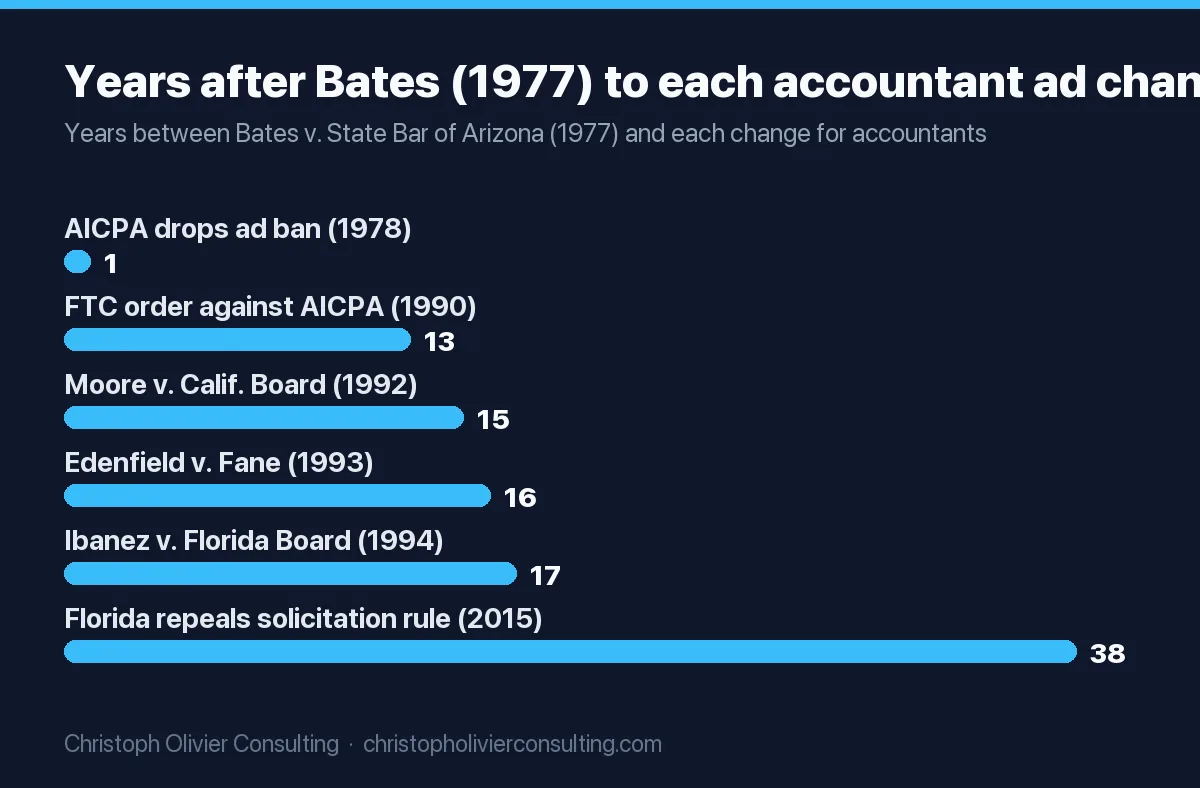
| Date | Event | What it changed for accountants | Primary source |
|---|---|---|---|
| June 27, 1977 | Bates v. State Bar of Arizona, 433 U.S. 350 | Professional advertising is protected commercial speech; false or misleading ads can still be restricted | Supreme Court opinion |
| 1978 | AICPA drops its advertising ban | Blanket ban replaced by a ban on false, misleading or deceptive advertising | Journal of Accountancy, 2014 |
| July 1990 | FTC consent order, In re AICPA, 113 F.T.C. 698 | AICPA may not restrict truthful self-laudatory or comparative claims, testimonials, “undignified” ads, direct solicitation, disclosed referral fees or trade names | FTC Decisions, vol. 113 |
| July 2, 1992 | Moore v. California State Board of Accountancy, 2 Cal.4th 999 | Unlicensed people may use “accountant” or “accounting” only with a qualifier or disclaimer that removes confusion with licensed CPAs | California Supreme Court opinion |
| April 26, 1993 | Edenfield v. Fane, 507 U.S. 761 | Florida’s ban on CPAs’ in-person, uninvited solicitation of business clients violates the First Amendment | Supreme Court opinion |
| June 13, 1994 | Ibanez v. Florida Board of Accountancy, 512 U.S. 136 | Board could not reprimand a lawyer-CPA for truthfully listing “CPA” and “CFP” in her ads | Supreme Court opinion |
| Dec. 21, 2015 | Florida repeals Rule 61H1-24.002 (Solicitation) | Florida’s separate solicitation rule is gone; its advertising rule 61H1-24.001 remains | Florida Administrative Code, ch. 61H1-24 |
The 1990 FTC order against the AICPA
The FTC’s complaint said the AICPA, then about 264,000 members and “approximately three-quarters of the CPAs in the United States,” restrained competition by restricting truthful ads, such as advertising that CPAs are “real tax experts,” that they offer “the expertise of a large national firm,” or that “John Smith says that their CPA firm was particularly responsive to his needs.”
The order (113 F.T.C. 698) told the AICPA to stop restricting “any self-laudatory or comparative claim,” “any testimonial or endorsement,” and “any advertisement not considered by AICPA to be professionally dignified or in good taste,” plus “the solicitation of any potential client by any means, including direct solicitation” and “the use of any trade name.” The AICPA kept only the power to police claims it “reasonably believes would be false or deceptive,” which is why today’s Code says nothing about ad style or channels.
Edenfield v. Fane: CPAs can cold-call business owners
Scott Fane built a tax practice in New Jersey by calling executives and setting meetings. When he moved to Florida, a board rule said a CPA “shall not by any direct, in-person, uninvited solicitation solicit an engagement.” In Edenfield v. Fane the Court held that “as applied to CPA solicitation in the business context, Florida’s prohibition is inconsistent with the free speech guarantees” of the Constitution.
Why CPAs get more room than lawyers: “Unlike a lawyer, who is trained in the art of persuasion, a CPA is trained in a way that emphasizes independence and objectivity rather than advocacy,” the syllabus says, and a CPA’s typical prospect is “a sophisticated and experienced business executive.” The Board “presents no studies,” and at the time “21 States place[d] no specific restrictions of any kind on solicitation by CPAs.” Compare that with the live-solicitation limits described on our page about whether lawyers are allowed to advertise.
The holding covers only solicitation “in the business context.” Consumer calls are a separate question, and state harassment rules still apply.
Ibanez: truthful credentials are protected
Silvia Ibanez, a lawyer, CPA and Certified Financial Planner, listed “CPA” and “CFP” in her yellow pages ad and on her cards. Florida reprimanded her. The Supreme Court in Ibanez held a State may ban commercial speech outright only if it is “false, deceptive, or misleading,” and threw out the reprimand.
What the AICPA rules on advertising say in 2026
The text below comes from the AICPA Code of Professional Conduct, “updated for all official releases through July 2026,” as posted by the Minnesota Board of Accountancy. The core rule is two sentences long.
ET 1.600.001, Advertising and Other Forms of Solicitation Rule: “A member in public practice shall not seek to obtain clients by advertising or other forms of solicitation in a manner that is false, misleading, or deceptive. Solicitation by the use of coercion, over-reaching, or harassing conduct is prohibited.”
Interpretation 1.600.010 then lists what counts as false, misleading or deceptive. Promotional efforts cross the line if they:
- “create false or unjustified expectations of favorable results”;
- “imply the ability to influence any court, tribunal, regulatory agency, or similar body or official”;
- quote a fee or fee range when it was likely “that such fees would be substantially increased” and you did not tell the prospect; or
- “contain any other representations that would be likely to cause a reasonable person to misunderstand or be deceived.”
It also closes the outsourcing loophole: if a third party such as a lead platform or agency brings you clients, you “should determine that the third party’s promotional efforts comply,” because “members must not do through others what they are prohibited from doing themselves.” Other Code sections that touch marketing:
| Rule (ET section) | What it says | What it means for your ads |
|---|---|---|
| 1.600.030 AICPA-awarded designation | A firm may use a designation such as PFS on letterhead and marketing only “if all the firm’s partners hold” it | One partner with a PFS does not make the firm a “PFS firm.” |
| 1.600.100 and 1.400.100 Use of the CPA credential | Breaking state rules on use of the CPA credential counts as false, misleading or deceptive use | State title rules (below) are enforced through the AICPA Code too. |
| 1.400.090 Acts Discreditable | Marketing your abilities, experience or qualifications in a false, misleading or deceptive way violates the Code, including claims about licensure or certification that do not meet the issuer’s requirements | Check every credential, award and “years of experience” claim on your site and LinkedIn. |
| 1.520.001 Commissions and referral fees | Referral fees paid or received “shall” be disclosed to the client; .080 says in writing | Paying for leads is allowed, with written disclosure. |
| 1.700.090 Disclosing client names | Naming a client is fine unless the name itself reveals confidential information | Logo walls are possible. A bankruptcy practice naming clients is the Code’s own example of a problem. |
| 1.800.001 and 1.820.030 Firm name | No misleading firm name; no “Members of the AICPA” unless all CPA owners are members; legal form must be accurate | Do not use “LLP,” “PC” or similar unless that is your legal form. |
For how the referral-fee rule works in practice, including state variations, see can CPA firms pay referral fees.
What are the 6 AICPA principles?
The Principles of Professional Conduct (ET 0.300) are Responsibilities, The Public Interest, Integrity, Objectivity and Independence, Due Care, and Scope and Nature of Services. For marketing, Integrity matters most: ET 0.300.040 says “service and the public trust should not be subordinated to personal gain and advantage.”
CPA advertising rules by state: Texas, California and Florida
AICPA membership is voluntary; your state board’s rules apply either way. Three large states show how much the detail varies.
| Issue | Texas (22 TAC ch. 501) | California (16 CCR and B&P Code) | Florida (61H1-24.001) |
|---|---|---|---|
| Core ad rule | No “false, fraudulent, misleading or deceptive statement or claim” (501.82(a)) | No advertising that is “false, fraudulent, misleading, or in violation of Section 17500” (16 CCR 63) | No advertising that is “fraudulent, false, deceptive, or misleading” (61H1-24.001(1)) |
| Testimonials | Must rest on “verifiable facts” (501.82(b)(1)(J)) | General rule; FTC rules apply | General rule; FTC rules apply |
| Specialist claims | No implied attainments “not supported in fact” | No title “likely to be confused” with CPA (B&P 5058) | “Specialist” requires a statement that it is “a self-designation and is not sanctioned by the state or federal government,” unless bona fide formal recognition |
| Record keeping | Keep email and direct mail ads plus recipient list for 36 months; record broadcasts and keep 36 months | None in the ad rule | None in the ad rule |
| Solicitation | No coercion, duress, overreaching or harassment; stop contacting anyone who has said no (501.82(c)) | Covered by the general rule | Separate solicitation rule repealed Dec. 21, 2015 |
| Firm name | Names implying “quality,” “special expertise” or “geographic area of service” presumed misleading (501.83) | Sole proprietor fictitious names must be registered with the Board (16 CCR 67) | Not in the ad rule |
Texas: watch your firm name and keep your emails
Of the three, Texas has the most detailed rules. Under 22 TAC 501.83, a firm name is presumed misleading if it “states or implies the quality of services offered, special expertise, expectation as to outcomes or favorable results, or geographic area of service.” So “Hill Country Tax Experts, CPAs” fails twice. “And company,” “associates” or “group” need “at least two employed licensees”; contractors do not count.
The record-keeping rule in 501.82(d) and (f) is easy to miss: for “an electronic or direct mail communication,” keep “a copy of the actual communication along with a list or other description of parties to whom the communication was distributed” for “at least 36 months from the date of its last distribution.” Messages to current clients and invited messages are exempt. Broadcasts must be recorded and kept 36 months too.
And if a Texas CPA markets through a business that is not a licensed CPA firm, 501.81(c) requires this exact disclaimer next to the entity’s name: “This firm is not a CPA firm and these services are not regulated by the Texas State Board of Public Accountancy.”
California: the title rules have teeth
California’s ad regulation, 16 CCR section 63, is one sentence; the Accountancy Act does the work. B&P Code 5055 reserves “certified public accountant” and “C.P.A.” for licensees and registered firms. Section 5058 bans “chartered accountant,” “certified accountant,” “licensed accountant” and similar titles, except for a California CPA using a comparable foreign title alongside “CPA.” Inactive and retired licensees must put “inactive” or “retired” right after the CPA designation on websites and business cards (5058.2, 5058.3). Violations of that article are misdemeanors punishable by up to six months in jail, a fine of up to $1,000, or both (5120).
What about the word “accountant” itself? California’s Regulation 2 lists “accountant” and “accounting” as titles likely to be confused with CPA. In Moore v. California State Board of Accountancy (1992), the state Supreme Court upheld the regulation but limited it: unlicensed people may use the terms when they add “an express disclaimer stating that the ‘accounting’ services being offered do not require a state license,” or a statement that they are not licensed by the state.
Florida: specialists and fear appeals
Florida’s Rule 61H1-24.001 treats business cards, letterhead, press releases and any “website, e-mail, or any other electronic communication” as advertising. Two items are unusual. First, a CPA who uses “specialty,” “specialist” or similar terms must state “that the use of the term is a self-designation and is not sanctioned by the state or federal government,” unless the claim rests on “bona fide formal recognition or attainment.” Second, an ad cannot appeal “primarily to a layperson’s fears, ignorance, or anxieties regarding his state of financial well-being,” which matters for IRS-problem and audit-defense campaigns.
Tax practices: IRS Circular 230 and client tax data
Tax practitioners have a second rulebook. Circular 230 section 10.30 bans “any form of public communication or private solicitation containing a false, fraudulent, or coercive statement or claim; or a misleading or deceptive statement or claim.” It adds:
- Label solicitations. Any lawful uninvited solicitation “must, nevertheless, clearly identify the solicitation as such and, if applicable, identify the source of the information used in choosing the recipient.”
- Published fees bind you for 30 days. You may publish fixed fees, hourly rates, fee ranges and the initial consultation fee, but you “may charge no more than the rate(s) published” for at least 30 calendar days after the last publication.
- Keep copies for 36 months. For direct mail and “e-commerce communications,” keep the actual communication and the recipient list; record radio and TV broadcasts.
- Stop when told. You “may not persist in attempting to contact a prospective client” who has said no.
- No “certified” for enrolled agents. EAs may not use “certified” or imply IRS employment.
The IRS Office of Professional Responsibility enforces this. A 2019 Tax Adviser article describes three OPR cases: a practitioner reprimanded and made to delete online videos that portrayed IRS agents negatively; website metadata naming prominent CPAs and attorneys who did not work at the firm; and a banner ad that kept listing a departed employee’s degrees.
Then there is your client list. Under Treasury Regulation 301.7216-2(n), a preparer may keep a list of names and contact details from returns it prepared, but the list “may not be used to solicit any service or product other than tax return preparation services.” Pitching advisory or other services from that data needs written consent under 301.7216-3. Penalties under 301.7216-1: up to one year and $1,000 (criminal), or $250 per misuse up to $10,000 a year (civil).
Are accountants allowed to say who their clients are?
Usually yes. ET 1.700.090 says disclosing a client’s name does not violate the confidentiality rule “if disclosure of the client’s name does not constitute the release of confidential client information.” The Code’s example: if your practice “is limited to bankruptcy matters,” naming a client “could suggest that the client may be experiencing financial difficulties.”
Case studies need more care. ET 1.700.060 says you can market “information based on his or her expertise or knowledge obtained from prior experiences with clients,” but “if the information may be identifiable to one or more clients, specific consent, preferably in writing, is required.” For testimonials, the FTC’s Consumer Review Rule (16 CFR Part 465) bans fake testimonials (465.2), paying for reviews “expressing a particular sentiment” (465.4), undisclosed reviews by your own officers or managers (465.5) and suppressing negative reviews (465.7). If you ask clients for reviews, the wording in our Google review request templates for accountants keeps the request sentiment-neutral.
What accountants can and cannot advertise
“Restricted” means allowed only if you meet the condition shown.
| Ad element | Status | Condition or reason | Rule |
|---|---|---|---|
| Paid search, social, TV, radio, billboards | Allowed | Content must be truthful | ET 1.600.001; FTC order 1990 |
| Cold calls and visits to business owners | Allowed | Business context; no coercion or harassment; stop when told | Edenfield; TX 501.82(c); Circ. 230 10.30(c) |
| Client testimonials and Google reviews | Allowed | Real clients, real experiences; no paid sentiment; TX: verifiable facts | 16 CFR 465; TX 501.82(b)(1)(J) |
| “Best,” “top,” “#1” claims | Restricted | Only if verifiable (an actual award or ranking you can cite) | TX 501.82(b)(1)(H); ET 1.600.010 |
| Published prices | Restricted | Disclose variables; tax fees binding 30 days | ET 1.600.010.02(c); FL (1)(h); Circ. 230 10.30(b) |
| “Specialist” or “expert” | Restricted | Florida self-designation statement; truthful everywhere | FL 61H1-24.001(1)(g) |
| Client names and logos | Restricted | Name must not reveal confidential facts; case studies need consent | ET 1.700.090, 1.700.060 |
| Paying for leads or referrals | Restricted | Written disclosure to the client | ET 1.520.001, 1.520.080 |
| Marketing non-tax services to your tax-prep list | Restricted | Taxpayer’s written consent | Treas. Reg. 301.7216-2(n), -3 |
| “We’ll cut your tax bill” or “audit-proof” promises | Banned | False or unjustified expectation of favorable results | ET 1.600.010.02(a); TX (b)(1)(C) |
| “Former IRS insiders who get results” | Banned | Implies ability to influence a regulator | ET 1.600.010.02(b); TX (b)(1)(G) |
| “CPA” for an unlicensed person or firm | Banned | Title reserved by state law | CA B&P 5055, 5120; TX 501.81 |
For real campaigns that work inside these limits, from Big 4 brand work to small-firm search ads, see these accounting firm advertising examples.
Copy-ready disclosure lines
Quoted from the rule text or built to satisfy it. Use the ones that apply to you.
- Florida specialist claim: “‘Tax specialist’ is a self-designation and is not sanctioned by the state or federal government.”
- Texas CPA working through an unlicensed entity (exact text required): “This firm is not a CPA firm and these services are not regulated by the Texas State Board of Public Accountancy.”
- California unlicensed bookkeeper or “accountant”: “[Name] is not licensed by the State of California. The accounting services offered do not require a state license.”
- Circular 230 uninvited solicitation: “This is a solicitation for tax services. We selected you using [source of the list].”
- Published tax fee: “Individual return preparation from $[X]. Final fee depends on [schedules, states, entities]. Filing fees and costs are [included / billed separately].”
- Referral fee (written, to the client): “We paid [referrer] $[amount] for referring you to our firm.” Add “This does not change our fee to you” only if it is true.
Pre-launch checklist: pass or fail
Run every ad, landing page and email through these. Any “no” is a fail.
- Is every factual claim (years, client counts, awards, rankings) provable with a document you have today?
- Does the ad avoid promising a result (refund, tax savings, audit outcome)?
- Does it avoid any hint of special access to the IRS, a court or a regulator?
- If a price appears, does the ad say what can change it, and will you honor a tax fee for 30 days?
- Does every person shown as “CPA” hold an active license, with “inactive” or “retired” added where California requires it?
- Does the firm name avoid quality, expertise and geography words, and do “& Co.,” “Associates” or “Group” reflect at least two employed licensees (Texas)?
- Are designations like PFS used for the firm only if every partner holds them (ET 1.600.030)?
- Are testimonials from real clients, unpaid for sentiment, with staff relationships disclosed?
- Do named clients or case studies have consent where the details could identify the client?
- If the list came from tax return data, is the offer limited to tax preparation, or do you hold written 7216 consent?
- Has a copy of each email or mail piece and its recipient list been saved for 36 months (Texas, Circular 230)?
- Have you reviewed the ads and site metadata your agency or lead vendor runs for you?
Why are CPAs declining, and does it change the rules?
It does not change the rules, but it is why more firms now market. The AICPA’s 2025 Trends report, as summarized by the Journal of Accountancy, counted 55,152 accounting bachelor’s and master’s degrees in 2023 to 2024, down 6.6% from the year before. New CPA Exam candidates fell from 42,626 in 2023 to 28,082 in 2024, a drop the AICPA links to the exam overhaul, with 16,448 new candidates in the first half of 2025. The report does not measure how many CPAs quit.
Even the AICPA now buys ads: on June 9, 2026 it launched a national advertising and social media campaign called CPA Trust.
How accountants compare with lawyers, doctors and architects
All four professions moved from bans to truthfulness rules after 1977. Accountants have the most freedom on solicitation, because Edenfield protects in-person contact with business prospects, while the Court in Edenfield expressly distinguished lawyers, whose in-person solicitation it had treated as riskier in Ohralik. Compare the HIPAA and testimonial limits on whether doctors are allowed to advertise and the project-credit rules on whether architects are allowed to advertise.
In my view, the real risk for most CPA firms is not a bold ad. It is a quiet failure: an agency’s metadata, a stale credential on a banner, an advisory pitch to tax clients without 7216 consent. If you want a second set of eyes on a campaign plan before it runs, you can book a consultation.
Ready to scale your revenue?
Book a free 30-min consultation. We’ll diagnose your growth bottleneck and map out the 3 highest-leverage moves for your business.
Frequently asked questions
Are CPAs allowed to advertise?
Yes. The AICPA dropped its advertising ban in 1978, and a 1990 FTC consent order bars it from restricting truthful ads, testimonials, comparative claims and solicitation. AICPA rule ET 1.600.001 now prohibits only advertising that is false, misleading or deceptive, and solicitation by coercion, over-reaching or harassment. State boards of accountancy add their own rules on titles, firm names, specialist claims and record keeping.
What are the AICPA advertising rules?
ET 1.600.001 says a member in public practice shall not seek clients through advertising or solicitation that is false, misleading or deceptive, and bans coercive or harassing solicitation. Interpretation 1.600.010 lists banned claims: false expectations of favorable results, implied influence over a court or regulator, and fee quotes likely to rise substantially without warning. Members are also responsible for promotions run by third parties that send them clients.
Can CPAs cold call or solicit clients in person?
Yes, for business prospects. In Edenfield v. Fane (1993), the Supreme Court struck down Florida's ban on CPAs' direct, in-person, uninvited solicitation as applied in the business context, noting that CPAs are trained in independence rather than persuasion. You still cannot coerce or harass, and Texas and IRS Circular 230 bar you from continuing to contact someone who has said no.
Are accountants allowed to say who their clients are?
Usually. AICPA ET 1.700.090 says naming a client is fine unless the name itself reveals confidential information, such as naming clients of a bankruptcy-only practice. Case studies with details that could identify a client need the client's specific consent, preferably in writing, under ET 1.700.060. Testimonials must come from real clients, and you cannot pay for reviews expressing a particular sentiment.
What are you not allowed to advertise as an accountant?
Promises of results such as guaranteed refunds or audit outcomes, claims of influence with the IRS or a court, fee quotes that hide likely increases, unverifiable self-praise or comparisons in Texas, fake or bought reviews, the CPA title if you are not licensed, and, in Florida, ads that appeal primarily to fears about financial well-being. Tax preparers also cannot market non-tax services from return data without written consent.
What are the 6 AICPA principles?
The AICPA Code's Principles of Professional Conduct (ET 0.300) are Responsibilities, The Public Interest, Integrity, Objectivity and Independence, Due Care, and Scope and Nature of Services. For marketing, Integrity is the most relevant: the Code says service and the public trust should not be subordinated to personal gain and advantage, and integrity cannot accommodate deceit.
Can non-CPAs call themselves accountants?
It depends on the state. In California, Regulation 2 treats "accountant" and "accounting" as titles likely to be confused with CPA, but Moore v. California State Board of Accountancy (1992) lets unlicensed people use them with a disclaimer that they are not state-licensed or that the services do not require a license. Using "CPA" without a license is a misdemeanor there, punishable by up to six months or $1,000.
Professional advertising rules