

Yes. Veterinarians in the United States are allowed to advertise, in any medium, including their prices. The American Veterinary Medical Association’s own ethics code says it directly: “Advertising by a veterinarian is ethical when there are no false, deceptive, or misleading statements or claims.” Florida’s veterinary board goes further and states that advertising by veterinarians “is permitted in order to disseminate information for the purpose of providing the public sufficient basis upon which to make an informed selection of veterinarians.”
Short answer: Vets can advertise services, hours, credentials and fees, on TV, social media, search ads or anywhere else, as long as every claim is true and provable. The real limits are narrow: no guarantees of a cure, no unprovable “best vet in town” claims, no “specialist” unless you are board certified by one of the 22 AVMA-recognized specialty organizations, and no paid or suppressed reviews (FTC penalties run up to $53,088 per violation). Some states add rules, such as California’s ban on “as low as” pricing.
Below: why the “vets can’t advertise” idea exists (it was true until the late 1970s), what each rulebook actually says with section numbers, four states side by side, a full answer on price advertising and “free exam” offers, an allowed/restricted/prohibited table, and a pass/fail checklist you can paste into your approval process. This is general information for practice owners and marketers, not legal advice; your state board’s current rules and a veterinary attorney have the final word.
Why people think vets aren’t allowed to advertise
Because for decades they mostly weren’t. In December 1978 the FTC’s Denver Regional Office published a Staff Report on Advertising of Veterinary Goods and Services. It records that on December 19, 1975 the Commission authorized an industrywide investigation of veterinary care, and that staff then surveyed the veterinary licensing boards of all fifty states and the District of Columbia. The finding: “veterinary advertising is prohibited or restricted by the laws of the majority of states and by the ethical codes of national, state and local veterinary associations.” The practice acts of nine states contained outright statutory prohibitions or restrictions.
Staff phoned clinics in six large cities, found “a high degree of price dispersion,” blamed it partly on the bans, and recommended a federal rule that would have overridden state restrictions on nondeceptive ads.
Then the profession moved first. After the Supreme Court’s 1977 decision in Bates v. State Bar of Arizona protected lawyer price advertising (the same case that reshaped the rules covered in our guide on whether lawyers are allowed to advertise), the AVMA temporarily rescinded its code provision prohibiting advertising and sent state boards a set of “Proposed Advertising and Solicitation Regulations.” The FTC report reprints them. That post-Bates model banned ads that predicted “future success,” guaranteed “a cure,” referred to “secret methods of treatment,” claimed specialist status without board certification, or were “not identified as a paid advertisement.” The report notes that the Commission itself never adopted the staff’s findings.
That wording survives. Texas still bans “a prediction of future success or a guarantee that satisfaction or a cure will result,” and Washington still bans ads referring “to secret methods of treatment” or “not identified as a paid advertisement or solicitation.” If a rule in your state sounds dated, that is likely why.
The rulebooks that apply to veterinary advertising
No single law governs vet ads. Five layers stack on top of each other, and the strictest one that applies to you wins.
| Source | Who it binds | What it says about ads | Section |
|---|---|---|---|
| AVMA Principles of Veterinary Medical Ethics | AVMA members; many boards use it as the benchmark | Ads are ethical when free of false, deceptive or misleading claims. Testimonials count as advertising and should be limited to verifiable statements. “Specialist” is reserved for board-certified vets. | Code of Conduct: Honesty and integrity; Titles; Conflicts of interest |
| AAVSB Practice Act Model (Sept 2026) | A template states copy into their practice acts | Boards may discipline for “false, fraudulent, or deceptive” statements “including, but not limited to, false or misleading advertising.” Only licensees may use the title Veterinarian. | Sections 401(a)(12)(ii) and 301(c) |
| State practice act and board rules | Every licensee in that state | Specialist wording, guarantees, superiority claims, price format, emergency hours, paid ad labels. See the state table below. | Varies (e.g., 22 TAC 573.30, Fla. Admin. Code 61G18-21.001) |
| FTC rules | Every business | Testimonials must reflect typical results; paid connections must be disclosed; fake, bought, insider and suppressed reviews are banned; “free” offers have conditions. | 16 CFR Parts 255, 465, 251 |
| FDA Center for Veterinary Medicine | Animal drug companies | Prescription animal drug promotion must be “truthful, balanced, and non-misleading,” with risk information given “the same prominence and emphasis as the benefit information.” | Federal Food, Drug, and Cosmetic Act |
What the AVMA ethics code says, line by line
The current Principles of Veterinary Medical Ethics no longer use numbered sections. The advertising language sits under the Code of Conduct heading “Honesty and integrity,” with related rules under “Titles” and “Conflicts of interest.” The key sentences:
- The standard: a misleading claim “is one which communicates false information or is intended, through a material omission, to leave a false impression.” Omissions count. A vaccine package price that leaves out the required exam fee can be misleading even if every number shown is accurate.
- What counts as advertising: any “communication that is designed to inform the public about the availability, nature, or price of products or services or to influence clients to use certain products or services.” That covers your website, Google Business Profile, social posts and reception-desk handouts, not just paid media.
- Testimonials: “Testimonials or endorsements are advertising. A veterinarian should limit their use and only permit representations that are readily subject to verification.” The code also tells vets to follow the FTC’s endorsement and testimonial guides.
- Product endorsements: a vet who endorses a commercial product “should publicly disclose if they are being compensated for their support, including when the veterinarian has ownership interest in the product.”
The code binds members ethically; it becomes law where a state board writes it into its rules, which the 1978 FTC report says a number of boards had done.
State veterinary advertising rules: four examples side by side
Quoted from each rule’s text. Check your own state’s board before you publish; wording and penalties differ.
| Rule | Texas | Florida | California | Washington |
|---|---|---|---|---|
| Main source | 22 TAC 573.30 (eff. June 14, 2012) | Rule 61G18-21.001 (amended 1998) | B&P Code 651 and 4883 | WAC 246-933-140 |
| Core ban | False, deceptive or misleading ads | Ads “in any way fraudulent, false, deceptive or misleading in form or content” | False, fraudulent, misleading or deceptive “statement, claim, or image” | False, fraudulent, deceptive or misleading ads |
| Cure or outcome promises | Banned: guarantees of satisfaction or a cure | Banned: “false or unjustified expectations of beneficial treatment or successful cures” | Banned: “false or unjustified expectations of favorable results” | Covered by the general ban |
| “Best” or superiority claims | Banned unless subject to “reasonable verification by the public” | Banned unless “such claims can be substantiated” | Banned unless substantiated “with objective scientific evidence” | Covered by the general ban |
| “Specialist” | Only if board certified in that specialty as recognized by the AVMA | Only diplomates of AVMA-recognized boards; “limits his practice to” is allowed | “Specialist” or “board certified” only with AVMA-recognized (or NAVTA-recognized, for techs) certification: 4883(s) | Only if certified by an AVMA-recognized board |
| Prices | No specific format rule | Partial disclosure of relevant facts is misleading | Exact prices only; no “as low as,” “and up,” “lowest prices” | No specific format rule |
| Extra requirements | Specialists must make proof of certification available to the public on request (573.23(c)) | Emergency ads must state hours and “veterinarian on premises” or “veterinarian on call” | Paying media for publicity must be disclosed; before/after images need the procedure named | Ads must be identified as paid; no “secret methods of treatment” |
| Consequence | Board discipline | Board citation or discipline (the rule implements 474.214(1)(e), F.S.) | Misdemeanor under 651(f) plus license discipline under 4883(f) | Board discipline |
Two details catch practices out. Florida’s rule applies “to media exposure of any nature regardless of whether it is in the form of paid advertising,” so a local news interview counts. And Texas also bars any “corporate or assumed name” for a practice that would be false, deceptive or misleading (573.36): a clinic called “Specialty Animal Hospital” with no board-certified specialist on staff is a risk before you have run a single ad.
Can veterinarians advertise prices?
Yes. The AVMA’s definition of advertising explicitly includes communication about “the price of products or services,” and the code’s fee-setting section says it is unethical for a group of veterinarians to push colleagues “to conform to a fee schedule or fixed fees.” Each practice sets and may publish its own prices. The AVMA’s post-Bates model regulations already allowed a fixed fee for a specific service, or a range of fees “provided that there is reasonable disclosure of all relevant variables.”
What changes by state is the format. California is the strictest of the four above. Under B&P Code 651(c), “Any price advertisement shall be exact,” the price for each service “shall be clearly identifiable,” and price ads cannot use “bait, discount, premiums, gifts” in a misleading way. Section 651(b)(4) also makes it misleading to advertise fees, “other than a standard consultation fee or a range of fees for specific types of services, without fully and specifically disclosing all variables and other material factors.”
Worked example: a dental cleaning price ad
- Fails in California: “Dental cleanings from $199.” (“from” is a phrase of similar import to “as low as.”)
- Passes: “Dental cleaning under anesthesia, dogs under 25 lb: $349. Includes pre-anesthetic exam and bloodwork. Extractions, if needed, are quoted separately after X-rays.”
The second version names the service, patient type, inclusions and exclusions: the disclosure Florida’s “partial disclosure” rule and the AVMA’s “material omission” language call for in any state.
“Free exam” and “first visit free” offers
The FTC’s Guide Concerning Use of the Word “Free” (16 CFR 251.1) applies to any business, including clinics. The rules that matter for a vet promotion:
- A “free” item tied to a purchase means the client pays no more than the regular price for the purchase. “Regular” means the price you actually charged for a “reasonably substantial period of time, i.e., a 30-day period.”
- All conditions must appear “in close conjunction with the offer.” An asterisk to a footnote does not count as proper disclosure.
- Do not run the same “free” offer in one trade area “for more than 6 months in any 12-month period,” and run no more than three such offers in an area in 12 months.
So “Free first exam for new clients with any vaccine visit through March 31 (vaccines billed at our regular prices)” works. Quietly raising the vaccine price during the promotion does not.
Why don’t vets advertise prices?
Some do, and nothing in the AVMA code or the four state rules above stops them. Most don’t for practical reasons: many services vary with the animal’s size, age and condition, and the disclosure rules make an honest price ad longer than a slogan. Pressure is moving the other way. In the UK, the Competition and Markets Authority’s 2026 Order requires practices treating household pets to publish a price list online covering up to 36 standard services from the next working day after 22 March 2027, and to include the consultation price in booking confirmations.
Who can say “specialist” or “board certified”
This is the rule boards enforce most consistently. According to the AVMA’s specialties page, there are 22 AVMA-recognized veterinary specialty organizations covering 48 distinct specialties, and more than 16,500 veterinarians hold diplomate status. Only those diplomates may use “specialist” under the AVMA code and the Texas, Florida, California and Washington rules above.
| Phrase | Board-certified diplomate | General practitioner with a focus | Source |
|---|---|---|---|
| “Board Certified (Veterinary Radiology)” | Yes, and Texas prescribes this exact format | No | 22 TAC 573.32 |
| “Cardiology specialist” | Yes, if certified in that specialty | No | AVMA Titles; 22 TAC 573.30(4) |
| “Specializing in feline medicine” | Yes | No: AVMA says GPs “should not use the terms ‘specialist’ or ‘specializing in'” | AVMA Titles |
| “Practice limited to cats” | Yes | Yes | AVMA Titles; Fla. 61G18-21.001(3)(d) |
| “Special interest in dentistry” | Yes | Yes, in Florida “a particular interest in” is expressly allowed | Fla. 61G18-21.001(3)(d) |
| “Board eligible” | No | No | AVMA Titles: “misleading” |
Texas also requires specialists to make proof of certification available to the public on request; linking each bio to the specialty college’s directory listing covers that.
Testimonials, reviews and product endorsements
Client stories are allowed in the US, but three FTC rules sit underneath the AVMA’s “limit their use” advice.
- Typical results. Under 16 CFR 255.2(b), a testimonial about a key result is read as what clients “will generally achieve.” If you cannot back that up, the ad must “clearly and conspicuously disclose the generally expected performance.”
- Paid or related endorsers. 16 CFR 255.5 requires disclosure of any material connection, including “free or discounted products.” A client who got a free dental in exchange for a video is a material connection. So is a staff member’s review.
- Reviews. The FTC’s Consumer Review Rule bans fake reviews (465.2), incentives “conditioned expressly or by implication” on a positive or negative review (465.4), undisclosed insider reviews by officers or managers (465.5), and suppressing reviews through groundless legal threats or intimidation (465.7). Asking every client to leave a review is expressly allowed as a “generalized solicitation.” Knowing violations can cost up to $53,088 per violation.
Our guide on how to get more Google reviews covers compliant request scripts; our roundup of FTC advertising enforcement statistics shows where the agency has actually brought cases.
Why do vets push Royal Canin and other brands?
We found no rule naming any brand. What the rules do cover is the conflict of interest behind any product recommendation. The AVMA code says a vet “should not allow any interests” other than patient welfare, client needs and public safety “to influence their choice of treatment,” should weigh conflicts before joining “vendor incentive programs,” and “should disclose potential conflicts of interest to clients.” In the UK, RCVS guidance 23.38 and 23.39 says recommendations must be “clinically justified” and not affected by any interest held by the vet or their employer. If your clinic earns a margin or rebate on a diet you recommend, disclosing it is the ethical baseline.
Using client pets in ads
Real patients make the best creative, with two obligations. First, privacy: the AVMA code says information in veterinary records “must not be released except as required or allowed by law, or by client consent.” Get written consent before you post a named pet, its story or anything from its chart. Second, in California, before-and-after images must name “what procedures were performed,” be “comparable in presentation,” and state that “the same ‘before’ and ‘after’ results may not occur for all patients” (651(b)(3)(C)).
Is it illegal to impersonate a veterinarian?
Yes. The model act many states draw from is explicit. AAVSB Practice Act Model Section 301(c) says “No Person shall use the designation Veterinarian, Licensed Veterinarian or any other designation indicating licensure status, including abbreviations, or hold themselves out as a Veterinarian unless licensed as such,” and Section 301(e) lets the board fine unlicensed practice and seek court action. Texas separately bars licensees from using any “certificate, college degree, or title to which he or she is not entitled” (573.34). For marketers: no ad or post should suggest a non-veterinarian on staff is a vet.
Allowed, restricted or prohibited: vet ad content at a glance
| Ad content | Status | Condition or reason |
|---|---|---|
| Name, address, hours, languages, schools, fees, payment plans | Allowed | Cal. B&P 651(h) lists these as permitted content, plus “any other item of factual information” that is not misleading |
| Exact prices for described services | Allowed | Disclose what is and is not included; exact figures in California |
| “Starting at” or “as low as” prices | Restricted | Prohibited in California (651(c)); elsewhere still needs full disclosure |
| “Free exam” promotions | Restricted | 16 CFR 251.1: regular price, conditions next to the offer, max 6 months in 12 |
| Client testimonials and reviews | Restricted | Verifiable, typical results, connections disclosed, client consent |
| “Specialist,” “board certified” | Restricted | Only AVMA-recognized diplomates, named specialty |
| “Practice limited to,” “special interest in” | Allowed | AVMA Titles; Florida rule |
| “Best vet in [city],” “top-rated surgeons” | Restricted | Needs substantiation (FL) or public verifiability (TX); objective evidence in CA |
| “24/7 emergency” | Restricted | Florida: state hours and “veterinarian on premises” or “on call” |
| Guaranteed cures or outcomes | Prohibited | 22 TAC 573.30(1); Fla. 61G18-21.001(3)(c) |
| “Board eligible” | Prohibited | AVMA Titles |
| Fake, bought or staff reviews without disclosure | Prohibited | 16 CFR 465.2, 465.4, 465.5 |
| Unmarked paid ads or advertorials | Prohibited in Washington | WAC 246-933-140(3); California requires disclosure of paid publicity (651(d)) |
| Prescription drug brand promotion | Mostly the manufacturer’s job | FDA CVM requires balanced risk information; clinics should use the maker’s approved materials |
Pre-launch checklist for veterinary ads
Copy this into your approval workflow. Each line is pass/fail; any fail means the ad does not go live.
- Proof file. Every factual claim (prices, “same-day appointments,” “fear free,” years in practice) has a document behind it. Fail: “we can find it if asked.”
- No outcome promises. No “cure,” “guaranteed,” “pain-free,” or “100% success.” Fail: any promise of a result.
- Superlatives verified. “Best,” “top,” “#1” only with a named, current, verifiable source shown in the ad. Fail: self-awarded titles.
- Specialist check. Every use of “specialist,” “specializing in” or “board certified” belongs to a diplomate of an AVMA-recognized organization, with the specialty named. Fail: GP bios that say “specializes in.”
- Practice name check. The clinic name itself implies nothing untrue (specialty, emergency, hospital). Fail: “Specialty” in the name with no specialist.
- Price format. Exact price, service described, inclusions and exclusions stated next to the price. Fail: “from,” “as low as,” or a footnote doing the disclosing.
- Free offers. Regular price charged for at least 30 days before; conditions next to the offer; this offer has run under 6 of the last 12 months. Fail: any one missing.
- Testimonials. Written client consent on file; result is typical or the usual result is disclosed; any freebie or relationship disclosed. Fail: verbal OK only.
- Reviews. Requests go to all clients; no reward tied to a rating; staff reviews disclose employment. Fail: “leave 5 stars for a free nail trim.”
- Emergency claims. Hours stated; “veterinarian on premises” or “on call” stated where Florida-style rules apply. Fail: “24/7 emergency” with an on-call vet and no disclosure.
- Labels and interests. Paid placements are labeled, and any payment, rebate or ownership interest in a promoted product is disclosed in the post itself. Fail: an unmarked advertorial, or disclosure only in a bio.
My view: items 4, 5 and 9 cause the most trouble in practice because they live outside the ad itself, in staff bios, the clinic name and the front-desk review script. Audit those once and most of the risk is gone.
What actually sends vets to the board
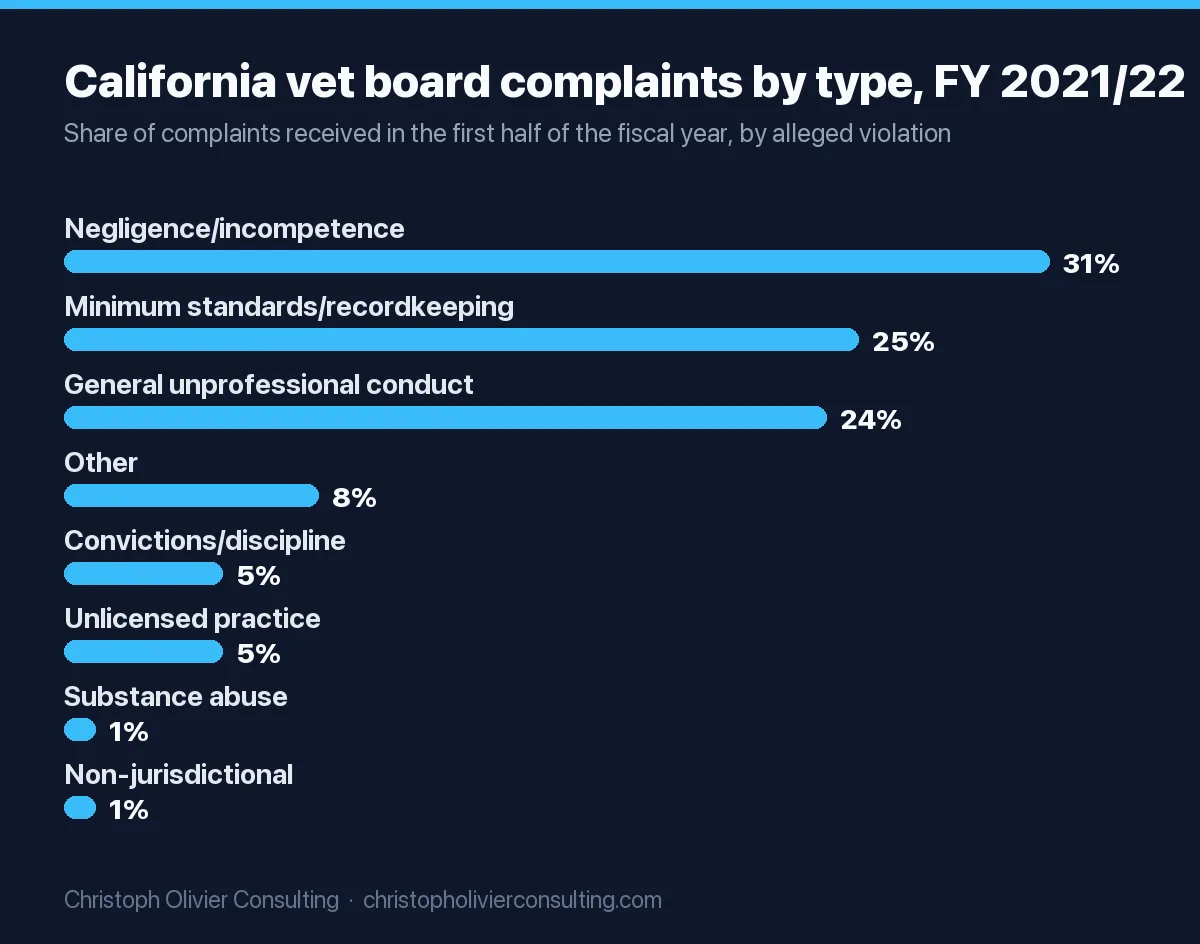
California’s Veterinary Medical Board reported that, halfway through fiscal year 2021/22, it had received 653 complaints and that “complaints alleging negligence and/or incompetence remain the highest category at 31%, which is similar to prior years,” followed by minimum standards and recordkeeping (25%) and general unprofessional conduct (24%) (VMB executive management report, January 2022). False advertising is just one of many grounds for discipline under 4883.
The best-known example of how far those care complaints can go involves a TV veterinarian. The Michigan Court of Appeals in 2016 reversed board discipline of Dr. Jan Pol over a dog’s eye surgery, finding no clear standard of care was shown, but in a separate case on December 19, 2019 (Docket No. 344666) it affirmed an order placing him on probation for negligence, to be discharged once he completed continuing education. We could not verify his 2026 practice status from an official source; Michigan’s license lookup is the place to check.
How the UK compares
UK vets can advertise too. RCVS supporting guidance chapter 23 says all advertising “should be accurate, truthful, and not of a character likely to bring the profession into disrepute” (23.15) and must comply with the CAP Code (23.44). The specialist rule mirrors the AVMA’s: only vets on the RCVS Specialist List may use “specialist,” and others “should not use such terms as ‘specialising in'” but may say “practice limited to” (23.26). Taking the title “vet” without registration is an offence under the Veterinary Surgeons Act 1966 (23.3). The big difference is mandatory price lists under the CMA Order described above.
What this means for your marketing plan
None of these rules stop a clinic from running search ads, local SEO, social video or direct mail. They shape what the ads say. Compliant vet marketing leads with specifics: species seen, availability, named credentials, exact routine prices, and client stories collected with written consent. The channel strategy that sits on top of this is in our veterinary marketing guide, and if you are sizing a budget, the veterinary clinic average revenue breakdown gives the baseline. The same questions for human medicine are answered in are doctors allowed to advertise, and for design firms in are architects allowed to advertise. If you want a second pair of eyes on a campaign before it goes live, you can book a consultation.
Ready to scale your revenue?
Book a free 30-min consultation. We’ll diagnose your growth bottleneck and map out the 3 highest-leverage moves for your business.
Frequently asked questions
Are vets allowed to advertise?
Yes. US veterinarians may advertise in any medium. The AVMA Principles of Veterinary Medical Ethics say advertising is ethical when it contains no false, deceptive or misleading statements, and Florida's board rule says vet advertising is permitted so the public can make an informed choice. Limits come from state board rules and FTC rules on testimonials, reviews and free offers.
Can veterinarians advertise prices?
Yes. The AVMA defines advertising to include prices, and each practice sets its own fees. States control the format: California Business and Professions Code 651(c) requires exact prices and bans phrases like 'as low as' and 'and up.' In every state, say what the price includes and excludes so the ad does not leave a false impression through omission.
Can a vet call themselves a specialist?
Only if they are board certified by an AVMA-recognized veterinary specialty organization. There are 22 such organizations covering 48 specialties. Texas, Florida, California and Washington all write this into their rules. A general practitioner may say 'practice limited to' or, in Florida, 'particular interest in,' but should not say 'specializing in' or 'board eligible.'
Can a veterinary clinic offer a free exam?
Yes, if the offer follows the FTC Guide on the word 'Free' (16 CFR 251.1). Anything bought with the free exam must be at the regular price charged for at least 30 days, all conditions must sit next to the offer rather than in a footnote, and the same free offer should not run more than 6 months in any 12-month period in one area.
Can vets use client testimonials and reviews?
Yes, with limits. The AVMA says testimonials are advertising and should only include verifiable statements. FTC rules require typical results or a clear disclosure of usual results, disclosure of any free care or relationship, and ban fake, bought, undisclosed staff and suppressed reviews. Asking all clients for a review is allowed. Get written client consent before using a pet's story.
Is it illegal to impersonate a veterinarian?
Yes. State practice acts limit the title to licensees. The AAVSB Practice Act Model, Section 301(c), says no person may use the designation Veterinarian or any abbreviation, or hold themselves out as one, unless licensed, and lets the board fine unlicensed practice. In the UK, using the title without RCVS registration is an offence under the Veterinary Surgeons Act 1966.
What is the most common complaint against veterinarians?
Negligence or incompetence. California's Veterinary Medical Board reported in January 2022 that negligence and incompetence made up 31 percent of complaints received in fiscal year 2021/22 to date, followed by minimum standards and recordkeeping at 25 percent and general unprofessional conduct at 24 percent. Advertising complaints are a small share by comparison.
Professional advertising rules