
Most travel agency owners make far less than the $102,000 to $114,000 “owner salary” figures on job sites. The typical owner in the U.S. is a home-based advisor whose business took in under $10,000 in 2022: 51.7% of the 76,090 travel businesses with no employees reported receipts below that line (Census Nonemployer Statistics 2022, my calculation). Employed travel agents earned a median of $50,160 in May 2025, commissions included (BLS Occupational Outlook Handbook). An owner who books full time can beat that wage. A part-timer usually does not.
Short answer: In my worked model built from Census, BLS and published host and franchise terms, a part-time advisor booking $150,000 a year through a host agency keeps about $10,000 before tax, a full-time advisor booking $750,000 keeps about $55,000, and the owner of a four-person storefront agency booking $4 million keeps about $173,000. Commission rate is the swing factor: at $4 million in sales, moving from a 10% to a 12% average commission moves owner pay from about $133,000 to $213,000.
Below: what each salary source actually measures, how much revenue travel agencies take in by size, how commission and host splits turn bookings into income, a three-size P&L with every assumption labeled, startup costs by business model, the number of trips you need to sell to match an employed agent’s pay, and a pass/fail worksheet.
Travel agency owner salary: what each source measures
No government survey asks travel agency owners what they pay themselves. BLS wage data excludes owners, and the job-site figures come from job ads and self-reports. ZipRecruiter shows $114,182 a year for November 2026 and Glassdoor shows $102,015 in their search listings. Neither describes the typical owner. Here is what the measurable sources say.
| Source and year | What it measures | Figure | How it was calculated |
|---|---|---|---|
| Census Nonemployer Statistics 2022, NAICS 5615 | Receipts per travel arrangement business with no paid employees (mostly home-based advisors) | $41,703 | $3.17 billion ÷ 76,090 businesses (my calculation) |
| Same file, sole proprietors only | Receipts per sole-proprietor travel business with no employees | $30,521 | $2.12 billion ÷ 69,562 businesses (my calculation) |
| Census SUSB 2022, NAICS 561510 | Receipts per travel agency firm with employees, all sizes | $4.76 million | $35.57 billion ÷ 7,476 firms; pulled up by 49 firms with $100 million or more (my calculation) |
| Census SUSB 2022, NAICS 561510 | Receipts per employer travel agency in the $100,000 to $499,999 band, the most common size | $243,756 | 2,967 firms, 1.6 employees each (my calculation) |
| BLS OEWS via the Occupational Outlook Handbook, May 2025 | Median pay of employed travel agents, all industries, commissions included | $50,160 | Published. 10th percentile $34,610; 90th percentile $76,660 |
| Same source | Median pay of travel agents employed in travel arrangement and reservation services | $49,650 | Published |
| IRS SOI sole proprietorships, tax year 2023 | Schedule C profit for travel agencies | Not broken out | Travel agencies sit inside “Administrative and support services” in Table 1 |
One detail matters for reading every Census number on this page. Census asks travel agents to report commissions or fees, not gross sales (Census Service Annual Survey form SA-5615T). So a home-based advisor with $41,703 in receipts likely booked several hundred thousand dollars of travel, and the $41,703 is closer to what reached their business before expenses. Large firms that sell travel as merchant of record may report differently, so treat the big-firm averages with care.
BLS also counts about 61,500 travel agent jobs in 2025, 12% of them self-employed, and projects 0% growth from 2025 to 2035 with about 5,900 openings a year from turnover (BLS OOH).
How much revenue does a travel agency make? Census data by size
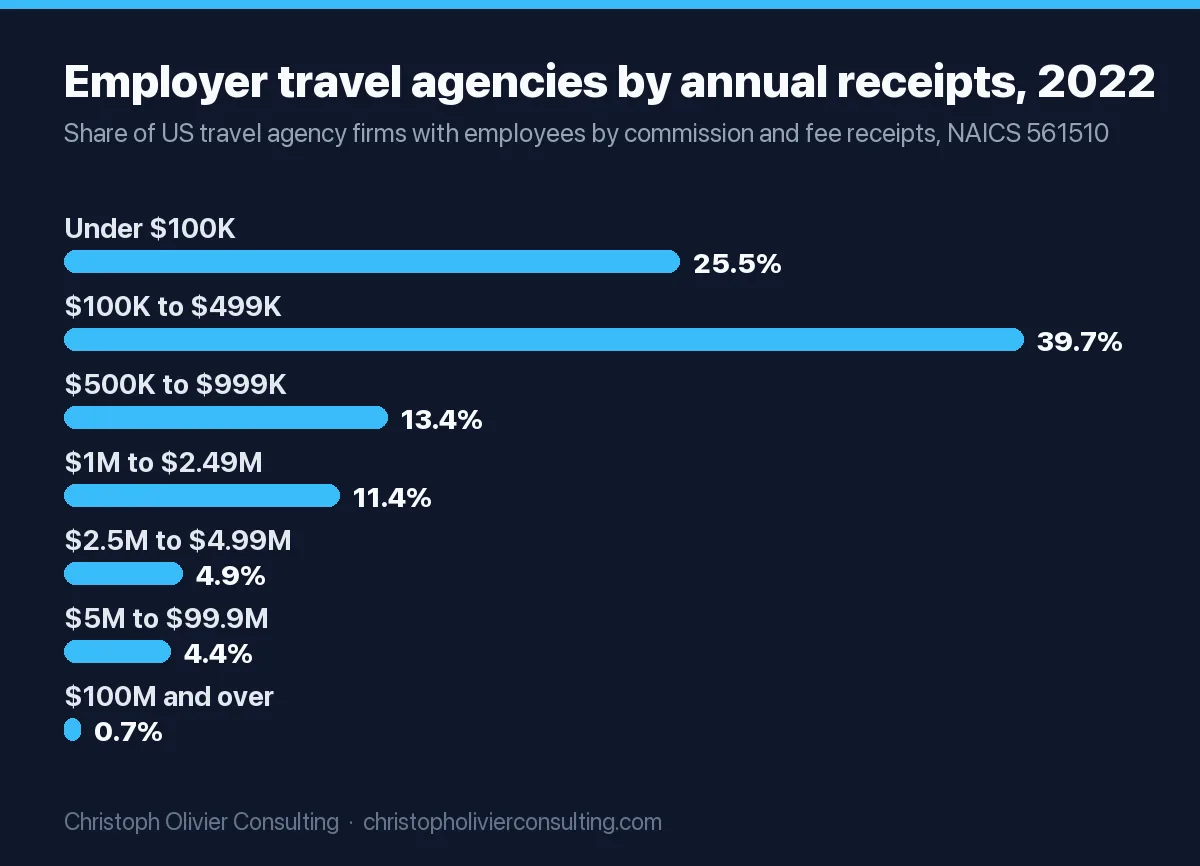
The employer agency average of $4.76 million is a chain number. 77.0% of all employer travel agency receipts went to the 49 firms with $100 million or more in 2022. The firm in the middle is small.
| Annual receipts of the firm | Travel agency firms | Share | Cumulative | Avg receipts per firm | Employees per firm | Payroll as % of receipts | Payroll per employee |
|---|---|---|---|---|---|---|---|
| Under $100,000 | 1,905 | 25.5% | 25.5% | $48,701 | 0.8 | 34.8% | $20,525 |
| $100,000 to $499,999 | 2,967 | 39.7% | 65.2% | $243,756 | 1.6 | 25.8% | $38,759 |
| $500,000 to $999,999 | 1,004 | 13.4% | 78.6% | $698,735 | 3.0 | 20.6% | $47,582 |
| $1 million to $2.49 million | 852 | 11.4% | 90.0% | $1,526,306 | 5.0 | 17.3% | $53,305 |
| $2.5 million to $4.99 million | 370 | 4.9% | 94.9% | $3,386,135 | 9.7 | 17.3% | $60,651 |
| $5 million to $99.9 million | 329 | 4.4% | 99.3% | $12,508,912 | 34.7 | 20.1% | $72,357 |
| $100 million and over | 49 | 0.7% | 100% | $558,788,755 | 999.8 | 20.2% | $112,658 |
Source: U.S. Census Bureau, SUSB 2022, U.S. 6-digit NAICS by enterprise receipts size, NAICS 561510 travel agencies, released April 10, 2025. Employer firms only. Shares, averages and ratios are my calculations. Employment is a mid-March count; payroll is annual wages before payroll taxes and benefits, and for incorporated firms can include officers.
What the table tells you:
- The median employer travel agency takes in $100,000 to $499,999 a year in commissions and fees. 65.2% of firms are under $500,000. That band averages 1.6 employees, which usually means the owner plus one agent or assistant.
- Payroll share falls as agencies grow. It is 25.8% of receipts in the $100,000 to $499,999 band and 17.3% from $1 million to $4.99 million. Larger agencies sell more per employee, which is where owner profit comes from.
- Employees in small agencies are paid like part-timers. $38,759 of payroll per employee in the most common band is below the $49,650 BLS median for full-time travel agents in the industry, which suggests many small-agency staff work part time.
Home-based advisors: the nonemployer picture
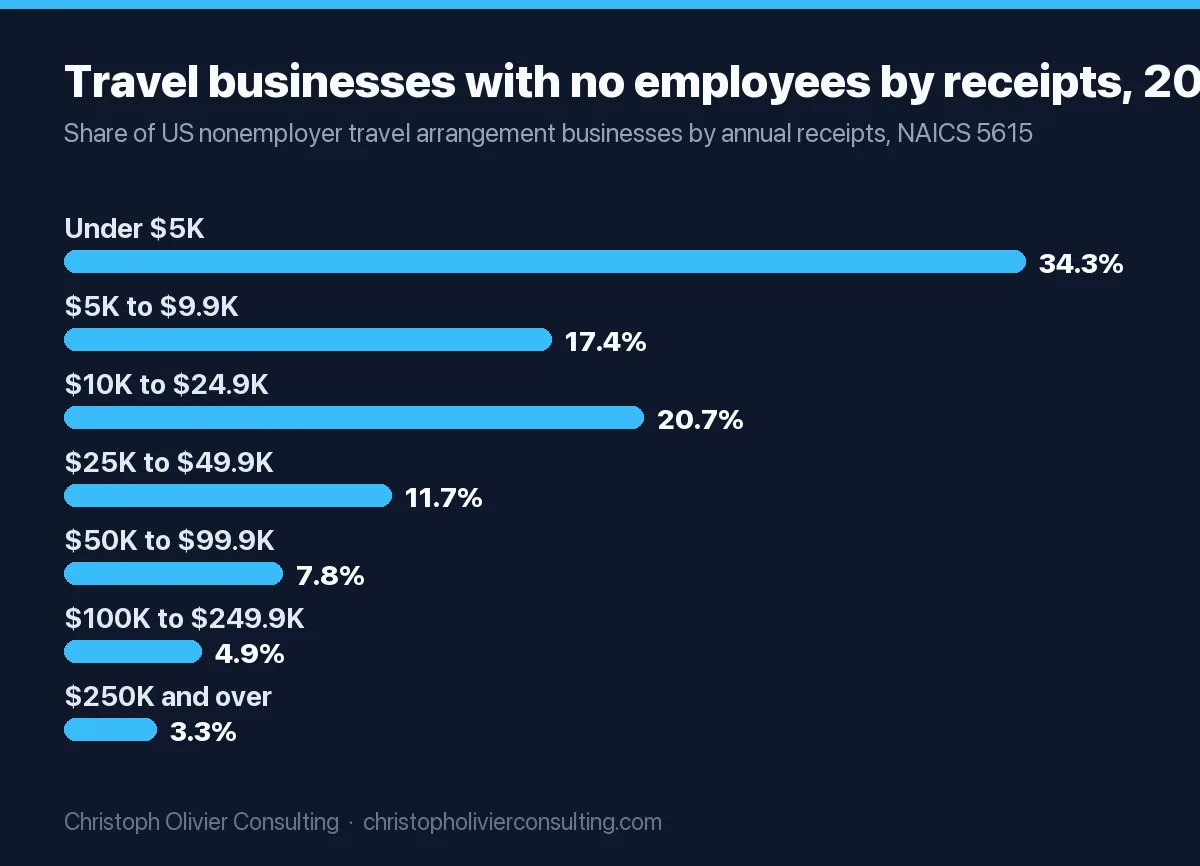
Most people asking “how much does a travel agency owner make” are, or will be, a business with no employees. The 2022 Nonemployer file for NAICS 5615 (travel agencies, tour operators and other reservation services combined; Census does not publish 561510 alone at this level) shows how small most of them are.
| Annual receipts | Businesses | Share | Cumulative |
|---|---|---|---|
| Under $5,000 | 26,089 | 34.3% | 34.3% |
| $5,000 to $9,999 | 13,234 | 17.4% | 51.7% |
| $10,000 to $24,999 | 15,721 | 20.7% | 72.3% |
| $25,000 to $49,999 | 8,905 | 11.7% | 84.0% |
| $50,000 to $99,999 | 5,899 | 7.8% | 91.8% |
| $100,000 to $249,999 | 3,731 | 4.9% | 96.7% |
| $250,000 and over | 2,511 | 3.3% | 100% |
Source: U.S. Census Bureau, Nonemployer Statistics 2022, NAICS 5615, all legal forms. Shares are my calculations. Receipts are before expenses.
Only 16.0% of these businesses took in $50,000 or more, and only 8.2% took in $100,000 or more. If your goal is to replace a $50,000 job, you need to land in roughly the top sixth of nonemployer travel businesses.
Owner pay is commission income minus costs, then salary plus profit
A travel agency does not sell travel for its own account in most cases. It earns a commission from the supplier, and sometimes a planning fee from the client. For an owner, pay is built in layers:
- Bookings, the retail value of the trips you sell.
- Times the commission rate on the commissionable part. Fora says hotel commissions are typically 10% to 15% and that its advisors average 12% across all supplier and booking types (Fora pricing, Fora host-agency guide). Cruise Planners uses an 18% average supplier commission in its own franchise example (Cruise Planners royalty page). Expedia’s partner site says flights “often carry very low or no commission” (Expedia Group partner blog). Taxes and port fees are not commissionable.
- Times your split if you work under a host or franchise. Fora starts advisors at 70/30, moves to 80/20 at $300,000 in annual bookings and 90/10 at $2 million (Fora pricing). Cruise Planners charges franchisees a 3% royalty on commissionable revenue, dropping to 2% at $500,000, 1% at $750,000 and 0% at $2 million (Cruise Planners). A fully independent agency keeps 100% but pays for everything a host provides.
- Minus operating costs: membership or franchise fees, insurance, technology, marketing, registrations, staff.
- What is left is the owner’s pay, before income tax and, for sole proprietors and LLC members, before the 15.3% self-employment tax (12.4% Social Security plus 2.9% Medicare, per IRS Topic 554).
Once you have staff, split that last line in two. One part is the wage you would pay someone to do your selling: $49,650 at the BLS industry median. The rest is profit, the return on your client list and your risk. A storefront owner who clears $100,000 is really earning about $50,000 in agent wages plus $50,000 in profit.
Travel agent profit margin: what the public companies disclose
The only audited margins in this business come from the online travel companies. They are context, not targets: their revenue is mostly merchant and advertising income, not agent commissions.
| Company, fiscal 2025 | Gross bookings | Revenue | Revenue as % of bookings | Net income | Net margin on revenue |
|---|---|---|---|---|---|
| Expedia Group 10-K | $119.59 billion | $14.73 billion | 12.3% (B2B segment 13.6%) | $1.29 billion | 8.8% (my calc.) |
| Booking Holdings 10-K | $186.11 billion | $26.92 billion | 14.5% | $5.40 billion | 20.1% (my calc.) |
Revenue margins are as published. Net margins are net income attributable to the company divided by total revenue (my calculations). Booking Holdings spent $8.19 billion, 30.4% of revenue, on marketing in 2025, a cost a referral-based independent agency mostly avoids.
The useful comparison: Expedia and Booking keep 12.3% and 14.5% of what travelers spend, close to the 10% to 18% commission range a human agency earns. The difference is that a host-affiliated advisor then gives 10% to 30% of that commission to the host, so the advisor’s take on a booking is about 7% to 14% of trip value before costs at a 10% to 15% commission. As a share of travel sold, owner pay in the three models below works out to 4.3% to 7.4% of bookings, or 39% to 61% of gross commission (my calculations). Compare that with other service businesses in the profit margin by industry table, or with a similar commission-driven model in insurance agency revenue and margins.
Worked P&L: what an owner keeps at three sizes
This is my own model, not survey data. Commission, split and fee terms come from the published Fora and BLS figures above. Everything else is a labeled assumption you should replace with your numbers.
| Line (own calculation) | Part-time, host agency | Full-time, host agency | Storefront agency, owner + 3 agents | Basis |
|---|---|---|---|---|
| Travel booked per year | $150,000 | $750,000 | $4,000,000 | Assumption |
| Average commission rate | 12% | 12% | 11% | Fora advisor average is 12%; the independent agency is assumed 1 point lower without a host’s preferred-partner rates |
| Gross commission | $18,000 | $90,000 | $440,000 | Bookings × rate |
| Kept after host split | $12,600 (70%) | $68,400 (70% to $300K, 80% above) | $440,000 (100%) | Fora published split tiers, applied to bookings above each threshold |
| Host membership | $299 | $299 | n/a | Fora annual plan |
| Agent wages | n/a | n/a | $148,950 | 3 × $49,650 BLS industry median |
| Payroll taxes and benefits | n/a | n/a | $17,874 | Assumption: 12% of wages |
| Rent | $0 (home) | $0 (home) | $30,000 | Assumption |
| Booking tech, CRM, website | $600 | $1,200 | $15,000 | Assumption |
| E&O and liability insurance | $0 | $1,500 | $4,000 | Fora covers advisors under its E&O policy but recommends an own policy for LLCs; amounts assumed |
| Marketing | $600 | $6,000 | $30,000 | Assumption |
| Registrations, IATAN, CLIA | $100 | $222 | $1,500 | State and association fees below |
| Accounting, bank, legal, other | $0 | $1,000 | $15,000 | Assumption |
| Familiarization travel and training | $1,000 | $3,000 | $5,000 | Assumption |
| Owner pay before income tax | $10,001 | $55,179 | $172,676 | Kept commission minus all lines |
| Self-employment tax if a sole proprietor | $1,413 | $7,797 | depends on entity | 15.3% on 92.35% of net earnings (IRS Topic 554) |
| Versus a $50,160 employed agent median | $40,159 short | $5,019 ahead before SE tax | $122,516 ahead, owner also sells | BLS May 2025 |
Why the storefront case looks so much better: it sells $1 million of travel per person, owner included, and keeps the full commission. Census suggests that is achievable but not typical. Firms in the $500,000 to $999,999 receipts band averaged $698,735 in commission and fee income with 3.0 employees, about $233,000 per employee (my calculation). My storefront case assumes $146,667 per employee, so it is not aggressive on productivity. It is aggressive on commission rate and on the owner keeping a $4 million book of clients.
How sensitive owner pay is to bookings and commission rate
Full-time host advisor model: same Fora split tiers and $13,221 in yearly costs, varying only bookings and average commission.
| Bookings per year (own calculation) | 10% average commission | 12% average commission | 15% average commission |
|---|---|---|---|
| $300,000 | $7,779 | $11,979 | $18,279 |
| $500,000 | $23,779 | $31,179 | $42,279 |
| $750,000 | $43,779 | $55,179 | $72,279 |
| $1,000,000 | $63,779 | $79,179 | $102,279 |
| $1,500,000 | $103,779 | $127,179 | $162,279 |
For the storefront model ($267,324 in yearly costs, 100% of commission kept), owner pay is $32,676 at $3 million and 10%, $172,676 at $4 million and 11%, and $332,676 at $5 million and 12%. Fixed costs make the storefront high-risk at low volume and very profitable at high volume.
How much does a travel agent make on a $10,000 trip?
Between nothing and about $1,800 to the agency, depending on what the $10,000 buys. At the 10% to 15% hotel range Fora cites, the agency earns $1,000 to $1,500 on a $10,000 commissionable hotel or package booking. On a flight-only booking it may earn close to nothing. Cruise Planners’ own example of a $10,000 commissionable booking at 18% pays $1,800 in commission, keeps a $300 royalty and leaves the franchise owner $1,500 (Cruise Planners).
For an advisor on a 70/30 host split at a 12% commission, the same trip pays $840. Suppliers pay after travel, not at booking: Cruise Planners says commissions are typically paid after the client’s trip concludes (Cruise Planners commission calculator). A trip booked in March for October is October income.
How many trips you need to sell to earn an agent’s median wage
Target: $50,160 (BLS median) plus $13,221 in yearly costs from the full-time model, so $63,381 of kept commission. Split held at 70% throughout, which is conservative because Fora’s split rises above $300,000 in bookings.
| Average commissionable trip value | At 10% commission | At 12% commission | At 15% commission |
|---|---|---|---|
| $3,000 | 302 trips ($210 each) | 252 trips ($252 each) | 202 trips ($315 each) |
| $5,000 | 182 trips ($350 each) | 151 trips ($420 each) | 121 trips ($525 each) |
| $10,000 | 91 trips ($700 each) | 76 trips ($840 each) | 61 trips ($1,050 each) |
Own calculation: trips needed = $63,381 ÷ (trip value × commission × 0.70), rounded up. Use your own numbers: trips = (target pay + yearly costs) ÷ (average trip × commission rate × your split).
The table explains most of the Reddit threads about this job. Selling 250 small trips a year is a call-center workload. Selling 60 to 90 high-value trips is a specialist business. If you are choosing a niche, start from this math, then build the client pipeline in travel agency marketing built on commission math.
Travel agent start up cost by business model
Startup cost depends almost entirely on whether you join a host, buy a franchise or go independent. These are the published fees I could verify, all checked November 2026.
| Cost item | Published amount | Who pays it | Source |
|---|---|---|---|
| Host agency membership (Fora) | $299 a year or $99 a quarter | Host-affiliated advisor | Fora pricing |
| Franchise fee (Cruise Planners) | $8,995 one time, plus 3% royalty on commissionable revenue to start | Franchise owner | Cruise Planners |
| IATAN accreditation application | $280 head office or branch; home-based and new businesses must show at least $10,000 in available or invested capital | Independent agency | IATAN requirements and fees |
| CLIA Travel Agency Membership | $429 a year, includes one $139 individual membership | Independent agency (optional) | CLIA |
| California seller of travel registration | $100 per business location a year, plus Travel Consumer Restitution Corporation assessment | Sellers doing business in CA | Bus. & Prof. Code § 17550.20 |
| Florida seller of travel registration | $300 a year plus surety bond up to $25,000; $50 a year per independent sales agent | Sellers located in or selling into FL | FDACS |
| Washington seller of travel license | $222 application, $222 renewal | Sellers doing business in WA | WA Department of Licensing |
| Hawaii travel agency renewal | $138 on-time renewal, active status; client trust account rules under HRS 468L | Agencies licensed in HI | Hawaii DCCA |
Own-calculation first-year budgets using those fees: a host-affiliated home advisor can start for roughly $1,300 to $3,000 (membership, a basic website and CRM, marketing, one registration). A Cruise Planners franchise starts at the $8,995 fee plus the same running costs. An independent agency with IATAN accreditation needs the $280 application, the $10,000 capital test for home-based or new businesses, insurance and a booking stack, so plan on $15,000 or more before you hire anyone. If you sell to clients in California, Florida, Washington or Hawaii, check the registration rules before you take a deposit, because they apply based on where you sell, not only where you live.
Is owning a travel agency profitable?
For a minority of owners, yes. Census shows the distribution is steep: half of nonemployer travel businesses took in under $10,000 in 2022, while 8.2% took in $100,000 or more. Among employer agencies, 65.2% had under $500,000 in commission and fee receipts. The model above says a home-based owner needs roughly $750,000 in yearly bookings at a 12% average commission to out-earn the $50,160 agent median, and a storefront owner needs $3 million or more to cover fixed costs comfortably. In my view, if you cannot name where your first 50 trips will come from, the numbers say to start under a host rather than an independent storefront.
What type of travel agent makes the most money?
The data points to three traits, not one job title. First, high commissionable trip values: the trips table shows a $10,000-average advisor needs a third as many sales as a $3,000-average one. Second, products with high commission rates: hotels at 10% to 15% and cruises around the 18% Cruise Planners uses in its example, versus flights that often pay little or nothing. Third, volume that moves you up a split or royalty tier: Fora’s 90/10 tier starts at $2 million and Cruise Planners’ royalty drops to 0% at $2 million. Employed agents top out lower: the BLS 90th percentile was $76,660 in May 2025.
Do I need an LLC as a travel agent?
Federal tax law does not require one. The IRS treats a single-member LLC as a disregarded entity reported on the owner’s own return unless it elects to be taxed as a corporation, and a multi-member LLC as a partnership by default (IRS LLC page). Either way, net earnings carry the 15.3% self-employment tax. An LLC is a liability and banking decision, not a tax saving by itself. Separate from entity choice, seller of travel registration in states such as California, Florida, Washington and Hawaii applies to the business, and Fora recommends its own E&O policy for advisors operating as an LLC (Fora cost guide). Ask a CPA before electing S corporation status.
Are travel agents declining?
Employment is flat, not collapsing. BLS projects 0% change in travel agent jobs from 2025 to 2035 (about 100 jobs added) and roughly 5,900 openings a year as people leave the job. The online platforms took the simple bookings: Expedia handled $119.59 billion and Booking Holdings $186.11 billion of travel in 2025. What is left for human agents is complex, high-value and group travel, which is exactly where the commission math works. If you sell hotel stays, it also helps to understand the other side of the deal, covered in how hotels weigh OTA commissions against direct bookings.
Pass/fail worksheet: will your agency pay you?
Run your last 12 months, or your plan, through these checks. Two or more fails mean the business is a side income, not a salary yet.
| Check | Pass | Fail | Benchmark source |
|---|---|---|---|
| Average commission rate on all bookings | 12% or more | Under 10% | Fora advisor average 12%; hotels 10% to 15% |
| Share of bookings that are flight-only | Under 10% | Over 30% | Flights often carry very low or no commission (Expedia Group) |
| Kept commission per trip sold | $500 or more | Under $250 | Own trips table: under $250 needs 250+ trips a year |
| Yearly bookings for a full-time host advisor | $750,000 or more | Under $400,000 | Own model: $750,000 at 12% clears the BLS median |
| Commission revenue per person in a storefront | $150,000 or more | Under $100,000 | Census SUSB: about $233,000 per employee in the $500K to $999K band |
| Owner pay versus employed agent median | Above $50,160 | Below $34,610 | BLS May 2025 median and 10th percentile |
| State registration in place before taking deposits | Yes, every state you sell into | No or unsure | CA, FL, WA, HI rules above |
If the worksheet shows the problem is lead flow rather than margins, compare the channels in tourism SEO for travel operators. If you want a second opinion on an agency growth plan, you can book a consultation. Outside the U.S., none of the Census, BLS or state registration figures here apply.
How the numbers on this page were built
- Census. SUSB 2022 for NAICS 561510 (employer travel agencies) and Nonemployer Statistics 2022 for NAICS 5615 (the finest level published for nonemployers). All averages, shares and ratios are my calculations. Census asks travel agents to report commissions and fees rather than gross sales.
- BLS. May 2025 OEWS figures as published in the Occupational Outlook Handbook for travel agents (SOC 41-3041), read from a November 1, 2026 archive copy because bls.gov blocked automated requests. Owners are not in OEWS.
- IRS. Sole Proprietorship Returns Table 1, tax year 2023, does not break out travel agencies, so no IRS profit figure is used.
- Host and franchise terms. Fora’s published pricing, split tiers and 12% average commission, and Cruise Planners’ published franchise fee and royalty tiers, are vendor statements, not audited figures.
- 10-K filings. Expedia Group and Booking Holdings fiscal 2025. Net margins are my calculations.
- Model assumptions. Booking volumes, the 11% storefront commission rate, payroll load, rent, technology, insurance, marketing, accounting and travel costs are my assumptions, labeled in each table.
Ready to scale your revenue?
Book a free 30-min consultation. We’ll diagnose your growth bottleneck and map out the 3 highest-leverage moves for your business.
Frequently asked questions
How much does a travel agency owner make?
No government survey reports owner pay. In a model built from Census, BLS and published host terms, a part-time advisor booking $150,000 a year through a host keeps about $10,000 before tax, a full-time advisor booking $750,000 keeps about $55,000, and the owner of a four-person agency booking $4 million keeps about $173,000. Half of nonemployer travel businesses took in under $10,000 in 2022.
What is the average travel agency owner salary?
There is no reliable average. Job sites show $102,015 (Glassdoor) to $114,182 (ZipRecruiter), built from listings and self-reports. Census puts receipts at $41,703 per travel business with no employees in 2022, before expenses. Employed travel agents earned a median of $50,160 in May 2025, which is the wage an owner is really competing with.
What is a travel agent's profit margin?
A travel agency earns a commission, typically 10% to 15% on hotels per Fora, often near zero on flights. After a 70/30 to 90/10 host split, an advisor keeps about 7% to 14% of trip value before costs. In the worked model on this page, owner pay equals 4.3% to 7.4% of bookings. Expedia kept 8.8% of revenue as net income in 2025, Booking Holdings 20.1%.
How much does a travel agent make on a $10,000 trip?
At a 10% to 15% commission the agency earns $1,000 to $1,500 on a $10,000 commissionable booking; taxes and port fees are excluded. On a 70/30 host split at 12%, the advisor keeps $840. Cruise Planners' own example at 18% pays $1,800, keeps a $300 royalty and leaves the franchise owner $1,500. Commission is usually paid after the client travels.
What is the travel agent start up cost?
It depends on the model. Fora's host membership is $299 a year or $99 a quarter. A Cruise Planners franchise is $8,995 one time plus a 3% royalty to start. An independent agency pays $280 for an IATAN application and must show $10,000 in capital if home-based or new. State seller of travel fees run $100 in California to $300 plus a bond in Florida.
Is owning a travel agency profitable?
For a minority. In 2022, 51.7% of nonemployer travel businesses had receipts under $10,000 and 8.2% reached $100,000. Among employer agencies, 65.2% had under $500,000 in commission and fee receipts. In the model on this page, a home-based owner needs about $750,000 in yearly bookings at a 12% average commission to beat the $50,160 median wage of employed agents.
Do I need an LLC as a travel agent?
Federal tax law does not require one. The IRS treats a single-member LLC as a disregarded entity on your own return unless it elects corporate tax treatment, so the 15.3% self-employment tax still applies to net earnings. An LLC is mainly a liability decision. State seller of travel registration in places like California, Florida, Washington and Hawaii applies regardless of entity type.
Small business owner income