

A retail marketing strategy for an independent store has three jobs, in this order: get found by shoppers within a few miles who are searching for something you stock, give them a reason to walk in that a website cannot match, and capture a phone number or email so the next visit does not depend on paid ads. Then you time all three to your own category’s sales curve, which for some store types puts more than a quarter of the year’s revenue into November and December.
That order matters because the store is still where most retail spending happens. The Census Bureau’s Quarterly Retail E-Commerce Sales report put e-commerce at 17.1% of total US retail sales in Q2 2026 (seasonally adjusted), growing 12.2% year over year against 6.7% for retail overall. Online is gaining share, but roughly 83 cents of every retail dollar is still spent somewhere other than an online checkout. Your plan should be built to win that spending, locally, against chains and marketplaces that outspend you on ads but cannot match you on proximity, expertise or relationships.
Want a specialist to build this for your business? See how CO Consulting’s marketing services work, starting with a diagnostic and audit.
This guide is written for the owner of a single store or a small chain (two to fifteen locations) and whoever runs marketing there. It skips the generic “4 Ps” lecture and gives you the parts most retail marketing guides leave out: real seasonality data by store type, the exact Google setup that puts your shelf on Maps, the federal rules behind SMS marketing for retail, and a worked budget calendar.
Start your retail marketing strategy with your store’s sales curve
Most tactic lists treat every retailer the same. A hardware store and a toy store should not be running the same calendar. The table below is built from the Census Bureau’s Monthly Retail Trade Survey estimates for 2025 (not seasonally adjusted, so the real swings show). If sales were flat all year, November plus December would be 16.7% of annual sales and every month would sit at an index of 1.00.
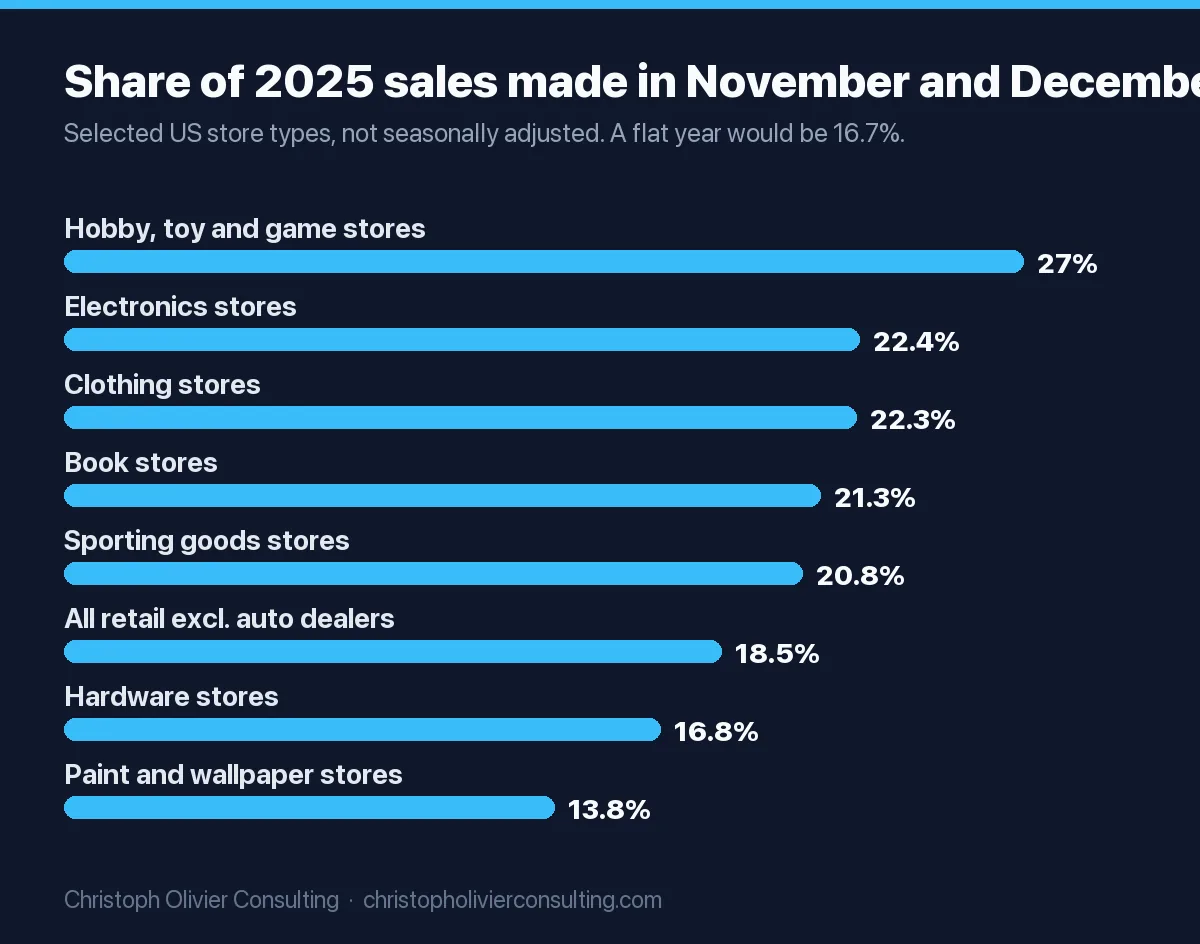
| Store type (Census category) | Nov + Dec share of 2025 sales | Peak month (index vs. average month) | Slowest month (index) | What it means for your plan |
|---|---|---|---|---|
| Hobby, toy and game stores | 27.0% | Dec (1.67) | Feb (0.72) | Build your list all year so Q4 is a harvest, not a scramble. Q4 was 36.2% of the year. |
| Department stores (benchmark) | 26.5% | Dec (1.82) | Jan (0.68) | The chains you compete with are at full volume in December. Do not try to outshout them then. |
| Electronics stores | 22.4% | Dec (1.49) | Feb (0.86) | Gift buying concentrates late. Service, setup and trade-in offers carry the slow months. |
| Clothing stores | 22.3% | Dec (1.48) | Jan (0.73) | Two seasons matter: spring (March) and holiday. January needs a clearance plan, not ads. |
| Book stores | 21.3% | Dec (1.64) | Feb (0.81) | January is the second-biggest month (gift cards, school terms). Plan a January event. |
| Sporting goods stores | 20.8% | Dec (1.48) | Feb (0.75) | August back-to-school and team seasons rival the holidays. Two peaks, two campaigns. |
| Shoe stores | 20.7% | Dec (1.42) | Jan (0.66) | August is the second peak. School-calendar marketing beats generic holiday promos. |
| Beer, wine and liquor stores | 19.4% | Dec (1.30) | Feb (0.85) | December is big, May is the runner-up. Tastings and events work year round. |
| Gift, novelty and souvenir stores | 18.4% | Oct (1.51) | Feb (0.68) | October, not December, is the peak. Halloween and fall tourism drive the year. |
| Used merchandise stores | 18.0% | Oct (1.13) | Jan (0.82) | A gentle curve. Steady weekly content and new-arrival alerts matter more than a season. |
| Hardware stores | 16.8% | May (1.12) | Feb (0.79) | Spring projects drive the year. Your “holiday” is April to June. |
| Furniture stores | 16.6% | May (1.06) | Jan (0.94) | The flattest curve in the table. Long consideration cycles reward retargeting and follow-up. |
| Paint and wallpaper stores | 13.8% | Jul (1.14) | Jan (0.79) | Summer is the season. Holiday promotions are mostly wasted here. |
| All retail, excluding auto dealers | 18.5% | Dec (1.17) | Feb (0.86) | The national average, for comparison. |
Index = that month’s 2025 sales divided by the average month. Census categories include chains as well as independents, 2025 figures are subject to revision, and your own POS history should overrule the national curve. Pull your last two years of monthly sales and put them next to your row. Where they differ, trust yours.
The practical point: your heaviest marketing effort should land a few weeks before your peak, and your list building should happen in the months when ads are cheap and you have time to talk to customers. For a toy store that means building the SMS and email list from February to September. For a hardware store it means owning March.
Job 1: Get found by shoppers who are a few miles away
The first job of any marketing strategy for retail stores is showing up when someone nearby searches “kids’ rain boots near me” or a specific product name. Google gives physical stores more free surface area here than most owners use.
Put your inventory on Google Search and Maps for free
Google’s Business Profile help on showcasing in-store products describes a free Local Inventory app that syncs products from your point-of-sale system, with Clover, Square and Lightspeed named as compatible systems. Eligibility is limited to stores in the US, Canada, UK, Ireland and Australia with a verified Business Profile, an eligible category, and products carrying manufacturer UPC or EAN barcodes. If you sell items with your own labels, Google says to put both the manufacturer barcode and your label on the product and scan both at checkout. Products can then appear on surfaces such as “See what’s in store” on your profile, plus Search, Maps and the Shopping tab.
No compatible POS? The Business Profile product editor lets you add items one at a time. Google also prompts stores with quick yes or no questions about whether they carry specific products, and those answers show in the Products section of your profile on Maps and Search. It takes minutes and many stores leave the questions unanswered.
Free local listings and local inventory ads through Merchant Center
If you have more SKUs, more than one location, or want to pay to promote stock, the route is Google Merchant Center. Google’s policy for local inventory ads and free local product listings requires a physical location where customers can view and buy the item, and a store that sells only to members is not eligible unless non-members can also buy. Here is the sequence, condensed from Google’s implementation guide:
- In Merchant Center, go to Settings, then Add-ons, and activate Free local listings (and Local inventory ads if you plan to advertise) for your country.
- Connect each store’s Business Profile. Google’s policy page says the store code in your local inventory data must match your Business Profile store code, and a mismatch is a common cause of the “No physical stores found” error.
- Choose how you report availability: per-store stock, or “ship to store” for pickup with a published turnaround time.
- Pick a product page experience. Google can host a product page for you if your website does not show in-store stock.
- Add inventory, either by uploading a local inventory file or by linking a local data provider that manages it for you.
- If your product pages do not show store stock, name an inventory verification contact and request verification.
- Only for paid local inventory ads: link a Google Ads account and build campaigns.
My view: get steps 1 through 6 live before you spend a dollar on local inventory ads. Free listings tell you which products people actually look for near your store, which is better input for ad spend than guessing.
The Business Profile basics that still decide the map pack
Accurate hours (including holiday hours, which is when they break most often), a category that matches what you mainly sell, recent photos of the shelves rather than the storefront only, and steady review requests at the register. Answer reviews by name. None of this is new, but in most local markets the independent with the complete profile beats the one with the bigger ad budget.
Job 2: Give people a reason to come in that a marketplace cannot copy
A marketplace wins on selection, price comparison and delivery. You win on things that only happen in a room: touching the product, expert advice, a fitting, a demo, a community of people who like the same thing. Your in-store marketing strategies should make those advantages visible and schedulable.
- Events with a calendar, not one-offs. A monthly build night at a hobby store, a Thursday tasting at a wine shop, a gait-analysis Saturday at a running store. Recurring events give your email and SMS list something to announce, and they give Google Business Profile posts something real to say.
- Clienteling. Record sizes, preferences and past purchases in the POS customer profile and use them. “The new fall boots in your size came in, I set a pair aside until Friday” is the single message a national chain struggles to send at scale.
- Displays that change on a schedule. Front-of-store and window changes every two to four weeks, tied to your sales curve. Photograph each one; that is your social content for the month.
- Vendor co-op funds. Many brands set aside co-op or market development money for the retailers who carry them. Ask each major vendor what they offer and what proof they need. It is the most overlooked line in small-store marketing budgets.
- Local partnerships. The coffee shop next door, the school PTA, the youth league. Cross-promotion costs little and reaches people who already live within your trade area.
The aim is that every channel points back to the same few reasons to visit. If you want to see how other brands tie store, email, social and search together, these multichannel marketing examples show the pattern.
Job 3: Own the relationship with email and SMS marketing for retail
Ads rent attention. A list of customers who agreed to hear from you is an asset you own, and your POS is the best list-building tool you have. Ask at checkout, offer something concrete (event invites, first look at new arrivals, a birthday treat), and record consent properly.
Email works well for longer content: new arrivals with photos, event calendars, gift guides. SMS works for time-sensitive, short messages: “it’s back in stock,” “two seats left Thursday,” “your order is ready.” Pick a tool that connects to your POS so purchase history drives who gets what; this comparison of SMS marketing platforms covers the options and pricing models.
The SMS rules a store owner actually needs to know
Retail texting is regulated by the Telephone Consumer Protection Act and by carrier rules. This is not legal advice, but these are the federal rules as written in 47 CFR 64.1200 and the carrier requirements that sit on top of them.
| Rule | What it requires of a store | Source |
|---|---|---|
| Written consent for marketing texts | Automated marketing messages need “prior express written consent”: a written, signed agreement that clearly authorizes the seller to send advertisements and includes the phone number they go to. Use a checkbox or keyword opt-in, never a pre-checked box. | 47 CFR 64.1200(a)(2) and (f)(9) |
| Opt-out keywords | Replies of stop, quit, end, revoke, opt out, cancel or unsubscribe are treated as reasonable revocation. Consumers can also opt out by other reasonable means. | 47 CFR 64.1200(a)(10) |
| Deadline to honor opt-outs | Within a reasonable time, no more than ten business days from receipt. In practice, configure your platform to stop instantly. | 47 CFR 64.1200(a)(10) |
| Confirmation text | One confirmation text after an opt-out is allowed if it only confirms the request and contains no promotion. | 47 CFR 64.1200(a)(12) |
| Quiet hours | Telephone solicitations are barred before 8 a.m. and after 9 p.m., recipient’s local time. Schedule campaigns inside that window. | 47 CFR 64.1200(c)(1) |
| Carrier registration (10DLC) | Texts sent from a standard 10-digit business number must be tied to a registered A2P 10DLC campaign. Twilio, for example, blocks messages to US numbers from unregistered 10DLC numbers. Toll-free numbers and short codes are separate sender types outside 10DLC. | Carrier and provider rules |
One moving part: the FCC released an order on October 1, 2026 revising the consent-revocation rules, with the changes taking effect November 25, 2026, according to a Brownstein Hyatt Farber Schreck client alert. The alert says the seven keywords and the ten-business-day window carry forward. If you text at volume, have counsel review your flows before the holiday season, and check your state, since state telemarketing laws can be stricter than the federal rule.
Sample SMS copy for a local store
Short, specific, with a reason to reply and a clear way out. Replace the brackets with your details.
- Register sign: “Text JOIN to [number] for event invites and new-arrival alerts from [Store]. Up to 4 msgs/month. Msg and data rates may apply. Reply STOP to cancel, HELP for help. Terms: [link]”
- Welcome: “[Store]: you’re in. Expect about 4 texts a month, events and restocks only. Our next event is [date]. Reply STOP anytime to opt out.”
- Event: “[Store]: Build night is Thu at 6pm, 12 seats, $10 kit included. Reply YES to hold a seat. Reply STOP to opt out.”
- Restock: “[Store]: the [product] you asked about is back, 6 in stock. We can hold one until Sat. Reply HOLD. Reply STOP to opt out.”
Notice what is missing: no all-caps discounts, no daily blasts. A store list is valuable because people trust it. Spend that trust on information they would be annoyed to miss.
Turn the curve into a retail marketing plan: a worked budget calendar
A retail marketing plan is the strategy with dates and dollars attached. Here is one method I like for small stores because it is simple enough to run on a spreadsheet: keep 40% of the annual budget as an always-on base spread evenly across the year (Business Profile, list building, events, a small evergreen search budget), and allocate the other 60% by the average of this month’s and next month’s share of sales, so spend leads demand instead of chasing it.
Worked example: a toy and hobby store with a $36,000 annual marketing budget, using the 2025 Census curve for hobby, toy and game stores. Substitute your own monthly sales once you have them.
| Month | Share of 2025 category sales | Suggested spend | Where the money goes |
|---|---|---|---|
| Jan | 6.4% | $2,540 | Gift card redemption follow-up, list cleanup, event calendar for spring |
| Feb | 6.0% | $2,620 | Slowest month: run in-store events, push SMS sign-ups at every sale |
| Mar | 7.2% | $2,690 | Spring break and Easter gifts; refresh Business Profile photos |
| Apr | 6.6% | $2,700 | Birthday-party offers to the list; school and league partnerships |
| May | 7.2% | $2,720 | End-of-school gifts; summer camp and club sign-ups |
| Jun | 6.9% | $2,720 | Summer program launch; rainy-day restock alerts |
| Jul | 7.2% | $2,850 | Mid-year review: which products get found on Google, which do not |
| Aug | 8.1% | $2,960 | Back-to-school; confirm holiday inventory feeds are complete |
| Sep | 8.2% | $3,080 | Holiday wish-list sign-ups; vendor co-op requests for Q4 |
| Oct | 9.2% | $3,610 | Halloween; start local inventory ads on top sellers; holiday event dates out |
| Nov | 13.1% | $4,120 | Biggest spend month: gift guides, Small Business Saturday, extended hours |
| Dec | 13.9% | $3,390 | Last-minute and pickup messaging; gift cards; January event teaser |
Spend peaks in November, not December, because most of the work of being chosen happens before the final weeks. December’s budget shifts toward people already on your list and toward last-minute “in stock today, pick up in an hour” messages, which is where a nearby store has the edge over shipping. The method is a starting point; a store with a strong August (shoes, sporting goods) gets a second hump automatically when you plug in its curve.
The 2026 holiday window in numbers
The National Retail Federation forecasts November and December 2026 retail sales will grow 4.2% over 2025 to $1.013 trillion, after 3.1% growth to $972 billion in 2025. NRF’s leadership described shoppers as prioritizing the holidays while staying mindful of budgets, and NRF expects 325,000 to 375,000 seasonal hires. Thanksgiving falls on November 26, which puts Small Business Saturday on November 28. For more on how shoppers behave in the window, see these holiday retail marketing statistics, and for campaign concepts that fit a local store, these Christmas marketing campaign ideas.
What to stop doing
Small retail budgets get eaten by tactics that look like marketing but rarely move a register. In most stores, these are the first to cut:
- Boosting posts with no offer and no audience limit. If you pay for social reach, restrict it to your trade area and give people a reason to visit this week.
- Discounting into your own peak. If November and December are a quarter of your year, a sitewide 25% off in early December gives away margin on sales you were likely to make. Use events and gift-with-purchase instead, and save markdowns for January.
- Paper punch cards. They reward loyalty but capture no data. A POS loyalty program that records who bought what does the same job and feeds your SMS and email.
- Competing on price-led search ads against marketplaces. Bid instead on what they cannot offer: “in stock near me,” same-day pickup, fitting, repair, classes.
- Random acts of content. One planned post per display change and per event beats daily filler.
Retail media, co-op money and when a retail marketing agency makes sense
Retail media means the ad networks that big retailers sell to the brands on their shelves; these retail media statistics show how much money now flows through them. For an independent store it matters in two ways. First, it is where your vendors’ marketing money increasingly goes, so ask them directly whether co-op funds exist for dealers like you. Second, a small chain with a decent email list, a busy website or in-store screens has a small version of the same asset: vendors will sometimes pay for featured placement in your newsletter or windows. Treat it as a bonus, not a strategy.
A retail marketing agency is worth paying when you have the plan above but not the hours to run it, usually somewhere past two or three locations. Ask any agency three things: can they work from your POS data rather than only ad platform data, have they set up Merchant Center local inventory before, and how do they handle SMS consent records. If you want an outside view on whether your current plan matches your sales curve, you can book a consultation.
How to tell if your retail marketing is working
Ad platform dashboards measure clicks. A store needs to measure visits and sales. Track these monthly, against the same month last year so seasonality does not fool you:
- Traffic: door counter or POS-estimated visitors, plus Business Profile calls, direction requests and website clicks.
- Conversion rate: transactions divided by visitors. Events and displays should move this, not only traffic.
- Average transaction value and units per transaction.
- Repeat rate: share of sales from customers identified in the POS who bought before.
- List growth: new SMS and email sign-ups per week, and opt-outs per send.
- Google product views: which listed products get seen, from Merchant Center or your Business Profile insights, to guide buying and ad spend.
If you only track one number, make it identified repeat sales. A retail marketing strategy that works turns first visits into a known customer list, and a known list into visits you can schedule.
Work with CO Consulting
Want this done for your business?
- A diagnostic call and an audit of your current marketing and numbers
- A prioritized 90-day plan built for your market
- Execution across SEO and AI search, paid ads, content, funnels and automation
- Weekly check-ins and monthly reporting, led by a fractional CMO
Frequently asked questions
What is a retail marketing strategy?
A retail marketing strategy is the plan a store uses to attract nearby shoppers, turn visits into sales and bring customers back. For an independent store it usually covers three jobs: being found on Google Search and Maps, giving people a reason to visit in person, and building an email and SMS list, all timed to the store's own seasonal sales curve.
What is the difference between a retail marketing strategy and a retail marketing plan?
The strategy decides who you are trying to reach, why they should choose your store and which channels you will rely on. The plan attaches dates, budgets and owners to that strategy: which campaigns run in which month, how much each gets, and how you will measure them. Most small stores need a one-page strategy and a twelve-month plan built on their sales history.
How much should a small retail store spend on marketing?
There is no single correct percentage. A practical approach is to set an annual figure you can sustain, keep part of it as an always-on base for your Google profile, list building and events, and weight the rest toward the weeks just before your peak months. Review the split each quarter against your POS sales so spending follows what actually sells.
Is SMS marketing legal for retail stores?
Yes, with consent. Federal rules in 47 CFR 64.1200 require prior express written consent for automated marketing texts, require you to honor opt-out words such as STOP within ten business days, and bar telephone solicitations before 8 a.m. or after 9 p.m. local time. Business texting numbers also need carrier registration, and some state laws are stricter.
Can I show my store's products on Google without a website?
Yes. Google Business Profile has a product editor for adding items one at a time, and a free Local Inventory app can sync in-store stock from compatible point-of-sale systems such as Clover, Square and Lightspeed, for stores with a verified profile and barcoded products. Products can then appear on your profile, Search, Maps and the Shopping tab.
How can independent retailers compete with Amazon?
Compete where a marketplace cannot: same-day availability a few miles away, expert advice, fittings, repairs, classes and events, and personal follow-up from staff who know the customer. Make that stock visible on Google, give people scheduled reasons to visit, and capture contact details at checkout so repeat visits do not depend on paid ads.
When should a store hire a retail marketing agency?
An agency usually makes sense once you have a clear plan but not the hours to run it, often past two or three locations. Ask whether they can work from your POS data, whether they have set up Google Merchant Center local inventory before, and how they store SMS consent records. A good agency should improve repeat sales, not only clicks.
More Growth Consulting guides
- Martial Arts School Marketing: A Playbook to Fill Mats and Keep Students
- Catering Business Marketing: The Channels That Actually Book Events
- Guest Posting: How to Earn Links and Authority Without Breaking Google’s Rules
- The 4 Ps of Marketing: Product, Price, Place, Promotion
- How Digital Marketing Grows a Business: The Engine, the ROI, and What to Expect
- Real Estate Marketing Plan Template
- All Growth Consulting guides →