

A strategic tax partner for tax advisors is an outside CPA, enrolled agent, tax attorney or tax planning firm that does the planning work your own firm does not, under one of three models: white-label plan production, co-advisory on shared clients, or referral with or without a revenue share. Financial advisors, CPA firms that only do compliance work, and estate or business attorneys are the usual buyers. Which model you can run depends on your license: the SEC Marketing Rule if you are an RIA, AICPA Code 1.520 if you are a CPA, Circular 230 if you practice before the IRS, and IRC 7216 consent before any tax return moves from one firm to the other.
Below: the three models side by side, every published price for tax planning partners and platforms (checked on the vendors’ own pages on 1 November 2026), the rules for each partner type, a copy-ready consent to disclose, a 100-point due-diligence scorecard, a co-advisory term sheet, and the revenue math with every assumption labeled.
Which kind of strategic tax partner does your firm need?
Start with the gap, not the vendor. Find your row, then read only the rules in its last column.
| Your firm | The gap clients notice | Partner type that fits | Rules you answer to |
|---|---|---|---|
| SEC-registered RIA or fee-only planner | Clients ask for Roth conversion, withdrawal order and business-owner tax projections you cannot sign off on | Co-advisory CPA or EA, or white-label plan production | SEC Marketing Rule 206(4)-1, Form ADV Part 2A Item 14, plus your partner’s 7216 duties |
| Hybrid or broker-dealer affiliated advisor | Same, plus clients with commission products | Your broker-dealer’s tax desk first, then an outside CPA | Marketing Rule for advisory business; your broker-dealer’s policy on outside payments |
| CPA firm that prepares returns but does not plan | Clients leave for a firm that sends a written multi-year plan | White-label planning partner or subcontractor | AICPA 1.520, 1.150.040, 1.300.040, 1.700.040; IRC 7216; state board |
| Enrolled agent practice | Business-owner clients want entity and compensation planning | CPA or tax attorney co-advisor for complex files | Circular 230 sections 10.27 and 10.30; IRC 7216 |
| Estate planning or business attorney | Plans need tax projections before documents are signed | Reciprocal referral CPA, or a CPA engaged on the matter | Your state’s version of ABA Model Rule 7.2(b)(4) |
If you are the CPA firm deciding which software, alliance or specialist programs to join, that is a different decision with different rules, covered in depth in our guide to strategic partnerships for accounting firms. This page is for the firm buying tax planning capacity from a partner.
Three ways to work with a strategic tax partner
Every arrangement on the market is one of these, or a mix. What changes between them is who signs the engagement letter, who sees the return, and whether money moves between the two firms.
| Model | How it works | Client signs with | Money between firms | Published examples |
|---|---|---|---|---|
| White-label plan production | The partner or platform builds the plan; it goes out under your brand and you present it | You | You pay the partner per plan or by subscription; you bill the client | TaxPlanIQ includes a “White labeled ROI Summary, slide deck and tax planning report” on every plan. Plan by Taxfyle produces a “White-labeled PDF branded with your logo, colors, and disclaimers.” Gelt lists a white-label model with co-branded flows, still in a “design partner phase.” |
| Co-advisory | Both firms serve the client; the tax partner owns the tax work, you own the investment and planning relationship | Both, or the tax partner directly | Usually none; each firm bills its own work | LPL’s Tax Planning Services (launched 26 October 2023) pair advisors with LPL tax specialists for one to three year planning scenarios. XY Planning Network describes three engagement levels: advisor-only, integrated, and client-only. |
| Referral, with or without revenue share | You introduce the client and step back from the tax work | The tax partner | None (reciprocal), a referral fee, or a share of the partner’s fees | Avantax’s Strategic Partnership Program lets a tax professional refer clients to an Avantax financial professional and receive “a commission split depending on your registrations,” with “no additional cost to the client.” Gelt’s referral model offers “revenue sharing opportunities.” |
None of these providers publishes a revenue-share percentage or a per-plan fee, so put any number from a sales call into the written agreement; the rules below require you to disclose it. A fourth option is software your own team runs, which suits W-2 households and retirees and struggles with multi-entity business owners.
What tax planning partners and platforms charge: published prices only
All figures are from each vendor’s own pricing page on 1 November 2026, shown in US dollars. “Not published” means the vendor gives no number and you need a written quote.
| Provider | Plan and price | Billing and limits | White-label output |
|---|---|---|---|
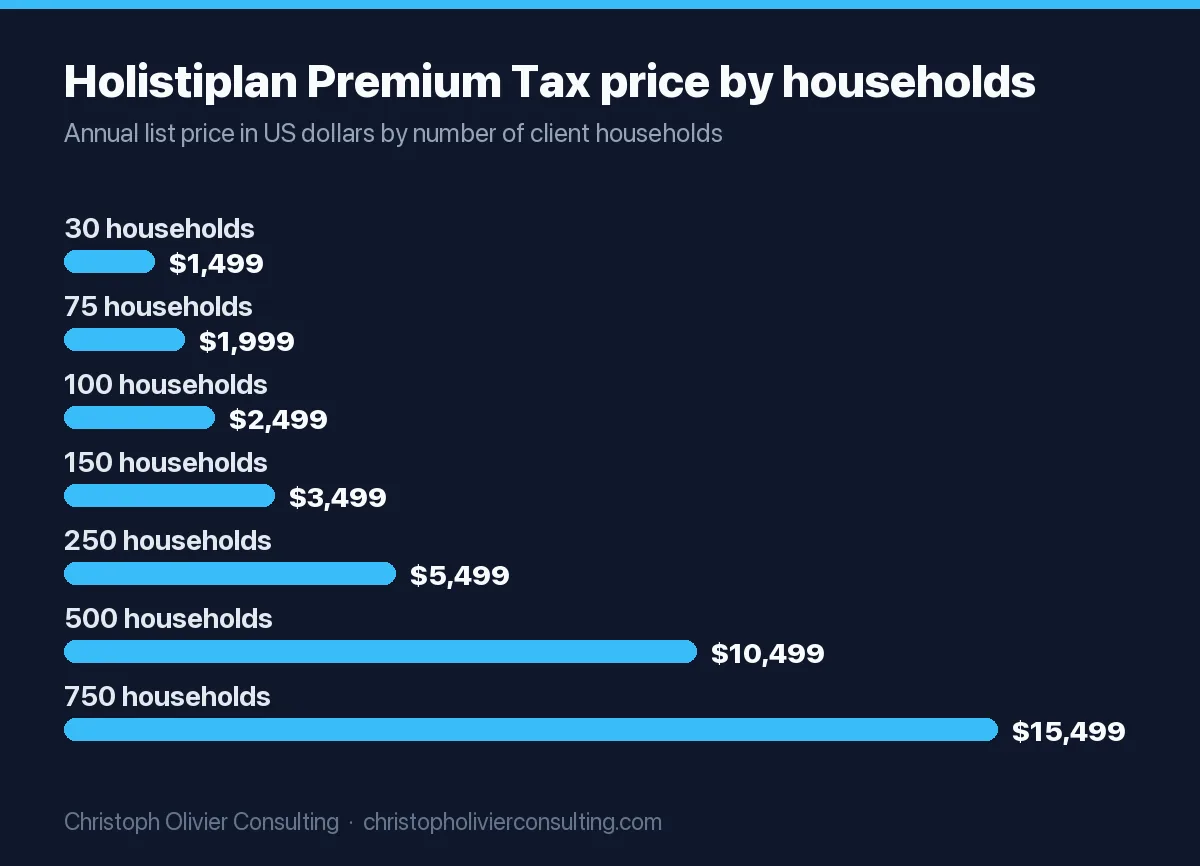
| Holistiplan | Basic Tax $749 a year at 30 households, $1,949 at 100, $4,049 at 250, $11,049 at 750. Premium Tax $1,499 at 30, $2,499 at 100, $5,499 at 250, $15,499 at 750. | Billed annually, priced by household count, unlimited users, 7-day free trial. Enterprise (over 750 households) is quote-only. Premium adds state scenarios and multi-year Roth conversion projections. | Client-ready summary reports and custom tax reports; discounts for NAPFA, ACP, Garrett Planning Network, Dynasty and SSG members |
| FP Alpha | Tax Planning from $1,125 for 75 credits to $9,750 for 750 credits. All-In-One Planning Solution $1,995 a year. | Prices “listed annually.” All-In-One includes 55 snapshots (35 tax, 10 estate, 10 insurance). Enterprise is custom pricing. | Custom reports in all packages |
| TaxPlanIQ | Basic from $397 a month, Standard from $697, Growth from $997. Advisor Accelerator Program add-on from $4,500. | Basic: 12 tax plans a year, 1 user. Standard: unlimited plans, 2 users. Growth: unlimited plans, 5 users, annual billing saves 15%. Projections and scenario modeling only on Growth. | Yes, on every plan |
| Corvee, now part of Instead | Instead Platform listed as “Free.” Instead Agent is “Pay per credit,” with pricing that “depends on your volume and usage.” | Existing Corvee accounts keep their pricing. Agent credits are valid 12 months; volume pricing via sales. | Custom-branded tax plans (per the Corvee page) |
| Plan by Taxfyle | Not published. “Your first 4 plans, free.” | Access through a waitlist; scans 49 strategies | Yes, branded PDF |
| LPL, Avantax, Gelt, Carson | Not published | Program terms come from the firm. Carson’s tax strategy program (announced 13 January 2025) is for its own advisors. | Not stated |
Converted to cost per client, using the vendors’ own numbers: Holistiplan Basic at 100 households is $19.49 a household and Premium is $24.99. FP Alpha’s 75-credit tax tier works out to $15.00 a credit and the 750-credit tier to $13.00. TaxPlanIQ Basic is $397 x 12 = $4,764 a year for 12 plans, so $397 a plan, while Growth is $997 x 12 = $11,964 a year, or $10,169.40 if the 15% annual saving applies, for unlimited plans. Software is cheap per client; the real costs are staff hours per plan and the credential behind the signature.
The rules for each partner type
A strategic tax partnership usually involves two licenses, and each side’s rules travel with it. Use this matrix first, then read the section for your license. This is general information, not legal advice; have your compliance officer or counsel sign off on the final agreement.
| You are | If you pay for referrals | If you receive money from the partner | Before client data moves |
|---|---|---|---|
| SEC-registered RIA | The referral is an endorsement: written agreement once pay exceeds $1,000 in 12 months, plus disclosures at the time of referral | Describe the arrangement and conflicts in Form ADV Part 2A Item 14.A | Your partner needs the client’s 7216 consent to send you return information it prepared |
| CPA (AICPA member) | Disclose the payment to the client in writing (1.520.001.04, 1.520.080) | Disclose in writing; no commissions on attest clients; California bars fees solely for referral | Tell the client about the third-party provider (1.150.040) and get a confidentiality contract or client consent (1.700.040), plus 7216 consent |
| EA or CPA practicing before the IRS | Do not accept help from anyone who gets clients in ways 10.30 forbids | No contingent fees outside the 10.27(b) exceptions | 7216 consent |
| Attorney | Nothing of value for a recommendation (Rule 7.2(b)) | Reciprocal referral only if not exclusive and the client is told | Client consent under your state’s confidentiality rule |
RIAs and financial advisors: SEC Marketing Rule and Form ADV
If you pay a CPA or EA for sending you clients, you are paying for an endorsement. Rule 206(4)-1 treats a compensated endorsement as an advertisement and sets three conditions: disclosures to the prospect when the endorsement is made, including that the person is compensated and any material conflicts, under paragraph (b)(1); a reasonable basis to believe the endorsement complies, plus a written agreement describing the activities and the compensation terms, under (b)(2); and no payments to disqualified persons, under (b)(3). The written agreement and disqualification checks are waived only for de minimis pay, defined as $1,000 or less in total during the preceding 12 months.
That threshold is easy to blow through. The SEC’s 16 December 2025 risk alert found advisers using lead-generation firms and adviser referral networks “without recognizing that certain arrangements created an endorsement,” and advisers who claimed the de minimis exemption because each payment was under $1,000 while the 12-month total was over it. The same logic applies to lead vendors, compared in our review of whether financial advisor lead generation services are worth it.
The money can also flow the other way. If the tax partner pays you or gives you any economic benefit for clients you send, Form ADV Part 2A Item 14.A requires you to describe the arrangement, explain the conflict, and say how you address it. Item 14.B covers you paying anyone outside your firm for referrals. Co-branded plans are advertising too: under paragraph (a) of the rule, nothing in them may imply a credential or a result you cannot substantiate.
CPAs: AICPA Code 1.520 and the third-party provider rules
The AICPA Code of Professional Conduct (updated for releases through September 2026) treats both directions the same way. Under 1.520.001.04, any member who accepts a referral fee for referring a CPA’s services, or pays one to get a client, “shall disclose such acceptance or payment to the client,” and 1.520.080 requires that disclosure in writing. If a planning partner pays you for recommending its product or service, that is a commission under 1.520.001, which is banned for clients whose audit, review, third-party compilation or prospective financial information examination your firm performs.
White-label work brings in three more interpretations. Before you send confidential client information to an outside provider, 1.150.040 says to inform the client, “preferably in writing,” and if the client objects, either do not use the provider or decline the engagement. Under 1.700.040 you also need a confidentiality contract with the provider or the client’s consent. And 1.300.040 makes you check the provider’s qualifications first and “adequately plan and supervise” its work. If you subcontract and rebill, 1.520.070 says a markup on the subcontracted services “would not constitute a commission.” Software vendor programs follow the same rule: Gusto’s revenue share option (0%, 10%, 15% or 20% by tier) and BILL’s referral program (up to $500 per referred client) are commissions too, and the full program table is on the accounting firm partnership page linked above.
State boards can be stricter. The California Board of Accountancy says a licensee “is prohibited from accepting any fee or commission solely for referral of a client to a third party,” and permitted commissions need a written disclosure signed by the client that states the amount or how it is computed.
Enrolled agents and CPAs: Circular 230 sections 10.27 and 10.30
Section 10.27 bars contingent fees for services, with exceptions for IRS examinations and challenges, certain interest and penalty claims, and judicial proceedings. Its definition of a contingent fee is a fee based on whether a return position avoids challenge or is sustained. A 2014 ruling in Ridgely stopped the IRS from applying the rule to ordinary refund claims, but AICPA 1.510.001 still bars CPA members from preparing an original or amended return or refund claim for a contingent fee. So a partner who prices plans as “a percentage of the tax we save you” needs a hard look before you sign.
Section 10.30 governs the co-branded material. It bars false, misleading or deceptive claims, bars use of the term “certified” or any implied employment relationship with the IRS, requires copies of direct mail and e-commerce communications to be kept for at least 36 months, and under 10.30(d) bars a practitioner from accepting assistance from anyone who, to the practitioner’s knowledge, obtains clients in a way the section forbids. The fee-publishing side of 10.30 is covered in our sales consultation playbook for accounting firms.
Attorneys: reciprocal referrals only
Under ABA Model Rule 7.2(b), as adopted in Minnesota’s Rule 7.2, a lawyer may not give anything of value for a recommendation, but may refer clients to a nonlawyer professional under a reciprocal agreement if it “is not exclusive” and the client “is informed of the existence and nature of the agreement.” The comment adds that such agreements “should not be of indefinite duration and should be reviewed periodically.” Check your own state’s version before you sign.
IRC 7216 consent before a return goes to your partner
This is the rule most strategic tax partnerships skip. Treasury Regulation 301.7216-2(d)(1) lets a preparer pass return information to another preparer to help prepare the return, but not for “substantive determinations,” defined as “an analysis, interpretation, or application of the law,” without first getting the taxpayer’s consent. Tax planning is substantive by definition. Paragraph (h)(1)(ii) adds that related or affiliated firms do not count as the same firm, so a “sister” planning company needs consent too.
Under 301.7216-3, the consent must be written and signed before the disclosure, name both parties, state the purpose and the recipient, list the information, and carry the taxpayer’s signature and date. With no stated duration it lasts one year. You cannot make return preparation conditional on it, and you cannot ask for a solicitation consent after handing over the completed return for signature. Rev. Proc. 2013-14 adds the format: a separate document (it can be attached to the engagement letter), at least 12-point type on paper, affirmative opt-in only, and fixed wording. A knowing or reckless violation of section 7216 is a misdemeanor with up to one year in prison, a fine of up to $1,000, or both; the civil penalty under section 6713 is $250 per disclosure or use, up to $10,000 a year.
Copy-ready consent to disclose to a planning partner. The first two paragraphs and the last one are the mandatory text from section 5.04(1)(a) and (d) of the Rev. Proc., in the required order; the authorization paragraph is yours to fill in. You may replace “we” with your firm’s name.
Federal law requires this consent form be provided to you. Unless authorized by law, we cannot disclose your tax return information to third parties for purposes other than the preparation and filing of your tax return without your consent. If you consent to the disclosure of your tax return information, Federal law may not protect your tax return information from further use or distribution.
You are not required to complete this form to engage our tax return preparation services. If we obtain your signature on this form by conditioning our tax return preparation services on your consent, your consent will not be valid. If you agree to the disclosure of your tax return information, your consent is valid for the amount of time that you specify. If you do not specify the duration of your consent, your consent is valid for one year from the date of signature.
I, [CLIENT NAME], authorize [YOUR FIRM] to disclose to [PARTNER FIRM NAME] my [2025] Form 1040 and all schedules, Forms W-2, 1099 and K-1, and [2026] year-to-date income figures, for the purpose of preparing a multi-year tax projection and tax planning recommendations. This consent is valid until [DATE].
Signature: ____________ Date: ____________
If you believe your tax return information has been disclosed or used improperly in a manner unauthorized by law or without your permission, you may contact the Treasury Inspector General for Tax Administration (TIGTA) by telephone at 1-800-366-4484, or by email at complaints@tigta.treas.gov.
If the partner is located outside the United States, section 5.04(1)(e) requires one more mandatory statement, and a longer one if the Social Security number is not masked. A consent to use (for your own planning offers) has different wording; it is in our client questionnaire template for tax planning firms, next to the intake questions that feed a plan.
Strategic tax partner due-diligence scorecard (100 points)
Run this on every candidate before the first client file moves. Five knockout gates come first: one “no” ends the conversation.
- The person who signs or reviews each plan is a CPA, EA or tax attorney, and you checked the license yourself.
- The partner will sign a written agreement that says who owns the client and the engagement letter.
- The partner uses a 7216 consent process (yours or theirs) before any return moves in either direction.
- No fee for a return or refund claim depends on the result (AICPA 1.510.001; Circular 230 10.27).
- Every dollar flowing either way can be disclosed to the client in writing, and your compliance officer approves it.
| Criterion | Points | Full points if | Zero if |
|---|---|---|---|
| Sample plan quality | 20 | Their redacted sample shows a multi-year projection, state tax, a stated assumptions page and the reviewer’s name | A one-page “savings estimate” with no assumptions |
| Fit with your clients’ issues | 15 | They can name recent work on your top three issues (for example Roth conversions, S corporation compensation, equity compensation) | Generalist answers to specific questions |
| Peak-season capacity | 15 | Written turnaround times for 1 February to 15 April | “It depends on volume” |
| Data security | 15 | SOC 2 Type II report on request (Holistiplan, for one, lists SOC 2 Type II on its pricing page), MFA, secure portal | Returns by email attachment |
| Pricing in writing | 10 | Per-plan or retainer fee, revision policy and any referral compensation stated in the agreement | “We’ll discuss on a call” |
| Client protection | 10 | Non-solicit clause and no investment or insurance product sales to your clients | Partner also sells products to the clients you send |
| Exit terms | 10 | Data returned or destroyed within 30 days; open plans finished or handed back | Partner keeps client files |
| Communication model | 5 | They support the level you want: advisor-only, integrated or client-only | One fixed model that does not fit your service |
My rule of thumb: 75 or more, sign; 60 to 74, pilot with three clients and rescore after one planning cycle; under 60, pass. These cutoffs are judgment, not research, so adjust them once you have results.
Co-advisory agreement term sheet (copy and edit)
Fill in the brackets and hand it to your attorney to turn into an agreement. It is a drafting aid, not legal advice.
| Term | Sample language | Why it is there |
|---|---|---|
| Roles | “[Advisor] provides investment and financial planning advice. [Tax Partner] provides tax projections and tax planning recommendations [and return preparation]. Neither party gives advice in the other’s area.” | Keeps each license inside its lane |
| Engagement | “[The client engages Tax Partner directly] OR [Advisor engages Tax Partner as a subcontractor and bills the client].” | Decides who owns the client and which rules apply |
| Fees | “Tax Partner charges [$ per plan / $ per year], fixed or hourly, never a percentage of tax saved.” | Circular 230 10.27; AICPA 1.510.001 |
| Referral compensation | “[No compensation is paid for referrals in either direction.] OR [Advisor pays Tax Partner [$/%] for each client who engages Advisor, within [30] days of the first fee collected.]” | Rule 206(4)-1(b)(2)(ii) written agreement; puts the number on paper |
| Disclosures | “Each party will disclose any referral compensation to the client in writing before the client engages, including the amount and the conflict.” | 206(4)-1(b)(1); AICPA 1.520.001.04 and 1.520.080; Form ADV Item 14 |
| Return information | “No tax return information moves between the parties until the client signs a consent to disclose meeting Treas. Reg. 301.7216-3 and Rev. Proc. 2013-14.” | IRC 7216 and section 6713 penalties |
| Data handling | “Client data is stored in [US-based, SOC 2 Type II] systems, used only for this engagement, and returned or destroyed within [30] days of request.” | AICPA 1.700.040 confidentiality contract |
| Credentials and signature | “Every plan is prepared or reviewed by a [CPA / EA / attorney] named on the plan. Advisor may not describe Tax Partner’s credential as its own.” | Marketing Rule paragraph (a); Circular 230 10.30 |
| Marketing approval | “Neither party uses the other’s name, logo or credential without written approval. Each party keeps copies of joint marketing for [36] months.” | 10.30(c) record keeping; your compliance review |
| Non-solicit and non-exclusivity | “Tax Partner will not solicit Advisor’s clients for investment or insurance services. This arrangement is not exclusive.” | Protects your book; required if either party is an attorney |
| Service levels | “Standard plans delivered within [10] business days, [20] between 1 February and 15 April.” | The busy season is when plans stall |
| Term and review | “Initial term [12] months, reviewed every [6] months; either party may end it on [60] days’ written notice.” | Matches the “not of indefinite duration” comment to Rule 7.2 |
To open the conversation with a prospective partner, the first-meeting emails in our referral partner outreach templates work for co-advisory pitches too.
Revenue math: what each model earns, with assumptions labeled
No one publishes a benchmark for what a strategic tax partnership earns, so build your own. The example is an RIA adding tax planning for 40 households a year. Vendor prices are the published figures above. Everything marked “assumption” is illustrative.
| Model | Cost per household | How it is calculated |
|---|---|---|
| Software, in-house | About $350 | Holistiplan Premium at the 75-household tier is $1,999 a year (40 households sit above the 30 tier). Assumption: 2 hours per plan at an internal cost of $150 an hour = $300. $1,999 / 40 = $49.98, plus $300 = $349.98. |
| White-label partner | $675 | Assumption: the partner quotes $600 a plan (no provider above publishes one). Assumption: 30 minutes of your review at $150 an hour = $75. |
| Co-advisory, client pays partner | $0 to you | The partner bills the client. Your cost is meeting time; your gain is retention, which you should track rather than assume. |
Now price it. XY Planning Network’s advisor blog gives a simple retainer example: a $199 a month planning fee versus a $249 tier that includes tax services, which it says collects “an additional $50/month, or $600/year.” At $600 a year of extra fee per household:
- Software in-house: $600 less $350 = $250 a household, or $10,000 across 40 households.
- White-label partner: $600 less $675 = minus $75 a household, or a $3,000 loss across 40 households. White-label only works here if your tier price rises above $675 or the partner’s fee falls below $525.
The software line looks better, but it assumes your team can handle every file. The households that need a partner are the complex ones: business owners, multi-state filers, equity compensation. A sensible split is software for straightforward households and a co-advisory partner for the rest.
Referral compensation changes the compliance picture faster than the profit picture. Assumption: an RIA pays a CPA 10% of the first-year advisory fee on a $750,000 account at 1.00%, so 10% of $7,500 = $750 per client. The first client is under the de minimis line. The second brings the 12-month total to $1,500, which requires the written agreement under Rule 206(4)-1(b)(2)(ii), and the CPA owes the client a written disclosure under AICPA 1.520.080. A California CPA could not take the fee at all if it is solely for the referral.
Where to start this quarter
- List the last ten tax questions clients asked that you could not answer in writing. That list is your partner spec.
- Pick the model: software for simple households, white-label if you want the plan under your brand, co-advisory if clients need a named CPA.
- Score two or three candidates on the scorecard above and ask each for a redacted sample plan and its fee in writing.
- Add the consent to disclose to your engagement packet before the first file moves.
- Sign the term sheet, pilot with three households, and rescore after one planning cycle.
If you are on the other side of this, a tax planning or tax law firm that wants to become the strategic partner advisors call, the CPA and enrolled agent referral programs in our tax planning firm marketing ideas show how to set up the inbound side. Once partner outreach starts eating billable hours, our guide on when to hire marketing help for a tax planning firm has a scorecard for that decision. And if you want an outside view on which partnership model fits your firm, you can book a consultation.
Frequently asked questions
What is a strategic tax partner for tax advisors?
It is an outside CPA, enrolled agent, tax attorney or tax planning firm that handles planning work your firm does not. Financial advisors, compliance-only CPA firms and attorneys use one of three models: white-label plan production under your brand, co-advisory where each firm serves its own part of the client, or a referral with or without a revenue share. Your license decides which model and payments are allowed.
Can a financial advisor pay a CPA for client referrals?
An SEC-registered adviser can, but a paid referral is an endorsement under Rule 206(4)-1. The prospect must be told the CPA is compensated and about any conflicts, and once payments pass $1,000 in the preceding 12 months you need a written agreement. The CPA must disclose the fee to the client in writing under AICPA 1.520.001.04 and 1.520.080, and California CPAs cannot accept a fee solely for a referral.
Can a CPA accept a revenue share from a tax planning partner?
Usually yes, with written disclosure to the client under AICPA 1.520.001 and 1.520.080. Commissions are banned for clients whose audit, review, third-party compilation or prospective financial information examination the firm performs. State boards can be stricter: California prohibits fees solely for referral and requires a signed written disclosure for permitted commissions. If you subcontract and rebill instead, 1.520.070 says the markup is not a commission.
Do I need client consent before sending a tax return to a tax planning partner?
Yes, if your firm prepared the return. Treasury Regulation 301.7216-2(d) lets you share return information with another preparer for help preparing the return, but not for substantive planning advice without the taxpayer's prior written consent. Rev. Proc. 2013-14 sets the mandatory wording, a separate document, 12-point type on paper and opt-in only. Penalties include $250 per disclosure under section 6713.
How much does outsourced tax planning cost for financial advisors?
Software is published: Holistiplan Premium Tax is $1,499 a year for 30 households and $2,499 for 100, FP Alpha's tax tier starts at $1,125 for 75 credits, and TaxPlanIQ starts at $397 a month for 12 plans a year. Partner-built plans are mostly quote-only. LPL, Avantax, Gelt and Taxfyle publish no per-plan fee, so get the price and any referral compensation in writing.
Can a strategic tax partner charge a percentage of the tax savings?
Be careful. Circular 230 section 10.27 bars contingent fees for services before the IRS outside listed exceptions such as examinations and judicial proceedings, although a 2014 court ruling stopped the IRS applying it to ordinary refund claims. AICPA 1.510.001 still bars CPAs from preparing an original or amended return or refund claim for a contingent fee. Fixed or hourly fees avoid the question.
More marketing guides for tax planning firms
- Sales Consultations for Tax Planning Firms: Discovery Calls That Convert
- How to Build a Marketing Plan for a Tax Planning Firm
- Marketing Channels for Tax Planning Firms: How to Build the Right Mix
- Video and YouTube Marketing for Tax Planning Firms
- Podcast Strategy for Tax Planning Firms
- Client Retention as a Growth Channel for Tax Planning Firms
- Marketing for Tax Planning Firms