

A lawyer referral service is an organization, usually run by a state or local bar association, that matches you with a private lawyer who handles your type of problem and agrees to a capped first consultation. At the bar-run services checked for this page on November 16, 2026, that first meeting costs between $0 and $50 for 30 minutes. After that, you pay the lawyer’s normal fees, and the lawyer pays the service a membership fee and often a percentage of the fee earned.
Short answer: A lawyer referral service (often called an LRS or LRIS) screens your legal problem and gives you the name of a vetted, insured lawyer near you. Bar-run services cap the first 30-minute consultation, typically at $50 or less (Alabama, North Carolina, South Carolina and Oregon all use $50; San Francisco charges $35). They are legitimate when they are run by a bar or certified by a regulator; for-profit “referral” websites are often lead sellers that play by different rules.
How do lawyer referral services work?
The mechanics are almost identical from state to state. The Alabama State Bar’s description is one of the clearest: a staff representative “gathers basic information and provides the name and contact information of an appropriate attorney in the county where the potential client requires assistance,” then emails the lawyer with your contact details. Here is the full sequence a caller goes through:
- You call or fill in the online form. The Oregon State Bar asks for your name, phone, email, location and “a short description of your legal problem.” Most services also run a 24/7 online matcher.
- Staff sort the problem by area of law and county. They do not give legal advice. Oregon says so directly: “We can’t give legal advice or answer legal questions, but we can help you find someone who can.”
- You get one lawyer’s name (sometimes more) from a panel of lawyers who signed up for that practice area and county.
- You book the first consultation yourself and mention that the referral service sent you, so the capped fee applies.
- After the capped meeting, normal pricing takes over. The South Carolina Bar puts it plainly: if the consultation runs past 30 minutes “or you hire the lawyer to represent you, the lawyer will charge you his or her normal fees.”
- If the lawyer is paid on the matter, the lawyer usually remits a share to the service. Alabama and North Carolina publish their percentage formulas (see the fee table below).
What a referral service is not: it is not free legal aid. North Carolina’s service states that it “does not make referrals for pro bono legal services” and that “Lawyers who accept referrals through the referral service do not work for free.” South Carolina says the same: “The lawyers do not take pro bono cases.”
Lawyer referral service fees: what five bar programs charge (checked Nov 16, 2026)
Every figure below comes from the bar program’s own page, read on November 16, 2026. Fees change, so confirm with the service when you call.
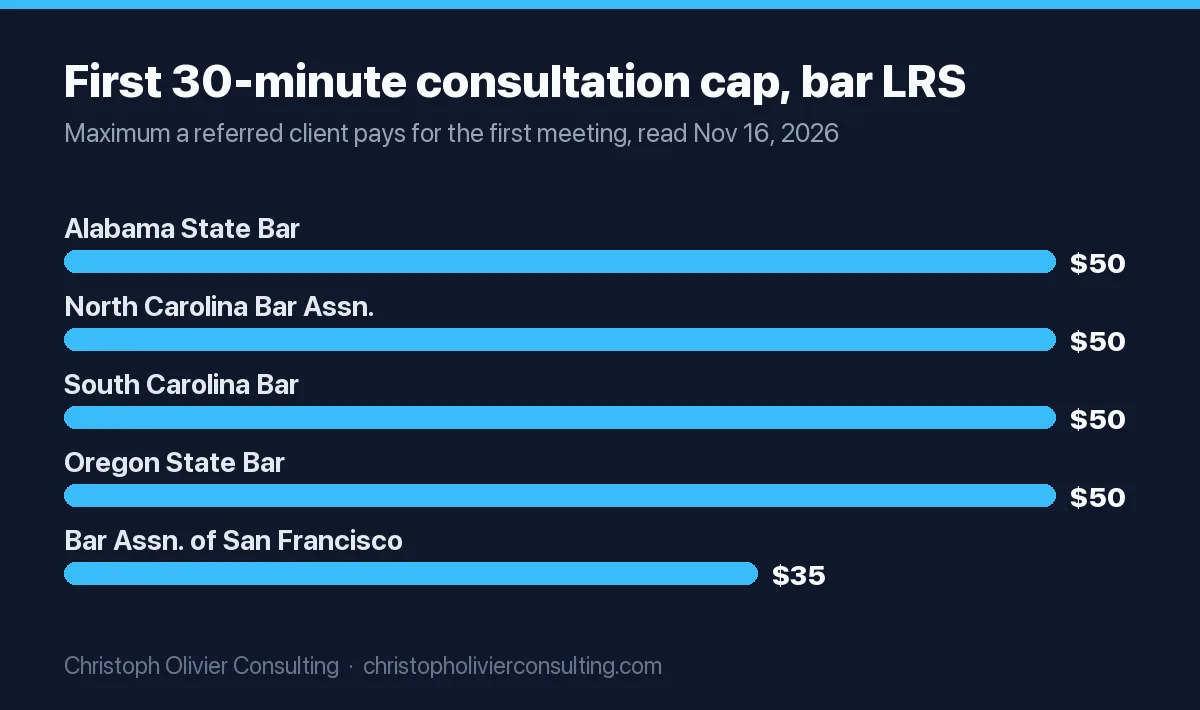
| Program | What you pay for the first consultation | What the panel lawyer pays the service | Source |
|---|---|---|---|
| Alabama State Bar LRS | No more than $50 for an initial 30-minute consultation; the lawyer may waive it | $100 a year (includes 10 practice areas, $5 per extra area); 5% of fees between $1,000 and $5,000, nothing under $1,000, capped at $250 | alabar.org |
| North Carolina Bar Association LRS | $50 for an initial 30-minute consultation | $150 a year (includes one practice panel, $50 per extra panel); 10% of total fees collected once fees reach $500 (5% for SSI, SSDI and workers’ compensation) | ncbar.org (public), ncbar.org (lawyers) |
| South Carolina Bar LRS | No more than $50 for a 30-minute consultation; no consultation fee allowed for contingency tort, Social Security (SSD and SSI) or workers’ compensation matters | $50 a year for each county selected; 10% of the collected net legal fee, excluding costs and the first $250 (per the LRS rules PDF dated June 2015) | scbar.org, SC LRS rules |
| Oregon State Bar Legal Referral Service | $50 or less, up to 30 minutes (lawyer or licensed paralegal) | Not stated on the public page | osbar.org |
| Bar Association of San Francisco LRIS | $35 for the referral, which includes the first 30-minute consultation; free for injury cases | Not stated on the public page | sfbar.org |
Two patterns stand out. First, $50 for 30 minutes is the most common cap among these programs. Second, the real cost of the service sits on the lawyer’s side: an annual fee plus a cut of fees earned. That cut is what funds the call center and advertising. Alabama says remitted fees “will be used for advertising and for upgrading and expanding the program.”
Lawyer referral service fee: a worked example
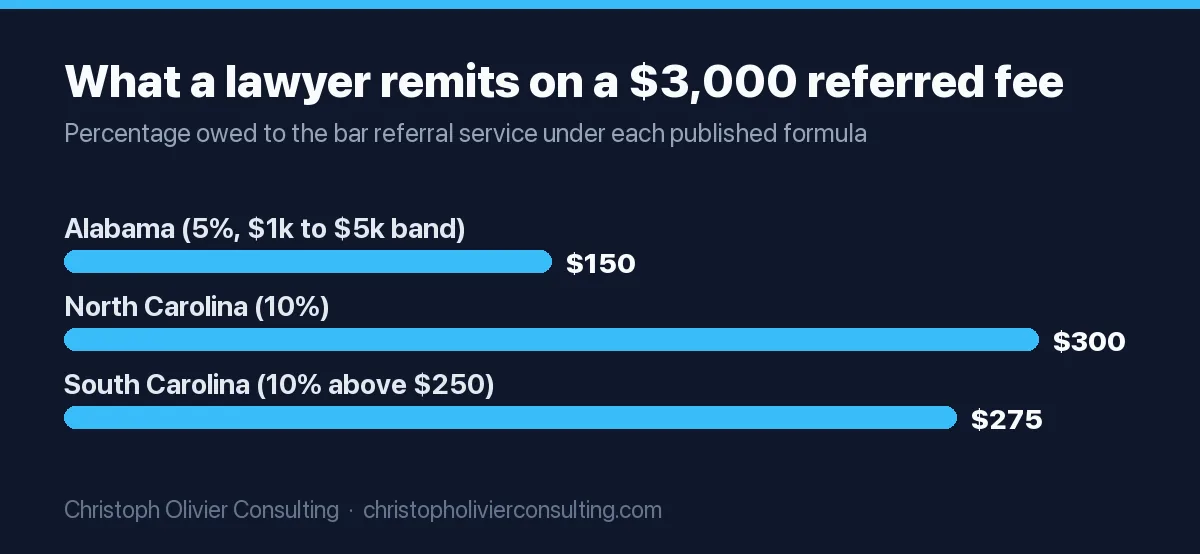
Here is what a panel lawyer would remit on the same matter under the three published formulas. The math follows each bar’s own wording; your engagement terms may differ.
| Legal fee collected on the referred matter | Alabama: 5% of the fee between $1,000 and $5,000 | North Carolina: 10% of total fees once they reach $500 | South Carolina: 10% of net fee above the first $250 |
|---|---|---|---|
| $400 | $0 (under $1,000) | $0 (under $500) | $15 |
| $1,000 | $50 | $100 | $75 |
| $3,000 | $150 | $300 | $275 |
| $6,000 | $250 (cap reached at $5,000) | $600 | $575 |
| $10,000 | $250 | $1,000 | $975 |
| $10,000 workers’ comp or SSDI matter | $250 | $500 (5% rate) | $975 |
Alabama’s own example confirms the cap logic: “if the case generates an attorney fee of $6,000 the attorney would remit $250.00 (which is 5% of $5,000).” The client is not supposed to pay this remittance on top of the bill. South Carolina’s LRS rules say a member “may not charge an LRS-referred client fees for legal services in excess of the fees charged for similar work done for the member’s other clients because of the obligation” to remit the percentage. California’s rules make that explicit for certified services: combined charges to the client from the service and the lawyer may not “exceed the total cost that the client would normally pay if no referral service were involved” (State Bar Rule 3.820(D)).
Are lawyer referral services legit?
Bar-run and regulator-certified services are legitimate, and the rules that govern them are public. The problem is the word “referral”: anyone can put it on a website. What separates a real lawyer referral service from a lead seller is written into the lawyer ethics rules.
ABA Model Rule 7.2(b) says a lawyer “shall not compensate, give or promise anything of value to a person for recommending the lawyer’s services,” with an exception in 7.2(b)(2): a lawyer may “pay the usual charges of a legal service plan or a not-for-profit or qualified lawyer referral service.” Comment [6] to the Model Rule (reproduced in New Hampshire’s annotated rule) explains why the exception is narrow: the public understands referral services to be “consumer-oriented organizations that provide unbiased referrals to lawyers with appropriate experience in the subject matter of the representation and afford other client protections, such as complaint procedures or malpractice insurance requirements.” A qualified service “is one that is approved by an appropriate regulatory authority.”
The same comment lists four protections drawn from the ABA’s model referral-service rules. A legitimate service should:
- let every licensed lawyer who meets reasonable, objective eligibility requirements join;
- require each participating lawyer to carry reasonably adequate malpractice insurance;
- act reasonably to assess client satisfaction and handle complaints; and
- not refer to lawyers who own, operate or are employed by the service.
You can see those protections in the bar programs above. Alabama requires panel lawyers to carry professional liability coverage of “not less than $100,000/$300,000.” North Carolina says “Active members of the LRS must maintain current malpractice insurance coverage.” California goes further and makes certification mandatory: under State Bar Rule 3.800, anyone who “refers prospective clients to attorneys must comply with minimum standards and be certified by the State Bar of California as a lawyer referral service unless exempt by law.”
Bar referral service vs for-profit “referral” site vs directory
| Question to ask | Bar-run or certified LRS | For-profit lead generator | Paid directory listing |
|---|---|---|---|
| Who decides which lawyer you get? | Staff, by practice area and county, under fair-rotation rules (California Rule 3.826 bars sending all referrals in an area to one firm) | Usually whichever lawyer bought the lead or the territory | You choose from listings; placement is often paid |
| Can it say it “recommends” the lawyer? | Yes, that is its approved function | No. ABA comment [5]: a lawyer must not pay a lead generator that implies it is “recommending the lawyer” | No, it is advertising under Rule 7.2(b)(1) |
| How does the lawyer pay? | Annual fee plus a percentage of fees earned (see table above) | Per lead, per month or per territory; percentage-of-fee deals raise fee-sharing problems under Rules 1.5(e) and 5.4 | Flat advertising cost |
| Malpractice insurance required? | Yes in the programs checked | Rarely a condition | No |
| Complaint process? | Yes (California Rule 3.820(E) requires telling every client how to complain) | Varies | Platform reviews only |
| Cap on first consultation? | Yes, $0 to $50 in the programs above | Usually none | None |
Comment [5] to Rule 7.2 is the line for-profit services must stay behind. A lawyer “may pay others for generating client leads, such as Internet-based client leads, as long as the lead generator does not recommend the lawyer,” and payment must be “consistent with Rules 1.5(e) (division of fees) and 5.4.” A lawyer must not pay a lead generator that “states, implies or creates a reasonable impression that it is recommending the lawyer, is making the referral without payment from the lawyer, or has analyzed a person’s legal problems when determining which lawyer should receive the referral.” If a website analyzes your case, says it “matched” you with the best lawyer and never mentions that lawyers pay it, those are the signs the comment describes.
How Florida draws the line: Rule 4-7.22 “qualifying providers”
Florida has the most detailed rule on this. Rule 4-7.22 of the Rules Regulating The Florida Bar (version dated October 22, 2026) calls every referral business a “qualifying provider”: anyone who “receives any benefit or consideration, monetary or otherwise, for the direct or indirect referral of prospective clients to lawyers,” including matching services, pooled advertising, lawyer listings and lead sellers. A Florida lawyer may only work with one that, among 12 conditions:
- receives “no fee or charge that is a division or sharing of fees,” unless it is The Florida Bar Lawyer Referral Service or a bar-approved service under chapter 8;
- does not imply it is “endorsed or approved by The Florida Bar”;
- does not look like a law firm to the public;
- tells the client the city, town or county of the lawyer’s bona fide office at the time of the referral; and
- has “lawyers from at least 4 different law firms” on the panel.
The comment spells out the money rule: “A fee calculated as a percentage of the fee received by a lawyer, or based on the success or perceived value of the case, would be an improper division of fees.” That is the cleanest statement anywhere of why a bar referral service can take 10% and a for-profit matching site cannot. The lawyer also carries the risk: a lawyer who skips due diligence on a provider “is responsible for the qualifying provider’s compliance with this rule.”
Red flags for a lawyer referral service
- No bar name and no certification number. California requires certified services to be certified by the State Bar; ask a California service for its certification and check it with the State Bar.
- It promises the “best” or a “top-rated” lawyer for your case. That is the recommending language comment [5] forbids lead generators to use.
- It asks detailed questions about your case and then sells a “match.” Analyzing your legal problem is the line the ABA comment draws.
- It does not say what the first consultation costs. Every bar program in the fee table publishes its cap.
- It gives you a lawyer outside your county or state with no explanation. Bar services refer by county; Alabama refers only when an appropriate lawyer “is available in that county.”
Do lawyers pay each other for referrals?
Sometimes, but only under strict conditions, and never as a bare “finder’s fee.” Comment [8] to Rule 7.2 says that, except as provided in Rule 1.5(e), “a lawyer who receives referrals from a lawyer or nonlawyer professional must not pay anything solely for the referral.” Rule 1.5(e) is the ABA rule on dividing a fee between lawyers in different firms, and states vary a lot in how they adopted it, so we keep the conditions and the state-by-state detail in our guide to law firm referral fees under ABA and state rules.
Lawyers can also trade referrals without money. Rule 7.2(b)(4) allows a reciprocal referral agreement if it “is not exclusive” and the client is informed of it. Rule 7.2(b)(5) allows “nominal gifts as an expression of appreciation” that are not a form of payment for the referral.
Can a lawyer give a referral fee to a referral service?
Yes, to the right kind of service. Rule 7.2(b)(2) permits paying “the usual charges” of a not-for-profit or qualified lawyer referral service, which is why Alabama and North Carolina can collect a percentage of fees from panel lawyers. Paying a percentage of fees to a for-profit company that is not qualified is different: comment [5] requires any payment to a lead generator to be consistent with Rule 1.5(e) on dividing fees and Rule 5.4 on professional independence, which is the fee-sharing problem.
Questions people ask before they call
Can I call a lawyer and ask a question for free?
Referral service staff cannot answer legal questions, and most bar panels charge for the first meeting. There are free routes, though. The Bar Association of San Francisco makes the referral and first 30-minute consultation free for injury cases. The Alabama State Bar lets panel lawyers waive the $50 consultation fee. South Carolina points people who cannot afford a lawyer to SC Free Legal Answers, a virtual clinic run with the American Bar Association where qualifying users post civil legal questions to volunteer lawyers. Oregon’s bar runs a Modest Means Program with reduced rates for family law, criminal defense, foreclosure and rental housing matters at the trial level.
What services does the South Carolina lawyer referral service offer?
The South Carolina Bar LRS refers you “by the type of law and by the area or location in which you need a lawyer.” Each participating lawyer charges no more than $50 for a 30-minute consultation. You can call (803) 799-7100 from 9 a.m. to noon and 1 p.m. to 5 p.m., Monday to Friday, or use the online service 24/7. The same page links to South Carolina Legal Services intake and SC Free Legal Answers for people who cannot pay.
How can I get a referral for a lawyer through the Alabama State Bar Association?
Call the Alabama State Bar LRS or use its online form. The phone line runs Monday through Friday, 8:30 to 11:30 a.m. and 1:30 to 4:30 p.m.; the online service is available 24 hours a day. A representative gives you the name of a lawyer in your county, and the lawyer charges no more than $50 for the first 30 minutes. The Alabama service only handles Alabama matters.
What not to tell the attorney in the first call
Nothing about your case needs to be hidden from your own lawyer; honesty is what makes the advice useful. The practical cautions are about money and scope. Do not agree to further work until you have a written fee agreement (Alabama tells its panel lawyers to get one before any work beyond the first 30 minutes). Tell the office up front that the referral service sent you, so the capped consultation fee is applied. And do not post case details on public forums or review sites before you have spoken with counsel.
What is the 80/20 rule for lawyers?
It is the Pareto principle applied to a practice: the idea that a small share of clients, matters or referral sources produces most of a firm’s revenue. It is a rule of thumb, not an ethics rule, and it has nothing to do with referral-service fees. For a firm deciding on a referral panel, the useful version is to track which sources send matters that actually pay, then spend more on those.
For law firms: should you join a lawyer referral panel?
For a small or new practice, a bar panel is one of the cheapest ethical intake channels available: a few hundred dollars a year plus a percentage you only pay when you are paid. It works best alongside the other channels in our breakdown of how law firms actually get clients. My view: treat it as a lead source with its own conversion numbers, not as a favor to the bar. Use this checklist before you sign up.
| Check | Pass | Fail |
|---|---|---|
| 1. Who runs it? | A state or local bar, or a service certified by your state’s regulator | A private company that cannot show bar approval or certification |
| 2. Is the fee structure written down? | Annual fee, panel fees and percentage published (like Alabama and North Carolina) | Fee “depends on volume” or is negotiated per lead |
| 3. Do the economics work? | Annual cost covered by one or two typical matters after the percentage | You would need many signed matters a year to break even |
| 4. Insurance requirement | You already carry the required malpractice limits (Alabama: $100,000/$300,000) | You would need new coverage just to join |
| 5. Consultation cap fits your practice | You can deliver a useful 30-minute consult for $50 or less | Your intake requires paid document review first |
| 6. Panel and county fit | Panels match your actual practice areas and the counties you serve | You would sign up for panels you do not regularly handle |
| 7. Reporting burden | You can report fees collected on referred matters | No system to track which matters came from the service |
| 8. Intake speed | Someone calls referred clients back the same business day | Referrals sit in an inbox |
Run the break-even math with your own numbers. In North Carolina, a lawyer on two panels pays $150 plus $50, or $200 a year, then 10% of fees on each referred matter. On a $2,500 matter, the lawyer keeps $2,250 after the $250 remittance, so a single signed matter covers the year. In Alabama, the $100 annual fee plus a 5% remittance (capped at $250) produces a similar result on modest matters and a much better one on large matters, because the remittance stops growing at $5,000.
If you also buy leads or ads, compare all of them in one place. Our guide to law firm lead generation covers how to measure cost per signed case, and the 2026 rules on lawyer advertising explain what any paid channel may and may not say. If you want an outside view of which intake channels deserve your budget, you can book a consultation.
Ready to scale your revenue?
Book a free 30-min consultation. We’ll diagnose your growth bottleneck and map out the 3 highest-leverage moves for your business.
Frequently asked questions
What is a lawyer referral service?
A lawyer referral service is an organization, usually run by a state or local bar association, that matches you with a private lawyer who handles your type of legal problem in your county. Panel lawyers carry malpractice insurance and agree to a capped first consultation, commonly $50 or less for 30 minutes. After that meeting, you pay the lawyer's normal fees if you hire them.
How do lawyer referral services work?
You call or fill in an online form and briefly describe your problem. Staff, who do not give legal advice, sort it by area of law and location and give you the name of a panel lawyer. You book the first consultation at the capped rate. If you hire the lawyer, you pay normal fees, and the lawyer usually remits a share of the fee to the service.
Are lawyer referral services legit?
Services run by a bar association or certified by a state regulator are legitimate and follow published rules: open panel membership, required malpractice insurance, complaint handling and fair rotation of referrals. Be more careful with for-profit websites that promise the best lawyer for your case. Many are lead sellers that lawyers pay, and ABA rules bar them from presenting themselves as recommending a lawyer.
How much is the lawyer referral service fee?
For clients, bar referral services checked in November 2026 cap the first 30-minute consultation at $50 in Alabama, North Carolina, South Carolina and Oregon, and $35 in San Francisco, where injury referrals are free. Lawyers pay the service an annual membership fee, such as $100 in Alabama or $150 in North Carolina, plus a percentage of fees earned on referred matters.
Do lawyers pay referral services a percentage of their fees?
Often, yes, when the service is a bar-run or approved not-for-profit service. North Carolina takes 10% of fees collected once they reach $500, South Carolina 10% of the net fee above the first $250, and Alabama 5% of fees between $1,000 and $5,000. Florida's Rule 4-7.22 says a percentage fee paid to a for-profit referral company is an improper division of fees.
Can I get free legal advice from a lawyer referral service?
Referral service staff cannot give legal advice, and bar referral panels generally do not take pro bono cases. Some programs waive the consultation fee for certain matters, such as injury cases in San Francisco or contingency tort, Social Security and workers' compensation matters in South Carolina. For free help, ask the service about legal aid, modest means programs or ABA Free Legal Answers.
Referral fee rules by profession