

To improve free trial conversion, fix three things in this order: the trial design (card upfront or not, length, trial vs freemium), the signup page (fewer fields, single sign-on, the payment terms stated beside the button), and the path to one activation event that predicts payment. The 2026 benchmark to beat: in ChartMogul and ProductLed’s 2026 Conversion Report, trials that require a credit card convert about 30% of signups to paid, more than 5x trials that do not.
Below: labeled benchmarks from four named sources with their dates and definitions, a trial design decision table with real products, a 10-point signup page audit, a worked method for picking your activation metric, a behavior-triggered email sequence you can paste into your tool, a CAC and payback worked example, the auto-renewal rules that apply when a trial converts on its own, and a 30-day test plan.
Free trial conversion rates: what the 2025 and 2026 benchmarks say
Every benchmark below comes from a vendor that sells to subscription businesses, uses its own definition of “converted,” and samples its own customers or survey respondents. Read the definition column before you compare a number to yours.
| Source and date | Sample | No card (opt-in) | Card required (opt-out) | Definition of converted |
|---|---|---|---|---|
| ChartMogul and ProductLed Conversion Report, published Feb 4, 2026 (vendor survey) | 200 software products, surveyed January 2026 | 8% median free-to-paid; 4% to 6% is GOOD, 10% to 15% is GREAT | About 30%; 25% to 35% is GOOD, 50% to 60% is GREAT | Share of free signups paying within six months |
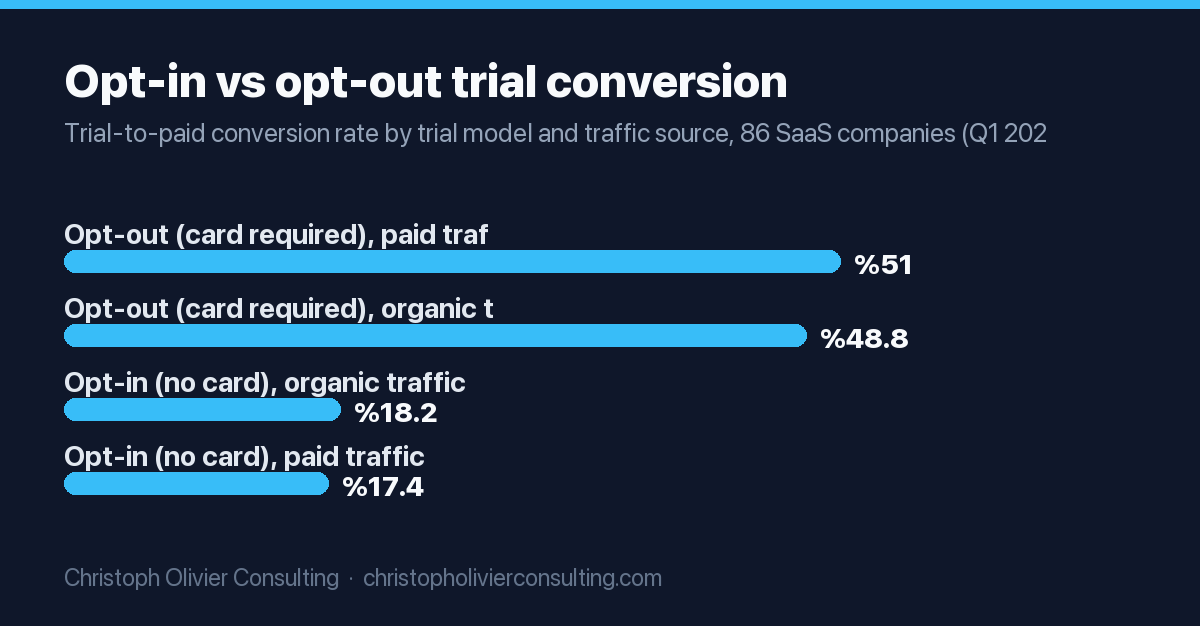
| First Page Sage SaaS Free Trial Conversion Rate Benchmarks, updated Sept 5, 2025 (agency client data) | 86 SaaS companies (71% B2B), Q1 2022 to Q3 2025 | 18.2% organic, 17.4% paid traffic | 48.8% organic, 51% paid traffic | Even a single paid month counts |
| RevenueCat trial length analysis, Sept 28, 2026 (billing vendor data) | 17,000+ App Store and Google Play apps, trials started Aug 2025 to Jul 2026 | Not split by card | 25.5% median for trials of 4 days or less; 42.5% for 17 to 32 days | Median app-level trial-to-paid; consumer mobile apps, not B2B SaaS |
| Recurly blog, Oct 17, 2018 (billing vendor data) | Recurly merchants, method not published | 66% B2B, 56.8% B2C (card status not stated) | Not stated; treat as dated and directional | |
Two practical readings. First, the opt-in numbers differ by more than 2x between ChartMogul (8%) and First Page Sage (17% to 18%), partly because First Page Sage counts a single paid month and ChartMogul uses a six-month window. Second, a card-required trial almost always converts a higher share of signups. Whether it produces more paying customers is a separate question, answered by the visitor-level math below. For the visitor-to-signup step on landing pages, our conversion rate benchmarks by industry break rates out by traffic source.
Opt-in vs opt-out: paying customers per 1,000 visitors
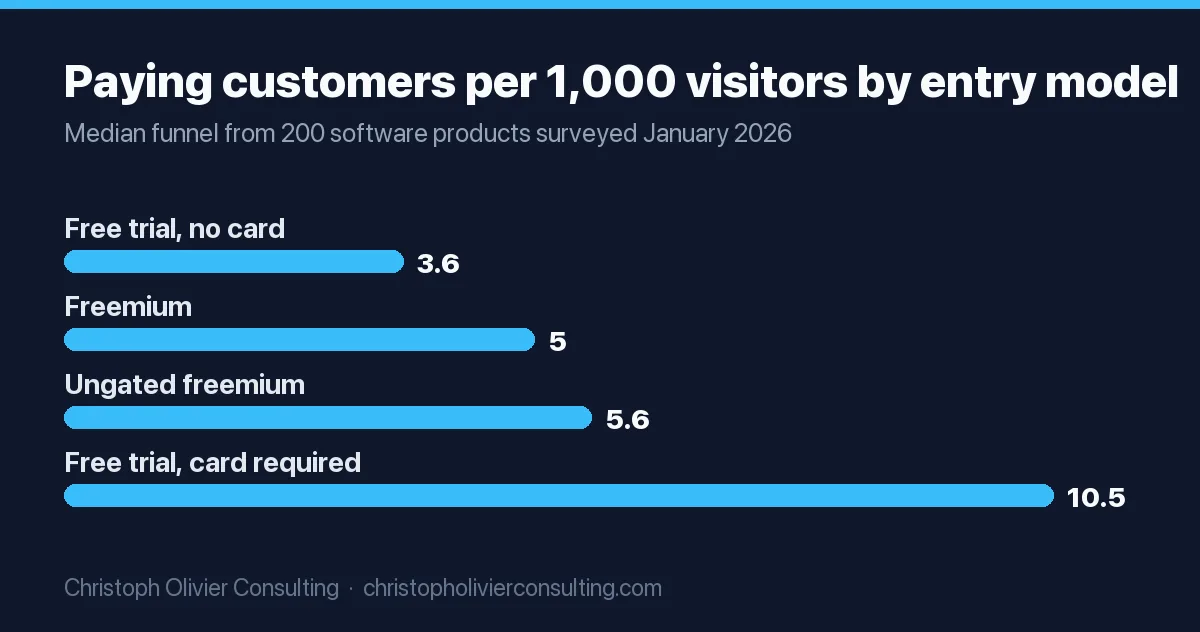
The signup step is where card-required trials lose. First Page Sage reports a visitor-to-trial rate of 7.1% for opt-in trials on paid traffic but only 2.2% for opt-out. ChartMogul’s funnel puts free trials at 45 signups per 1,000 visitors and card-required trials at 35. Run both through to paying customers and the two sources disagree:
| Per 1,000 visitors | No card: signups | No card: paying | Card required: signups | Card required: paying |
|---|---|---|---|---|
| First Page Sage, paid traffic | 71 | 12.4 (71 x 17.4%) | 22 | 11.2 (22 x 51%) |
| ChartMogul and ProductLed, 2026 | 45 | 3.6 | 35 | 10.5 |
In First Page Sage’s data the two models end up roughly even. In ChartMogul’s, the card-required trial yields almost 3x the customers. Neither answer transfers to your product, which is why the 30-day plan at the end tests the card requirement on your own traffic instead of copying a benchmark.
Choose the trial design first: card, length, freemium or reverse trial
ChartMogul’s 2026 survey found the free trial is the primary entry point for 57% of products, freemium for 26%, reverse trial for 7%, interactive demo for 7% and paid trial for 4%. Only 20% of free trial products require a card upfront. Here is how the options compare, with a real product using each one.
| Design | Evidence (source) | Real example (as published by the vendor) | Pick it when |
|---|---|---|---|
| Opt-in trial, no card | 4% to 6% GOOD, 10% to 15% GREAT (ChartMogul 2026) | Sprout Social: 30-day trial, “No credit card required,” Enterprise gets a demo instead | Value needs setup or a team to show, and you can nurture signups |
| Opt-out trial, card required, auto-converts | 25% to 35% GOOD, 50% to 60% GREAT (ChartMogul 2026); 48.8% to 51% (First Page Sage 2025) | LinkedIn Sales Navigator: auto-renews to paid one month after the trial starts; LinkedIn advises cancelling at least one day before renewal | Buyers already know the category and first value shows in session one |
| Freemium | 3% to 5% GOOD for signup-required freemium; free trials convert slightly higher, but the gap disappears once signup rates are counted (ChartMogul 2026) | HubSpot Sales Hub: free plan “for up to 2 users. No credit card required” (pricing page) | Usage spreads by invitation and a free user costs you little to serve |
| Reverse trial (full paid plan, then drops to free) | 4% to 6% GOOD, 8% to 12% GREAT; small sample, difference not statistically significant (ChartMogul 2026) | Airtable: first workspace gets a 14-day Team trial, then stays on Free or upgrades; adding a payment method starts billing | You want freemium’s reach but users need to feel the paid features first |
How long should a free trial be?
Fourteen days is the default: 62% of free trial products in the ChartMogul survey use it, with 14% at 7 days and 14% at 30 days. The best public data on length comes from consumer apps. In RevenueCat’s 17,000-app analysis, monthly plans converted at 39.6% with trials of 4 days or less, 45.9% at 5 to 9 days, 46.6% at 10 to 16 days and 43.7% at 17 to 32 days. RevenueCat calls the pattern correlational. My rule: set the trial to the time a typical activated user needs to hit the activation event twice, then test one length shorter.
How long are typical free trials for sales and social media platforms?
Thirty days is common at the top of this category. Sprout Social offers 30 days with no card. LinkedIn Sales Navigator converts to paid one month after the trial starts, emails a reminder before the trial ends for LinkedIn.com signups, and, per its help page, sends no email reminder for Android purchases. LinkedIn also limits repeat trials: cancel a free Premium trial and you cannot start another for at least 12 months.
How to optimize a free trial signup page: a 10-point audit
The signup page decides how many people ever see your product. Score your page against each line. Anything marked “fail” is a test candidate.
| # | Check | Pass if | Why (evidence) |
|---|---|---|---|
| 1 | Fields before product access | 3 or fewer (work email, password or SSO, maybe name); company size, phone and role move to an in-app survey | Blivakker.no cut a 17-field registration form to 14 and submissions rose 11% in a VWO case study |
| 2 | Single sign-on above the email field | “Continue with Google” and, for B2B, Microsoft are offered first | Google’s own case studies report sign-ups up 50% to 60% for Reddit with the Sign in with Google button and up 47% on web for Pinterest with One Tap (vendor-published, no dates or test design given) |
| 3 | Payment terms beside the button | “No credit card required,” or the exact charge amount and date for card trials | For auto-converting trials, ROSCA requires material terms disclosed before billing information is collected (see the compliance section) |
| 4 | Button says what happens | “Start my 14-day trial,” not “Submit” | Removes the “what am I signing up for” question |
| 5 | First-session promise | One line on what the user will have done in 10 minutes (“Your first report, built from your own data”) | Sets up the activation event |
| 6 | Exits | No header menu links except “Log in” | Every link is a way off the page |
| 7 | Email verification | User lands in the product; verification runs in the background | A verify-first wall adds a step before value |
| 8 | Proof near the form | A named customer logo or quote relevant to the visitor’s segment | Answers “do companies like mine use this” |
| 9 | Mobile | Form and SSO work at phone width with the keyboard open | Test on a real phone, not a resized desktop browser |
| 10 | Benchmarked signup rate | Visitor-to-trial within reach of First Page Sage’s 7.1% (opt-in, paid) or 2.2% (opt-out, paid) | Tells you whether the page or the product is the bottleneck |
Change one line per test and size it before you start; our A/B testing guide covers sample size and the false wins that come from stopping early.
How to improve free trial to paid conversions: define one activation event
An activation event is the single in-product action that best separates trials that pay from trials that do not. Find it from your own data in four steps:
- Export the last 60 to 90 days of trials with a paid or not-paid outcome.
- List 5 to 10 candidate actions in the first 3 days (connected a data source, invited a teammate, created a second project, sent first invoice).
- For each action, calculate the paid rate for users who did it vs users who did not, and the share of all paying users who did it.
- Pick the action with a large gap that most paying users also took. A rare action with a huge gap is a power-user signal, not an activation event.
A worked example with 400 trials and 60 paying customers (illustrative numbers):
| Candidate action | Did it | Paid rate if done | Paid rate if not | Share of payers who did it |
|---|---|---|---|---|
| Connected a data source | 160 (40%) | 30% (48 of 160) | 5% (12 of 240) | 80% (48 of 60) |
| Invited a teammate | 60 (15%) | 45% (27 of 60) | 9.7% (33 of 340) | 45% (27 of 60) |
“Invited a teammate” has the higher paid rate, but 55% of payers never did it. “Connected a data source” covers 80% of payers with a 6x gap, so it becomes the activation event. Your onboarding now has one job: get every trial to connect a data source in session one. Track two numbers weekly: activation rate and median hours from signup to activation. The correlation is not proof of cause; the test plan below checks it by pushing more users to the event and watching whether paid rate follows.
Free trial onboarding email sequence (behavior-triggered, copy-ready)
Each email fires on what the user did or did not do, not on a calendar day. Replace the bracketed text. If you want the fixed-schedule version with subject lines by day, the trial-to-paid drip in our email drip campaign examples pairs with this one.
| Trigger | Subject | Body (first lines) | CTA |
|---|---|---|---|
| Signup, sent immediately | Your first [result] takes 4 minutes | Hi [name], the fastest way to see [product] work is to [activation action]. Here is the one screen you need. | [Do the action] |
| Not activated after 24 hours | Stuck on [activation step]? | Most people who stall here are missing [the API key / the CSV export]. Here is where to find it in [their tool], with a screenshot. Or reply and I will do it with you. | Finish setup |
| Activated | Your [result] is live. Here is what most teams do next | You just [did the action]. Teams that get value fastest do [second action] next, because [concrete outcome]. | [Second action] |
| Hits a plan limit or premium feature | You found a [plan] feature | [Feature] is part of [plan] at [$X]/month. Your trial includes it until [date], so keep using it. | See [plan] |
| Not activated at 50% of trial | Should I extend your trial? | You have not had a chance to [activation action] yet. Reply “extend” and I will add 7 days. | Reply |
| 3 days before end (card trials: required notice content) | Your trial ends [date]: [$X] will be charged | Your trial of [product] ends on [date]. Unless you cancel, we will charge [$X] per [month] to your card ending [1234]. Cancel in one click here: [link]. | Keep my plan / Cancel |
| Trial ended, did not pay (no-card trials) | Your [data/projects] are saved | Your trial ended, but your [projects] are saved for [30] days. Pick up where you left off on [plan]. | Reactivate |
The reminder email is a conversion tool as well as a compliance step: a clear charge date and a one-click cancel link are what separates a trial business from a chargeback problem.
How to reduce your cost per acquisition for free trial users
Count CAC per paying customer, never per trial. The formula: CAC = (ad spend + sales and marketing salaries + tools for the period) ÷ new paying customers from that period. Trial volume can rise while CAC gets worse.
Worked CAC and payback example
A hypothetical B2B tool buys 4,000 paid visitors a month for $12,000 and spends another $6,000 on tools and a part-time onboarding specialist. Price: $150 per month. Gross margin: 80%. Conversion rates are First Page Sage’s paid-traffic medians.
| Step | Opt-in (no card) | Opt-out (card) |
|---|---|---|
| Trials | 4,000 x 7.1% = 284 | 4,000 x 2.2% = 88 |
| Paying customers | 284 x 17.4% = 49.4 | 88 x 51% = 44.9 |
| Ad-only CAC | $12,000 ÷ 49.4 = $243 | $12,000 ÷ 44.9 = $267 |
| Fully loaded CAC ($18,000) | $364 | $401 |
| Payback: CAC ÷ ($150 x 80% = $120 a month) | 3.0 months | 3.3 months |
| If 30% of card conversions cancel after month one | n/a | 31.4 customers, CAC $573, 4.8 months |
The last row matters because First Page Sage counts a single paid month as a conversion. Auto-converted customers who did not mean to stay inflate the rate and then churn, so measure opt-out trials on month-two retention, not first charge. Now the lever: lift opt-in trial-to-paid from 17.4% to 22% through activation work and CAC drops from $364 to $288 ($18,000 ÷ 62.5) with the same budget.
Payback assumes revenue per customer stays flat. If your net revenue retention is above 100%, calculated the same way as in our upselling and cross selling guide (starting revenue plus expansion minus contraction minus churn, divided by starting revenue), the real payback is shorter. If gross revenue retention is weak, it is longer than the formula shows.
Six CAC levers that work on trial funnels
- Bid on paid customers, not trial starts. In Google Ads, import trial-to-paid as a “Converted lead” goal (Goals, Conversions, Summary, then “+ Create conversion action,” Import, “CRMs, files, or other data sources”). Google says these goals let Smart Bidding optimize toward business outcomes rather than lead volume.
- Cut channels on cost per paying customer. A channel with cheap trials and a 3% trial-to-paid rate is expensive.
- Raise trial-to-paid before buying more traffic. In the example, a 4.6-point lift saved $76 per customer.
- Route humans only to qualified trials. 80% of free trial products in the ChartMogul survey add human touchpoints for enterprise users. Send a person when a trial hits the activation event and matches your target account size, not to every signup.
- Test the card requirement on your own traffic. The visitor-level table shows the answer flips between datasets.
- Re-engage expired no-card trials. They already know the product and you already have their email address, so a win-back email costs you no media spend.
Free trials that auto-convert: ROSCA and California auto-renewal rules
A trial that charges a card at the end is a negative option offer. Federally, the Restore Online Shoppers’ Confidence Act (15 U.S.C. 8403) requires three things: clear and conspicuous disclosure of all material terms before you collect billing information, the consumer’s express informed consent before you charge, and a simple mechanism to stop recurring charges. The FTC’s 2024 click-to-cancel rule was vacated by the Eighth Circuit on July 8, 2025 in Custom Communications, Inc. v. FTC, on procedural grounds (WilmerHale). The FTC’s rule page shows a February 12, 2026 notice conforming the rule to the court decision and a March 2026 advance notice of proposed rulemaking. ROSCA enforcement continued: in April 2025 the FTC sued Uber, alleging some Uber One free-trial users were charged before the trial ended and that cancelling could take up to 23 screens and 32 actions. These are allegations; the court decides the case.
Use this as a pass/fail checklist for any trial sold to California residents (summary, not legal advice; confirm with counsel):
| Requirement | Pass if | Source |
|---|---|---|
| Free trials are covered | Your free-to-paid conversion follows the same rules as an auto-renewal (AB 2863, effective July 1, 2025) | Fenwick; Barnes & Thornburg |
| Express affirmative consent | A separate consent step for the renewal terms, with records kept for 3 years or 1 year after the contract ends, whichever is longer | Fenwick |
| Trials longer than 31 days | A notice 3 to 21 days before the trial ends that says it will renew, the renewal length and terms, how to cancel, your contact details and, by email, a cancel link (AB 390, effective July 1, 2022) | Cooley |
| Online cancellation | A prominent direct link or button, or a preformatted termination email, with no steps that obstruct or delay cancelling | Cooley |
| Save offers | Any retention discount shown at cancel sits beside a “click to cancel” button | Fenwick |
| Price changes and annual reminder | Price change notice 7 to 30 days ahead; a yearly reminder of the service, charges and how to cancel | Fenwick |
A 14-day trial falls under the 31-day threshold for the pre-expiry notice in California, but sending one anyway costs nothing and answers ROSCA’s consent point. For the full 2026 status of click-to-cancel and state laws alongside churn data, see our subscription economy statistics.
A 30-day free trial conversion test plan
| Days | Work | Output and pass criteria |
|---|---|---|
| 1 to 5 | Pull 90 days of trials. Calculate visitor-to-trial, trial-to-paid, month-two retention and fully loaded CAC by channel. | Baseline sheet; each number compared with the matching benchmark row above |
| 6 to 10 | Run the activation analysis. Score the signup page on the 10-point audit. Run the compliance checklist. | One activation event chosen; a list of failed audit lines; compliance gaps fixed before any test ships |
| 11 to 13 | Ship the biggest signup page fix (usually fields or SSO) as an A/B test. Turn on the behavior-triggered emails. | Test sized for your traffic; emails live with stop rules on activation and payment |
| 14 to 24 | Rebuild the first session around the activation event: empty states, a checklist with one item, a setup call offer for target accounts. | Activation rate and median time to activation tracked daily |
| 25 to 30 | Read results. Switch Google Ads to the converted-lead goal if trial-to-paid is now tracked reliably. Plan the card-required test for the next cycle. | Keep a change only if it lifts the next step (activation or paid), not just signups |
One caution on reading results: a 14-day trial cohort that starts on day 11 will not finish until day 25, and its paid outcome lands after that. Judge the signup test on signups and activation within 30 days, and judge trial-to-paid on the full cohort the following month. If you want a second pair of eyes on the numbers before you commit budget, you can book a consultation.
Frequently asked questions
What is a good free trial conversion rate?
It depends on whether you ask for a card. ChartMogul and ProductLed's 2026 Conversion Report puts no-card trials at 4% to 6% GOOD and 10% to 15% GREAT, and card-required trials at 25% to 35% GOOD and 50% to 60% GREAT, measured as signups paying within six months. First Page Sage's 2025 data shows about 18% for opt-in and 49% to 51% for opt-out, counting a single paid month.
How do I optimize a free trial signup page?
Cut fields to three or fewer before product access, offer Continue with Google or Microsoft above the email field, state the payment terms next to the button, make the button name the trial length, remove menu links, and land users in the product instead of an email verification wall. Then compare your visitor-to-trial rate with First Page Sage's 7.1% opt-in and 2.2% opt-out paid-traffic medians.
How do I reduce cost per acquisition for free trial users?
Measure CAC per paying customer, not per trial: total sales and marketing cost divided by new paying customers. Then import trial-to-paid as a converted lead goal in Google Ads so bidding chases payers, cut channels with poor trial-to-paid rates, raise activation before buying traffic, and send sales reps only to trials that activate and fit your target account size.
Do free trials convert better with or without a credit card?
Per signup, card-required trials convert far higher: about 30% versus 8% in ChartMogul's 2026 report. Per visitor the answer varies. In ChartMogul's funnel, card-required trials produce 10.5 paying customers per 1,000 visitors versus 3.6, but First Page Sage's 2025 paid-traffic rates give roughly 11.2 versus 12.4. Test the card requirement on your own traffic.
How long should a free trial be?
Fourteen days is the default; 62% of free trial products in ChartMogul's 2026 survey use it, with 14% at 7 days and 14% at 30 days. RevenueCat's analysis of 17,000+ apps found monthly-plan trials converting best at 10 to 16 days (46.6%). Set yours to the time an activated user needs to reach your activation event twice, then test one length shorter.
Is it legal to auto-convert a free trial to paid?
Yes, if you follow ROSCA: disclose all material terms before collecting billing details, get express informed consent before charging, and offer a simple way to stop charges. California's Automatic Renewal Law treats free-to-paid conversions as auto-renewals, requires separate consent and online cancellation, and for trials over 31 days requires a notice 3 to 21 days before the trial ends. Confirm with counsel.
Why don't people convert on my free trial?
Usually because they never reached value. If most non-payers never completed your activation event, fix onboarding before pricing or emails. Other common causes: the signup page attracted the wrong visitors, the trial ended before setup was done, the upgrade prompt never appeared at a moment of value, or the price was a surprise because terms were not stated at signup.
More Funnels, Conversion & Email guides
- Guest Posting: How to Earn Links and Authority Without Breaking Google's Rules
- House Cleaning Marketing: The Recurring-Revenue Playbook
- Painting Company Marketing: Cost Per Booked Job by Channel
- Wedding Planner Marketing: How to Book More Weddings in 2026
- Welcome Email Sequence: The 5-Email Series You Can Copy
- Auto Repair Shop Marketing: The Cost-Per-Customer and LTV Math That Sets Your Priorities