
Cosmetic dentist marketing works when you measure it by cost per new case and case lifetime value, not by clicks or raw lead counts. A single veneer or implant case can be worth $5,000 to $40,000 over its lifetime, so a $300 to $1,000 acquisition cost can still return well. This guide gives channel benchmarks, a cost-per-case chart, the LTV math, and an ADA-aware compliance checklist you can hand to your team.
Last reviewed: September 2026
Why cosmetic dentistry marketing runs on case value, not lead volume
Cosmetic cases are high-ticket and low-frequency, so the economics differ from routine dental marketing. Roughly 35% to 50% of dental leads convert to booked patients, and cosmetic consults often convert lower because of price and long consideration time. Judge every channel by cost per booked case and production per case, not by cost per click or cost per form fill.
This mirrors how we approach SEO for professional services: the goal is qualified demand from people ready to buy a defined outcome, then a consult process that turns interest into a booked case. One implant patient a month can justify a budget that looks inefficient on average-patient math.
Cost per new case by channel
Cost per new cosmetic case in 2026 typically ranges from about $60 through referrals to $1,000 or more for implant-intent paid search. Referral programs and organic SEO tend to deliver the lowest long-run cost per case, while Google Ads for veneers and implants cost the most per case but reach patients at the moment of highest intent. The table below pairs with the chart under this section.
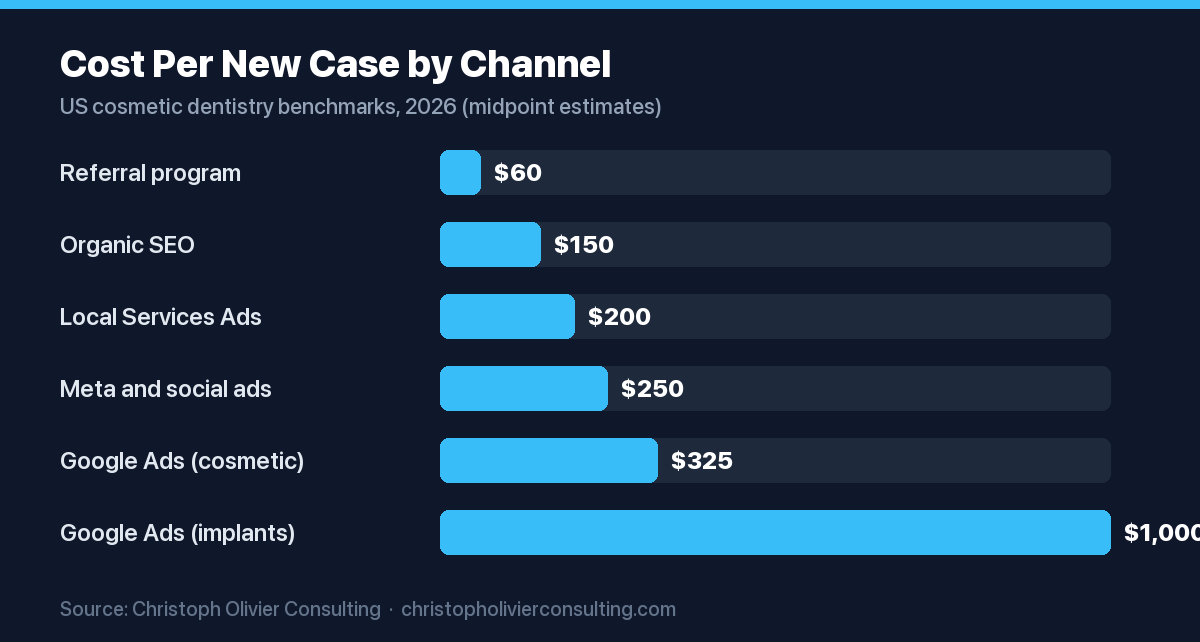
| Channel | Typical cost per new case (2026) | Notes |
|---|---|---|
| Referral program | $25 to $100 | Existing patients and partner referrals; lowest cost, limited scale |
| Organic SEO | $50 to $300 | Compounds over time; lowest long-run cost per case |
| Local Services Ads | $150 to $250 | Google-screened, pay-per-lead; volume capped by Google allocation |
| Meta and social ads | $200 to $300 | Awareness and remarketing; before/after formats are restricted |
| Google Ads (general cosmetic) | $150 to $500 | High intent; strong for whitening, Invisalign, crowns |
| Google Ads (veneers) | $300 to $800 | Higher case value supports higher acquisition cost |
| Google Ads (implants) | $500 to $1,500 | Highest cost per case, highest production per case |
Figures are US benchmark estimates and vary by market competition, ad quality, and intake speed. Chart values use range midpoints.
The channels that book high-value cosmetic cases
Most practices win with two or three focused channels rather than a thin spread across many. A durable mix pairs a strong local SEO base with paid search on your highest-value services, then reviews and referrals to lower blended cost per case. Each channel below plays a distinct role in the funnel.
Local SEO and Google Business Profile
Local SEO and a complete Google Business Profile capture near-me and branded searches at the lowest long-run cost per case. Optimize your profile categories, services, photos, and review cadence, then build service pages for veneers, implants, and whitening. Local search is a core part of small business lead generation and compounds without paying per click.
Google Ads and Local Services Ads
Paid search reaches patients at peak intent and can produce consult requests within days. Local Services Ads bill per screened lead and often run $35 to $90 per lead for dental practices, while standard Google Ads for high-ticket treatment can return 4:1 to 10:1 in the first year. Segment campaigns by service so implant and veneer budgets stay separate from whitening.
Reviews and referrals
Reviews and referrals lower your blended cost per case by improving conversion on every other channel. Ask for reviews after visible results, respond within your privacy limits, and build referral relationships with general dentists and past cosmetic patients. Referral cases often cost $25 to $100 to acquire, the lowest of any channel, though volume is limited.
Before and after content within ad policy
Before and after galleries convert well, but paid platforms restrict some formats, so many practices keep detailed galleries on owned channels such as their website and email. On social, use compliant creative and remarketing while linking to on-site proof. This blends with broader social media lead generation without depending on ad formats that may be rejected.
A compliant claims and before/after checklist
Cosmetic dental advertising must be truthful and not misleading, and patient images require written authorization. The checklist below reflects ADA advertising standards and common state board rules, but rules vary by state, so confirm current requirements with your own state dental board and legal counsel before publishing.
- Get written patient authorization for any before/after image, and HIPAA-valid authorization for identifiable full-face photos.
- Avoid guaranteed-outcome or success-rate claims unless you can substantiate them with reliable evidence.
- Do not advertise as a “cosmetic dentistry specialist” if your state board does not recognize it as a specialty; describe services offered instead.
- Use conditional language such as “results may vary” and “individual results depend on your case.”
- Confirm current paid-platform policy for health and before/after creative before each campaign launch.
How to lower your cost per new case
You lower cost per new case by improving conversion and case value at the same time, not only by cutting ad spend. Faster intake, better service pages, and disciplined tracking usually move the number more than a lower bid. Work through these steps in order.
- Track every lead by channel and by treatment type, then calculate cost per booked case, not cost per lead.
- Improve speed to lead so consult requests get a call back within minutes, not hours.
- Build dedicated service pages for veneers, implants, and whitening with compliant proof and clear next steps.
- Tighten paid search to high-intent terms and negative keywords, and separate implant budgets from lower-ticket services.
- Systematize reviews and referrals to raise conversion across all other channels.
- Reallocate monthly toward the two or three channels with the lowest cost per case and the highest production.
Case value and lifetime value math
Case value and lifetime value decide how much you can afford to acquire a patient. A whitening patient may be worth a few thousand dollars over time, while an implant patient can reach $8,000 to $40,000 including follow-up and referrals. When you know these numbers, a higher acquisition cost on high-ticket services becomes a sound decision.
| Case type | Typical case value | Estimated patient lifetime value |
|---|---|---|
| Teeth whitening | $300 to $1,000 | $2,000 to $5,000 |
| Veneers (multiple teeth) | $10,000 to $25,000 | $5,000 to $15,000 |
| Single dental implant | $3,000 to $6,000 | $8,000 to $40,000 |
| Full-arch or All-on-4 | $20,000 to $50,000 | $8,000 to $40,000 |
If you want a channel mix and tracking model built around your own case values, our fractional CMO services map budget to cost per case and production per treatment type.
Frequently asked questions
How much should a cosmetic dentist spend on marketing?
Most practices invest about 5% of monthly production, which often lands between $3,000 and $20,000 per month all-in, covering ad spend, agency fees, and tooling. High-ticket practices may spend more on paid search because a single implant or veneer case can return many times its acquisition cost. Track spend by channel and by treatment type rather than as one lump figure.
What is a good cost per new patient for a cosmetic dental practice?
A reasonable cost per new cosmetic case in 2026 runs from about $60 through referrals to $1,000 or more for implant-intent Google Ads. Whitening and general cosmetic cases often sit between $150 and $500. Because case value is high, an acquisition cost that looks large can still be efficient once you measure production and lifetime value per case rather than cost per lead.
Can cosmetic dentists use before and after photos in ads?
In many situations yes, with limits. You typically need written patient authorization, and under HIPAA you need valid authorization for identifiable full-face images. Paid social platforms restrict some before and after formats, so many practices keep detailed galleries on owned channels such as their website. Confirm current platform policy and your state dental board rules before running any campaign.
Which marketing channel gives cosmetic dentists the best ROI?
Organic SEO and referrals usually give the lowest long-run cost per case, while Google Ads reaches patients at peak intent for veneers and implants. Google Ads for high-ticket dental treatment often returns 4:1 to 10:1 in the first year. The strongest mix combines a solid local SEO base with focused paid search on your highest-value services, then reviews to lift conversion.
How long does cosmetic dental marketing take to work?
Paid search and Local Services Ads can produce consult requests within days, while SEO and content usually take several months to compound. Many practices see paid channels stabilize case flow within one to three months and organic rankings improve over six to twelve months. Plan for both a fast channel and a compounding channel so cost per case falls over time.
Is it legal to advertise as a cosmetic dentistry specialist?
Often it is not, depending on your state. If a state dental board does not recognize cosmetic dentistry as a specialty, calling yourself a specialist may be treated as false or misleading and can lead to disciplinary action. Many dentists instead describe the services they offer, such as veneers or implants, and confirm exact wording with their state board and legal counsel.
More marketing guides for rank on ai: get cited by ai search
- Foundation Repair Marketing: The Cost-Per-Booked-Job Playbook
- Garage Door Company Marketing: The 2026 Channel and Cost Guide
- Hair Restoration Marketing: A 2026 Cost Per Consult Playbook
- Kitchen Remodeling Marketing: A Channel Plan That Books High-Ticket Projects
- Locksmith Marketing: A 2026 Playbook for Booked Jobs and Beating Lead-Gen Spam
- Logo Design Cost in 2026: What You Pay by Source
- Rank on AI: Get Cited by AI Search