

A content roadmap is a quarter-by-quarter plan that sets which content you will create over the next 6 to 12 months, in what order, for which audience and which business goal. It sits between your content strategy, which says why you publish, and your content calendar, which fixes exact publish dates.
In practice it is one table: quarters down the side, themes, formats, owners and KPIs across the top. The Content Marketing Institute puts it in one line: “A content strategy roadmap is a high-level plan designed to achieve your marketing objectives.” Below you get that table ready to copy, a filled-in 12-month example for a professional-services firm, the exact Search Console steps to decide what goes on it, tool prices, and the checklist to run every quarter.
Content roadmap vs content calendar vs content strategy
The three documents answer different questions, and each one depends on the one above it. If you only remember one row, make it the time horizon.
| Content strategy | Content roadmap | Content calendar | |
|---|---|---|---|
| Question it answers | Why publish, for whom, to what end? | What do we build next, in what order, with what capacity? | What goes live on which date, and who ships it? |
| Time horizon | 1 to 3 years | 6 to 12 months, by quarter | 2 to 12 weeks, by day |
| Unit of planning | Audiences, positioning, goals, channels | Themes, priority assets, effort in person-days, owners, KPIs | Titles, briefs, deadlines, publish dates |
| Owner | Founder, managing partner or CMO | Head of content or fractional CMO | Editor or content coordinator |
| Updated | Yearly | Monthly status check, quarterly re-plan | Weekly |
| Lives in | A 2 to 5 page document | A spreadsheet tab or timeline board | A calendar or task board |
| What goes wrong without it | Content with no point of view | Random posts that never add up to a topic you own | Good plans that never ship |
Is a content strategy roadmap different from a content marketing roadmap?
Not in practice. Searchers use “content roadmap”, “content strategy roadmap” and “content marketing roadmap” for the same document. The useful distinction is altitude: a “content strategy roadmap” usually carries a one-page strategy header (goal, audience, themes) on top of the quarterly table, and a “content marketing roadmap” often adds distribution channels such as email and LinkedIn. The template below includes both, so you do not need two documents. If you still need the strategy layer itself, start with a B2B content marketing strategy and come back.
Content roadmap template (copy-ready)
The template has two parts: a five-line header that leadership signs off once a year, and a backlog table with one row per asset. Paste the header into the top of a sheet, then the CSV row below into cell A10 and split it into columns.
Part 1: the roadmap header
| Field | What to write | Example |
|---|---|---|
| North-star goal | One business outcome with a number and a date | 36 qualified consultations from organic search and email by 31 December |
| Audience | Who signs and who influences | Owners and CFOs of $2M to $20M service businesses; their outside accountant |
| Themes (3 to 5) | Each theme maps to a service you sell | Fractional CFO pricing; cash flow; exit readiness |
| Capacity | Real person-days per month, including expert review | 10 days/month marketing, 1 day/month partner review |
| Review dates | Monthly status check, quarterly re-plan, already booked | Last Friday of each month; first Tuesday of each quarter |
Part 2: the backlog table (quarters x themes x formats x owners x KPIs)
| Quarter | Theme | Asset (working title) | Format | Type | Buyer stage | Target query | Owner | Effort (days) | Score | KPI and target | Status |
|---|---|---|---|---|---|---|---|---|---|---|---|
| Q1 | [Theme 1] | [Pillar page title] | Long-form guide | New | Comparing | [Primary keyword] | [One name] | [ ] | [ ] | [Top 10 for X in 90 days] | Not started |
| Q1 | [Theme 1] | [Existing page] | Article | Refresh | Deciding | [Query it already ranks for] | [One name] | [ ] | [ ] | [Position 15 to top 5] | In progress |
| Q1 | [Theme 1] | [Template or calculator] | Download + page | New | Problem-aware | [Template query] | [One name] | [ ] | [ ] | [Email signups] | Backlog |
| Q2 | [Theme 2] | [Two overlapping posts] | Article | Consolidate | Comparing | [Shared query] | [One name] | [ ] | [ ] | [One URL ranking, not two] | Backlog |
CSV header row to paste:
Quarter,Theme,Asset,Format,Type (new/refresh/consolidate/retire),Buyer stage,Target query,Owner,Effort (person-days),Score,KPI and target,Status,Publish month,NotesThree rules keep the template honest. One owner per row, never “team”. Effort includes review time, because partner or compliance review is where professional-services content stalls. Target windows are quarters or months, never dates: dates belong in your content calendar, which is fed from this table once a quarter is approved.
Filled-in example: a 12-month roadmap for a B2B professional-services firm
This is an illustrative plan, not a client case. The firm is a hypothetical 15-person outsourced accounting and fractional CFO practice that sells to owners of $2M to $20M service businesses. One marketing manager spends half her time on content (10 person-days a month, so 30 a quarter), and a partner gives one review day a month. Q1 is planned to the asset, Q2 to the theme and priority assets, Q3 and Q4 stay directional.
| Quarter | Theme | Assets and formats | Owners | Effort | KPI |
|---|---|---|---|---|---|
| Q1 (detailed) | Fractional CFO pricing and scope (decision stage) | Pillar guide “Fractional CFO cost” (6 days); comparison page “Fractional CFO vs controller vs bookkeeper” with table (4); refresh 3 posts sitting at positions 11 to 20 in Search Console (2 each, 6); 13-week cash flow template plus how-to page (6); 12 LinkedIn posts cut from the pillar for two partners (3); partner review (3) | Marketing manager writes; Partner A reviews; Partner B posts on LinkedIn | 28 of 30 days | Pillar in top 10 for “fractional cfo cost” within 90 days of publishing; 9 consultations booked from organic and LinkedIn; 60 template downloads |
| Q2 (themes and priorities) | Cash flow and month-end close (problem stage) | Cash flow pillar (6); 4 supporting articles answering intake-call questions (3 each, 12); one 45-minute webinar with Partner A (5); 3 newsletter issues (1 each, 3); review (3) | Marketing manager; Partner A presents webinar | 29 of 30 days | 4 of 5 new pages earning impressions within 60 days; 80 webinar registrants; 9 consultations |
| Q3 (directional) | Exit and sale readiness (new service line) | Pillar on preparing financials for a sale; 3 supporting articles; one process explainer showing how the engagement runs, step by step | Marketing manager; Partner B | About 30 days | First consultations tagged “exit readiness” in the CRM |
| Q4 (directional) | Proof and refresh | Refresh every Q1 page with new figures; consolidate any posts competing for the same query; one benchmark piece only if partners approve using anonymized client data | Marketing manager; Partner A signs off data | About 30 days | Q1 pages holding or improving position; consultations on target for the year |
Why this order: Q1 goes to the pages closest to revenue (pricing and comparison) plus refreshes, because pages already ranking on page two tend to move faster than brand new URLs. The new service line waits until Q3 so the firm can collect real prospect questions in Q1 and Q2 first. The capacity math is the part most roadmaps skip: Q1 lists 28 days of work against 30 available, which leaves 2 days of slack for the week a partner is out.
Each theme here is a hub page with supporting articles, the pillar and hub-and-spoke model. Before you lock the backlog, assign each target query to exactly one URL with keyword mapping, or two of your own pages will compete for it.
How to prioritize roadmap topics with Google Search Console
Search Console tells you which queries Google already shows your site for, which is the cheapest evidence you will get about where a page can win. Every UI label below comes from Google’s help docs for the Performance report overview and advanced filtering and comparison.
- Open the Performance report for Search results. Google’s default view shows clicks and impressions for the past three months. Keep that range for a quarterly review.
- Turn on all four metrics. Select the headings above the chart so total clicks, total impressions, average CTR and average position are all showing.
- Read the Queries tab, sorted by impressions. This is your demand list. Note the position of each query: in the table, average position is the position for that row, and in the chart it is “the average position of the topmost result from your site.”
- Isolate question queries. Click + Add filter, choose Queries, then Custom (regex), keep Matches regex, and paste
^(what|how|why|which|when|can|does|is|should). Click Apply. Google uses RE2 syntax, partial matching and case-insensitive matching by default. Every question with impressions but no page that answers it in the heading is a roadmap row. - Check which page ranks for each top query. Click any query row to filter by it, then open the Pages tab. Two or more URLs splitting impressions for one query is a “consolidate” row, not a “new” row.
- Find pages that are losing ground. Open the date filter, choose Compare, and set the last 3 months against the previous period. The table adds a Difference column. Google suggests Weekly or Monthly granularity for date comparisons to remove day-of-week effects.
- Export and paste into the backlog. The export button downloads chart and table data. Values shown as “~” or “-” export as zeros, so do not read those as real zeros.
Then translate each signal into a row type. The position bands below are my working rules of thumb, not Google thresholds:
| What you see in Search Console | Roadmap action | Typical effort | Priority |
|---|---|---|---|
| Position 1 to 10, high impressions, low CTR | Rewrite title and meta description; put the direct answer in the first two sentences | 0.5 day | Do this month, outside the roadmap |
| Position 11 to 20 on a query tied to a service | Refresh: answer every query the page shows for, add a table or template, add internal links | 1 to 2 days | Top of next quarter |
| Position 21 to 50, query clearly different from the page topic | New dedicated page, mapped to that query only | 3 to 6 days | Score it with RICE |
| Two URLs share impressions for one query | Consolidate into the stronger URL and 301 the other | 1 day | Next quarter |
| Clicks down in Compare, position stable | Check the results page for new features; update facts and date-sensitive figures | 1 day | Next quarter |
| Published 90 days ago, zero impressions | Inspect the URL for indexing problems before writing anything new on the topic | 0.5 day | Immediately |
Scoring the backlog with RICE
When you have more candidate rows than capacity, score them. RICE was published by Sean McBride on the Intercom blog in January 2018 for product teams: Reach times Impact times Confidence, divided by Effort. Intercom scores impact as 3 (massive), 2 (high), 1 (medium), 0.5 (low) or 0.25 (minimal), and confidence as 100%, 80% or 50%. Intercom measures effort in person-months; for content, person-days work better.
Worked example using the Q1 rows above, with reach on a 1 to 5 scale based on Search Console impressions and how often sales hears the question:
- Refresh of a post at position 14: reach 4 x impact 2 x confidence 0.8 / effort 2 days = 3.2
- New “fractional CFO vs controller” comparison page: 3 x 2 x 0.8 / 4 = 1.2
- New exit-readiness pillar: 2 x 3 x 0.5 / 6 = 0.5, which is why it waits for Q3
Re-score each quarter with the new Search Console export. Do not let reach dominate: a low-volume, decision-stage page next to your booking link often beats a high-volume definition post on business value. If you are turning a whole keyword set into dated briefs, the SEO content plan picks up where the roadmap stops.
Tools for a content roadmap, with verified US prices
A spreadsheet is enough for most firms under 20 people. Move to a tool when you need a timeline view, approvals, or more than three people editing. Prices below are per month, taken from each vendor’s own pricing page in October 2026.
| Tool | Plan that fits a roadmap | Price billed annually | Price billed monthly | Free plan | Best for |
|---|---|---|---|---|---|
| Notion | Plus | $10 per seat | $12 per seat | Yes, for individuals | Roadmap, briefs and strategy doc in one workspace |
| Asana | Starter (adds Timeline and Gantt views) | $10.99 per user | $13.49 per user | Personal: 2 users collaborate free | Teams that need dependencies and due dates |
| Airtable | Team | $20 per user | Check the pricing page | Yes | Database-style backlog; read-only reviewers are not charged |
| CoSchedule | Professional (2 seats included, up to 3) or Suite for content and campaign planning | $49 per plan; Suite from $69 | $59 per plan | Social only: 15 posts at a time on 1 profile | Teams that want the roadmap and social calendar together |
| Trello | Premium (adds Calendar, Timeline and Table views) | $10 per user | $12.50 per user | Up to 10 collaborators per Workspace, 10 boards | Simple kanban by quarter |
What it costs for the example firm, with one marketing manager and two partners who need access, on annual billing:
- Notion Plus: 3 seats x $10 = $30 a month
- Asana Starter: 3 x $10.99 = $32.97 a month
- Airtable Team: 1 editor x $20 = $20 a month, if the partners only view (Airtable does not charge read-only collaborators)
- Trello Premium: 3 x $10 = $30 a month
- CoSchedule Professional: $49 for 2 seats plus $29 for the third = $78 a month
Notion Business ($20 per seat annually, $24 monthly), Asana Advanced ($24.99 annually, $30.49 monthly), Airtable Business ($45 annually) and Trello Standard ($5 annually, $6 monthly) are the steps up or down. For the rest of the stack (SEO research, writing, analytics), see the content marketing tools breakdown.
Quarterly content roadmap review checklist
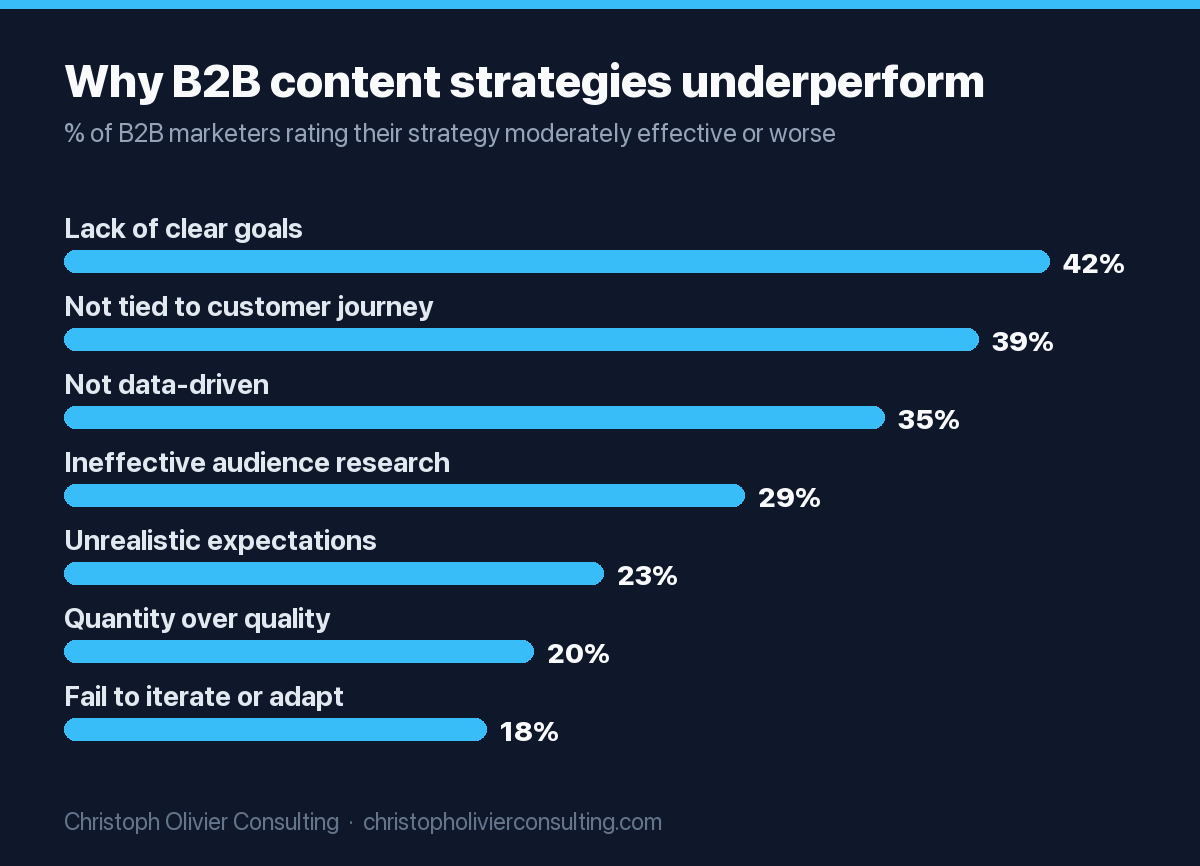
Run this on the first working day of each quarter, with the Search Console export from the steps above open. It targets the most common reasons B2B strategies underperform in CMI and MarketingProfs research: among 980 B2B marketers surveyed in mid-2024, 95% had a content strategy but only 29% rated it extremely or very effective.
| Check | Pass if | If it fails |
|---|---|---|
| 1. Goal still stands | The north-star goal has a number, and leadership confirms it in the review | Re-set the goal before touching the backlog |
| 2. Shipped vs planned | At least 80% of last quarter’s effort days shipped (my rule of thumb) | Cut next quarter’s plan to what actually shipped, not what was hoped |
| 3. Every asset has a KPI reading | Each shipped row shows its KPI against target | Add the reading now; a row with no measurement cannot be re-scored |
| 4. Indexing | Every page older than 90 days has impressions in Search Console | Inspect the URL before writing more on that theme |
| 5. Position bands | Pages that slipped into positions 11 to 20 are in next quarter’s refresh lane | Add them as refresh rows |
| 6. One URL per query | No top query shows two of your URLs in the Pages tab | Add a consolidate row |
| 7. Themes map to services | Every theme leads to a service page and a booking path | Retire the theme or add the missing service link |
| 8. Capacity math | Next quarter’s effort total is at or below available person-days | Drop the lowest-scoring rows until it fits |
| 9. Refresh lane exists | Refresh and consolidate rows take a real share of next quarter (I aim for about a quarter of the days) | Move the top-scoring refreshes ahead of new pages |
| 10. Sign-off | Next quarter is locked, owners named, rows pushed to the calendar | Book the sign-off meeting before the review ends |
On refreshes, change the substance, not the date. Google’s guidance on helpful, people-first content lists as a warning sign: “Are you changing the date of pages to make them seem fresh when the content has not substantially changed?” It also flags “producing lots of content on many different topics in hopes that some of it might perform well in search results.” A roadmap with three to five service-linked themes is the practical answer to both. If you have not looked at your existing pages in a year, run a website content audit first, then fill the backlog.
Drafting is no longer the scarce skill. CMI’s 2026 research release says “9 in 10 marketers already use AI to churn out content” while “fewer than 4 in 10 say it has actually improved performance.” Choosing what to make and in what order is the roadmap’s job. If you want a second set of eyes on your goals, backlog and scores before you lock a quarter, you can book a consultation.
Frequently asked questions
What is a content roadmap?
A content roadmap is a quarter-by-quarter plan of which content you will create over the next 6 to 12 months, in what order, for which audience and which business goal. Each row names an asset, its format, one owner, the effort in person-days and the KPI it is judged on. It sits between the content strategy, which explains why you publish, and the content calendar, which sets exact dates.
What is the difference between a content roadmap and a content calendar?
A content roadmap decides what you will build and in what order, by quarter, theme and priority, over 6 to 12 months. A content calendar schedules individual pieces on specific dates with deadlines, usually two to twelve weeks ahead. The roadmap feeds the calendar: once leadership approves a quarter, its top-scored rows move into the calendar for dated production.
What is a content strategy roadmap?
A content strategy roadmap is the same quarterly plan with a one-page strategy header on top: the north-star goal, the audience, three to five themes tied to services you sell, monthly capacity and review dates. Most teams searching for a content strategy roadmap, a content marketing roadmap or a content roadmap need this single document, not three separate ones.
What should a content marketing roadmap include?
At minimum: quarter, theme, asset working title, format, type (new, refresh, consolidate or retire), buyer stage, target query, one named owner, effort in person-days including review time, a priority score, and the KPI with a target. A content marketing roadmap usually adds the distribution channel for each asset, such as the newsletter, LinkedIn or a webinar.
How do you build a blog roadmap?
Export the Queries and Pages tabs from the Search Console Performance report, list every question your buyers ask, and group them into three to five themes linked to your services. Score each idea on reach, impact, confidence and effort, fill each quarter from the top of the ranked list until capacity runs out, then give every post one owner and a target month.
Is a content map the same as a content roadmap?
No. A content map links existing or planned content to audiences and buying stages, so you can see gaps, such as no decision-stage page for a service. A content roadmap takes those gaps and sequences them over time with owners, effort and KPIs. Build or refresh the map first, then use it as an input to the roadmap backlog.
How far ahead should a content roadmap go?
Twelve months is a practical default. Plan the next quarter in detail, down to each asset, owner and effort estimate. Keep the second quarter at the theme and priority-asset level, and treat quarters three and four as directional. Re-score the backlog every quarter with a fresh Search Console export, because rankings, sales questions and capacity all change.
More Content Marketing guides
- How to Build a Content Calendar You Actually Keep
- What Is Content Marketing? Modern Playbook
- TikTok Marketing: How Businesses Turn Views Into Leads
- Brand Equity: What It Is, How to Measure It, and How to Build It
- Content Marketing for Startups: What to Build First With No Team or Budget
- Ecommerce Content Optimization: A Playbook for Copy That Ranks and Sells
- All Content Marketing guides →