
Last reviewed: October 2026
A medical device marketing strategy is a plan for winning adoption of a regulated product across a buying committee of clinicians, value analysis committees, supply chain, finance and payors, while keeping every claim inside the device’s cleared or approved indications. The strategies that work in 2026 start with the regulatory boundaries, map each buyer to the evidence they need, and only then pick channels.
Most guides on this topic list generic tactics: build a brand, post on social, go to trade shows. This page covers what they skip: the FDA and FTC rules that decide what you can say, how hospital committees actually evaluate new devices, an 8-step launch plan, a table of audiences, messages and channels, a worked plan template and the metrics that show whether it is working. It is a marketing framework, not legal advice. Run every claim past your regulatory counsel.
What is a medical device marketing strategy?
A medical device marketing strategy defines who decides whether your device gets used and bought, what evidence each of those people needs, which claims you are legally allowed to make, and which channels deliver that evidence. It differs from general B2B marketing because the product label caps the message and several stakeholders can veto the purchase.
Three things set medtech marketing apart from selling software or services:
- The label is a legal ceiling. Your cleared or approved indications define the claims you can promote. Copy that drifts past them can misbrand the device.
- The buyer is a committee. A surgeon can love your product and still lose the argument at the value analysis committee or in procurement.
- Relationships with clinicians are regulated. Consulting fees, meals, travel and education funding fall under industry codes and federal transparency reporting.
If you market other kinds of healthcare organizations, the broader principles in our guide to healthcare marketing still apply. This page stays focused on devices sold into hospitals, ambulatory surgery centers and physician practices.
The regulatory spine of medical device marketing
Every medical device marketing decision sits inside four sets of rules: who regulates your advertising, what your clearance or approval lets you claim, how you may share information on unapproved uses, and how you interact with and pay health care professionals. Get these right first, because no channel plan can rescue a claim that should never have been published.
FDA or FTC: who polices your ads
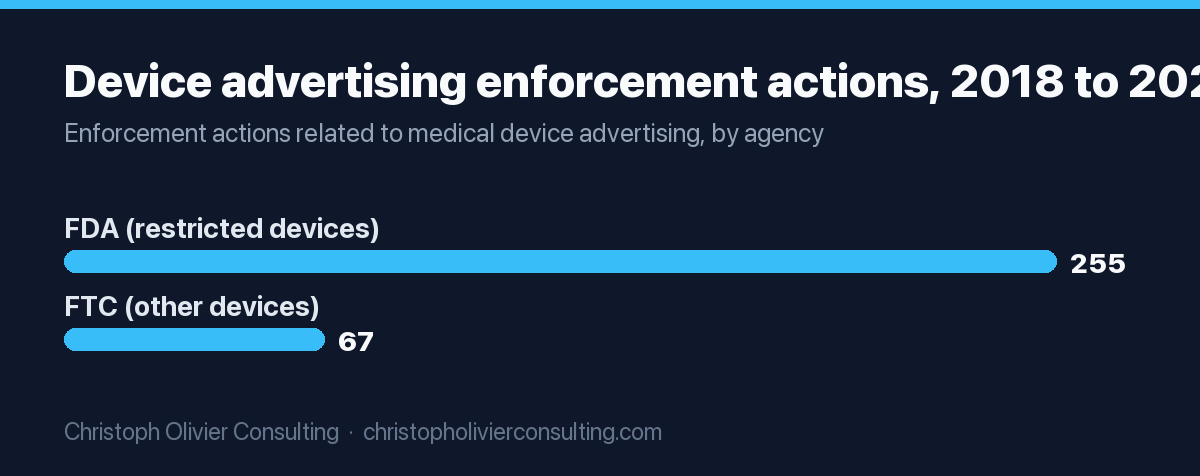
Jurisdiction depends on the device. Under section 502 of the FD&C Act (21 U.S.C. 352), a restricted device is misbranded if its advertising is “false or misleading in any particular,” and its ads must carry a brief statement of the intended uses and relevant warnings, precautions, side effects and contraindications. A 2023 GAO report on direct-to-consumer device advertising explains the split: FDA oversees restricted devices, while the FTC covers other devices. GAO reported that FDA took 255 enforcement actions related to device advertising from 2018 through 2022, and the FTC took 67 public enforcement actions over the same period.
The same GAO report notes that FDA learns of potential violations partly through complaints submitted by individuals or competitors. Assume your competitors read your ads closely.
For devices under FTC jurisdiction, the FTC’s Health Products Compliance Guidance expects health claims to be backed by “competent and reliable scientific evidence.” One of its examples involves an FDA-cleared Class II muscle stimulation belt: clearance for muscle stimulation did not allow the marketer to imply broader weight-loss benefits.
Cleared is not approved
If your device reached market through a 510(k), do not call it “FDA approved.” Under 21 CFR 807.97, a substantial equivalence determination “does not in any way denote official approval of the device,” and any representation that creates an impression of official approval “is misleading and constitutes misbranding.” Use “FDA-cleared” for 510(k) devices and reserve “approved” for devices with a premarket approval (PMA).
Claims must match the indications for use
FDA’s 510(k) overview states that a new submission is required when “the device is to be marketed for a new or different intended use.” 21 CFR 807.81(a)(3) lists a major change or modification in intended use as one trigger. In practice, marketing can create a new intended use by accident: a campaign that promotes a patient population or clinical outcome outside the indications is a regulatory event, not just a copy problem.
For content that goes beyond the label wording but stays within it, FDA’s guidance on communications consistent with FDA-required labeling (June 2018) applies a three-factor test: how the communication compares with the labeled conditions of use, whether it increases the potential for harm relative to the labeling, and whether the labeled directions for use enable safe and effective use under the conditions the communication describes. Failing any one factor means the communication is not consistent with the labeling.
Scientific information on unapproved uses
Clinicians may use devices off-label, and they often ask about it. FDA’s January 2025 final guidance on communications to health care providers about scientific information on unapproved uses says such communications should be truthful and non-misleading and should be separate from promotional communications about approved uses. Its own example is the conference exhibit hall: unapproved-use material should not be attached to or intermingled with promotional pieces. The document carries a note that it is not for current implementation while some information collection provisions are under OMB review, so confirm its status with counsel before relying on it.
Payors and value analysis committees: a 2026 development
In June 2026 FDA issued a revised draft of its guidance on drug and device manufacturer communications with payors, formulary committees and similar entities. The draft reflects section 3630 of the Consolidated Appropriations Act, 2023, which made the health care economic information (HCEI) provisions of section 502(a) applicable to devices. It names technology assessment committees and other multidisciplinary entities that make acquisition decisions on a population basis as part of the audience, and it excludes clinicians making individual patient decisions. It is a draft and not for implementation, but it signals that a health economics track aimed at committees is a distinct, legitimate content line.
Map the medical device buying committee
Hospital device purchases are rarely one person’s call. Surgeons and proceduralists create demand, but value analysis committees, supply chain, finance and administrators decide whether the device enters the building, and payors decide whether the procedure is paid. Your strategy needs a distinct message, proof point and channel for each of these roles.
A published account from Vanderbilt shows how this works in practice. In Olson, Obremskey and Bozic (Clinical Orthopaedics and Related Research, 2013), each committee met monthly with 10 physicians and six administrators or supply chain officers. Physician champions submitted requests, permanent requests required peer-reviewed literature, and “no industry representatives are permitted to be present or to present.” Over two years, 92% of products presented were approved, 5% approved with stipulations and 3% rejected. The lesson for marketers: you may never be in the room, so your materials have to equip the physician champion who is.
| Audience | What they decide | What they need to see | Best channels | Compliance guardrail |
|---|---|---|---|---|
| Surgeons and proceduralists | Whether to request and use the device | Clinical data, technique, outcomes versus current standard of care | KOL peer education, hands-on training, conferences, journals | On-label claims only; unapproved-use information separate and identified |
| Nurses, OR staff, biomed | Workflow fit, setup, reprocessing, training load | Instructions, in-service plans, time and step comparisons | In-service training, video, clinical specialists | Technical support in the clinical setting governed by company policy and the AdvaMed Code |
| Value analysis committee | Whether the device is added, trialed or rejected | Evidence summary, cost impact, alternatives, physician champion request | Value dossier, physician champion toolkit | HCEI must be accurate and objective; you may not be allowed in the room |
| Supply chain and procurement | Contract terms, standardization, vendor approval | Pricing structure, contract options, supply reliability | Account-based outreach, GPO and IDN contracting teams | Pricing and discounts structured with counsel under fraud and abuse rules |
| CFO and administration | Capital or budget approval, service line strategy | Total cost, reimbursement, throughput and capacity effects | Executive briefings, business case models | Economic claims supported and not tied to inducements |
| Payors and technology assessment | Coverage and reimbursement | Health economic models, clinical evidence, coding information | Market access team, payor dossiers | FDA payor communication guidance (2026 draft for devices) |
| Patients (where appropriate) | Whether to ask about the procedure | Plain-language benefits and risks, where to find a treating physician | Patient education site, search, physician locator | Restricted-device ads need brief statement of uses and risks |
HCP rules: the AdvaMed Code and Open Payments
Any marketing that touches physicians, advanced practice clinicians or teaching hospitals runs through two filters: the AdvaMed Code of Ethics, the industry’s voluntary standard for interactions with health care professionals, and the federal Open Payments program, which publishes many payments and transfers of value. Plan KOL programs, meals, travel and sponsorships with both in view.
What the AdvaMed Code means for marketing
AdvaMed approved revisions to its Code in March 2022 covering value-based arrangements, virtual programs and meetings, and speaker programs in response to the OIG’s 2020 Special Fraud Alert. The current Code text sets several rules marketers run into constantly:
- Consulting and KOL arrangements should rest on a legitimate need, fair market value compensation and written agreements, and sales personnel cannot control or unduly influence which clinician is hired.
- Entertainment and recreation are prohibited “in any form,” regardless of value, consulting status or whether the activity is secondary to an educational purpose.
- Unapproved-use responses should come from authorized personnel, be truthful and non-misleading, and be identified as unapproved or uncleared.
- Coverage, reimbursement and health economics information may be shared if accurate and objective, but not as an unlawful inducement.
Open Payments: your KOL program is public
Under the CMS Open Payments program, device manufacturers report payments and transfers of value each year between February 1 and March 31, and CMS publishes the data by June 30. Covered recipients include physicians, physician assistants, nurse practitioners, clinical nurse specialists, certified registered nurse anesthetists, certified nurse-midwives and teaching hospitals. For Program Year 2025, CMS published 17.07 million records totaling $14.67 billion in payments and transfers of value across drug and device makers. Treat every consulting fee as something the clinician’s peers and patients can look up.
How to build a medical device marketing strategy in 8 steps
Build the strategy in the order the risk flows: claims first, buyers second, evidence third, channels fourth. Starting from a campaign idea usually means rewriting it after regulatory review. These eight steps work for a new launch or for resetting the plan on a device already on the market.
- Lock the claims matrix. List every claim you want to make, the exact indication language it rests on, the evidence behind it, the required risk information and the correct regulatory wording (“cleared” or “approved”). It becomes the source of truth for every asset.
- Map the committee per site of care. Hospitals, ambulatory surgery centers and physician offices buy differently. For each, name the clinical champion, the committee or approver, the economic buyer and the people whose workflow changes.
- Build the evidence and economics package. Assemble clinical data, a plain-language evidence summary, a cost and workflow model, and accurate coding and reimbursement information. Keep committee-level economic content separate from clinician-facing promotion.
- Position against the current standard of care. Define the problem your device solves relative to how clinicians treat patients today. That framing travels better through a committee than claims aimed at a named rival, and it keeps you out of comparative claims you cannot substantiate.
- Recruit and contract KOLs properly. Document legitimate need, pay fair market value, sign written agreements and plan for Open Payments disclosure.
- Choose channels by stage and audience. Use the table above. Awareness among specialists, evaluation by committees and adoption by staff each need different channels and assets.
- Stand up review and sales enablement. Set a medical, legal and regulatory review workflow with turnaround times, then give reps a library of approved assets, talk tracks and the physician champion toolkit.
- Set metrics and a review cadence. Agree on stage-level metrics before launch and review them on a fixed schedule, adjusting channels rather than claims.
Medtech marketing channels and what each one is for
Medtech marketing channels are not interchangeable. Peer education and conferences build clinical credibility, content and search capture clinicians and committee members doing their own research, LinkedIn and account-based programs reach named health systems, and sales enablement converts interest into trials. Pick channels for the job each stage of the buying committee needs done.
KOLs and peer-to-peer education
Clinicians trust peers who use the device. Proctoring, case observation, peer-led workshops and podium presentations do the heavy lifting for adoption. Keep them inside AdvaMed Code limits.
Medical conferences
Treat the booth as a promotional space and keep any unapproved-use scientific material clearly identified and physically separate, as FDA’s 2025 guidance describes for exhibit halls.
Content and evidence marketing
Evidence summaries, technique videos, case-based articles and economic explainers give champions material to forward to committees. A content marketing consultant who understands review workflows can keep a regulated content engine moving without rework.
Search and the product website
Clinicians, nurses and supply chain staff research procedures, product categories and technique questions online. Build pages around the clinical problem and the on-label use, with separate, clearly labeled sections for health care professionals where appropriate.
LinkedIn and account-based marketing
When your market is a few hundred health systems, account-based programs that coordinate ads, content and rep outreach to named accounts fit better than broad demand generation. Our guides to LinkedIn marketing for B2B and the account-based marketing statistics worth knowing cover targeting by role and account.
Sales enablement
Reps need approved assets they can actually use: a one-page value summary, a committee submission kit, objection handling grounded in the label and a demo or evaluation plan.
Digital marketing for medical devices without compliance surprises
Digital marketing for medical devices follows the same claim rules as print, with a few traps of its own: character-limited ads, comment threads, retargeting that follows clinicians from unapproved-use content to promotional pages, and search campaigns built on terms outside the indications. Design the controls into the program before launch.
- Short-form ads still need required information. GAO’s report notes that FDA has issued guidance for internet and social media platforms with character space limitations. For restricted devices, plan how each format delivers the intended use and risk information.
- Keep unapproved-use content separate. Do not link, retarget or bundle scientific information on unapproved uses with promotional pages.
- Audit keyword lists against the label. Bidding on a condition your device is not indicated for can read as promotion for that use. This is my practical recommendation, not a quoted rule, so confirm your approach with counsel.
- Govern user comments and testimonials. Decide in advance how you moderate and respond to off-label questions and adverse event mentions on your channels.
Analytics, tracking and nurture flows work as in any considered B2B purchase. Our overview of B2B digital marketing covers that foundation.
Medical device marketing plan example
Below is an illustrative template for a hypothetical 510(k)-cleared, single-use device used in outpatient orthopedic procedures and sold to hospitals and ambulatory surgery centers. It is a structure to fill in with your own data, not a case study, and the bracketed fields mark where your numbers and evidence go.
- Objective: [number] new accounts with an approved evaluation and [number] accounts converted to contract within [period].
- Claims matrix: [indication wording], [three priority claims], [evidence source for each], [required risk statement], wording “FDA-cleared.”
- Priority accounts: [list of health systems and surgery centers], each with a named clinical champion, committee contact and economic buyer.
- Champion toolkit: evidence summary, cost and workflow model, committee request template, in-service training plan.
- Peer program: [number] trained proctors under written FMV agreements, case observation calendar, Open Payments tracking.
- Channels: two specialty conferences, LinkedIn and account-based ads to named accounts, procedure-focused search pages, monthly email to engaged clinicians.
- Review workflow: medical, legal and regulatory review with a [number]-day turnaround target and a claims matrix check on every asset.
- Metrics review: monthly at the stage level, quarterly against the objective.
Metrics: how to measure medical device marketing
Measure medical device marketing by stage of the buying committee, not by channel vanity numbers. The metrics that matter most track whether target accounts move from clinical interest to an approved evaluation, a committee decision and repeat use, because that path, not website traffic, is where revenue is won or lost.
| Stage | Metric | Why it matters |
|---|---|---|
| Awareness | Engaged clinicians and accounts in the target list | Shows whether you reach the right specialists at the right systems |
| Interest | Evaluation or demo requests from target accounts | The first signal a champion is forming |
| Committee | Committee submissions and decisions (approved, stipulated, rejected) | Where most medtech pipelines stall |
| Trial | Evaluation completion rate and time to decision | Shows whether training and support work |
| Adoption | Repeat use and number of users per account | Separates a one-off trial from real adoption |
| Compliance | Review turnaround and assets returned for claim issues | Rising rework means the claims matrix is not being used |
Common medical device marketing mistakes
The most expensive mistakes in medical device marketing are claim drift, ignoring the committee, and treating HCP programs as hospitality. Each one is avoidable with a claims matrix, a committee map and a written policy for interactions with clinicians, set up before the first campaign goes live.
- Saying “FDA approved” for a 510(k)-cleared device.
- Promoting outcomes or patient groups outside the indications for use.
- Marketing only to surgeons and leaving the value analysis committee with nothing to review.
- Mixing unapproved-use scientific material into promotional booths, decks or landing pages.
- Running KOL programs without documented need, fair market value or disclosure planning.
In my experience the teams that move fastest are the ones whose marketing, sales and regulatory leads agree on the claims matrix before anyone writes copy. If you want a second set of eyes on your plan, you can book a consultation and we can walk through it together.
Frequently asked questions
Can a medical device company say its 510(k) device is FDA approved?
No. Under 21 CFR 807.97, a 510(k) substantial equivalence determination does not denote official FDA approval, and any representation that creates an impression of official approval is misleading and constitutes misbranding. Use the phrase FDA-cleared for 510(k) devices, and reserve FDA-approved for devices that went through premarket approval (PMA).
Who regulates medical device advertising, the FDA or the FTC?
It depends on the device. FDA regulates advertising for restricted devices under section 502(q) and (r) of the FD&C Act, which requires a brief statement of intended uses and relevant risks. The FTC covers advertising for other devices and expects health claims to be supported by competent and reliable scientific evidence.
Can medical device companies talk about off-label uses?
Clinicians may use devices off-label, but companies cannot promote unapproved uses. FDA's January 2025 guidance describes how firms can share truthful, non-misleading scientific information on unapproved uses with health care providers, kept separate from promotional material. The AdvaMed Code adds that such responses should come from authorized personnel and be identified as unapproved.
Who sits on a hospital value analysis committee?
Composition varies by health system, but committees usually combine physicians with supply chain, finance and administrative staff. In one published Vanderbilt example, each committee met monthly with 10 physicians and six administrators or supply chain officers, physician champions brought the requests, and industry representatives were not allowed to attend or present.
What should a medical device marketing plan include?
A solid plan includes a claims matrix tied to the indications for use, a buying committee map for each site of care, an evidence and economics package, KOL and peer education programs that follow the AdvaMed Code, a channel plan by audience, a medical, legal and regulatory review workflow, and stage-level metrics such as committee approvals and repeat use.
What are the key medical device marketing trends for 2026?
Several regulatory shifts shape 2026 plans. FDA's June 2026 revised draft guidance would apply health care economic information rules to device communications with payors and technology assessment committees. FDA finalized guidance on scientific information about unapproved uses in January 2025. Open Payments data keeps growing, with $14.67 billion reported for Program Year 2025.
More Growth Consulting guides
- Healthcare Marketing: How Practices Attract and Keep Patients
- B2B Digital Marketing: A Channel Strategy Playbook
- Car Dealership Marketing: Cost Per Sold Unit by Channel
- Business-to-Business Marketing Strategy for Small and Midsize Firms
- What Does Marketing Do? The 7 Jobs a Marketing Function Actually Performs
- Types of Websites: What Each Is For and Which One Your Business Needs
- All Growth Consulting guides →