
Last reviewed: October 2026
Ecommerce email marketing is the practice of using automated flows and scheduled campaigns to turn store visitors into first-time buyers and first-time buyers into repeat customers. The revenue usually comes from a small set of behavior-triggered flows: welcome, browse and cart abandonment, post-purchase, replenishment, winback and VIP. In Omnisend’s 2026 Ecommerce Marketing Report, automations were 2% of email sends but drove 30% of email revenue.
This guide gives you the full system: the flows to build first, with timing and goals for each, the benchmarks you can actually verify, a segmentation model, a campaign calendar, SMS pairing, the 2026 deliverability rules and a 90-day rollout template. It is written for store owners and marketing leads who want a working program, not a list of tips.
What is ecommerce email marketing?
Ecommerce email marketing is email an online store sends to drive purchases, repeat orders and loyalty. It has two parts: automated flows triggered by shopper behavior, such as a cart left behind, and scheduled campaigns sent to segments, such as a new collection launch. Strong programs treat flows as the base and campaigns as the layer on top.
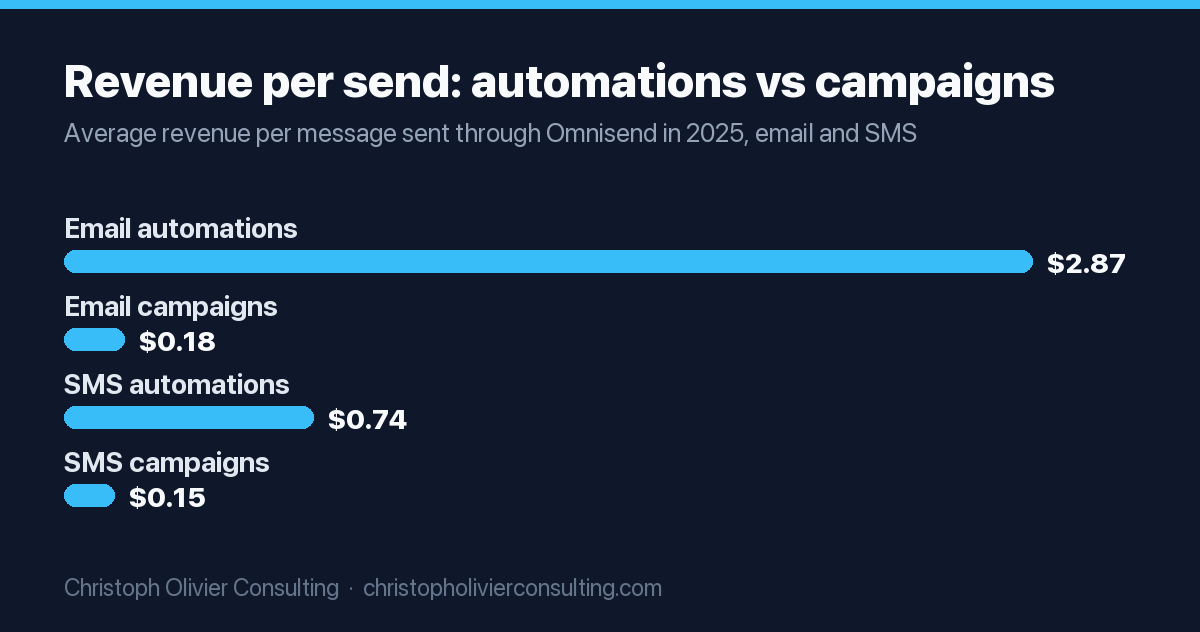
The split matters because the two parts behave very differently. Omnisend analyzed 27 billion emails sent by 150,000 brands in 2025 and found automations earned $2.87 per send against $0.18 for campaigns, a 16x gap (Omnisend, 2026). Campaigns still matter. They carry launches, promotions and brand story to your whole list. But flows reach people at the moment intent is highest, so they earn more per message.
Email also sits inside a bigger growth plan. If you have not yet set targets for acquisition, retention and average order value, start with your ecommerce marketing strategy and then build the email program to serve those numbers.
The 7 core ecommerce email flows (with timing and goals)
The seven ecommerce email flows that most stores need are welcome, browse abandonment, cart abandonment, post-purchase, replenishment, winback and VIP. Each is triggered by a specific behavior, has one job and stops when the shopper takes the action you want. Build them in roughly that order, because the earliest flows catch the highest-intent traffic.
The timings below are common starting points, not rules. Test them against your own purchase cycle.
| Flow | Trigger | Typical emails and timing | Goal | Exit condition |
|---|---|---|---|---|
| Welcome series | New subscriber | 3 to 5 emails over 7 to 14 days; first email immediately | First purchase, set expectations | Places an order |
| Browse abandonment | Viewed a product, no cart | 1 to 2 emails; first within a few hours | Bring them back to the product | Adds to cart or buys |
| Cart abandonment | Added to cart, no checkout | 2 to 3 emails over 1 to 3 days; first within 1 to 4 hours | Recover the order | Places an order |
| Checkout abandonment (branch of cart flow) | Started checkout, no order | 2 to 3 emails; first within 1 hour | Remove the last objection | Places an order |
| Post-purchase | Order placed or delivered | 3 to 4 emails over 2 to 4 weeks | Reduce returns, earn review, second order | Second order |
| Replenishment | Time since last order of a consumable | 1 to 2 emails timed to usage cycle | Reorder before they run out | Reorders |
| Winback | No order in 1.5 to 2x your normal buying cycle | 2 to 4 emails over 2 to 4 weeks | Reactivate or clean the list | Purchases or is suppressed |
| VIP / loyalty | Hits spend or order-count threshold | Ongoing, plus milestone emails | Retain top customers, raise lifetime value | Drops below threshold |
Welcome series
The welcome series introduces the brand, delivers any signup offer and answers the questions that stop a first order: shipping cost, returns, sizing, why you. In Klaviyo’s 2026 data, the welcome series had the highest average email click rate of any flow at 6.5% (Klaviyo, 2026). Split new subscribers into “never purchased” and “already a customer” so buyers do not get a first-order discount.
Browse, cart and checkout abandonment
These three flows target shoppers who showed intent and left. Baymard Institute’s average documented cart abandonment rate is 70.22%, based on 50 studies, and the top stated reason is extra costs such as shipping, tax and fees (Baymard Institute). That tells you what the first reminder should answer. For a deeper look at the numbers, see these cart abandonment statistics, and for copy and sequence structure, this guide to the abandoned cart email.
Post-purchase and replenishment
Post-purchase emails protect the order you just won. Send order and shipping updates, then setup or usage tips, then a review request after delivery, then a cross-sell. Replenishment only works for consumables, so calculate the median days between reorders for each product and trigger a few days before that point.
Winback and VIP
Winback flows go to customers who have gone quiet. Define “lapsed” from your own data, then send a reminder, a reason to return and, finally, a sunset email that removes non-responders. VIP flows do the opposite: they recognize your best customers with early access, service perks or exclusive products rather than ever-deeper discounts.
All of these are forms of triggered emails, and if you want to see full sequences laid out message by message, these email drip campaign examples are a useful reference.
Ecommerce email marketing benchmarks for 2026
Use benchmarks from platforms that publish their own aggregated data, and compare like with like. The most useful 2026 numbers come from Klaviyo’s abandoned cart report and Omnisend’s annual ecommerce report. Both show the same pattern: automated flows earn far more per message than campaigns, and abandoned cart is the top revenue flow.
| Metric | Benchmark | Source and sample |
|---|---|---|
| Abandoned cart email revenue per recipient (average) | $6.77 | Klaviyo 2026, 110,000+ customers |
| Abandoned cart email RPR (top 10%) | $13.70 | Klaviyo 2026 |
| Abandoned cart email click rate (average / top 10%) | 6% / 11.3% | Klaviyo 2026 |
| Welcome series email click rate (average) | 6.5% | Klaviyo 2026 |
| Abandoned cart SMS RPR (average) | $4.48 | Klaviyo 2026 |
| Automations’ share of email sends / email revenue | 2% / 30% | Omnisend 2026, 27B emails in 2025 |
| Email click-to-conversion rate (all email) | 9% | Omnisend 2026 |
| Share of automated orders from abandoned cart and welcome | 76% | Omnisend 2026 |
| Back-in-stock conversion rate | 6.46% (highest automation type) | Omnisend 2026 |
Two caveats. First, these are platform averages across many store sizes and categories, so your numbers can sit well above or below them. Second, open rates are no longer a reliable success metric, because privacy features in some mail apps register opens that never happened. Judge performance on clicks, placed orders and revenue per recipient instead.
How to build an ecommerce email marketing strategy
An ecommerce email marketing strategy is a written plan for who you email, what triggers each message, what you send on a schedule and how you measure it. Build it in a fixed order: tracking and list first, revenue flows second, segmentation third, campaigns fourth. Skipping ahead to campaigns is the most common reason programs stall.
- Connect your store data. Integrate your platform so the email tool sees product views, carts, checkouts, orders and refunds. Without this, no flow can trigger.
- Authenticate your sending domain. Set up SPF, DKIM and DMARC before you send at volume (details in the deliverability section below).
- Install signup capture. A popup or flyout with a clear reason to join, plus checkout opt-in.
- Launch the welcome and abandonment flows. These catch your highest-intent traffic and, in Omnisend’s data, abandoned cart and welcome alone produced 76% of automated orders.
- Add post-purchase, replenishment and winback. These move first-time buyers to a second order, which is where lifetime value is made.
- Segment the list. Start with engagement and RFM segments, described below.
- Set a campaign calendar. Plan four to eight weeks ahead and tie each send to a product, season or story.
- Measure and iterate monthly. Review revenue per recipient by flow, list growth, and spam and unsubscribe rates.
Segmentation for email marketing for ecommerce: the RFM model
RFM segmentation groups customers by Recency (how recently they bought), Frequency (how often they buy) and Monetary value (how much they spend). It is the most practical segmentation model for email marketing for ecommerce because it uses order data you already have and maps directly to what each group needs to hear next.
Score each customer 1 to 5 on each dimension, using quintiles of your own customer base. Then group the scores into a handful of actionable segments:
| Segment | RFM pattern | What to send | What to avoid |
|---|---|---|---|
| Champions | High R, high F, high M | Early access, new products, referral asks | Discounts they do not need |
| Loyal customers | Mid to high R, high F | Cross-sells, loyalty rewards, bundles | Generic blasts |
| Recent first-time buyers | High R, F = 1 | Post-purchase education, second-order nudge | Heavy promo frequency |
| At risk | Low R, high F or M | Winback with a reason to return, “what changed?” survey | Waiting too long to act |
| Hibernating | Low R, low F, low M | One winback attempt, then sunset | Mailing indefinitely |
| Subscribers, never purchased | No orders | Social proof, bestsellers, first-order offer | Customer-only messaging |
Layer engagement on top. Someone who clicked last week and someone who has not opened in six months should not get the same frequency, even if their order history looks similar.
Building an ecommerce email campaign calendar
A campaign calendar sets what you send on a schedule, outside of flows. Many stores do well with one to three campaigns a week to engaged segments, planned four to eight weeks ahead, each tied to a clear reason: a launch, restock, season, guide or customer story. Frequency should rise for engaged subscribers and drop for disengaged ones.
A simple monthly rhythm works for most catalogs:
- Week 1: new product or collection launch to the full engaged list.
- Week 2: educational or how-to content tied to a product category.
- Week 3: social proof: reviews, user photos, bestsellers.
- Week 4: a segment-specific offer or bundle, for example to “at risk” customers only.
Then layer the retail calendar: Valentine’s Day, Mother’s and Father’s Day, back to school, Black Friday and Cyber Monday, and the holiday shipping cutoff. Ramp volume gradually before peak season rather than suddenly mailing your whole list, because sudden spikes to unengaged addresses are how spam complaints climb.
Growing your list with popups and signup forms
List growth for an online store comes mainly from on-site signup forms, especially popups and flyouts, plus opt-in at checkout. The forms that convert give a clear, specific reason to subscribe, ask for as little as possible and appear at a sensible moment, such as after a short delay, on scroll or on exit intent.
- Offer something concrete. A first-order discount, free shipping, early access, a size guide or a quiz result.
- Ask for email first. Collect the phone number on a second step if you also run SMS.
- Suppress for known subscribers and customers. Showing a signup popup to someone already on your list wastes the impression.
- Respect mobile. Make the close button large and the form small on phones.
- Never buy lists. Purchased addresses damage your sender reputation and can reach spam traps.
Pairing email with SMS
SMS works best as a short, high-urgency companion to email, not a copy of it. Use it for cart recovery, shipping updates, restocks and time-boxed launches, sent only to subscribers who opted in to texts. Keep SMS volume well below email volume, because each text interrupts and each send costs money.
The data supports pairing the two on high-intent moments. Klaviyo’s 2026 report shows an average abandoned cart SMS click rate of 10.3% and revenue per recipient of $4.48 (Klaviyo, 2026). Omnisend found automated SMS earned $0.74 per send versus $0.15 for SMS campaigns (Omnisend, 2026).
A common cart pattern: email at one to four hours, SMS a few hours later if the cart is still open, then a final email the next day. Suppress the SMS if the email was clicked. On compliance, US federal rules require the prior express written consent of the recipient for marketing messages sent with automated dialing technology (47 CFR 64.1200). State rules can add more, so have counsel review your opt-in language.
Deliverability and compliance rules for 2026
Deliverability is whether your email reaches the inbox. For any store sending at volume, the baseline is fixed: authenticate your domain with SPF, DKIM and DMARC, include one-click unsubscribe in marketing email, honor opt-outs quickly and keep spam complaints low. Miss these and even a great flow can land in spam.
Google’s rules for senders of more than 5,000 messages a day to Gmail took effect February 1, 2024 (Google sender guidelines):
- Set up SPF and DKIM for your domain, and DMARC for your sending domain.
- Marketing and subscribed messages must support one-click unsubscribe and show a visible unsubscribe link.
- Keep the spam rate in Postmaster Tools below 0.10% and avoid ever reaching 0.30%.
Google’s FAQ recommends processing unsubscribes within 48 hours and confirms that transactional messages, such as order confirmations, do not need one-click unsubscribe (Google sender FAQ). Under the US CAN-SPAM Act, you must honor opt-outs within 10 business days, identify commercial messages and include a physical address, and each violating email can draw penalties of up to $53,088 (FTC CAN-SPAM guide).
Practical habits that keep you in the inbox: send campaigns mostly to people who engaged in the last 60 to 120 days, run a sunset flow for long-inactive subscribers, warm up new sending domains slowly and watch complaint rates weekly rather than at quarter end.
How to measure ecommerce email marketing performance
Measure ecommerce email marketing on revenue per recipient, placed order rate and click rate by flow and by campaign, plus list growth and spam complaint rate. Open rate is now a weak signal. The most honest test of email’s value is incremental revenue: what you earn compared with a holdout group that did not receive the message.
| Metric | What it tells you | Watch out for |
|---|---|---|
| Revenue per recipient (RPR) | Money earned per person sent; best single comparison metric | Attribution windows differ by platform |
| Placed order rate | Share of recipients who bought | Discount-heavy flows can inflate it at margin cost |
| Click rate | Content and offer relevance | Bot clicks from security scanners |
| Email share of store revenue | Channel dependence | Very high share can mean weak acquisition, not strong email |
| Spam complaint rate | List health and deliverability risk | Gmail threshold is 0.30%, target below 0.10% |
| Unsubscribe rate | Frequency and relevance fit | Spikes after list imports or frequency jumps |
Platform-attributed revenue usually counts any order within a set window after an open or click, so it overstates email’s true contribution. For your top two or three flows, run a holdout test: send to 90% of eligible shoppers, hold back 10% and compare conversion. That gives you a cleaner read on what the flow actually adds.
Worked example: a 90-day email rollout template
Here is a practical 90-day plan for a store that has a list but only basic emails running. It is a template, not a case study: the timing and sequence reflect common practice, and your results will depend on traffic, margins, catalog and offer. Adjust the order if one flow clearly matters more for your products.
Days 1 to 30: foundation and highest-intent flows.
- Audit authentication (SPF, DKIM, DMARC) and confirm one-click unsubscribe works.
- Confirm store events (viewed product, added to cart, started checkout, placed order) reach your email tool.
- Rebuild the signup form with one clear offer and a mobile-friendly layout.
- Launch the welcome series (3 emails) and cart abandonment (3 emails, with checkout abandonment as a branch).
Days 31 to 60: second-order flows and segmentation.
- Launch browse abandonment (2 emails) and post-purchase (4 emails including a review request).
- Build RFM and engagement segments, then restrict campaigns to subscribers engaged in the last 90 days.
- Set a four-week campaign calendar using the weekly rhythm above.
Days 61 to 90: retention and measurement.
- Launch winback and a sunset flow; add replenishment if you sell consumables.
- Add SMS to cart recovery for opted-in subscribers only.
- Start a 10% holdout on the cart flow and report RPR by flow monthly.
By day 90 you should have the seven core flows live, a segmented calendar and a measurement baseline to improve against. If you would like a second set of eyes on how email fits your wider growth plan, you can book a consultation and we can walk through it together.
Frequently asked questions
What is ecommerce email marketing?
Ecommerce email marketing is the use of email by an online store to win first purchases, drive repeat orders and build loyalty. It combines automated flows triggered by shopper behavior, such as welcome, cart abandonment and post-purchase emails, with scheduled campaigns sent to segments for launches, promotions and seasonal events.
What are the most important ecommerce email flows?
Start with the welcome series and cart abandonment, because they reach shoppers at peak intent. Then add browse abandonment, post-purchase, replenishment for consumables, winback for lapsed customers and a VIP flow for top spenders. In Omnisend's 2026 report, abandoned cart and welcome messages alone drove 76% of automated orders.
How often should an ecommerce store send marketing emails?
Many stores send one to three campaigns a week to engaged subscribers, on top of automated flows. The right frequency depends on catalog size, purchase cycle and engagement. Send more to people who click often, less to people who rarely engage, and watch unsubscribe and spam complaint rates as you raise volume.
What is a good revenue per recipient for abandoned cart emails?
Klaviyo's 2026 abandoned cart benchmark report puts average email revenue per recipient at $6.77 and the top 10% at $13.70, based on more than 110,000 Klaviyo customers. Results vary widely by industry, order value and offer, so track your own trend over time rather than chasing a single benchmark.
Should I use SMS as well as email for my online store?
SMS can work well alongside email for high-urgency moments such as cart recovery, shipping updates and restocks. Keep SMS volume lower than email and only text subscribers who opted in. US rules require prior express written consent for automated marketing texts, so have counsel review your opt-in language.
What deliverability rules apply to ecommerce email in 2026?
If you send more than 5,000 messages a day to Gmail, Google requires SPF, DKIM and DMARC, one-click unsubscribe on marketing email and a spam rate below 0.30%, with a target under 0.10%. CAN-SPAM separately requires honoring opt-outs within 10 business days and including a physical address.
More Funnels & Email guides
- Abandoned Cart Email: The 3-Email Sequence That Recovers Revenue
- Conversion Funnel Optimization Audit
- Welcome Email Sequence: The 5-Email Series You Can Copy
- Marketing Funnel Stages: Awareness to Revenue
- What Is a Sales Funnel? Anatomy & Examples
- Best Landing Page Builder in 2026: How to Choose
- All Funnels & Email guides →