
Last reviewed: October 2026
Affiliate networks are marketplaces that sit between brands (advertisers) and the publishers, creators and sites that promote them. They handle tracking, reporting and commission payouts in exchange for platform fees or a cut of each sale. The major names in 2026 are CJ, Rakuten Advertising, Awin (which absorbed ShareASale in 2025), impact.com, ClickBank and, for B2B software, PartnerStack. Amazon Associates is usually listed with them, but it is one company’s affiliate program, not a network.
This guide covers how affiliate networks get paid, network vs in-house programs, the major networks with the fees they actually publish, and how to choose one. It also covers what most “best of” lists skip: FTC disclosure duties and fraud.
What are affiliate networks?
An affiliate network is a third-party platform that connects many merchants with many affiliates under one set of terms and one tracking system. Merchants list their programs, publishers apply to the ones that fit their audience, and the network tracks clicks and sales, reports results and pays commissions. It is the middle layer of the affiliate market.
The standard definition describes a network as an intermediary between publishers and merchant affiliate programs. Three parties are involved:
- Advertiser (also called merchant or brand): the company paying for sales, leads or other actions.
- Publisher (also called affiliate or partner): the site, creator, newsletter, coupon site or app that sends traffic.
- Network: the platform that issues tracking links, attributes conversions, reports, and moves money between the two.
Advertisers get tracking, reporting, payment processing and access to existing publishers. Publishers get one login, one dashboard and one consolidated payment across many brands. If you want to see what good programs look like in practice, our roundup of affiliate marketing examples shows how different brands structure their offers.
How affiliate networks make money
Affiliate networks earn mostly from advertisers, not publishers. The usual mix is a setup fee, a monthly platform fee, and a performance fee charged on each tracked transaction, sometimes called an override. Publishers generally join free. The network’s income therefore rises with the sales its publishers drive, which aligns incentives but adds a cost layer on every order.
The Wikipedia entry on affiliate networks lists the same three revenue streams: initial setup fees, recurring membership fees, and a percentage of affiliate earnings. Published price lists show how this works in 2026:
- Percentage of sale value. Awin’s US pricing page charges a tracking fee on top of the commission you pay partners. Its own example: “On a $100 sale with 6% commission, your partner gets $6 and Awin gets $3.50.”
- Platform subscription plus transaction fee. impact.com’s published plans for its Shopify and BigCommerce integrations run from $30 a month (Starter) to $2,500 a month (Pro), plus a 2.5% transaction fee on partner-driven transactions and a one-time setup fee.
- Reseller model. ClickBank’s fee article explains that ClickBank buys each product from the seller at 92.5% of the sale price plus $1, so it keeps 7.5% + $1 per sale, and charges a $49.95 one-time activation fee.
Whatever the model, the network fee sits on top of the publisher’s commission. Model it before you sign.
Affiliate network vs affiliate program: what is the difference?
An affiliate program is one company’s offer to pay partners for results: its terms, its commission rates, its partners. An affiliate network is the shared marketplace and infrastructure where many programs live. Every network hosts programs, but not every program runs on a network. Many brands run in-house programs on their own tracking software instead.
The trade-off is reach versus control. An in-house program on dedicated software, the kind covered in our guide to the best affiliate marketing software, gives you full control of terms and data, but you recruit every partner yourself.
| Factor | Affiliate network | In-house affiliate program |
|---|---|---|
| Partner recruitment | Existing publisher marketplace; publishers can find and apply to you | You recruit every partner yourself |
| Cost model | Platform fee plus a performance fee per transaction (for example, 2.5% to 3.5% of sale value on Awin’s published plans) | Software subscription; no per-sale network fee |
| Control over terms | Your commission and rules, inside the network’s standard terms | Fully yours |
| Partner data and relationships | Shared with the platform; partners may also work your competitors in the same marketplace | Owned directly |
| Payouts and tax paperwork | Handled by the network, one payment per publisher | Handled by you or your software’s payout feature |
| Fraud and compliance monitoring | Network tools plus your own review | Entirely your responsibility |
| Best fit | Retail and consumer brands that need volume and discovery | Brands with an existing audience, customers or partner list to activate |
Where Amazon Associates fits
Amazon Associates is a single merchant’s affiliate program, not a network. Publishers link only to Amazon products, at rates and rules Amazon sets. There is no marketplace of other brands to join, and Amazon is both the program owner and the tracking platform. It is often listed with networks because it is the largest program many publishers start with.
Under the Associates Program policies, a qualifying purchase must happen within a single session that ends 24 hours after the click, unless the customer added the product to the cart during that session and completes the order within 89 days. The Operating Agreement also requires publishers to state “As an Amazon Associate I earn from qualifying purchases.”
The best affiliate networks in 2026: a verified list
There is no single best affiliate network. The right one depends on what you sell and who buys it. Retail and consumer brands usually shortlist CJ, Rakuten Advertising, Awin and impact.com. ClickBank focuses on digital products, and PartnerStack focuses on B2B software. The table below shows only pricing each company publishes on its own site as of October 2026.
| Network | Typical fit | Published advertiser pricing (Oct 2026) | Source |
|---|---|---|---|
| Awin (now includes former ShareASale programs) | Retail, travel, consumer brands of most sizes | Access: $49/month + 3.5% tracking fee on transaction value, 3-month minimum. Accelerate: from $99/month + 2.5%. Advanced: custom. | Awin pricing |
| impact.com | Brands of most sizes that want self-serve tiers | Starter $30/month, Essentials $500/month, Pro $2,500/month, Enterprise custom; 2.5% transaction fee on partner-driven transactions; one-time setup fee | impact.com integrated platform prices |
| CJ (Commission Junction) | Large retail and enterprise programs | Not published; pricing through a sales conversation | cj.com |
| Rakuten Advertising | Large and international retail programs | Not published; contact form for advertisers | rakutenadvertising.com |
| ClickBank | Digital products, courses and info products | $49.95 one-time activation; keeps 7.5% + $1 per sale; $5 per payout | ClickBank fees |
| PartnerStack | B2B SaaS partner and affiliate programs | Custom pricing on Launch, Growth and Enterprise tiers, based on program size and features; no limit on partners | PartnerStack pricing |
| Amazon Associates (a program, not a network) | Publishers covering physical products | Free for publishers; commission rates from 0% to 10% by category | Amazon rate table |
Awin and the end of ShareASale
Awin is the network most US advertisers now meet when they look for self-serve pricing. It also absorbed ShareASale: according to Hello Partner, all active ShareASale customers were moved onto the Awin platform by August 15, 2025, and ShareASale was set to cease US operations in October 2025.
impact.com
impact.com is one of the few large platforms that publishes tiered pricing, from a $30 Starter plan up to a $2,500 Pro plan, plus a per-transaction fee. That makes budgeting easier for a brand testing the channel.
CJ and Rakuten Advertising
Both are long-established networks that price through sales conversations. CJ calls itself “the world’s largest and most established partnership-based performance marketing ecosystem,” and Rakuten Advertising claims “25+ years leading affiliate.” Treat these as the companies’ own claims and ask for references in your vertical.
ClickBank
ClickBank works differently from the others. It acts as the retailer of record for digital products, processes the payment, and splits the proceeds between seller and affiliate after its fee. That suits course and info-product creators more than service firms.
PartnerStack
PartnerStack is built for B2B software companies. Beyond link tracking, its plans cover lead and deal registration, partner onboarding and training, and a B2B partner marketplace. If you sell subscriptions to businesses, it fits the buying cycle better than a retail network.
What an affiliate network costs: a worked example
An affiliate network’s real cost is commission plus network fee plus platform fee, divided by affiliate revenue. On Awin’s published Access plan, a brand paying partners 10% commission spends about 13.5% of each affiliate sale before the monthly fee. The plan that is cheapest depends on your monthly affiliate revenue.
Here is a worked example using Awin’s published US plans. Assume a $300 average order, a 10% partner commission, and 50 affiliate sales a month ($15,000 in affiliate revenue). These order numbers are illustrative, not a benchmark.
| Line item | Access plan | Accelerate plan (entry price) |
|---|---|---|
| Partner commission (10% of $15,000) | $1,500 | $1,500 |
| Awin tracking fee (3.5% vs 2.5% of $15,000) | $525 | $375 |
| Monthly platform fee | $49 | $99 |
| Total monthly cost | $2,074 | $1,974 |
| Cost as a share of affiliate revenue | 13.8% | 13.2% |
The fee gap between the two plans is 1 percentage point of sale value, against $50 a month in platform fees. So the break-even is $5,000 a month in affiliate revenue: below that, Access is cheaper; above it, Accelerate is (at its entry price). To run the same math for any network:
- Estimate realistic monthly affiliate revenue for year one.
- Multiply by your planned commission rate.
- Add the network’s performance fee on the base it uses (sale value, commission or transaction).
- Add monthly platform fees and amortize any setup fee over 12 months.
- Divide the total by affiliate revenue and compare it with your gross margin and your cost per sale in paid search or social.
What publishers earn: commission rates and cookie windows
Publisher earnings depend on the program, not the network. Each advertiser sets its own commission rate and cookie window inside the network. Amazon’s published rate table shows the spread within one program: from 0% on gift cards to 10% on luxury beauty, with most physical product categories between 1% and 4.5%.
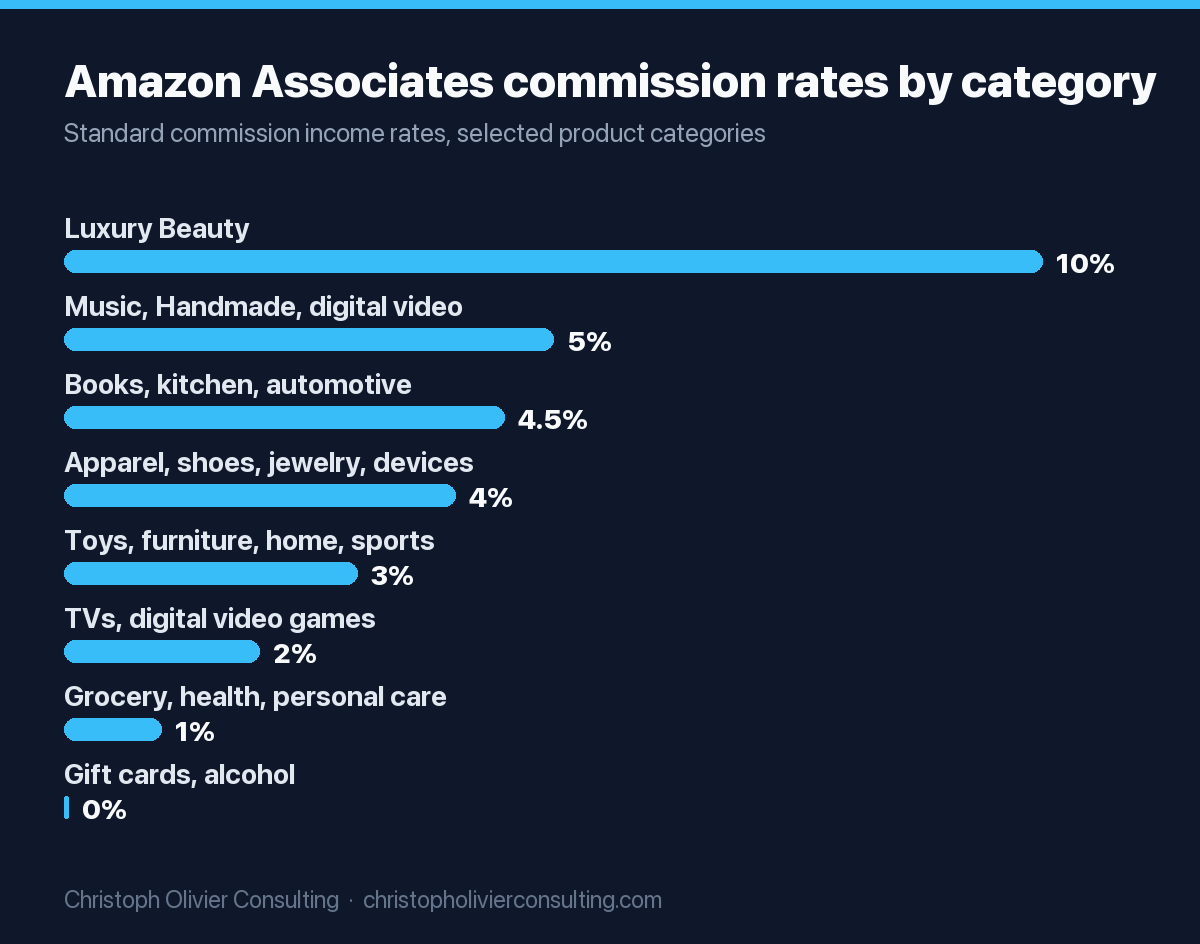
Two numbers matter more than the headline rate. The first is the attribution window: Amazon’s is a 24-hour session with an 89-day exception for items added to the cart, while many network programs set longer cookie windows of their own. The second is the reversal rate, the share of commissions later cancelled for returns or invalid orders, which networks show in publisher reports. For wider benchmarks, see our collection of affiliate marketing statistics.
How to choose an affiliate network as a publisher
As a publisher, choose affiliate networks by the brands your audience already buys, then by payment reliability and reporting quality. Joining a network is usually free, so the real cost is your time and the trust you spend recommending products. Most serious publishers end up on several networks plus a few direct programs.
- Brand fit: search the network’s advertiser directory for the specific brands you already recommend.
- Payment terms: payout threshold, frequency, currency and fees (ClickBank, for example, charges $5 per payout).
- Attribution window: compare cookie lengths across programs for the same product type.
- Reversal history: after 90 days, check each advertiser’s reversal rate.
- Disclosure rules: read each program’s terms; Amazon, for example, requires specific wording.
How to choose an affiliate network as an advertiser
Choose an affiliate network by where your likely publishers already are, not by headline network size. Start with your category and buyer, list the publishers you want, check which networks they use, then compare total cost, attribution rules, fraud tools and contract terms. A smaller network your target publishers use beats a larger one they ignore.
- Define the action you pay for. A sale, a qualified lead, a booked call or a trial. Retail networks are built around sales; B2B platforms such as PartnerStack also support lead and deal registration.
- List 20 to 30 target publishers. Look at who ranks, reviews and compares products in your category, then check which networks their disclosures or links reveal.
- Model the full cost using the worked example above, including minimum contract terms such as Awin Access’s 3-month minimum.
- Check attribution options. Ask whether you can reward assisting partners (content, comparison sites) as well as the last click, and whether coupon and cashback sites can be paid differently.
- Review fraud and compliance tooling. Ask how the network detects cookie stuffing, trademark bidding and fake leads, and how it monitors disclosures.
- Plan recruitment and management time. A network gives access, not results. Someone still has to approve partners, brief them, and optimize offers every month.
- Agree a 90-day test plan with clear targets for active partners, revenue and cost per sale before committing to an annual tier.
Affiliate programs work best as one part of a broader partnership marketing strategy, where affiliates, co-marketing partners and referral sources are managed with the same discipline.
FTC rules: disclosure duties for affiliates and advertisers
US affiliates must clearly disclose that they earn commissions, close to the recommendation itself. Under the FTC’s Endorsement Guides, revised in 2023, advertisers also share responsibility: they are expected to train, monitor and act on affiliate disclosure failures. Joining a network does not move that duty onto the network.
The FTC’s own Endorsement Guides FAQ sets out the practical rules:
- Placement: the closer the disclosure is to the recommendation, the better. A disclosure page elsewhere on the site is not enough if readers cannot see the endorsement and the disclosure together.
- Wording that works: “I get commissions for purchases made through links in this post,” or “Paid link” next to the link.
- Wording that falls short: “affiliate link” alone, “commissionable link,” or a hyperlinked disclosure that readers can easily skip.
- Advertiser programs: brands should have reasonable programs to train affiliates, monitor what they publish, and act on problems.
For video and social, the FTC’s Disclosures 101 for Social Media Influencers adds that disclosures belong in the video itself, not only in the description, and that a platform’s built-in disclosure tool may not be enough on its own.
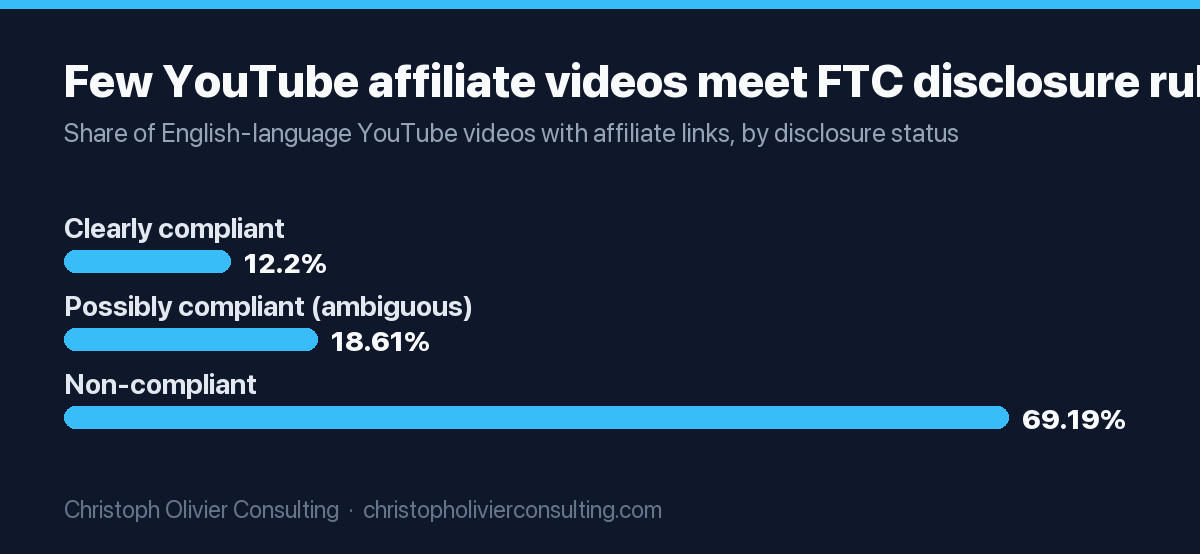
Compliance is still poor in practice. A 2026 study, Turning Trust to Transactions, analyzed over 2 million YouTube videos from nearly 540,000 creators. Among 139,900 English-language videos with affiliate links, only 45.52% included any disclosure, and just 12.20% had disclosures that clearly met FTC guidelines. If you run a program, give partners template wording and check their pages.
Affiliate fraud risks and how to protect your program
The main affiliate fraud risk is paying commission for sales you would have made anyway. Cookie stuffing, trademark bidding, coupon hijacking and fake leads all claim credit without creating demand. Networks run detection tools, but advertisers still need their own checks, because the network earns its fee on fraudulent and genuine transactions alike.
The best-known case shows the scale. eBay’s top affiliate, Shawn Hogan, collected $28 million in commissions through cookie stuffing, where widgets dropped eBay affiliate cookies on visitors’ computers so he was credited for purchases he did not drive. As Marketing Land reported, he was sentenced on May 2, 2014 to five months in federal prison and a $25,000 fine after pleading guilty to wire fraud.
Common patterns to watch:
- Cookie stuffing: affiliate cookies set without a real click, often through hidden frames, pop-ups or browser extensions.
- Trademark or brand bidding: affiliates buying ads on your brand name to intercept customers already looking for you.
- Coupon and cashback hijacking: last-second clicks at checkout that overwrite the content partner who actually influenced the sale.
- Fake or low-quality leads: form fills with invalid details on cost-per-lead offers.
Controls that help: a lock period before commissions are approved, written bans on brand bidding with regular search checks, separate rates for coupon sites, lead validation before payout, and a monthly review of partners with abnormal conversion rates.
Template: affiliate network evaluation scorecard
Use a weighted scorecard to compare two or three affiliate networks on the same terms. Score each criterion from 1 to 5, multiply by its weight and add the results. The weights below are a starting point for a B2C brand; shift weight toward lead tracking and partner management if you sell B2B.
| Criterion | Weight | Questions to ask | Network A (1 to 5) | Network B (1 to 5) |
|---|---|---|---|---|
| Publisher fit | 25% | How many of my 20 to 30 target publishers are already active here? | ||
| Total cost at forecast revenue | 20% | Commission + performance fee + platform fee + setup, as a share of affiliate revenue? | ||
| Attribution flexibility | 15% | Can I pay assisting partners and set different rates by partner type? | ||
| Fraud and compliance tools | 15% | How are cookie stuffing, brand bidding and missing disclosures detected and handled? | ||
| Contract terms | 10% | Minimum term, notice period, data export on exit? | ||
| Reporting and integrations | 10% | Does it connect to my store, CRM and analytics without manual work? | ||
| Support | 5% | Who is my contact, and what is included at my tier? |
Pre-launch checklist:
- Commission terms written, including what is excluded (returns, existing customers, brand search).
- Disclosure requirements and sample wording sent to every approved partner.
- Approval rules for new publishers documented.
- Tracking tested end to end with a live test order.
- Lock period and reversal policy set.
- Monthly review owner named.
Do affiliate networks make sense for service businesses?
For most professional-service firms, a public affiliate network is not the first move. Networks are built for high-volume online transactions, and most service firms sell through consultations, proposals and relationships. A structured referral or partner program usually fits better, though some productized services and software-led firms can make a network work.
Law, accounting and advisory firms usually win more from a few trusted introducers than from hundreds of anonymous publishers, and regulated professions often restrict paying for referrals. Our referral marketing guide covers how to design that kind of program. In my experience, firms that do well with affiliates treat them like any channel: a clear offer, a cost ceiling and an owner for the numbers.
If you are weighing an affiliate network against a referral or partnership program and want a second opinion on the economics, you can book a consultation and we will walk through it together.
Frequently asked questions
What is an affiliate network?
An affiliate network is a third-party platform that connects many brands with many publishers under one tracking and payment system. Brands list their affiliate programs, publishers apply to promote them, and the network tracks clicks and sales, reports results and pays commissions. Examples include Awin, CJ, Rakuten Advertising, impact.com, ClickBank and PartnerStack.
What is the difference between an affiliate network and an affiliate program?
An affiliate program is one company's offer to pay partners for sales or leads, with its own commission rates and rules. An affiliate network is the marketplace and infrastructure where many programs are hosted. Every network contains programs, but a program can also run in-house on its own software without any network. Amazon Associates is a program, not a network.
How much do affiliate networks charge advertisers?
It varies by network. Awin's published US plans cost $49 a month plus a 3.5% tracking fee on sale value, or from $99 a month plus 2.5%. impact.com publishes plans from $30 to $2,500 a month plus a 2.5% transaction fee. ClickBank keeps 7.5% plus $1 per sale. CJ and Rakuten Advertising price through sales conversations.
Is it free to join an affiliate network as a publisher?
In most cases, yes. Networks earn their revenue from advertisers, so publishers usually join free and are paid commissions set by each brand. Some networks charge payout fees, for example ClickBank charges $5 per payment issued. Each brand inside the network still has to approve your application before you can promote its products.
Which affiliate network is best for B2B SaaS?
PartnerStack is built specifically for B2B software companies and supports affiliate links, lead and deal registration, partner onboarding and a B2B partner marketplace. Retail networks such as Awin or impact.com can also work if you sell lower-priced software online. The better choice depends on whether your partners send clicks, leads or co-sell deals.
Do affiliates have to disclose affiliate links?
Yes. Under the FTC's Endorsement Guides, US affiliates must clearly disclose that they earn commissions, close to the recommendation. Phrases like 'I get commissions for purchases made through links in this post' work; 'affiliate link' alone may not. Advertisers are also expected to train and monitor their affiliates, even when the program runs on a network.
Does ShareASale still exist?
Not as a separate network. Awin, which owned ShareASale, moved all active ShareASale customers onto the Awin platform by August 15, 2025, and ShareASale was set to cease US operations in October 2025. Former ShareASale advertisers and publishers now work inside Awin, so lists recommending ShareASale as a standalone network are out of date.
More Referrals & Partnerships guides
- Referral Marketing: How It Works and How to Build a Program
- Marketing Mistakes Fund Managers and Capital Raisers Make
- Investor Meetings That Convert for Fund Managers
- LP Annual Meeting Agenda Template for Fund Managers
- How to Build an Investor Pipeline as a Fund Manager: A Repeatable System
- Marketing Channels for Fund Managers and Capital Raisers
- All Referrals & Partnerships guides →