
Last reviewed: October 2026
The best affiliate marketing software in 2026 depends on how you bill and who your partners are. For Stripe-billed SaaS, Rewardful and FirstPromoter start at $49 a month with no transaction fee. Shopify stores get the most for the least from UpPromote or Refersion. Programs that need a partner marketplace, B2B deal registration or enterprise attribution belong on impact.com, PartnerStack or Everflow.
This guide compares 11 affiliate tracking platforms on the things that decide total cost and fit: list price, transaction fees, caps, tracking method, payouts and integrations. Every price below was checked on the vendor’s own pricing page on 13 October 2026 and is shown in USD. Vendors change pricing often, so confirm before you sign.
Best affiliate marketing software at a glance
Eleven platforms cover almost every in-house affiliate program in 2026. Self-serve tools (Rewardful, FirstPromoter, Tapfiliate, Partnero, Refersion, UpPromote) cost $0 to $199 a month at entry. Mid-market trackers (Post Affiliate Pro, Trackdesk) run $89 to $299. Partner platforms (impact.com, PartnerStack, Everflow) add marketplaces and enterprise tracking, mostly on quoted pricing.
| Platform | Best for | Entry price (monthly billing) | Transaction fee | Free trial or plan |
|---|---|---|---|---|
| impact.com | Brands that want a partner marketplace and room to scale | From $30/mo (Starter) | 2.5% of partner-driven transactions | No free plan listed |
| PartnerStack | B2B SaaS with resellers, referral and affiliate partners | Quoted after demo | Not published | Demo |
| Everflow | Performance marketers and networks running many offers | Quoted (pricing form) | Not published | Demo |
| Refersion | Ecommerce brands that want first-party tracking | $39/mo (Launch) | 3% Launch, 2% Growth | Free marketplace listing |
| UpPromote | Shopify stores (Shopify-only) | $0 (Free), $29.99/mo (Growth) | 0% Free, then 2% to 1% | Free plan |
| Rewardful | Stripe-billed SaaS and subscriptions | $49/mo (Starter) | 0% | 14-day trial |
| FirstPromoter | SaaS on Stripe, Paddle, Chargebee, Recurly or Braintree | $49/mo (Starter) | None listed | Trial not confirmed |
| Tapfiliate | Small ecommerce or SaaS programs needing 30+ integrations | $89/mo (Launch) | None listed | 7-day trial (Launch) |
| Partnero | Growing programs that want no partner or revenue caps | $59/mo ($49 annual) | None (“no hidden fees”) | 30-day trial |
| Post Affiliate Pro | Teams needing deep configuration, MLM or EU/US data hosting | $89/mo (Starter) | None listed | Not confirmed |
| Trackdesk | High-volume programs that want unlimited clicks and conversions | $299/mo (Business) | Not specified | 14-day assisted trial |
How to choose affiliate tracking software
Choose affiliate tracking software by matching three things: your billing system, your partner type and your expected affiliate revenue. Billing decides which tools can attribute sales reliably. Partner type decides whether you need a marketplace or deal registration. Revenue decides whether a flat fee or a percentage fee costs less over a year.
Work through these questions in order. Most teams can cut the list to two or three tools in under an hour.
- Where does the money get collected? If revenue runs through Stripe invoices, a billing-native tool such as Rewardful is the shortest path; its help docs say it is designed for businesses that use Stripe Invoices. If you sell on Shopify, start with Shopify apps. If deals close in a CRM, look at platforms with lead and deal registration.
- Who will promote you? Customers and fans need simple links and coupons. Content publishers and creators may expect a marketplace. Agencies, consultants and resellers need deal registration and longer attribution windows.
- How much affiliate revenue do you expect in year one? Under about $15,000 a month, flat-fee tools are usually cheapest. Percentage fees grow with every sale, so model both at 2x your forecast.
- How will you pay partners? Check the payout rails your partners actually use (PayPal, Wise, bank transfer, store credit) and whether payouts are automated or manual.
- What has to integrate? List your billing, ecommerce, CRM and email tools, then confirm each one on the vendor’s integration page, not a review site.
The 11 best affiliate marketing software platforms, reviewed
The 11 platforms below fall into three groups: partner platforms for larger programs, ecommerce trackers, and self-serve SaaS tools. Each review lists the verified entry price, the main limit to watch and who the tool fits. Prices are monthly billing in USD unless noted, as published on 13 October 2026.
impact.com: best partner platform with a published entry price
impact.com now lists four tiers: Starter “priced from $30/mo”, Essentials from $500/mo, Pro from $2,500/mo and a quoted Enterprise tier. A 2.5% transaction fee applies only to partner-driven transactions. Starter covers plugin integrations, promo code and link tracking and basic reporting. Marketplace access starts at Essentials, while cross-device and API-based tracking start at Pro. It suits brands that expect to outgrow a simple tracker and want to recruit from an existing partner pool.
PartnerStack: best for B2B SaaS partner ecosystems
PartnerStack does not publish prices; its page says pricing “is based on your partner program size, feature needs and level of support” and is confirmed during a demo. Even the Launch tier supports “affiliate link tracking or lead and deal registration”, access to the PartnerStack Marketplace and CRM integrations. Higher tiers add MDF management and partner learning tools. It fits software companies that mix affiliates, referral partners and resellers.
Everflow: best for performance marketers running many offers
Everflow sells on quoted pricing through a “Request Personalized Pricing” form, so budget time for a sales cycle. It is built for advertisers and networks managing many offers, partners and payout rules at once. Consider it when your program looks more like a media-buying operation than a customer referral scheme.
Refersion: best ecommerce tracker with cookieless tracking
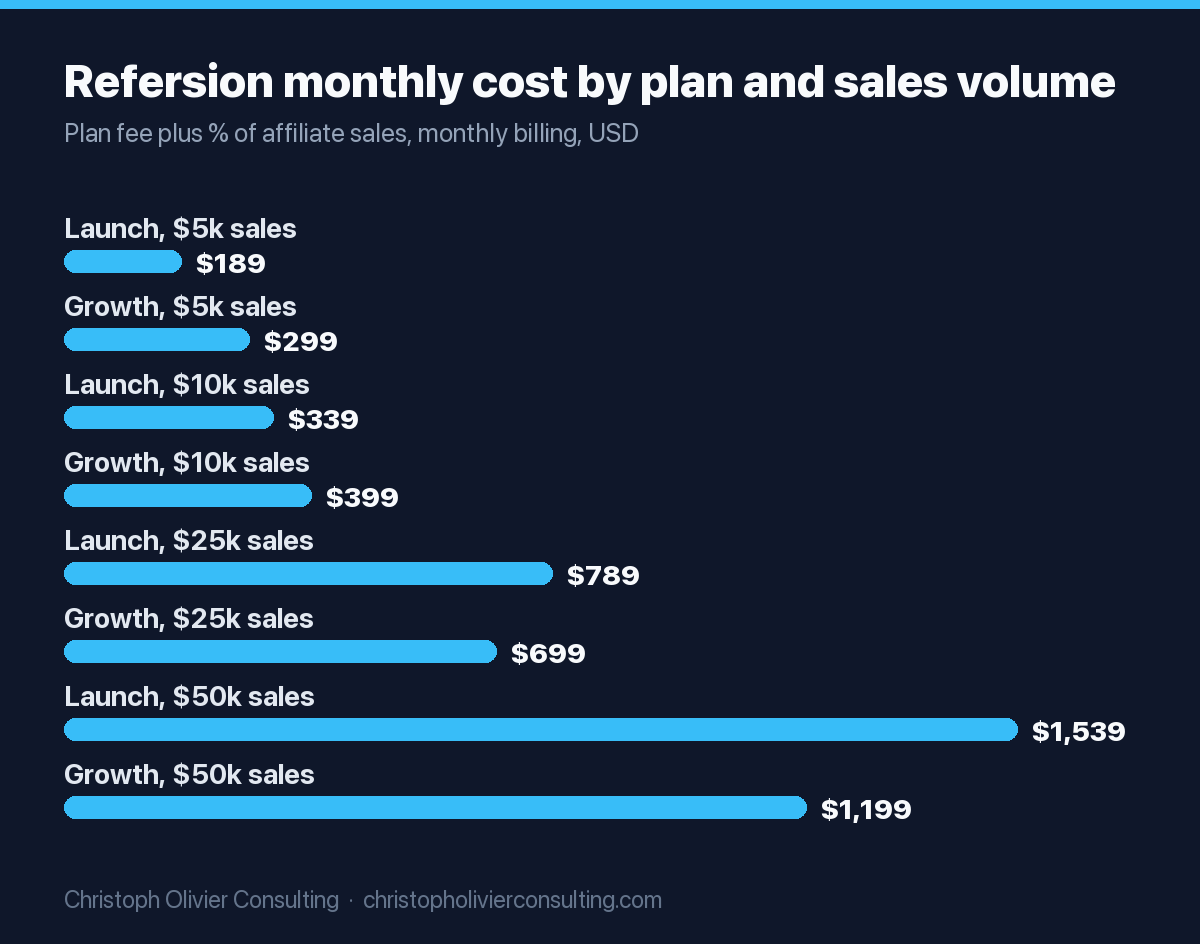
Refersion starts at $39/mo on Launch ($29/mo billed annually) plus 3% of affiliate-driven sales. Growth is $199/mo ($159/mo annually) plus 2%. Launch already includes unlimited affiliates, clicks and conversions and a “first-party tracking domain (no cookies)”. A free Marketplace Listing tier lets you publish percent-of-sale offers. Watch the percentage fee: it becomes your largest cost as the program grows.
UpPromote: best for Shopify stores on a tight budget
UpPromote is built for Shopify and sold through the Shopify App Store. The Free plan covers one program with link and coupon tracking and no transaction fee. Paid plans run $29.99, $89.99 and $199.99 a month, with fees falling from 2% to 1.5% to 1% of successful referral sales. Multi-level marketing and PayPal auto-pay start on Professional.
Rewardful: best for Stripe-billed SaaS
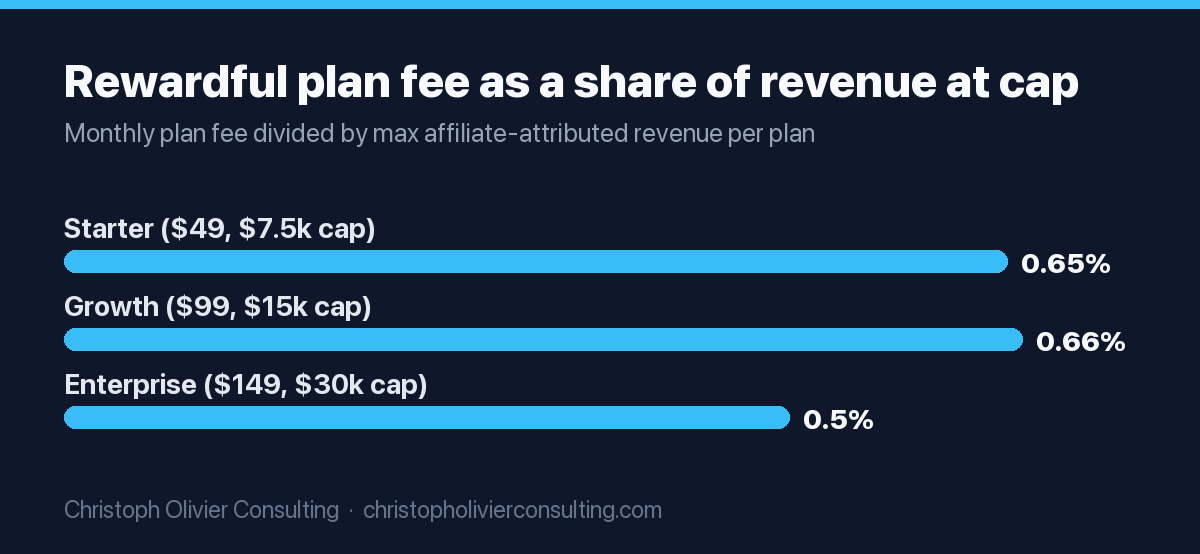
Rewardful costs $49/mo on Starter (up to $7,500 a month in affiliate-attributed revenue), $99/mo on Growth (up to $15,000) and from $149/mo on Enterprise (up to $30,000 on the entry tier). Every plan carries “0% transaction fee on affiliate-attributed revenue”, unlimited affiliates and a 14-day trial. Optional Managed Payouts cost a 3% processing fee. Branded portals and PayPal or Wise payouts start on Growth.
FirstPromoter: best SaaS tool for mixed billing stacks
FirstPromoter mirrors that price ladder: $49/mo Starter (up to $5,000 a month of affiliate revenue, 1,000 affiliates max), $99/mo Business (up to $15,000) and $149/mo Enterprise above that. It integrates with Stripe, Paddle, Chargebee, Recurly and Braintree, and tracks referral links, coupons, direct URLs and sub-IDs. Mass payouts run through PayPal, Wise, Stripe, crypto or bank transfer.
Tapfiliate: best for small programs that need many integrations
Tapfiliate Launch costs $89/mo ($74/mo annually) with “30+ pre-built integrations (Shopify, BigCommerce, Stripe etc.)”, recurring commissions and coupon tracking. Launch caps you at 50 affiliates, 5,000 clicks and 500 conversions a month. Scale ($179/mo, $149 annually) lifts that to unlimited affiliates, 100,000 clicks and 10,000 conversions, plus automated payouts.
Partnero: best for uncapped growth at a flat fee
Partnero Starter is $59/mo ($49/mo billed annually) and Partner is $199/mo ($159 annually), with Enterprise quoted. Every plan advertises “unlimited partners, transactions, & revenue”, a white-label partner portal, automated payouts and a 30-day trial. Extra seats cost $29 per user per month, which matters if several people manage the program.
Post Affiliate Pro: best for deep configuration and data residency
Post Affiliate Pro runs from $89/mo Starter (10,000 tracking requests) to $139 Pro (1,000,000 requests, 220+ integrations), $269 Ultimate and $649 Network, with annual discounts. Ultimate adds performance rewards and forced-matrix MLM structures. All plans let you choose an EU or US data center, a practical point for European programs.
Trackdesk: best for high volume without usage caps
Trackdesk starts at $299/mo on Business, $499/mo on Enterprise and “from $1,199/mo” on Enterprise PLUS. Every tier includes unlimited clicks, conversions and affiliate partners plus fraud protection, which makes costs predictable. Business limits you to 5 seats, 10 active offers and 2 currencies, so check those caps first.
What affiliate marketing software actually costs
Affiliate marketing software costs between $0 and about $2,500 a month at published list prices in 2026, before transaction fees. The fee model matters more than the sticker price. A flat-fee tool costs the same at any revenue inside its cap, while a percentage fee rises with every affiliate sale you make.
Use this table to compare the two fee models side by side. All figures are monthly billing from each vendor’s pricing page.
| Fee model | Platform and plan | Monthly fee | Variable cost | Main limit |
|---|---|---|---|---|
| Flat, revenue-capped | Rewardful Starter / Growth | $49 / $99 | 0% | $7,500 / $15,000 monthly affiliate revenue |
| Flat, revenue-capped | FirstPromoter Starter / Business | $49 / $99 | None listed | $5,000 / $15,000 monthly affiliate revenue |
| Flat, usage-capped | Tapfiliate Launch / Scale | $89 / $179 | None listed | 500 / 10,000 conversions a month |
| Flat, uncapped | Partnero Starter / Partner | $59 / $199 | None | 1 / 3 programs and team members |
| Flat, uncapped | Trackdesk Business | $299 | Not specified | 5 seats, 10 active offers |
| Base plus percentage | Refersion Launch / Growth | $39 / $199 | 3% / 2% of affiliate sales | None listed on core usage |
| Base plus percentage | UpPromote Growth / Professional / Enterprise | $29.99 / $89.99 / $199.99 | 2% / 1.5% / 1% of referral sales | Shopify only |
| Base plus percentage | impact.com Starter / Essentials | From $30 / from $500 | 2.5% of partner-driven transactions | Marketplace from Essentials |
The break-even maths is simple. On Refersion, Launch costs $39 plus 3% and Growth costs $199 plus 2%, so the two plans cost the same at $16,000 a month of affiliate sales. Below that, Launch is cheaper. Above it, Growth wins, and the gap widens with every extra dollar.
Flat-fee SaaS tools look different. At Rewardful’s own caps, each plan’s fee works out to well under 1% of the affiliate revenue it covers, compared with 2% to 3% on percentage-fee plans. Those percentages are on top of the commission you pay partners, so they compound. For wider program benchmarks, see these affiliate marketing statistics.
Affiliate tracking methods compared
Affiliate tracking software attributes a sale in one of five ways: a referral link, a coupon code, a first-party domain, a billing-system integration, or an API or server-side event. The method decides how much attribution survives ad blockers, cross-device journeys and offline deals. Strong programs combine at least two methods.
| Method | How it works | Strength | Weakness | Examples in this guide |
|---|---|---|---|---|
| Referral link | Partner shares a unique URL, such as example.com?via=name | Simple for any partner | Lost if the visitor switches device or browser | Every platform listed |
| Coupon code | A partner-specific code credits the sale at checkout | Works offline, in podcasts and on video | Codes leak to coupon sites | FirstPromoter, Tapfiliate, UpPromote, Trackdesk |
| First-party tracking domain | Tracking runs on your own domain instead of a third-party cookie | More resilient to browser restrictions | Needs DNS setup | Refersion (“no cookies” on Launch) |
| Billing integration | The tool links the referred customer to invoices in Stripe, Paddle or similar | Credits renewals and upgrades automatically | Tied to supported billing systems | Rewardful, FirstPromoter |
| API, cross-device or deal registration | Server-side events or CRM deal records credit the partner | Covers long, multi-touch B2B sales | Needs developer or RevOps time | impact.com Pro, PartnerStack |
Affiliate management software vs an affiliate network
Affiliate management software tracks and pays partners you recruit yourself. An affiliate network rents you access to its existing publishers in exchange for fees, usually on top of commission. Choose software when you already have an audience of customers or partners. Choose a network when you need reach fast and have no partner list.
Many brands end up with both: an in-house program for customers, consultants and agencies, plus a network or marketplace for publisher reach. Partner platforms blur the line. On impact.com, marketplace access starts at the Essentials tier, and PartnerStack includes marketplace access from its Launch plan. If a network is on your shortlist, compare the main options in this guide to affiliate networks before you commit to a contract.
- Pick software if you have more than a few dozen happy customers, an email list or partners who already send you work.
- Pick a network if you sell a consumer product with broad appeal and need publishers you cannot reach directly.
- Pick a partner platform if you need both, plus contracts, deal registration or multi-team management.
In-house affiliate program software for service businesses
Service businesses rarely need consumer-style affiliate software. Their best partners are accountants, lawyers, agencies and past clients who refer a handful of high-value deals a year. For them, in-house affiliate program software should prioritize lead and deal registration, CRM sync and manual approval over click tracking and coupon codes.
A referral from another professional often closes weeks after the first conversation, offline and after several calls. A 30-day cookie misses that. Look for platforms that let partners register a lead, sync it to your CRM and credit the partner when the deal closes. PartnerStack lists lead and deal registration on its entry plan; on self-serve tools, test direct URL or manual commission features during the trial.
The program design matters more than the tool. My view: a professional-services firm with fewer than 20 active referral partners can often run on a simple tracker plus a clear agreement, then upgrade once volume justifies it. This referral marketing guide covers incentive design, and a broader channel sales strategy helps when partners resell rather than refer.
How to launch an in-house affiliate program in 30 days
You can launch an in-house affiliate program in about 30 days if you decide terms before you pick software. Set commission, attribution window and payout rules first, then configure the tool, recruit a small founding group and review results weekly. Most delays come from unclear terms, not technology.
- Week 1, define terms. Commission rate or flat bounty, recurring or one-time, attribution window, minimum payout, payout schedule and what counts as a qualified sale.
- Week 1, write the partner agreement. Include disclosure rules, banned claims, brand-bidding rules and how disputes are handled.
- Week 2, set up the tool. Connect billing or your store, install tracking, set up the partner portal and test one full referral from click to commission.
- Week 2, build the partner kit. Approved copy, product facts, images and a sample disclosure line partners can paste.
- Week 3, recruit 10 to 20 founding partners. Start with customers and professionals who already refer you. Real-world affiliate marketing examples show how other brands frame the invitation.
- Week 4, review and fix. Check tracking accuracy against your billing data, spot-check partner content for disclosures and adjust terms before you open the program wider.
FTC disclosure rules for affiliate programs
Under the FTC’s Endorsement Guides, affiliates must disclose that they earn a commission, clearly and close to the recommendation. The brand running the program also carries responsibility. The FTC says advertisers “need to have reasonable programs in place to train and monitor members of their network,” so your software and process should support monitoring.
The FTC’s Endorsement Guides FAQ gives three practical rules. First, affiliates “should disclose your relationship to the retailer clearly and conspicuously.” Second, placement matters: “The closer the disclosure is to your recommendation, the better.” Third, wording matters. The FAQ notes consumers “might not understand that ‘affiliate link’ means that the person placing the link is getting paid,” while “‘Paid link’ right next to an affiliate link should be an adequate disclosure.”
For the brand, the same FAQ states: “Your company is ultimately responsible for what others do on your behalf.” In practice, build these steps into your program:
- Put disclosure and claims rules in the partner agreement and onboarding.
- Give partners approved disclosure wording, not just a link to the rules.
- Spot-check partner pages and posts on a schedule, starting with your highest earners.
- Pause commissions or remove partners who will not fix violations.
This is general information, not legal advice. If you operate in regulated fields such as finance, health or legal services, have counsel review your partner terms.
Affiliate software selection checklist
Use this checklist during free trials and demos. A platform that fails any of the first five items is usually the wrong fit, however good its reviews look. Score the rest to separate close finalists, and keep notes so the decision survives a change of team.
Affiliate software scorecard (copy and fill in per vendor)
- Integrates natively with our billing or store: ________
- Tested one full referral from click to commission in the trial
- Supports our partner type (customers, creators, professionals, resellers)
- Payout rails our partners use: PayPal / Wise / bank / store credit
- Total monthly cost at 1x and 2x forecast affiliate revenue: $____ / $____
- Revenue, conversion, affiliate or seat caps we would hit in 12 months
- Tracking methods: link / coupon / first-party / billing / API / deal registration
- Fraud controls and manual approval of commissions
- Branded partner portal and custom domain on the plan we would buy
- Data export and API access if we switch later
- Support level and onboarding included
If you want a second pair of eyes on program design or tool fit before you commit, you can book a consultation and we can walk through your numbers.
Frequently asked questions
What is the best affiliate marketing software in 2026?
It depends on your billing and partners. Stripe-billed SaaS teams often choose Rewardful or FirstPromoter from $49 a month. Shopify stores look at UpPromote or Refersion. Brands that need a partner marketplace or enterprise tracking choose impact.com, PartnerStack or Everflow. Match the tool to how you collect revenue first, then compare total cost at your expected affiliate revenue.
Is there free affiliate tracking software?
Yes, with limits. UpPromote offers a free plan for Shopify stores with one program, link and coupon tracking and no transaction fee. Refersion offers a free marketplace listing tier. Most other platforms offer free trials of 7 to 30 days rather than free plans, so use the trial to test one full referral before paying.
How much does affiliate management software cost?
Published entry prices in October 2026 range from $0 (UpPromote Free) to $299 a month (Trackdesk Business), with impact.com tiers from $30 to $2,500 a month plus a 2.5% transaction fee. Some platforms, including PartnerStack and Everflow, quote prices only after a demo. Always add percentage fees and partner commissions to compare true cost.
What is the difference between affiliate software and an affiliate network?
Affiliate software tracks and pays partners you recruit yourself, usually for a monthly fee. An affiliate network gives you access to its existing publishers and typically charges fees on top of commissions. Software suits brands with customers or partners ready to refer. Networks suit brands that need publisher reach they cannot build quickly on their own.
Can a service business use affiliate software for referral partners?
Yes. Professional-service firms can use affiliate or partner software to track referrals from accountants, lawyers, agencies and past clients. Prioritize lead or deal registration, CRM sync and manual approval, because high-value referrals often close offline weeks later. A small partner group can often start on a simple tracker and a clear written agreement.
Do affiliates have to disclose affiliate links?
Yes. The FTC's Endorsement Guides FAQ says affiliates should disclose their relationship clearly and conspicuously, close to the recommendation. It notes the words 'affiliate link' alone may not be understood, while 'paid link' next to the link should be adequate. Brands running programs should train and monitor partners, because they remain responsible for what partners do.
More Referrals & Partnerships guides
- Referral Marketing: How It Works and How to Build a Program
- Fund One-Pager Template for Fund Managers
- How Fund Managers Can Build LP Relationships and an Investor Pipeline
- How Financial Advisors Build Referral Partnerships (CPAs, Estate Attorneys, Insurance)
- How Fund Managers Reach Family Offices and RIAs
- Marketing Calendar for Fund Managers: An Investor-Communication Cadence
- All Referrals & Partnerships guides →