
Last reviewed: October 2026
A digital marketing virtual assistant is a remote contractor who runs the repeatable execution work in your marketing: scheduling social posts, publishing blog content, building email campaigns, updating your website and pulling weekly reports. Published 2026 market rates run from about $7.50 to $17 an hour for offshore assistants hired through a staffing firm to about $36 to $39 an hour for US-based assistants on managed plans. A VA executes a plan well; they are not the person who should write it.
This guide is for owners and partners of professional-service firms and 7-figure service businesses who want marketing to stop depending on their own evenings. It covers what a marketing virtual assistant can and cannot do, verified price ranges, how a VA compares with a freelancer, an agency and a fractional CMO, where to hire, a hiring checklist with the questions to ask, how to give access safely, and a 30-day onboarding checklist you can copy.
Need senior marketing leadership without a full-time hire? See CO Consulting’s fractional CMO services.
What is a digital marketing virtual assistant?
A digital marketing virtual assistant is a remote, usually part-time contractor who handles recurring marketing tasks inside tools you already own: your social accounts, CMS, email platform, ad accounts and analytics. They follow your calendar, brand rules and checklists. The value is consistency: the newsletter goes out and the report lands every Monday.
The role sits between a general admin assistant and a specialist. A digital marketing VA knows the marketing tools: Canva, a scheduler, WordPress, an email platform, Google Analytics and the basics of the Meta and Google ad interfaces. Managed providers such as Time etc list the same core menu: social media marketing, content scheduling, community management, SEO, email campaigns, website updates, graphic design for ads, reporting and lead generation support.
What separates a good hire from a frustrating one is rarely skill. It is whether you hand them a clear plan. One staffing firm puts the boundary plainly: “You keep the strategy and the budget decisions. Your VA keeps the channels running.” That is the right mental model for the rest of this guide.
What a marketing virtual assistant can and cannot do
A marketing virtual assistant can reliably own execution: posting, publishing, formatting, list hygiene, basic design from templates, campaign setup to a spec and routine reporting. They usually cannot own strategy: choosing your positioning, deciding which channels deserve budget, setting offers and pricing, or diagnosing why pipeline dropped. Those calls need senior judgment and accountability for revenue.
Use this table to scope the role before you write a job post. The middle column is safe to delegate on day one. The right column is where you, a specialist or a fractional leader stays in charge.
| Function | A VA can own (with your SOP) | Keep with you or a senior lead |
|---|---|---|
| Social media | Content calendar upkeep, scheduling, resizing assets, replying to routine comments and DMs, moderation | Brand voice, what you take a public stance on, handling complaints or press |
| Content and SEO | Uploading and formatting posts in WordPress, alt text, internal links from a list, meta fields, basic keyword lookups | Topic strategy, what to publish and why, expert review of claims |
| Email and SMS | Building campaigns from templates, segment pulls, list cleaning, scheduling, checking links | Offers, nurture logic, what to say to which segment |
| Paid ads | Uploading creative, duplicating campaigns to a spec, daily spend checks, flagging anomalies | Budgets, bidding strategy, audience strategy, kill or scale decisions |
| Website | Text and image updates, form tests, broken link checks, plugin update reminders | Site architecture, conversion strategy, developer work |
| Reporting | Pulling numbers into a dashboard or sheet every week, noting what changed | Interpreting the numbers and deciding what to change |
| Lead handling | CRM data entry, tagging, routing form fills, list building from defined sources | Sales process, qualification rules, follow-up scripts |
If most of your wish list sits in the right column, you need direction first and a VA second.
How much does a digital marketing virtual assistant cost in 2026?
A digital marketing virtual assistant costs roughly $7.50 to $17 an hour through an offshore staffing firm, about $400 to $2,400 a month full time if you hire a Filipino assistant directly, and $36 to $39 an hour on a managed US-based plan. Rates rise with specialty: analytics and paid ads cost more than social posting.
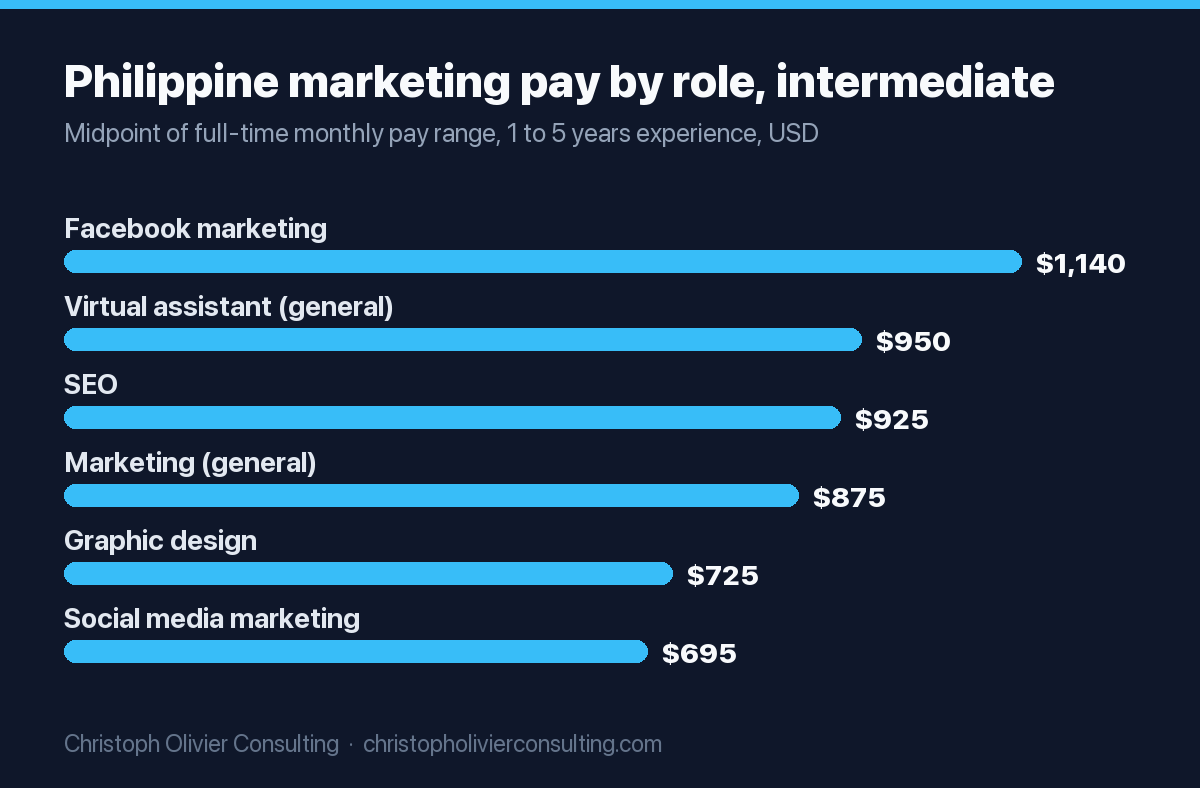
The figures below are published market ranges from the providers named, not quotes. Your price depends on hours, skills, time zone overlap and how much management you want included.
| Hiring route | Published market range | What the price includes | Source |
|---|---|---|---|
| Offshore VA via staffing firm, social media | $7.50 to $9 per hour | Recruiting, screening and a skills test | VA Masters |
| Offshore VA via staffing firm, marketing and advertising | $8.50 to $15 per hour | Same | VA Masters |
| Offshore VA via staffing firm, analytics and data | $9.50 to $17 per hour | Same | VA Masters |
| Offshore VA via staffing firm, part time (80 hours a month) | About $600 to $1,360 per month | Same | VA Masters |
| Direct hire in the Philippines, social media marketing, full time | $500 to $1,200 per month (beginner to expert) | Salary only; you recruit and manage | OnlineJobs.ph, April 2026 |
| Direct hire in the Philippines, Facebook marketing, full time | $400 to $2,400 per month | Salary only | OnlineJobs.ph, April 2026 |
| Direct hire in the Philippines, SEO, full time | $365 to $1,265 per month | Salary only | OnlineJobs.ph, April 2026 |
| US-based managed VA plan | $390 for 10 hours to $2,160 for 60 hours per month ($39 to $36 an hour) | Matching, replacement, rollover hours on larger plans | Time etc pricing |
For a US benchmark, the Bureau of Labor Statistics reports a median wage of $37.87 an hour ($78,760 a year) for market research analysts and marketing specialists in May 2025, before benefits. That is the employee alternative a part-time contractor is usually measured against.
Digital marketing VA vs freelancer vs agency vs fractional CMO
A digital marketing VA is the cheapest way to buy consistent execution, a freelance specialist buys deeper skill in one channel, an agency buys a team and a process, and a fractional CMO buys senior strategy and accountability. Most 7-figure firms end up combining two of these: a strategy owner plus an execution layer.
| Option | Best for | Owns strategy? | Typical pricing model | Main risk |
|---|---|---|---|---|
| Do it yourself | Very early firms with time but no budget | Yes, you | Your hours | Marketing stops when you get busy |
| Digital marketing VA | Firms that already know what works and need it done every week | No | Hourly or monthly hour blocks | Busywork without direction |
| Freelance specialist | One channel that needs real skill, such as SEO or paid search | Within their channel | Hourly, project or retainer | Channel silos; no one owns the whole funnel |
| Agency | Volume execution across several channels | Partly, often tied to the services they sell | Monthly retainer plus setup | Junior staff on your account; recommendations shaped by their menu |
| Fractional CMO | Firms that need a plan, priorities and someone accountable for pipeline | Yes | Monthly retainer for part-time senior time | Needs an execution layer to carry out the plan |
If you are weighing the specialist route, our guides to hiring a freelance digital marketer and a digital marketing specialist cover rates and scoping for those roles. If the honest problem is that nobody owns the plan, start with fractional CMO services and add a VA once there is a calendar to execute.
Where to hire a marketing virtual assistant
You can hire a marketing virtual assistant in three ways: through an open freelance marketplace, by posting directly on a regional job board, or through a managed VA company that recruits, vets and replaces for you. Marketplaces are the cheapest to start, direct hiring gives the lowest ongoing cost, and managed firms cost more but save you recruiting time.
- Freelance marketplaces. Large talent pools, reviews and built-in payments. You do the screening. Good for trial projects.
- Regional job boards. OnlineJobs.ph is the best known for the Philippines. Its own guide notes that “most Filipino VAs have a salary range in mind when they apply for jobs which you are expected to negotiate.” You handle contracts, payment and management.
- Offshore staffing firms. They write the job description, run skills tests and shortlist candidates. VA Masters, for example, says first candidates usually arrive within 2 business days, with a median of 17 days from opening a role to hire.
- US-based managed VA companies. Monthly hour plans, a matched assistant and replacement if it does not work. Expect the highest hourly rate and the least admin on your side.
Whichever route you choose, confirm with your accountant how the person should be classified and paid. Contractor rules differ by country and state.
How to hire a marketing virtual assistant: step by step
To hire a marketing virtual assistant, list the weekly tasks, write SOPs for the top three, post a role that names your tools, screen finalists with a paid test task, interview the top two or three, and start with a 30-day trial that has clear checkpoints. Skipping the SOPs is where most VA hires go wrong.
- Write the weekly task list. List every recurring marketing task, how long it takes you now and how often it happens. Circle the ones that follow the same steps each time.
- Pick a scope you can manage. Start with 10 to 20 hours a month on two or three functions, such as social scheduling and newsletter builds. Expand once quality is steady.
- Document the top three tasks. Record a 5 minute screen video of you doing each one, then turn it into a written checklist.
- Write the job post. Name the exact tools, hours, time zone overlap, and what a good week looks like. Vague posts attract generalists.
- Run a paid test task. Give finalists the same small, real assignment: schedule a week of posts from your content bank, or build a newsletter draft from a brief. Pay for it.
- Interview for judgment, not just tools. Use the questions below.
- Check references. Ask past clients how the person handled a mistake.
- Start a 30-day trial. Use the onboarding checklist further down, and agree on a review date before day one.
Questions to ask a marketing virtual assistant
- How would you schedule a month of LinkedIn posts in our tool? What do you need from me?
- Tell me about a time you published something with an error. What happened next?
- How do you prefer to receive instructions, and how do you flag when something is unclear?
- How many hours of overlap can you give with our business hours?
- How do you store client passwords today?
Red flags
- Promises of specific growth numbers, follower counts or rankings. Execution support cannot honestly promise outcomes.
- Asks for your main account password instead of their own login with a defined role.
- Refuses a paid test task or a trial period.
- Offers to “run your strategy” at an assistant’s rate. Strategy at that price is usually a template.
- Unclear answers about other clients, confidentiality or where your files will live.
Social media virtual assistant: what to delegate and what to keep
A social media virtual assistant should own scheduling, formatting, resizing, routine replies and the weekly metrics pull. You should keep the topics, the opinions and anything sensitive: complaints, client situations, regulatory questions and press. In professional services, a reply that reads like advice can create real risk, so give your VA escalation rules in writing.
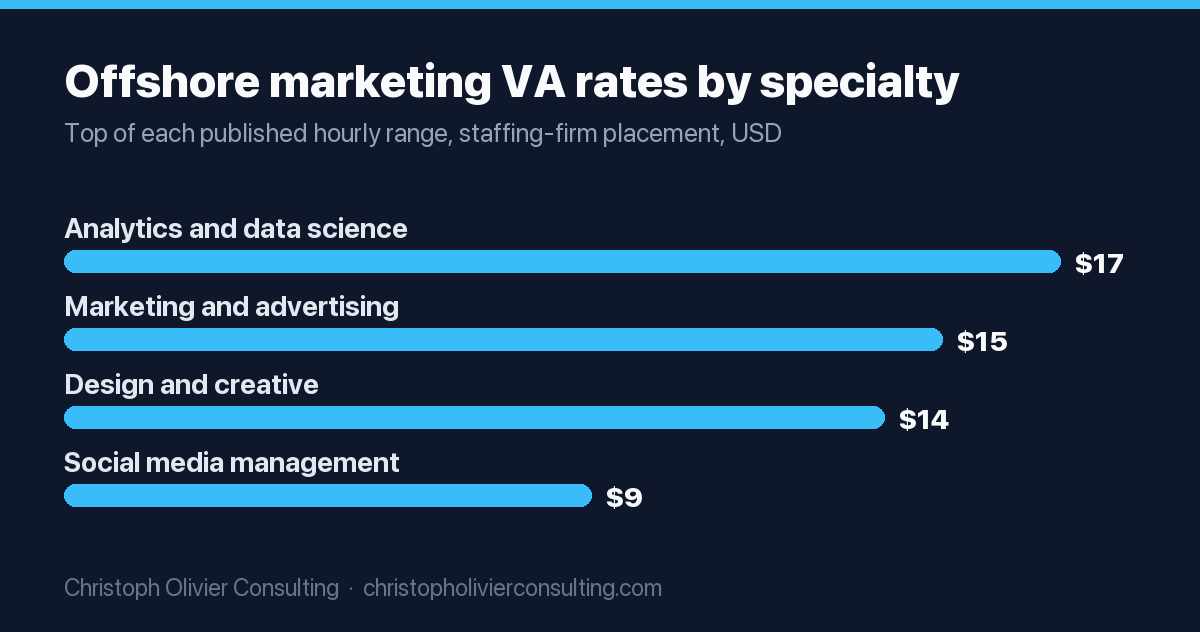
The cleanest setup is a shared content bank: your team supplies ideas, notes, photos and short videos, and the VA turns them into scheduled posts in approved formats. Add a one page reply guide listing what the VA can answer, what to escalate, and the words they should never use. Rates for this work are among the lowest in the market; VA Masters lists social media management at $7.50 to $9 an hour, below its paid ads and analytics categories.
If social has become a real acquisition channel with video production, paid amplification and community work, one assistant will not cover it. Our guide to building a social media marketing team explains which roles to add and in what order.
How to give a VA access without risking your accounts
Give a virtual assistant their own login with the lowest role that lets them do the job, never your owner password. Google Ads, Google Analytics and Meta all support named users with limited roles. Share any remaining passwords through a password manager, turn on multi-factor authentication, and remove access the day the engagement ends.
Here is how least-privilege access looks on the platforms a marketing VA touches most:
| Platform | Roles available | Sensible VA starting role |
|---|---|---|
| Google Ads | Email-only, Billing, Read-only, Standard, Admin | Read-only for reporting; Standard only if they edit campaigns to your spec. Admin can grant access and change access levels, so keep it with the owner. |
| Google Analytics 4 | Administrator, Editor, Marketer, Analyst, Viewer, plus “No Cost Metrics” and “No Revenue Metrics” restrictions | Viewer for reporting. Add the revenue or cost restrictions if they do not need those numbers. |
| Meta (Facebook and Instagram) | Full control or partial access on the business portfolio and each asset, with task-based permissions | Partial access to the specific Page or ad account, limited to the tasks they perform, such as content or messages |
| WordPress | Built-in roles such as Administrator, Editor, Author, Contributor | Editor or Author, not Administrator, unless they maintain plugins |
For anything that still needs a shared password, use a password manager. CISA, the US Cybersecurity and Infrastructure Security Agency, recommends passwords of “at least 16 characters” and a different strong password for each account, and describes a password manager as “an easy-to-use program that generates, stores and even fills in all your passwords.”
Google’s own tutorial walks through adding a user and choosing an access level in Google Ads:
Template: the 30-day onboarding checklist
A 30-day onboarding plan gives a new digital marketing VA access in week one, supervised work in week two, independent work with review in week three, and a scorecard in week four. Copy the checklist below, adjust the tasks to your channels, and agree on it with the VA before they start.
Week 1: Access and context
- Sign contract with confidentiality clause; confirm hours, time zone overlap and pay schedule.
- Create named logins with limited roles (Google Ads, GA4, Meta, CMS, email platform). No shared owner passwords.
- Share via password manager anything that cannot have a named login. Turn on MFA everywhere.
- Share brand guide, tone rules, approved templates, and the content calendar.
- Walk through the top three SOPs on a live call; record it.
Week 2: Supervised work
- VA drafts one week of social posts; you approve before scheduling.
- VA builds one newsletter in the email platform; you review and send.
- VA pulls the first weekly report into the agreed sheet or dashboard.
Week 3: Independent work with review
- VA schedules posts without pre-approval; you spot-check after publishing.
- VA handles routine comments and DMs using the reply guide; escalations logged.
- VA publishes one blog post end to end: formatting, images, alt text, meta fields, internal links.
Week 4: Scorecard and decision
- On-time delivery: tasks done by the agreed day (target: all of them).
- Error rate: posts or emails that needed a fix after going live.
- Time you got back each week.
- Decision: continue, adjust scope, or end the trial. Remove access the same day if ending.
Once tasks repeat cleanly for a month, look for the ones software can do instead. Report pulls, form routing and post recycling are often cheaper to automate than to staff, and our guide to business automation shows where to start.
Worked example: what a part-time marketing VA costs a 7-figure firm
For a typical service firm delegating about 40 hours of marketing execution a month, a US-based managed plan costs about $1,480, and an offshore staffing-firm assistant in the marketing and advertising category costs roughly $340 to $600. Neither figure includes the time you spend managing, which usually runs heaviest in the first month.
Assume a 12-person accounting firm wants 12 LinkedIn posts scheduled with replies (about 12 hours), 2 newsletters built (about 8 hours), 4 blog posts published (about 12 hours) and a weekly report (about 8 hours). That is roughly 40 hours a month. Priced against the published ranges above:
- US managed plan: Time etc lists a 40 hour plan at $1,480 a month ($37 an hour).
- Offshore staffing firm: 40 hours at $8.50 to $15 an hour is about $340 to $600 a month.
- Doing it yourself: 40 hours of a partner’s time, which most partners can bill at several times either figure.
The arithmetic favors delegation. The real question is who decides what those posts and articles say. If the answer is “nobody,” a VA will execute an empty calendar very efficiently. I would rather a firm spend its first month of budget on a clear plan than on an assistant waiting for instructions.
When a digital marketing VA is the wrong hire
A digital marketing VA is the wrong hire when you do not yet know which channels produce clients, when you expect them to set strategy, when your work is highly regulated and every post needs expert review, or when you have no time to manage them. In those cases, fix direction or capacity first, then add execution.
Signs you need strategy before an assistant:
- You cannot name the two channels that brought your last ten clients.
- You have no content calendar, offer or target list for a VA to work from.
- Your plan for the VA is “help us grow on social.”
This is the gap I see most often with professional-service firms: plenty of activity, no owner of the plan. If that sounds familiar, CO Consulting starts with an audit and a 90-day plan, built on content systems that have produced over 200 million organic views and on experience managing millions in ad spend. We can also help match you with the right execution help, VA, freelancer or agency, once the plan is set. Results vary and nothing here is a guarantee, but if you want a second opinion on what to delegate, you can book a consultation and we will talk it through.
Work with CO Consulting
Senior marketing leadership, without the full-time hire
- One senior owner of strategy, budget, vendors and the weekly scorecard
- Audit first, then a prioritized 90-day plan with measurable milestones
- Weekly team leadership, monthly strategic reviews and quarterly planning
- No guarantees we cannot back up; reporting tied to pipeline
Frequently asked questions
What does a digital marketing virtual assistant do?
A digital marketing virtual assistant handles recurring marketing execution: scheduling social posts, replying to routine comments, building email campaigns, publishing blog posts in your CMS, updating website content, making template graphics and pulling weekly reports. They work inside your tools and follow your calendar and SOPs. Strategy, budgets and messaging decisions usually stay with you or a senior marketer.
How much does a marketing virtual assistant cost per hour?
Published 2026 market ranges run from about $7.50 to $17 an hour for offshore assistants placed by a staffing firm, depending on specialty, to about $36 to $39 an hour on US-based managed plans. Direct full-time hires in the Philippines are typically paid monthly, with marketing roles listed between a few hundred and about $2,400 a month depending on experience.
Is a virtual assistant or an agency better for digital marketing?
A virtual assistant is better when you already know what works and need it done consistently at a low cost. An agency is better when you need several specialists and higher-volume execution across channels. Neither is designed to replace a strategy owner, so many firms pair a fractional CMO or internal lead with a VA or agency for execution.
What should I ask before I hire a marketing virtual assistant?
Ask them to walk through a real task in your tools, describe a mistake they made and how they fixed it, list the tools they used in the last six months, explain how they store client passwords, and say how many hours of overlap they can give. Then give finalists a small paid test task that mirrors the actual work.
How do I give a virtual assistant safe access to my accounts?
Create a named login for the assistant with the lowest role that fits the work, such as Read-only or Standard in Google Ads, Viewer in Google Analytics and partial access to specific assets in Meta. Share any unavoidable passwords through a password manager, turn on multi-factor authentication and remove access on the day the engagement ends.
Can a social media virtual assistant run my social media strategy?
In most cases, no. A social media virtual assistant is strongest at scheduling, formatting, community replies and reporting from a plan you approve. Choosing topics, positions and which platforms deserve effort is strategy work. Give your VA a content bank, a reply guide and escalation rules, and keep the direction with you or a senior marketer.
How long does it take to onboard a digital marketing VA?
Plan on about 30 days: week one for access and context, week two for supervised work, week three for independent work with spot checks, and week four for a scorecard and a decision. Most of the effort is writing SOPs for the top tasks, which also makes later replacement or automation much easier.