
Last reviewed: October 2026
A digital marketing specialist is the person who runs the day to day work of your online marketing: paid search and social ads, SEO, email, analytics and reporting. The closest federal benchmark, the BLS category for market research analysts and marketing specialists, shows a median salary of $78,760 in May 2025. Freelance and agency equivalents usually cost more per hour but less per year if you need fewer than 40 hours a week.
This guide is written for owners and marketing leads deciding whether to hire one. It covers what the role actually does, the skills that matter, how it differs from a manager or strategist, verified pay and market rate ranges, how it compares with a freelancer, an agency or a fractional CMO, a hiring process with interview questions and a paid test project, the red flags, and a 90-day onboarding plan.
Need senior marketing leadership without a full-time hire? See CO Consulting’s fractional CMO services.
What does a digital marketing specialist do?
A digital marketing specialist plans, launches, measures and improves marketing campaigns on online channels. In practice that means building and optimizing ad campaigns, improving search visibility, sending email, publishing content and reporting results. Most specialists go deep on one or two channels and execute a plan someone else sets, rather than owning the whole strategy.
The U.S. government does not track “digital marketing specialist” as its own occupation. The nearest match is O*NET’s Search Marketing Strategists (13-1161.01), whose reported job titles include Internet Marketing Specialist, Digital Marketing Strategist, Paid Search Strategist and SEO Strategist. Its core tasks read like a typical job ad:
- Manage tracking and reporting of search activity and give analyses to marketing leaders.
- Optimize text, graphics and multimedia assets for SEO.
- Collect and analyze web metrics such as visits, time on site, page views per visit and transaction volume.
- Take part in developing or implementing the online marketing strategy.
- Analyze search engine patterns to decide where keywords should be placed.
A typical week
For a professional service firm or a 7-figure service business, a good specialist’s week often looks like this: check ad spend pacing and search terms on Monday, publish or update one or two pages, build or adjust an email sequence, fix tracking issues as they appear, and send a short report that ties leads and booked consultations back to channels. If your current hire spends most of the week “posting” and little of it measuring, you have a coordinator, not a specialist.
What a specialist usually does not do
Specialists rarely set budget across channels, choose your positioning, define your ideal client or manage other people. Those are manager and strategist jobs. Hiring a specialist and expecting strategy is the most common mismatch I see in smaller professional service firms.
Digital marketing specialist skills to look for
The digital marketing specialist skills that matter most are hands-on platform skill in at least one paid or organic channel, clean measurement (analytics, conversion tracking, CRM data), clear writing, and the habit of testing. Certifications help screen applicants, but a portfolio of real accounts and results tells you far more than a badge.
O*NET lists the technology skills employers ask for in this occupation, flagging several as in demand: Google Analytics, Microsoft Excel, Google Ads, Tableau, WordPress and Python. Top ranking career guides, such as Coursera’s overview of the role, add SEO, PPC, social, email, marketing automation, CRM and A/B testing, plus communication and project management.
| Skill area | What “good” looks like | How to check it |
|---|---|---|
| Paid search and paid social | Builds campaigns around conversions, not clicks; prunes wasted search terms weekly | Screen share of a real account they managed; ask what they cut and why |
| SEO | Can explain technical, on-page and content priorities for your site in plain English | Give them your site and 30 minutes; ask for their top 5 fixes |
| Analytics and tracking | Sets up GA4 key events, ad conversions and CRM source fields that agree with each other | Ask how they would reconcile ad platform leads with CRM leads |
| Email and automation | Builds nurture sequences tied to the sales process, not just newsletters | Ask for a sequence they wrote and its open, click and booked-call data |
| Writing | Short, specific copy for ads, landing pages and email | Paid test project (see below) |
| Testing mindset | Forms a hypothesis, changes one variable, reads results honestly | Ask about a test that failed and what they learned |
On certifications: Google’s free Skillshop certifications are a reasonable baseline for an ads candidate. Google has also introduced virtually proctored professional certifications and says those exams will require a fee in the future, so a professional certification signals more effort than the free tier. Neither replaces a look inside a live account.
Specialist vs generalist vs manager vs strategist
A digital marketing specialist executes one or two channels in depth. A generalist covers many channels at moderate depth. A manager owns the plan, budget and people. A strategist decides positioning, audience and channel mix. Small firms often need a generalist or a manager first, and specialists once a channel is proven.
| Role | Owns | Typical output | Best fit when |
|---|---|---|---|
| Digital marketing specialist | Execution of one or two channels | Campaigns, optimizations, channel reports | The channel already works and needs more hours of skilled work |
| Digital marketing generalist | Execution across many channels | Website updates, email, social, light ads | You are early and need coverage more than depth |
| Marketing manager | Plan, budget, vendors, people | Quarterly plan, budget allocation, team management | You have two or more people or vendors to coordinate |
| Marketing or content strategist | Positioning, audience, messaging, channel mix | Strategy documents, editorial plans, briefs | Growth has stalled and nobody can say why |
| Fractional CMO | Marketing leadership on a part-time basis | Strategy, hiring, vendor selection, executive reporting | You need senior judgment but not a full-time executive |
If the role you are writing is really a manager role, start from a marketing manager job description template instead. If the gap is messaging and editorial direction, a content strategist is the better first hire.
Digital marketing specialist salary and market rates in 2026
The BLS reports a May 2025 median salary of $78,760 for market research analysts and marketing specialists, with the lowest 10 percent under $43,390 and the top 10 percent above $155,480. BLS does not separate digital specialists, so treat these as the closest benchmark. Freelance and agency figures below are market ranges, not official data.
Employee salary (closest federal benchmark)
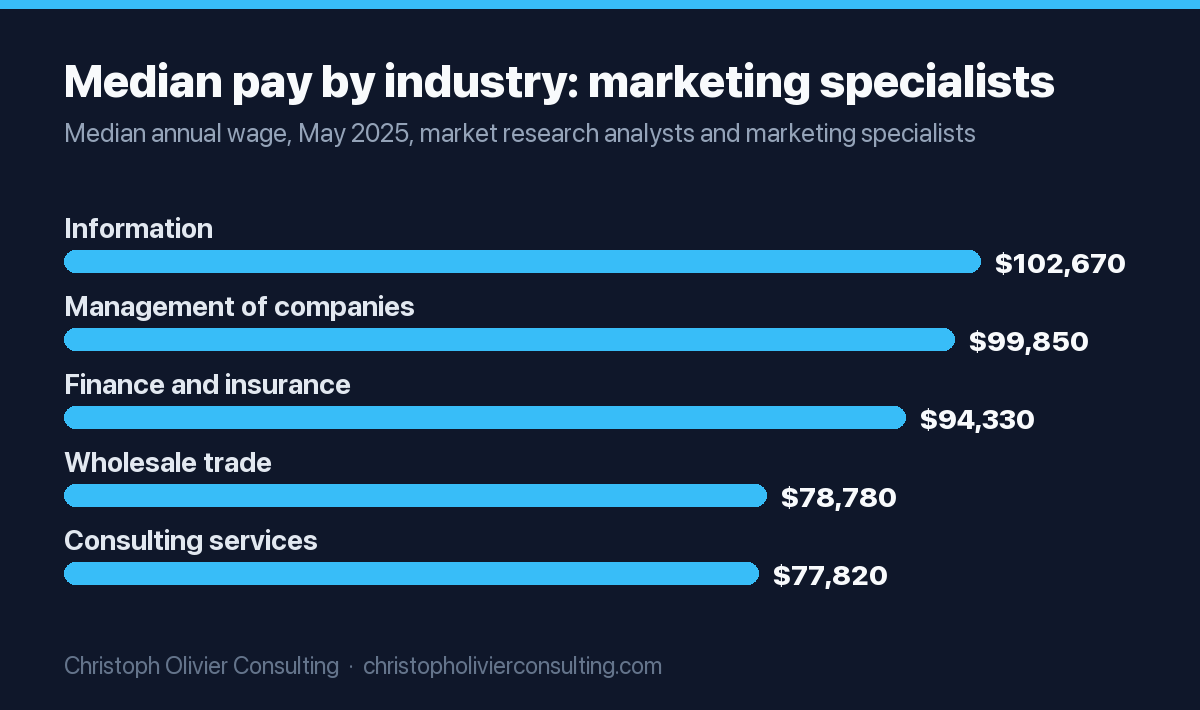
The BLS Occupational Outlook Handbook groups marketing specialists with market research analysts (SOC 13-1161). For May 2025 it reports a median of $78,760 a year, or $37.87 an hour, across 952,700 jobs, with employment projected to grow 7 percent from 2025 to 2035 and about 82,000 openings a year. Pay varies by industry: the median was $102,670 in the information sector and $77,820 in management, scientific and technical consulting services. For comparison, the median for marketing managers was $166,790 in May 2025.
Salary is not the full cost. BLS compensation data for June 2026 shows private employers paid $32.82 an hour in wages and $14.07 in benefits, so benefits made up 30.0 percent of total compensation. That works out to roughly 43 cents of benefits for every dollar of wages.
Freelance and agency market ranges
MarketerHire’s 2026 rate guide lists freelance marketing consultant rates of $50 to $100 an hour at junior level (1 to 3 years), $100 to $175 mid-level, $175 to $250 senior and $250 to $350 or more for expert or fractional CMO talent. By specialty it lists PPC at $150 to $300 an hour and SEO consultants at $150 to $250. These are one marketplace’s ranges and skew toward vetted senior talent.
Agency pricing spreads widely. In SE Ranking’s survey of 260 agencies (fielded in 2024 across North America, Europe and Asia Pacific), 64 percent of SEO agencies charged under $1,000 a month and 40 percent of US and Canadian agencies charged more than $125 an hour. Low retainers usually buy a small slice of a junior person’s time, so compare hours and seniority, not just the invoice.
Worked example: what a full-time specialist really costs
Take the BLS median salary of $78,760. Add benefits at the June 2026 private industry ratio ($14.07 for every $32.82 of wages, about 43 percent) and the loaded cost is roughly $112,500 a year. That excludes software, ad spend, recruiting and your own management time. A mid-level freelancer on MarketerHire’s monthly range of $5,000 to $10,000 would cost $60,000 to $120,000 a year for a part-time commitment. The full-time employee wins when you have 40 hours of steady work. The freelancer wins when you have 10 to 20.
Hire a digital marketing specialist, freelancer, agency or fractional CMO?
Hire an in-house digital marketing specialist when one channel needs full-time attention and someone can manage them. Use a freelancer for a defined project or part-time channel work. Use an agency when you need several skills at once. Bring in a fractional CMO when the problem is strategy, budget or who to hire.
| Option | Typical cost basis | Strengths | Weaknesses | Best for |
|---|---|---|---|---|
| DIY (owner or office staff) | Your time plus tools | Cheapest cash cost; you know the business | Slow learning curve; work stops when you get busy | Very early firms testing one channel |
| In-house specialist | Salary plus benefits (BLS median $78,760 before benefits) | Full attention, builds institutional knowledge | Needs a manager; one person, one or two channels | A proven channel with 40 hours of weekly work |
| Freelance specialist | Hourly or monthly retainer (market ranges above) | Fast start, senior skill without overhead | Limited capacity; continuity risk | Defined projects or part-time channel work |
| Agency | Monthly retainer, widely varying | Several skills under one contract | Junior staff may do the work; less control | Multi-channel execution at scale |
| Fractional CMO | Monthly retainer (MarketerHire lists $12,000 to $25,000 for the specialty) | Senior strategy, hiring and vendor oversight | Does not replace execution hours | Setting direction and managing specialists or agencies |
Many firms end up with a blend: a fractional leader setting direction, one in-house specialist, and freelancers for spikes. For a closer look at the freelance route, see the guide to hiring a freelance digital marketer. If you are planning a full in-house group, the article on building a social media marketing team shows how roles split as you grow.
When to hire a digital marketing specialist (and when not to)
Hire a digital marketing specialist when you know which channel produces clients, the work exceeds what you or a freelancer can cover, and someone can set goals and review the output. Do not hire one to “figure out marketing.” Without a plan and a manager, even a strong specialist tends to drift into busywork.
Signals you are ready:
- One channel (search ads, SEO, referrals plus email) already produces booked consultations and you can trace them in your CRM.
- You are paying a freelancer or agency for 25 or more hours a month of the same work.
- You have a written plan with 90-day targets, even a simple one.
- A named person will meet with the hire weekly.
Signals you are not ready:
- No one can say which channel produces clients today.
- Tracking is broken or missing, so results cannot be measured.
- You want positioning, pricing or messaging fixed. That is strategy work.
- The plan is “post more on social.”
How to hire a digital marketing specialist: step by step
To hire a digital marketing specialist well, define the outcome before the title, choose the employment model, write a scorecard, screen for evidence inside real accounts, run a short paid test, check references, and grant access through official platform roles. The whole process usually takes four to eight weeks for an employee and less for a freelancer.
- Write the outcome. One sentence: “Within 12 months, this person will grow qualified consultation requests from search by X while keeping cost per lead under Y.” Use your own numbers.
- Pick the model. Employee, freelancer, agency or fractional, using the comparison table above.
- Build a scorecard. Three to five must-have skills from the skills table, each with how you will test it.
- Post a specific job description. Name the channels, tools, budget size and reporting line. Vague ads attract vague candidates.
- Screen for proof. Ask for a screen share of an account they managed, not a slide deck.
- Interview with the questions below. Have two people score each answer against the scorecard.
- Run a paid test project. Keep it to four to six hours and pay for it.
- Check references. Ask former managers what the candidate measured and what changed.
- Grant access the right way. Invite them to your own accounts with role-based access rather than sharing passwords or letting them build accounts you do not own.
On that last step: Google Ads offers five access levels (email-only, billing, read-only, standard and admin), and only admin can give account access to others. GA4 has five roles; the Marketer role can create audiences, manage events and change attribution models without full administrator control. Standard in Google Ads and Marketer in GA4 are often enough for a new specialist. Keep admin with an owner.
Interview questions and a paid test project
The best interview questions for a digital marketing specialist ask for specific numbers, specific decisions and specific failures from accounts they ran. Pair them with a short paid test using your real situation. Together they show how a candidate thinks, writes and measures far better than a resume or certification list.
Interview questions
- Walk me through an account you managed. What was the goal, the budget and the result, and how did you measure it?
- What was the last thing you turned off or cut, and why?
- Our ad platform says 40 leads this month and our CRM shows 22. What would you check first?
- Tell me about a test that failed. What did you change afterward?
- How would you decide whether to spend the next $5,000 on search ads or SEO for a firm like ours?
- What would you need from me in the first two weeks to do this job well?
- Which part of digital marketing are you weakest at, and who would you bring in for it?
Template: a paid test project
Send this to two or three finalists. Pay a flat fee for four to six hours of work.
- Brief: “Here is our website, our main service, our ideal client and read-only access to our Google Ads and GA4.”
- Task 1: List the five changes you would make in the first 30 days, ranked by expected impact, with one sentence of reasoning each.
- Task 2: Write three search ad headlines and one landing page headline for our main service.
- Task 3: Describe the weekly report you would send us: which metrics, which source and why.
- Scoring: Specificity to our business (40 percent), measurement thinking (30 percent), writing quality (20 percent), clarity about what they would not do yet (10 percent).
Red flags when hiring a digital marketing specialist
The biggest red flags are guaranteed rankings or lead numbers, reports built on vanity metrics, refusal to work inside accounts you own, and no examples of measured results. A candidate who cannot explain what they cut, what failed or how they tracked a lead to revenue is usually not ready to run your budget.
- Guarantees. “Page one in 30 days” or a fixed lead count. Platforms and search results change too often for honest guarantees.
- Vanity reporting. Impressions, followers and clicks with no link to consultations or revenue.
- Account ownership games. Wanting to run ads in their own account, or asking for your passwords instead of role-based access.
- Every channel, expert level. Genuine specialists name the channels they are weaker in.
- No questions about your business. Good candidates ask about your clients, margins and sales process before proposing tactics.
- Locked-in contracts without exit terms for freelancers or agencies. Look for 30-day notice and written ownership of all assets and data.
A 90-day onboarding plan for a new specialist
A good 90-day onboarding plan gives a new digital marketing specialist two weeks to learn and audit, the rest of the first month to fix tracking and quick wins, month two to launch planned changes, and month three to report results and propose the next quarter. Agree on targets before day one.
- Days 1 to 14: learn and audit. Meet sales and client-facing staff. Review the last 12 months of channel and CRM data. Deliver a written audit with the top ten problems.
- Days 15 to 30: fix measurement and quick wins. Make sure ad conversions, GA4 key events and CRM lead sources agree. Remove obvious waste. Set up a one-page weekly report.
- Days 31 to 60: execute the plan. Launch the two or three highest-impact changes from the audit, such as a rebuilt campaign, a new landing page or a nurture sequence.
- Days 61 to 90: review and propose. Compare results with the targets you agreed. Present what worked, what did not, and a plan and budget for the next quarter.
Hold a 30-minute weekly check-in throughout. The specialist brings numbers and decisions needed; you bring business context, such as which services you want more of and which clients you want fewer of.
If you want help finding the right person
Through our fractional CMO services, CO Consulting can help you decide which role you need and match you with the right specialist. The work starts with an audit and a 90-day plan. I have built content systems that generated more than 200 million organic views and have managed millions of dollars in ad spend. There are no guarantees in marketing, but a clear plan makes the hire far more likely to work. If that would help, you can book a consultation and we will look at your situation together.
Work with CO Consulting
Senior marketing leadership, without the full-time hire
- One senior owner of strategy, budget, vendors and the weekly scorecard
- Audit first, then a prioritized 90-day plan with measurable milestones
- Weekly team leadership, monthly strategic reviews and quarterly planning
- No guarantees we cannot back up; reporting tied to pipeline
Frequently asked questions
What does a digital marketing specialist do?
A digital marketing specialist runs and improves online marketing campaigns, usually in one or two channels such as paid search, paid social, SEO or email. Typical work includes building campaigns, optimizing pages for search, tracking conversions in analytics, writing ad and email copy, and reporting which channels produce leads. Most execute a plan set by a manager or strategist rather than setting overall strategy themselves.
How much does a digital marketing specialist make?
BLS does not track digital specialists separately. The closest category, market research analysts and marketing specialists, had a median salary of $78,760 in May 2025, with the lowest 10 percent under $43,390 and the top 10 percent above $155,480. Pay is higher in sectors such as information, where the median was $102,670. Benefits add roughly 43 cents per wage dollar for private employers.
What skills should a digital marketing specialist have?
Look for hands-on skill in at least one paid or organic channel, reliable measurement using tools such as Google Analytics and Google Ads conversion tracking, clear copywriting, spreadsheet skills, and a habit of testing one change at a time. O*NET lists Google Analytics, Excel, Google Ads, Tableau, WordPress and Python among in-demand technology skills for the closest occupation.
Should I hire a digital marketing specialist or an agency?
Hire an in-house specialist when one proven channel needs about 40 hours of work a week and someone can manage them. Choose an agency when you need several skills at once, such as ads, SEO and design, and can accept less day to day control. A freelancer suits defined projects or part-time channel work, and a fractional CMO suits strategy and oversight.
What is the difference between a digital marketing specialist and a digital marketing manager?
A specialist executes campaigns in one or two channels. A manager owns the marketing plan, budget allocation, vendors and people, and is accountable for overall results. The pay gap reflects this: BLS reports a May 2025 median of $166,790 for marketing managers versus $78,760 for the marketing specialist category. Many small firms need a manager or fractional leader before a specialist.
Do digital marketing certifications matter when hiring?
They help with screening but should not decide the hire. Free Google Skillshop certifications show baseline platform knowledge. Google has also added virtually proctored professional certifications that it says will carry a fee in the future, which signals more effort. A screen share of a real account and a short paid test project tell you much more about actual ability.
More Fractional CMO guides
- Fractional CMO Services: The Full Scope of What Gets Delivered
- CMO and Marketing Budget Statistics 2026: Verified Benchmarks From Gartner and The CMO Survey
- What Is a Fractional CMO? Roles & Cost
- Marketing Director vs Fractional CMO
- Fractional CMO Cost in 2026: Rates & ROI
- What Is Fractional Marketing? Model, Cost, and When to Use It
- All Fractional CMO guides →