
Last reviewed: October 2026

A SaaS SEO agency is an SEO firm that specializes in software companies: it builds comparison, alternatives, integration and use-case pages, fixes technical problems on JavaScript-heavy marketing sites and docs, and measures success in signups, demos and pipeline instead of traffic. Published price ranges from SaaS-focused agencies run from about $5,000 to $30,000+ per month, far above the general SEO market. The right fit depends on your stage, deal size and in-house capacity.
This guide is for founders, CMOs and marketing leads who are about to hire. It covers what a SaaS SEO agency should do in 2026, verified market price ranges, an agency vs in-house vs fractional comparison, how AI search changes the scope, a step-by-step selection process, the questions to ask, the red flags, and a scorecard template you can copy.
Would you rather hand SEO to a specialist? CO Consulting’s SEO services start with a month-one audit that decides the plan, and AI search optimization is included.
What does a SaaS SEO agency do?
A SaaS SEO agency plans and executes organic search for software companies. The work centers on pages that capture buyers already comparing tools, technical fixes for app-style websites, content that earns links and AI citations, and reporting tied to trials, demos and revenue. The difference from a general SEO shop is focus: fewer traffic goals, more pipeline goals.
SaaS SEO is different because of how software gets bought. Buyers compare several products, read reviews, test free trials and often involve a committee. A plumber needs to rank for “plumber near me.” A project management tool needs to rank for “Asana alternatives,” “best project management software for agencies,” “[your tool] vs [competitor]” and “Slack integration for task tracking.” Those queries are fewer in volume but much closer to a purchase.
SaaS sites also bring their own technical baggage: marketing sites built on JavaScript frameworks, help centers and docs on subdomains, logged-in app pages that should never be indexed, and pricing pages that change every quarter. A good B2B SaaS SEO agency handles both sides, the content strategy and the plumbing. If you want the wider channel picture first, start with this overview of SaaS marketing channels and plays, since SEO rarely works in isolation from product, sales and paid acquisition.
Core SaaS SEO services to expect
Expect five service lines from a serious SaaS SEO agency: product-led content (comparison, alternatives, integration, use-case and template pages), technical SEO for the marketing site and docs, AI search visibility, link earning, and measurement tied to signups and pipeline. If a proposal covers only blog posts and backlinks, it is a content vendor, not a SaaS SEO partner.
Product-led content that matches buying intent
The highest-value SaaS pages sit at the bottom of the funnel. Grow and Convert, an agency that publishes its own client data, reports that comparison and alternative keywords averaged an 8.43% conversion rate and category keywords averaged 4.85%, while typical SEO content converts to product CTAs at “less than half a percent” (Grow and Convert, bottom-of-the-funnel keywords). Treat those as one agency’s results, not a benchmark, but the direction is worth testing on your own site.
Typical page types a SaaS SEO agency should propose:
- Comparison and alternatives pages: “[competitor] alternatives,” “[you] vs [competitor].” Honest, factual and kept current.
- Integration pages: one page per meaningful integration, explaining the workflow it enables.
- Use-case and industry pages: “[category] software for [role or industry].”
- Templates and tools: free templates, calculators and generators that rank and convert.
- Programmatic templates: pages generated from structured data, only where each page carries unique value.
Be careful with programmatic SEO. Google’s spam policies define scaled content abuse as “when many pages are generated for the primary purpose of manipulating search rankings” (Google Search spam policies). Programmatic pages are fine when each one answers a real query with real data. Thousands of near-identical pages are a liability. For the content side in depth, see this product-led SaaS content marketing playbook.
Technical SEO for marketing sites, apps and docs
Many SaaS marketing sites run on JavaScript frameworks. Google processes JavaScript sites in three phases, crawling, rendering and indexing, and says “server-side or pre-rendering is still a great idea” because it makes sites faster and not all bots run JavaScript (Google JavaScript SEO basics). Google also notes it can only follow links that are <a> elements with an href, and recommends the History API over URL fragments for client-side routing.
A SaaS-savvy technical audit should cover rendering mode, internal linking in navigation components, soft 404s in single-page apps, canonical handling across the marketing site, docs and help center, indexation of logged-in or staging URLs, and site speed on pricing and signup pages.
AI search visibility
Buyers now ask ChatGPT, Perplexity and Google’s AI features for software shortlists. Google states there are “no additional requirements to appear in AI Overviews or AI Mode” and that the same foundational SEO best practices apply (Google, AI features and your website). In practice that means clear, citable answers, current pricing and feature facts, and a presence on the third-party sites AI tools cite. Be skeptical of anyone selling a secret AI ranking trick.
Link earning, not link buying
Links still matter, but how you get them matters more. Google lists “buying or selling links for ranking purposes” as link spam (Google Search spam policies). A good agency earns links with original data, useful tools, integration partner pages, founder commentary and digital PR. Ask to see examples of links they earned, not a price list of placements.
Measurement tied to pipeline
Traffic is an input. The outputs are trial signups, demo requests, product-qualified leads and pipeline. Your agency should map every target keyword to a page and a conversion goal (this guide to keyword mapping includes a template), then report organic conversions by page type, not just rankings.
SaaS SEO agency pricing in 2026: market ranges
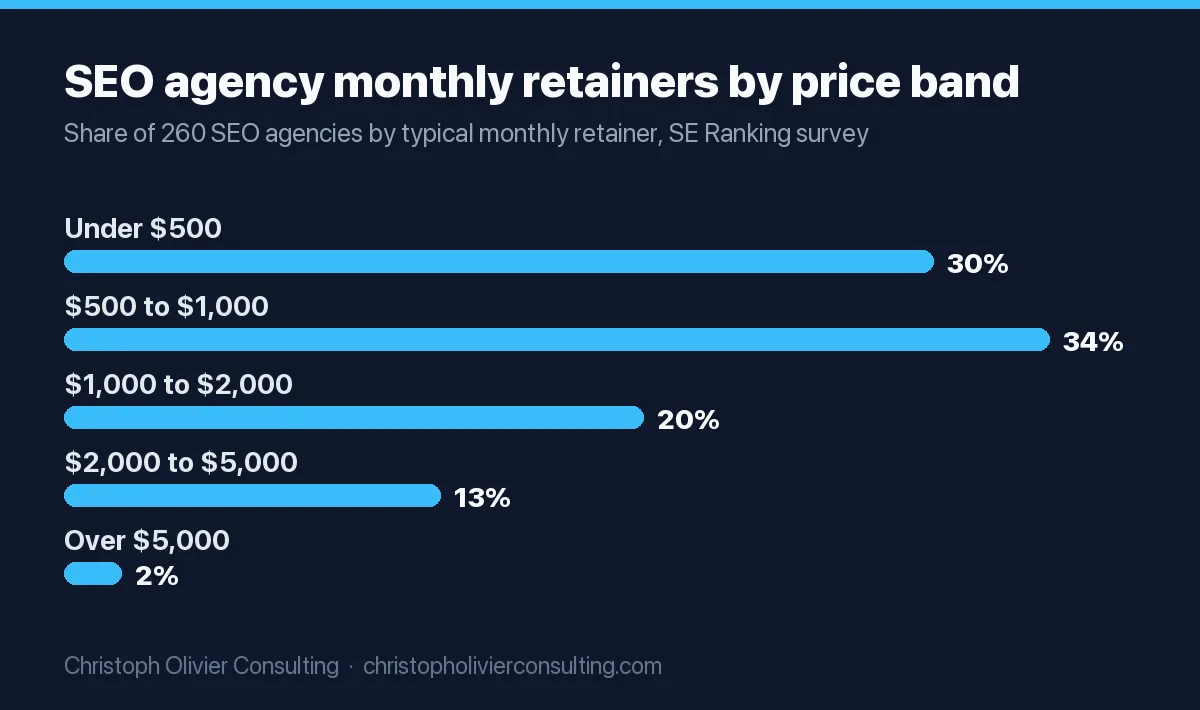
General SEO agencies mostly charge under $1,000 a month, but SaaS-focused agencies publish ranges of roughly $5,000 to $30,000+ per month. The gap reflects scope: SaaS programs usually include senior strategy, subject-matter writers, technical SEO and link earning. Treat every figure below as a market range from surveys or vendor-published pricing, not a quote.
| Source | What it measures | Published figure |
|---|---|---|
| SE Ranking agency pricing survey (260 agencies, published Dec 2024) | General SEO agencies, monthly retainer | 64% charge under $1,000/month; 2% charge over $5,000. Over $2,000/month: 22% in US and Canada vs 9% in Europe. |
| Ahrefs SEO pricing survey (439 providers, updated Aug 2024) | Average monthly retainer by provider type | Agencies about $3,209; consultants about $3,250; freelancers about $1,349 (averages use the top of each price tier). |
| SimpleTiger SEO services page (SaaS-focused agency) | Vendor-published range | “Anywhere from $5,000 to $30,000+ per month.” |
| DerivateX SaaS SEO pricing 2026 (SaaS-focused agency) | Vendor-published tiers, all-in including off-site budget | About $6,000, $9,500 to $10,000, and $14,000 to $15,000 per month by tier; a $3,500 one-off technical audit. |
Three things drive where a quote lands:
- Page volume: how many new commercial pages and refreshes ship each month.
- Seniority: whether a senior strategist works your account weekly or reviews it monthly.
- Scope: whether technical SEO, development time, digital PR and attribution are included or billed separately.
A low retainer is not automatically a bad deal, and a high one is not automatically good. What matters is cost per shipped, ranking, converting page. When you compare offers, ask each firm to split its price into those three lines so you can see the scope differences that hide behind a monthly number.
Agency vs in-house vs fractional: SEO for SaaS companies by stage
An agency gives you a full team fast. An in-house hire gives you control and product knowledge but takes months to recruit and covers one skill set. A fractional SEO lead or fractional CMO sets strategy and manages specialists for a part-time fee. Many smaller SaaS teams get the best value from a hybrid.
| Model | Cost reference (verified) | Strengths | Weak spots | Usually fits |
|---|---|---|---|---|
| SaaS SEO agency | Vendor-published ranges of about $5,000 to $30,000+/month | Full team on day one: strategy, writers, technical, links | Less product depth; quality varies by account team | Post product-market fit, clear ICP, budget for 6+ months |
| In-house SEO hire | BLS median wage for marketing specialists: $78,760/year (May 2025), wages only | Deep product knowledge, full-time focus | One person rarely covers content, technical and links; recruiting time | Companies with a content team and dev support already in place |
| In-house marketing leader | BLS median wage for marketing managers: $166,790/year (May 2025), wages only | Owns strategy across channels | Expensive before the channel is proven | Scale-ups with several channels to run |
| Fractional SEO lead or fractional CMO | Ahrefs survey: consultants average about $3,250/month; most common band $2,501 to $5,000 | Senior judgment part-time; can hire and manage vendors | Needs executors (writers, devs, agency) to ship the work | Seed to Series B teams, or teams unsure what to buy |
Wage figures come from the US Bureau of Labor Statistics for market research analysts and marketing specialists and for marketing managers. They exclude benefits, payroll taxes and tools, so the real cost of an in-house hire is higher. An in-house team also needs a tool stack; this comparison of enterprise SEO tools covers the main platforms.
My view: if nobody on your team can judge SEO work, hire senior judgment before you hire volume. A fractional lead who writes the plan and holds an agency accountable often prevents the most expensive mistake, which is paying for a year of the wrong pages.
Why AI search now belongs in a B2B SaaS SEO agency’s scope
Software buyers increasingly start research in AI chatbots, so a 2026 SaaS SEO scope should cover how your product appears in AI answers, not only in Google’s blue links. G2’s 2026 survey of 1,076 B2B software buyers found 51% start research with an AI chatbot more often than with Google, up from 29% in its 2025 report.
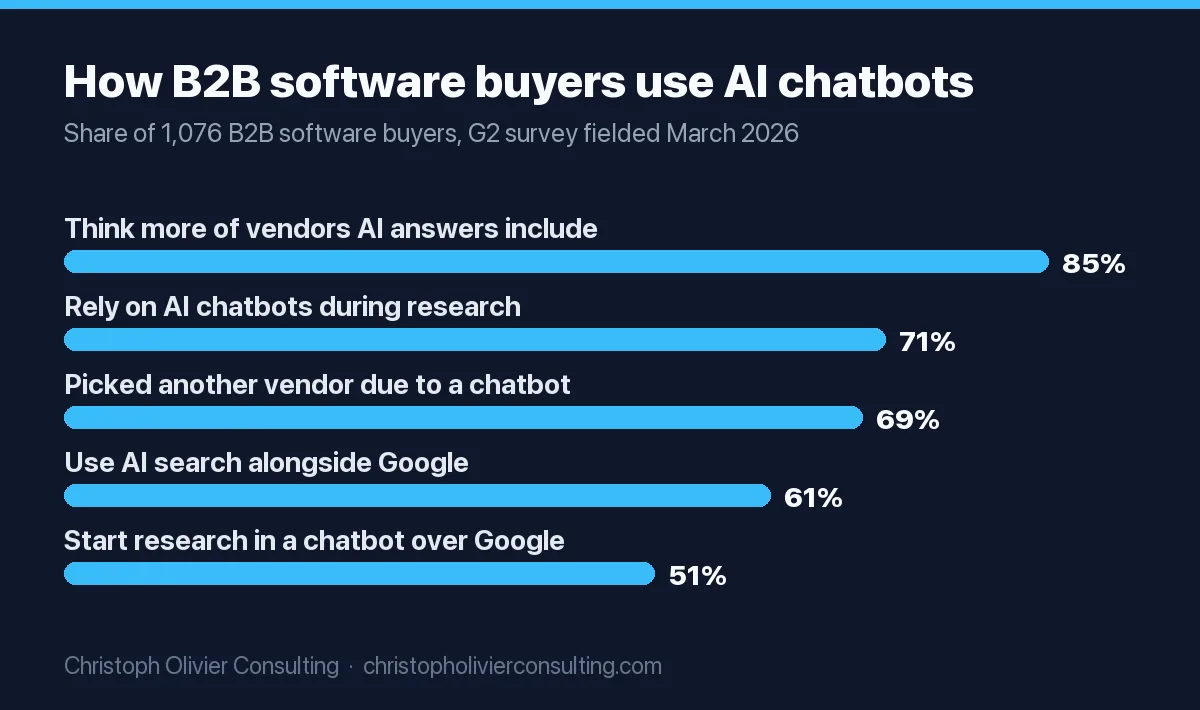
The same G2 research, fielded in March 2026, reports that 71% of buyers rely on AI chatbots at some point in research, 85% think more highly of a vendor when a chatbot includes it in an answer, and 69% chose a different vendor than planned because of a chatbot recommendation (G2, The Answer Economy). G2 runs a review site that AI tools cite, so it has an interest in this finding; treat the exact numbers with that in mind.
What this means for agency scope:
- Pricing, feature and integration facts on your site should be explicit, current and easy to quote.
- Comparison pages should be fair enough that an AI system would cite them.
- Review profiles, partner directories and community answers become part of the SEO program.
- Reporting should note that Google counts AI Overview and AI Mode traffic inside the normal Web search type in Search Console (Google), so AI visibility needs separate tracking.
How to choose a SaaS SEO agency: a 7-step process
Choose a SaaS SEO agency by defining the outcome first, shortlisting only firms with software clients, testing their thinking with a paid audit or pilot, and checking references for pipeline results, not traffic charts. The process below often takes four to six weeks and protects you from the most common hiring mistakes.
- Write the goal in pipeline terms. For example: more trial signups from comparison and category searches, or more demo requests from enterprise use-case pages. Include your average contract value and sales cycle.
- Audit what you have. Pull Search Console data, list your existing commercial pages and note technical constraints (framework, CMS, docs platform, dev capacity).
- Shortlist three to five firms with SaaS case studies. Look for case studies that show signups, demos or revenue, with the client named or verifiable.
- Send the same brief to each. Ask for a 90-day plan, team names and roles, deliverables per month and what is out of scope.
- Run a paid audit or 90-day pilot. A paid diagnostic shows how a firm thinks before you commit to a long contract.
- Call two references. Ask what changed in signups or pipeline, how fast problems were fixed and whether the senior people stayed on the account.
- Negotiate the contract. Prefer a short initial term, clear page counts, ownership of all content and accounts, and the right to exit with notice.
If you would rather not run this process alone, our SEO services include matching SaaS teams with vetted specialists. The approach is audit-first with a 90-day plan, built on content systems I have built that earned over 200 million organic views and on millions of dollars in managed ad spend. There are no ranking guarantees; nobody can honestly offer one.
Questions to ask a SaaS SEO agency before you sign
Ask questions that force specifics: which pages they would build first and why, who does the work, how they attribute signups and pipeline, and how they handle technical fixes on your stack. Google’s own hiring guidance adds the basics: past work, adherence to Search Essentials, expected results and timeframe, and industry experience.
Google suggests asking any potential SEO, among other things, whether you “follow the Google Search Essentials” and “What kind of results do you expect to see, and in what timeframe?” (Google, Do you need an SEO?). Add these SaaS-specific questions:
- Which 10 pages would you build or fix first on our site, and why those?
- How do you prioritize comparison, alternatives and integration pages against top-of-funnel content?
- Who writes, and do they understand our buyer and product category?
- Who handles technical changes, and how do you work with our developers and our framework?
- How do you track trials, demos and pipeline from organic search, including first-touch and last-touch views?
- How do you approach AI search visibility, and how do you measure it?
- Show us links you earned for a SaaS client. How were they earned?
- What happens to underperforming pages after 90 days?
- What is the minimum term, and what do we own if we leave?
Red flags when hiring a SaaS SEO agency
Walk away from guaranteed rankings, secret methods, link packages, vague reporting and long lock-in contracts with no pilot. Google states plainly that “no one can guarantee a #1 ranking on Google.” Also be cautious of firms whose case studies show only traffic growth, never signups or revenue, for software clients.
- Guarantees. Google: “If they guarantee you that their changes will give you first place in search results, find someone else” (Google).
- Secrecy. Google warns to be careful “if a company is secretive or won’t clearly explain what they intend to do.”
- Bought links. Paid links that pass ranking credit break Google’s link spam policy.
- Mass AI pages with no data. High-volume generated pages risk the scaled content abuse policy.
- Traffic-only reporting. Rankings and sessions without conversions hide whether the work pays.
- Bait and switch. Senior people in the pitch, juniors on the account. Ask for named team members in the contract.
- Account control. Google advises giving an SEO only read access to Search Console during an audit. Keep ownership of every account and asset.
What the first 90 days should look like
A strong SaaS SEO engagement front-loads diagnosis and quick fixes, then ships commercial pages by month two. You should see a written plan, technical fixes and the first bottom-of-funnel pages within 90 days. Pipeline impact usually takes longer, so judge the first quarter on output quality and leading indicators.
| Window | What should ship | What to judge it on |
|---|---|---|
| Days 1 to 30 | Technical audit, keyword-to-page map, competitor and SERP review, measurement setup for signups and demos | Specific findings tied to your site, not a generic checklist |
| Days 31 to 60 | Priority technical fixes, first comparison or alternatives pages, refreshes of existing commercial pages | Accuracy, fairness, conversion paths on each page |
| Days 61 to 90 | Integration and use-case pages, first link-earning assets, first performance review | Indexation, early rankings, early organic conversions, a plan for quarter two |
On longer timelines, be wary of precise promises. One SaaS agency publishes its own estimate of a first honest pipeline read at months four to nine, depending on budget (DerivateX). That is a vendor estimate, not a rule. Your results depend on domain strength, competition, deal size and how fast your team can approve pages.
Template: SaaS SEO agency scorecard
Use a weighted scorecard to compare SaaS SEO agencies on the same criteria. Score each firm from 1 to 5 on every row, multiply by the weight and add the totals. Weight pipeline evidence and the quality of the 90-day plan most heavily, because those predict results better than a polished pitch deck.
| Criterion | Weight | What a 5 looks like |
|---|---|---|
| SaaS case studies with signups, demos or revenue | 25% | Named or verifiable clients, conversion data, similar deal size |
| Quality of the 90-day plan for your site | 20% | Specific pages, specific fixes, clear priority logic |
| Technical SEO depth on your stack | 15% | Has worked with your framework, docs platform and CMS |
| Content quality and subject knowledge | 15% | Writers who understand your buyer; samples that could be cited |
| Measurement and attribution | 10% | Reports organic signups and pipeline by page type |
| Link earning approach | 5% | Earned links from data, tools and PR; no paid placements |
| AI search approach | 5% | Practical plan, honest about what it cannot control |
| Terms and team | 5% | Pilot or short term, named team, you own all assets |
Before you sign, confirm:
- Named team members and their weekly hours on your account.
- Monthly deliverables in page counts, not hours.
- Who implements technical fixes and how many dev hours you must supply.
- Reporting cadence and the conversion metrics in every report.
- Your ownership of all content, accounts, data and tools.
- Exit terms and notice period.
- No ranking guarantees and no paid link placements in the contract.
A SaaS SEO agency can be one of the best investments a software company makes, when the scope matches your stage and the agency is accountable for pipeline. If you want a second opinion on a proposal or help building the shortlist, you can book a consultation and we will look at it together.
Work with CO Consulting
Want SEO that brings in qualified clients?
- A month-one audit that decides the mix, written into a 90-day plan you can hold us to
- Technical, on-page, local, content and AI search work in one engagement
- Monthly tracking of whether ChatGPT, Perplexity and Google AI Overviews cite your business
- Reporting tied to pipeline, not vanity rankings. No ranking guarantees, ever
Frequently asked questions
What does a SaaS SEO agency do?
A SaaS SEO agency runs organic search for software companies. It builds comparison, alternatives, integration and use-case pages, fixes technical issues on JavaScript-heavy marketing sites and docs, earns links, works on visibility in AI answers, and reports on trial signups, demo requests and pipeline instead of traffic alone. The focus on buying-intent pages and revenue metrics is what separates it from a general SEO agency.
How much does a SaaS SEO agency cost?
Published market ranges from SaaS-focused agencies run from about $5,000 to $30,000+ per month, depending on page volume, seniority and scope. General SEO agencies charge much less: in SE Ranking's survey of 260 agencies, 64% charged under $1,000 a month and only 2% charged over $5,000. Always compare offers by deliverables, not by the monthly number alone.
How is SaaS SEO different from regular SEO?
SaaS SEO targets buyers who compare software, so it prioritizes alternatives, versus, integration and use-case pages over local or broad informational terms. It also deals with JavaScript frameworks, docs subdomains and app pages that should not be indexed. Success is measured in signups, demos and pipeline across longer, committee-based buying cycles rather than in sessions or rankings.
Should a SaaS company hire an SEO agency or build in-house?
It depends on stage and capacity. An agency gives you a full team quickly; an in-house hire gives product depth but rarely covers content, technical SEO and links alone. The BLS median wage for marketing specialists was $78,760 in May 2025, before benefits and tools. Many smaller SaaS teams use a fractional lead to set strategy and manage an agency or freelancers.
How long does SaaS SEO take to work?
Expect output and leading indicators in the first 90 days: technical fixes, new commercial pages, indexation and early rankings. Pipeline impact usually takes longer. One SaaS agency publishes its own estimate of a first pipeline read at months four to nine depending on budget, but that is a vendor estimate. Domain strength, competition and approval speed all change the timeline.
Do SaaS SEO agencies help with AI search like ChatGPT?
Good ones do. G2's 2026 survey of 1,076 B2B software buyers found 51% start research in an AI chatbot more often than Google. Google says there are no extra requirements to appear in AI Overviews or AI Mode, so the work is solid SEO plus clear, citable facts, fair comparison pages and a presence on third-party sites AI tools cite.
What are the red flags when hiring a SaaS SEO agency?
Walk away from guaranteed rankings, secret methods, paid link packages, mass AI-generated pages, traffic-only reporting and long contracts with no pilot. Google states that no one can guarantee a number one ranking. Also insist on named team members in the contract and keep ownership of your Search Console, analytics and all content.
More SEO guides
- SEO Platform Demo: What to Ask, What to Test, and How to Avoid a Bad Purchase
- AEO and GEO: AI Search Changes SEO
- Web Development and SEO Services: How to Build a Site That Ranks
- How to Rank on Perplexity (2026): A Guide to Getting Cited
- SEO for Web Designers: What to Get Right Before You Hand Off the Build
- SEA Advertising: What Search Engine Advertising Is (and Why Americans Call It PPC)
- All SEO guides →