

Digital marketing for doctors comes down to who controls the few screens a new patient looks at between typing a search and booking a slot: your Google listing, your directory profiles, your reviews, your website and your booking path. Ads and social media help once those five work. Every one of them also runs through HIPAA and your state medical board’s advertising rules, which most marketing guides skip.
This guide is for the practice administrator or physician-owner of an independent practice, not a hospital marketing department. It follows the order a patient actually moves in, shows what to fix at each step, and flags the compliance traps that have already cost practices real money.
Want a specialist to build this for your business? See how CO Consulting’s marketing services work, starting with a diagnostic and audit.
Digital marketing for doctors starts at five patient checkpoints
A patient rarely reads your About page first. In most cases the path looks like this: a search for a specialty or symptom plus a town, a scan of the map results, a look at star ratings on Google or a directory, a quick check of your site for insurance and location, then a booking attempt. Each step is a place to lose them.
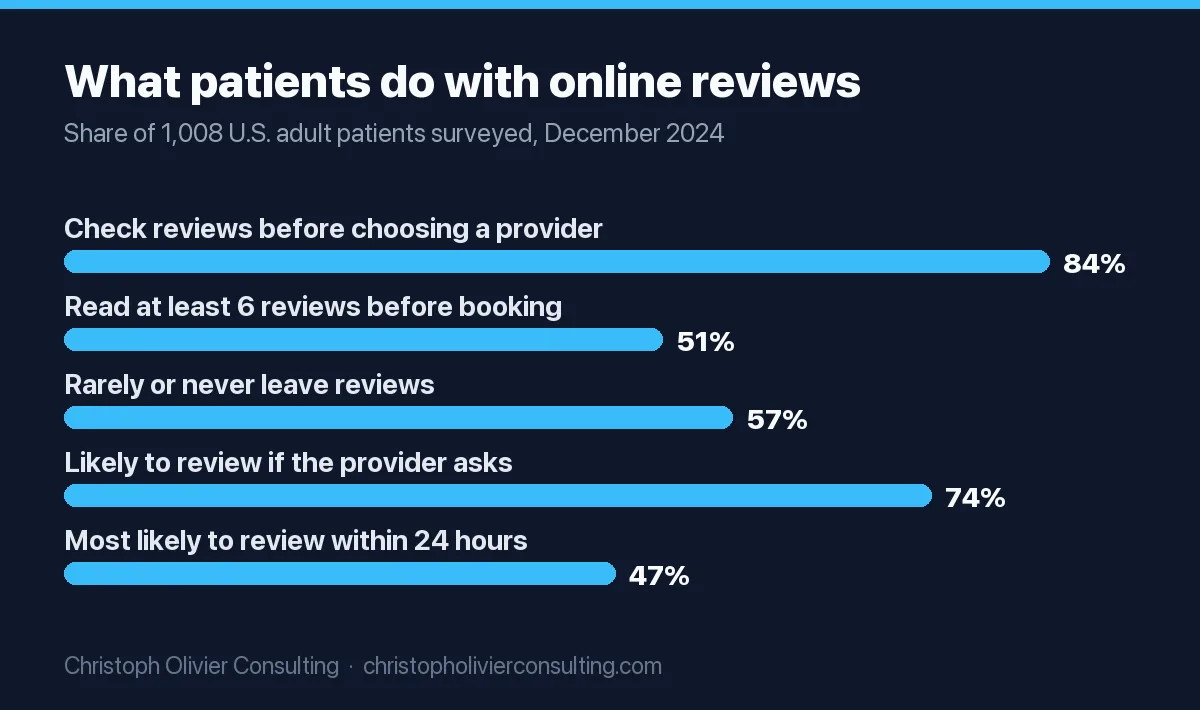
Reviews carry more weight than many physicians expect. In a December 2024 survey of 1,008 U.S. adults run by the reputation software company rater8, 84% said they check online reviews before choosing a new provider, and 51% read at least six reviews before scheduling. rater8 sells review software, so treat the numbers as directional, but they match what most practices see in their phone logs.
The rest of this guide takes the checkpoints in order.
Checkpoint 1: Your Google listing, practitioner profile or practice profile?
Google Business Profile treats doctors as “individual practitioners,” and its rules decide how many listings you should have and what they are called. Getting this wrong is one of the most common reasons a practice shows up under the wrong name, or not at all, in the map results. Google’s guidelines for representing your business set out three situations:
| Your setup | What Google’s guidelines call for | Common mistake |
|---|---|---|
| Solo physician, the only public-facing practitioner at a branded practice | One shared profile, named in the format “[Practice name]: [Physician name]” | Two competing listings (practice and doctor) that split reviews and calls |
| Group practice, several physicians at one location | One profile for the location, plus a profile for each public-facing physician titled with only the physician’s name | Physician profiles stuffed with keywords or specialties in the name |
| One physician with several specialties | A single practitioner profile. Google says practitioners should not have multiple profiles to cover different specializations | A separate listing for each service line |
Google also says support staff should not have their own profiles, and that a practitioner profile is for someone who can be contacted directly at the verified location during stated hours. If a physician has left, or a nurse has a listing, clean that up before you spend a dollar on ads. The broader mechanics of categories, service areas and local citations are covered in our local SEO playbook for service businesses.
Checkpoint 2: The directory profiles that exist whether you claimed them or not
Most licensed physicians already have profiles on several health directories, built from public data. Patients see them in search results next to your own site. You can’t opt out of most of them, but you can make sure the information is accurate. Here is who controls what:
| Platform | What it is | How it makes money from you | What to do this quarter |
|---|---|---|---|
| Google Business Profile | Map and local search listing | Free listing. Paid exposure comes through Google Ads | Verify, fix names per the table above, add hours, insurance notes, photos and a booking link |
| Doximity | Physician network. Its 2025 annual report says members include more than 80% of U.S. physicians, and its network powers the U.S. News Doctor Finder, which publicly displays summary profiles | Not an ad channel for most independent practices. Treat it as a reputation profile | Claim your profile, check specialty, hospital affiliations and practice address |
| Healthgrades | Consumer doctor directory with ratings | Basic profile is generally free to claim; premium options are sold | Find your existing listing, confirm address, insurance and photo; request corrections |
| Zocdoc | Booking marketplace | A fee per new-patient booking that varies by specialty and location, with no subscription | Decide using the break-even test in Checkpoint 5 |
| Your payers’ provider directories | Insurer “find a doctor” tools | None. They are part of your contract | Check every plan you accept. Wrong addresses here send in-network patients elsewhere |
One owner should hold the logins for every profile, in the practice’s name, not in a departed office manager’s personal email. That single change prevents most of the “we can’t edit our listing” problems I see.
Checkpoint 3: Reviews, and the replies that drew HIPAA penalties
Asking for reviews is the highest-return habit in physician marketing, and replying to them is where practices get fined. Both deserve a written process.
How to ask for reviews without breaking the rules
The same rater8 survey found that 57% of patients rarely or never leave reviews for their providers, yet 74% are at least somewhat likely to leave one when the provider asks. Email was the preferred channel (45.7%) over text (29.2%), and 47% said they are most likely to review within 24 hours of the visit. That points to a simple system: an automated email the same day, sent to every patient, not just the happy ones.
Sending to everyone matters because of the FTC’s final rule on fake reviews and testimonials, announced in August 2024. It bans fake reviews (including AI-written ones), incentives conditioned on a positive or negative sentiment, undisclosed reviews from insiders such as staff, and suppressing negative reviews through groundless legal threats or intimidation. The FTC can seek civil penalties against knowing violators. Gating your request so only satisfied patients get the link is risky ground, and offering a gift card for a five-star review is clearly out.
Sample same-day request email, written to stay general:
Subject: How was your visit today?
Thank you for choosing [Practice name]. If you have two minutes, we’d value an honest review of your experience. It helps other patients in [Town] find care. [Review link]
If something didn’t go well, please call our office manager at [number]. We read every message.
Note what is missing: no mention of the condition, procedure or reason for the visit. The email goes only to the address the patient gave you, and it should follow your Notice of Privacy Practices. The general mechanics of a review program are the same across service firms, and our guide to online reviews and testimonials covers request timing and display in more depth.
How to reply without disclosing PHI
The HHS Office for Civil Rights has penalized practices for disclosing patient information online, including in replies that confirmed someone was a patient or discussed their care. As tallied by HIPAA Journal:
| Year | Practice | Amount | What happened |
|---|---|---|---|
| 2019 | Elite Dental Associates (Texas) | $10,000 settlement | Impermissible online disclosure of PHI |
| 2022 | New Vision Dental (California) | $23,000 plus a corrective action plan | The owner’s Yelp replies named patients who had posted under a moniker and revealed treatment and insurance details (HIPAA Journal) |
| 2022 | Dr. U. Phillip Igbinadolor, D.M.D. & Associates (North Carolina) | $50,000 civil money penalty | Impermissible online disclosure of PHI |
| 2023 | Manasa Health Center (New Jersey psychiatric practice) | $30,000 plus a two-year corrective action plan | Replies to negative Google reviews disclosed mental health diagnosis and treatment details for four patients |
OCR Director Melanie Fontes Rainer put it bluntly in the New Vision case: providers cannot disclose patients’ protected health information when responding to negative online reviews. The Privacy Rule does not stop you from replying. It stops you from saying anything that confirms the reviewer is your patient or describes their care. A mental health diagnosis is among the most sensitive details a careless reply can expose, which is one reason our mental health practice marketing guide treats review replies as a compliance task first.
Two reply templates that stay inside the line:
Negative review: “We take every comment seriously. Privacy law prevents us from discussing anyone’s care online, but we’d like to hear more. Please call our practice manager, [Name], at [number].”
Positive review: “Thank you for taking the time to post this. We’re glad to have this feedback and we pass every review to our team.”
Neither says “your visit,” “your procedure” or “we’re glad you’re feeling better,” since each of those phrases confirms a treatment relationship. Write these into a policy, and limit reply rights to one or two trained people.
Checkpoint 4: Your website, and the tracking pixel question
When a patient clicks through, they want three answers fast: do you take my insurance, where are you, and how do I book. Put all three above the fold on the homepage and on every service page. A page per condition or procedure you actually treat, written for patients, does most of the SEO work for a local practice.
The harder issue is what runs underneath the page. HHS guidance on use of online tracking technologies by HIPAA covered entities says tracking on user-authenticated pages, such as a patient portal, generally has access to PHI. It also says tracking on public pages that let someone schedule an appointment or use a symptom checker may collect PHI, for example an email address or the reason for the visit. In those cases, HIPAA applies and you need a business associate agreement (BAA) with the vendor.
There is an important limit. On June 20, 2024, a federal court in American Hospital Association v. Becerra vacated the part of that guidance saying HIPAA is triggered just because a tracker connects a visitor’s IP address with a visit to a public page about specific health conditions or providers. HHS notes that order at the top of the guidance. The rest still stands, including the parts about portals, booking forms and BAAs.
What that means in practice for a small practice:
- List every script on your site: analytics, ad pixels, chat widgets, heatmaps and session recording tools, and the booking widget.
- Remove ad pixels and session replay tools from the patient portal, intake forms and booking pages.
- Ask each remaining vendor, in writing, whether it will sign a BAA. HHS says that if a tracking vendor won’t, you can use a different vendor, such as a customer data platform, that will sign a BAA and pass along only de-identified data.
- Re-check after every website rebuild or new plug-in, since agencies often add pixels by default.
Checkpoint 5: Booking, own it or rent it from a marketplace
Online booking reduces drop-off, but you have two models. You can add a scheduling tool linked to your practice management system, or you can list on a marketplace like Zocdoc. Zocdoc’s own explanation of its pricing says the fee is charged per new-patient booking, varies by specialty and location, is charged at booking rather than based on whether the visit happens (a cancellation within 24 hours may be waived), does not apply to existing patients, and can be limited with a monthly spend cap.
The test is simple arithmetic. Work out what one new patient is worth to your practice over a year, using your own collections data for that specialty and payer mix. Compare it with your quoted booking fee, adjusted for your no-show rate. A practice with long-term patient relationships, such as primary care, reads that math very differently from a practice where most visits are one-off. Ask the marketplace for your specific fee before you sign, and track marketplace patients separately in your reports so you can see whether they return.
Paid ads and social: what platforms restrict in marketing for medical practices
Google Ads treats health as a sensitive interest category. Its health targeting policy covers products, services or procedures to treat or manage chronic conditions, and invasive procedures including cosmetic surgery, surgical procedures and injections. When you promote those, you can’t use advertiser-curated audiences: Customer Match, your data segments, audience expansion and lookalike segments. You can still use location targeting, demographics and Google’s predefined audiences.
For most independent practices that is fine, because the best-performing search ads are local and intent-led anyway: “[specialty] near me,” “[procedure] [town].” Send them to a page that matches the search, not the homepage. Cosmetic and procedure-led specialties have their own rules on images and claims, which our dermatology marketing guide works through.
On social media, the rule is the same as for reviews. A photo, video or story that identifies a patient is protected health information when you post it as their provider. Get written authorization before posting it, and never post a patient who has not signed one, even if they appear only in the background. Educational posts by the physician on common questions are lower risk and often perform as well.
The advertising rules your medical board and others enforce
Marketing agencies outside healthcare rarely know these rules. Here is a compliance matrix of the sources that most often apply to an independent U.S. practice. State rules vary, so check your own board; Texas is shown as an example.
| Source | What it says | Marketing trap to avoid |
|---|---|---|
| AMA Code of Medical Ethics, Opinion 9.6.1 | Advertising must be true and not materially misleading. Objective claims about experience, competence or quality must be supportable by facts | Testimonials that don’t reflect the results comparable patients generally get; claims of exclusive skill; implying guaranteed results |
| Texas Medical Board, 22 TAC 164.3 (current version effective January 9, 2025) | Bars false, deceptive or misleading advertising and lists specific violations | “Board eligible” or “board qualified”; testimonials without a disclaimer on the person’s credentials and disclosure of any compensation; models not identified as models; failing to disclose that an ad or article is a paid presentation; claiming a unique or exclusive skill without substantiation; offering a permanent cure for an incurable condition |
| Texas board certification claims (summarized by TMLT) | “Board certified” is tied to recognized certifying organizations such as ABMS member boards or the Bureau of Osteopathic Specialists | Listing a certification from an unrecognized body, or one that has lapsed |
| HIPAA Privacy Rule, enforced by HHS OCR | No PHI in public replies, posts or tracking without permission or a BAA | Review replies that confirm a patient relationship; pixels on booking and portal pages |
| FTC rule on consumer reviews and testimonials | Bans fake, insider and sentiment-conditioned reviews and review suppression | Staff reviews, paid five-star reviews, threatening reviewers |
| Google Ads health policy | Restricts advertiser-curated audiences for health content | Uploading patient lists for Customer Match |
A quick review by your healthcare attorney or malpractice carrier’s risk team before a campaign launches is cheap compared with a board complaint.
A 90-day order of operations for an independent practice
Medical practice marketing strategies fail most often because practices start with the visible, expensive pieces (a new website, social media, ads) before the listings and reviews that patients check first. A better order:
- Weeks 1 to 2: Take inventory. Gather logins for Google Business Profile, Doximity, Healthgrades, any marketplace and every payer directory into practice-owned accounts. Note every wrong address, name or phone number.
- Weeks 2 to 4: Fix the Google structure. Apply the practitioner versus practice rules above. Add hours, insurance information, photos of the office (not patients) and a booking link.
- Weeks 3 to 5: Correct the directories. Claim and update Doximity and Healthgrades profiles. Request fixes on payer directories.
- Weeks 4 to 6: Write the review policy. Adopt the request email and reply templates, name who may reply, and train front-desk staff on what they may say.
- Weeks 5 to 8: Audit the website. Put insurance, location and booking above the fold. List every tracking script and remove or cover with a BAA anything on booking, intake or portal pages.
- Weeks 6 to 10: Turn on the review request. Send it to every patient, same day. Watch volume and rating weekly.
- Weeks 8 to 12: Add one paid channel. Usually local Google search ads to condition or procedure pages, within the health policy limits. Track calls and bookings, not clicks.
- Week 12: Review the numbers. New patients by source, cost per new patient by channel, review count and rating, and marketplace patients who returned.
Physician marketing done in this order often shows up first as more calls from the map results and better-rated profiles, long before any content or SEO work matures. If you want help setting up the measurement and deciding which channels deserve budget, you can book a consultation. For how this fits with marketing across other healthcare businesses, see our broader healthcare marketing guide.
Work with CO Consulting
Want this done for your business?
- A diagnostic call and an audit of your current marketing and numbers
- A prioritized 90-day plan built for your market
- Execution across SEO and AI search, paid ads, content, funnels and automation
- Weekly check-ins and monthly reporting, led by a fractional CMO
Frequently asked questions
What is the most important digital marketing step for a small medical practice?
For most independent practices, it is fixing the Google Business Profile and directory listings patients check first, then building a steady flow of reviews. Google's guidelines set specific rules for practitioner versus practice profiles, and a survey by rater8 found 84% of patients check online reviews before choosing a new provider. Ads and content work better once these are accurate.
Can doctors respond to negative online reviews under HIPAA?
Yes, but only in general terms. A reply cannot confirm the reviewer is a patient or mention their visit, diagnosis, treatment or insurance. HHS's Office for Civil Rights has settled with practices that did this, including a $30,000 settlement with a New Jersey psychiatric practice in 2023. Invite the reviewer to call the office instead.
Are tracking pixels allowed on medical practice websites?
HHS guidance says trackers on patient portals generally access PHI, and trackers on public booking or symptom-checker pages may collect it, which requires a business associate agreement with the vendor. A 2024 court ruling vacated only the part about IP addresses on general public health pages. Remove ad pixels from booking, intake and portal pages unless a vendor signs a BAA.
Can doctors use patient testimonials in advertising?
It depends on your state. The AMA's ethics opinion says testimonials tend to be deceptive when they do not reflect results comparable patients generally get. Texas, for example, requires a disclaimer on the credentials of the person giving the testimonial and disclosure of any compensation. Any patient story also needs written HIPAA authorization before you publish it.
Is Zocdoc worth it for a medical practice?
It depends on what a new patient is worth to you. Zocdoc charges a fee per new-patient booking that varies by specialty and location, with no subscription and an optional monthly spend cap. Compare your quoted fee, adjusted for no-shows, with a year of collections from a typical new patient. Practices with long-term patient relationships often find the math easier to justify.
Can medical practices use remarketing or Customer Match in Google Ads?
Often not. Google treats health as a sensitive interest category. When ads promote treatment of chronic conditions or invasive procedures such as surgery or injections, advertiser-curated audiences like Customer Match, your data segments and lookalikes are not allowed. Location targeting, demographics and Google's predefined audiences remain available, and local search ads usually perform well without them.
More Growth Consulting guides
- Healthcare Marketing: How Practices Attract and Keep Patients
- Marketing Manager Job Description Template
- Plastic Surgery Marketing: A Practice Growth Playbook for 2026
- Nonprofit Marketing: A Small-Budget Playbook That Wins Donors
- Coffee Shop Marketing: The Frequency Economics That Beat One-Time Discounts
- Marketing Strategy Consultant: What They Do, Cost, and How to Hire One
- All Growth Consulting guides →