

Pharmaceutical marketing in 2026 is mostly a physician business run under the toughest FDA scrutiny in two decades. The money has always gone mainly to healthcare professionals, not to TV, and since September 2025 the FDA has turned an enforcement program that sent one warning letter in 2023 and zero in 2024 back into a steady stream of public letters. If you run a brand, four questions decide your year: where the budget goes, what the agency will object to, whether TV survives the coming “adequate provision” rule, and which agency can do the work without earning you a letter.
This briefing is written for brand managers, marketing directors and commercial leads at pharma and specialty drug companies. It is organized around those decisions, not around a textbook definition. Hospitals, practices and other providers follow a different playbook, covered in our guide to healthcare marketing.
Need senior marketing leadership without a full-time hire? See CO Consulting’s fractional CMO services.
Where pharmaceutical marketing money actually goes
TV ads are the part of pharma marketing everyone sees. They are not where most of the money goes. The most complete peer-reviewed tally, Schwartz and Woloshin’s “Medical Marketing in the United States, 1997-2016” in JAMA, found that total medical marketing rose from $17.7 billion to $29.9 billion over those 20 years. Direct-to-consumer prescription drug advertising grew from $1.3 billion to $6 billion, or 4.6 million ads including 663,000 TV commercials. Marketing to healthcare professionals was still the larger bucket at $20.3 billion.
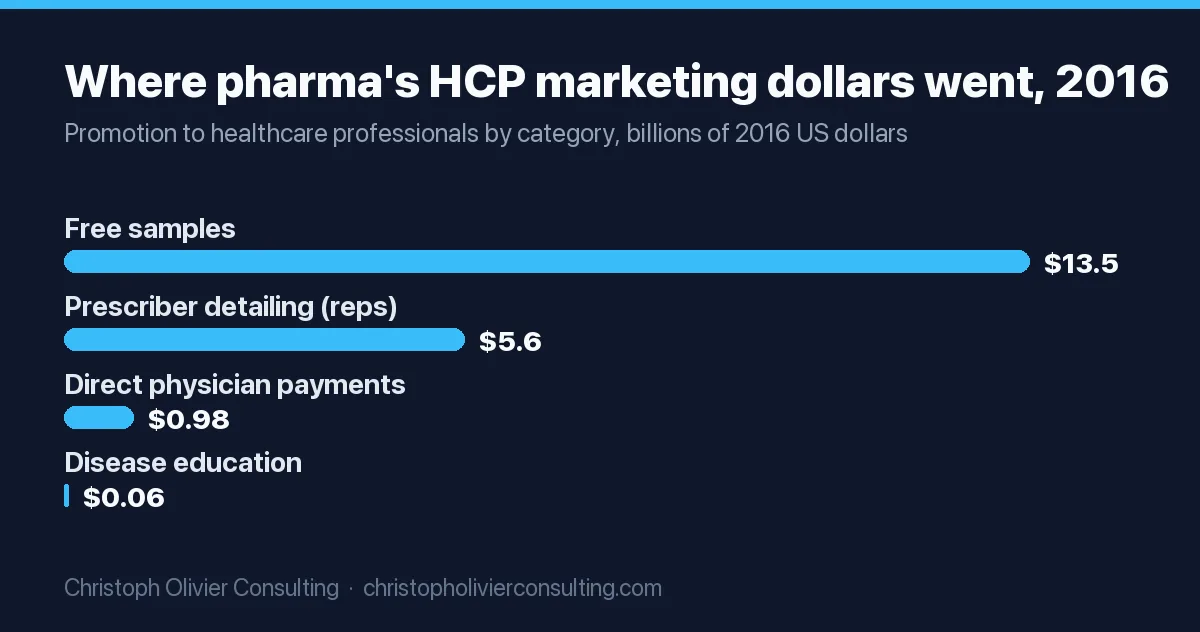
Inside that professional bucket, free samples and rep detailing dominated. Direct payments to physicians, the line item that draws the most headlines, was under a billion dollars.
The study uses 2016 dollars and predates the shift to streaming and social, so treat the split as structural rather than current. The lesson still holds for planning: most brands win or lose at the prescriber, and a plan that starts with the consumer campaign and treats HCP work as support usually has the order backwards.
What changed after September 9, 2025
The short version: FDA stopped writing guidance and started writing letters. The timeline below is the context your regulatory and legal reviewers are working from.
| When | What happened | What it means for your plan |
|---|---|---|
| 1969 | The “adequate provision” language is codified at 21 CFR 202.1(e)(1)(i)(B), per Foley Hoag’s history of the rule. | Broadcast ads can show a major statement of risks and point elsewhere for the full labeling. |
| 1997 to 1999 | FDA’s draft (1997) and final (1999) consumer broadcast guidance makes TV drug ads practical. FDA now calls this the loophole “created in 1997.” | The modern 60-second TV spot rests on this guidance, not on a statute. |
| 1997 to 2016 | Promotional pieces submitted to FDA rose from 34,182 to 97,252 while FDA violation letters fell from 156 to 11 (JAMA, 2019). | A generation of brand teams learned to work in a low-enforcement era. |
| Nov 2023, compliance Nov 2024 | The “clear, conspicuous and neutral” final rule for TV and radio major statements (88 FR 80958). | Your TV risk presentation now has five specific tests (see the next section). |
| Sept 9, 2025 | Presidential memorandum. FDA sends “thousands” of letters to drug companies and about 100 cease-and-desist letters, announces rulemaking on adequate provision, and flags social media problems, including undisclosed paid influencer promotion (FDA). | Every active campaign became a review candidate overnight. |
| Sept 16, 2025 | FDA posts a mix of warning and untitled letters to drugmakers, telehealth companies and compounding pharmacies, signed on behalf of the CDER director rather than the Office of Prescription Drug Promotion (Manatt). | Telehealth partners and compounders are in scope, so your partner ecosystem is too. |
| March 2026 | An untitled letter on a TV video for an injectable incretin objects to a factual “most FDA-approved uses” claim and even to shirt colors (Sidley). | True statements and creative choices can both be read as implied superiority. |
| Expected Dec 2026 | Proposed rule “Transparency in Direct-to-Consumer Advertising” (RIN 0910-AJ14), listed on the 2026 Unified Agenda as economically significant (Foley Hoag). | Your 2027 media plan needs a version without the current TV format. |
FDA also says it is using AI and other tech-enabled tools to surveil and review drug ads. Assume reach is no longer a reason a piece goes unnoticed.
The rules every pharma promotional piece has to clear
Most of what OPDP enforces sits in one regulation, 21 CFR 202.1, plus a handful of guidances and industry codes. This matrix maps each one to where brand teams tend to get caught.
| Rule | What it actually requires | Where teams get caught |
|---|---|---|
| Brief summary, 21 CFR 202.1(e)(1) | Every prescription drug ad must present “a true statement of information in brief summary” on side effects, contraindications and effectiveness. | Print and digital units that cut risk copy to fit a layout. |
| Broadcast major statement and adequate provision, 202.1(e)(1)(i) | TV and radio ads must state the major risks in the audio, and either include the brief summary or make adequate provision for the full labeling. | The rule the 2026 proposal would remove. Plans built on it are exposed. |
| Clear, conspicuous and neutral, 202.1(e)(1)(ii) | Consumer-friendly language; risk audio as understandable as the rest of the ad; audio and text at the same time on TV; readable text; no audio or visual elements that interfere with comprehension. | Upbeat scenes, music swells and fast cuts during the risk read. |
| Fair balance, 202.1(e)(5)(ii) | An ad is misleading if effectiveness is presented in “greater scope, depth, or detail” than risk without a fair balance of risk information. | Benefit-heavy landing pages, sales aids and social posts. |
| Reminder ads, 202.1(e)(2)(i) | Exempt from the brief summary only if they name the drug without indications or dosage recommendations. | “Reminder” units that slip in a hint of what the drug treats. |
| Form FDA 2253, 21 CFR 314.81(b)(3)(i) | Promotional labeling and ads must be submitted at first dissemination or publication, with Form FDA-2253 and current professional labeling. | Agency-made social content and influencer posts that never get logged. |
| Character-space draft guidance (June 2014) | If you make a benefit claim in a limited-space post, put risk in the same post and link to fuller risk information; if both will not fit, reconsider the platform (FDA draft guidance). | Paid search headlines and short-form social. |
| PhRMA Code (revised, effective Jan 1, 2022) | No company-paid alcohol at speaker programs, no renowned or extravagant venues, limits on repeat attendance, speakers not chosen or paid on expected prescribing revenue (Hogan Lovells). | Legacy speaker bureaus and local dinner programs. |
| HHS-OIG Special Fraud Alert (Nov 2020) | OIG says, as summarized by Hogan Lovells, it is “skeptical about the educational value” of speaker programs and flags generous fees and attendees with no legitimate reason to be there. | Programs that look like rewards for high prescribers. |
| Open Payments (Sunshine Act) | Manufacturers report payments and transfers of value to physicians, advanced practice providers and teaching hospitals; CMS publishes the data each year (CMS). | Every meal and fee becomes public and searchable by recipient. |
Two calibration notes. If your team’s idea of “misleading” comes from consumer false advertising examples, recalibrate: under fair balance, a true claim can still be a violation when risk is underweighted. And if you also sell devices, medical device marketing runs under a different FDA framework, so do not reuse drug review templates without a regulatory check.
Read the letters like a brief: six patterns FDA keeps citing
The fastest way to lower your risk is to treat recent letters as a creative brief written by the regulator. These patterns come straight from the 2025 and 2026 letters and FDA’s own statements. Use the right column as pre-flight questions in your promotional review committee (PRC or MLR) before anything goes out.
| Pattern | Where it showed up | Pre-flight question for review |
|---|---|---|
| 1. Risk statement drowned out | Several September 2025 letters focused on how the major statement was presented, flagging attention-grabbing visuals and frequent scene changes (Manatt). | If you watch only the risk read, with sound on, is anything on screen competing for attention? |
| 2. Quality of life oversold | Overstated efficacy was among the most common violations, especially visuals implying a better life than patients can typically expect. | Would a typical trial patient recognize their outcome in this footage? |
| 3. Superiority by implication | The March 2026 incretin letter objected to a factual “most FDA-approved uses” claim and to an orange shirt for the brand against gray for others (Sidley). | Does any line, color, gag or casting choice suggest we beat other drugs without head-to-head data? |
| 4. “Same as the approved drug” | Letters to compounders cited claims implying compounded GLP-1 products are the same as FDA-approved ones. | Do our partners, telehealth platforms or affiliates describe our drug or its substitutes in ways we would not approve? |
| 5. Benefit without risk in social | FDA cites a 2024 review finding 100% of pharma social posts highlighted benefits but only 33% mentioned harms (FDA). | Does every post with a benefit claim carry risk in the same post, plus a link to full risk? |
| 6. Undisclosed influencer promotion | FDA’s September 2025 announcement names “undisclosed paid influencer promotion” as a problem. | Is every paid creator disclosed, scripted for fair balance, logged on Form 2253 and monitored after posting? |
One caution on pattern 3. Sidley notes the 2026 letter sits uneasily with a 2005 Zyrtec letter in which FDA did not object to truthful statements about approved indications. That tension may be tested in court. Until it is, plan as if the stricter reading applies.
Should you keep TV in the plan? A scenario plan for the adequate provision rule
The proposed rule would remove the adequate provision pathway in 202.1(e)(1)(i)(B). Broadcast ads would then have to carry the full brief summary themselves. Foley Hoag describes “broadcast” here as TV, radio and streaming, and FDA’s own announcement says the loophole has been used in “broadcast and digital ads.” Fitting a full brief summary into a 30 or 60 second spot is hard to picture, so the honest planning question is not “how do we comply” but “what replaces the reach TV gives us.”
Federal timetables slip, and the Unified Agenda is a plan rather than a promise. So plan in scenarios, with a trigger for each.
| Scenario | Trigger to watch | Media moves |
|---|---|---|
| A. Proposed and finalized close to as described | NPRM published in the Federal Register, comment period closes, final rule issued | Shift broadcast weight to HCP channels, owned patient programs, unbranded disease awareness and search. Keep TV only for reminder ads if the final text still permits them. |
| B. Softened or delayed | NPRM slips past December 2026, or the text adds a shorter disclosure format | Keep TV but re-cut every spot to pass the five clear, conspicuous and neutral tests, and hold 20 to 30% of the TV budget flexible so you can move it within a quarter. |
| C. Challenged in court | Industry or trade association litigation on First Amendment grounds (Foley Hoag cites Central Hudson and Zauderer) | Do not bet the launch on the outcome. Build scenario A’s channels anyway, since they pay off in all three cases. |
The 20 to 30% flexible hold is my rule of thumb, not an industry standard. Pick the number your contracts and upfront commitments actually allow.
Whatever scenario you plan for, these steps are worth doing before the proposal lands:
- Measure your TV dependence. Estimate what share of new-to-brand prescriptions and branded search you can attribute to linear and streaming TV. If it is the main driver, you are the brand this rule hits hardest.
- Re-cut current spots to the 2023 standard now. The risk read is where most September 2025 letters landed, and the clear, conspicuous and neutral tests already apply.
- Build the replacement channels early. HCP omnichannel, patient support programs and search need months of data before they can carry volume.
- Audit partners. Telehealth platforms, affiliates and creators who talk about your drug are part of your risk, as the compounder and telehealth letters showed.
- Prepare your comment position. Work with regulatory affairs and your trade association so your brand’s evidence is in the record when the comment period opens.
HCP marketing that holds up: reps, speaker programs and Open Payments
Every dollar of HCP marketing is now public by recipient. CMS’s Program Year 2025 release, published in 2026, covers 17.07 million records worth $14.67 billion: $9.50 billion in research payments, $3.92 billion in general payments and $1.25 billion in ownership and investment interests. Across seven years, CMS has published 93.87 million records totaling $82.24 billion.
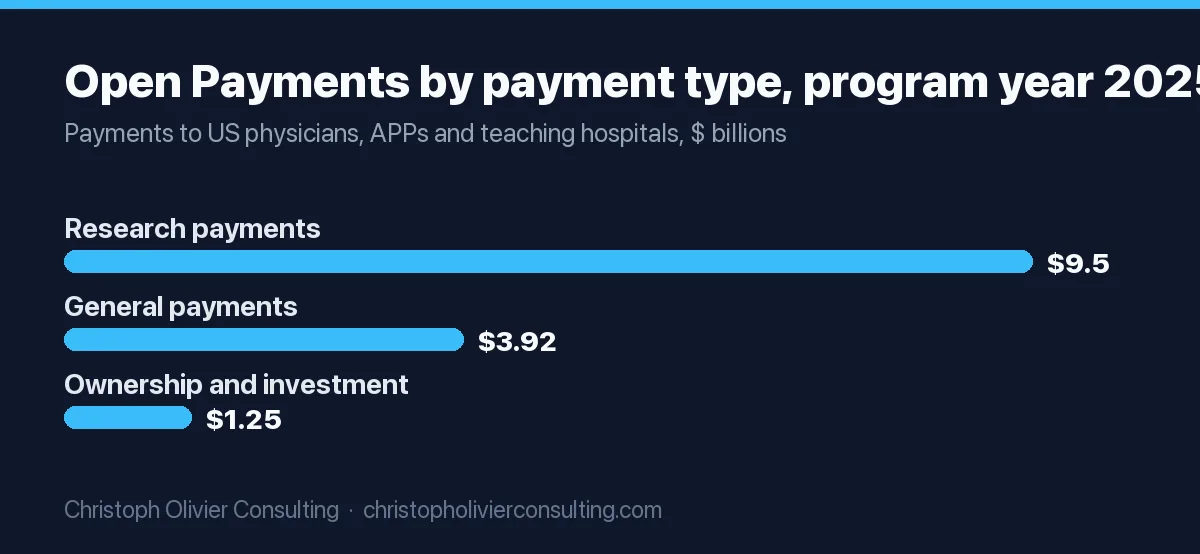
Research dominates the dollars, but general payments, the meals, speaker fees and travel your field team controls, are the line reporters and payers look up first. Practical rules for 2026:
- Design speaker programs to the PhRMA Code, not to habit. Modest meals, no company-paid alcohol, no showcase venues, and speakers chosen for expertise rather than prescribing volume. Track repeat attendance by name.
- Look up your own brand before a journalist does. Pull your company’s Open Payments records each year and check whether your top recipients overlap with your top prescribers in a way that would be hard to explain.
- Move HCP education toward formats with clear educational value. OIG’s skepticism about speaker programs is a reason to invest in medical education content, clinical tools and peer-to-peer formats your medical affairs team can stand behind.
- Coordinate reps and digital. Rep-triggered email, HCP portals and endemic media work best as one sequence, with the same approved claims everywhere. Our roundup of multichannel marketing examples shows how sequenced touchpoints look in practice.
Pharma digital marketing: what each channel can carry
Pharma digital marketing is where the September 2025 announcement put new attention, and where the 2014 draft guidance on character limits still does most of the work. Use this as a planning view, then confirm each unit with your review team.
| Channel | What it can carry well | Rule that limits it |
|---|---|---|
| Paid search | High-intent patients and HCPs looking for a condition or a brand | Character limits: benefit claims need risk in the same unit plus a link, or the ad should stay a reminder |
| Paid social | Disease awareness and branded reach with targeting | Fair balance in each post; comment monitoring; Form 2253 at first publication |
| Creators and influencers | Patient voice and condition education | FDA’s stated focus on undisclosed paid influencer promotion; disclosure; the same fair balance as a brand ad |
| Streaming and CTV | TV-like reach with better targeting | Foley Hoag reads “broadcast” in the proposal as including streaming, so plan it with TV, not with digital |
| Brand and HCP websites | Full prescribing information, savings programs, dosing tools | Fair balance on every benefit page; Form 2253 at first dissemination |
| HCP email and portals | Clinical data, access updates, rep follow-up | Same approved claims as the sales aid; consistent with labeling |
The common thread: if a format cannot hold the benefit and the risk together, FDA’s own guidance says to reconsider the format for that message. That is not a reason to avoid digital. It is a reason to brief creative inside the constraint from day one instead of trimming risk copy at the end.
How to choose a pharmaceutical marketing agency in 2026
Start by deciding what you are buying. Pharma marketing services usually split into four jobs: brand strategy and creative, HCP and medical communications, media planning and buying, and regulatory-ready production (the agency side of MLR). Large brands often split these across specialists. Smaller brands and emerging companies often want one pharmaceutical marketing agency to cover most of them. Neither model is wrong. The mistake is hiring a creative shop and assuming it can run HCP data, or hiring a media buyer and expecting brand strategy.
Questions to ask in the pitch, and what a strong answer sounds like
| Ask | Strong answer | Warning sign |
|---|---|---|
| “Walk us through a recent FDA letter in our category and what you would have done differently.” | Names the letter, the cited issue and the specific creative or copy fix | General talk about “compliance being in our DNA” |
| “How do you build a TV spot to pass the clear, conspicuous and neutral tests?” | Explains dual modality, text timing and quiet visuals during the risk read | Has not read the 2023 rule |
| “What is your plan if adequate provision goes away?” | Shows a reallocation model across HCP, owned, search and awareness | “We will wait and see” |
| “How do you manage creators and Form 2253 for social?” | A written process for disclosure, scripts, submission and monitoring | Treats influencers like consumer brand partnerships |
| “How many MLR rounds do your pieces take, and why?” | Tracks it and can explain how it reduces rework | No data, or blames the client’s review team |
| “Who works on our account after the pitch team leaves?” | Names the day-to-day team and their category experience | Vague staffing, junior team hidden until signing |
If media is a large share of your budget, judge the buying side separately; our guide to choosing a paid media agency covers fee models and how to read an audit of an incumbent.
A selection process you can run in about six weeks
- Write a one-page brief with the brand’s stage (launch, growth, mature, loss of exclusivity), the audience split between HCP and patient, and the regulatory context, including your exposure to the adequate provision proposal.
- Long-list five or six agencies with work in your therapeutic area and audience. Ask for two pieces that went through MLR, not just award entries.
- Run a paid working session with two or three finalists on a real problem, such as re-cutting your current spot’s risk read, rather than a speculative campaign pitch.
- Bring regulatory and medical into the room. Your reviewers will live with this agency’s drafts. Their read of each finalist matters as much as marketing’s.
- Check references on rework, not on creativity: how many review rounds, how fast fixes came back, how the agency handled a compliance problem.
- Contract for the scenario plan. Build in the ability to move budget between TV, HCP and digital without renegotiating the whole scope.
If you want an outside view on agency pitches or a 2027 plan that holds up under each rule scenario, you can book a consultation and I will give you a straight read on both.
The short version for your next planning meeting
Plan from the prescriber out, because that is where most of the money and most of the decisions sit. Treat every 2025 and 2026 letter as a creative brief. Re-cut TV to the 2023 standard now and build the channels that would replace it, since they pay off whether or not the adequate provision rule survives. And choose agencies on how they handle review, not on how they pitch.
Work with CO Consulting
Senior marketing leadership, without the full-time hire
- One senior owner of strategy, budget, vendors and the weekly scorecard
- Audit first, then a prioritized 90-day plan with measurable milestones
- Weekly team leadership, monthly strategic reviews and quarterly planning
- No guarantees we cannot back up; reporting tied to pipeline
Frequently asked questions
What is pharmaceutical marketing?
Pharmaceutical marketing is how drug companies promote prescription and specialty medicines to healthcare professionals, patients and payers. It covers sales reps, speaker programs, medical education, TV and digital advertising, websites and patient support programs. In the US, nearly all of it must follow FDA rules in 21 CFR 202.1, including fair balance between benefits and risks, and payments to prescribers are published through CMS Open Payments.
What is the adequate provision loophole in drug advertising?
Adequate provision is the part of 21 CFR 202.1(e)(1)(i)(B) that lets TV and radio drug ads state only the major risks and point viewers elsewhere, such as a website or phone number, for full labeling. FDA plans a proposed rule, Transparency in Direct-to-Consumer Advertising, listed for December 2026, that would remove this option and require the full brief summary in the ad itself.
What did the FDA do to drug ads in September 2025?
On September 9, 2025, FDA said it was sending thousands of letters to drug companies and about 100 cease-and-desist letters over misleading ads, and announced rulemaking on adequate provision. Letters posted on September 16 went to drugmakers, telehealth companies and compounding pharmacies, often citing risk statements drowned out by visuals and overstated quality of life benefits.
How much do pharmaceutical companies pay doctors?
CMS Open Payments data for program year 2025, published in 2026, shows 17.07 million records worth $14.67 billion. That includes $9.50 billion in research payments, $3.92 billion in general payments such as meals, speaking fees and travel, and $1.25 billion in ownership and investment interests. The records are searchable by physician, advanced practice provider and teaching hospital.
What should I look for in a pharmaceutical marketing agency?
Look for an agency that can explain recent FDA letters in your category and how it would avoid them, build TV risk statements to the 2023 clear, conspicuous and neutral rule, manage creators and Form FDA 2253 submissions, and track MLR review rounds. Ask for work that went through medical, legal and regulatory review, meet the day-to-day team, and test finalists in a paid working session.
Can pharma companies advertise on social media?
Yes, but each post carries the same obligations as other promotion. FDA's 2014 draft guidance on character-limited platforms says a post with a benefit claim should include risk information in the same post plus a link to fuller risk details, and if both will not fit, the firm should reconsider that platform. Posts must also be submitted on Form FDA 2253 at first publication.
Do PhRMA Code rules apply to speaker programs?
The PhRMA Code is a voluntary industry code followed by many, if not most, pharmaceutical and biotech companies. Its revision effective January 1, 2022 says companies should not pay for alcohol at speaker programs, should avoid renowned or extravagant venues, should limit repeat attendance without an educational need, and should not choose or pay speakers based on expected prescribing revenue. It followed a November 2020 HHS-OIG Special Fraud Alert.
More Growth Consulting guides
- Healthcare Marketing: How Practices Attract and Keep Patients
- AIDA Model: Attention, Interest, Desire, Action Explained
- 12 Marketing Strategy Frameworks Compared
- Martial Arts School Marketing: A Playbook to Fill Mats and Keep Students
- Ecommerce Marketing Strategy: A Channel-by-Channel Plan Built on LTV:CAC
- Business-to-Business Marketing Strategy for Small and Midsize Firms
- All Growth Consulting guides →