

The pharmacy marketing services worth paying for in 2026 do three jobs for an independent store: they keep the scripts you already fill from walking out the door, they give a chain or mail-order patient a concrete reason to transfer, and they put the clinical services chains can’t match in front of the people who need them. Almost everything else, from generic “transfer your prescription” postcards to a social feed full of holiday graphics, is noise unless it feeds one of those three jobs.
There is a second filter most marketing vendors skip. More than half of your volume is probably government-paid: the 2025 NCPA Digest reports that Medicare Part D and Medicaid together account for 52% of prescriptions at independents. That puts most of your patients under HIPAA’s marketing rules, the FCC’s texting rules and the federal ban on inducing Medicare and Medicaid patients to pick a provider. A campaign that ignores those rules is not cheap, it is a liability. This guide organizes pharmacy marketing strategies around that reality: what to send, what you can’t send, and who to hire for which part.
Want a specialist to build this for your business? See how CO Consulting’s marketing services work, starting with a diagnostic and audit.
For context on who you are competing as: NCPA counts 18,960 independent pharmacies as of July 2025, down from 18,984 a year earlier, and independents are nearly 36% of all US retail pharmacies. The average independent filled 67,601 prescriptions in 2024, while gross profit hit a 10-year low (same NCPA Digest summary). Thin margins mean marketing has to be measured in scripts and patients, not likes.
Start with the patients who already fill with you
The cheapest new prescription is the refill a current patient would otherwise forget, delay, or move to mail order. That makes adherence outreach and medication synchronization your first marketing program, not a back-office project.
HIPAA helps you here. Under the definition of marketing at 45 CFR 164.501, a communication “to provide refill reminders or otherwise communicate about a drug or biologic that is currently being prescribed” is not marketing, as long as any payment you receive from a third party for sending it is reasonably related to your cost of sending it. HHS spelled out the edges in its September 2013 refill reminder guidance:
- Inside the exception: refill reminders, messages about generic equivalents of a drug being prescribed, messages about a prescription that lapsed within the last 90 calendar days, adherence messages, and, for self-administered drugs, messages about the drug delivery system.
- Outside the exception: messages about a new formulation of the current drug, about adjunctive drugs, or encouraging a switch to an alternative medicine.
The practical takeaway: you can build an automated refill and lapsed-script program without collecting marketing authorizations, which is exactly what a chain does at scale. The difference you can add is a human one. Med sync, where a pharmacist aligns a patient’s maintenance medications to one pickup date and calls a few days ahead, turns a dozen separate trips into one appointment and gives you a monthly reason to talk. If you already run email or text sequences, the logic is the same as any well-built triggered email program: the event (a refill due, a script lapsing at day 30, a missed pickup) fires the message, not a calendar.
Two checks before you switch it on. First, if a manufacturer funds an adherence program, keep the paperwork showing the payment covers only your reasonable direct and indirect costs, which is the condition in the HHS guidance. Second, keep lapsed-script outreach inside the 90-day window; after that, the message no longer fits the exception.
Prescription transfers: give people a reason, not a gift card
Every pharmacy says “we’ll transfer your prescriptions for free.” Because everyone offers it, it is not a reason to switch. A transfer campaign works when it names the specific frustration your target patient has and the specific fix you offer: the pharmacist who answers the phone, same-day local delivery, med sync, compounding the chain sends out, or a vaccine without an appointment.
Two rule changes shape how you can do this.
Controlled substances can move now. Since a DEA final rule effective August 28, 2023, an electronic prescription for a schedule II to V controlled substance can be transferred between DEA-registered retail pharmacies for initial filling, at the patient’s request, on a one-time basis, where state law allows it. DEA clarified that the one-time limit is per prescription, and authorized refills move with it. For a patient who left a chain because a stimulant or pain prescription was stuck at an out-of-stock store, that is a real, specific message.
Inducements to Medicare and Medicaid patients are capped. The HHS Office of Inspector General’s December 2016 policy statement explains that under section 1128A(a)(5) of the Social Security Act, offering a Medicare or Medicaid beneficiary anything of value that is likely to influence their choice of provider can bring civil monetary penalties. OIG interprets permitted “nominal value” gifts as no more than $15 per item or $75 per patient per year, and never cash or cash equivalents. Because you usually cannot tell which households on a mailing list are on Medicare or Medicaid, design every transfer offer as if they all are. A branded tote or a pill organizer can fit; a “$25 for every transfer” coupon is the kind of offer to clear with healthcare counsel first.
Copy you can adapt for a transfer postcard or landing page:
Tired of waiting in the drive-through line? At [Pharmacy Name], your pharmacist knows your name and answers the phone. We line up your monthly medications for one pickup day, deliver across [town], and can move your prescriptions from another pharmacy with one call. Bring your bottles in, or call [phone], and we handle the rest.
Notice what it does not do: no price promise, no cash incentive, no claim about outcomes. It sells the experience you can actually deliver.
Which pharmacy services to put in front of the market
Services are where independents can stand apart, but only some of them are rare enough to be a reason to choose you. According to the 2025 NCPA Digest, 93% of independents offer flu immunizations, 92% offer other immunizations, 80% offer medication therapy management, 73% blood pressure monitoring, 55% long-term care services and 45% compounding.
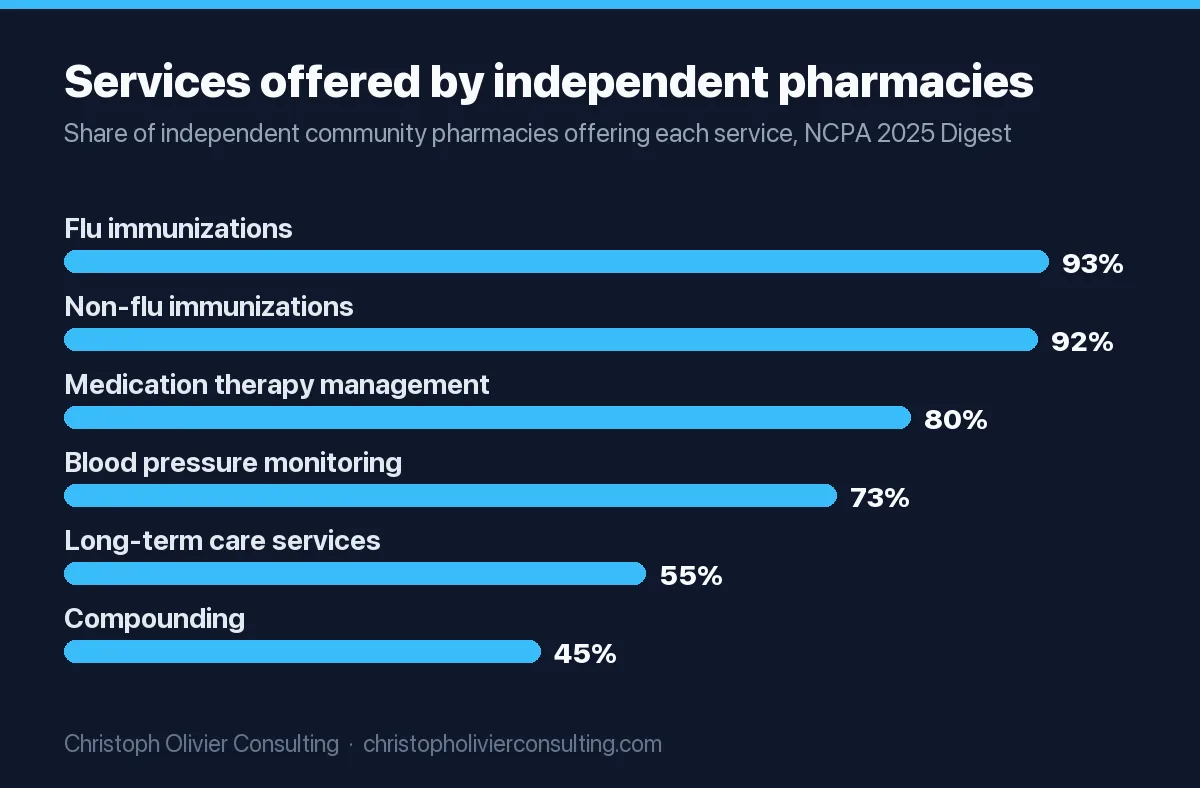
Flu shots and other immunizations are close to universal, so “we give flu shots” will not win a patient from a chain that also gives them. What wins is convenience and timing: walk-in hours, Saturday clinics, and a reminder before the patient’s usual chain sends one. Compounding, offered by fewer than half of independents in the NCPA data, is a true differentiator, and it is worth its own page on your site and its own pitch to local prescribers, veterinarians and dermatologists. Medication therapy management and blood pressure checks are strongest as relationship tools: they give a pharmacist a reason to sit down with a patient, which is when transfers of the rest of a family’s prescriptions tend to happen.
HIPAA treats promotion of your own services differently from refill reminders. The same regulation excludes from “marketing” a communication describing a health-related product or service provided by the covered entity making the communication, except where you receive financial remuneration from a third party for making it. So a flu clinic announcement to your own patients, paid for by you, is generally fine under HIPAA. The same announcement funded by a vaccine manufacturer is marketing and needs each patient’s written authorization. Ask that question of every co-funded campaign.
Getting found when someone searches “pharmacy near me”
For a walk-in business, your Google Business Profile does more selling than your website. Google says local results are mainly based on relevance, distance and prominence, that more reviews and positive ratings can help local ranking, and that “there’s no way to request or pay for a better local ranking.” That last line is useful when a vendor promises map-pack placement.
The pharmacy-specific moves:
- Pick “Pharmacy” as the primary category, then add secondary categories that match real services, such as compounding or medical supply, only if you actually offer them.
- Keep pharmacy hours separate and accurate, including lunch closures and holiday hours. A patient who drives over during a closed pharmacy counter hour rarely gives you a second chance.
- List services (immunizations, delivery, med sync, compounding) and back each one with a page on your site that explains how it works.
- Ask for reviews the same way every time, at pickup, with a printed QR code. Never offer anything in exchange, and never confirm in a public reply that the reviewer is your patient or mention their medication.
The same principles apply to any local service business; our local SEO playbook for service businesses covers citations, location pages and review velocity in more depth.
Paid search is narrower than most owners expect. Google’s healthcare and medicines policy allows online pharmacies in the US only if they are accredited by LegitScript, NABP’s Digital Pharmacy Accreditation or the .Pharmacy program, and certified with Google, and it restricts prescription drug terms in ads, landing pages and keywords. If your website lets people order or refill online, plan for certification before you spend on ads. Ads that promote walk-in services such as immunizations or compounding consultations, written without prescription drug names, are the simpler place to start.
Texting patients: what the FCC and HIPAA each allow
Texting is the channel patients actually read, and it is governed by two separate sets of rules. HIPAA decides what the message may say. The Telephone Consumer Protection Act decides whether you may send it at all.
In its 2015 TCPA order (FCC 15-72), the FCC exempted certain healthcare calls and texts, naming “prescription notifications” among them, subject to strict conditions. The text must go only to the wireless number the patient provided; must state your pharmacy’s name and contact information; must contain no telemarketing, solicitation or advertising and no billing or financial content; must comply with HIPAA; should be 160 characters or less; is limited to one message per day and three per week; and must tell the recipient they can reply STOP, with opt-outs honored immediately. Anything promotional falls outside that exemption, so collect clear, written opt-in consent for marketing texts and have counsel review your consent wording. If you are choosing a tool, our comparison of SMS marketing platforms covers consent capture and opt-out handling.
Here is a message-by-message compliance matrix built from those primary sources. It is a planning aid, not legal advice; state law can add requirements.
| Message you want to send | HIPAA (45 CFR 164.501 and HHS guidance) | Texting (FCC 15-72) and other rules | Verdict |
|---|---|---|---|
| “Your refill is ready” or “due” for a current prescription | Not marketing (refill reminder exception), if any third-party payment only covers your cost | Fits the “prescription notification” exemption if all conditions are met; no drug name needed | Send |
| Outreach on a prescription that lapsed 30 or 60 days ago | Inside the exception (lapsed within 90 calendar days) | Same conditions as above | Send, stop at day 90 |
| “A generic of your medication is available” | Inside the exception | Keep it informational, no pricing promotion | Send |
| Manufacturer-funded message about a new formulation or add-on drug | Outside the refill exception; paid communication is marketing and needs written authorization | Promotional; needs opt-in consent | Avoid unless authorized |
| “Walk-in flu shots this Saturday” to your own patients | Not marketing if you pay for it (your own health-related service); marketing if a manufacturer pays | Promotional, outside the healthcare exemption; needs opt-in consent | Send to opted-in list |
| Transfer coupon mailed to a neighborhood | No patient data used, so HIPAA is not the issue | OIG: non-cash gifts only, max $15 per item and $75 per patient per year for Medicare and Medicaid beneficiaries | Non-cash, nominal only |
| Advertising prescription prices | Not a HIPAA issue | State rules vary; for example, Colorado law allows price ads but requires the generic name whenever a brand name is advertised | Check your state board rules |
| Retargeting pixel on your refill or patient portal pages | OCR guidance on tracking technologies still applies to authenticated pages (see below) | Also check your ad platform’s own health data rules | Remove from logged-in pages |
Sample texts written to fit the exemption (under 160 characters, name and contact, STOP language, no drug name, no promotion):
- “[Pharmacy Name]: a prescription is ready for pickup. Questions? Call [phone]. Reply STOP to opt out.”
- “[Pharmacy Name]: a refill is due this week. Reply or call [phone] to have it ready. Reply STOP to opt out.”
And one promotional text, for patients who opted in to marketing messages only:
- “[Pharmacy Name]: walk-in flu shots Sat 9 to 1, no appointment. Most insurance accepted. Reply STOP to opt out.”
Your website, tracking pixels and the refill page
Many pharmacy websites come from a vendor with a refill form and analytics or ad pixels baked in. That combination drew federal attention. In June 2024, a federal court in American Hospital Association v. Becerra vacated the part of the HHS Office for Civil Rights tracking-technology guidance that covered public, unauthenticated web pages, and HHS dropped its appeal in August 2024, as summarized by Morrison Foerster. Pages behind a login, such as a patient portal or refill account, were not part of that ruling and remain the higher-risk area.
A simple rule for an independent: run ad and analytics pixels on public pages like your homepage, services pages and blog if you want them, and keep them off refill forms, portals and anything that captures prescription numbers. Ask your website vendor in writing which scripts load on those pages, and whether they will sign a business associate agreement.
Prescribers are a marketing channel too
A handful of local prescribers often decide where a large share of new scripts land, especially for compounding, specialty and long-term care patients. Prescriber marketing is relationship work: a one-page sheet listing what you stock, what you compound, your delivery radius and a direct pharmacist line; a short visit to each office manager; and fast, clean answers on prior authorizations and clarifications. Physicians’ own marketing pressures are covered in our guide to doctor marketing, and understanding them makes your pitch sharper: you are offering their staff fewer callbacks and their patients fewer gaps.
Two cautions. Never offer prescribers or their staff anything of value tied to referrals; federal anti-kickback law applies, and this is a conversation for healthcare counsel. And clinical collaboration networks can add credibility: the NCPA Digest summary notes more than 3,500 pharmacies participate in CPESN USA, across 48 community-based networks in 45 states and DC, which gives you a structure for enhanced services that payers and prescribers recognize.
A 12-month independent pharmacy marketing calendar
The pharmacy year has two hard deadlines that most generic marketing calendars miss: flu season and Medicare open enrollment. Build around them.
| When | What is happening | Marketing move |
|---|---|---|
| January | New Medicare plan coverage starts January 1, per Medicare.gov; patients meet new formularies and networks | Call or text patients whose plan changed; post “we accept [plans]” on your site and Google profile; prescriber outreach on formulary switches |
| February to April | Quieter counter after flu season | Med sync enrollment push; prescriber visits; compounding page and referral sheet refresh |
| May to July | Summer travel, school and camp forms | Review request routine; Google profile photos and services; plan fall flu staffing and consent list growth |
| August | Too early for most adult flu shots: CDC says adults, especially 65 and older, generally should not be vaccinated in July or August | Build the flu campaign and pre-registration list; don’t push older adults to vaccinate yet |
| September to October | CDC: September and October are generally good times to vaccinate, ideally by the end of October | Walk-in and Saturday flu clinics; texts to opted-in patients; EDDM postcard to your delivery radius |
| October 15 to December 7 | Medicare Open Enrollment: patients can join, switch or drop plans | Remind patients to confirm your pharmacy is in network for any plan they choose; point them to Medicare’s Plan Finder and stay neutral on which plan to pick |
| Late November to December | Holiday hours and travel | Update holiday hours on Google; early refill reminders before closures |
Buying pharmacy marketing services: what your banner covers and what to hire
Most independents already have some marketing help bundled into a membership, and the first step is using it before buying more. Here is how the main types of providers usually divide the work.
| Provider type | What they typically cover | Watch for |
|---|---|---|
| Wholesaler franchise or banner programs (for example Health Mart, Good Neighbor Pharmacy) | Brand templates, seasonal campaigns, and in some cases matching funds for approved local marketing | Messaging shared with thousands of stores; little that is specific to your town or your services |
| Buying cooperatives | Print, signage and direct mail; APCI, for one, offers members free design, at-cost printing and EDDM postcard mailings, some eligible for Health Mart Matching Funds | Strong on print, lighter on search, texting and measurement |
| Pharmacy-specialist agencies and software vendors | Websites, refill apps, texting, review tools, often connected to your pharmacy management system | Pixels on refill pages, consent capture, business associate agreements, long contracts |
| Generalist local agency or fractional CMO | Strategy, local search, budget allocation and measurement across channels | Unfamiliarity with HIPAA marketing rules, OIG inducement limits and TCPA conditions |
Before you sign with any pharmacy marketing service, get written answers to these questions:
- Will you sign a business associate agreement, and which of your systems will touch patient data?
- Which tracking scripts load on our refill, portal and contact pages? Can we see the list?
- How do you collect and store texting consent, and how do STOP requests reach our pharmacy system?
- Will you report transfers in, new patients, med sync enrollments and scripts per patient, or only clicks and impressions?
- Who owns our domain, Google Business Profile, phone numbers and patient lists if we leave?
- Does any campaign you propose include manufacturer funding? If so, how does it stay inside HIPAA’s cost-only limits?
- What is the minimum term, and what does cancellation cost?
The measurement question matters most. For an independent, the numbers that prove marketing works are new patients from transfers, the share of maintenance patients on med sync, refill on-time rates, and services booked. A vendor that can’t connect its work to at least one of those is selling activity.
In my experience, the stores that get the most from outside help keep the relationship work, prescriber visits and the pharmacist’s voice in-house, and hire out the plumbing: the website, the texting platform, the review routine and the reporting. Broader patterns across practices and clinics are in our healthcare marketing guide. If you want a second opinion on a vendor proposal or a budget split before you sign, you can book a consultation.
Pharmacy marketing ideas to stop, start and keep
A quick audit you can run this week:
- Stop: cash or gift-card transfer incentives; pixels on refill pages; texting patients who never opted in to promotions; social posts that only say “we’re here for you.”
- Start: an automated refill and lapsed-script program inside the 90-day window; a transfer message built around one specific advantage; a compounding or specialty services page; a prescriber one-pager.
- Keep: the pharmacist who knows patients by name, and every chance to show it, in the review replies you write (without health details), the phone that a person answers and the delivery driver who knows the neighborhood.
Work with CO Consulting
Want this done for your business?
- A diagnostic call and an audit of your current marketing and numbers
- A prioritized 90-day plan built for your market
- Execution across SEO and AI search, paid ads, content, funnels and automation
- Weekly check-ins and monthly reporting, led by a fractional CMO
Frequently asked questions
What do pharmacy marketing services usually include?
Most packages for independent pharmacies combine a website with online refills, a texting or refill reminder platform, Google Business Profile and review management, social posts, and print or direct mail such as EDDM postcards. The useful ones also report patient-level results: transfers in, med sync enrollments and scripts per patient. Check that any vendor touching patient data will sign a business associate agreement.
Are refill reminders considered marketing under HIPAA?
No, in most cases. The HIPAA definition of marketing at 45 CFR 164.501 excludes refill reminders and other communications about a drug currently prescribed to the patient, provided any third-party payment for sending them is reasonably related to the pharmacy's cost. HHS guidance includes generic-equivalent messages, adherence messages and prescriptions that lapsed within the last 90 calendar days.
Can a pharmacy offer a gift card for transferring a prescription?
Be careful. An HHS OIG policy statement from December 2016 says gifts to Medicare or Medicaid beneficiaries that could influence their choice of provider must be of nominal value, no more than $15 per item or $75 per patient per year, and never cash or cash equivalents. Since most mailing lists include beneficiaries, keep transfer offers non-cash and ask healthcare counsel first.
Can pharmacies text patients without written consent?
The FCC's 2015 TCPA order exempts certain healthcare texts, including prescription notifications, if they go to the number the patient provided, name the pharmacy, stay under 160 characters, contain no advertising or billing content, are limited to one a day and three a week, and offer STOP opt-out. Promotional texts fall outside that exemption, so collect opt-in consent for them.
Can an independent pharmacy run Google Ads?
Yes, with limits. Google's healthcare and medicines policy allows online pharmacies in the US only when they hold LegitScript, NABP Digital Pharmacy or .Pharmacy accreditation and are certified with Google, and it restricts prescription drug terms in ads and keywords. Ads for walk-in services such as immunizations or compounding consultations, written without drug names, are usually the simpler starting point.
What independent pharmacy marketing works best on a small budget?
Start with the patients you already serve: an automated refill and lapsed-script program, med sync enrollment, and a consistent review request at pickup. Then build one transfer message around a specific advantage, such as delivery or compounding, and keep your Google Business Profile complete. These steps cost little and tie directly to scripts filled.
More Growth Consulting guides
- Healthcare Marketing: How Practices Attract and Keep Patients
- 31 Free Marketing Tools Worth Using in 2026
- Customer Success Software: Categories, Features, and Pricing
- How to Get More Google Reviews (Without Breaking Google’s Rules)
- Locksmith Marketing: A 2026 Playbook for Booked Jobs and Beating Lead-Gen Spam
- Geofencing Marketing: How It Works, What It Costs, and When It Fits
- All Growth Consulting guides →