

Credit union marketing in 2026 has a scale problem hiding inside a growth story. Federally insured credit unions added 2.3 million members in the year to June 2026, yet about 56% of them ended the period with fewer members than they started with, according to NCUA’s second-quarter 2026 map review. The growth is real, but it is pooling in the largest institutions.
If you run marketing at a credit union, you also work under three constraints a bank marketer or a fintech growth team rarely thinks about all at once: who you are allowed to serve (your field of membership), what you are allowed to say (NCUA, Truth in Savings and Reg Z advertising rules), and where you are allowed to aim (the lending restrictions Google and Meta apply to your ads). This guide is built around those three constraints, then turns them into the campaigns that move deposits, loans and new members.
Want a specialist to build this for your business? See how CO Consulting’s marketing services work, starting with a diagnostic and audit.
Where credit union growth is actually happening in 2026
NCUA’s Quarterly Credit Union Data Summary for 2026 Q2 counts 4,214 federally insured credit unions serving 146.1 million members. Split the system by size and the picture changes. The 2,438 credit unions with under $100 million in assets serve 6.3 million members combined, and their membership fell 7.3% over the year. The 748 complex credit unions, those over $500 million in assets, serve 124.2 million members and grew membership 2.8%.
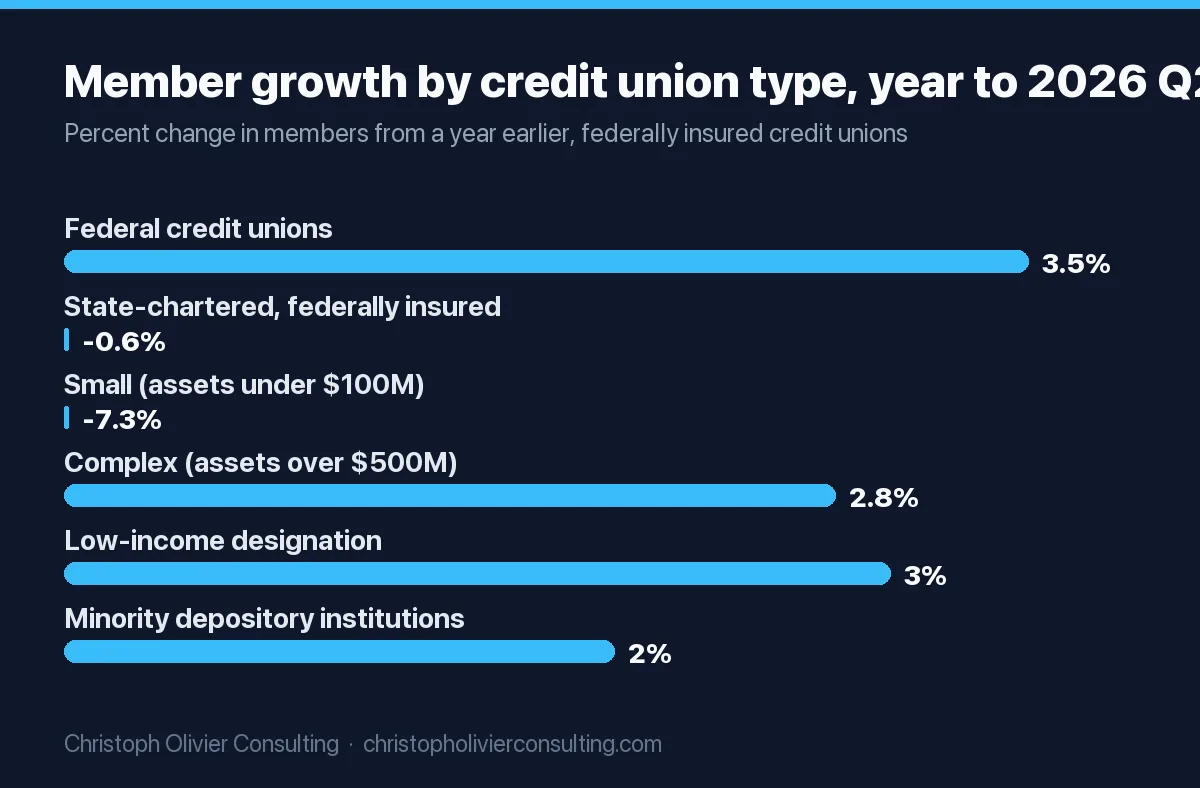
The median story is flat to negative. NCUA’s map review puts the median change in membership at minus 0.6%, with membership declining in 34 states. So “grow membership” is not a generic goal for most credit unions. It is a defensive one: replace the members you lose to age, moves and switching, then add net new ones in the products that carry your balance sheet.
Two more numbers from the same NCUA summary should shape your 2026 plan:
- Lending is outrunning funding at the margin. Total loans grew 4.9% to $1.76 trillion and insured shares and deposits grew 4.3%, with a system loan to share ratio of 82.9%. Deposit gathering still matters.
- Auto is flat, and mix matters. Auto loans grew just 0.4% to $485.4 billion. Used auto loans rose 1.2% while new auto loans fell 1.1%.
The rest of this guide assumes you are a marketing director at a credit union somewhere in the middle of that distribution: big enough to run paid media and a real onboarding program, small enough that every dollar has to show up as members, balances or funded loans.
Constraint 1: your field of membership is your audience list
A bank can sell to anyone. You can sell only to people inside your field of membership. NCUA explains on its field of membership expansion page that a federal credit union holds one of three charters (single common bond, multiple common bond or community) and that the charter “determines what groups or geographic areas it may serve.” A federal credit union also needs NCUA approval before changing that field. State-chartered credit unions follow their state’s rules, so confirm the details with your state regulator.
That makes your charter the first marketing document you should read, before any persona deck. Here is how each charter type translates into channel choices:
| Charter type | Who is eligible | What it means for your marketing |
|---|---|---|
| Single common bond (occupational or associational) | One group, such as employees of a company or members of an association | The sponsor is your best channel: new-hire onboarding, benefits enrollment, intranet and payroll deduction. Broad geographic ads mostly reach people who cannot join. |
| Multiple common bond | Several groups, each with its own bond (often called SEGs) | Market group by group. Keep a public list of eligible employers and associations, and build landing pages for your largest groups. NCUA allows these credit unions to add underserved areas, which opens geographic campaigns there. |
| Community | People connected to a geographic area that meets NCUA’s definition of a well-defined local community or rural district | Geography is your audience. Local search, local sponsorships and branch-area media fit well, but ad platform radius rules (Constraint 3) will spill outside your boundary. |
The practical rule for every charter: make eligibility a ten-second answer. Put “Who can join” in your main navigation, answer it in one plain sentence at the top of every product landing page, and offer a short eligibility check before the application starts. A prospect who discovers on page four of an application that they do not qualify is wasted spend and a bad brand moment.
Constraint 2: the advertising rules that touch almost every credit union ad
Four sets of rules show up again and again in credit union ads. Most generic credit union marketing strategies guides mention “compliance” in one paragraph. The table below maps them to the ad types you actually produce, based on the regulation text.
- NCUA’s advertising statement (12 CFR Part 740). Under 12 CFR 740.5, an insured credit union must include the official advertising statement in its advertisements, including its main internet page. The statement can be “Federally insured by NCUA,” “Insured by NCUA,” the longer “This credit union is federally insured by the National Credit Union Administration,” or a reproduction of the official sign. Its font can be no smaller than the smallest font used elsewhere in the ad to inform consumers. Separately, 12 CFR 740.4 requires the official sign on your website if you take deposits or open accounts online.
- Truth in Savings for credit unions (12 CFR Part 707). Credit unions follow NCUA’s own Truth in Savings rule, Part 707, the counterpart to the Reg DD rule banks cite. The advertising section, 12 CFR 707.8, governs any ad for a share account.
- Reg Z advertising rules for loans (12 CFR 1026.24). Section 1026.24 requires any stated finance charge rate to appear as an “annual percentage rate” and lists the trigger terms that force extra disclosures in closed-end loan ads.
- Equal housing notices (12 CFR 701.31). Under 12 CFR 701.31(d), a federal credit union that advertises real estate-related loans must include the Equal Housing Lender or Equal Housing Opportunity logotype in written and visual ads, or say it is an “Equal Housing Lender” in oral ads.
Credit union ad compliance matrix
| Ad type | NCUA statement (Part 740) | Truth in Savings (Part 707) | Reg Z (1026.24) | Equal housing (701.31) |
|---|---|---|---|---|
| Homepage | Required on the main internet page; official sign also required if you take deposits or open accounts online | Applies to any share rate you show | Applies to any loan terms you show | Applies if you promote real estate loans |
| Share certificate or savings rate ad (print, digital, social) | Required | Full rules: APY, plus the extra disclosures stating an APY triggers | No | No |
| Same rate ad on a billboard | Required (billboards are not on the exception list) | Reduced list under the outdoor media exemption | No | No |
| Radio or TV spot of 30 seconds or less | Not required (740.5(c) exception; TV display ads excluded from it) | Reduced list under the broadcast exemption | Applies to loan spots | Oral “Equal Housing Lender” statement for real estate loan spots |
| “Free checking” ad | Required | “Free” or “no cost” only if no maintenance or activity fee may apply | No | No |
| Auto or personal loan ad | Not required (ads that do not relate to member accounts, such as loans, are excepted) | No | APR rule plus trigger terms | No |
| Mortgage or other real estate loan ad | Not required (loan ad) | No | Yes; ask compliance which Reg Z section covers lines of credit | Required for federal credit unions |
| Newsletter sent only to existing members | Not on the exception list | Mostly exempt, but any rate must be called APY with a note to contact an employee about fees and terms | Applies to loan terms | Applies to real estate loan promotions |
| Signs inside your branch | Not required (office signs excepted) | Same light rules as member newsletters | Applies to loan terms | Lobby nondiscrimination notice required if you make real estate loans |
| Pens, key chains, calendars | Not required (impractical items excepted) | Only if a rate appears | Only if loan terms appear | No |
This matrix is a production aid, not legal advice. Your compliance officer signs off, and state-chartered credit unions may have additional state rules. Two points catch even experienced teams. First, loan ads do not need the NCUA statement, so many credit unions include it anyway for brand consistency; that is a choice, not a requirement. Second, Part 707 bans the word “profit” when describing dividends or interest, and bans ads that are misleading or misrepresent the account agreement. The same logic sits behind most of the false advertising examples regulators pursue: the headline promised something the fine print took away.
Constraint 3: credit union digital marketing runs on lending ad rules
Google and Meta apply rules written for fair lending to credit union ads, and they apply whether or not your product is a loan. Meta’s Special Ad Category documentation requires advertisers running financial products and services campaigns in the US, or aimed at US audiences, to use the Financial Products and Services category since January 2025. Google’s personalized advertising policy treats consumer finance as an “access to opportunities” category in the US and Canada.
| Targeting lever | Google Ads (consumer finance, US) | Meta (Financial Products and Services) |
|---|---|---|
| Age and gender | Cannot be used, along with parental and marital status | Age fixed at 18 to 65+; gender cannot be chosen |
| ZIP codes | Cannot be used | Not supported |
| Radius | At least 1 km around a location; city targeting allowed | At least 15 miles around a city, address or dropped pin |
| Location exclusions | Not addressed in this policy | Not supported |
| Lookalikes and detailed targeting | Predefined audiences allowed, minus the restricted demographics | No lookalikes; no demographic or behavior targeting; interests only from an approved list |
| Your own member lists | Not addressed in this policy | Custom Audiences supported, subject to an eligibility check |
Put that next to Constraint 1 and you see the real problem: your field of membership boundary and the platforms’ targeting boundaries do not match. A community charter that covers one county cannot exclude the next county on Meta, and a 15-mile minimum radius around a rural branch can reach people who are not eligible. You also cannot age-target a “first credit card” or “first car loan” campaign to young adults on either platform.
What works inside those limits:
- Let the creative do the targeting. If you want 22-year-olds, write and shoot for 22-year-olds. The platforms will find people who respond to it.
- Say who can join in the ad. A line such as “Open to anyone who lives or works in [County]” filters clicks before you pay for the landing page visit.
- Favor search intent. People searching for an auto refinance or a certificate rate in your city are self-selecting, and Google still allows city and radius targeting.
- Judge by cost per eligible application, not cost per click. Cheap clicks from outside your field of membership are not cheap.
With those three constraints mapped, the campaigns get simpler. Most credit union marketing calendars have a dozen campaigns on them. Three usually carry the balance sheet: deposits, auto loans and new member acquisition. Each one has a different job, a different regulation and a different weak spot.
Credit union marketing strategies for deposits: follow the money
NCUA’s Q2 2026 summary shows where members put new money over the year. Money market accounts grew fastest, share drafts (checking) next, then share certificates. Regular savings grew slowly and IRA balances were flat.
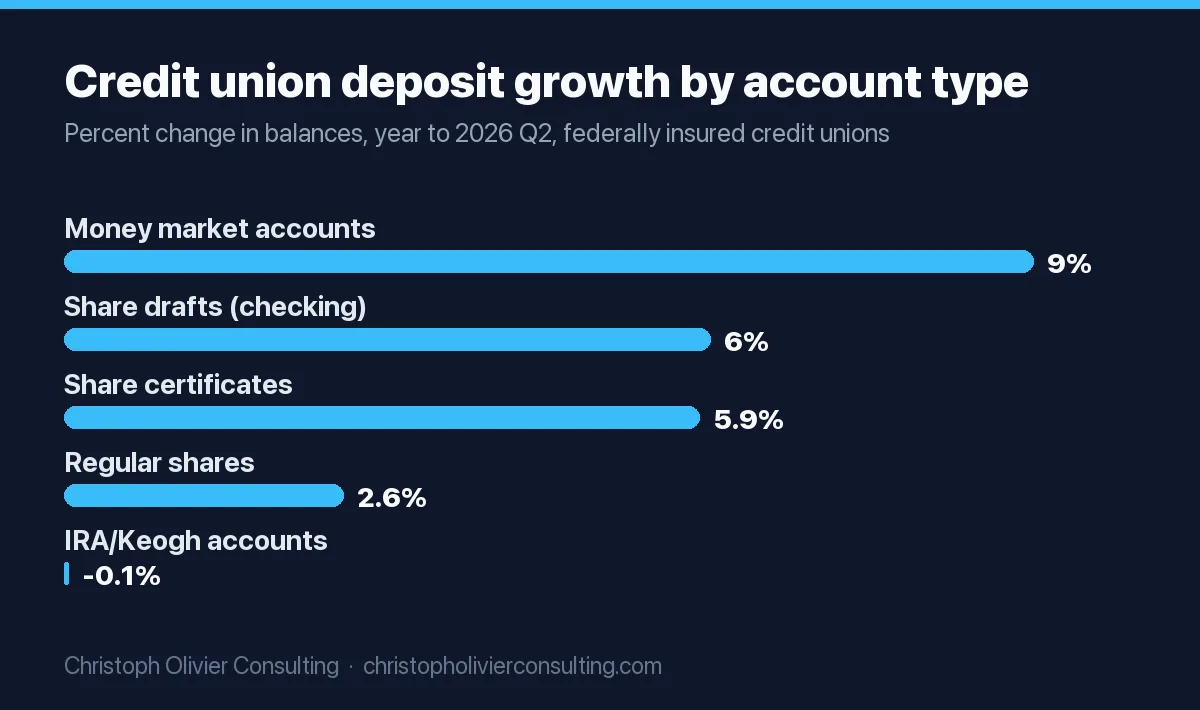
That points to two campaign types. A rate-led certificate or money market campaign brings in balances quickly, but often from rate shoppers. A checking-led campaign is slower and harder to win, but share draft accounts tend to make you the member’s everyday institution. Most credit unions need both, with the checking campaign carrying the primary-relationship goal.
Here is a sample digital ad for a certificate special, written to the Part 707 and Part 740 rules. The bracketed items are yours to fill in:
Lock in [X.XX]% APY for 13 months.
Our 13-month share certificate pays [X.XX]% Annual Percentage Yield (APY), accurate as of [date]. $[500] minimum to open and to earn the APY. A penalty may be imposed for early withdrawal. Fees could reduce earnings. Open to anyone who lives or works in [County]. Federally insured by NCUA.
Why each line is there:
- “Annual Percentage Yield (APY)” spelled out once: 707.8(b) requires the rate as an APY, and the abbreviation is allowed only after the full term appears.
- “Accurate as of [date]”: the period or date the APY is offered or accurate.
- “$[500] minimum to open and to earn the APY”: the minimum balance to earn the APY, plus the opening deposit if it is higher.
- “13 months” and “penalty may be imposed”: the term and early withdrawal statements required for term share accounts.
- “Fees could reduce earnings”: the fees statement.
- “Federally insured by NCUA”: the short form of the 740.5 statement, no smaller than your smallest informational font.
On a billboard or a radio spot, the 707.8(e) media exemption lets you drop several items, including the accuracy date, the opening deposit, the fees statement and the early withdrawal statement. You still need the APY, the minimum balance to earn it and the term. A billboard still needs the NCUA statement.
Auto loan campaigns: used cars and refinances
Used auto loans grew while new auto loans shrank in NCUA’s year-over-year data, and the auto loan delinquency rate edged down to 81 basis points. That supports a used-vehicle and refinance message, since a refinance offer lets you speak to members who financed elsewhere at a dealer.
Reg Z is where auto ads go wrong. Under 1026.24(d), four terms trigger extra disclosures: the down payment amount or percentage, the number of payments or repayment period, the amount of any payment, and the amount of any finance charge. Mention any one of them and you must also state the down payment, the full repayment terms and the APR, including whether it can increase.
Compare two versions of the same banner:
- Triggers disclosures, missing them: “Drive home for $389 a month.” The monthly payment is a trigger term, and nothing else is disclosed.
- Complete: “Used auto loans from [X.XX]% APR. Example: a $[25,000] loan for 60 months at [X.XX]% APR has 60 monthly payments of $[xxx]. [No down payment required / down payment of X% required.] Fixed rate. Rate based on credit.” The rule allows a single typical example that shows all applicable terms.
A headline that states only an APR, such as “Auto loans from [X.XX]% APR,” does not hit a 1026.24(d) trigger by itself, which is why many lenders keep the banner short and put the full example on the landing page. Let compliance decide where the line sits for your formats.
Run the campaign math before you launch. A simple hypothetical: if $15,000 of media produces 300 eligible applications and 25% of them fund, you paid $200 per funded loan. Whether that is good depends on your own yield, cost of funds and expected loan life, so put those numbers in the plan, not an industry average.
New member campaigns: reaching people who do not know you exist
Younger consumers are less familiar with credit unions. PYMNTS Intelligence reported in April 2025 that only 20% of Gen Z consumers had had some contact with a credit union, against 33% of baby boomers, and that Gen Z consumers were 53% more likely than boomers to cite lack of familiarity as a reason for not joining.
That is an awareness and eligibility problem first, not a rate problem. Because you cannot age-target on the big platforms, younger-member growth tends to come through the places young adults pass through: employer groups in your field of membership, local schools and colleges, first-car and first-apartment moments, and members’ own children. Educational content works here too, and the trust-building tactics in our list of financial advisor marketing ideas translate well to a credit union’s financial education program.
Community positioning is your honest advantage against banks and fintech apps: you are member-owned and local. It only lands if you show it with specifics (which schools, which employers, which local projects) rather than a slogan.
The first 90 days decide whether a new member stays
Acquisition is the expensive half of member growth. Onboarding is where you get paid back, by turning a single-product member into one who runs their everyday money through you. A sequence that works for many credit unions looks like this:
- Day 0 to 2: welcome email and in-app message with one job: set up digital banking and the debit card. No cross-sell yet.
- Week 1: move direct deposit. Give the member the exact steps and your routing number in the email itself.
- Week 2 to 3: a short “what you get as a member” message. Show the products available to them, framed around their situation, not a product catalog.
- Day 30: first relevant offer, chosen from what you know: an auto refinance for members with a car loan elsewhere, a certificate for members with high savings balances.
- Day 45 to 60: a branch or phone touch for members who have not activated their card or moved direct deposit.
- Day 90: a check-in survey and a second offer, then hand the member to your regular lifecycle program.
Two cautions. The marketing emails in that sequence fall under CAN-SPAM, which the FTC’s compliance guide says requires accurate headers and subject lines, a valid postal address, a clear opt-out and processing opt-outs within 10 business days. Mixed messages count as commercial if the subject line reads as a promotion. And any rate you quote in an email still follows Part 707 or Reg Z. For subject line and content ideas, our roundup of email marketing ideas has formats you can adapt, and these multichannel marketing examples show how to coordinate email, app, direct mail and branch staff so a member does not get the same offer four times.
What to report to your board each quarter
Boards and CEOs at credit unions think in Call Report terms. Report marketing in the same language and your budget conversations get easier. A credit union marketing scorecard that maps to the balance sheet:
| Metric | Why it matters | Where the data lives |
|---|---|---|
| Net member growth (new members minus closures) | Gross new members hide attrition, which is the real problem for most of the system | Core system |
| Eligible applications and cost per eligible application | Filters out clicks from outside your field of membership | Loan origination and account opening platforms |
| Cost per funded loan, by product | Ties media spend to the loan book | Ad platforms plus loan origination system |
| Direct deposit and debit activation rate at 90 days | Your best early signal of primary relationships | Core and card processor |
| Products per member, new cohort versus prior cohort | Shows whether onboarding works | Core system |
| Your growth versus peers | Context the board will ask for | NCUA quarterly Call Report data |
Most of the attribution work is joining ad platform data to your core and loan systems. Our guide to digital marketing analytics covers how to set up that tracking so you can report funded loans by channel rather than clicks.
Choosing a credit union marketing agency: questions that filter fast
Many agencies list credit unions as an industry. Fewer have worked inside the constraints above. Before you sign, ask:
- Show me a share certificate ad you produced and walk me through each Part 707 disclosure in it.
- How do you handle our field of membership on Meta, given the 15-mile radius minimum and no location exclusions?
- What do you report: clicks and leads, or eligible applications and funded loans by product?
- Who reviews copy for compliance before it reaches our compliance officer, and how many revision rounds does that usually take?
- How will you connect ad data to our core and loan origination systems?
- Which of your recommendations would you skip if our budget were half of what we have proposed?
The last question tells you whether the agency can prioritize. In my experience, the best answer names one or two channels to cut, with a reason tied to your field of membership or your loan mix. If you would rather have an outside senior marketer build the plan and hold agencies to it, you can book a consultation to talk through your credit union’s numbers.
Work with CO Consulting
Want this done for your business?
- A diagnostic call and an audit of your current marketing and numbers
- A prioritized 90-day plan built for your market
- Execution across SEO and AI search, paid ads, content, funnels and automation
- Weekly check-ins and monthly reporting, led by a fractional CMO
Frequently asked questions
How is credit union marketing different from bank marketing?
A credit union can only serve people inside its field of membership, so eligibility shapes every campaign. Credit unions also follow NCUA's own advertising rules: the official advertising statement under Part 740 and NCUA's Truth in Savings rule, Part 707, rather than Reg DD. Loan ads follow Reg Z like any lender. And on Google and Meta, credit union ads fall under consumer finance targeting restrictions.
Do credit union ads have to say "Federally insured by NCUA"?
Most do. Under 12 CFR 740.5, insured credit unions must include the official advertising statement in advertisements and on the main internet page. Exceptions include ads for loans and other services that do not relate to member accounts, radio and non-display TV ads of 30 seconds or less, signs in the office, and items like pens and key chains. The statement's font can be no smaller than the ad's smallest informational font.
Can a credit union advertise free checking?
Only if it is truly free. NCUA's Truth in Savings advertising rule, 12 CFR 707.8, says an account may not be described as free or no cost, or with a similar term, if any maintenance or activity fee may be imposed on it. The same rule bans misleading ads and bans using the word profit for dividends or interest.
Can credit unions target Facebook or Google ads by ZIP code or age?
No. Meta requires US financial products and services ads to use its Special Ad Category, which removes ZIP code, gender and age targeting and sets a 15-mile minimum radius. Google's policy bars age, gender, parental status, marital status and ZIP code targeting for consumer finance ads in the US and Canada, with a minimum 1 km radius. Use creative, eligibility language and search intent instead.
What are the best credit union marketing strategies for younger members?
Start with awareness and eligibility, because many younger consumers are not familiar with credit unions. Since you cannot age-target on major ad platforms, work through the places young adults pass through: employer groups in your field of membership, schools, first car loans and members' families. Write creative for that audience, make joining fast on mobile, and use the first 90 days to win direct deposit.
How do I choose a credit union marketing agency?
Test for regulatory and data fluency, not just creative. Ask the agency to walk you through the Part 707 disclosures in a certificate ad it produced, explain how it handles your field of membership under Meta's radius rules, and show reports built on eligible applications and funded loans rather than clicks. Ask what it would cut at half the budget to see whether it can prioritize.
Does Reg DD apply to credit unions?
Credit unions follow NCUA's Truth in Savings regulation, 12 CFR Part 707, which is the credit union counterpart to Reg DD for banks. Its advertising section, 707.8, requires rates to be stated as an annual percentage yield, limits other rates to the dividend rate, and requires added disclosures such as minimum balance and term when an ad states an APY or a bonus.
More Growth Consulting guides
- The History of Marketing: 6 Eras That Rewrote How Companies Sell
- Buyer Personas That Actually Inform Marketing
- Coffee Shop Marketing: The Frequency Economics That Beat One-Time Discounts
- What Is Account-Based Marketing?
- How to Run a Marketing SWOT Analysis (With a Filled Example and Template)
- Chief Marketing Officer: Role, Comp & Impact
- All Growth Consulting guides →