

To advertise as a therapist, spend your money and hours where clients actually start looking: referral relationships with local physicians, one or two paid directory profiles (Psychology Today costs $29.95 a month), a free Google Business Profile if you see people in an office, and, if you take insurance, a credentialing platform such as Headway, Rula or Grow Therapy that charges nothing to join. Google Ads come later. Mental health clicks averaged $4.22 and leads $141.17 in LocaliQ’s latest healthcare benchmark, and Google blocks remarketing for counseling services.
Below: every channel with its price as listed on the vendor’s own page on November 9, 2026, a decision table by practice type, two copy-ready templates, and the ethics and HIPAA rules that limit what you can say and track. For the broader strategy (niche, specialty pages, content), see our mental health marketing guide.
Short answer: Start with what costs under $60 a month: a Psychology Today profile ($29.95), a second directory that fits your niche, a Google Business Profile (free, in-person offices only) and a referral email to 10 nearby primary care practices. If you take insurance, add Headway, Rula or Grow, which charge no membership fee. Do not ask clients for reviews or testimonials, and keep ad pixels off your contact forms.
Where people actually look for a therapist
In a 2025 Thriveworks survey of more than 2,000 U.S. adults who were in therapy, had recently received care or planned to start within a year, the most common places people said they would look were their primary care provider (39%), friends and family (32%) and their insurance company’s resources (31%). Search engines came fourth at 28%. Online directories like Psychology Today followed at 26%, health websites at 25%, social media ads at 21% and therapists’ own social accounts at 18%. Respondents could pick several sources, and Thriveworks is itself a therapy provider, so read the numbers as direction, not precision.
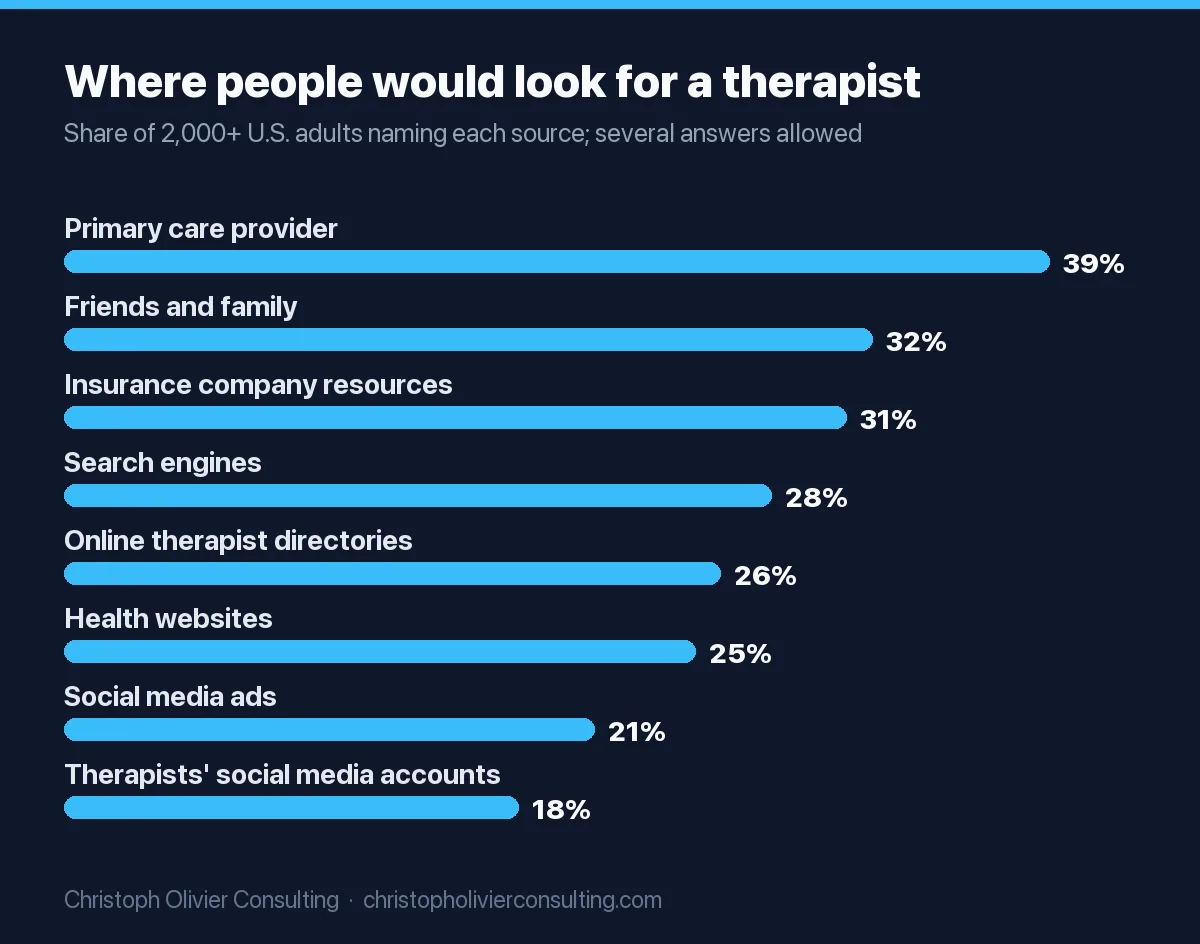
Two things follow. First, the top three sources are not ads at all: you reach them through physician relationships, word of mouth and being in network. Second, the same survey found that 95% of people say knowing their out-of-pocket cost before booking is important or very important. Whatever you publish should state your fee or the plans you take.
What each channel costs (November 2026)
List prices from each company’s own pricing or provider page. “Fits best” is my judgment, not the vendor’s claim.
| Channel | What you pay | What you get | Fits best |
|---|---|---|---|
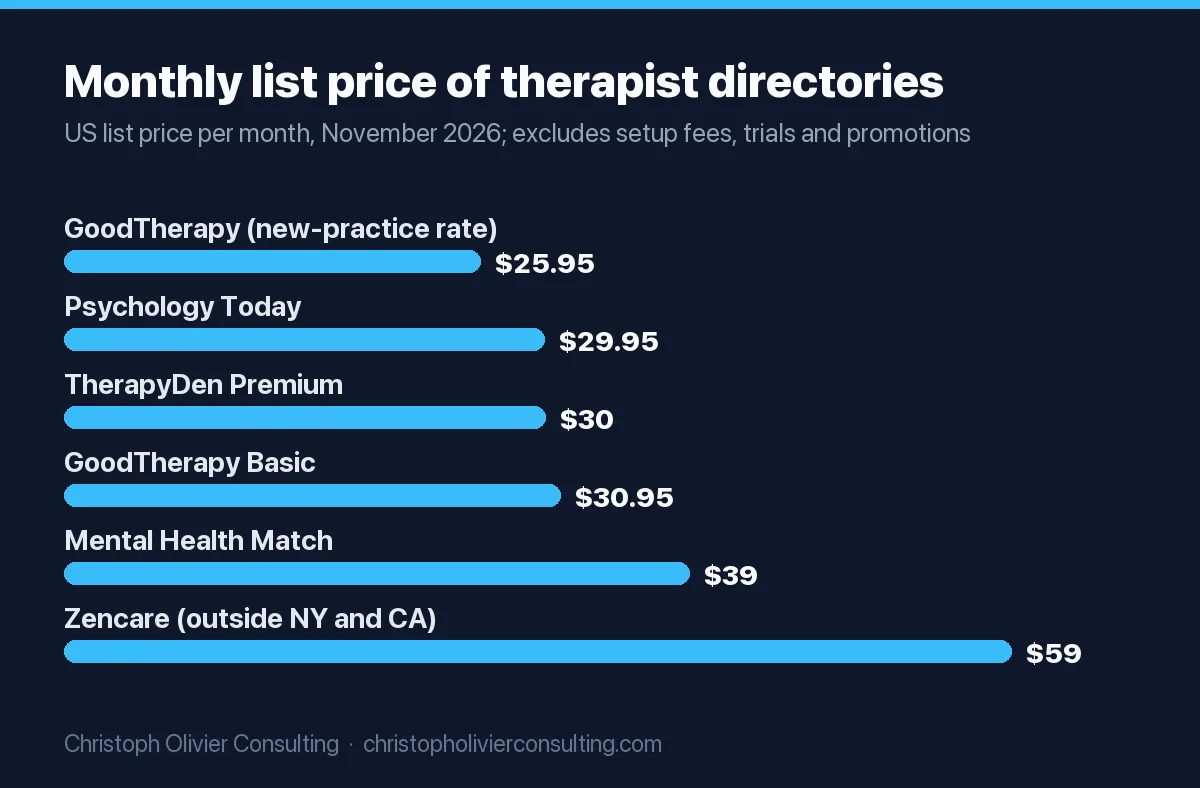
| Psychology Today | $29.95 a month, “No plans or contracts” | Directory profile, protected phone number, free teletherapy platform, a free month for each colleague who joins from your invitation | Almost every practice |
| GoodTherapy | Basic $30.95 a month; Pro $40.95 a month. Practices 3 years old or less: $25.95 a month or $310 a year for the first two years | Profile, real-time referral metrics; Pro adds unlimited CE credits and practice management (US members) | New practices that also need CE hours |
| TherapyDen | Free profile; premium $30 a month, cancel any time | Free profiles do not appear in TherapyDen search results, list only one online state and cannot list groups. Premium removes those limits | Inclusive or identity-focused niches; multi-state telehealth |
| Mental Health Match | Free for 60 days, then $39 a month or $375 a year | Directory profile after a free trial | A low-cost second directory |
| Zencare | From $59 a month plus an $80 one-time setup fee; $69 a month in NY and CA | Profile, unlimited zip code coverage, a 50-minute photo and video shoot | Private-pay clinicians in large metros |
| Insurance platforms: Alma, Headway, Rula, Grow Therapy | Alma $125 a month, or $95 a month billed at $1,140 a year, plus sales tax. Headway, Rula and Grow: no membership fee | Credentialing, billing, a listing in the platform’s client search, referrals (compared below) | In-network clinicians |
| Google Business Profile | Free | Map and local search listing | Practices with a staffed, signed office |
| Google Ads | Mental health averages: $4.22 per click, $141.17 per lead (LocaliQ) | Search ads for queries like “couples therapist [city]” | Filling specific openings once your profiles convert |
| Physician and school referrals | Your time | The source 39% of seekers name first | Every practice |
Directory math is simple. Psychology Today costs $359.40 a year. At a $150 session fee, one client who comes three times ($450) pays for the year. Zencare’s first year costs $788 ($59 times 12, plus $80 setup), so it needs about six sessions at $150. Ask yourself whether the directory will produce one new client every few months, not whether it is “worth it” in general. Psychology Today and GoodTherapy both advertise real-time referral data, so check your numbers after 90 days and cancel what produces nothing.
Which channels to start with: a decision table by practice situation
The right mix depends on who pays you. Monthly cash costs below are computed from the price table above and exclude your time.
| Your situation | Month 1 | Months 2 to 4 | Hold off on | Cash cost to start |
|---|---|---|---|---|
| Brand-new solo practice, few or no clients | Psychology Today; GoodTherapy new-practice rate; Google Business Profile if you have an office; referral email to 10 primary care practices | One specialty page on your website; follow-up visits to the practices that replied | Google Ads, paid social, agencies | $55.90 a month ($29.95 + $25.95) |
| Insurance-based (in network or want to be) | One credentialing platform (Headway, Rula or Grow); Psychology Today listing your plans; Medicare enrollment if eligible | A second platform only if the first leaves gaps by plan or state; physician referrals | Paid ads (platform referrals cost nothing) | $29.95 a month |
| Private-pay niche (couples, perinatal, a specific population) | Psychology Today with a niche-first opening; Zencare or Mental Health Match; referral outreach to the professionals your niche already sees | Google Ads on 5 to 10 niche keywords; a superbill and out-of-network explainer on your site | Insurance platforms, broad “therapist near me” ads | $68.95 a month (with Mental Health Match) to $88.95 a month (with Zencare, plus its $80 setup), before ads |
| Telehealth only, no office | Psychology Today; TherapyDen premium if you hold licenses in several states; Rula or Grow if you take insurance | Specialty pages that name every state you are licensed in | Google Business Profile (online-only businesses are ineligible) | $59.95 a month |
| Group practice filling associates’ caseloads | One profile per clinician on Psychology Today; an insurance platform for associates where allowed | Google Ads to clinician-specific pages; a referral sheet listing each clinician’s openings | Shared generic profiles that hide who the client will see | $29.95 per clinician a month |
My view: most solo therapists overspend on websites and ads in month one and underspend on the two free things that move fastest, a well-written directory opening and ten physician introductions.
Directory profiles: the opening lines do the selling
On a Psychology Today search results page, a client sees your photo, title and the first few sentences of your statement. On the Denver results page I read on November 9, 2026, previews ran up to roughly 640 characters, and the 20 previews on page one followed a pattern: none mentioned a fee, one mentioned insurance, one mentioned online sessions, three mentioned openings, and eight leaned on words like warm, empathetic, safe space, compassionate, collaborative or non-judgmental. That makes it easy to stand out by being concrete.
Use this order for the opening: who you help, what their problem looks like in their own words, how you work, where (office, video, which state), what it costs or which plans you take, and when you can see them.
Directory profile opening paragraph template
[Who you work with, specifically: age, life stage, situation]. [One or two sentences describing what it looks like day to day, in words a client would use, no diagnosis labels]. I use [one or two approaches you are trained in] to [what you work on together]. Sessions are [in my office in neighborhood/city] and [by video anywhere in state]. My fee is $[X] per [50]-minute session; [I am in network with plan A and plan B] / [I provide superbills for out-of-network reimbursement]. I have [day/time] openings [this month]. [Call/email/book] for a free [15]-minute phone consultation.
[Name], [license], licensed in [state(s)]. [Highest earned degree and field].
Filled in for a private-pay couples LMFT (an in-network clinician swaps the fee line for “I am in network with [plans]”):
Couples who keep having the same argument about chores, money or in-laws, and both leave it feeling unheard. I use the Gottman Method and Emotionally Focused Therapy to slow those arguments down and find what is underneath them. Sessions are in my office near Washington Park or by video anywhere in Colorado. My fee is $175 per 75-minute session; I provide superbills for out-of-network benefits. I have Tuesday and Thursday evening openings this month. Email me for a free 15-minute phone consultation.
Before you publish, check the opening against the ethics rules in the table further down. The usual problems are an implied guarantee (“you will feel better in six sessions”), a specialty you have not trained in (AAMFT 9.5 limits specialization claims to work you have taken “reasonable steps to ensure the competence” of), “Dr.” on a master’s-level counseling profile (ACA C.4.d), and a fee that does not match what you actually charge (APA 5.01(b) names fees among the things psychologists may not misstate). If you use a method’s name, such as Gottman Method, list only the training you have completed.
Insurance platforms: Headway, Alma, Rula and Grow compared
For insurance clients, the platforms are the cheapest advertising available: they credential you, list you in their own search and send referrals. Only Alma charges a monthly fee, and none publishes per-session rates, so you can only compare after a sales call.
| Platform | What it costs you | How you are paid | Your status | Published rates? |
|---|---|---|---|---|
| Headway | No membership fee; keeps a percentage of session payments where the contract allows | Every two weeks, “whether or not we’ve been reimbursed” | In network through Headway’s payer contracts | No. “Rates vary depending on factors like license type and insurance plan” |
| Alma | $125 a month, or $95 a month billed yearly | Insurance billed through Alma; income from cash-pay clients “stays with you” | Paying member | No |
| Rula | No fees for therapists | Every two weeks, no invoicing | 1099 independent contractor, no minimum caseload | No |
| Grow Therapy | No membership fee listed | Per session, weekly; protected from payor clawbacks | 1099 independent contractor | No. “Pay rates vary by payor, state, session type, and license type” |
Questions to ask each one before you sign: the payout for your intake session and your most common session length, by plan, in your state; whether you may also see your own private-pay clients outside the platform; who owns the client relationship if you leave; and how fast the first referrals typically arrive for your license type in your area.
One change many counselors and MFTs missed: since January 1, 2024, marriage and family therapists and mental health counselors can bill Medicare independently, paid at 75% of what a clinical psychologist receives under the Medicare Physician Fee Schedule. If your community skews older, Medicare enrollment can be a marketing decision as much as a billing one.
Google Business Profile: free, if you see clients in person
Google’s eligibility rules say a business “must make in-person contact with customers during its stated hours” and list “online-only businesses” as ineligible. A telehealth-only practice should not create one. The profile guidelines add two rules therapists trip over:
- Shared or sublet offices. You cannot list an office at a co-working space “unless that office maintains clear signage, receives customers at the location during business hours, and is staffed during business hours by your business staff.” A virtual office address is not eligible.
- Naming. A solo clinician under a practice brand uses one profile named “[brand]: [practitioner name]”. In a group, the practice gets a location profile and each public-facing clinician may have one under their own name only, never one per specialty.
Reviews are where most therapists get this channel wrong. The general advice in our guide to getting more Google reviews is built for businesses that may ask customers directly. You may not: all four codes below bar soliciting testimonials from current clients. Let reviews arrive on their own, and when you reply, never confirm that the reviewer was your client. A neutral reply such as “Thank you. We are not able to discuss anyone’s care here; please call the office if you would like to talk” works for praise and complaints alike.
Google Ads for therapists: what the health policies block and what clicks cost
You can run search ads for a therapy practice, but with fewer tools than other businesses. Google’s Health in personalized advertising policy treats “Counseling services for mental health issues like depression, anxiety” as personal health content in a sensitive interest category. Advertisers in that category cannot use advertiser-curated audiences, which Google lists as Customer Match, your data segments (remarketing), audience expansion and lookalike segments. Predefined Google audiences such as in-market, affinity and life events remain available, and users under 18 are not eligible for personalized ads of any kind.
Google’s Healthcare and medicines policy requires certification for categories such as prescription drug services, online pharmacies, telemedicine that facilitates prescribing and health insurance; talk therapy that does not prescribe is not among them. It does prohibit “promotion of speculative and/or experimental medical treatments,” so keep claims to established services.
What therapy ads cost
LocaliQ’s healthcare benchmarks, drawn from more than 3,500 healthcare campaigns and published in December 2025, put the mental health category at a $4.22 average cost per click, a 4.46% click-through rate, a 1.85% conversion rate and a $141.17 average cost per lead, the highest cost per lead of any healthcare subcategory it measured. Its CPC rose 42% and its cost per lead 146% year over year. Our broader table of Google Ads CPC benchmarks by industry puts those figures in context.
A worked example with a $600 monthly test budget. The first two lines use LocaliQ averages; the last three are your own inputs, shown with sample numbers:
- $600 at a $4.22 average CPC buys about 142 clicks.
- At the $141.17 average cost per lead, $600 buys about 4 inquiries. (Averages are calculated across many accounts, so CPC and cost per lead do not multiply out exactly.)
- If 1 of those 4 inquiries becomes a client (your consult-to-client rate)…
- …who attends 10 sessions at $150 (your fee and your average length of care)…
- …the month returns $1,500 in fees against $600 in ad spend. If none convert, you have learned that for $600.
Setup that fits the rules: target a radius around your office, bid on specific phrases (“couples therapist Denver”, “postpartum anxiety therapist”, “therapist for teens near me”), send each ad to a matching specialty page rather than your homepage, run ads only during hours someone can answer the phone, and track calls and form submissions without a third-party pixel on the form itself (see the HIPAA section). Our guide to a Google Ads budget for a small business covers how to size the test.
Getting referrals from physicians and schools
Primary care is where 39% of seekers say they would start. The professional codes aim their solicitation limits at vulnerable potential clients, not at colleagues, so a direct, professional introduction to a physician’s office is ordinary practice building. Two limits to keep in mind: ACA C.3.d says counselors “do not use their places of employment or institutional affiliation to recruit clients” for their private practices, which matters if you also work in a school or agency, and nothing in a referral relationship should involve payment or gifts in exchange for referrals.
The sequence that works: list 10 primary care, pediatric or OB practices within your service area; call each front desk and ask who handles behavioral health referrals (often a practice manager or care coordinator, not the physician); send the email below; follow up once after 10 business days; and when a referred client signs a release, send a short note back confirming the client was seen.
Physician referral outreach email
Subject: Therapy referrals for [population]: openings this month, [plans or fee]
Hi [Name],
I am a [license] in private practice at [address or “by video across state”], and I work mainly with [population, for example “adults with anxiety and panic” or “new parents in the first year after birth”]. I am writing because your patients may need someone with openings now.
The short version for your referral list:
- Who I see: [ages, issues, and one thing you do not treat, so the office can triage]
- Availability: new clients within [X] days; [days and times]
- Payment: [plans] / $[fee] with superbills / [sliding scale details]
- How to refer: patients call or email me directly at [phone] / [email]; your office can fax a referral to [fax]
- Coordination: with the patient’s written permission, I send a brief note confirming they were seen
If it is useful, I can drop off a one-page referral sheet or join a staff huddle for 10 minutes. Either way, thank you for the work you do.
[Name], [credentials]
[License number and state] | [phone] | [website]
For school counselors, cut it to three lines: the ages you see, your next opening and how a parent reaches you. Write the “how to refer” line for parents. More referral mechanics, including thank-you and follow-up habits, are in our referral marketing guide.
The ethics rules that limit therapist advertising
Each profession’s code covers the same ground: accuracy, testimonials and solicitation. Quotes are from each organization’s current published code. Your state licensing board’s rules apply on top of these.
| Code and standard | What it says | What it means for your ads |
|---|---|---|
| APA 5.01 (psychologists) | Public statements include “paid or unpaid advertising” and “directory listings”; no false or deceptive statements about credentials, services, “results or degree of success,” or “their fees” | Your directory profile counts. No outcome promises; fees as charged |
| APA 5.02(c) | “A paid advertisement relating to psychologists’ activities must be identified or clearly recognizable as such.” | Sponsored posts and paid placements must be labeled |
| APA 5.04 | Public advice must “not indicate that a professional relationship has been established” | No individualized advice in social comments |
| APA 5.05 | “Psychologists do not solicit testimonials from current therapy clients/patients or other persons who because of their particular circumstances are vulnerable to undue influence.” | Do not ask current clients for reviews |
| APA 5.06 | No “uninvited in-person solicitation of business” from people vulnerable to undue influence; “community outreach services” are not barred | Give the community talk; do not approach individuals afterward to sell sessions |
| ACA C.3.a (counselors) | Counselors identify their credentials “in an accurate manner that is not false, misleading, deceptive, or fraudulent” | License type and state on every profile |
| ACA C.3.b | Counselors “do not solicit them from current clients, former clients, or any other persons who may be vulnerable to undue influence,” and “obtain permission for the use of any testimonial” | Stricter than APA: former clients are covered too |
| ACA C.3.d | Counselors “do not use their places of employment or institutional affiliation to recruit clients” | No recruiting from your agency or school job |
| NASW 4.06(c) (social workers) | Representations of “credentials, education, competence, affiliations, services provided, or results to be achieved are accurate” | No “results to be achieved” claims you cannot support |
| NASW 4.07(a) and (b) | No soliciting testimonial endorsements, “including solicitation of consent to use a client’s prior statement,” from current clients or vulnerable people; no “uninvited solicitation” of vulnerable potential clients | You cannot ask a current client whether you may quote their thank-you card |
| AAMFT 9.1 (MFTs, code effective January 1, 2026) | MFTs “accurately represent their affiliations, licensure, supervision status, educational degrees, competencies, training, and experience” | Associates and pre-licensed clinicians state their supervision status |
| AAMFT 9.2 | Ads must be “true, accurate, and comply with applicable law”; MFTs “do not solicit testimonials or endorsements from current clients” or vulnerable persons | Same testimonial limit, now written into the advertising standard |
| AAMFT 9.5 | MFTs represent themselves as providing specialized services “only after taking reasonable steps to ensure the competence of their work” | “Specializing in” needs training behind it |
HIPAA rules on marketing and retargeting pixels
First, check whether HIPAA applies to you. CMS explains that health care providers are covered entities if they submit HIPAA transactions, like claims, electronically. If you bill insurance or a platform bills for you, assume you are covered. A cash-only therapist who never submits electronic transactions may fall outside HIPAA, but not outside your ethics code’s confidentiality duties or the FTC Act: the FTC ordered BetterHelp to pay $7.8 million in 2023 and banned it from sharing health data for advertising and personal information for re-targeting, after alleging it passed email addresses, IP addresses and health questionnaire answers to Facebook, Snapchat, Criteo and Pinterest.
The marketing rule
HIPAA defines marketing as “a communication about a product or service that encourages recipients of the communication to purchase or use the product or service,” and 45 CFR 164.508(a)(3) requires a client’s authorization for any use or disclosure of protected health information for marketing, except face-to-face communication or “a promotional gift of nominal value.” The definition excludes communications describing a health-related service you provide yourself, unless a third party pays you to send them. In practice:
- Emailing your own clients about a new group you run is not marketing under the definition.
- Uploading your client list to an ad platform to target them with ads is a disclosure of PHI for marketing. It needs authorizations, and Google bans Customer Match for counseling services anyway.
- Promoting a third party’s product to clients in exchange for payment is marketing with remuneration, and the authorization must say so.
Tracking pixels after the 2024 court ruling
HHS’s online tracking technologies bulletin still says “disclosures of PHI to tracking technology vendors for marketing purposes, without individuals’ HIPAA-compliant authorizations, would constitute impermissible disclosures.” On June 20, 2024, in American Hospital Association v. Becerra, a federal court in the Northern District of Texas vacated one part of that guidance: the idea that HIPAA is triggered when a tracker connects an IP address with a visit to a public, unauthenticated page about health conditions or providers. HHS withdrew its appeal on August 29, 2024, and the bulletin still carries a note that HHS “is evaluating its next steps.”
What survived matters more for a therapy website: trackers on a page where people book appointments can still collect PHI, such as an email address or the reason for seeking care; cookie banners “do not constitute a valid HIPAA authorization”; and a vendor that receives PHI needs a BAA, with a promise to strip PHI afterward not enough. The practical rules:
- Keep the Meta pixel, Google Ads remarketing tags and similar scripts off any page where someone enters a name, email, phone number or reason for reaching out: contact forms, booking pages, intake and client portal login.
- Before installing any analytics or ad tag, ask the vendor in writing whether it will sign a BAA. If it will not, it does not go on those pages.
- Count inquiries inside your HIPAA-compliant scheduling or EHR system, and compare monthly totals with your ad spend by hand if needed.
- Do not build retargeting audiences from visitors to your specialty pages. Google blocks it for counseling services, and the FTC’s BetterHelp order bans sharing personal information for re-targeting.
Free marketing for therapists: what actually costs nothing
The video above comes from TherapyDen’s own channel and walks through attracting clients from Psychology Today, GoodTherapy and TherapyDen. It is several years old, so use the prices in this guide, not any mentioned in the video.
“Free” means no cash, not no time. Besides a Google Business Profile (in-person offices only):
- TherapyDen free profile: gives you a shareable profile link that can appear in Google, but it does not appear in TherapyDen’s own search results.
- Mental Health Match: free for the first 60 days, then $39 a month. Put a cancel reminder in your calendar.
- Headway, Rula and Grow: no fee to join if you take insurance.
- Physician and school outreach: the email above, sent to 10 practices, costs one afternoon.
- Community talks: a free workshop at a library, employer or parent group is the kind of community outreach APA 5.06 does not bar. Hand out a card with your website; do not pitch individuals afterward.
If you would like a second set of eyes on your channel mix or profile copy before you spend on ads, you can book a consultation.
Ready to scale your revenue?
Book a free 30-min consultation. We’ll diagnose your growth bottleneck and map out the 3 highest-leverage moves for your business.
Frequently asked questions
How do I advertise myself as a therapist?
Start where people look first: physician referrals, a Psychology Today profile ($29.95 a month), a second directory that fits your niche, and a free Google Business Profile if you see clients in an office. If you take insurance, join Headway, Rula or Grow, which charge no membership fee. Add Google Ads only once your profiles convert, and keep every ad accurate under your ethics code.
How do you get clients as a new therapist in private practice?
In month one, publish a Psychology Today profile whose opening states who you help, your fee or plans and your openings, add GoodTherapy's new-practice rate ($25.95 a month), and email 10 nearby primary care practices with your availability. That costs about $56 a month. In a 2025 Thriveworks survey, 39% of people said they would ask their primary care provider first.
Is Psychology Today worth it for therapists?
For most practices, yes, because the math is forgiving. The profile costs $29.95 a month, or $359.40 a year, with no contract. At a $150 session fee, one client who attends three sessions covers the year. Check the referral data in your account after 90 days and rewrite the opening lines before you decide to cancel.
Can therapists use Google Ads?
Yes. Talk therapy that does not prescribe needs no special Google healthcare certification. But Google classes counseling for issues like depression and anxiety as personal health content, so you cannot use remarketing, Customer Match or lookalike audiences. LocaliQ's latest benchmark put mental health at $4.22 per click and $141.17 per lead on average, so test with a small, capped budget.
Can therapists ask clients for reviews or testimonials?
Not current clients. APA 5.05, ACA C.3.b, NASW 4.07(b) and AAMFT 9.2 all bar soliciting testimonials from current clients or other people vulnerable to undue influence, and ACA extends that to former clients. Let reviews arrive on their own, and when you reply, never confirm that the reviewer was your client.
What free marketing can therapists do?
A Google Business Profile (in-person offices only), a free TherapyDen profile link (it does not appear in TherapyDen's own search), Mental Health Match's 60-day free trial, insurance platforms with no joining fee, outreach emails to physicians and schools, and free community talks. Each costs time rather than cash.
Is the Meta or Google pixel HIPAA compliant on a therapy website?
Not on pages where people enter names, emails or reasons for seeking care, unless the vendor signs a business associate agreement. HHS guidance says cookie banners are not a HIPAA authorization. A 2024 court ruling narrowed the guidance for public pages, but booking and contact pages remain risky, and Google bars remarketing for counseling services anyway.