

The marketing ideas that work for massage therapists come in three groups: ones that bring in new clients (your Google Business Profile category, referral partners, corporate chair days), ones that bring clients back (rebooking at checkout, reminders, waitlists), and ones that raise what each client spends (memberships, packages, gift cards). For most solo practices, getting clients back pays the most. AMTA’s July 2025 consumer survey found the average massage client received 2.7 massages in the past 12 months, so a client who books monthly is worth more than four average clients.
Below, all 18 ideas are scored by cost, time to results and effort. You also get the advertising rules that apply to massage in five states, the Google and Meta ad policies, current prices for four booking platforms, a rebooking calculation with the math shown, a checkout script, a pitch for referral partners and a 12-month calendar.
Short answer: Start with three free moves: set your Google Business Profile primary category to Massage therapist, ask every client to rebook before they leave the room, and pitch two local chiropractors or physical therapists. With 20 new clients a month at $100 a visit, raising your rebooking rate from 40% to 50% adds about 80 visits, or $8,000 in revenue, from one year of new clients. Before you run any ad, check whether your state requires your license number in it. Florida, Washington, Illinois and Georgia do.
18 massage marketing ideas, scored by cost, time and effort
Costs come from the vendor pages cited later in this article. “Time to first results” and “Effort” are my own estimates for a solo therapist already licensed and taking bookings. Treat them as a starting order, not a promise. Score: 5 = do it this month, 1 = do it last.
| # | Idea | Goal | Cash cost | Time to first results | Effort | Score |
|---|---|---|---|---|---|---|
| 1 | Ask every client to rebook at checkout (script below) | Rebooking | $0 | Same day | Low | 5 |
| 2 | Set the right Google Business Profile primary category | New clients | $0 | 2 to 8 weeks | Low | 5 |
| 3 | Automated text and email reminders | Rebooking | $0 on Square Free; included in Vagaro ($30/mo); MassageBook Practice ($59/mo) | First week | Low | 5 |
| 4 | Ask for a Google review after the second visit | New clients | $0 | 1 to 3 months | Low | 4 |
| 5 | Referral partners: chiropractors, PTs, gyms | New clients | $0 to printing costs | 1 to 3 months | Medium | 4 |
| 6 | Cancellation waitlist | Rebooking | Square Plus $49/mo; Vagaro included; MassageBook Clinic $99/mo | First week | Low | 4 |
| 7 | Monthly membership | Higher ticket | $0 on platforms that include it | 1 to 3 months | Medium | 4 |
| 8 | Prepaid packages (3 or 5 sessions) | Higher ticket | $0 | Same week | Low | 4 |
| 9 | Gift cards plus a promotional bonus card | Higher ticket | 2.5% load fee on Square Free and Plus; Vagaro online cart $10/mo | Seasonal peaks | Low | 4 |
| 10 | Win-back text when a client is overdue | Rebooking | $0 to text add-on (Vagaro text marketing from $20/mo) | 2 to 4 weeks | Low | 4 |
| 11 | Directory and marketplace listings | New clients | AMTA locator free for members; Mindbody app fee 20% of first purchase, capped at $30 | 2 to 6 weeks | Low | 3 |
| 12 | Corporate chair massage days | New clients | Your time and a chair | 1 to 2 months | High | 3 |
| 13 | Google Search ads, judged by booked visits | New clients | Budget you set | Days | Medium | 3 |
| 14 | Client referral reward (check your state first) | New clients | Cost of the reward | 1 to 3 months | Low | 3 |
| 15 | Social content built around why people book | New clients | $0 | 3 to 6 months | High | 3 |
| 16 | Facebook and Instagram ads with a first-visit offer | New clients | Budget you set | Days to weeks | Medium | 2 |
| 17 | Race expos and community event booths | New clients | Booth fee | Event day | High | 2 |
| 18 | Seasonal campaigns from a 12-month calendar | All three | $0 | Each season | Medium | 3 |
Before you advertise: license numbers and platform rules
This is the part the software-vendor idea lists skip, and it applies to every flyer, Instagram bio and Google ad you run. Several states require your license number in every advertisement, and some define “advertisement” broadly enough to cover a business card or a social profile. Here are five, quoted from the statute or board rule itself.
| State | Rule | What it requires |
|---|---|---|
| Florida | Fla. Stat. 480.0465 | License number “in any advertisement of massage therapy services appearing in any advertising medium,” including the Internet. Ads must also show the establishment’s physical address and the phone number given to the department (waived only for owners with more than five Florida locations). No ads on any website “known for advertising prostitution services, escort services, or sexual services.” |
| Washington | RCW 18.108.040(1)(c) | “A massage therapist’s name and license number must conspicuously appear on all of the massage therapist’s advertisements.” Only licensees may use “licensed massage therapist” or “L.M.T.” |
| Illinois | 225 ILCS 57/50 | “A massage therapist shall include the current license number issued by the Department on all advertisements.” Advertising covers cards, signs, vehicle markings and directory listings. Advertising massage without a license is a misdemeanor. The section is currently scheduled for repeal on January 1, 2032. |
| Georgia | Ga. Comp. R. & Regs. 345-10-.03 | License number “on all forms of advertisement.” Establishments with more than one therapist must add the statement “Georgia Licensed Massage Therapists.” No advertising in conjunction with adult entertainment, escort or dating services. |
| Texas | 16 Tex. Admin. Code 117.93 | If you advertise under an assumed name, each ad must carry your full legal name or license number; establishments must show their license number with their name. No false, misleading or not readily verifiable advertising, including unrealistic expectations of treatment results and false claims about insurance coverage. |
The practical fix takes ten minutes: put “Jane Smith, LMT, License #XXXX” in your Instagram bio, Facebook page, Google Business Profile description, website footer, business card and every ad template. If you are not in one of these five states, look up your own board’s advertising rule before you print anything.
How Google, Meta and Craigslist treat massage ads
- Google Ads. Google’s sexual content policy lists “Content that focuses on non-sexual massage or therapeutic touch” as an allowed example. Keep ad text and images clinical: the condition, the technique, the session length, your license.
- Meta (Facebook and Instagram). Meta’s ad standard on adult sexual solicitation says ads must not facilitate “commercial sexual services between adults,” and ads can’t “Contain content discussing sexual practices or experiences, even without sexual solicitation.” Ads must also comply with Meta’s separate Health and Wellness advertising standard.
- Craigslist. Craigslist shut its Therapeutic Services section in April 2018, shortly after Congress passed FOSTA-SESTA (H.R. 1865). One therapist said in a sworn declaration that he had found about 90 percent of his clients there and was then blocked from reposting in Skilled Services. The New York services menu now shows a “health/well” category. In Florida, posting on any site “known for” sex ads is itself a violation, so classified boards with that reputation are a legal risk, not just a brand one.
Ideas that bring in new clients
Demand is there. AMTA’s 2026 industry fact sheet reports that 23% of men and 19% of women received a massage in the last year. So is competition: the Bureau of Labor Statistics counts 155,400 massage therapist jobs in 2025, projects 15% growth to 2035, and says 36% are self-employed. These six ideas get you found by the people already looking.
Choose the right Google Business Profile category
In Whitespark’s 2026 Local Search Ranking Factors survey, 47 local search experts scored 187 factors, and the primary category ranked first. Additional categories ranked eighth, and you can add up to nine of them, according to Whitespark’s category guide. Typing “massage” into the category box returns options including Massage therapist, Massage spa, and Thai and sports massage categories, per MASSAGE Magazine’s setup walkthrough, whose author advises solo therapists who chose Massage spa to reconsider if they do not offer spa services.
Three rules from Google’s own Business Profile guidelines that massage therapists break most often:
- Category. Use “as few categories as possible” and do not use categories “solely as keywords.” Pick Massage therapist as primary if massage is what you do; add a sports massage category only if you actually offer sports work.
- Name. Your profile name must match your real-world name. “Including unnecessary information in your business name isn’t permitted, and could result in the suspension of your Business Profile.” “Jane Smith Massage” is fine; “Jane Smith Massage | Deep Tissue Austin” is not.
- Address. If you are mobile and serve clients at their homes, you are a service-area business: set a service area and clear your home address from the profile.
Then get reviews. Ask after the second visit, when the client has decided they like you, with a direct link to your review form. Our guide on how to get more Google reviews covers the wording and Google’s rules on incentives.
Directory and marketplace listings
Each booking platform runs a consumer marketplace, and the costs differ more than the listings do. AMTA members get a free profile on AMTA’s Find a Massage Therapist national locator. MassageBook includes a directory listing in its $29 Launch plan. Vagaro includes a free marketplace listing on every plan. Mindbody’s app listing is free, but when the app delivers a client you would not otherwise have had, Mindbody charges 20% of that first purchase, capped at $30, per its pricing page. At a 50% rebooking rate a new client is worth about $200 in visits (see the math below), so a $30 cap is a cheap acquisition cost if the client rebooks.
Referral partners: chiropractors, PTs and gyms
Healthcare referrals are the clearest data point in AMTA’s research. Per the 2026 fact sheet, 74% of massage therapists receive referrals from other massage therapists, 64% from other healthcare professionals and 60% from chiropractic offices. On the consumer side, of people who discussed massage with their doctor, 22% were referred to a massage therapist, per AMTA’s 2025 consumer survey.
Three ways to make a partnership stick:
- Swap capacity, not cash. Other therapists who are booked out are your top referral source. Tell three colleagues which days you have openings and which techniques you cover that they do not.
- Make the referral easy. Give the partner a short stack of cards with your booking link as a QR code and the conditions you work with. The chiropractic and physical therapy practices you pitch run their own patient-acquisition math, so frame massage as something that helps their patients stick with a care plan.
- Do not pay per referral without checking the law. In Florida, massage therapists are “health care practitioners” under s. 456.001, and s. 456.054 makes it unlawful to “offer, pay, solicit, or receive a kickback, directly or indirectly, overtly or covertly, in cash or in kind, for referring or soliciting patients.” The statute defines a kickback as a payment “to any person” for referrals, with an exception for payments that are tax deductible as an ordinary and necessary business expense, so whether a client “refer a friend, get $20” credit counts is not obvious. Ask your board or a health-care attorney before you launch either kind of program.
Copy-ready referral partner pitch
Subject: A massage option for your [low back / post-injury / prenatal] patients
Hi Dr. [Name],
I’m [Your name], a licensed massage therapist (License #[number]) at [address], about [X] minutes from your office. I focus on [two specific things, e.g. low back pain and post-surgical scar tissue], and I already see clients who are under chiropractic or PT care.
Two things I can offer your patients:
1. Openings within 5 business days for anyone you send, with a [30-minute / 60-minute] first session.
2. A short written summary back to you after the first visit, if the patient signs a release, so you know what I found and what we worked on.
I’m not asking for anything in return beyond the chance to be on your list. Could I drop off a few referral cards and take 10 minutes to show you how I work? I’m free [day] or [day] at lunch.
[Name], LMT #[number]
[Phone] · [Booking link]
Corporate chair massage days
Chair days are a sampling channel: one employer, many potential clients, one booking page. The math is simple. At 15-minute slots you see four people an hour, so a three-hour block reaches about 12 employees. Charge the employer your normal hourly rate for your time, and give every person a card with a QR code to a first full session. Count the event as a success only by the number of full sessions booked in the next 30 days. If you are in Florida, Illinois, Washington or Georgia, that card is an advertisement and needs your license number.
Google Search ads, judged by booked visits
Search ads reach people typing “massage near me” or “deep tissue massage [city],” which is the highest-intent traffic you can buy. The trap is measuring clicks. Connect your booking software to your ads account or count bookings by source, and judge the campaign on cost per booked first visit against what a client is worth to you. Keep the copy clinical so it stays inside Google’s policy above.
Social media marketing for massage therapists: post about why clients book
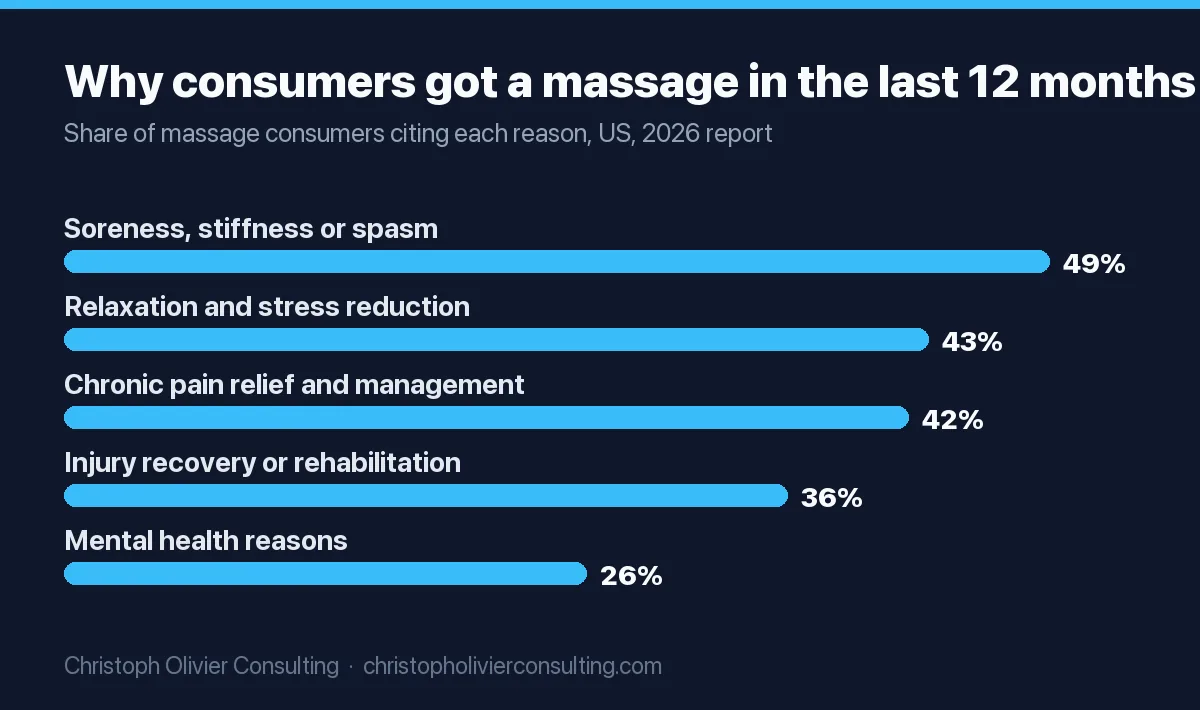
Most massage social feeds show candles and stones. AMTA’s data says clients book for specific problems. Per the 2026 fact sheet, the top reasons for a massage in the last 12 months were soreness, stiffness or spasm (49%), relaxation and stress reduction (43%), chronic pain relief and management (42%), injury recovery or rehabilitation (36%) and mental health reasons (26%). Build your content pillars from that list.
- Soreness and stiffness: a 30-second desk stretch for the exact muscle you work on most, ending with “if this doesn’t release it, that’s what a session is for.”
- Chronic pain: what a first session for low back pain looks like, step by step, so a nervous first-timer knows what to expect.
- Injury recovery: how you coordinate with a client’s chiropractor or PT (with no patient details).
- Stress: your room, your music, your intake process, shot in daylight. Clinical and calm, never suggestive.
Two settings matter more than posting frequency. First, put your license number in your bio if your state requires it in ads. Second, connect a “Book” button to your scheduler: Vagaro lists booking on Instagram and Facebook as included, and MassageBook lists a Facebook and Instagram integration. Paid social follows the same Meta policy covered above. For ad formats that work for local service businesses, see our salon marketing playbook, which deals with the same booking and rebooking mechanics.
Ideas that bring clients back (rebooking)
Rebooking is where a solo practice wins or loses. Here is what a 10-point change in your rebooking rate is worth, with the assumptions shown so you can swap in your own numbers.
The rebooking math, worked through
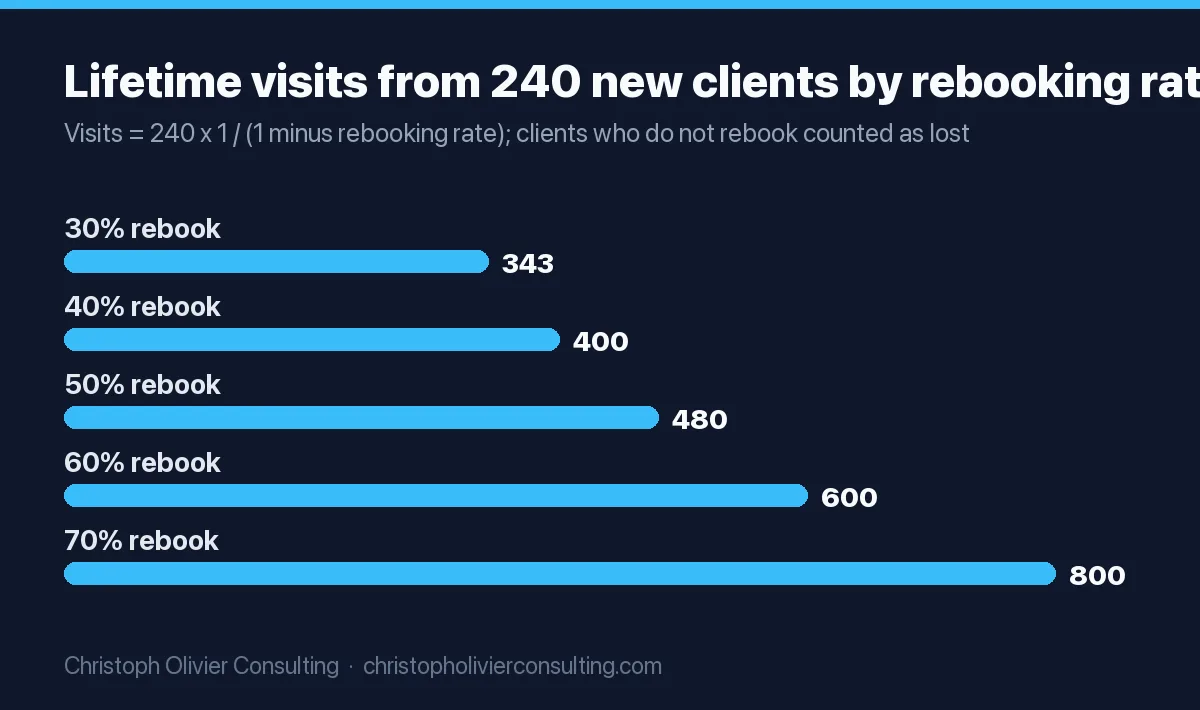
Assumptions: 20 new clients a month (240 a year) and $100 per visit. Each time a client checks out, they either rebook or they don’t, and a client who doesn’t rebook at checkout is counted as gone. That last assumption is conservative, because some return later on their own. Under those rules, the expected number of visits per new client is 1 divided by (1 minus the rebooking rate).
| Rebooking rate at checkout | Visits per new client | Visits from one year of new clients (240) | Revenue at $100 a visit | Gain vs. 10 points lower |
|---|---|---|---|---|
| 30% | 1.43 | 343 | $34,286 | n/a |
| 40% | 1.67 | 400 | $40,000 | +$5,714 |
| 50% | 2.00 | 480 | $48,000 | +$8,000 |
| 60% | 2.50 | 600 | $60,000 | +$12,000 |
| 70% | 3.33 | 800 | $80,000 | +$20,000 |
Two things jump out. Each 10-point gain is worth more than the last, because a rebooked client keeps getting chances to rebook again. And moving from 40% to 50% is worth as much as finding 48 extra new clients a year at the 40% rate (480 visits minus 400, divided by 1.67 visits each). That is why the checkout script below comes before any ad spend. Our customer lifetime value guide shows how to run the same calculation with gross margin instead of revenue.
The rebooking script at checkout
Ask before the client leaves the table area, while the result is fresh, and offer two specific times instead of an open question.
You: “How does your [shoulder / low back] feel compared to when you came in?”
Client: “Much better.”
You: “Good. That [muscle group] was holding a lot, and it usually tightens back up within [2 to 4] weeks for someone who [sits at a desk / runs / lifts]. To keep the progress, I’d see you in [3] weeks. I have [Tuesday the 14th at 5:30] or [Thursday the 16th at 12:00]. Which works better?”
If they hesitate: “No problem. Want me to hold the Tuesday slot, and you can cancel by text up to 24 hours before if it doesn’t work?”
If they say no: “Totally fine. I’ll text you in [3] weeks with a couple of openings so you don’t have to remember.”
Then do what you said: the “no” clients go on a reminder list. Track one number weekly: rebooked at checkout divided by checkouts.
Reminders, waitlists and win-back texts
- Reminders. Square Appointments includes appointment reminders on its free plan; Vagaro includes unlimited notifications and reminders on every plan; MassageBook adds text and email reminders on its $59 Practice plan.
- Waitlist and no-show fees. Square puts its waitlist and cancellation and no-show fees on Square Plus ($49 a month per location). MassageBook puts waitlists on Clinic ($99). Vagaro includes customer waitlist options. A waitlist turns a same-day cancellation into a filled slot instead of lost revenue.
- Win-back. Set a trigger at 1.5 times each client’s usual interval (a monthly client who hits six weeks gets a text). Keep it short: “Hi [Name], it’s [You] at [Studio]. I have two openings next week, [day/time] and [day/time]. Want one?” If you plan to send promotional texts in bulk, compare tools in our SMS marketing platforms review.
Ideas that raise the average ticket
Monthly memberships
A membership turns the 2.7-visit average client into a 12-visit client. The design that works for most solo therapists: one 60-minute session per month at a price below your drop-in rate, unused sessions roll over for one month only, and members get first pick of evening slots. Price it so 12 months of membership revenue covers your time at a rate you are happy with, then compare it with a drop-in client: 12 member visits at $90 is $1,080 a year, while an average client at 2.7 visits of $100 is $270. Vagaro includes memberships on every plan; MassageBook lists monthly membership management. Our loyalty program guide covers how to keep perks from eating your margin.
Prepaid packages
Offer 3-packs and 5-packs at the checkout moment, right after the rebooking question, for clients who will not commit to a monthly charge. A small discount (one session’s worth of savings spread across five, at most) is enough. Packages also improve rebooking, because a client with sessions paid for has a reason to book the next one.
Gift cards and promotional bonus cards
Gift cards bring in buyers who are not your clients, and their recipients are new clients you did not pay to acquire. Two federal rules shape the offer, under Regulation E 12 CFR 1005.20:
- A gift certificate’s funds cannot expire sooner than five years after it was issued, and inactivity fees are allowed only after a year without use, at most one per month. Your state’s law may be stricter.
- Loyalty, award and promotional cards are excluded from those rules if the front says the card is “issued for loyalty, award, or promotional purposes.”
That second rule makes the classic holiday offer work: sell a $100 gift card at face value, and add a separate $20 bonus card marked as promotional, valid for a set window you choose, such as your slowest months. Check fees before you pick a tool: Square charges a 2.5% load fee on gift cards on its Free and Plus plans and none on Premium, Vagaro’s online shopping cart for selling gift cards online is $10 a month, and MassageBook’s gift certificates start on the Practice plan.
Booking software costs for massage therapists (2026 prices)
Most of the ideas above run through your booking system, so the plan you are on decides which ones you can use. Prices are from each vendor’s US pricing page, read in November 2026.
| Platform | Plans and monthly price | Card processing | Marketing features that matter here |
|---|---|---|---|
| MassageBook | Launch $29, Practice $59, Clinic $99. AMTA members get 25% off, ABMP members 10% off. 30-day free trial | 2.6% + $0.15 per in-person transaction via Stripe or Square | Launch: directory listing, review collection, limit of 3 services. Practice: reminders, intake forms, gift certificates, automated campaigns. Clinic: unlimited staff, rooms, couples bookings, waitlists |
| Vagaro | $30 for one calendar (“Just Me”), shown at $23.99 for the first 6 months; each added calendar $10, up to seven | Not listed on the pricing page | Included: memberships, packages, gift certificates, waitlist, unlimited reminders, 1,000 free emails a month, marketplace listing. Add-ons: text marketing from $20, forms $10, online shopping cart $10, MySite website $20 |
| Square Appointments | Free $0, Plus $49, Premium $149 (per location) | In person: 2.6% + 15¢ (Free), 2.5% + 15¢ (Plus), 2.4% + 15¢ (Premium). Online: 3.3% + 30¢ (Free), 2.9% + 30¢ (Plus, Premium) | Free: online booking site, reminders, unlimited staff calendars. Plus: cancellation and no-show fees, waitlist. Gift card load fee 2.5% on Free and Plus |
| Mindbody | Starter from $79 per location; Accelerate and Ultimate by quote | A rate plus a fixed $0.10 to $0.30 per transaction, varying by payment type | App listing; new-client fee 20% of first purchase, capped at $30. Text reminders from Accelerate; automated email and text marketing on Ultimate |
For a solo therapist starting out, the cheapest route to reminders plus a waitlist is either Vagaro at $30 or Square Plus at $49. If you are an AMTA member, MassageBook Practice at its member price ($44.25) adds gift certificates and automated campaigns built for massage.
A 12-month massage marketing calendar
Holiday dates matter for gift cards: Mother’s Day is the second Sunday in May (May 10, 2026 and May 9, 2027) and Father’s Day the third Sunday in June (June 21, 2026 and June 20, 2027). Start gift card promotion about three weeks before each.
| Month | Hook | Offer or action | Channel |
|---|---|---|---|
| January | New Year health goals; holiday gift cards waiting to be used | Remind gift card holders to book; launch memberships | Email, text |
| February | Valentine’s Day | Gift cards; couples sessions if you have the room | Instagram, Google Business Profile post |
| March | Spring training for runners and recreational sports | Pitch running clubs and gyms; sports massage content | Partner outreach |
| April | Mother’s Day lead-in | Gift card promotion starts mid-April | Email to past clients |
| May | Mother’s Day | Gift cards plus promotional bonus card | Email, social, front desk |
| June | Father’s Day; summer schedules | Gift cards; summer evening slots for members | Email, text |
| July | Yard work, travel, summer sports | Soreness and recovery content | Social |
| August | Back to school; consumers with children under 18 at home are 10% more likely to get a massage, per AMTA’s 2026 fact sheet | Weekday daytime “parent hours” | Social, email |
| September | Employers plan next year’s wellness budgets | Pitch corporate chair days | Email and LinkedIn to HR |
| October | Fall race season | Race expo booth or post-race recovery offer | Events, partners |
| November | Holiday gift buying begins | Gift card sale with bonus card | Email, social, Google Business Profile post |
| December | Last-minute gifts; year-end corporate gifting | Digital gift cards; bulk gift cards for employers | Email, text |
A 90-day marketing strategy for a massage therapist
If you only have a few hours a week, do the ideas in this order. Each step builds on the one before it.
- Week 1: compliance and profile. Add your license number to every bio, card and template. Set your Google Business Profile primary category, fix the name, set a service area if you are mobile.
- Week 2: booking system. Turn on reminders, a waitlist and an online booking link in every profile. Start tracking rebooked-at-checkout rate.
- Weeks 3 and 4: rebooking script. Use it on every client. Add the review request for second-visit clients.
- Month 2: referral partners. Send the pitch to five chiropractors, physical therapists or gyms within 15 minutes of you. Follow up in person with cards.
- Month 2: one corporate pitch. Offer a single three-hour chair day to one local employer.
- Month 3: higher ticket. Launch a membership and a 5-pack. Put the next gift card season on the calendar.
- Month 3: paid ads, only now. With rebooking working, every paid new client is worth more, so test a small Google Search budget and judge it by booked first visits.
If you run a multi-therapist studio and want a second pair of eyes on the numbers before you spend on ads, you can book a consultation.
Ready to scale your revenue?
Book a free 30-min consultation. We’ll diagnose your growth bottleneck and map out the 3 highest-leverage moves for your business.
Frequently asked questions
What are the best marketing ideas for massage therapists?
Start with the free ones that compound: ask every client to rebook at checkout, set your Google Business Profile primary category to Massage therapist, request reviews after the second visit, and pitch nearby chiropractors and physical therapists. Then add memberships, packages and gift cards to raise what each client spends. Paid ads come last, once rebooking works, because every paid new client is then worth more.
How do massage therapists get more clients fast?
The fastest new bookings usually come from people already looking: a correct Google Business Profile, a booking button on every profile, marketplace listings such as Vagaro or Mindbody, and Google Search ads judged by booked first visits. Referral partners take one to three months but send clients with a reason to come back. Healthcare referrals are common: AMTA reports 64% of therapists get referrals from other healthcare professionals.
Does social media marketing work for massage therapists?
It works best as proof, not as the main source of new clients. Post about the problems people book for: AMTA's 2026 fact sheet lists soreness or stiffness (49%), relaxation and stress (43%), chronic pain (42%) and injury recovery (36%). Add a booking button, keep content clinical to stay inside Meta's ad rules, and put your license number in your bio if your state requires it in ads.
Do massage therapists have to put their license number on ads?
In several states, yes. Florida statute 480.0465 requires the license number in any advertisement in any medium, including the Internet, plus the establishment address and phone. Washington, Illinois and Georgia require it on all advertisements, and Texas requires your legal name or license number when you advertise under an assumed name. Check your own state board's advertising rule before printing cards or running ads.
How do I get massage clients to rebook?
Ask before they leave the treatment area, tie the next visit to what you found in the session, and offer two specific times instead of an open question. If they say no, promise a text with openings in a few weeks and send it. Track rebooked at checkout divided by checkouts every week. In a 240 new client year at $100 a visit, going from 40% to 50% adds about $8,000.
How much does massage booking software cost?
As of November 2026: MassageBook runs $29, $59 or $99 a month, with 25% off for AMTA members. Vagaro is $30 a month for one calendar plus $10 per added calendar. Square Appointments has a free plan, Plus at $49 and Premium at $149 per location. Mindbody Starter begins at $79 a month per location. Card processing is charged on top of each.
Can a massage therapist pay a chiropractor for referrals?
Be careful. In Florida, massage therapists are health care practitioners, and statute 456.054 makes it unlawful to offer or pay a kickback in cash or in kind for referring patients. Other states have their own fee-splitting rules. Build partnerships on fast access, a short written summary back to the referrer and mutual referrals instead, and ask your board or a health-care attorney before paying anyone per referral.