

There is no audited industry average for how much plastic surgeons spend on marketing, so the useful number is what one new surgical patient costs you. In a 74-practice panel published in November 2026, a marketing-sourced surgical patient cost $874 through SEO, $1,573 through Meta ads and $1,848 through Google Ads, all-in. Multiply that by the patients you need: a solo surgeon who wants 6 new surgical patients a month from marketing should plan on roughly $6,200 to $7,250 a month, and a 3-surgeon group in a top-10 metro can pass $60,000.
Short answer: Budget from patients, not from a percentage. Take the number of new surgical patients you want each month, multiply by your cost per booked patient (about $874 to $1,848 by channel in 2026 agency panel data), and check the result against the surgeon fee: at ASPS fee midpoints, acquisition costs about 14% to 28% of the fee depending on the procedure. For most solo practices that lands between $6,000 and $17,000 a month.
This page is the budget math. The wider growth plan (content, ad policy, consult conversion) lives in our plastic surgery marketing playbook; here you get the sourced unit costs, a worked cost-per-patient example, budgets for three practice sizes, a copy-ready monthly sheet, a 5-line ROI formula and the advertising rules that limit where the money can go.
How much do plastic surgeons spend on marketing? What the published numbers rest on
Neither of the two specialty societies publishes practice marketing spend. The ASPS 2025 Procedural Statistics Report, released September 1, 2026, counts procedures, regions, ages and patient motivations. The Aesthetic Society’s statistics page lists 2023 as its latest annual report, and that report also covers procedure volumes, not budgets. Every percentage you see quoted comes from somewhere else:
| Figure you will see quoted | Where it actually comes from | Sample | Specific to plastic surgery? |
|---|---|---|---|
| 7% to 8% of revenue | A 2012 SBA community blog post by a community moderator: “small businesses with revenues less than $5 million should allocate 7-8 percent,” assuming 10% to 12% margins after all expenses. The same post says many businesses spend 2% to 3% at run rate. | None (rule of thumb) | No |
| 1% to 5% of gross revenue | Tebra private practice survey: 62% of practices allocate 1% to 5%; the most common annual budget was $15,000 or more (15% of respondents). Repeated in a 2026 PRS Global Open review on marketing a plastic surgery practice, which adds that aggressive-growth practices “may allocate upwards of 10%.” | 106 private practice respondents, 94% physicians | No (all specialties) |
| 8% to 12%, or 12% to 15% for growth mode | Agency pages ranking for this query | Not disclosed | Claimed, not shown |
| $1,543 blended cost per new surgical patient | First Page Sage, Plastic Surgery Patient Acquisition Costs: 2026 Report (November 4, 2026) | 74 US plastic surgery and aesthetic practices, March 2023 to October 2026, agency client data plus research | Yes |
The percentage rules are not wrong, they are just untethered. A practice where 70% of revenue is injectables and a practice that does 300 facelifts a year can both be “at 8%” with completely different patient economics. The only dataset in the table that is specific to plastic surgery measures cost per patient, so that is the unit this page builds on. One caution: First Page Sage is an SEO and generative-search agency reporting on its own panel, so treat its channel ranking as directional, not audited.
Start from the procedure: ASPS surgeon fees vs. what a patient costs to acquire
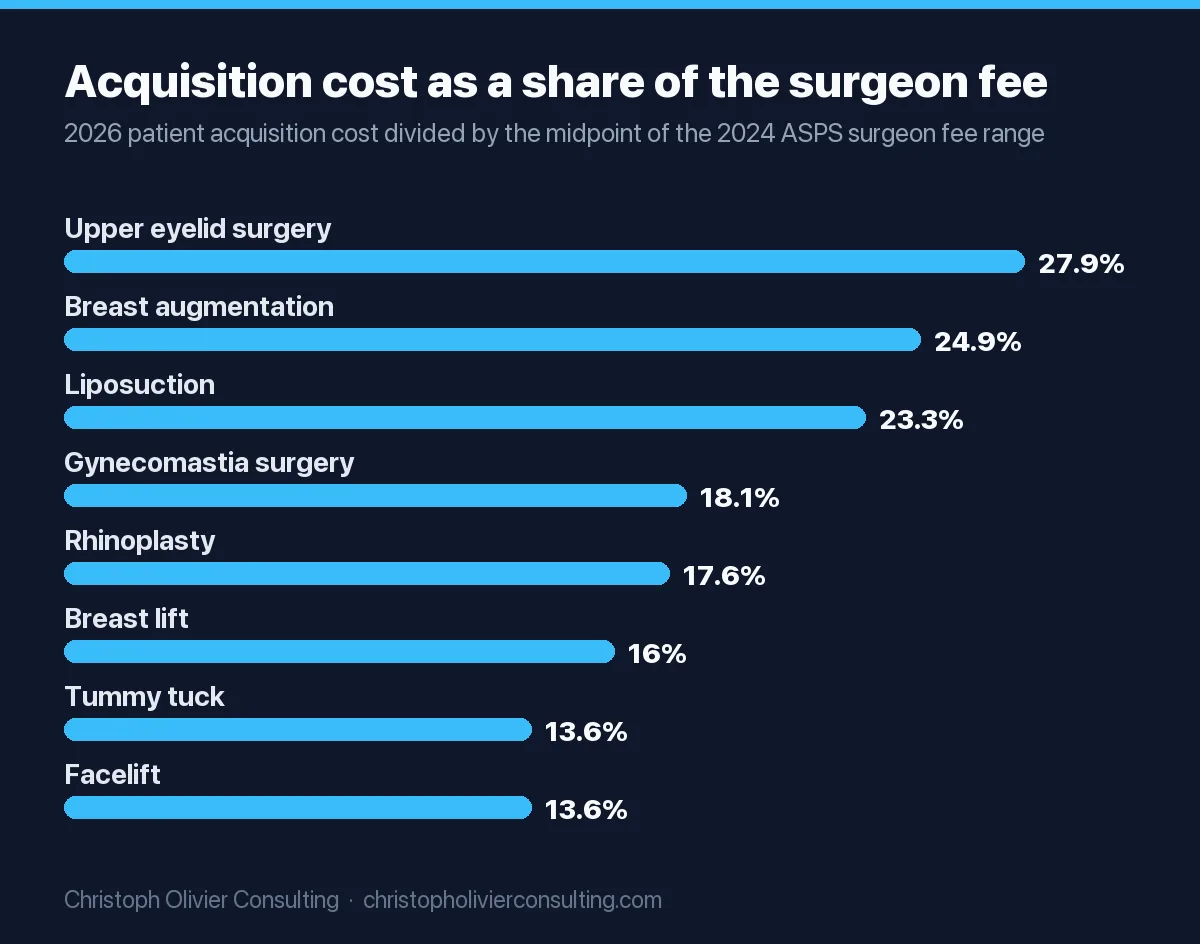
ASPS stopped publishing a single average fee. Its 2024 Average Surgeon/Physician Fees table gives a projected range per procedure, “an aggregate projection based on averages submitted by surveyed members,” and the 2025 report has no fee table, so the 2024 ranges are the latest. These are surgeon fees only; First Page Sage’s case revenue figure adds facility and anesthesia on top. The table below sets those fees next to 2025 volumes and the 2026 acquisition cost for the same procedure:
| Procedure | 2025 procedures (ASPS) | 2024 surgeon fee range (ASPS) | Range midpoint | Patient acquisition cost, 2026 (First Page Sage) | Acquisition cost as % of fee midpoint |
|---|---|---|---|---|---|
| Liposuction | 317,196 | $4,300 to $7,500 | $5,900 | $1,377 | 23.3% |
| Breast augmentation | 304,234 | $4,575 to $8,000 | $6,288 | $1,566 | 24.9% |
| Tummy tuck | 173,251 | $8,000 to $13,500 | $10,750 | $1,463 | 13.6% |
| Breast lift | 156,131 | $6,500 to $11,000 | $8,750 | $1,404 | 16.0% |
| Eyelid surgery (upper) | 118,978 (all eyelid) | $3,000 to $5,500 | $4,250 | $1,184 | 27.9% |
| Facelift | 77,933 | $12,000 to $19,000 | $15,500 | $2,108 | 13.6% |
| Rhinoplasty | 43,116 | $7,500 to $12,500 | $10,000 | $1,758 | 17.6% |
| Gynecomastia surgery | 23,318 | $5,000 to $9,000 | $7,000 | $1,269 | 18.1% |
Volumes are from the ASPS 2025 report (total cosmetic surgery: 1,523,330 procedures, up 7%). Midpoints and percentages are our arithmetic. First Page Sage measures acquisition cost against total case revenue including facility and anesthesia, which is why its own report shows 9.9% to 14.6% for these eight procedures; against the surgeon’s fee alone, the share rises by about a third to nearly double.
Three things fall out of this table. Your highest-volume procedures (liposuction, breast augmentation) are the ones where acquisition eats the biggest slice of the fee, so they need the tightest cost control. Facelifts and tummy tucks tolerate a much higher cost per patient. And the volume-weighted midpoint fee across the top five procedures (liposuction, breast augmentation, tummy tuck, breast lift, upper eyelid) is $7,028, which is the average fee used in the budgets below.
Plastic surgeon marketing cost per patient: a worked example
Cost per booked patient is a chain of three numbers: what a lead costs, how many leads attend a consult, and how many consults book surgery. Here is the chain for Google search ads, media cost only.
The sourced inputs. LocaliQ’s healthcare search advertising benchmarks (updated January 13, 2026; 3,542 US campaigns, October 2024 to September 2025, medians) put Plastic and Cosmetic Surgery at a $5.75 cost per click, 5.81% click-through rate, 8.52% conversion rate and $102.51 cost per lead. For consult-to-surgery, the published anchor is a 2022 Aesthetic Surgery Journal Open Forum study of NYU Langone’s resident aesthetic clinic, where 144 of 379 consultations in 2021 led to an operation: 38.0%. That clinic charged fees below the national average, so treat 38% as a reference point, not a target.
The adjustable assumption. No public dataset reports lead-to-attended-consult rates for cosmetic surgery from a neutral source. First Page Sage’s paid search figures ($379 per lead, $1,003 per consultation) imply about 38%; this example uses 35%. Replace both rates with your own CRM numbers after 90 days.
- Leads needed per booked patient = 1 ÷ (0.35 × 0.38) = 7.52 leads.
- Cost per consult = $102.51 ÷ 0.35 = $292.89.
- Cost per booked patient (media only) = $292.89 ÷ 0.38 = $770.75.
- Ten new surgical patients a month from search = about 75 leads and about $7,708 in media.
- Against the $6,288 breast augmentation midpoint fee, $770.75 is 12.3% of the surgeon fee before any agency or creative cost.
How sensitive is that? Very. Front-desk speed and consult quality move the result more than bids do, which is why lead response time belongs in the budget conversation.
| Scenario (media cost per lead $102.51) | Lead to consult | Consult to booked | Leads per patient | Cost per consult | Cost per booked patient |
|---|---|---|---|---|---|
| Weak follow-up | 25% | 30% | 13.33 | $410.04 | $1,366.80 |
| Base case | 35% | 38% | 7.52 | $292.89 | $770.75 |
| Strong intake and consult | 45% | 50% | 4.44 | $227.80 | $455.60 |
The gap between the base case ($770.75) and First Page Sage’s all-in paid search figure ($1,848) is explained by what each counts and where. LocaliQ’s figure is media only and a national campaign median. First Page Sage includes agency fees and creative, and its costs vary sharply by market size, with cost per click rising from $11.20 in markets under 250,000 people to $38.60 in the top 10 metros:
| Market tier (First Page Sage, 2026) | Average cost per click | Cost per lead | Patient acquisition cost | Competing practices per 100,000 residents |
|---|---|---|---|---|
| Top 10 metros | $38.60 | $548 | $2,657 | 6.8 |
| Metros 11 to 40 | $26.10 | $399 | $1,948 | 4.9 |
| Markets of 250,000 to 1 million | $17.40 | $264 | $1,316 | 3.2 |
| Markets under 250,000 | $11.20 | $182 | $939 | 1.7 |
A $5.75 median across all plastic and cosmetic surgery campaigns sits well below First Page Sage’s $11.20 to $38.60 by market, so check which figure your own keyword mix and city resemble before you set the paid search line. Our Google Ads CPC benchmarks by industry page shows how the cosmetic surgery median compares with other verticals.
Cost per lead, consult and booked patient by channel
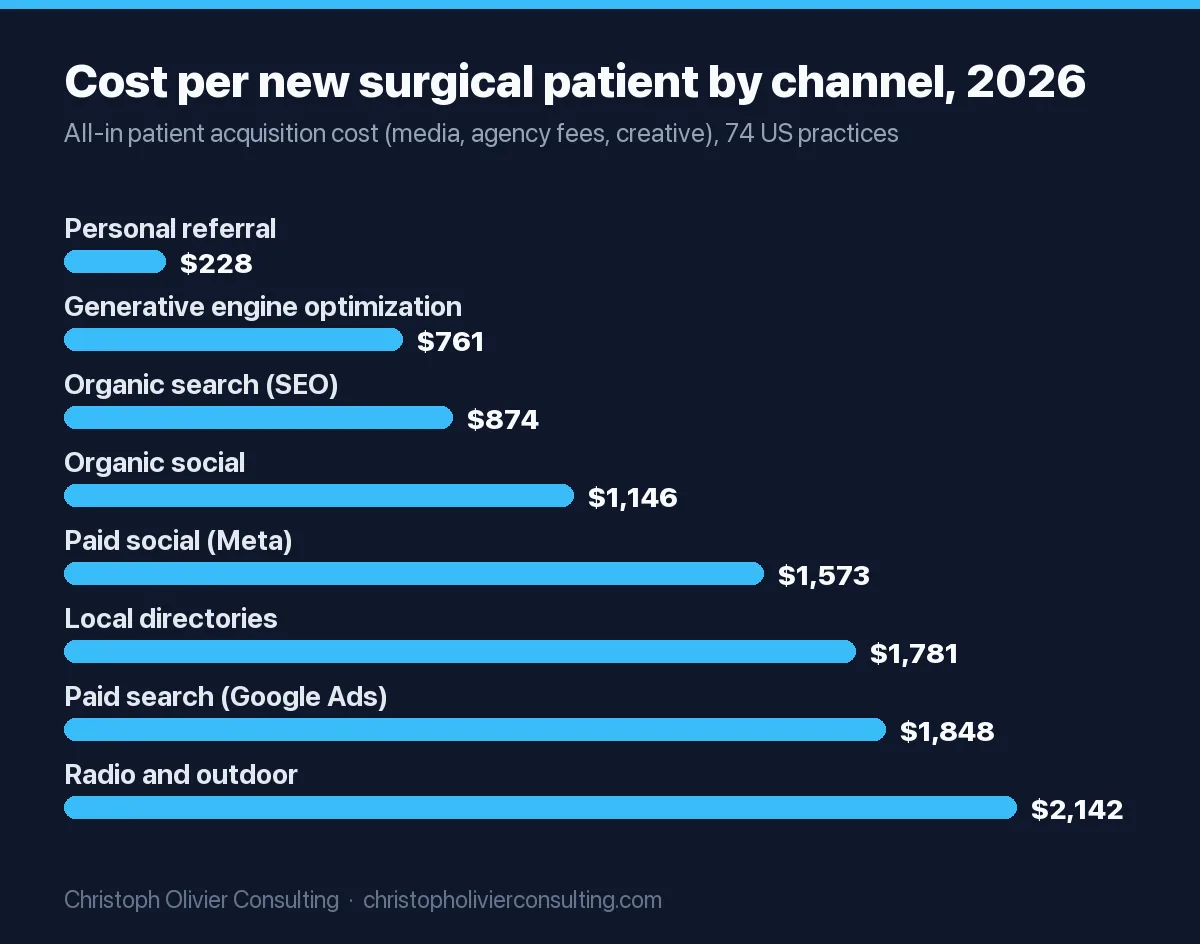
This is the unit-cost table the budgets below are built from. Lead-to-consult and consult-to-patient rates are not published by First Page Sage; they are implied by dividing its own columns.
| Channel | Cost per lead | Cost per consultation | Patient acquisition cost | Implied lead to consult | Implied consult to patient |
|---|---|---|---|---|---|
| Personal referral | $46 | $107 | $228 | 43.0% | 46.9% |
| Generative engine optimization | $139 | $358 | $761 | 38.8% | 47.0% |
| Organic search (SEO) | $164 | $431 | $874 | 38.1% | 49.3% |
| Organic social | $183 | $524 | $1,146 | 34.9% | 45.7% |
| Paid social (Meta) | $221 | $698 | $1,573 | 31.7% | 44.4% |
| Direct mail | $338 | $892 | $1,694 | 37.9% | 52.7% |
| Local directories | $247 | $812 | $1,781 | 30.4% | 45.6% |
| Paid search (Google Ads) | $379 | $1,003 | $1,848 | 37.8% | 54.3% |
| Influencer partnerships | $289 | $934 | $1,997 | 30.9% | 46.8% |
| Radio and outdoor | $421 | $1,158 | $2,142 | 36.4% | 54.1% |
Source: First Page Sage, 2026, all-in (media, agency fees, creative), excluding clinical staff time. The same report puts the blended average at $771 in 2020 and $1,543 in 2026.
Two budget lessons. Referral and search channels cost less per patient but cannot be switched on in a month; paid search and Meta can, at roughly double the price. And directories sit near the expensive end. We could not find provider pricing on RealSelf’s public pages, so get a written quote and score it by booked patients, not by profile views or leads. Lower-ticket work behaves differently again: the same report puts an injectables-only patient at $302, and LocaliQ puts a dermatology search lead at $18.54, which is why many surgeons fund injectables marketing out of a separate line, as covered in our med spa marketing guide.
Marketing budget for a plastic surgeon: three practice sizes
Each budget below is patients times channel cost. The patient targets and channel mixes are illustrative assumptions; the unit costs are First Page Sage’s 2026 channel figures from the table above. The revenue line uses the $7,028 volume-weighted ASPS fee midpoint and counts surgeon fees only.
| Line | Solo surgeon, building (6 new surgical patients a month) | Established solo (12 a month) | 3-surgeon group (30 a month) |
|---|---|---|---|
| Referral program (at $228) | 1 patient: $228 | 2: $456 | 4: $912 |
| SEO and content (at $874) | 2: $1,748 | 4: $3,496 | 8: $6,992 |
| Generative engine optimization (at $761) | 0 | 1: $761 | 2: $1,522 |
| Google Ads (at $1,848) | 2: $3,696 | 3: $5,544 | 8: $14,784 |
| Meta ads (at $1,573) | 1: $1,573 | 2: $3,146 | 5: $7,865 |
| Directories (at $1,781) | 0 | 0 | 2: $3,562 |
| Influencer partnerships (at $1,997) | 0 | 0 | 1: $1,997 |
| Monthly budget, national unit costs | $7,245 | $13,403 | $37,634 |
| Annual budget | $86,940 | $160,836 | $451,608 |
| Surgeon fees from these patients a year (at $7,028) | $506,022 | $1,012,045 | $2,530,112 |
| Marketing as % of those fees | 17.2% | 15.9% | 17.8% |
| Market-adjusted monthly budget (scaled by tier cost ÷ $1,543 blended) | Market of 250,000 to 1 million: about $6,179 | Metro 11 to 40: about $16,921 | Top 10 metro: about $64,805 |
| Market-adjusted % of fees | 14.7% | 20.1% | 30.7% |
The market adjustment is approximate: it scales the whole channel mix by First Page Sage’s tier acquisition cost divided by its blended average. Note what the percentages mean. They are marketing as a share of the fees that marketing produced, not of total practice revenue. Add referral-only, returning and nonsurgical revenue and the same budgets fall to a much smaller share of gross revenue, which is how two practices “at 8%” can be spending wildly different amounts per patient. In my view the share of the fee you are paying per patient is the number to manage, because it is the one that tells you which procedure and which channel to cut.
The monthly marketing budget sheet (copy-ready layout)
Build this as one tab per month. Fill columns A to D at the start of the month and E to K at month end; the last two columns make the next month’s decision for you. If you have never set a budget this way, our guide on how to set a marketing budget covers the method in general terms.
| Column | What goes in it | Formula or rule |
|---|---|---|
| A. Channel | One row per channel: Google Ads, Meta, SEO and content, directories, referral program, email, events | Keep injectables in separate rows from surgery |
| B. Target booked surgical patients (plan) | How many new surgical bookings you want from this channel | Set from capacity: open OR days × cases per day, minus referral bookings |
| C. Cost per booked patient (trailing 90 days) | Your own number; use the channel table above until you have 90 days of data | Total channel cost ÷ booked patients, last 90 days |
| D. Planned spend | Media plus fees plus creative for the channel | = B × C |
| E. Actual spend | Invoices and ad platform totals | From billing, not from the agency report |
| F. Leads | Form fills, calls over 60 seconds, booked online consults | From call tracking and CRM, deduplicated |
| G. Consults held | Attended consults only, virtual or in person | G ÷ F = consult rate |
| H. Booked surgeries | Deposits taken, not consults “pending” | H ÷ G = booking rate |
| I. Actual cost per booked patient | The control number | = E ÷ H |
| J. Ceiling | The most you will pay for one patient on this channel | Average fee for the channel’s procedures × your ceiling share (for example 20%) |
| K. Next month’s action | Scale, hold or cut | I under 75% of J: raise D by 20%. I between 75% and 100% of J: hold. I over J two months running: cut D by 25% and fix the funnel stage with the worst rate |
The 75%, 20% and 25% thresholds in column K are my working rules, not industry standards; tune them to your cash position. On pacing: The Aesthetic Society’s 2023 statistics report that winter months see the most cosmetic surgeries and summer months are slower. Because consults precede surgery dates, shift spend toward the months when patients are deciding for a winter date, and use the slower summer stretch for content and SEO work that pays later.
The 5-line ROI formula for plastic surgery marketing
Copy these five lines into the bottom of the sheet:
- Booked patients = Leads × consult rate × booking rate
- Cost per booked patient = Total marketing cost ÷ Booked patients
- Fee revenue = Booked patients × Average surgeon fee (add facility fees only if you own the OR)
- Gross profit = Fee revenue × Contribution margin (what is left after implants, staff, supplies and the other direct costs of the case)
- Marketing ROI = (Gross profit minus Total marketing cost) ÷ Total marketing cost
Worked with the solo budget above: 6 booked patients × $7,028.09 = $42,168.54 in fees. At an assumed 45% contribution margin (replace it with your accountant’s number), gross profit is $18,975.84. Subtract the $7,245 budget and divide by it: ROI is 161.9%, and the cost per booked patient is $1,207.50. Line 5 ignores repeat procedures and referrals from these patients, so it understates long-run value; the LTV to CAC ratio is the follow-on metric once you have a year of data.
Advertising rules that decide where the budget can go
Several common “growth hacks” in aesthetics are banned outright, and others carry compliance costs you should budget for. The rules below are the ones that most often change a plastic surgery spending plan:
| Rule | What it says | What it does to the budget |
|---|---|---|
| ASPS Code of Ethics (updated January 2025), Section 2, Article I(J) | A member may not participate in a “charity raffle, fund raising event, contest or other promotion in which the prize is any procedure, or an integral component of a procedure (e.g. breast implants)” | No “win a free procedure” giveaways for lead capture. Budget giveaways around non-procedure prizes or skip them. |
| ASPS Code, Article I(G)(4) to (7) and (12) to (14) | No atypical results without disclosure; no before-and-after photos using different light, poses or techniques; no unrepresentative testimonials; no guarantees; board-certified claims only for boards recognized by ABMS (or the Canadian and Quebec equivalents); paid ads must be identifiable as paid | Budget for consistent clinical photography and a disclosure review step on every ad and post. |
| ASPS Code, Article II(B) to (D) | Compensated endorsements allowed only with clear and conspicuous disclosure; the member must approve every ad before release, keep a copy for one year and is personally responsible for agencies and paid endorsers; models must be labeled if they did not receive the service | Influencer contracts need disclosure terms; keep an ad archive. Your agency’s mistakes are your ethics problem. |
| FTC Endorsement Guides, 16 CFR Part 255, §255.2(b) | A testimonial on a key attribute is read as typical; without substantiation that it is typical, the ad “should clearly and conspicuously disclose the generally expected performance” | Before-and-after and testimonial ads need either substantiation or a real expected-results disclosure, not just “results vary.” |
| FTC Consumer Reviews and Testimonials Rule, 16 CFR Part 465, in force since October 21, 2024 | Bans fake or bought reviews (§465.2), incentives conditioned on positive or negative sentiment (§465.4), undisclosed insider reviews by staff (§465.5) and review suppression through threats or by hiding negative reviews on a page that implies it shows them all (§465.7). The FTC sent warning letters to 10 companies on December 22, 2025, citing penalties of up to $53,088 per violation | Review budget goes to asking every patient the same neutral way, never to paying for reviews or gating requests by sentiment. Our guide on getting more Google reviews shows compliant request flows. |
| California Business and Professions Code §651, (b)(3) | Bans altered photos; model photos must say so; before-and-after views must name the procedures performed, be comparable in poses and lighting, and state that “the same ‘before’ and ‘after’ results may not occur for all patients” | Every gallery image and ad creative needs a caption workflow. Budget the time or the agency hours. |
| California §651(c) and (h)(5)(C) | Price ads must be exact, without “as low as,” “and up” or “lowest prices”; “board certified” only for an ABMS member board or an approved equivalent, with the board’s full name given comparable prominence. Knowing violations can bring fines up to $10,000 per event under §651(k) | “As low as” and “and up” promos are out in California, and “from $X” style offers risk falling under the statute’s “words or phrases of similar import”; price promotions need exact figures. Other states have their own medical board rules, so check yours before launching price ads. |
This is a marketing summary, not legal advice. Have counsel or your state medical board’s guidance confirm anything that touches pricing claims, photos or testimonials before it runs. If you want a second pair of eyes on the budget math or the channel mix, you can book a consultation.
Ready to scale your revenue?
Book a free 30-min consultation. We’ll diagnose your growth bottleneck and map out the 3 highest-leverage moves for your business.
Frequently asked questions
How much should a plastic surgeon spend on marketing?
Set the budget from patients, not a percentage. Multiply the new surgical patients you want each month by your cost per booked patient. Using 2026 agency panel costs of $874 (SEO) to $1,848 (Google Ads) per patient, a solo surgeon targeting 6 marketing-sourced patients a month needs about $6,200 to $7,250 a month, and an established solo practice targeting 12 needs about $13,400 to $16,900.
How much do plastic surgeons spend on marketing?
No specialty society publishes an average. ASPS and The Aesthetic Society report procedures, not budgets. A Tebra survey of 106 private practices across specialties found 62% spend 1% to 5% of gross revenue, and the often quoted 7% to 8% comes from a 2012 SBA blog post for all small businesses. The only plastic surgery dataset found measures cost per patient: $1,543 blended in 2026.
What is the plastic surgeon marketing cost per patient?
First Page Sage's 2026 panel of 74 practices puts all-in cost per new surgical patient at $228 for personal referrals, $874 for SEO, $1,573 for Meta ads and $1,848 for Google Ads, with a $1,543 blended average. Media-only search math is lower: a $102.51 cost per lead at a 35% consult rate and 38% booking rate gives about $771 per booked patient.
What percentage of revenue should a plastic surgery practice spend on marketing?
Percentages hide the real cost, because a practice heavy in injectables and a facelift practice can both sit at 8% with very different patient economics. Track acquisition cost as a share of the surgeon fee instead. At 2024 ASPS fee midpoints, 2026 acquisition costs equal about 14% of the fee for facelifts and tummy tucks and about 25% to 28% for breast augmentation and upper eyelid surgery.
What is a good cost per consultation for plastic surgery?
It depends on the channel and your booking rate. First Page Sage reports $107 per consultation from referrals, $431 from SEO, $698 from Meta ads and $1,003 from Google Ads, all-in. On media alone, a $102.51 search lead with a 35% show-up rate costs about $293 per consult. A consult is only good value if enough of them book, so judge it by cost per booked patient.
Can a plastic surgeon run giveaways or pay for reviews to get leads?
No on both for most practices. The ASPS Code of Ethics bars members from raffles, contests or promotions where the prize is a procedure or a component such as implants. The FTC rule on consumer reviews, in force since October 21, 2024, bans buying reviews and incentives tied to positive sentiment, and the FTC has cited penalties of up to $53,088 per violation.