

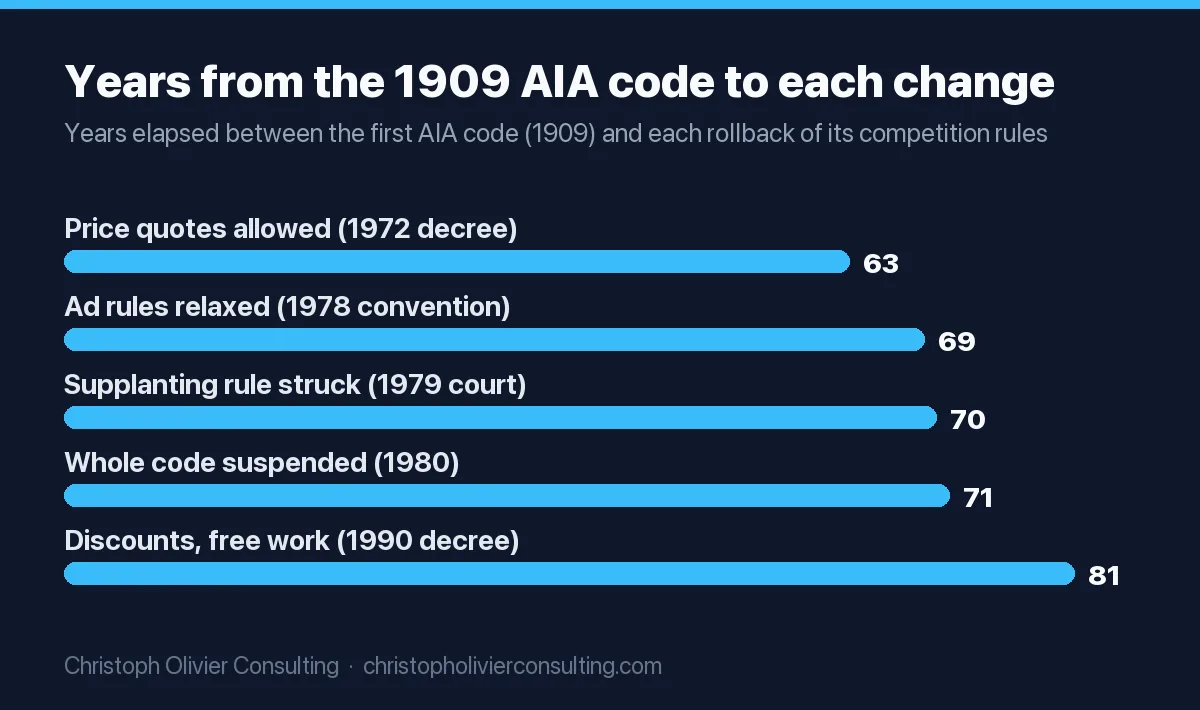
Yes. In the United States, architects are allowed to advertise, and no AIA rule or federal law stops them. The American Institute of Architects (AIA) treated advertising as unprofessional from its first code in 1909 until delegates relaxed the restriction at the 1978 AIA convention, after U.S. Justice Department antitrust action against the AIA’s fee rules. The AIA then suspended its entire code in 1980. What still limits architects today is narrower: no misleading claims, accurate credit for project work, and state rules on who can use the word “architect”.
This page gives you the real history with the court and DOJ documents, the exact AIA, NCARB and state board rules that apply to ads in 2026, and a pass/fail checklist you can run on your website and campaigns. One exception matters for the “why are architects not allowed to advertise” question: in India, registered architects still are not allowed to advertise, and the Council of Architecture repeated that in 2022.
Short answer: US architects can run paid ads, publish fees, offer discounts and post testimonials. The limits are truthfulness rules: AIA Rule 4.201 bars misleading claims about qualifications and credit, NCARB Model Rules 3.1 to 3.4 say the same for state boards, and some states add specifics, such as Florida requiring the architect’s license number in advertising. The old ban was an AIA ethics rule, not a law, and it is gone.
Why architects were not allowed to advertise
The ban was never a statute. It was a rule the profession wrote for itself. The AIA adopted its first formal rules of conduct in 1909, and under that code “paid advertising by architects was not allowed,” according to the Architect’s Handbook of Professional Practice (14th edition, Wiley). The same code barred architects from competing on fees and from engaging in the building trades.
The wording was blunt. The AIA’s Canons of Ethics, printed in the Journal of the American Institute of Architects in January 1915, list what “is unprofessional for an architect.” Item 4 reads, in full: “To advertise.” Item 11 banned attempts “to supplant a fellow architect,” and item 12 banned competing “with a fellow architect for employment on the basis of professional charges.”
The reasoning was professional dignity. Architectural historian Andrew Shanken’s study “Breaking the Taboo” (Journal of the Society of Architectural Historians, 2010) traces how the AIA formalized a stricter policy in 1927: “An architect will not advertise for the purpose of self-laudatory publicity.” The same rule barred architects from helping to fund publications that illustrated their own work. Reputation was supposed to come from the buildings, not from promotion.
That is the whole answer to “why architects are not allowed to advertise”: a 1909 professional norm that survived, with loosening and debate, for roughly seven decades. It ended because federal antitrust enforcement made the AIA’s competition rules legally risky.
How the ban ended: the DOJ, the courts and the FTC
Two separate legal levers ended the restrictions, and it helps to keep them apart. Antitrust law (the Sherman Act) applies to private associations like the AIA. The First Amendment applies to government regulators like state licensing boards. The AIA’s rules fell to the first. Bates is the leading case for the second.
| Date | Event | What it changed | Primary source |
|---|---|---|---|
| 1909 | First AIA code of conduct | Paid advertising, fee competition and building-trade work treated as unprofessional | AIA Best Practices; Architect’s Handbook |
| Jan 1915 | Canons of Ethics published | “It is unprofessional for an architect… 4. To advertise.” | Journal of the AIA, vol. 3 |
| May 17, 1972 | DOJ sues the AIA, Civil Action No. 992-72 (D.D.C.) | Antitrust complaint over the AIA’s ban on submitting price quotations | 1972 Final Judgment |
| June 19, 1972 | Consent judgment entered (Judge Charles Richey) | AIA barred from prohibiting price quotations; had 60 days to amend its standards and 5 years of required statements and reports | DOJ legacy judgment page |
| June 27, 1977 | Bates v. State Bar of Arizona, 433 U.S. 350 | Lawyer advertising is protected commercial speech; false or misleading ads can still be restrained | Supreme Court opinion |
| Apr 25, 1978 | National Society of Professional Engineers v. United States, 435 U.S. 679 | Engineers’ ethics ban on competitive bidding violated the Sherman Act | U.S. Reports |
| 1978 | AIA convention vote | Delegates “relaxed the ethical restraints on contracting and advertising by architects” | Wisconsin Architect, April 1979 |
| June 25, 1979 | Mardirosian v. AIA, 474 F. Supp. 628 (D.D.C., Judge Sirica) | AIA ethics Standard 9 (no supplanting another architect) held an unreasonable restraint of trade | Court opinion |
| 1980 to 1986 | AIA suspends its code | Voluntary “ethical principles” from 1981; members adopt a new enforceable code in 1986 | Architect’s Handbook |
| Mar 13, 1989 | FTC staff letter to South Carolina | Warns that a state board rule banning competitive bidding and “donated” services likely harms competition | FTC staff comment |
| July 5, 1990 | DOJ sues the AIA again, Civil No. 90-1567 | Targets a 1984 Chicago Chapter fee policy banning bidding, discounts and free services | DOJ press release |
| Oct 31, 1990 | Second consent decree entered | 10-year decree; $50,000 for investigation costs; supersedes and terminates the 1972 judgment | Stipulation and Final Judgment |
| June 9, 2026 | Current AIA Code edition | Antitrust statement: bids, discounts and free services are “not, in themselves, unethical” | 2026 AIA Code |
The 1972 consent decree
The first DOJ case was about price, not ads. The June 19, 1972 Final Judgment ordered the AIA to remove any provision “which prohibits or limits the submission of price quotations for architectural services by members,” and for five years to print a statement in its Standards of Ethical Practice that quoting a price “is not considered an unethical practice.” The AIA consented without admitting any violation. A common blog claim that “the AIA decreed in 1972” gets this backwards: a federal court entered the decree in a DOJ lawsuit.
The 1978 convention and the 1980 suspension
Advertising itself loosened through the AIA’s own vote. A contemporary report in the April 1979 Wisconsin Architect states that “action taken by delegates at the 1978 AIA Convention relaxed the ethical restraints on contracting and advertising by architects,” and that year’s Wisconsin convention scheduled a seminar titled “Advertising: How It Fits Into Your Marketing Program.” Then the courts went further. In Mardirosian v. American Institute of Architects, decided June 25, 1979, Judge Sirica held that the AIA’s Standard 9, used to suspend an architect for seeking a commission another architect had already been selected for, was “an unreasonable and hence, under sections 1 and 3, an unlawful restraint of trade.” The Architect’s Handbook records the AIA’s response: “in 1980 the AIA suspended its code of ethics.”
The 1990 consent decree
The second DOJ case shows why the AIA’s current code includes a formal antitrust statement. According to the Competitive Impact Statement, the AIA’s Chicago Chapter adopted a Compensation and Fee Policy Statement in September 1984 saying, among other things, “Architects shall not provide professional services without compensation,” and about 6,000 copies circulated in at least seven states. The Final Judgment entered October 31, 1990 barred the AIA and its roughly 280 components from any code that treats competitive bids, discounts or free services as unethical. It ran ten years and, per the DOJ press release, required the AIA to pay $50,000 toward investigation costs.
Bates v. State Bar of Arizona (1977)
Bates was about two lawyers who advertised low fees for routine legal services, not architects. Its importance is the rule it set for any licensed profession regulated by the state: blanket suppression of truthful professional advertising violates the First Amendment. The Court’s opinion also listed what regulators can still do: “Advertising that is false, deceptive, or misleading of course is subject to restraint,” and “there may be reasonable restrictions on the time, place, and manner of advertising.” That is exactly the shape of today’s architecture board rules. Lawyers still live with more detailed rules than architects, as our guide to what the bar allows in Facebook ads for lawyers shows.
What the FTC did
The FTC’s role was advocacy against state rules, not a case against the AIA. In a March 13, 1989 staff letter to South Carolina’s Legislative Audit Council, FTC staff reviewed the Board of Architectural Examiners’ Regulation 11-17, which as interpreted banned competitive bidding and “donating” services to win a project. Staff concluded the regulation “is likely to impede competition” and noted that free preliminary designs help new firms compete with incumbents. Today the FTC matters to architects the same way it matters to any advertiser: through its deception authority and its review and endorsement rules, covered in the checklist below. Our roundup of false advertising cases and what they cost shows how that enforcement plays out in other industries.
What the AIA Code of Ethics says about advertising in 2026
The current 2026 Code of Ethics and Professional Conduct, “current as of June 9, 2026,” contains no advertising ban. The AIA says so directly in its Best Practices summary: “The AIA’s code does not prohibit advertising of professional services,” but it “does contain provisions that could be violated in the context of advertising, however, such as making false statements or failing to properly credit other participants in a project.” Only Rules of Conduct are mandatory, and they bind AIA members, not every licensed architect. These are the rules that touch marketing:
| AIA rule | What it requires (2026 text) | Where it bites in marketing |
|---|---|---|
| Antitrust statement | Bids, price quotes, discounts and free services “are not, in themselves, unethical” | You can advertise fees, run promotions and offer free first consultations |
| Rule 2.301 | Disclose when you are compensated for public statements on architectural issues, or have an economic interest | Sponsored articles, paid product talks, manufacturer-funded webinars |
| Rule 3.301 | Do not “intentionally or recklessly mislead existing or prospective clients about the results that can be achieved” | Promises on cost savings, approval timelines, energy performance |
| Rule 4.103 | No knowingly false statements of material fact when speaking professionally | Bios, award claims, RFQ responses |
| Rule 4.201 | No “misleading, deceptive, or false statements or claims” about qualifications, experience or performance; state the scope of your role on work you claim | Portfolio pages, project credits, “we designed” language |
| Rule 4.202 | Make reasonable efforts so people you supervise follow the Code | Marketing staff and agencies writing in your name |
| Rule 5.301 | Recognize the professional contributions of employees, colleagues and business associates | Naming the architect of record, associate firms and project teams |
The commentary to Rule 4.201 says the rule “is meant to prevent Members from claiming or implying credit for work which they did not do, misleading others, and denying other participants in a project their proper share of credit.” In practice, portfolio credit is where most firms get into trouble, not ad spend.
NCARB Model Rules: what state boards copy
State licensing boards, not the AIA, can take away a license. Many base their conduct rules on NCARB’s Model Rules of Conduct (revised July 2023). Rule 3, titled “Full Disclosure,” is the advertising core:
- 3.1: “An architect shall not make statements that are misleading, deceptive, or false.”
- 3.2: Disclose compensation or an economic interest when making public statements on architectural matters.
- 3.3: Do not misrepresent “the architect’s qualifications, capabilities, and experience or that of the architect’s firm.”
- 3.4: Do not “misrepresent or overstate the scope of the architect’s responsibility in connection with work for which the architect or the architect’s firm is claiming credit.”
Two other model rules affect promotion. Rule 2.2 bars accepting compensation from material or equipment suppliers “for specifying or endorsing their products in connection with a project.” Rule 4.5 bars any payment or gift meant to influence an official’s judgment on a project.
State board rules on advertising: four examples
State law adds the most specific requirements. These four states show the range, verified from the statute or board rule text in November 2026. Check your own board before you publish, because the details differ.
| State | Title and name rules | Advertising rules | Source |
|---|---|---|---|
| California | Unlicensed persons may not advertise or use any sign or card suggesting they are an architect “or is an architectural designer”; misdemeanor, $100 to $5,000 fine and/or up to one year in county jail | Licensee must “accurately represent” qualifications and scope of responsibility on projects for which credit is claimed | B&P Code 5536; 16 CCR 160(e) |
| Florida | Using “architect” or “registered architect” without a license is a first-degree misdemeanor | Each architect “must include her or his license number in any newspaper, telephone directory, or other advertising medium”; firms show their qualifying agent’s number; false or misleading ads are grounds for discipline | Fla. Stat. 481.221(10), 481.223, 481.225(1)(f) |
| Texas | A firm may use “architect” or “architecture” in its name only if it employs at least one Architect full time (or associates under rule 1.122) who supervises the architectural work | No false, misleading or deceptive advertising; no free plans or design services of “significant value” to a government entity during selection for public work | 22 TAC 1.123; 22 TAC 1.144 |
| New York | Former employees should not claim “unconditional credit” for projects contracted in a previous employer’s name | Projects listed as credits that “remain unconstructed” should be marked “unbuilt” or similar | NYSED practice guideline |
Note the Texas free-design rule. The AIA code and the 1990 decree say free services are not unethical, but Texas still restricts giving design work of significant value to a public client during a selection. A national firm needs both layers in its playbook.
What architects can and cannot do in ads: quick reference
| Practice | Allowed in the US? | Condition or limit |
|---|---|---|
| Paid search, social, print or radio ads | Yes | Truthful content; in Florida, include the license number |
| Publishing fees, discounts or a free first consultation | Yes | AIA antitrust statement; Texas limits free design for public selections |
| Client testimonials and Google reviews | Yes | No fake reviews and no paying for positive ones (16 CFR 465); disclose material connections (16 CFR 255.5) |
| Showing projects from a previous firm | Restricted | Name the prior firm and your actual role (AIA 4.201; NY guideline) |
| Renderings of projects never built | Restricted | Label them “unbuilt” or “concept” (NY guideline) |
| “Architecture” in a firm name | Restricted | Licensed architect in control (Texas 1.123; similar logic in the UK) |
| Unlicensed staff titled “architectural designer” (California) | No | B&P Code 5536(a) |
| Paid manufacturer endorsements tied to a project | No | NCARB Rule 2.2; California 16 CCR 160(d)(3) |
| Sponsored articles or paid speaking | Yes | Disclose the payment (AIA 2.301; NCARB 3.2) |
Compliance checklist for architecture firm ads and websites
Run this on your website, proposal templates and every campaign before launch. Each item has a pass condition. This is a marketing checklist, not legal advice; your state board’s rules and a lawyer’s review control.
- Title check. Pass if every person called “architect” on the site holds a current license in the state where the page markets services. Fail if bios use “architect” for unlicensed designers or graduates. Use “designer,” or “architectural intern” for AXP enrollees in Texas.
- Firm name check. Pass if a firm using “architect” or “architecture” in its name has a licensed architect in control of the architectural work in each state you market in.
- License number check. Pass if ads in Florida show the architect’s license number, or the qualifying agent’s number for a firm. Easiest fix: put it in the site footer and ad templates everywhere.
- Project credit check. Pass if every portfolio project states your firm’s role (architect of record, design architect, associate architect, interiors only) and names partner firms. Fail if a joint venture project reads as yours alone.
- Former-employer check. Pass if projects from a principal’s previous firm name that firm and the person’s role on it.
- Unbuilt check. Pass if renderings, competition entries and stalled projects carry an “unbuilt” or “concept” label next to the image.
- Results check. Pass if claims about cost, schedule, approvals or energy use cite the specific project and measured result. Fail on “we guarantee approval” or “save 30%” with no basis (AIA 3.301).
- Award check. Pass if each award names the issuer, year and project, and the award went to your firm, not a collaborator.
- Review check. Pass if you never write, buy or incentivize reviews of a particular sentiment, and any review written by your own officers or managers clearly discloses that relationship (16 CFR 465.4, 465.5).
- Disclosure check. Pass if paid manufacturer content, sponsored posts and speaking fees are disclosed where readers see them (AIA 2.301, 16 CFR 255.5).
- Public-work check. Pass if no free plans or design of significant value go to a government client during a selection where Texas-style rules apply.
- Agency check. Pass if your marketing staff or agency has a written brief covering items 1 to 10, since AIA Rule 4.202 makes supervisors responsible for reasonable efforts.
Outside the US: the UK and India
United Kingdom: Advertising is allowed. The ARB’s Architects Code 2025 lists, under Standard 1 (Honesty and integrity), that architects “promote their services responsibly and accurately.” The title is protected by section 20 of the Architects Act 1997: no one may carry on business under a name containing “architect” unless registered, and a firm may do so only if its architecture work is under the control and management of a registered person.
India: Advertising is still prohibited. In a May 4, 2022 letter to all registered architects, the Council of Architecture cited Regulation 2(1)(xxv) of the Architects (Professional Conduct) Regulations, 1989: an architect “shall not advertise his professional services.” The allowed exceptions are narrow, such as a name on a building in lettering no taller than 10 cm, brochures sent only to potential clients identified “by name and position,” and directory listings. This is where many “why architects are not allowed to advertise” answers come from.
So what should an architecture firm actually advertise?
The legal room is wide. The real constraint is what works for a high-consideration, referral-heavy service. In my view, most firms get more from accurate, well-credited project pages than from broad paid reach, because every rule above rewards specificity anyway. A project page that states the brief, your role, the constraints and the measured outcome is both compliant and persuasive. Our content marketing system for architects shows how to turn finished projects into that kind of page, and the social media guide for architecture firms covers channels and posting cadence. If you also sell engineering services, the engineering firm marketing playbook covers the shortlist-driven side of the market.
The anxiety many architects still feel about self-promotion is a leftover from a rule the profession dropped more than 45 years ago. If you want a second set of eyes on a campaign or a portfolio rebuild, you can book a consultation.
Ready to scale your revenue?
Book a free 30-min consultation. We’ll diagnose your growth bottleneck and map out the 3 highest-leverage moves for your business.
Frequently asked questions
Are architects allowed to advertise?
Yes, in the United States. No federal law or AIA rule bans advertising by architects. The AIA treated advertising as unprofessional from 1909, relaxed that rule at its 1978 convention and suspended its whole code in 1980. Today the limits are truthfulness rules: no misleading claims about qualifications or results, accurate project credit, and state rules on who may use the title architect.
Why are architects not allowed to advertise?
In the US they are, but the belief has two sources. First, the AIA's own ethics code banned advertising for about seven decades, starting in 1909, on grounds of professional dignity. Second, some countries still ban it. India's Council of Architecture reminded architects in May 2022 that Regulation 2(1)(xxv) of the 1989 professional conduct rules says an architect shall not advertise professional services.
What does the AIA code of ethics say about advertising?
The 2026 AIA Code does not prohibit advertising. The AIA says some rules can still be broken through ads. Rule 4.201 bars misleading, deceptive or false claims about qualifications, experience or performance and requires accurate credit. Rule 3.301 bars misleading clients about achievable results. Rule 2.301 requires disclosing paid statements, and Rule 5.301 requires recognizing colleagues' contributions.
Can architects advertise their fees or offer discounts?
Yes. The 2026 AIA Code's antitrust statement says competitive bids, price quotations, discounts and free services are not, in themselves, unethical. That language traces to DOJ consent decrees entered in 1972 and 1990. State rules can still apply: Texas bars giving free plans or design services of significant value to a government entity while it is selecting an architect for public work.
Can an architecture firm use client testimonials and reviews in ads?
Yes, with the same FTC rules any business follows. Under 16 CFR Part 465 you may not write fake reviews or pay for reviews expressing a particular sentiment, and reviews by your own officers or managers need clear disclosure. Under 16 CFR 255.5, disclose any material connection such as payment or free services. Keep testimonials tied to real projects you actually led.
Can I show projects I worked on at a previous firm?
Yes, if you describe them accurately. AIA Rule 4.201 and NCARB Model Rule 3.4 require you to state the scope of your responsibility on work you claim. New York's licensing guideline says former employees should not claim unconditional credit, should name the previous firm and their role, and should mark projects that were never built as unbuilt.
Can unlicensed designers advertise as architects?
No. State law reserves the title. In California, an unlicensed person who advertises as an architect or architectural designer commits a misdemeanor with a fine of $100 to $5,000. Florida makes unlicensed use of the title a first-degree misdemeanor. Texas lets a firm use architect or architecture in its name only when a licensed architect supervises its architectural work.