

Yes. In the United States doctors are allowed to advertise, and have been since the Federal Trade Commission ordered the American Medical Association to stop restricting physician advertising in 1979. The AMA’s own Code of Medical Ethics now says it plainly: “There are no restrictions on advertising by physicians except those that can be specifically justified to protect the public from deceptive practices.” What limits you today is not a ban but five overlapping rulebooks: the FTC Act, the FTC’s testimonial rules, HIPAA, your state medical board, and the AMA’s ethics opinion.
Short answer: Doctors can advertise in the US in any medium, including TV, radio, direct mail and online, as long as every claim is true, substantiated and not misleading. Patient testimonials are allowed, but they must reflect typical results or disclose what patients generally get, and naming or showing a patient needs a signed HIPAA authorization. “Board certified” claims are tightly defined by state law, and fake, bought or suppressed reviews can cost up to $53,088 per violation under the FTC’s 2024 rule.
Below: the real history (with dates from the court record), what each rulebook actually says, three states’ rules side by side, a table of allowed, restricted and prohibited ad content, and a pre-launch checklist you can paste into your approval process. This is general information for marketers and practice owners, not legal advice; have a healthcare attorney licensed in your state review anything high stakes.
Why people think doctors can’t advertise: the AMA ban and FTC v. AMA
For most of American medical history, organized medicine treated advertising as unethical. A 2006 essay in the Journal of Medical Ethics quotes the first AMA Code of Ethics (1847) calling it “derogatory to the dignity of the profession … to resort to public advertisements.” By the 1970s, the AMA’s 1957 “Principles of Medical Ethics” and the Judicial Council opinions interpreting them restricted advertising and solicitation, and the FTC alleged that state and local medical societies followed the AMA’s lead.
The FTC challenged those rules as a restraint on competition. The FTC’s own account of the case says the Commission found the advertising ban kept doctors from giving the public truthful information about price and quality. Here is the sequence, taken from the Second Circuit opinion and the Supreme Court’s per curiam:
| Date | Event | Source |
|---|---|---|
| Dec 19, 1975 | FTC files complaint against the AMA, the Connecticut State Medical Society and the New Haven County Medical Association over restrictions on advertising, solicitation and contracts with non-physicians | 638 F.2d 443 |
| Sep 7, 1977 to May 5, 1978 | FTC administrative hearings | 638 F.2d 443 |
| Nov 13, 1978 | Administrative law judge Ernest G. Barnes finds the ethical restrictions violate Section 5 of the FTC Act | 638 F.2d 443 |
| Oct 12, 1979 | Commission affirms and issues its Opinion and Final Order (FTC Docket No. 9064), reported at 94 F.T.C. 701 | 638 F.2d 443; US brief in Cal. Dental Ass’n v. FTC |
| Oct 7, 1980 | US Court of Appeals for the Second Circuit enforces the order with minor modifications (argued May 2, 1980) | 638 F.2d 443 |
| Mar 23, 1982 | Supreme Court affirms “by an equally divided Court”; Justice Blackmun took no part | 455 U.S. 676 |
Two details matter for marketers. First, the Supreme Court never wrote a merits opinion. A 4 to 4 split simply left the Second Circuit’s judgment in place, and the FTC notes that by then the AMA had abandoned any claim that its conduct was lawful and contested only jurisdiction. Second, the order did not make everything fair game. It expressly let the AMA keep “reasonable ethical guidelines” on representations “that would be false or deceptive within the meaning of Section 5 of the Federal Trade Commission Act,” and on “uninvited, in-person solicitation of actual or potential patients, who, because of their particular circumstances, are vulnerable to undue influence.” That carve-out is, in effect, the shape of physician advertising rules ever since.
What the AMA Code of Medical Ethics says now (Opinion 9.6.1)
The current text is AMA Code of Medical Ethics Opinion 9.6.1, Advertising & Publicity, tied to Principle II (“be honest in all professional interactions”). It permits advertising in “any newspaper, magazine, telephone directory, radio, television, direct mail, or other advertising” and lists what an ad may include: your educational background, how fees are determined (including charges for specific services), credit or payment methods, and “any other nondeceptive information.”
It then flags four things as having “a significant potential for deception”:
- Patient testimonials about your skill “tend to be deceptive when they do not reflect the results that patients with conditions comparable to the testimoniant’s condition generally receive.”
- Exclusive or unique skill claims. Because physicians are ethically obliged to share medical advances, such claims are suspect, though a true claim of being the only provider of a skill in a particular area is permissible.
- Case-count claims (“we have treated thousands of patients with X”) are deceptive if they imply certainty of result.
- Aggressive, high-pressure advertising that creates “unjustified medical expectations.”
The opinion also adopts the federal standard: before an ad runs, you should have “a reasonable basis for claims,” measured by what you know and what “a reasonable, prudent advertiser should have discovered.” The AMA describes its Code as “widely recognized as authoritative ethics guidance for physicians”; it is professional guidance rather than law, but it tracks the FTC rules below closely.
The five rulebooks that limit physician advertising
| Rulebook | What it controls in your ads | Who enforces | Consequence |
|---|---|---|---|
| FTC Act Section 5 (15 U.S.C. 45) | Any “unfair or deceptive acts or practices,” including unsubstantiated claims | Federal Trade Commission | Orders, refunds; civil penalties for rule or order violations |
| Endorsement Guides (16 CFR Part 255, revised 2023) | Testimonials, reviews, influencer and expert endorsements, disclosures | FTC (guides interpret Section 5) | Section 5 liability for advertiser, endorser and agency |
| Consumer Review Rule (16 CFR Part 465, effective Oct 21, 2024) | Fake, bought, insider and suppressed reviews; fake followers | FTC | Civil penalties, currently up to $53,088 per violation |
| HIPAA Privacy Rule (45 CFR 164.508) | Using any patient’s information in marketing, testimonials, review replies, ad tracking | HHS Office for Civil Rights | Settlements from $10,000 to $2.2 million in the cases below |
| State medical practice acts and board rules | “Board certified,” specialty claims, before-and-after photos, prices, required identification | State medical board | Discipline up to license revocation; in California also a misdemeanor |
FTC Act: true, and provable before you publish
Section 5 declares “unfair or deceptive acts or practices in or affecting commerce” unlawful. For a practice, that means outcome claims (“90% of patients pain-free in two weeks”), comparisons (“the most experienced LASIK surgeon in Denver”) and price claims need evidence in your file before the ad runs, not after a complaint. If you want to see what the FTC actually pursues, our breakdown of FTC advertising enforcement statistics and the case list in false advertising examples show the patterns.
Can doctors use patient testimonials?
Yes, but testimonials are where most physician ads go wrong, because three separate rules apply to the same 30-second video.
1. The FTC Endorsement Guides: typical results or a real disclosure
Under 16 CFR 255.2, a testimonial about a “central or key attribute” will be read as what patients “will generally achieve.” If you cannot substantiate that, the ad “should clearly and conspicuously disclose the generally expected performance.” The Guides’ own example rejects “Results not typical” and “you are not likely to have similar results” as insufficient. So the common agency advice to add “individual results may vary” does not fix an atypical testimonial; you need the typical number (for example, “In our 2025 patients, average weight loss at 6 months was 9%,” if your records support it). Section 255.2(a) adds that “consumer endorsements themselves are not competent and reliable scientific evidence,” so a testimonial cannot be the proof behind a treatment claim.
Three more rules from Part 255 that bite practices:
- If the people in the ad are actors, use real patients or “clearly and conspicuously disclose” that they are not actual patients (255.2(c)).
- When you ask for, filter, publish or edit reviews, you “should not take actions that have the effect of distorting” what patients think (255.2(d)). Showing only 5-star reviews on your site is the classic problem.
- Doctors who endorse products are expert endorsers. The Guides’ example says a physician paid to post about a product on social media “should clearly and conspicuously disclose the doctor’s connection with the company,” and a physician who owns part of the company or earns a percentage of sales must disclose that even in a TV ad.
2. The FTC Consumer Review Rule (2024): what is flatly banned
The final rule, published August 22, 2024 and effective October 21, 2024, makes these specific acts violations of 16 CFR Part 465:
- Writing, creating or selling reviews or testimonials from people who do not exist, never had the treatment, or whose experience is misrepresented (465.2). AI-generated reviews from patients who do not exist fall here.
- Giving anything of value “in exchange for, or conditioned expressly or by implication on” a review “expressing a particular sentiment, whether positive or negative” (465.4). A gift card for every review is a different question from a gift card for every 5-star review; the rule targets the second.
- Reviews or testimonials by owners, managers or staff without a clear disclosure of the relationship, and managers soliciting reviews from staff or relatives without instructing them to disclose (465.5).
- Running a “best doctors” or ratings site you control while presenting it as independent (465.6).
- Unfounded legal threats, intimidation or public false accusations to get a review removed, and hiding negative reviews on your own site while implying you show all of them (465.7).
- Buying fake followers, likes or views to misrepresent influence (465.8).
Generalized requests to all patients to leave a review are expressly carved out (465.2(d) and 465.5). That is the safe way to grow volume, and the playbook in how to get more Google reviews is built on it.
3. Texas, California and Florida add their own testimonial rules
Texas deems a testimonial misleading unless it carries “a disclaimer or warning as to the credentials of the person making the testimonial” and “a disclosure of compensation provided in exchange for the testimonial,” and requires that models or actors be “explicitly” identified (22 Tex. Admin. Code 164.3). California treats any endorsement or testimonial “likely to mislead or deceive because of a failure to disclose material facts” as false advertising (Bus. & Prof. Code 651(b)(8)).
4. HIPAA: a testimonial is a disclosure of health information
Naming a patient, showing their face or before-and-after photos, or describing their treatment discloses protected health information. The HIPAA Privacy Rule says a covered entity “may not use or disclose protected health information without an authorization that is valid” unless another provision permits it (45 CFR 164.508(a)(1)), and advertising is not one of those provisions. A valid authorization must describe the information, the purpose, who receives it, an expiration date or event, and carry the patient’s signature and date, plus a statement of the right to revoke in writing (164.508(c)). Get it signed before filming, and keep it with the ad file.
Responding to online reviews: the HIPAA cases
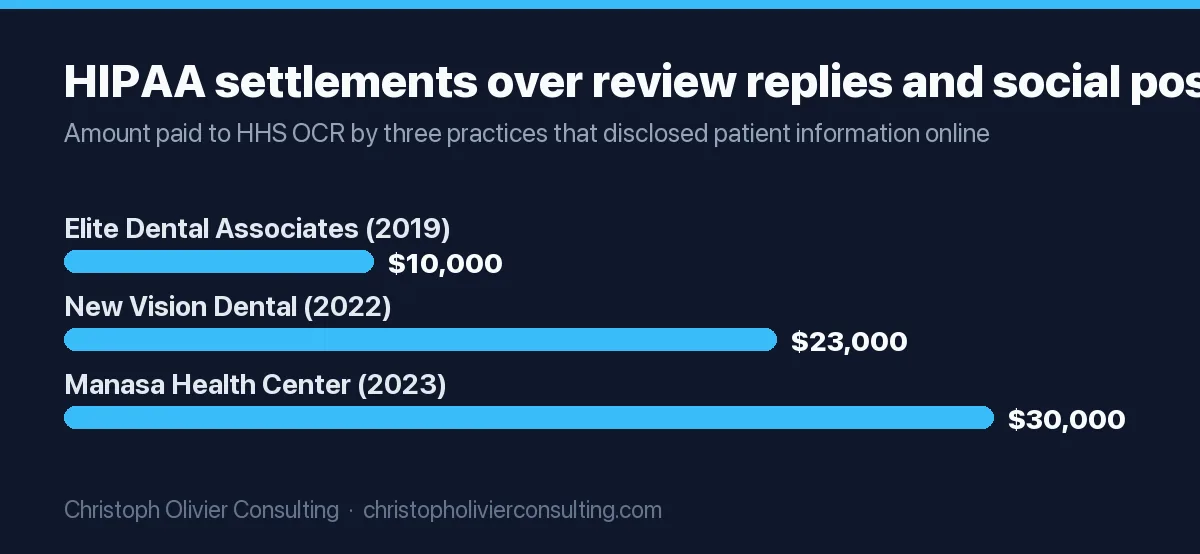
The most expensive marketing mistake small practices make is not an ad. It is a reply to a bad review that confirms the reviewer was a patient or discusses their care. HHS’s Office for Civil Rights (OCR) has settled several cases over review replies and social media posts, and it has also penalized hospitals for letting media crews film patients without authorization:
| Year | Organization | What happened (per HHS) | Paid to OCR |
|---|---|---|---|
| 2019 | Elite Dental Associates, Dallas, TX | Social media disclosures of patients’ protected health information | $10,000 |
| 2022 | New Vision Dental (B. Brandon Au, DDS, Inc.), CA | Disclosed PHI “in response to online reviews” | $23,000 |
| 2023 | Manasa Health Center, NJ (psychiatry) | Disclosed PHI in responses to negative online reviews | $30,000 |
| 2018 | Boston Medical Center, Brigham and Women’s, Mass General | Let ABC film a documentary on premises without patient authorization | $999,000 combined |
| 2016 | New York Presbyterian Hospital | Disclosed two patients’ PHI to news media during “NY Med” filming | $2,200,000 |
Each of the three practice cases also came with a corrective action plan. The safe reply template contains no confirmation that the person is a patient and no clinical detail: “We take every concern seriously and can’t discuss anyone’s care online. Please call our practice manager at [number] so we can talk directly.”
HIPAA and ad targeting: marketing lists and tracking pixels
HIPAA defines marketing as “a communication about a product or service that encourages recipients of the communication to purchase or use the product or service,” and requires written authorization for it, with two exceptions: face-to-face communication and promotional gifts of nominal value (45 CFR 164.501, 164.508(a)(3)). The HHS marketing guidance draws the practical lines:
- Allowed without authorization: telling your own patients about your own services, for example a hospital using its patient list to announce a new orthopedic group or a new MRI machine; refill reminders; treatment and care-coordination messages.
- Needs authorization: promoting a third party’s product to your patients, and any arrangement where you are paid to let someone else market to them. If a third party pays you, the authorization must say so.
- Never without authorization from each person: selling or handing patient lists to another company for its own marketing.
Retargeting pixels are the newer risk. HHS’s bulletin on online tracking technologies still governs pixels on patient portals and other authenticated pages, but on June 20, 2024 a federal court in American Hospital Association v. Becerra (N.D. Tex.) vacated the part saying HIPAA is triggered when a tracker connects an IP address with a visit to an unauthenticated public page about specific health conditions or providers. Keep ad pixels off logged-in pages, appointment flows and forms that collect health information, and treat public-page tracking as a legal question for counsel.
“Board certified” and other state medical board rules
States define what you may call yourself, and “board certified” is the claim boards police most. Three large states, side by side:
| Rule | Texas | California | Florida |
|---|---|---|---|
| Who may say “board certified” | Current certification by an ABMS member board, the AOA Bureau of Osteopathic Specialists, the American Board of Oral and Maxillofacial Surgery, or a board the Texas Medical Board approved (22 TAC 164.4) | ABMS member board, a board with equivalent requirements approved before Jan 1, 2019, or a board with an ACGME-approved training program in the specialty (B&P 651(h)(5)(C)) | ABMS specialty boards or a recognizing agency approved by the Board of Medicine (F.S. 458.3312) |
| Wording requirement | “Board eligible,” “board qualified” or similar language is deemed misleading | Must give the full name of the certifying board “comparable prominence” with “board certified” | Must name the specialty board; unapproved boards require a set disclaimer in the same print size (64B8-11.001) |
| Testimonials and models | Credentials disclaimer and compensation disclosure; identify models or actors | Model photos must say so; before-and-after photos must list procedures, be comparable in pose and lighting, and state results may not occur for all patients | No testimonial-specific clause; general ban on ads that create “false or unjustified expectations of beneficial assistance” |
| Prices | No deceptive fee claims, including “free” when a third party is billed | Price ads must be exact; no “as low as,” “and up” or “lowest prices” | Fee statements must disclose all variables affecting the fee |
| Superiority claims | No unique or exclusive skill claim without substantiation | Only if relevant and backed by objective scientific evidence | No impression of superiority beyond a simple listing of earned credentials |
| Other must-dos | Disclose paid presentations and infomercials; disclose supervision of non-physicians at satellite sites | Disclose payment to media for publicity; violation is a misdemeanor and grounds for discipline | Name the physician conspicuously; identify as M.D., P.A. or A.A.; keep copies of broadcast ads for 6 months |
Florida’s rule lists the non-ABMS bodies the Board of Medicine has approved, among them the American Board of Facial Plastic & Reconstructive Surgery (approved February 1997) and the American Board of Pain Medicine (August 1999). If your marketing agency writes “board-certified cosmetic surgeon,” check the certifying body against your state’s list first; this is the claim that shows up most in cosmetic and plastic surgery marketing.
Allowed, restricted or prohibited: physician ad content at a glance
This table compiles the rules above into one decision aid. “Restricted” means allowed only when the condition is met.
| Ad element | Status | Condition or reason | Rule |
|---|---|---|---|
| Name, address, hours, languages spoken, insurance accepted | Allowed | Factual information | CA 651(h); AMA 9.6.1 |
| Education, training, hospital affiliations, publications | Allowed | Must be accurate | CA 651(h); AMA 9.6.1 |
| Fees and payment plans | Restricted | Exact prices, all variables disclosed, no “as low as” | CA 651(c); FL 64B8-11.001(2)(g) |
| “Board certified” | Restricted | Only recognized boards, named in full | TX 164.4; CA 651(h)(5); FL 458.3312 |
| Patient testimonials | Restricted | Typical results or disclosure of generally expected results; signed HIPAA authorization; state disclaimers | 16 CFR 255.2; 45 CFR 164.508; TX 164.3 |
| Before-and-after photos | Restricted | Real patient, unaltered, procedures listed, comparable lighting and pose, authorization signed | CA 651(b)(3)(C); 45 CFR 164.508 |
| Actors or models | Restricted | Clearly labeled as not actual patients | 16 CFR 255.2(c); TX 164.3(b)(4); CA 651(b)(3)(B) |
| “Best,” “leading,” “most experienced” | Restricted | Objective, substantiated evidence on file | CA 651(b)(6); TX 164.3(b)(6); FTC Act s.5 |
| Doctor endorsing a product on social media | Restricted | Disclose payment, equity or sales commission | 16 CFR 255.5 |
| Incentive for any review, regardless of rating | Restricted | Must not be conditioned, expressly or by implication, on a positive or negative rating | 16 CFR 465.4 |
| “Permanent cure” for an incurable condition | Prohibited | Deemed misleading | TX 164.3(b)(2) |
| Fake or AI-written patient reviews | Prohibited | Civil penalties per violation | 16 CFR 465.2 |
| Paying only for 5-star reviews | Prohibited | Sentiment-conditioned incentive | 16 CFR 465.4 |
| Hiding negative reviews on your site while implying you show all | Prohibited | Review suppression | 16 CFR 465.7(b) |
| Confirming patient status or details in a review reply | Prohibited | Impermissible PHI disclosure | 45 CFR 164.508; OCR settlements |
| Selling or sharing patient lists for others’ marketing | Prohibited without each patient’s authorization | Remunerated marketing | 45 CFR 164.501, 164.508(a)(3) |
Pre-launch compliance checklist for physician ads
Copy this into your ad approval workflow. Every item is pass or fail; one fail means the ad does not run.
- Claim file. Every outcome, statistic, comparison and “best/most” claim has written evidence attached. Pass: evidence existed before launch. Fail: “we’ll pull numbers if asked.”
- Typical results. Each testimonial reflects what patients generally get, or the ad states the generally expected result in plain numbers. Fail: “results may vary” as the only disclosure.
- HIPAA authorization. Every identifiable patient (name, face, voice, photo, story) has a signed, dated authorization naming the purpose, recipients and expiration. Fail: verbal OK or an intake-form checkbox.
- Before-and-after photos. Same pose, lighting and angle; no retouching; procedures listed; “results may not occur for all patients” shown (required in California).
- Models and actors are labeled as such in the ad itself, not in a link.
- Compensation disclosed. Any free or discounted care, payment or relationship behind a testimonial or endorsement is disclosed clearly and conspicuously.
- Board certification. The certifying board is on your state’s recognized list and named in full next to “board certified.” No “board eligible.”
- Identification. Physician named conspicuously with M.D. or D.O. (Florida requires M.D., P.A. or A.A. identification).
- Prices. Exact figures, all variables disclosed, no “as low as” or “and up” in California; “free” only if no third party is billed.
- No cure or guarantee language for incurable or variable-outcome conditions.
- Reviews. Review requests go to all patients, not only happy ones; no incentive tied to rating; staff and family reviews disclose the relationship; your site shows negative reviews too.
- Review replies. Response template contains no confirmation of patient status or clinical detail.
- Tracking. No ad pixels on portals, booking flows or forms that capture health information; vendor contracts reviewed.
- Paid placements. Sponsored articles, infomercials and paid media appearances are labeled as paid (Texas and California require it).
- Archive. A copy of every broadcast or video ad is stored (Florida: at least 6 months from airing) along with its claim file and authorizations.
My view: items 2, 3 and 11 are the easiest to skip under deadline pressure, because they slow production down. Put them in the creative brief so releases and typical-result numbers are collected during the shoot, not chased afterward.
How the UK compares
UK doctors can advertise too, with tighter content rules. Non-broadcast ads fall under Section 12 of the CAP Code, enforced by the Advertising Standards Authority, alongside doctors’ professional standards from the General Medical Council. Key differences from the US:
- “Prescription-only medicines or prescription-only medical treatments may not be advertised to the public” (rule 12.12).
- Marketers “must not use health professionals or celebrities to endorse medicines” (12.18).
- Practitioners offering treatments “must have relevant and recognised qualifications,” and marketers should encourage consumers to take independent medical advice before significant or physically invasive treatments (12.3).
- Unqualified claims such as “cure” and “rejuvenation” are “not generally acceptable” (12.7), and objective claims need evidence, “if relevant consisting of trials conducted on people” (12.1).
What this means for your marketing plan
None of these rules stop a practice from running paid search, local SEO, video or social campaigns. They decide what the ads can say. In practice, the compliant version of most campaigns leads with access, credentials and process (who you are, what you treat, how fast patients get seen, what it costs) rather than outcome promises, and it treats patient stories as a documented asset with signed releases rather than a quick social post. The channel strategy that sits on top of this is covered in our guides to doctor marketing and healthcare marketing, and if you are deciding how much to spend, the plastic surgeon marketing budget model shows the cost-per-patient math. If you want a second pair of eyes on a campaign before it launches, you can book a consultation.
Ready to scale your revenue?
Book a free 30-min consultation. We’ll diagnose your growth bottleneck and map out the 3 highest-leverage moves for your business.
Frequently asked questions
Are doctors allowed to advertise in the US?
Yes. Since the FTC's October 12, 1979 order against the American Medical Association, upheld by the Second Circuit in 1980 and left standing by an equally divided Supreme Court in 1982, physicians may advertise in any medium. AMA Opinion 9.6.1 now allows any advertising that is not false, misleading or deceptive. Limits come from the FTC Act, HIPAA and state medical board rules.
Can doctors use patient testimonials in ads?
Yes, with conditions. Under the FTC Endorsement Guides, a testimonial must reflect results patients generally get, or the ad must clearly state the generally expected result; 'results not typical' is not enough. Naming or showing a patient needs a signed HIPAA authorization, and states such as Texas require credential and compensation disclosures.
What are the physician advertising rules?
Five sets apply: Section 5 of the FTC Act (no deceptive or unsubstantiated claims), the FTC Endorsement Guides and 2024 Consumer Review Rule (testimonials and reviews), the HIPAA Privacy Rule (patient information in marketing), your state medical board's advertising rules (board certification, prices, photos), and AMA Code of Medical Ethics Opinion 9.6.1 for AMA members.
Can a doctor say they are board certified?
Only if the certifying body is recognized by the state. Texas allows ABMS member boards, the AOA Bureau of Osteopathic Specialists, the American Board of Oral and Maxillofacial Surgery or a Texas Medical Board approved board. California requires the full board name given comparable prominence. Florida requires naming the board and a disclaimer for unapproved boards.
Can doctors respond to online reviews?
Yes, but never confirm that the reviewer is a patient or discuss their care. HHS has settled HIPAA cases with practices that disclosed patient information in review replies or social posts, including New Vision Dental ($23,000, 2022) and Manasa Health Center ($30,000, 2023). Use a neutral reply that invites the person to call the office.
Can doctors pay patients for reviews?
The FTC's Consumer Review Rule, effective October 21, 2024, bans incentives conditioned on a positive or negative review and bans fake, insider and suppressed reviews, with civil penalties of up to $53,088 per violation. Generalized requests asking all patients to leave a review are expressly allowed under the rule.
Can doctors post on social media?
Yes. Social posts that promote the practice are advertising, so the same rules apply: claims must be truthful and substantiated, patient photos and stories need HIPAA authorization, and a doctor paid to promote a product must clearly disclose that connection under the FTC Endorsement Guides.