

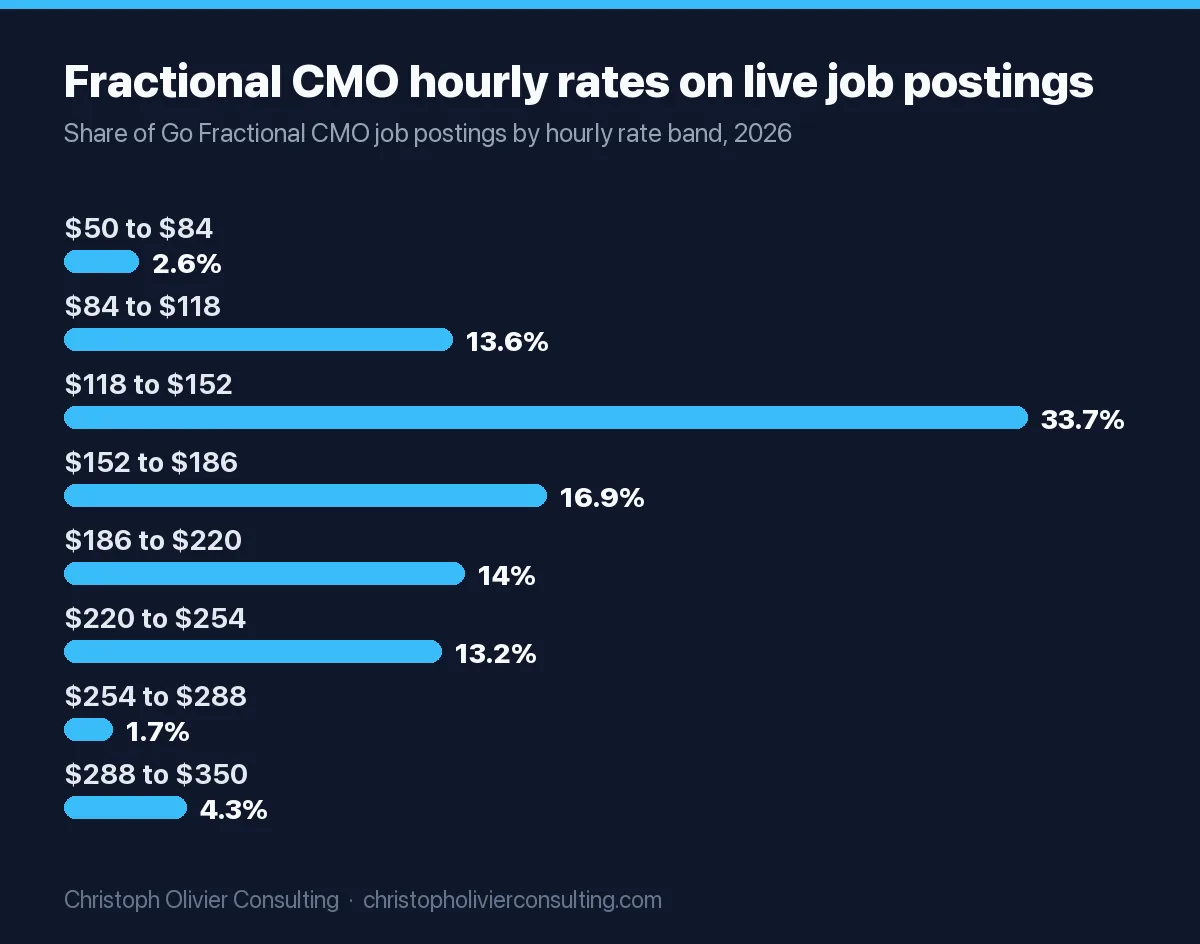
A fractional CMO proposal is a two to four page sales document that restates the client’s problem, commits to goals and KPIs, lays out the first 90 days month by month, names what is out of scope, states the hours you will give, and offers two or three priced options. The template below has all of that in a block you can copy, followed by a filled-in example and the published 2026 rate data you need to price it. Current marketplace benchmarks put a fractional CMO at about $125 to $200 an hour and roughly $8,500 to $13,600 a month at 17 hours a week.
Short answer: Put nine sections in this order: situation, goals and KPIs, 30/60/90-day plan, scope by month, out of scope, team and time commitment, three investment options, assumptions, next step. Price each tier as hours per month times your hourly rate. Go Fractional’s live CMO benchmark shows a $170 average and a $125 to $200 middle band, so 40 hours a month lands at $5,000 to $8,000.
This page is the proposal: the document that gets a yes. The legal agreement you sign afterward (term, notice, IP, confidentiality, liability) is a separate document. Fractional Jobs draws the same line: the proposal “is NOT the legal contract,” it sets mutual expectations about what the engagement is and is not.
Copy-ready fractional CMO proposal template
Replace every [bracket]. Delete any line you cannot fill with a real number or a real date; an empty promise reads worse than a missing one. Keep it to the length a CEO reads in one sitting.
FRACTIONAL CMO PROPOSAL
Prepared for: [Client company], attention [Decision maker name, title]
Prepared by: [Your name, title, company]
Date: [Date]        Valid until: [Date + 30 days]

1. WHAT WE HEARD (SITUATION SUMMARY)
[Company] is a [type of business] with [revenue band] in revenue and [headcount] people.
Today, marketing is run by [who: the owner / an office manager / two agencies with no one senior over them].
In our conversations on [dates], you told us:
  • [Problem 1 in the client's words, e.g. "Leads come in, but nobody knows which ones turn into clients."]
  • [Problem 2, e.g. "We spend about $[X] a month on ads and cannot say what it returns."]
  • [Problem 3, e.g. "We want more [specific service] work and less [low-margin service] work."]
What has been tried: [past agency, campaigns, hires, and what happened].
Why now: [trigger: growth target, partner retirement, new service line, lost key client, funding].

2. GOALS AND KPIs
By [date, normally 6 or 12 months out], marketing will be judged on:
  Goal 1: [Business outcome, e.g. grow [service] revenue from $[baseline] to $[target]]
    KPI: [metric] | Baseline: [number, source] | 90-day target: [number] | 6-month target: [number]
  Goal 2: [e.g. lower cost to acquire a client]
    KPI: [metric] | Baseline: [number, source] | 90-day target: [number] | 6-month target: [number]
  Goal 3: [e.g. build a measurement system the owner trusts]
    KPI: [e.g. % of new clients with a known source] | Baseline: [number] | Target: [number]
Baselines will be confirmed in month 1. If a baseline is unknown, the 90-day target is to measure it.

3. THE FIRST 90 DAYS (30/60/90 PLAN)
Days 1 to 30: Diagnose
  • Interviews with [owner, sales lead, 3 to 5 recent clients]
  • Audit of [website, CRM, ad accounts, analytics, agency contracts, last 12 months of spend]
  • Deliverable on day [30]: Marketing diagnostic (findings, baselines, top 5 problems ranked by revenue impact)
Days 31 to 60: Plan and fix the basics
  • Positioning and ideal client profile for [priority service]
  • 12-month marketing plan with budget by channel and stop rules
  • Tracking fixes: [lead source capture in CRM, call tracking, conversion events]
  • Deliverable on day [60]: Approved plan + one-page KPI scorecard
Days 61 to 90: Launch and measure
  • Launch [first 1 to 2 priority initiatives, e.g. referral program, paid search rebuild]
  • Rewrite scopes for [agency / freelancers] to match the plan
  • Deliverable on day [90]: First monthly results review against the scorecard; go / adjust / stop decisions

4. SCOPE BY MONTH (MONTH 4 ONWARD)
Every month you get:
  • [N] hours of senior marketing leadership (see Section 6)
  • [Weekly / biweekly] [45]-minute working session with [owner / leadership team]
  • Monthly scorecard and written summary by the [5th] business day
  • Management of [named agencies, freelancers, internal staff]
  • Budget allocation decisions within the approved total of $[X] per month
  • [Quarterly] planning session and plan update
  • [Optional: hiring support for first marketing hire; sales and marketing handoff rules]

5. OUT OF SCOPE
Not included in the fee, quoted separately if needed:
  • Ad spend, software subscriptions and media costs (paid by [Client] directly)
  • Hands-on execution: [ad buying, content writing, design, web development, email builds]
  • Agency and freelancer fees
  • Work outside [marketing], such as [sales management, pricing, product]
  • More than [N] hours in a month without written approval
  • [Anything the client raised that you are not taking on]

6. TEAM AND TIME COMMITMENT
Lead: [Your name], [one line of relevant experience that you can prove].
Supporting: [names and roles, or "none: execution stays with your team and vendors"].
Time: [N] hours per month, typically [N] hours per week, [days available].
Response time: replies within [1] business day on [Slack / email]; urgent issues same day.
From [Client]: a named point of contact, admin access to [systems], and [N] hours a month of the owner's time.

7. INVESTMENT OPTIONS
Option A: [Advisor]      [N] hours/month   $[price] per month
  Strategy, monthly review, KPI scorecard. Your team executes without day-to-day oversight.
Option B: [Lead]         [N] hours/month   $[price] per month   (recommended)
  Everything in A, plus vendor management, weekly session, budget ownership.
Option C: [Embedded]     [N] hours/month   $[price] per month
  Everything in B, plus team management, leadership meetings, hiring support.
One-time setup (optional): $[price] for the days 1 to 60 diagnostic and plan if bought alone.
Initial term: [3] months, then month to month with [30] days' notice.
Billing: monthly in advance on the [1st]. Expenses only with prior written approval.

8. ASSUMPTIONS
This proposal assumes:
  • [Client] provides access to [CRM, analytics, ad accounts, financial reports] within [5] business days of start
  • A decision maker attends the [weekly / biweekly] session
  • Marketing budget of about $[X] per month is available for the plan
  • [Any other condition the price depends on]
If an assumption changes, we will agree a revised scope or fee in writing before work continues.

9. NEXT STEPS
  1. Reply with your chosen option by [date].
  2. We send the engagement agreement for signature.
  3. Kickoff call on [date]; access checklist sent the same day.
[Your name] | [phone] | [email]
The ordering matters. Snack Club argues for two or three pages with the price on page one and separate lines for setup, strategy and execution, because one blended number “makes every change a renegotiation.” If your client is a buying committee rather than one owner, move Section 7 to the top and keep the rest in the order above.
What each section has to prove
| Section | The question the buyer is asking | Write this | Not this |
|---|---|---|---|
| Situation summary | Did you listen? | Their problems in their words, with dates of the calls | A paragraph about how marketing is changing |
| Goals and KPIs | How will I know it worked? | Metric, baseline, source, 90-day and 6-month target | “Increase brand awareness” |
| 30/60/90 plan | What happens before I see results? | A named deliverable with a due day in each 30-day block | “Discovery phase” with no output |
| Scope by month | What do I get every month? | Meetings, reports, decisions you own, vendors you manage | “Ongoing strategic support” |
| Out of scope | What will cost extra? | Ad spend, tools, execution, overage hours, other functions | Nothing, or “TBD” |
| Team and time | Who shows up, and how much? | Hours per month, cadence, response time, what you need from them | “As much time as it takes” |
| Investment options | What is the smallest safe yes? | Three tiers that differ by hours and ownership, one marked recommended | One price, or a tier no one should buy |
| Assumptions | What could change the price? | Access, budget, owner time, data quality | Legal clauses (those go in the agreement) |
| Next steps | What do I do now? | One action with a date | “Let us know your thoughts” |
For the goals section, pick KPIs the owner already looks at, such as booked consultations, cost per new client and revenue by service line. If you need a starting list, our guide to marketing KPIs that matter separates the revenue metrics from the vanity ones.
Fractional CMO scope of work by engagement level
Scope is where most proposals go vague. The cleanest way to pin it down is to tie each tier to a block of hours and list what those hours buy. The cost column below uses the formula Go Fractional publishes for its CMO benchmark (hours per week times 4 weeks times hourly rate) at its 25th percentile ($125) and 75th percentile ($200) rates. The last column is MarketerHire’s published range for a similar commitment.
| Level | Hours per week / month | Cost at $125 to $200 an hour | Deliverables a client should see | MarketerHire published range |
|---|---|---|---|---|
| Advisor | 5 / 20 | $2,500 to $4,000 | Monthly strategy session, 12-month plan and quarterly update, KPI scorecard review, answers by email. No vendor management. | Strategy only, 5 to 10 hrs/week: $3,000 to $6,000 |
| Lead | 10 / 40 | $5,000 to $8,000 | Everything in Advisor, plus weekly session with the owner, budget allocation by channel, management of 1 to 3 agencies or freelancers, monthly written report. | Top of the strategy-only band: about $6,000 |
| Embedded | 17 / 68 | $8,500 to $13,600 | Everything in Lead, plus managing internal marketing staff, a seat in the leadership meeting, sales and marketing handoff rules, quarterly business review. | Strategy plus execution oversight, 15 to 20 hrs/week: $7,000 to $12,000 |
| Build | 20+ / 80+ | $10,000 to $16,000 or more | Everything in Embedded, plus building the function: hiring the first marketing roles, choosing the stack, writing agency scopes from scratch. | Past 20 hrs/week; no price published |
Two published reference points help you choose the middle tier. Go Fractional says its typical CMO scope is about 17 hours a week, and its pricing guide recommends at least 10 hours a week or 40 hours a month so the executive has time to learn the business. Fractional Jobs calls a retainer of “$10,000 per month for approximately 10 hours per week” the gold standard for a fractional executive. That works out to roughly $250 an hour at 40 hours a month, above Go Fractional’s 75th percentile, so treat it as a ceiling for experienced operators rather than a market midpoint.
If you want the full list of activities a fractional CMO can own across these tiers, our breakdown of fractional CMO services goes deliverable by deliverable. The short video in this section, from Neal Schaffer, who sells fractional CMO services himself, walks through how an engagement is scoped in practice, including contract lengths of 3, 6 or 12 months.
How to price the three options: published fractional CMO rates
Every number in your investment section should trace back to a rate you can defend. These are the published figures we could verify in November 2026. Sources disagree because they measure different things: live job postings, marketplace placements, or a firm’s own pricing.
| Source | What it measures | Hourly | Monthly | Hours assumed |
|---|---|---|---|---|
| Go Fractional CMO rate benchmark (live page, read Nov 2026) | Rates on live fractional CMO job postings | $170 average; $125 to $200 middle 50% | $8,500 to $13,600 ($11,500 at the average) | 17 hrs/week |
| Go Fractional, 2026 State of Fractional Work (updated Jun 9, 2026) | CMO jobs posted in the prior 90 days (27 jobs) | $176 average; $125 to $200 25th to 75th percentile | Not stated | Not stated |
| MarketerHire (Apr 15, 2026) | Marketplace’s published price ranges | $150 to $350 | $3,000 to $15,000 retainer; $5,000 to $10,000 for most Series A to B companies | 10 to 20 hrs/week |
| Go Fractional pricing guide | The firm’s own retainer and day rates | $150 to $500 range | $4,000 to $20,000 retainer; day rates $1,200 to $2,500 | About 20 hrs/week average in its network |
| Fractional Jobs | Job board’s guidance to fractional executives | Not stated | $10,000 “gold standard” | About 10 hrs/week |
Our article on fractional CMO cost in 2026 covers what drives a rate up or down and how the fee compares with a full-time hire. For the proposal itself, use this rule of thumb built from the table:
- Pick your hourly anchor. If you are new to fractional work, the Go Fractional middle band ($125 to $200) is what clients are seeing on job postings. If you sit above it, be ready to show why in Section 6.
- Multiply by the hours in each tier. 20, 40 and 68 hours a month match the Advisor, Lead and Embedded rows above.
- Round down to the nearest $100, as Go Fractional does in its own math. A clean number reads like a decision, not a calculation.
- Price the setup separately if days 1 to 60 take noticeably more hours than a normal month.
- Mark the middle tier as recommended and make sure it is the one that actually covers the goals in Section 2.
The MarketerHire piece also notes most retainers start with 3-month minimums, and Go Fractional’s economics page says the best relationships in its network are “retainer-based, billed upfront, three or more months long” with a specific scope. That is why the template defaults to a 3-month initial term, billed monthly in advance.
Fractional CMO proposal example (hypothetical example)
Everything below is a hypothetical example written for this page. The firm, its numbers and its people are invented to show how a completed proposal reads. The prices are calculated from the Go Fractional $170 average hourly rate, not from any real engagement.
Fractional CMO Proposal for Northgate Tax & Accounting (hypothetical example)
Prepared for: Dana Reyes, Managing Partner. Valid for 30 days.
1. What we heard. Northgate is a 12-person CPA firm with about $2.1M in annual revenue. Roughly 65% of revenue comes from individual returns filed January to April, which leaves staff underused from May to December. Marketing today is a part-time office manager posting to LinkedIn and a web agency on a $900 monthly maintenance plan. You told us: “We want year-round advisory clients, not more 1040s,” and “We get referrals but have no idea how many or from whom.” A Google Ads test in 2025 spent $6,000 over four months; nobody tracked which calls became clients.
2. Goals and KPIs.
| Goal | KPI | Baseline (hypothetical) | 90-day target | 6-month target |
|---|---|---|---|---|
| Grow advisory and monthly bookkeeping clients | New recurring-fee clients signed | 2 per quarter | Baseline confirmed, pipeline of 10 qualified prospects | 5 per quarter |
| Know where clients come from | % of new clients with a recorded source | Unknown | 90% | 95% |
| Make referrals repeatable | Referral introductions per month | Unknown | Measured monthly | Target set from the 90-day baseline |
3. First 90 days. Days 1 to 30: interviews with both partners and five current advisory clients; audit of the website, CRM, Google Business Profile and the 2025 ads account; diagnostic delivered on day 30. Days 31 to 60: positioning for the advisory service, a 12-month plan with a $3,500 monthly working budget, source tracking added to the intake form and CRM; plan and scorecard approved on day 60. Days 61 to 90: launch a referral program for existing clients and a quarterly email to the 1,400-contact client list; rewrite the web agency’s scope; first results review on day 90.
4. Scope by month (from month 4). Biweekly 45-minute session with Dana, scorecard by the 5th business day, management of the web agency and one freelance writer, budget decisions inside the approved $3,500, quarterly plan update.
5. Out of scope. Ad spend and software, website development, writing and design, tax season staffing, pricing of tax services, hours above the chosen tier without written approval.
6. Team and time. One fractional CMO, no subcontractors. Replies within one business day. Northgate provides admin access to the CRM, website and ad accounts within five business days, and two hours a month of Dana’s time outside the scheduled sessions.
| Option | Hours per month | Math at $170 an hour | Monthly fee | What changes |
|---|---|---|---|---|
| A: Advisor | 20 | 20 x $170 = $3,400 | $3,400 | Plan and monthly review; office manager executes alone |
| B: Lead (recommended) | 40 | 40 x $170 = $6,800 | $6,800 | Adds biweekly sessions, vendor management and budget ownership |
| C: Embedded | 68 | 68 x $170 = $11,560 | $11,500 (rounded down) | Adds managing the office manager’s marketing time, partner meetings, hiring a marketing coordinator |
7. Terms in brief. 3-month initial term, then month to month with 30 days’ notice. Billed monthly in advance. Full terms in the engagement agreement.
8. Assumptions. Access granted within five business days; the $3,500 monthly working budget is available from month 2; the partners agree to ask every new client how they heard about the firm.
9. Next steps. Choose an option by the 15th; we send the agreement; kickoff on the 1st.
Notice what the example does not do. It does not promise a revenue number in 90 days, because the baselines are unknown. It sets the first target as measuring the baseline, which is honest and still gives the client a pass/fail milestone. If you work with accounting firms, our page on a fractional CMO for accounting firms covers the seasonal pattern this example plans around.
How many clients a fractional CMO carries, and what to promise on time
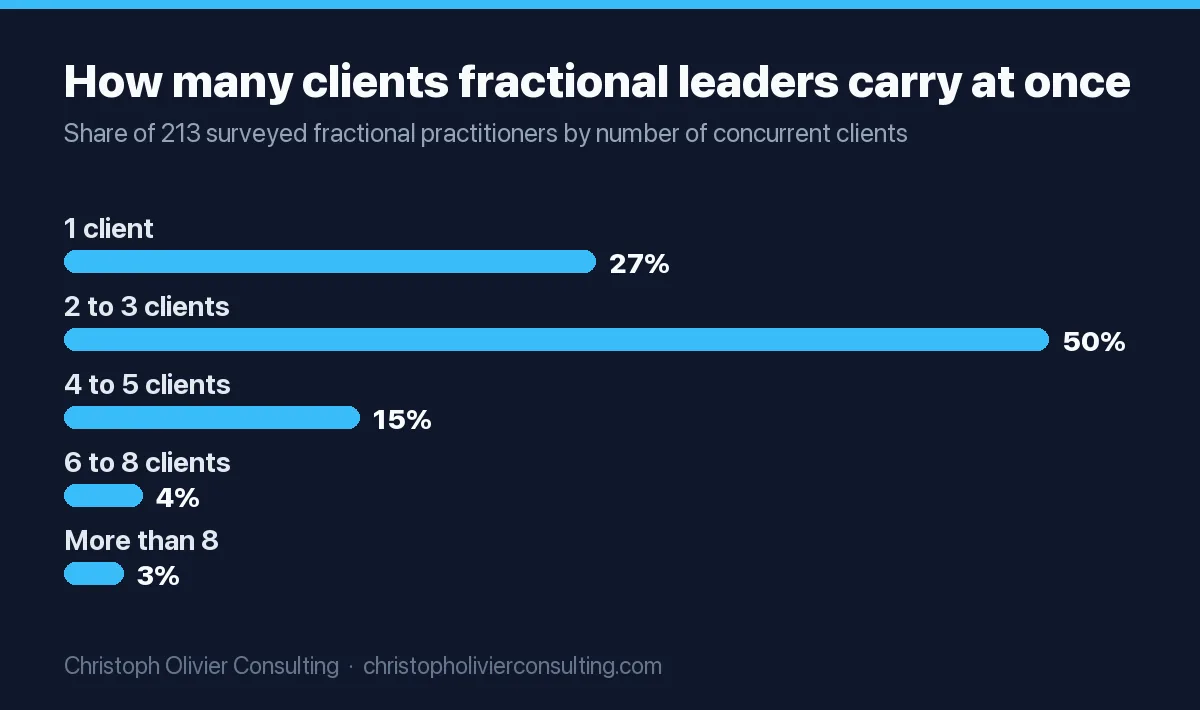
Section 6 of the template is where buyers test whether you are really available. Go Fractional’s 2026 survey of 213 fractional practitioners found half work with two or three clients at once, and its report notes four to five clients is common in marketing. A buyer who knows that will read “as needed” as “after my other clients.” Put an hours number, a meeting cadence and a response time in writing.
If the client’s main question is whether they need a fractional leader at all, not which tier, step back to when to hire a fractional CMO before sending pricing.
What belongs in the proposal and what goes in the contract
Keep legal terms out of the proposal. A buyer reading indemnity language on page two starts reading like a lawyer, not like a CEO picturing results. The proposal names the commercial basics; the agreement holds the enforceable detail.
| Topic | In the proposal | In the agreement |
|---|---|---|
| Term | “3 months, then month to month” | Start date, renewal mechanics, notice rules |
| Fees | Tier prices, billing in advance | Invoicing, late payment, expenses, rate changes |
| Scope | Deliverables, hours, out-of-scope list | Change-order process, overage handling |
| Accounts and data | Access you need to start | Ownership of ad accounts, analytics and work product |
| Confidentiality and conflicts | Not covered | Confidentiality, non-solicit, conflicts with competing clients |
| Ending the engagement | Notice period in one line | Termination, handover, work in progress |
Fractional CMO proposal review checklist (pass/fail)
Run your draft through these tests before it goes out. One fail is a rewrite, not a judgment call. Buyers can use the same list to grade proposals they receive; it works the same way our guide to reading an SEO proposal does for agency pitches.
| # | Test | Pass | Fail |
|---|---|---|---|
| 1 | Situation in the client’s words | At least two direct problems from the calls, with dates | Generic market commentary |
| 2 | Every KPI has a baseline | Number and source, or “measure in month 1” | Target with no starting point |
| 3 | No guaranteed outcomes | Targets framed as targets, with what you control | “We will double your leads” |
| 4 | 30/60/90 has outputs | A named deliverable and due day in each block | Phases with activities only |
| 5 | Hours are stated | Hours per month for each tier | “Flexible” or “as needed” |
| 6 | Out of scope is explicit | Ad spend, tools, execution and overage listed | No out-of-scope section |
| 7 | Price math holds | Each tier = hours x a rate you can cite | Tiers with no visible logic |
| 8 | Execution priced apart from strategy | Separate lines or clearly excluded | One blended number |
| 9 | Client obligations named | Access, owner time, budget, by date | All obligations on your side |
| 10 | Assumptions that move the price | Listed, with “revise in writing” rule | Missing |
| 11 | Proof is real | Only results you can document and are allowed to share | Unnamed or unverifiable case studies |
| 12 | One next step with a date | “Reply with your option by [date]” | “Let us know” |
| 13 | Length | Readable in one sitting, price easy to find | Ten pages before the price |
| 14 | Expiry date | Valid-until date on page one | Open-ended pricing |
If you are on the buying side and want a second read of a fractional CMO proposal against this list, you can book a consultation and bring the document. If you are writing your first one, the companion step is the plan the proposal promises; our guide to creating a marketing plan shows what the day-60 deliverable should contain.
Ready to scale your revenue?
Book a free 30-min consultation. We’ll diagnose your growth bottleneck and map out the 3 highest-leverage moves for your business.
Frequently asked questions
What should a fractional CMO proposal include?
Nine sections: a situation summary in the client's words, goals and KPIs with baselines, a 30/60/90-day plan with a deliverable in each block, monthly scope, an out-of-scope list, team and hours, two or three priced options, assumptions that would change the price, and one next step with a date. Legal terms such as IP, confidentiality and termination belong in the separate engagement agreement.
How much should I charge in a fractional CMO proposal?
Price each tier as hours per month times an hourly rate you can defend. Go Fractional's live CMO benchmark shows a $170 average and a $125 to $200 middle band in November 2026, which works out to $8,500 to $13,600 a month at 17 hours a week. MarketerHire publishes $3,000 to $15,000 a month for retainers.
What is a typical fractional CMO scope of work?
It depends on hours. At about 20 hours a month you get strategy, a plan and a monthly review. At 40 hours you add weekly sessions, vendor management and budget ownership. At 60 to 70 hours the CMO also manages staff and sits in leadership meetings. Execution such as ad buying, writing and web work is usually out of scope and priced separately.
How long should a fractional CMO proposal be?
Short enough to read in one sitting, usually two to four pages, with the price easy to find. Snack Club recommends two or three pages with the price on page one. Put detail into the 30/60/90 plan and the scope list, not into background on your firm or general commentary about marketing.
Is a fractional CMO proposal the same as a contract?
No. The proposal sells the engagement: problem, plan, scope, hours and price. The contract or engagement agreement makes it enforceable: term and renewal, payment terms, ownership of accounts and work product, confidentiality and termination. Fractional Jobs makes the same distinction. Send the proposal first, then the agreement once the client picks an option.
How many hours a month does a fractional CMO work?
Published benchmarks cluster around 10 to 20 hours a week. Go Fractional's CMO benchmark uses a typical 17 hours a week, its pricing guide recommends at least 10 hours a week or 40 hours a month, and MarketerHire cites 10 to 20 hours a week for most clients. State the exact monthly hours for each tier in the proposal.