
Last reviewed: October 2026
A fractional CMO for accounting firms is a senior marketing leader who runs your firm’s growth strategy on a part-time retainer, usually two to three days a week, instead of you hiring a full-time chief marketing officer or handing execution to an agency. For a $2M to $10M firm, that means someone who can own the growth equation (revenue per partner, realization, the advisory and CAS mix) and keep every claim inside AICPA and state-board advertising rules, at roughly 40% to 70% less than a full-time hire.
What a fractional CMO for accounting firms actually does
A fractional CMO sets the marketing strategy, decides which channels get budget, hires and supervises the specialists or agencies who execute, and reports growth in the numbers a managing partner already tracks. The job is leadership and accountability, not campaign button-pushing. For most firms under $10M the partner has been the de facto CMO, and this role takes that off the partner’s desk.
In practice the work splits into three layers. Strategy: positioning, niche, and the client-mix target. Orchestration: choosing and managing SEO, local, paid, content, and referral efforts so they pull together. Measurement: tying spend to booked advisory work and revenue per partner, not vanity lead counts. A good fractional CMO spends more time saying no to the wrong tactics than launching new ones.
When a fractional CMO beats an agency or a full-time hire
A fractional CMO fits when you need senior marketing judgment but cannot justify a full-time executive, and when your problem is strategy and coordination rather than a single channel. An agency fits when you already know the strategy and just need execution in one lane. A full-time CMO fits when marketing is large and complex enough to need a daily, dedicated leader. The honest menu below shows where each one wins.
| Option | Works best when | Not the right fit when |
|---|---|---|
| Fractional CMO | You are a $2M to $10M firm, marketing is run reactively by a partner, you need strategy plus someone to manage the people doing the work, and you want senior leadership without a six-figure hire. | You have under about $500K in revenue and need low-cost execution, or your marketing is already large enough to keep a full-time leader busy every day. |
| Marketing agency | Your strategy and positioning are settled and you need skilled execution in a defined lane (local SEO, Google Ads, content production) with clear briefs. | You need someone to decide the strategy, hold channels accountable to firm economics, or make the compliance calls. Most agencies execute; they do not own the growth equation. |
| Full-time CMO | You are a regional firm, often $10M+, with enough marketing volume, team, and budget to keep a dedicated executive fully engaged and to absorb the loaded cost. | You cannot realistically fill a senior leader’s week, or the loaded cost (salary, benefits, equity, notice) would swallow a marketing budget that should be funding actual campaigns. |
| Partner-as-CMO (status quo) | You are very small, early, and the partner genuinely has the time and interest to learn and run marketing. | Billable time is worth more than the marketing is returning, efforts are inconsistent, or growth has stalled because no one owns it. |
The decision is rarely clean. Many firms run a fractional CMO on top of one or two specialist agencies, so the CMO sets direction and the agencies execute. That is a valid structure and often the right one. Rather than guess which mix fits your firm, a short consultation is the sensible next step.
What a fractional CMO costs versus an agency or a full-time hire
Expect a fractional CMO retainer in the range of about $8,000 to $15,000 a month for professional-services work, with roughly $10,000 to $12,000 common for a $2M to $10M firm. A full-service marketing agency retainer for a small business commonly runs around $3,000 to $5,000 a month. A full-time CMO lands near $29,000 to $42,000 a month once salary and benefits are loaded in.
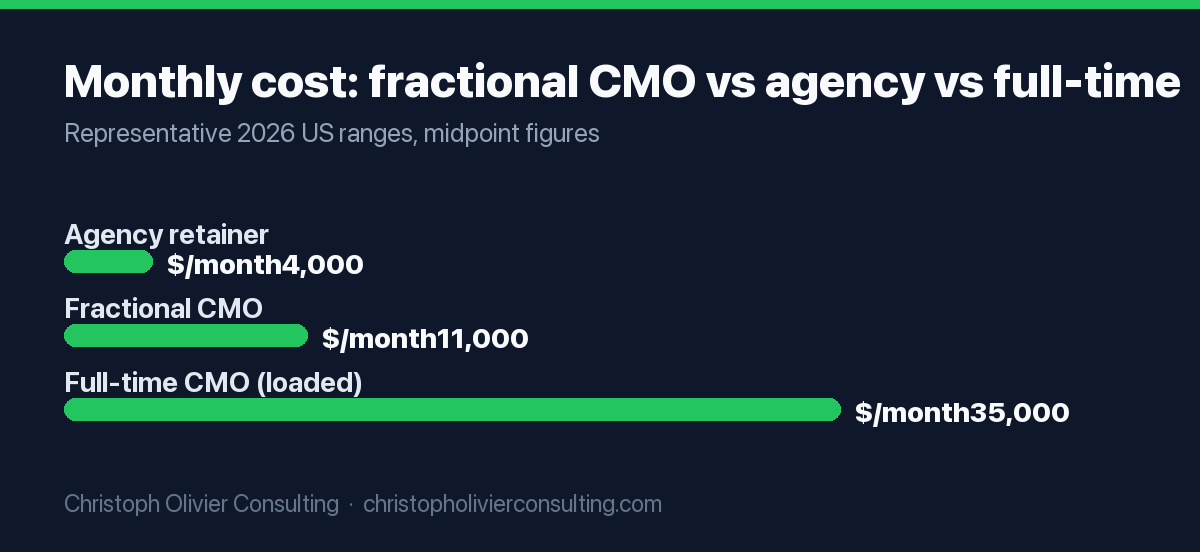
The figures are not apples-to-apples, and it would be dishonest to pretend they are. An agency at $4,000 a month buys execution in a narrow lane, not senior strategy or accountability for firm economics. A fractional CMO costs more per month than that agency but replaces the function of a $300,000-plus executive and manages the agencies you do keep. Below is the honest monthly comparison; use it as a starting frame, not a quote.
- Scope first, price second. Decide whether you are buying strategy, execution, or both before you compare numbers.
- Count the loaded cost of a hire. A full-time CMO is not just salary; benefits add roughly 30% on top, plus recruiting time and severance risk.
- Judge spend against margin, not revenue. An accounting client can stay for a decade, so a signed advisory client is worth far more than a cost-per-lead view suggests.
For a fuller budgeting framework, see how much accounting firms should spend on marketing.
The growth equation a fractional CMO owns for your firm
Generic agencies sell lead volume. That is the wrong outcome for a profession that is capacity-constrained, with the CPA pipeline down roughly 30% since 2016 and firms already turning work away. The real job is a better client mix, shifting the book toward recurring advisory and client advisory services (CAS), where the margin and growth are. A fractional CMO manages marketing to those economics.
The numbers that matter to a managing partner, and that this role is accountable to:
- Revenue per partner. The 2025 Rosenberg Survey put average income per partner near $615,000; marketing should move this, not just the inbox.
- Realization and utilization. Better-fit clients lift realization (commonly 85% to 97%) because you are not discounting to win price-shoppers.
- Advisory and CAS mix. CAS revenue rose about 61% since the 2022 benchmark and advisory-heavy firms produce roughly 17% more revenue per work hour; marketing should feed that shift.
- Client lifetime value on margin. Long tenure makes a signed advisory client worth defending a higher acquisition cost, judged on gross margin over years.
A timely example: the One Big Beautiful Bill Act, signed July 4, 2025, made the QBI deduction and bonus depreciation permanent, raised the SALT cap, and added new deductions for tips and overtime. That is a fresh advisory conversation to market around in the 2026 season, and a fractional CMO builds the content and campaigns to own it.
Methods, limits, and compliance for CPA firm marketing
CPA firm marketing sits under two layers of rules: the AICPA Code of Professional Conduct and your state board of accountancy, which can be stricter. A fractional CMO who knows the profession keeps every claim inside those rules. No competent practitioner can promise rankings, lead counts, or revenue, and the rules themselves bar several claims an untrained agency makes without thinking.
What a CPA firm cannot say, and what we build around:
- No false, misleading, or deceptive claims. AICPA Rule 1.600.001 bars advertising that is false, misleading, or deceptive, and bars solicitation by coercion or harassment.
- No self-laudatory or unverifiable claims. “Best CPA firm” or “#1 tax firm” language is not permitted where it is not based on verifiable facts (for example Texas 22 TAC 501.82).
- No guaranteed outcomes. Guaranteed refunds, assured savings, or guaranteed audit protection read as deceptive and unperformable.
- Testimonials are state-regulated. Texas requires testimonials be based on verifiable facts; Florida treats them cautiously. Review strategy has to be handled state by state, not with a generic review-gating playbook.
- Confidentiality holds in marketing too. AICPA Rule 1.700.001 and IRC Sec. 7216 mean client data cannot go into public AI tools without consent or a no-training agreement, so any AI workflow we run avoids client PII.
These rules are state-specific and current as of 2026. Nothing here is a guarantee of results. Marketing moves probabilities, and the honest framing is conditional: done well, these methods tend to improve client mix and inbound quality over time, with no assured number attached.
Fractional CMO versus our other accounting-firm services
A fractional CMO is the leadership layer; the channel services are the execution beneath it. If you already have clear direction and need one channel built, a single specialist engagement is the better and cheaper choice. If you need someone to set strategy and then coordinate several channels, the fractional CMO role is what ties them together. Here is the honest split.
Pick a single service when the problem is contained. For visibility in organic search for advisory and niche topics, start with SEO for accounting firms. To win the local “near me” moment through Google Business Profile, start with local SEO for accounting firms. For the full picture of channels and how they fit together, the marketing for accounting firms hub maps the whole system. Choose the fractional CMO when no one at the firm owns the strategy across all of these.
Book a consultation
If you run a $2M to $10M accounting firm and marketing has become reactive, a short call will tell you honestly whether a fractional CMO, a single specialist, or a different structure fits your situation. There is no obligation and no guaranteed-outcome pitch. Book a consultation to talk through your growth equation.
Frequently asked questions
What does a fractional CMO for accounting firms cost?
For professional-services work, retainers commonly run about $8,000 to $15,000 a month, with roughly $10,000 to $12,000 typical for a $2M to $10M firm. That is usually 40% to 70% below the loaded cost of a full-time CMO, which runs about $29,000 to $42,000 a month once salary and benefits are counted. Scope drives the number, so treat these as ranges, not a quote.
How is a fractional CMO different from a marketing agency?
An agency executes in a defined lane, such as local SEO or paid ads, usually at around $3,000 to $5,000 a month. A fractional CMO sets the strategy, decides where budget goes, and manages the agencies and specialists who execute, while staying accountable to firm economics like revenue per partner and advisory mix. Many firms run both: the CMO directs, the agency delivers.
When is my firm too small for a fractional CMO?
If your firm is under roughly $500K in revenue and your main need is low-cost execution, a single specialist or focused agency is usually the better fit. The fractional CMO model earns its retainer once a firm is large enough, generally $2M to $10M, to need senior strategy and coordination across several channels but cannot justify a full-time executive hire.
Can a fractional CMO guarantee more clients or higher rankings?
No, and any marketer who promises that for a CPA firm is ignoring the rules. AICPA Rule 1.600.001 bars false, misleading, and guaranteed-outcome claims, and state boards add their own limits. Honest marketing improves the probability of better-fit clients and a stronger advisory mix over time; it does not come with an assured number of leads or a guaranteed ranking.
Will a fractional CMO understand CPA advertising and confidentiality rules?
That is the point of hiring one who knows the profession. The work stays inside AICPA Rule 1.600.001 on advertising, handles testimonials state by state (Texas 501.82, Florida’s cautious stance), and respects confidentiality under Rule 1.700.001 and IRC Sec. 7216 by keeping client data out of public AI tools. Rules are state-specific and current as of 2026.
All CO Consulting marketing services for accounting firms
- Marketing for CPA & Accounting Firms (overview)
- Fractional CMO (you are here)
- Revenue Growth
- SEO
- Local SEO
- Meta (Facebook & Instagram) Ads
- Content Marketing
- AI Marketing
- Rank on ChatGPT (AI Search)
- Referral Marketing
Book a consultation to map the right mix for your firm.