
Last reviewed: October 2026
Revenue growth for accounting firms is a growth equation, not a lead-count. The partners who pull ahead lift revenue per partner and realization by moving the client mix toward advisory and client advisory services (CAS), by pricing and packaging the work properly, and by keeping their best clients for years. Buying more cheap tax-prep leads does the opposite when the firm is already short on people to do the work.
This page explains how we approach revenue growth for accounting firms, when outside help is worth it, when it is not, and the compliance rules that shape what any marketing or growth partner can honestly promise you.
What revenue growth for accounting firms actually means
For a managing partner, revenue growth means more profit per partner and per full-time employee, not a bigger pile of unqualified inquiries. The levers that move it are client mix (advisory and CAS share of the book), pricing and packaging, realization (fees collected against standard rates), and retention. A firm can grow top-line revenue and still go backwards on profit if it adds low-margin compliance work it has no capacity to deliver.
The growth equation: the four levers that move revenue per partner
Think of firm revenue as rate times realized hours times retention, upgraded by client mix. Four levers move the number: shift the mix toward higher-value advisory and CAS, price and package for outcomes instead of hours, protect realization so discounting does not quietly erase gains, and retain high-value clients whose tenure can run a decade or more. Lead generation only matters after these are working, because new clients flow into whatever economics you already have.
- Client mix: move from one-off 1040s toward recurring advisory and CAS retainers.
- Pricing and packaging: replace hourly quotes with tiered, outcome-based packages.
- Realization and capacity: collect more of standard fees and free up senior time.
- Retention and client LTV: keep the right clients longer and cross-sell advisory.
Why raw lead volume is the wrong target
Most firms are capacity-constrained, not demand-starved. CPA exam candidates are down roughly 30% since 2016, accounting degree completions fell about 30% over a decade, and there are around 1.78 million working accountants, close to 10% fewer than in 2019. A generic “50 leads a month” campaign aims at a problem most firms do not have. The constraint is who does the work, so the growth message is client quality and capacity, not volume.
Shifting your client mix toward advisory and CAS
This is the core of the growth story. Advisory and CAS carry higher margins and recurring revenue, and the data shows the gap. CAS practices reported a median growth rate near 17%, and median annual CAS revenue rose 61% since the 2022 benchmark to about $1.6M per respondent. Inside Public Accounting found firms earning more than 60% of revenue outside compliance produced about $152 of revenue per work hour versus about $130 across the IPA 100, roughly 17% higher.
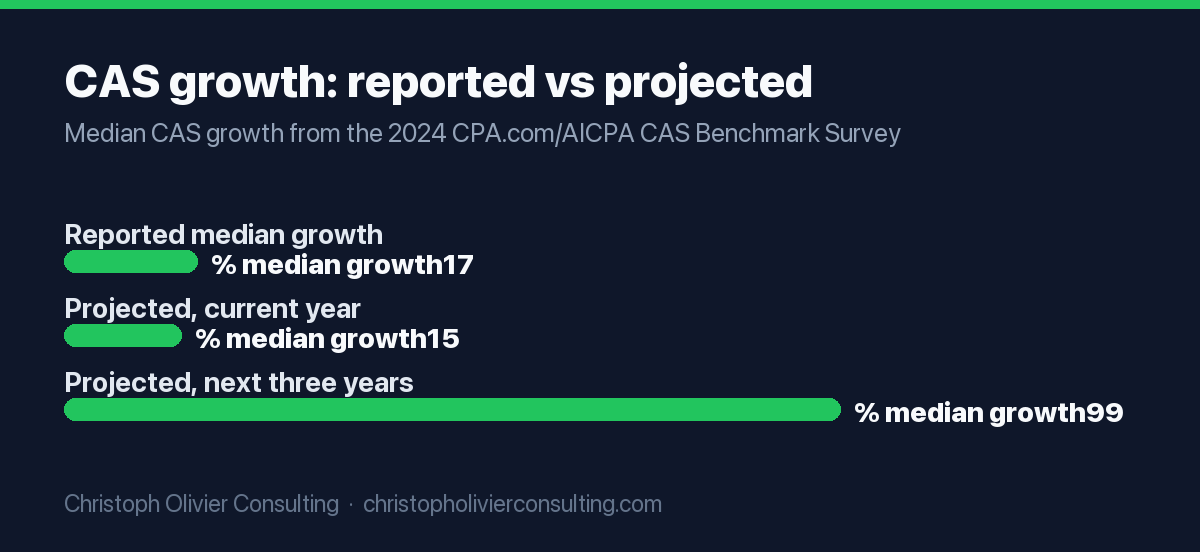
One honest caveat: that revenue-per-hour comparison is a correlation, not proof that advisory work alone causes higher output. Advisory-heavy firms often differ in pricing, client selection, and staffing too. The direction is consistent across several sources, which is why we treat mix as a lever to build deliberately rather than a guaranteed switch.
Pricing and packaging for outcomes, not hours
Pricing is the fastest lever most firms underuse. Only about 10% of CAS practices still bill advisory work hourly, and firms that package value-based tiers report higher close rates and stronger monthly recurring revenue than firms quoting by the timesheet. We help you build predictable compliance packages alongside tiered advisory pricing, so buyers compare your fee to an outcome instead of an hourly rate. We frame ranges honestly and never promise a specific revenue figure.
Retention, realization, and client LTV
An accounting relationship can last ten years or more, so small changes in retention compound hard. Protecting realization (collecting more of standard fees instead of writing time off) and reducing churn among high-value clients often beats chasing new logos. Because true lifetime value should be measured on gross margin across a long tenure, firms can usually justify spending more to win and keep the right client than a generic agency assumes.
Is revenue growth consulting the right fit for your firm?
Outside revenue-growth help fits some firms and not others. The honest read depends on your size, your current advisory share, and whether your constraint is strategy or simple capacity. Use the menu below as a starting point, then book a consultation so we can pressure-test it against your actual numbers rather than deciding for you from a table.
| Situation | Works well when | Not the right fit when |
|---|---|---|
| Firm size $2M to $10M | You can justify senior growth strategy but cannot absorb a full-time hire | You are a solo practitioner who mainly needs more hours in the day |
| Advisory and CAS share | Compliance dominates the book and you want to build recurring advisory revenue | Advisory is already most of your revenue and running well |
| Pricing maturity | You still quote hourly and suspect you are underpricing advisory | You have tiered, value-based packaging already in place |
| Capacity | You want fewer, higher-value clients to match limited staff | You have spare capacity and genuinely need raw lead volume first |
| Data readiness | You track revenue per partner, realization, and mix, or want to start | You have no interest in measuring the economics behind growth |
Revenue growth consulting vs a fractional CMO vs referral marketing
These overlap, so here is the honest routing. Revenue-growth consulting works on the whole equation (mix, pricing, realization, retention). If your real gap is leading and running the marketing function over time, a fractional CMO for accounting firms is the better fit. If your single biggest lever is structuring referrals and centers of influence, start with referral marketing for accounting firms. For the full menu of channels, see our marketing for accounting firms hub, and for budget context read how much accounting firms should spend on marketing.
Methods, limits, and compliance for CPA firms
Any growth or marketing claim a CPA firm makes is governed by the AICPA Code of Professional Conduct and your state board, which can be stricter. Under AICPA Rule 1.600.001 a firm cannot seek clients through advertising that is false, misleading, or deceptive, cannot use self-laudatory claims that are not verifiable (such as “the best CPA firm in the state”), and cannot promise guaranteed outcomes. That is why we will never promise a specific revenue lift, growth rate, or ranking.
What we do promise is a method and conditional language. We model targets from your own benchmarks (revenue per partner, realization, advisory share), test pricing and mix changes in stages, and report results honestly, including when something does not work. Testimonials and reviews are state-regulated for CPAs (for example, Texas Rule 501.82 requires testimonials to rest on verifiable facts, and several states treat them cautiously), so we build review strategy state by state rather than copying a generic playbook. Benchmarks cited here come from reported industry surveys and describe the profession, not a prediction for your firm.
Frequently asked questions
Short answers to the questions partners ask most about revenue growth for accounting firms are below.
Book a revenue-growth consultation
If you want to pressure-test your growth equation against your own numbers, the next step is a conversation, not a contract. We will look at your client mix, pricing, realization, and capacity, and tell you honestly where the biggest gains are and whether outside help is even worth it. Book a consultation to get started.
Frequently asked questions
What does revenue growth for accounting firms actually mean?
It means lifting profit per partner and per employee by improving client mix, pricing, realization, and retention, not simply generating more leads. A firm can grow top-line revenue and still lose profit by adding low-margin compliance work it lacks the capacity to deliver.
Why is more lead volume often the wrong goal?
Most firms are capacity-constrained. CPA candidates are down about 30% since 2016 and there are roughly 10% fewer working accountants than in 2019, so the constraint is staff, not demand. Fewer, higher-value, better-fit clients beat a flood of cheap tax-prep inquiries.
How much faster does advisory and CAS revenue grow?
CAS practices reported median growth near 17%, and median annual CAS revenue rose 61% since the 2022 benchmark. Firms earning most revenue outside compliance also showed higher revenue per work hour (about $152 vs $130), though that figure is a correlation, not a guarantee.
Can you guarantee a specific revenue increase?
No. AICPA Rule 1.600.001 prohibits false, misleading, or guaranteed-outcome claims for CPA firms, so any honest partner will model targets from your own benchmarks and use conditional language instead of promising a number, a growth rate, or a ranking.
Is this different from hiring a fractional CMO?
Yes. Revenue-growth consulting works the whole equation of mix, pricing, realization, and retention. A fractional CMO leads and runs the marketing function over time. Many firms start with a growth diagnosis, then add fractional leadership if the gap is ongoing execution.
Does better pricing really move the number?
Often more than new leads. Only about 10% of CAS practices still bill advisory hourly, and firms using tiered, value-based packages report higher close rates and stronger recurring revenue. Pricing is usually the fastest lever an underpriced firm can pull.
All CO Consulting marketing services for accounting firms
- Marketing for CPA & Accounting Firms (overview)
- Fractional CMO
- Revenue Growth (you are here)
- SEO
- Local SEO
- Meta (Facebook & Instagram) Ads
- Content Marketing
- AI Marketing
- Rank on ChatGPT (AI Search)
- Referral Marketing
Book a consultation to map the right mix for your firm.