
Last reviewed: October 2026
Facebook ads for accounting firms now work as a demand-generation channel, not a precision search-capture channel. Since Meta forced financial advertisers into its Financial Products and Services Special Ad Category on January 21, 2025, the ZIP, age, gender, and lookalike targeting that old agency playbooks depended on is gone. Firms that win on Facebook and Instagram today lead with a strong offer, a specific creative, and a lead magnet, then qualify the prospect after the click.
Why Facebook ads for accounting firms changed in 2025
Meta introduced a Financial Products and Services Special Ad Category in late 2024 and made it mandatory for United States financial advertisers on January 21, 2025. It absorbed the older Credit category. Ads that should sit in this category can be rejected if the category is not selected, so the setting is not optional guesswork; it is an account-level compliance decision.
Whether a general CPA or bookkeeping ad is strictly required to self-declare this category is not clearly documented by Meta, whose named examples lean toward banking, insurance, loans, and investments. The honest advice: expect possible classification, check the setting in your own Ads Manager, and plan your targeting as if the restrictions apply. Mis-setting it is a common way accounts get flagged.
What the Special Ad Category strips from the generic playbook
Inside the category, Meta removes the levers most agencies build campaigns around. You lose ZIP or postal-code targeting, age and gender targeting (age is locked to a broad 18 to 65+ band), audience exclusions, standard lookalike audiences, and many detailed-interest filters. Location targeting carries a 15-mile minimum radius. A pitch built on tight demographic or interest layering simply cannot run.
| Targeting lever | Normal campaign | Inside the Special Ad Category |
|---|---|---|
| ZIP / postal code | Allowed | Blocked; 15-mile minimum radius |
| Age and gender | Allowed | Locked to 18 to 65+, no gender filter |
| Lookalike audiences | Allowed | Replaced by restricted Special Ad Audiences |
| Audience exclusions | Allowed | Blocked |
| Detailed interests | Full set | Limited set |
| Custom audiences (retargeting, client list) | Allowed | Still allowed |
What survives matters as much as what breaks. Custom audiences built from your own first-party data, such as an email list or site retargeting, still work, and they become the backbone of a compliant funnel.
The demand-generation approach that still works
With targeting flattened, the ad creative and the offer carry the campaign. Facebook and Instagram are interruption channels: nobody searches there for a CPA the way they do on Google. So the job is to generate demand from people who were not actively looking, then capture and qualify them. The sequence that holds up under the category restrictions:
- Lead magnet first. Offer something specific and useful, such as a 2026 OBBBA tax-change checklist, an entity-structure guide, or a year-end planning worksheet, rather than a generic “contact us.”
- Creative does the targeting. Because you cannot pre-select the audience tightly, the ad copy and visual must name the exact prospect (“business owners filing an S-corp return,” for example) so the right people self-identify.
- Broad targeting plus the algorithm. Give Meta a wide audience and let delivery optimization find responders. Broad beats narrow when narrow is no longer available anyway.
- Qualify after the click. Use the landing page and form questions (revenue band, entity type, service need) to filter fit, since you can no longer filter it in the targeting.
- Retarget and nurture. Feed lead-magnet downloaders into a retargeting custom audience and an email sequence, because an accounting decision has a long consideration cycle.
When Facebook ads are the right fit for your accounting firm
Facebook ads suit some firm situations and work against others. This channel builds awareness and an email list for a longer nurture; it is weaker for capturing someone with urgent, high-intent need right now. Use this menu to judge fit, then book a call to pressure-test it against your firm.
| Facebook and Instagram ads work best when… | Not the right fit when… |
|---|---|
| You have a strong lead magnet or seminar/webinar offer to promote | You only want to appear for high-intent searchers ready to hire now (that is Google Ads) |
| You serve a clear niche you can name in creative (dentists, real estate investors, SaaS founders) | You cannot describe your ideal client specifically enough for creative to self-select them |
| You can nurture leads by email over weeks or months | You have no follow-up system and expect signed clients from a single click |
| You have capacity to take on better-fit clients | You are already at capacity and chasing volume you cannot serve |
| You want to warm up a local market and support referrals | Your entire growth model is referral-only and you want no paid demand gen |
What Facebook ads for accounting firms cost
Reported cost per lead for accounting firms on Facebook commonly falls around $20 to $55 for a general inquiry, and roughly $40 to $90 for a qualified business-owner lead, reflecting a competitive business-to-business auction. Treat these as reported ranges, not promises; your cost moves with offer strength, creative, season (tax season is more expensive), and geography. A lead is a form fill, not a signed client, so plan budget against your close rate and client lifetime value on margin, not on raw lead count.
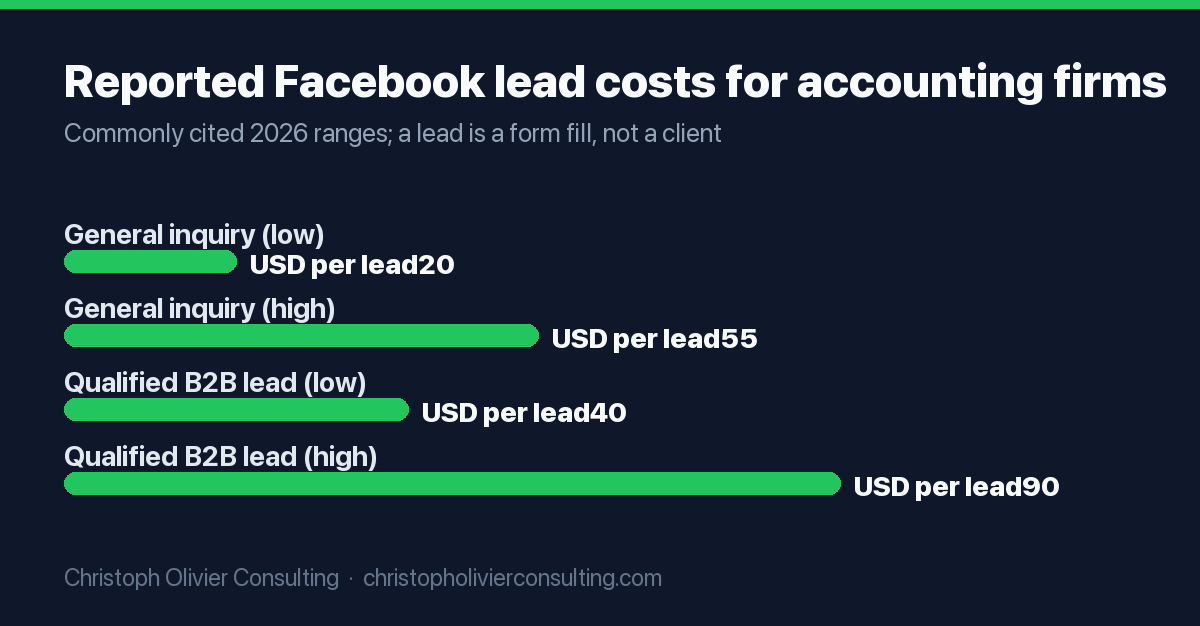
Small practices often run $8,000 to $20,000 per year, weighted toward tax season; mid-size firms targeting business clients commonly budget a few thousand dollars per month for steady advisory lead flow. For how these numbers fit a full plan, see how much accounting firms should spend on marketing.
Methods, limits, and compliance for CPA firms
CPA firms answer to the AICPA Code of Professional Conduct and to their state board, and paid social is a frequent place those rules get broken. The compliance guardrails below are built into any Meta program I would run for a firm, and they are stricter than what a generic agency applies.
- No false, misleading, or deceptive claims (AICPA Rule 1.600.001). That rules out guaranteed-refund, guaranteed-savings, or “audit-proof” ad hooks, and self-laudatory claims such as “the best CPA firm” that are not based on verifiable fact.
- Testimonials are state-regulated. Texas (22 TAC 501.82) allows testimonials only when based on verifiable facts; Florida treats client testimonials cautiously under Rule 61H1-24.001. Confirm your own state board’s current text before running review-based creative, rather than assuming the generic “stack up five-star testimonials” tactic is legal everywhere.
- Confidentiality holds in marketing too (AICPA Rule 1.700.001). Client names, numbers, and situations do not go into ad copy or case studies without specific consent.
- Credentials must be accurate. Only an actively licensed person or firm may present itself as a “CPA” in ad copy or bios.
- Category and claims are not a guarantee of results. No ethical program promises leads, cost per lead, or ranking; delivery is probabilistic and set conditionally.
This is a conservative reading of the rules, and board rules are state-specific and current as of 2026; your firm’s own counsel or board remains the final word.
Facebook ads versus other CO services for accounting firms
Paid social is one channel, not a strategy. It earns its place when you have an offer worth promoting and a system to nurture what it produces. If your need is different, another service fits better, and I will say so before taking a Meta engagement.
- Want to capture people actively searching “CPA near me” or “R&D tax credit accountant” right now? Start with Google Ads for accounting firms.
- Have no lead magnet or thought-leadership assets to run ads against yet? Build those first with content marketing for accounting firms.
- Not sure which channels belong in the mix at all? The marketing for accounting firms hub lays out the full situational menu.
Book a consultation
If you want an honest read on whether Facebook and Instagram ads fit your firm’s offer, capacity, and compliance posture, book a consultation. We will look at your lead magnet, your targeting options under the Special Ad Category, and whether paid social or another channel earns your next marketing dollar.
Frequently asked questions
Are Facebook ads worth it for accounting firms in 2026?
They can be, as a demand-generation and list-building channel rather than a direct search-capture one. Since the Special Ad Category removed precise targeting on January 21, 2025, firms that win lead with a specific lead magnet and strong creative, then qualify leads after the click and nurture them by email. If you have no offer or follow-up system, Google Ads or content usually pays back faster.
Do accounting firms have to use Meta's Financial Products and Services Special Ad Category?
Meta made the category mandatory for United States financial advertisers on January 21, 2025, and ads can be rejected if an appropriate category is not selected. Whether a general CPA or bookkeeping ad must self-declare it is not clearly documented, since Meta’s named examples lean toward banking, insurance, and loans. Check the setting in your own Ads Manager and plan targeting as if the restrictions apply.
What targeting do accounting firms lose in the Special Ad Category?
You lose ZIP or postal-code targeting (a 15-mile minimum radius applies), age and gender targeting (age locks to 18 to 65+), audience exclusions, standard lookalike audiences, and many detailed interests. Custom audiences from your own first-party data, such as retargeting and client-list audiences, still work and become the core of a compliant funnel.
How much do Facebook ads cost for an accounting firm?
Reported cost per lead commonly runs about $20 to $55 for a general inquiry and roughly $40 to $90 for a qualified business-owner lead. These are reported ranges, not promises; cost moves with your offer, creative, season, and location. A lead is a form fill, not a signed client, so budget against your close rate and client lifetime value.
What can a CPA firm not say in a Facebook ad?
Under AICPA Rule 1.600.001, no false, misleading, or deceptive claims, no guaranteed-refund or guaranteed-savings language, and no self-laudatory claims like best or number one that are not based on verifiable fact. Testimonials are state-regulated (Texas requires verifiable facts; Florida is cautious), and client details stay confidential under Rule 1.700.001 without specific consent.
All CO Consulting marketing services for accounting firms
- Marketing for CPA & Accounting Firms (overview)
- Fractional CMO
- Revenue Growth
- SEO
- Local SEO
- Meta (Facebook & Instagram) Ads (you are here)
- Content Marketing
- AI Marketing
- Rank on ChatGPT (AI Search)
- Referral Marketing
Book a consultation to map the right mix for your firm.