
Last reviewed: October 2026
Referral marketing for accounting firms is the practice of turning your best clients and your professional network (attorneys, financial advisors, and bankers) into a steady, trackable source of better-fit work, built on reciprocity and education rather than paid lead-buying. For CPA and tax firms it is the highest-yield channel, and it carries a compliance layer most marketers ignore: AICPA Rule 1.520 on commissions and referral fees.
This page explains when a referral program is the right move for your firm, how to build a reciprocal center-of-influence (COI) engine, and where the ethics rules draw hard lines. It is written for the managing partner or owner who is also the de facto head of marketing.
Why referral marketing for accounting firms works
Because word of mouth is how firms actually get hired. In TaxDome’s 2025 survey of business clients, 58% said they found their current accountant through a referral, against 17% from online search and just 3% from advertising. The firms that treat referrals as a managed system, not a lucky accident, compound a channel that already dominates acquisition.
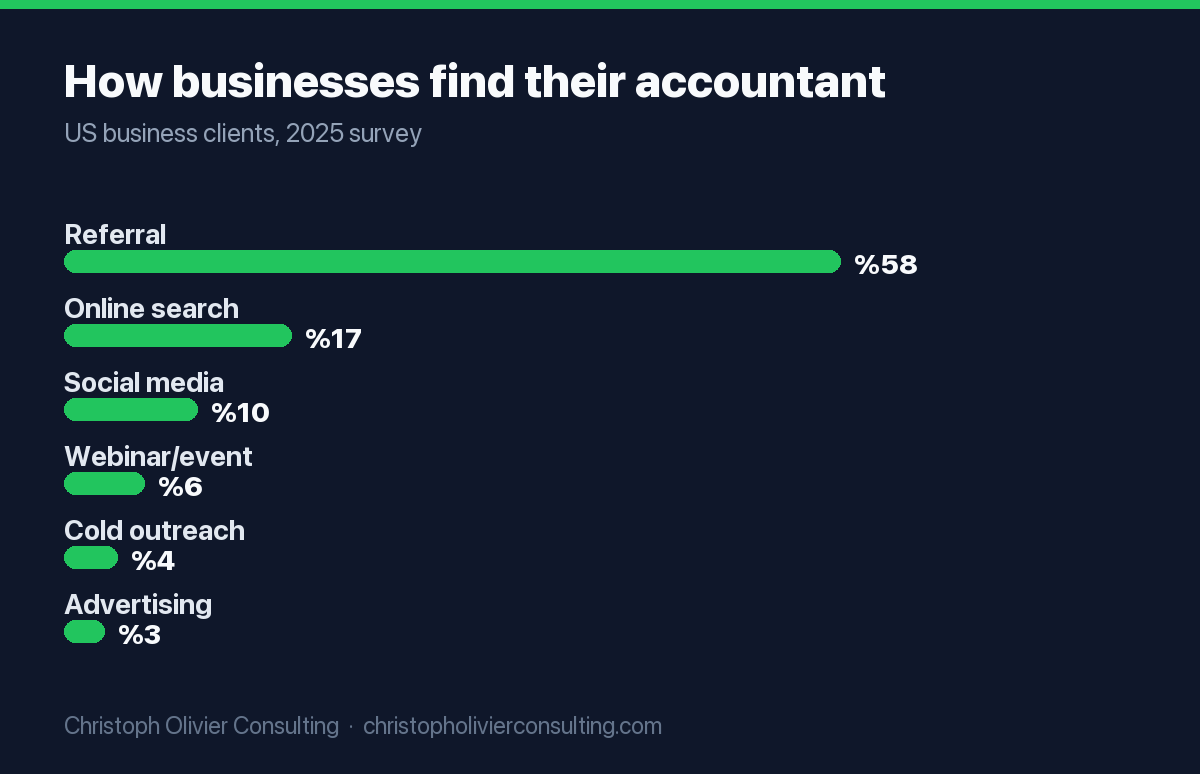
The deeper reason is client quality. A referred client arrives pre-trusted, closes faster, and tends to fit your ideal profile better than a cold search lead. For capacity-constrained firms (the CPA pipeline has shrunk sharply since 2016), the goal is not raw lead volume but a better client mix, more advisory and CAS retainers, fewer one-off price-shoppers. Referrals bias toward exactly that kind of client.
Referrals from clients vs centers of influence
Two distinct engines sit inside “referrals.” Client referrals come from happy clients who recommend you to peers. COI referrals come from other professionals whose clients also need an accountant. Client referrals are higher in volume; COI referrals are higher in value and more systematizable, which is why a mature program runs both in parallel.
Centers of influence: attorneys, financial advisors, and bankers
A center of influence is a non-competing professional who serves the same clients you want and can send work your way. For accounting firms the core COIs are estate and business attorneys, financial advisors and wealth managers, commercial bankers, insurance agents, and fractional CFOs. The relationship is reciprocal: referrals flow both ways and both parties look good to the shared client.
Why these three partner types matter most
Attorneys (estate, M&A, divorce, business formation) routinely hit moments where a client needs tax or advisory help. Financial advisors need a tax partner to execute planning and often formalize CPA alliances. Bankers see cash-flow and lending events that trigger CFO and bookkeeping needs. Each sees your ideal client at a decision point you rarely reach first.
Depth beats breadth
Firms that win at COI referrals cultivate a handful of deep partnerships, not a long thin list. A practical target is 10 to 20 prospective partners, narrowed over time to 3 to 5 who refer consistently. Depth is built with mutual client criteria, a simple hand-off workflow, and regular check-ins, usually over quarters, not weeks.
The compliance spine: AICPA Rule 1.520 on commissions and referral fees
This is the part generic agencies get wrong. Under the AICPA Code of Professional Conduct, Rule 1.520.001 (Commissions and Referral Fees) governs money that changes hands for sending or receiving business. It does not ban referrals; it regulates paid ones. A reciprocal, no-fee COI network is the safe default, and paid arrangements require written disclosure and are sometimes prohibited outright.
When commissions are prohibited
A member may not accept a commission to recommend a product or service to a client, or receive a commission for a product or service supplied by a client, when the firm also performs an audit or review of that client’s financial statements (or certain compilations and prospective-financial-information work). In plain terms: if you do attest work for a client, commission arrangements tied to that client are off the table.
When referral fees are allowed, with disclosure
A member who pays a referral fee to obtain a client, or accepts a referral fee for referring a client to another provider, must disclose that arrangement to the client in writing. Disclosure is the condition, not a formality. State boards of accountancy can be stricter than the AICPA, and a few restrict these arrangements further, so the rule is always “AICPA plus your state board,” confirmed as current for 2026.
The practical takeaway
Most strong accounting referral engines never touch a fee. They run on reciprocity, shared education, and good client outcomes, which keeps them clear of the commission prohibition entirely and simpler to defend to a board. Advertising and solicitation around a referral program must also stay inside AICPA Rule 1.600: no false, misleading, self-laudatory, or guaranteed-outcome claims.
Is referral marketing the right fit for your firm?
A referral program fits most firms, but it is not the fastest channel in every situation. The honest answer depends on your partner network, your capacity, and your timeline. The menu below lays out where a COI-led referral engine is the right first move and where another channel should lead instead. The decision is yours; a consultation is where we pressure-test it against your firm.
| Scenario | Referral marketing works best when… | Not the right fit (or not first) when… |
|---|---|---|
| Your network | You already know attorneys, advisors, or bankers who serve your ideal client and reciprocity is realistic | You have no professional network yet and need visibility now; pair with local SEO or content first |
| Capacity | You can take on better-fit, higher-value clients and want to improve mix, not just volume | You are fully booked with no plan to add staff, outsource, or productize; referrals will create a waitlist |
| Timeline | You can invest over two to four quarters for compounding, durable pipeline | You need bookings within weeks for tax season; paid search captures intent faster |
| Service mix | You sell advisory, CAS, or niche work that partners can confidently refer | You only sell commoditized 1040s where price, not trust, drives the choice |
| Compliance posture | You want a channel that is clean under AICPA Rule 1.520 and your state board | You expected to simply pay for leads; that path collides with the commission and disclosure rules |
How to build a reciprocal, education-led COI engine
A referral engine is a repeatable system, not a request to “send me clients.” The build follows a clear sequence, and each step is designed to stay inside the compliance guardrails above. The aim is a small number of partners who refer because working with you makes them look good to their own clients.
- Define your ideal referral. Name the client profile, services, and revenue band you want more of so partners can recognize a fit on sight.
- Map and shortlist COIs. List 10 to 20 attorneys, advisors, and bankers who already serve that profile; prioritize by overlap and trust.
- Lead with value. Offer education first: a joint webinar on the 2026 OBBBA changes, a co-written client guide, or a referral you give them before asking for one.
- Agree on a simple workflow. Define how hand-offs happen, who owns the intro, and what the shared client experiences, so referrals feel effortless and professional.
- Set the compliance ground rules. Default to no-fee reciprocity; if any fee or commission is ever involved, confirm it is permitted and document the written disclosure under Rule 1.520.
- Make giving easy for clients. Ask at natural high-trust moments and keep review and testimonial requests inside your state’s rules on verifiable claims.
- Track and review. Log every referral source, close rate, and client value; revisit partnerships quarterly and double down on the 3 to 5 that produce.
Referral marketing vs other CO Consulting services
Referral marketing is usually the highest-return channel, but it is slow to start and depends on relationships you partly control. Other services fill the gaps. Here is the honest trade-off so you can see where a referral engine should sit in your mix rather than stand alone.
When another service should lead
If you need pipeline before tax season, paid search or local SEO captures existing intent faster than a COI network can mature. If you lack the senior bandwidth to run the whole growth plan, a fractional CMO for accounting firms can own referral, content, and channels together. Referral programs also compound far better when fed by content marketing for accounting firms, since shared education is what makes partners refer.
For the full channel picture and how the pieces fit, start with the marketing for accounting firms hub, and if budget is the open question, see how much accounting firms should spend on marketing.
Methods, limits, and what we do not promise
Referral growth is earned and probabilistic. We can build the system, the partnerships, and the tracking; we cannot and will not guarantee a specific number of referrals, clients, or revenue. That restraint is both honest and required: AICPA Rule 1.600 bars guaranteed-outcome and self-laudatory claims in CPA marketing, so any program promising assured results is a red flag.
Our limits, stated plainly
Results depend on your network, service mix, capacity, and follow-through. Timelines run in quarters, not weeks. Any paid referral arrangement must clear AICPA Rule 1.520 and your state board, and some states are stricter. Testimonials and reviews must rest on verifiable facts, which varies by state. We confirm the current rules before we build, not after.
Book a consultation
If you want referral marketing for accounting firms built as a compliant, trackable system rather than a hope, let’s map your network and your client mix together. Book a consultation and we will pressure-test whether a COI engine should lead your growth or support another channel first.
Frequently asked questions
What is referral marketing for accounting firms?
It is a managed system that turns your clients and professional network, mainly attorneys, financial advisors, and bankers, into a steady source of better-fit work. It runs on reciprocity and shared education rather than paid lead-buying, and it stays inside AICPA Rule 1.520 on commissions and referral fees.
Can a CPA firm pay or accept referral fees?
Sometimes, with written disclosure to the client. Under AICPA Rule 1.520, referral fees must be disclosed, and commissions are prohibited when your firm performs an audit, review, or certain compilations for that same client. State boards can be stricter, so most firms default to no-fee reciprocal referrals to stay clearly compliant.
Who are the best centers of influence for an accounting firm?
Estate and business attorneys, financial advisors and wealth managers, and commercial bankers are the core three, followed by insurance agents and fractional CFOs. They see your ideal client at tax, planning, lending, and transaction moments. Depth beats breadth: cultivate 3 to 5 consistent partners rather than a long, thin list.
How long does a referral program take to produce clients?
Expect two to four quarters for a COI engine to compound into reliable pipeline, because it depends on trust and reciprocity. If you need bookings within weeks, paid search or local SEO captures existing intent faster, and a referral program is best built alongside those channels rather than instead of them.
Is referral marketing better than SEO or ads for CPA firms?
Referrals are usually the highest-value channel (58% of clients find their accountant this way), but they start slowly and depend on relationships. Ads and SEO capture intent faster. The right answer is a mix; a consultation is where we decide what should lead for your specific firm and timeline.
All CO Consulting marketing services for accounting firms
- Marketing for CPA & Accounting Firms (overview)
- Fractional CMO
- Revenue Growth
- SEO
- Local SEO
- Meta (Facebook & Instagram) Ads
- Content Marketing
- AI Marketing
- Rank on ChatGPT (AI Search)
- Referral Marketing (you are here)
Book a consultation to map the right mix for your firm.