
Content marketing for accounting firms is the practice of publishing useful, accurate tax and advisory material so better-fit clients find and trust your firm before they ever call. For CPA and EA firms, it is less about chasing lead volume and more about building a visible expert reputation that supports advisory and CAS positioning.
Last reviewed: October 2026
What content marketing for accounting firms actually does
Content marketing for accounting firms turns your partners’ expertise into articles, guides, and explainers that answer the questions clients already search. Done well, it attracts higher-value, better-fit work, shortens the trust-building step, and reduces reliance on referrals alone. It is a long-horizon asset, not a short-term lead switch, and results compound over quarters rather than days.
Why thought leadership beats chasing lead volume
Most firms are capacity-constrained, not demand-starved. The CPA pipeline has shrunk, so the goal is a better client mix and more advisory revenue, not more cheap tax-prep inquiries. Hinge’s 2026 study found high-growth accounting and financial-services firms invest about 9% of revenue in marketing versus roughly 5% at no-growth peers, and lean on thought leadership far more.
- Pick one or two niches your firm already serves well.
- Map the recurring questions those clients ask during engagements.
- Publish primary-sourced answers under a named, credentialed author.
- Repurpose each piece into email, LinkedIn, and a short client memo.
- Track consultations booked and client fit, not raw page views.
The OBBBA 2026 content engine
The One Big Beautiful Bill Act, signed July 4, 2025, is the dominant 2026 filing-season story and a ready-made content calendar. It made the 20% QBI deduction and 100% bonus depreciation permanent, raised the SALT cap, added deductions for tips and overtime, and lifted the 1099-NEC reporting threshold from $600 to $2,000. Every change is a fresh client conversation generic agencies will miss.
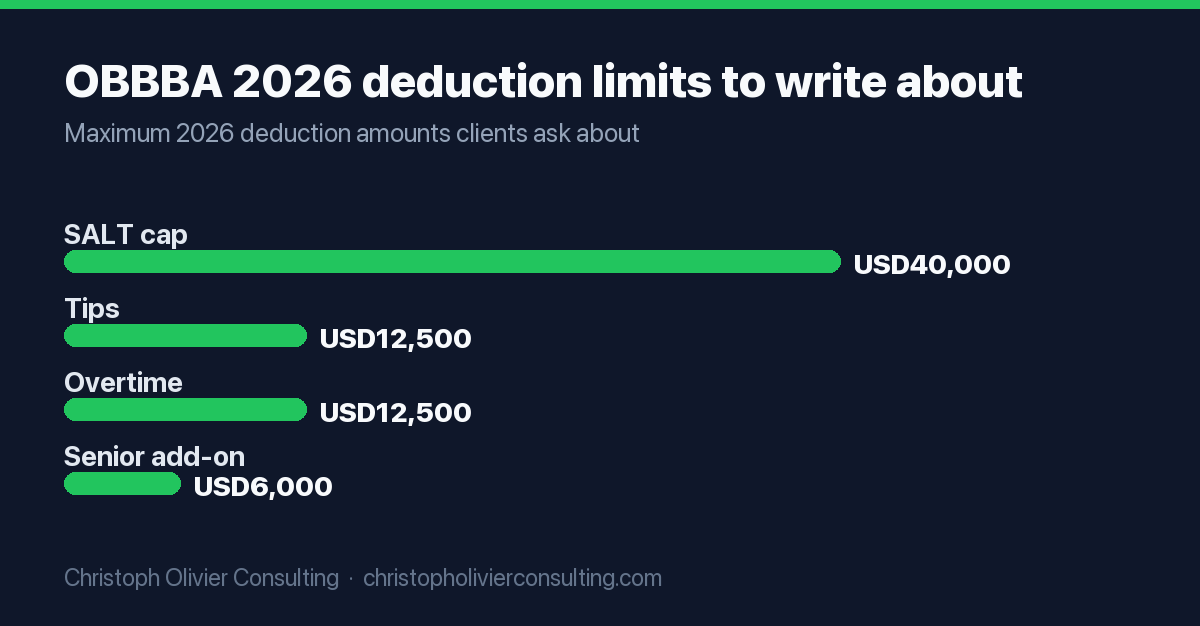
Each provision maps to a planning article, a client FAQ, and a seasonal email. Below are four 2026 maximum deduction amounts clients will ask about, which make natural article topics.
A situational menu: where content fits your firm
Content marketing is not right for every firm at every stage. The table below is an honest guide, not a decision. Use it to see whether a content program fits your current capacity and goals, then book a consultation so we can pressure-test the call against your actual book and staffing.
| Situation | Content marketing works best when | Content marketing is not the right fit when |
|---|---|---|
| Firm stage | You have a defensible niche and want to shift toward advisory or CAS retainers | You need billable work this week and have no capacity to onboard it |
| Author bench | A partner, CPA, or EA can lend their name and review drafts for accuracy | No one can stand behind the content as a credentialed, accountable author |
| Time horizon | You can commit two to four quarters before judging results | You expect signed clients within 30 days from a standing start |
| Client mix goal | You want fewer, higher-value, better-fit clients over time | Your only goal is maximum cheap tax-prep volume right now |
| Compliance posture | You want claims checked against AICPA and state-board rules | You want aggressive “best firm” or guaranteed-savings messaging |
How we build a compliant content program
We start from your economics and your niche, not a keyword list. The work pairs partner expertise with research and editing so each piece is accurate, citable, and safe to publish. Every claim passes a compliance check before it goes live, and client specifics never appear without consent.
- Positioning and niche: pick the one or two practice areas worth owning.
- Topic research: map search demand to real client questions and OBBBA changes.
- Expert drafting: write with partner input, cite primary sources, name the author.
- Compliance review: screen for misleading, self-laudatory, or guaranteed claims.
- Distribution: repurpose into email and social; measure consultations booked.
Methods, limits, and compliance for CPA content
Accounting is a regulated profession, so content carries rules most agencies ignore. AICPA Rule 1.600.001 bars advertising that is false, misleading, deceptive, or self-laudatory, which rules out “#1 firm” or guaranteed-savings language. Rule 1.700.001 protects client confidentiality, so case studies and examples stay anonymized or consented. State boards can be stricter, and we write to the stricter standard.
Practical limits to set expectations honestly: content takes time to earn rankings and trust, outcomes depend on your niche and follow-through, and we cannot guarantee specific traffic, leads, or ranking positions. We use conditional language in both the content and our own claims. Testimonials are state-regulated for CPAs, so we rely on factual, verifiable client statements rather than curated marketing quotes.
Content marketing vs other CO services
Content marketing is the engine that feeds several channels, but it is not always the first move. If you need to capture people already searching for a CPA, SEO for accounting firms may come first. If you want to use AI tools safely on top of your content, AI marketing for accounting firms covers the confidentiality guardrails. Content and SEO usually work best together.
To size the investment, see how much accounting firms should spend on marketing, and for the full channel picture start at our marketing for accounting firms hub. Not sure which to start with? That is exactly the question a consultation answers.
Book a consultation to map a content program to your firm’s niche, capacity, and advisory goals, with a compliance check built in from the first draft.
Frequently asked questions
What is content marketing for accounting firms?
It is publishing accurate, useful tax and advisory content so better-fit clients find and trust your firm. For CPA and EA firms it supports advisory and CAS positioning and reduces reliance on referrals, rather than chasing cheap, high-volume tax-prep leads.
How long before content marketing produces results?
Plan on two to four quarters before judging it. Organic visibility and trust compound over time, and outcomes depend on your niche, author bench, and follow-through. We set expectations with conditional language and never guarantee specific traffic, leads, or rankings.
Is content marketing compliant for CPA firms?
Yes, when written to the rules. We screen every claim against AICPA Rule 1.600.001 (no false, misleading, or self-laudatory claims) and protect client confidentiality under Rule 1.700.001. State boards can be stricter, so we write to the stricter standard and anonymize client specifics.
What should accounting firms write about in 2026?
The OBBBA changes are the clearest content engine: permanent QBI and bonus depreciation, the higher SALT cap, new tips and overtime deductions, and the 1099 threshold rising from $600 to $2,000. Each provision maps to a planning article, client FAQ, and seasonal email.
Do I need content marketing or SEO first?
They usually work together, but priority depends on your goals. SEO captures people already searching for a CPA; content builds the expert authority that SEO and AI search reward. A consultation is the fastest way to decide the right starting point for your firm.
All CO Consulting marketing services for accounting firms
- Marketing for CPA & Accounting Firms (overview)
- Fractional CMO
- Revenue Growth
- SEO
- Local SEO
- Meta (Facebook & Instagram) Ads
- Content Marketing (you are here)
- AI Marketing
- Rank on ChatGPT (AI Search)
- Referral Marketing
Book a consultation to map the right mix for your firm.