

The doctor office marketing ideas that work best for an independent practice are mostly unglamorous: book more of the visits your current patients are already due for, make it easy for referring doctors to send you patients, and make sure Google and your website answer “do you take my insurance, and can I book online?” in five seconds. Ads and social posts come after those. Below are 14 specific ideas for primary care and specialist offices, each with a cost level, time to impact, the number to track and the compliance rule that applies, plus a 90-day checklist.
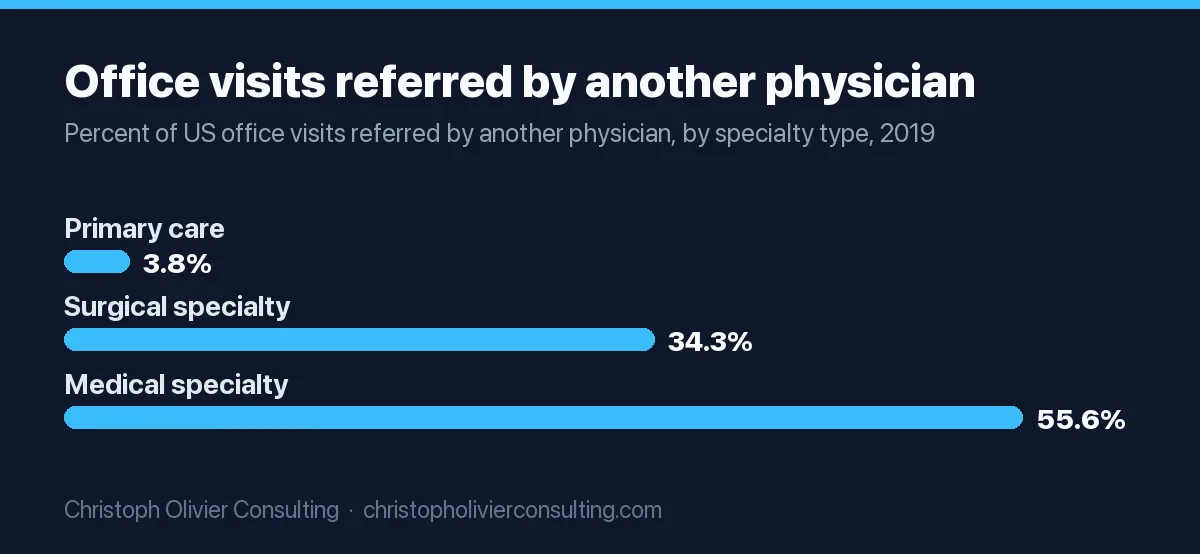
Short answer: Start with ideas that use patients and referrers you already have. In the CDC’s 2019 national survey of office visits, only 16.8% of visits were by new patients, and among new-patient visits to doctors who were not the patient’s primary care physician, 52.0% were referred by another physician. So Medicare wellness visit outreach, recall texts, referral-physician outreach and a booking-ready Google profile usually pay off before paid ads do.
What the visit data says about where your patients come from
Most “marketing ideas for doctors” lists skip the one dataset that describes how Americans actually use physician offices: the CDC’s National Ambulatory Medical Care Survey. Its 2019 National Summary Tables (the tables CDC still links from its FastStats page) estimate about 1.04 billion office visits that year. Four numbers in those tables should shape your marketing plan:
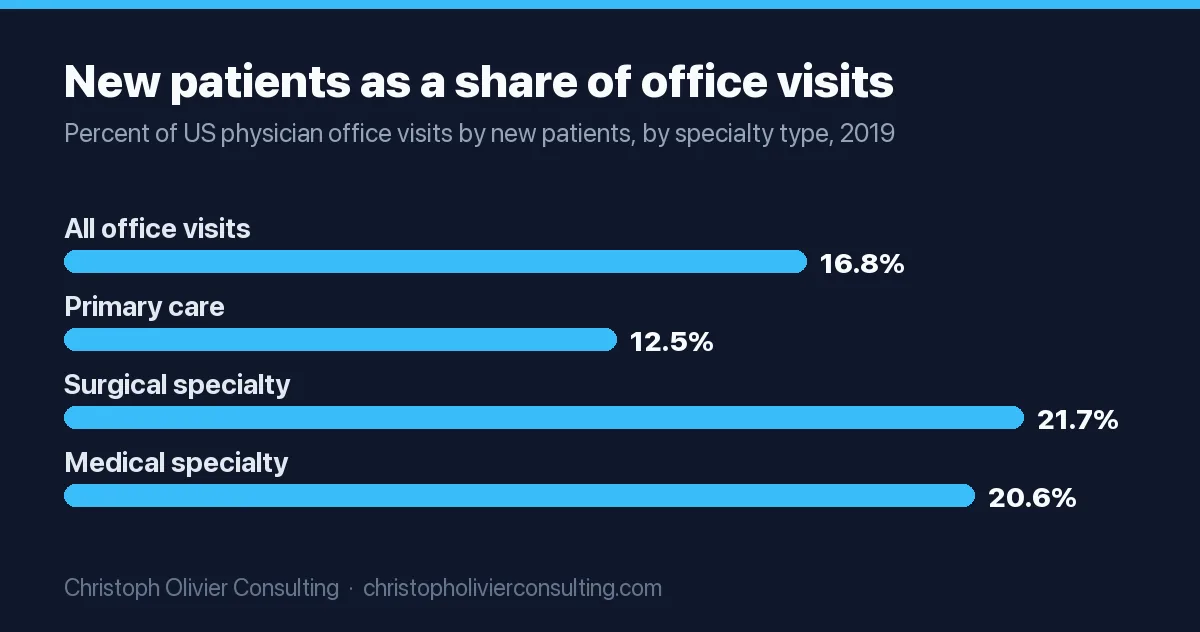
- Existing patients are most of the volume. 83.2% of visits were by established patients and 16.8% by new patients (Table 6). In primary care the new-patient share was only 12.5%.
- Specialists live on referrals. 55.6% of visits to medical specialists and 34.3% of visits to surgical specialists were referred by another physician (Table 7). For primary care it was 3.8%.
- Older patients drive visits. Patients 65 and over made 36.1% of all visits, at a rate of 708.5 visits per 100 people per year (Table 3).
- Insurance decides the shortlist. Private insurance was an expected payer at 57.9% of visits, Medicare at 30.8% and Medicaid or CHIP at 13.7% (Table 5; a visit can have more than one payer).
The online side matters too. In the CDC’s NCHS Data Brief 482, 58.5% of adults used the internet to look for health or medical information in the past 12 months (July to December 2022), and 41.5% used it to communicate with a doctor or doctor’s office. And per FastStats, 84.7% of adults had a visit with a doctor or other health care professional in 2025, so the job is less about creating demand than about being the office people pick and come back to.
| Data point | Value | Period | Source | What it means for your marketing |
|---|---|---|---|---|
| Office visits to physicians, US | 1,036,484,000 (reported estimate) | 2019 | NAMCS Table 1 | The market is large and mostly repeat business |
| Visits by new patients | 16.8% (primary care 12.5%, surgical 21.7%, medical specialty 20.6%) | 2019 | NAMCS Tables 6 and 8 | Retention and recall ideas touch the other 83.2% |
| New-patient visits to a non-PCP that were physician-referred | 52.0% | 2019 | NAMCS Table 6 | Specialists should market to referring offices first |
| Visits by patients 65+ | 36.1% | 2019 | NAMCS Table 3 | Medicare wellness visit outreach has a big base |
| Adults who used the internet to look for health information | 58.5% | Jul to Dec 2022 | NCHS Data Brief 482 | Your website and Google profile get checked |
| Adults who used the internet to communicate with a doctor’s office | 41.5% | Jul to Dec 2022 | NCHS Data Brief 482 | Online booking and messaging are expected, not extras |
| Adults who used telemedicine | 37.0% (43.3% of adults 65+) | 2021 | NCHS Data Brief 445 | Older patients are not a reason to skip telehealth |
If you have not yet fixed the basics (Google listing structure, directory profiles, review replies, tracking pixels), do that first; our digital marketing guide for doctors covers those five patient checkpoints and the HIPAA penalty cases in detail. This page is the idea list you work through once that foundation is in place.
The doctor office marketing ideas matrix
Cost, effort, impact and time ratings are my editorial judgment for a one to ten physician independent office, not measured data. The metric column is what you should actually track.
| # | Idea | Best for | Cost | Effort | Likely impact | Time to first results | Metric to track |
|---|---|---|---|---|---|---|---|
| 1 | Medicare Annual Wellness Visit outreach | Primary care, internal medicine | Low (staff time) | Medium | High | 2 to 6 weeks | AWVs billed per month (G0438/G0439) |
| 2 | Recall and reactivation texts | All | Low | Low | High | 1 to 4 weeks | Overdue patients booked / patients messaged |
| 3 | Fall vaccine plus wellness visit push | Primary care | Low | Medium | Medium | Seasonal (Sep to Nov) | AWVs with same-day vaccine |
| 4 | Referral-physician outreach list | Specialists | Low | Medium | High | 1 to 3 months | New referrals per referring office per month |
| 5 | Referral turnaround promise (consult notes, access) | Specialists | Low | Medium | High | 1 to 3 months | Days from referral to appointment |
| 6 | Google categories set as “is a” | All | Free | Low | Medium | 2 to 8 weeks | Profile calls and direction requests |
| 7 | Booking and telemedicine links on Google | All | Free to low | Low | Medium | 1 to 4 weeks | Booking clicks from the profile |
| 8 | One insurance-accepted page per plan family | All | Low | Medium | Medium | 1 to 3 months | Organic visits to insurance pages, calls after |
| 9 | Online scheduling for new-patient slots | All | Medium (software) | Medium | High | 2 to 6 weeks | New-patient bookings made online |
| 10 | Telehealth visit page | Primary care, behavioral, follow-up heavy specialties | Low | Low | Medium | 1 to 2 months | Telehealth visits booked by new patients |
| 11 | Ask every patient for a review, the same way | All | Low | Low | High | 2 to 8 weeks | New Google reviews per month |
| 12 | DOT physicals via the FMCSA National Registry | Family medicine, occupational health, urgent care | Medium (training, exam) | High | Medium | 3 to 6 months | DOT exams per month, employer accounts |
| 13 | Employer health partnerships | Primary care, occupational health | Low to medium | High | Medium | 3 to 6 months | Employer-referred visits |
| 14 | Community health events | Primary care, pediatrics, cardiology, endocrinology | Low to medium | Medium | Low to medium | 1 to 3 months | Appointments booked at or after the event |
Ideas that fill the schedule from patients you already have
1. Run a Medicare Annual Wellness Visit outreach list
This is the highest-return idea for most primary care offices because the patients are already yours and the visit costs them nothing. Per Medicare.gov, patients pay nothing for the yearly wellness visit if the provider accepts assignment, and the Part B deductible does not apply. The first one can’t happen within 12 months of Part B enrollment or the “Welcome to Medicare” visit, and after that it is available once every 12 months.
The CMS provider page gives you the codes to build the list from your billing system: G0438 for the first AWV and G0439 for subsequent ones, billable once in a 12-month period, and not within 12 months of G0402 (the Welcome to Medicare exam). CMS also states that it pays for G0438 and G0439 when delivered by telehealth.
Why it is under-used: an analysis of fee-for-service claims published in Preventive Medicine Reports found that only 16.0% of 28 million eligible beneficiaries had an AWV in 2014. That figure is old, so treat it as a sign of the gap, not a current rate. Your own number is the one that matters: pull every Medicare patient with no G0438 or G0439 claim in the last 12 months.
Copy-ready phone script:
“Hi, this is [name] from [practice]. Dr. [name] asked us to call patients who are due for their yearly Medicare wellness visit. It’s a visit to update your prevention plan and screening schedule, and Medicare covers it with no cost to you when it’s billed on its own. Can I find you a time in the next few weeks? Please bring your medication list, including vitamins, and the names of any other doctors you see.”
The last line comes from the CMS page, which suggests patients bring medical records, family history, a full list of medications and supplements, and a list of their other providers.
- Cost: staff time. Time to impact: the first booked visits within a few weeks.
- Measure: AWVs billed per month and the share of eligible patients with an AWV in the past 12 months.
- Compliance: do not say the whole appointment is free. Medicare.gov warns patients may owe coinsurance and the deductible for extra services in the same visit, and the AWV “isn’t a routine physical exam.” Say that in the script if the patient asks.
2. Send recall and reactivation texts that stay inside the FCC healthcare rule
Overdue chronic-care follow-ups and lapsed patients are the cheapest bookings you will ever get. Two rules shape the messages.
First, HIPAA. The HHS guidance on marketing says a communication about your own health-related services, or one made for the patient’s treatment, is not “marketing” under the Privacy Rule, so it does not need a patient authorization. A reminder about a follow-up visit at your office fits. Promoting another company’s product to your patient list does not.
Second, the FCC. The Telephone Consumer Protection Act rule at 47 CFR 64.1200(a)(9)(iv) exempts healthcare provider calls and texts to a patient’s wireless number only if all conditions are met, including:
- sent only to the wireless number the patient gave you, and not charged to the patient;
- limited to purposes such as appointment confirmations and reminders, wellness checkups, lab results and prescription notifications;
- no telemarketing, solicitation, advertising or billing content;
- 160 characters or less for texts, one message per day and no more than three per week per patient;
- an opt-out in every message (for texts, reply “STOP”), honored immediately.
Copy-ready texts (fill in names, then confirm each stays under 160 characters):
- “[Practice] here. Dr. [Name] would like to see you for your follow-up visit. Book at [short link] or call [phone]. Reply STOP to opt out.”
- “[Practice]: you’re due for your yearly wellness checkup. Book at [short link] or call [phone]. Reply STOP to opt out.”
Keep diagnoses, test names and balances out of the text. The rule bans billing content, and a shared phone screen is not private.
- Cost: usually included in your practice management or patient-messaging software. Time to impact: one to four weeks.
- Measure: booked visits divided by patients messaged, per campaign. If you send broader email newsletters, our list of email marketing ideas has campaign formats you can adapt.
- Compliance: a promotional text (a new cosmetic service, a sale) is not a healthcare message and generally needs the patient’s prior express written consent under paragraph (a)(2) of the same rule.
3. Pair the wellness visit with fall vaccines
The same claims study found the share of beneficiaries who got a flu vaccine at their AWV ranged from under 0.1% in June to 36.8% in October 2014. Patients who had an AWV also had a higher flu vaccination rate than those who did not (63.8% vs 41.6%). The practical idea: front-load AWV outreach to September and October so one visit covers both, and say so in the reminder (“book your wellness visit and flu shot together”).
- Cost: low. Time to impact: seasonal.
- Measure: AWVs with a same-day vaccine, September to November.
- Compliance: same as ideas 1 and 2.
Ideas for getting found and booked online
4. Set your Google categories with the “is a” test
Google’s Business Profile guidelines say to pick categories that complete the sentence “This business IS a,” not “this business HAS a,” to use as few as possible, and not to use categories as keywords. For a doctor’s office that means the single most specific physician category for your specialty as the primary category, not a list of every test you run. Put the tests and procedures in the services section and on your website instead.
- Cost: free. Time to impact: weeks.
- Measure: calls, website clicks and direction requests in the profile’s performance report.
- Compliance: one physician gets one practitioner profile, not one per specialty; the doctor marketing guide linked above has the setup table.
5. Add booking and telemedicine links to your Business Profile
Per Google’s help page on business links, a profile can carry a single link to a list of services “such as telemedicine or virtual,” plus up to 10 links per category for actions like booking an appointment. If you have more than one booking link, you can mark one as “Business preferred.” Third-party booking links can also appear automatically through partners, so check what is showing and set your own scheduler as preferred.
- Cost: free (the scheduler itself may not be). Time to impact: one to four weeks.
- Measure: booking clicks, then bookings attributed to the link (add a UTM tag).
- Compliance: if your scheduler page has ad pixels on it, read the HHS online tracking guidance summary in the doctor marketing guide before you send traffic there.
6. Build one insurance-accepted page per plan family
Insurance is the first filter for most patients, and Google is no longer a reliable place to show it. As of November 2026, Google’s former help article on adding health insurance networks to a Business Profile (answer 9798848) redirects to the Help Center home page, so do not count on Google displaying your plans. Put them on your own site instead:
- One page per major plan family you are in network with, named the way patients search (for example “[Plan name] doctors in [town]”).
- The exact plan products you accept, and the ones you do not.
- Whether you are accepting new patients on that plan, with the date last updated.
- A booking button and the phone number, above the fold.
With private insurance an expected payer at 57.9% of visits and Medicare at 30.8% in the NAMCS tables, a Medicare page and pages for your two or three largest commercial plans cover most of your traffic.
- Cost: low. Time to impact: one to three months for search traffic.
- Measure: visits to each insurance page and calls or bookings that follow.
- Compliance: keep it accurate. Update the page the day a contract changes, because a wrong in-network claim sends a patient to a surprise bill and an angry review.
7. Open new-patient slots to online scheduling
41.5% of adults already used the internet to communicate with a doctor’s office in late 2022 (NCHS), and the rate was highest at ages 30 to 44 (47.7%). You do not have to open your whole calendar. Start with a fixed block of new-patient slots per provider per week, with the intake questions short and the insurance question first.
- Cost: medium if your practice management system needs an add-on. Time to impact: two to six weeks.
- Measure: share of new-patient bookings made online, and no-show rate for online versus phone bookings.
- Compliance: the scheduler vendor will handle patient information, so it needs a business associate agreement.
8. Publish a telehealth page with the rules that apply now
The CMS Telehealth FAQ updated October 2026 says that through December 31, 2027, Medicare patients can receive telehealth services anywhere in the United States, and that starting January 1, 2028, except for behavioral health, they will generally need to be in a medical facility in a rural area. In the 2021 NHIS data, 43.3% of adults 65 and over used telemedicine, the highest of any age group. A short page that lists which visit types you do by video (follow-ups, medication checks, results reviews), which plans cover them and how to book gives patients searching for a telehealth option somewhere to land.
- Cost: low. Time to impact: one to two months.
- Measure: telehealth bookings by new versus established patients.
- Compliance: date the page and recheck it before January 1, 2028, when the Medicare rules change.
Ideas for reviews and reputation
9. Ask every patient for a review, the same way
Asking is allowed. Filtering who you ask is the risk. The FTC Endorsement Guides at 16 CFR 255.2 give the exact example: a business that asks for feedback and then invites only the very happy customers to post reviews may be acting unfairly or deceptively if the resulting reviews are more positive than they would otherwise be, while inviting all recent customers is fine “even if it had expressed its hope for positive reviews.” The FTC’s 2024 rule at 16 CFR Part 465 also bans incentives conditioned on a positive or negative review and requires officers and managers to disclose their relationship if they post reviews. Google’s own review guidance goes further and treats any incentive for posting, changing or removing a review as fake content.
The process: one same-day message to every patient seen, with a direct review link, no mention of the visit reason, and no gift. Our guide on how to get more Google reviews has the link setup and request wording.
- Cost: low. Time to impact: two to eight weeks.
- Measure: new Google reviews per month and the share of patients asked.
- Compliance: no review gating, no gift cards, no staff or family reviews without disclosure.
10. Reply to reviews without confirming anyone is a patient
HHS’s Office for Civil Rights settled with Manasa Health Center, a New Jersey psychiatric practice, after it disclosed patient information in replies to negative online reviews; the practice paid $30,000 and agreed to a corrective action plan. A safe reply template: “We take every comment seriously, but privacy law prevents us from discussing anyone’s care online. Please call our practice manager at [phone] so we can talk directly.” Limit reply rights to one or two trained people.
- Cost: free. Time to impact: immediate risk reduction.
- Measure: reply rate on reviews, and zero replies that mention a visit, diagnosis or treatment.
- Compliance: the full penalty case list is in the doctor marketing guide.
Referral and partnership ideas for specialists and primary care
11. Build a referral-physician list from the free NPI Registry
Because more than half of new-patient specialist visits are physician-referred (NAMCS Table 6), a specialist’s best marketing list is the primary care offices within driving distance. CMS publishes every active NPI record, including name, specialty taxonomy and practice address, through the NPI Registry. Its free API lets you search by taxonomy description and postal code (with trailing wildcards such as “837*”), returns up to 200 results per request, and can page through up to 1,200 records over six requests.
The outreach itself should be about access and communication, not perks:
Copy-ready referral letter (short version): “Dr. [Name], we are [practice], [specialty] at [address]. For your patients we currently offer new-patient appointments within [X] business days, a direct referral line at [phone] that skips our main queue, and consult notes back to your office within [X] days of the visit. We accept [plans]. Our referral form is at [link]. If there is anything about referrals to us that has frustrated your staff, I would like to hear it.”
- Cost: low. Time to impact: one to three months.
- Measure: referrals per referring office per month, and days from referral received to appointment.
- Compliance: the HHS-OIG fraud and abuse roadmap for physicians is blunt: in federal health care programs, “paying for referrals is a crime,” and remuneration includes anything of value, such as free rent or expensive meals. Compete on access and speed, not gifts. The general mechanics of partner programs in our referral marketing guide apply, but the reward pieces do not apply to physician referrals.
12. Get listed on the FMCSA National Registry for DOT physicals
Interstate commercial motor vehicle drivers need their physical qualification exam from an FMCSA-certified medical examiner, and the FMCSA National Registry includes a national database of names and contact information for those examiners. The path is: register online, complete training with an accredited provider, pass the exam, and have your license validated. Under 49 CFR Part 390, Subpart D, eligible examiners include doctors of medicine and osteopathy, physician assistants and advanced practice nurses authorized under state law, and the certification credential expires 10 years after issuance. For a family medicine or urgent care office, the listing is a steady source of new adults who often become primary care patients.
- Cost: medium (training and exam fees, clinician time). Time to impact: three to six months.
- Measure: DOT exams per month and how many of those patients book a second, non-DOT visit.
- Compliance: keep your state license and the FMCSA credential current; the credential has to be renewed before its 10-year expiry.
13. Offer local employers a simple health services menu
Once you can do DOT exams, the same employers usually need pre-employment physicals and work-related injury visits. Build a one-page menu: services, turnaround for paperwork, same-week availability, a named contact, and how billing works. Start with trucking, construction and logistics firms near your office. These are commercial arrangements with the employer, so price them in writing and run the contract past your healthcare attorney, especially if any federal program patients could be involved.
- Cost: low to medium. Time to impact: three to six months.
- Measure: employer accounts, visits per account per month.
- Compliance: the OIG roadmap’s kickback warnings apply to any arrangement that steers federal program patients.
14. Run community health events that book appointments
Blood pressure checks at a senior center, a flu clinic, a sports-physical day before school starts, a diabetes Q&A at the library. The point is a booked appointment, so bring a tablet with your scheduler open and a card with your insurance list. Two federal limits shape giveaways and offers:
- The OIG policy statement on gifts of nominal value (December 7, 2016) allows gifts to Medicare and Medicaid beneficiaries worth no more than $15 per item or $75 in total per patient per year, and never cash or cash equivalents.
- The OIG roadmap says routinely waiving Medicare and Medicaid copays could implicate the Anti-Kickback Statute and that “you may not advertise that you will forgive copayments.” Check any free service offered to Medicare or Medicaid patients against these limits with counsel, and never print “no copay” on a flyer.
Our healthcare marketing guide covers how events fit with the rest of a practice’s channel mix.
- Cost: low to medium. Time to impact: one to three months.
- Measure: appointments booked at the event or within 30 days with the event as source.
- Compliance: sign-up sheets that collect health details are patient information once you use them; store them like any other record.
The 90-day implementation checklist
Each row has a pass/fail test so you know the task is actually done, not just started.
| Weeks | Task | Owner | Pass if |
|---|---|---|---|
| 1 | Pull Medicare patients with no G0438/G0439 in 12 months | Billing | A dated list exists with phone numbers and assigned provider |
| 1 | Pull patients overdue for follow-up (by your own recall rules) | Clinical lead | List sorted by provider and months overdue |
| 1 to 2 | Fix Google primary category and services; add booking and telemedicine links | Office manager | Category passes the “is a” test; your scheduler is the preferred booking link |
| 2 | Write and approve recall texts against 47 CFR 64.1200(a)(9)(iv) | Office manager plus compliance | Every text is 160 characters or less, has practice name and STOP opt-out, no billing or promo content |
| 2 to 4 | Start AWV calls with the script | Front desk | At least one call attempt logged for every patient on the list |
| 3 to 4 | Launch same-day review request to every patient seen | Front desk | Request goes to all patients, no filter, no incentive |
| 3 to 5 | Publish Medicare page and top 2 to 3 commercial plan pages | Marketing | Each page lists accepted products, new-patient status and a “last updated” date |
| 4 to 6 | Open a weekly block of new-patient slots online | Office manager | Scheduler live, BAA signed, insurance question first |
| 4 to 6 | Build referral list from the NPI Registry API (specialists) | Marketing | List of target offices with taxonomy, address and a named contact |
| 6 to 8 | Send referral letters and visit the top 10 offices | Physician plus liaison | Letters sent; no gifts beyond what counsel approved |
| 6 to 8 | Publish telehealth page | Marketing | Page dated, visit types listed, CMS rules current |
| 8 to 10 | Decide on FMCSA registry and employer menu (family medicine, urgent care) | Owner | Go or no-go recorded with reasons |
| 8 to 12 | Hold one community event | Office manager | Scheduler on site; giveaways at or under $15 per item |
| 12 | Review results | Owner | AWVs per month, recall bookings, new reviews, referrals per office and online bookings all compared with week 1 |
If you want a budget for paid channels after these are running, the cost-per-patient approach in our plastic surgeon marketing budget breakdown transfers to any specialty, and our dental marketing guide shows the same recall-first logic in another appointment-driven practice. If you would rather have someone build the plan with your numbers, you can book a consultation.
Ready to scale your revenue?
Book a free 30-min consultation. We’ll diagnose your growth bottleneck and map out the 3 highest-leverage moves for your business.
Frequently asked questions
What are some effective marketing ideas for a doctor's office?
Start with patients and referrers you already have. In the CDC's 2019 office visit survey, 83.2% of visits were by established patients and over half of new-patient specialist visits were physician-referred. So the strongest first ideas are Medicare Annual Wellness Visit outreach, recall texts, referral-physician outreach, booking links on your Google profile, insurance-accepted pages and asking every patient for a review.
How do you market a doctor's office on a small budget?
Most high-return ideas cost staff time, not ad spend. Pull Medicare patients with no wellness visit in 12 months and call them, text overdue patients within the FCC healthcare message limits, fix your Google category and booking link, send a same-day review request to every patient, and build a referral list from the free CMS NPI Registry. Add paid ads only once those are running.
Can a medical practice text patients for marketing?
Reminders about appointments, wellness checkups and lab results can be texted to the wireless number a patient gave you under 47 CFR 64.1200(a)(9)(iv), if each text is 160 characters or less, names the practice, offers a STOP opt-out, and you send no more than one per day and three per week. Promotional texts with no healthcare purpose generally need prior express written consent.
Can doctors offer incentives for Google reviews?
No. The FTC rule at 16 CFR Part 465 bans incentives conditioned on a review expressing a particular sentiment, and Google treats any incentive for posting, changing or removing a review as fake content. The FTC Endorsement Guides also warn against asking only happy patients. Ask every patient the same way, with a direct link and no reward.
How can a specialist get more referrals from primary care doctors?
Market access and communication, not perks. Build a list of nearby primary care offices from the CMS NPI Registry API, then send a short letter with your new-patient wait time, a direct referral line, accepted plans and how fast consult notes go back. Paying for or rewarding referrals of Medicare or Medicaid patients can violate the Anti-Kickback Statute.
What giveaways are allowed at a medical practice health fair?
For Medicare and Medicaid beneficiaries, the HHS-OIG treats gifts as nominal if they are worth no more than $15 per item and $75 in total per patient per year, and never cash or cash equivalents. The OIG also says you may not advertise that you will forgive copayments. Run any free service offered to beneficiaries past counsel.