

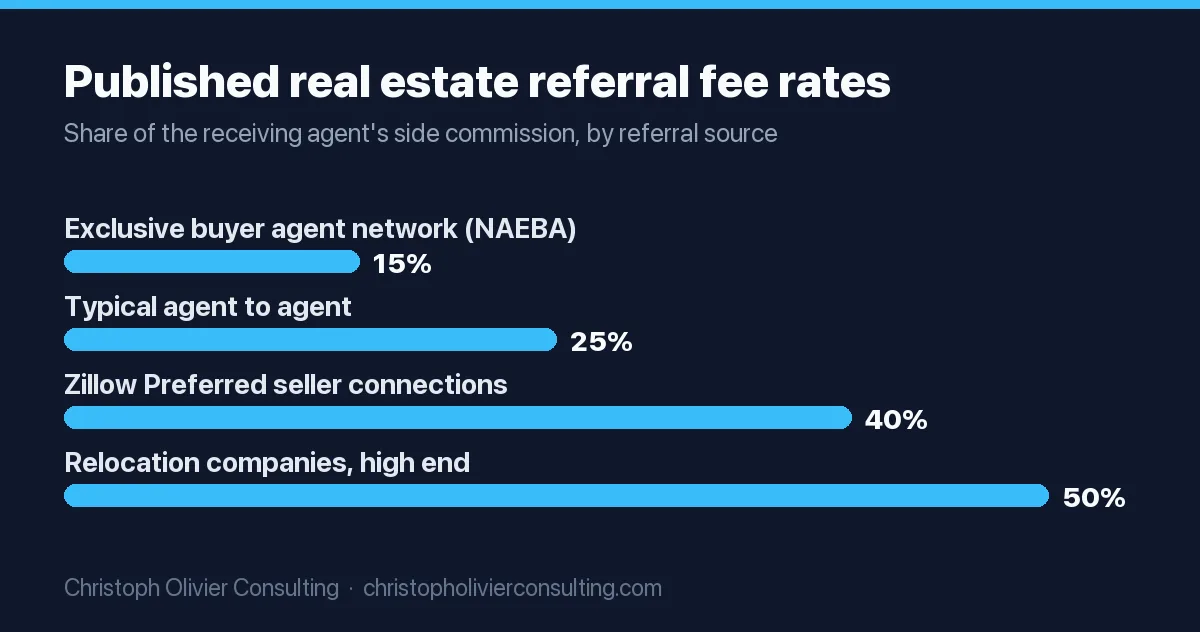
The standard real estate agent referral fee is 25% of the commission the receiving agent earns on their side of the deal, paid broker to broker at closing. The Consumer Federation of America’s 2020 referral fee report found “general agreement” that one quarter is the typical rate, with most fees between 20% and 35%. Lead platforms charge more: Zillow’s Preferred pricing page (archived November 2025) sets its “success fee” at 40% for every seller connection.
Who can be paid is a tighter question than how much. In all 11 states checked for this article, a licensee cannot pay an unlicensed person a referral fee tied to the closing. The exceptions are narrow and written into specific statutes: Texas lets you give merchandise worth $50 or less, Florida and Virginia carve out apartment tenants, and Washington exempts referrers whose pay does not depend on a closing. Below: the rate data with sources, worked math, an 11-state rule table with citations to the official text, the RESPA line between agent referrals and lender or title kickbacks, what the NAR Code of Ethics says, and a pass/fail referral agreement checklist. This summarizes published rules, not legal advice. Check your state commission before you pay anyone.
Short answer: Expect 25% of the receiving agent’s side commission, with 20% to 35% the common range and 30% to 40% at referral platforms. The fee goes from the receiving broker to the referring broker, never agent to agent directly. Paying an unlicensed friend or past client a share of your commission for a referral is prohibited in every state in the table below; Texas allows a gift of merchandise worth $50 or less instead.
What’s a typical real estate referral fee?
There is no regulated rate. Referral fees are negotiated between brokers, so the only honest numbers are the ones referral programs publish and the ones researchers have collected. Here is what is on the record:
| Referral source | Published fee | What it is a share of | Source |
|---|---|---|---|
| Agent to agent, “typical” | 25% | Commission collected by the receiving agent | CFA, Sept 2020 |
| Agent to agent, common range | 20% to 35% (full range 10% to 50%) | Same | CFA, Sept 2020 |
| National Association of Exclusive Buyer Agents members | 15% | Same | CFA, Sept 2020 (private communication cited in the report) |
| Relocation companies, high end | Up to 50% | Buying agent’s commission | CFA, Sept 2020 |
| Zillow Preferred, seller connections | 40%, all markets | Full commission you expect for your side | Zillow Preferred pricing page (archived Nov 18, 2025) |
| Zillow Preferred, buyer connections | Varies by market and price | Same | Zillow Preferred pricing page |
| Commission-based referral companies (Zillow, Realtor.com and others) | 30% to 40% | Agent’s earnings at closing | Consumer Policy Center report, Feb 2026, as reported by Real Estate News |
| Redfin partner agents | “A portion of her commission,” percentage not disclosed | Partner agent’s commission | Redfin 2024 Form 10-K |
Two details change the real number more than the headline percentage. First, the base: Zillow calculates its fee on “the full commission you expect to receive for your side of the transaction,” before your brokerage split. Write the base into your own agreements, because “25% of net” after franchise fees and splits is a much smaller check than 25% of gross. Second, the timing: Zillow can change its fee “at any time by providing 15 days’ notice,” and the new rate applies to connections received after the notice period. We could not verify a current published rate for Realtor.com or HomeLight on their own public pages, so ask for it in writing before you accept their leads.
If you buy leads as well as trade referrals, treat the fee as a cost per closed deal and compare it with your other channels. The math for that comparison is in our guide to lead generation for real estate agents.
How much does an agent get for a referral fee?
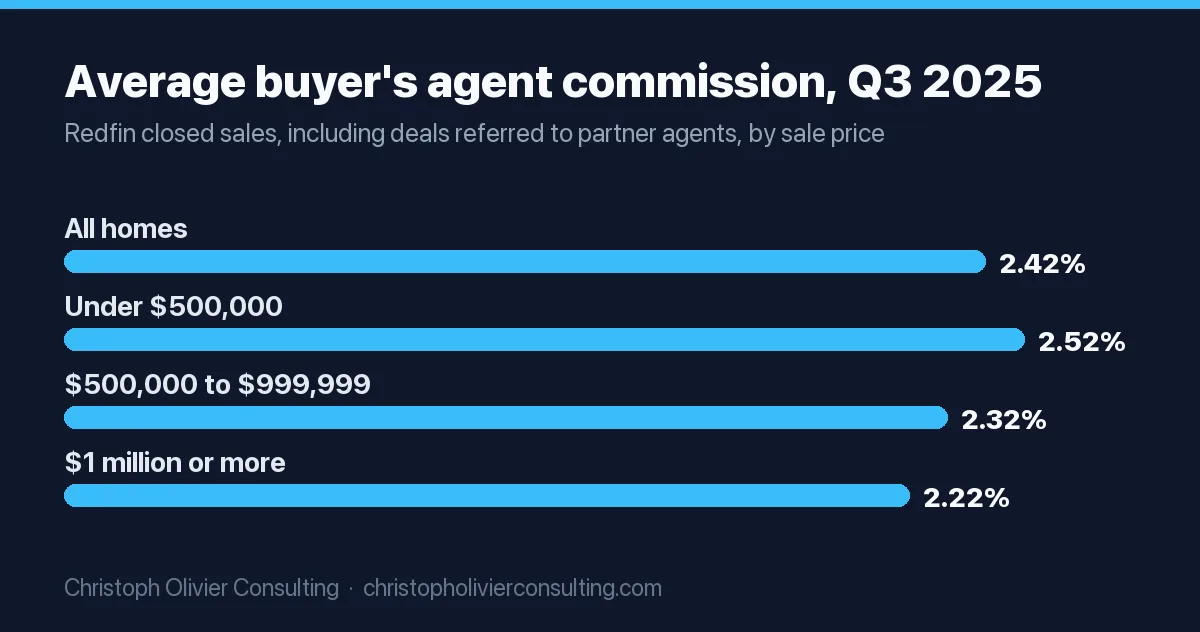
Here is the math on a $400,000 purchase where the buyer’s agent earns 2.42%, the national average buyer’s agent commission Redfin reported for Q3 2025. The 70% split for the referring agent is an example; use your own brokerage agreement.
| Step | 25% agent-to-agent referral | 40% platform fee |
|---|---|---|
| Receiving agent’s side commission ($400,000 x 2.42%) | $9,680 | $9,680 |
| Referral fee paid by the receiving broker | $2,420 | $3,872 |
| Left for the receiving agent, before their own split | $7,260 | $5,808 |
| Referring agent’s take at a 70% split with their broker | $1,694 | Not applicable (platform keeps it) |
So the referring agent does not get the full $2,420. The fee lands in the referring brokerage’s account, and the agent is paid through their own split. That is not a convention; in many states it is the law, as the state table below shows.
Is 3% realtor fee normal?
Three percent per side is a common starting point, but the average is lower. Redfin’s analysis of its closed sales, including deals it referred to partner agents, put the average buyer’s agent commission at 2.42% in Q3 2025, up from 2.36% a year earlier when the post-settlement rules took effect. Rates fall as price rises: 2.52% under $500,000 and 2.22% at $1 million or more. Commissions are negotiated per deal, and a referral fee comes out of whatever was negotiated, not on top of it.
Do realtors make money on referrals?
Yes, and for some agents it is a real income line. A 2018 survey of more than 1,200 agents by ReferralExchange, summarized in the CFA report, found 87% had received referral income in the prior year and 45% earned at least $10,000 from referrals. A 2026 Consumer Policy Center report cited a survey estimating that 42% of agents earn between $10,000 and $50,000 a year from agent-to-agent referral fees, according to Real Estate News. Treat both as survey estimates; no agency publishes referral income data.
Three rules decide whether you can collect:
- Your license must be active when you make the referral. Texas spells this out: TREC’s FAQ says you can be paid a referral fee on an inactive or expired license “as long as your license was active when you engaged in brokerage activity,” including “when making a referral” (TREC FAQ).
- The money flows through your broker. California B&P Code 10137 says a salesperson shall not accept compensation “from any person other than the broker under whom he or she is at the time licensed.” Texas Occupations Code 1101.651(b) and Arizona ARS 32-2155(A) say the same in their own words.
- Referral-only status is a broker arrangement, not a separate license, in many states. In Texas a referral business (a Limited Function Referral Office) “must have a business entity brokerage license,” and “any referral fee must be paid to the sponsoring broker” (TREC FAQ).
If you are building a referral engine on purpose rather than waiting for one, the program design side is covered in our referral marketing guide.
Can a realtor pay a referral fee to a non-licensed person?
Not as a fee tied to the deal, in any of the 11 states below. Outside three narrow carve-outs (apartment tenants in Florida and Virginia, and referrers in Washington whose pay does not depend on a closing), the answer is no. The reasoning is the same everywhere: referring a buyer or seller for pay is brokerage activity, so the person you pay must hold a license. The North Carolina Real Estate Commission puts it bluntly in language quoted by NC REALTORS: “no licensee may pay a finder’s fee, referral fee, ‘bird dog’ fee or similar compensation to an unlicensed person.” The same article says the exception for sharing with parties to the transaction “does NOT extend to parties the broker represented in a prior transaction (i.e., a past client).”
What you can usually do instead:
- Rebate to your own client. Texas allows a rebate to the party you represent (TREC Rule 535.147(d)), New York RPL 442 allows part of the commission to go to the buyer, seller, landlord or tenant as long as it is not “for performing any activity requiring a license,” and Illinois allows consideration to a party to the contract (225 ILCS 454/10-15(c)).
- A small gift, where the state says so. Texas: merchandise with a retail value of $50 or less is not “valuable consideration.” California REALTORS (C.A.R.) says the law “does not prohibit an innocent show of appreciation to a non-licensee,” such as flowers or a bottle of wine, “so long as there is no expectation of compensation” (C.A.R. referral fee flyer).
- Pay a licensee. If your friend wants referral income, they can get licensed and hang the license with a broker.
Referral fee rules in 11 states, with citations
Each row cites the statute or regulation and links the official legislature or commission text. “Cash referral fee to unlicensed person” means a fee for sending you a buyer, seller, landlord or tenant who is not otherwise a party you represent.
| State | Rule | Cash referral fee to unlicensed person? | Exception or detail worth knowing |
|---|---|---|---|
| Texas | Occ. Code 1101.651(a) to (c); 22 TAC 535.20 | No | Gifts of merchandise worth $50 or less are allowed. A store or restaurant gift card is fine; a Visa or American Express card is not. Sales agents may pay only through their sponsoring broker. |
| California | B&P Code 10137 | No, for acts within the license law | Brokers may pay a broker of another state. Licensee-to-licensee shares must be “paid through the responsible broker.” |
| Florida | F.S. 475.25(1)(h); 475.011(13) | No, and the statute names “the referral of real estate business” explicitly | Apartment owners and property managers may pay a tenant up to $50 per transaction for referring a renter. Fines up to $5,000 per count. |
| New York | Real Property Law 442 | No | Payees limited to associated licensed salespersons, licensed brokers and out-of-state brokers. Rebates to a party are allowed if not for licensed activity. |
| Illinois | 225 ILCS 454/10-15(e) | No | Cash, gifts, prizes or rebates may go to a consumer as an inducement to use your services (10-15(d)), but not to a non-party “in exchange for a referral.” |
| North Carolina | G.S. 93A-6(a)(9) | No | Commission position: no finder’s, referral or “bird dog” fee to unlicensed persons, including past clients. |
| Arizona | ARS 32-2155(A), (C) | No | A broker “shall employ and pay only active licensees.” A payer who relied in good faith on a license certificate is relieved of the penalty. |
| Ohio | ORC 4735.20(A); 4735.18(A)(11) | No | Brokers may pay a licensed broker of another state or country under commission rules (4735.20(B)). |
| Washington | RCW 18.85.301; 18.85.151(8) | Not contingent on closing, possibly; contingent, no | Exempts a person providing referrals who does no negotiation or brokerage work and whose “compensation is not contingent upon receipt of compensation by the licensee.” Agents pay only through the designated broker. |
| Pennsylvania | 63 P.S. 455.604(a)(12.1) | No | Bars a broker from paying “anyone other than his licensed employees or another real estate broker.” |
| Virginia | 18VAC135-20-280(1); Code 54.1-2103(A)(7), (E) | No | An existing residential tenant may receive a fee for referring a new tenant to the owner. An attorney who refers a client cannot take compensation unless also licensed. |
Texas: the $50 gift rule, read precisely
22 TAC 535.20(a) says a referral “made with the expectation of receiving valuable consideration” requires a license, and defines valuable consideration to include money and “gifts of merchandise having a retail value greater than $50.” TREC’s FAQ applies it: a $50 restaurant or department store gift card is permissible; a bank gift card “which can be converted to cash is not”; cash or a rent credit is never allowed; a cruise raffle for referrers fails because the prize is worth more than $50 and may be an illegal lottery under Penal Code 47. Paying any portion of a commission to anyone other than a Texas broker or an out-of-state broker exposes you to discipline under Occupations Code 1101.652(b)(11).
Washington: the one state here with a non-contingent door
Washington’s licensing exemption in RCW 18.85.151(8) is the most permissive text in the table, and it has two conditions: the referrer is “not involved in the negotiation, execution of documents, or related real estate brokerage services,” and their pay does not depend on whether you get paid. A flat thank-you that is owed whether or not the deal closes fits the words. A percentage of your commission does not. Confirm any recurring arrangement with the Department of Licensing before you rely on it.
California: the statute versus the “finder” debate
B&P Code 10137 makes it unlawful for a broker to compensate an unlicensed person “for performing any of the acts within the scope of this chapter.” C.A.R. reads soliciting clients for an agent as one of those acts (C.A.R. flyer). The DRE and the Department of Financial Protection and Innovation also said in a June 30, 2025 joint advisory that they “will investigate, whether individually or jointly, referral fee arrangements by their respective licensees.” If someone tells you California allows paying a “finder,” get that in a written legal opinion first.
Is it legal to pay referral fees? The RESPA line
Federal law adds a second filter whenever the deal involves a federally related mortgage loan. RESPA Section 8, implemented by Regulation X at 12 CFR 1024.14(b), says no person “shall give and no person shall accept any fee, kickback or other thing of value” for referring settlement service business. It then exempts, at 1024.14(g)(1)(v), “payments pursuant to cooperative brokerage and referral arrangements or agreements between real estate agents and real estate brokers.” The same paragraph limits that exemption to “fee divisions within real estate brokerage arrangements when all parties are acting in a real estate brokerage capacity,” with “no applicability” to fees between real estate brokers and mortgage brokers.
| Money flow | RESPA Section 8 | State license law |
|---|---|---|
| Broker pays broker for a buyer or seller referral | Exempt (1024.14(g)(1)(v)) | Allowed; pay through brokers |
| Agent pays agent at another firm directly | Exempt as a brokerage arrangement | Not allowed in TX, CA, WA, AZ; route through brokers |
| Lender, title company or inspector pays you for sending clients | Prohibited (1024.14(b)) | Also barred for inspectors in Texas (Rule 535.220(e)(3), per TREC) |
| You pay a mortgage broker for buyer referrals | Not covered by the brokerage exemption | Payee is not a real estate licensee |
| You pay a past client cash for a referral | Outside the brokerage exemption, since the payee is not acting as a broker | Prohibited in all 11 states above |
| Your employer pays you for referral activity | Permitted (1024.14(g)(1)(vii)) | Allowed through your broker |
The penalties are personal. Under 12 U.S.C. 2607(d), a violation carries a fine of up to $10,000, up to one year in prison, or both, plus liability for “three times the amount of any charge paid for such settlement service.” An agreement does not need to be written to count: 1024.14(e) says a referral arrangement “may be established by a practice, pattern or course of conduct.” Keep referral documents for five years, the retention period in 1024.14(h). If you work alongside loan officers, our page on mortgage marketing covers co-marketing that stays on the right side of this line.
What the NAR Code of Ethics says about referral fees
The 2026 Code of Ethics does not set a rate or ban agent-to-agent fees. Four articles matter:
- Article 3: REALTORS® must cooperate with other brokers, but “the obligation to cooperate does not include the obligation to share commissions, fees, or to otherwise compensate another broker.” Nobody owes you a referral fee without an agreement.
- Article 6: When recommending products or services such as mortgage financing or title insurance, you must disclose “any financial benefits or fees, other than real estate referral fees,” you may receive. Agent-to-agent referral fees are expressly carved out of this disclosure duty.
- Article 7: You may not accept compensation from more than one party “without disclosure to, and the informed consent of” your client. It was amended effective January 2026.
- Article 17: Contractual disputes between REALTORS® at different firms go to mediation or arbitration under board policy rather than litigation, and that covers an unpaid referral fee between REALTORS® at different firms.
Referral fee disclosure: what changed in 2025 and 2026
Agent-to-agent fees are legal, but the pressure to disclose them to consumers is rising. As reported by Real Estate News: a class action filed against Zillow in September 2025 alleges referral payments maintain “high and inflexible commissions” and are not disclosed to buyers or sellers; NAR’s Delegate Body rejected a referral fee transparency proposal at NAR NXT in November 2025; and eXp Realty and Benchmark Realty rolled out their own referral fee disclosure forms anyway. Zillow disputes the Consumer Policy Center’s conclusions and calls referral fees “a business and marketing expense.” None of this changes the statutes above today. It does make a one-line written disclosure to your client a cheap habit to adopt now.
Real estate referral agreement checklist (pass/fail)
Run every referral agreement through these checks before anyone signs. Each item maps to a rule or a common dispute; one “fail” means fix the agreement first.
| # | Check | Pass if | Why |
|---|---|---|---|
| 1 | Parties are brokerages | Both brokers are named and sign, with license numbers and states | TX 1101.651(c), CA 10137, WA 18.85.301(3): agents pay and get paid through brokers |
| 2 | Payee is licensed | You checked the payee’s license on the state lookup the day you sign | AZ 32-2155(C) protects good-faith reliance on a license certificate |
| 3 | Referring license was active | Active on the date of the referral | TREC FAQ: active “when making a referral” |
| 4 | Out-of-state broker clause | Referring broker does no negotiating in the receiving state | TX 1101.651(a)(2), FL 475.25(1)(h) |
| 5 | Fee and base | Percentage stated, base defined as gross side commission (or net, spelled out) | A vague base is the easiest term to dispute |
| 6 | Client identified | Client name, contact and transaction type (buy, sell, lease) listed | Prevents “that was my lead” fights |
| 7 | Term | Expiration date and whether a second purchase or a lease is covered | An open-ended referral has no end date to point to |
| 8 | Payment mechanics | Paid at closing by disbursement authorization from escrow or title, to the referring broker | Keeps money out of agents’ hands |
| 9 | No settlement providers | No lender, title or inspector is a party or payee | RESPA 1024.14(b) and (g)(1)(v) |
| 10 | Dispute path | Names board arbitration (REALTORS®) or a venue | NAR Article 17 |
| 11 | Client disclosure | Client told in writing that a referral fee will be paid | Not required everywhere, but it is where brokerages are heading |
| 12 | Records | Signed copy stored for at least five years | RESPA 1024.14(h) retention period |
Copy-ready core clause you can adapt with your broker:
“[Receiving Broker], license no. [ ], [state], agrees to pay [Referring Broker], license no. [ ], [state], a referral fee of [25]% of the gross commission received by Receiving Broker on its side of any [purchase / sale / lease] by [Client name] that closes on or before [date]. The fee is payable only to Referring Broker, at closing, by disbursement authorization to the escrow or title company. Referring Broker represents that its licensee held an active license when the referral was made and will perform no negotiation in [receiving state]. No part of this fee will be paid to any settlement service provider or unlicensed person. Disputes between the parties will be resolved under [board arbitration / venue]. Client [has / has not] been informed of this fee in writing.”
Need a referral system that sits inside a full marketing plan, with tracking for which partners send closings? The real estate marketing plan template has a slot for it, and if you want help building the partner side, you can book a consultation.
Ready to scale your revenue?
Book a free 30-min consultation. We’ll diagnose your growth bottleneck and map out the 3 highest-leverage moves for your business.
Frequently asked questions
What is the standard real estate referral fee percentage?
About 25% of the commission the receiving agent earns on their side. The Consumer Federation of America found general agreement on one quarter as the typical rate, with most fees between 20% and 35%. Referral platforms charge more: Zillow's Preferred program charges 40% on seller connections, and a 2026 Consumer Policy Center report put commission-based referral companies at 30% to 40%.
Can a realtor pay a referral fee to a non licensed person?
Not a fee tied to the closing in any of the 11 states we checked, including Texas, California, Florida, New York and Illinois. Texas allows a gift of merchandise worth $50 or less, Florida and Virginia allow limited apartment tenant referral fees, and Washington exempts referrers whose pay does not depend on the licensee getting paid. Rebates to your own client are a separate, often permitted, category.
How does a real estate agent referral commission get paid?
The receiving broker pays the referring broker at closing, usually through a disbursement authorization to escrow or title. The referring agent is then paid through their own brokerage split. States such as Texas, California and Washington require agents to pay and receive compensation only through their sponsoring or designated broker, not agent to agent.
What should a real estate referral agreement include?
Both brokerages and license numbers, the client's name and transaction type, the fee percentage and whether it is based on gross or net side commission, an expiration date, payment at closing to the referring broker, a statement that no settlement service provider or unlicensed person shares the fee, a dispute path such as board arbitration, and whether the client was told about the fee in writing.
Is it legal to pay referral fees under RESPA?
Between real estate agents and brokers, yes. Regulation X at 12 CFR 1024.14(g)(1)(v) exempts cooperative brokerage and referral arrangements when everyone acts in a brokerage capacity. Fees between agents and lenders, title companies or mortgage brokers for referrals are prohibited, with fines up to $10,000, up to one year in prison and treble damages under 12 U.S.C. 2607(d).
Can I get a referral fee with an inactive license?
It depends on the state and on timing. Texas says yes if your license was active when you made the referral, and the fee must be paid through your current or former sponsoring broker under TREC Rule 535.3. Other states may differ, so check your commission's rules before you accept a fee on an inactive license.
Referral fee rules by profession