

The occupational therapy marketing ideas that fill a caseload are mostly referral ideas. An OT practice grows when the people who already see your future patients (pediatricians, hand surgeons, early intervention coordinators, discharge planners, school teams) know exactly what you treat, how fast you can start, and how easy you make their paperwork. Google, reviews and content then catch the families and adults who search on their own.
This page gives you 15 ideas scored for an OT private practice, a referral-source map tied to the federal rules that shape each channel, a copy-ready physician letter, a 90-day plan, and the ethics and gift limits you need to stay inside. Every rule is quoted from the primary text.
Short answer: Market an occupational therapy practice to referral sources first: physicians and NPs who sign Medicare plans of care, early intervention programs, schools and specialist surgeons. Back that with a complete Google Business Profile, ethical review requests and plain-language content for parents and adult patients. Keep every claim inside AOTA Code Standard 6F and keep gifts to referring physicians under the 2026 Stark limit of $535 a year.
15 occupational therapy marketing ideas, scored for a private practice
A pediatric sensory clinic and a hand therapy practice need different ideas. The table below scores each idea on cost and speed and names the rule you should check before you start. The scores are my judgment as a marketer, not survey data: use them to sequence, then test against your own intake log.
| # | Idea | Best fit | Cost | Speed to first referral | Rule to check first |
|---|---|---|---|---|---|
| 1 | Physician and NP referral visits with a one-page “what we treat” sheet and a signed-plan turnaround promise | Adult outpatient, hand, neuro, pediatrics | Low | Fast | Anti-Kickback Statute, Stark gift limit |
| 2 | Get on the provider list of your county early intervention (Part C) program | Pediatric, birth to 3 | Low | Medium | IDEA Part C, state contract terms |
| 3 | Hand surgeon and orthopedic office partnership (post-op protocol sheet, fast first visit) | Hand and upper extremity | Low | Fast | Stark, AOTA 5B (represent credentials accurately) |
| 4 | Hospital and inpatient rehab discharge planner list (same-week openings, insurance accepted) | Stroke, ortho, neuro rehab | Low | Medium | Stark and AKS if anything of value changes hands |
| 5 | Google Business Profile with the right category, hours, photos and services | Every practice | Free | Medium | Google category guidelines |
| 6 | Ethical review requests to every discharged patient (never only the happy ones) | Every practice | Free | Slow, compounding | Google review policy, HIPAA in replies |
| 7 | Condition pages written in parents’ and patients’ words (“my child cannot hold a pencil”, “can’t button after wrist fracture”) | Every practice | Low | Slow | AOTA 6F (no misleading claims) |
| 8 | Free developmental talk for preschool and daycare staff | Pediatric | Low | Medium | IDEA child find is the school’s duty, not yours to sell |
| 9 | Insurance and self-pay price page with what the first visit includes | Every practice | Free | Medium | AOTA 3A (fees fair and legal) |
| 10 | Fall-prevention or home-safety workshop at senior centers | Geriatric, home modification | Low | Medium | Anti-Kickback Statute (no freebies tied to booking) |
| 11 | Case manager outreach (workers’ comp, auto, long-term disability) | Work injury, hand, return to work | Low | Medium | State workers’ comp rules |
| 12 | Patient story videos with signed HIPAA authorization | Every practice | Medium | Slow | 45 CFR 164.508, AOTA 6D |
| 13 | Search ads on “pediatric occupational therapy near me” style terms | Self-pay and pediatric | High | Fast | AOTA 6F applies to ad copy |
| 14 | Referral thank-you note to the referring office (no gift needed) | Every practice | Free | Compounding | Stark and AKS if you add anything of value |
| 15 | Monthly progress-update fax or portal note to the referrer | Every practice | Free | Compounding | AOTA 6A confidentiality |
Start with ideas 1, 2, 3 and 15, because so much OT care runs through a clinician’s order or plan-of-care signature (the Medicare rule is below). Ideas 5 to 7 carry more weight in a self-pay pediatric clinic, where parents may search before they ask their pediatrician. If you also manage PT under the same roof, the channel economics overlap with our physical therapy marketing playbook, which works through cost per patient by channel.
Occupational therapy referral sources: who sends patients and what they need from you
A referral source refers when you solve its problem. Each source below has a different problem, and several are defined by federal rules.
| Referral source | Patients they send | What they need from you | Rule that shapes the channel |
|---|---|---|---|
| Pediatricians and family physicians | Fine motor delay, feeding, sensory processing, handwriting | Short wait list, a one-line summary back after evaluation, clear age range you treat | 34 CFR 303.303(c) names “Physicians” as a primary referral source for early intervention |
| Early intervention (Part C) service coordinators | Infants and toddlers under 3 | Enrollment as a provider, capacity in specific zip codes, reports on the program’s forms | Primary referral sources must refer “in no case more than seven days” after identification (34 CFR 303.303(a)(2)(i)) |
| Schools and LEAs (special education teams) | School-age children who need services outside school hours or beyond the IEP | Respect for the IEP process, summer and after-school capacity | OT is a listed related service under IDEA (34 CFR 300.34); schools must identify children “even though they are advancing from grade to grade” (34 CFR 300.111(c)) |
| Hand surgeons and orthopedists | Post-op tendon repairs, fractures, splinting | Protocol adherence, first visit within days of surgery, custom orthosis capability | Stark law if you bill Medicare and give them anything of value |
| Neurologists, stroke units and inpatient rehab | Stroke, TBI, Parkinson’s, MS | Openings, transportation guidance, ADL-focused goals in the report | Medicare plan of care certification (below) |
| Nurse practitioners and physician assistants | Same as physicians | Same as physicians | NPs, CNSs and PAs may certify Medicare therapy plans (42 CFR 424.24(c)) |
| Home health agencies and SNFs | Patients stepping down to outpatient care | Smooth transfer, no gap in services | Stark and AKS if anything of value changes hands |
| Hospitals, public health and child welfare agencies, shelters | Infants and toddlers with suspected delays | A path into the Part C system | All are named primary referral sources in 34 CFR 303.303(c) |
| Parents and adult patients | Self-referrals | A clear answer to “do I need a prescription?” and a fast intake | Your state practice act and each payer contract |
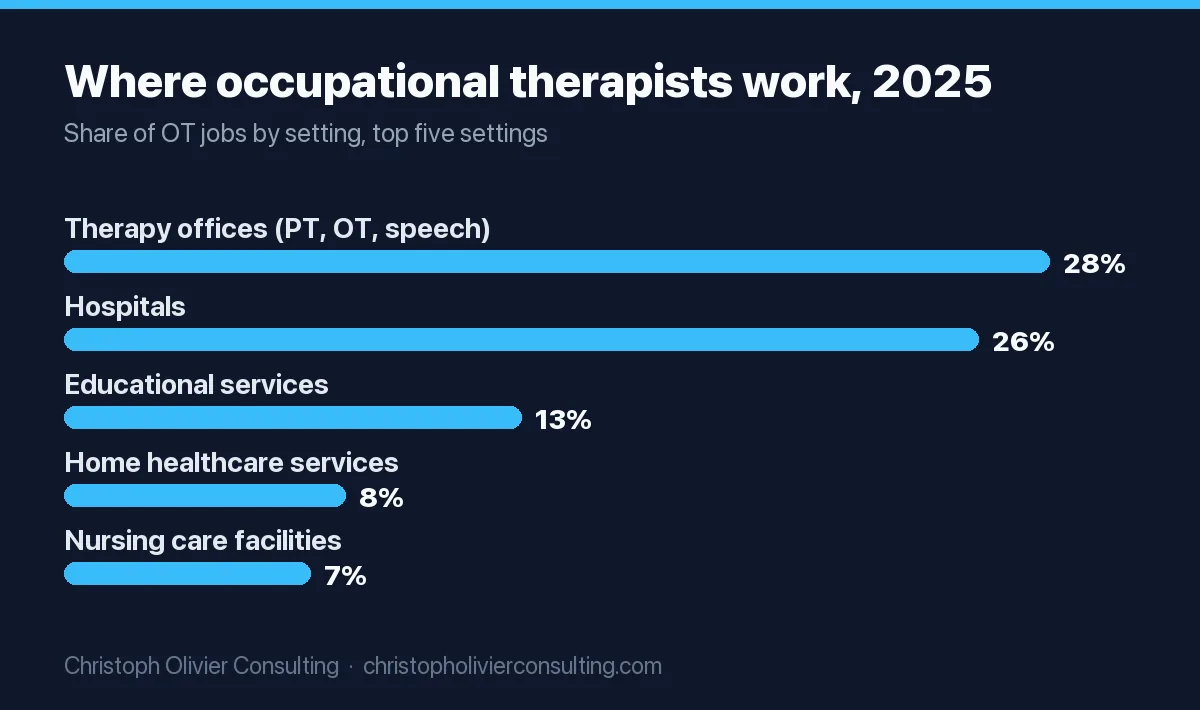
Where do OTs work, and therefore where are your referral relationships? The BLS Occupational Outlook Handbook counts 169,600 occupational therapist jobs in 2025 and breaks them down by setting. Therapy offices are the largest employer at 28%, but hospitals (26%) and schools (13%) together employ more OTs, which is why discharge planners and school teams are worth a dedicated outreach list.
The tracking sheet and follow-up cadence are in our referral marketing guide.
The Medicare rule that makes physician offices your best channel
Most marketing advice for OTs skips the single rule that decides how much a physician’s office values you. For Medicare outpatient therapy, the plan of care has to be certified. Under 42 CFR 424.24(c):
- The certification states that the patient “needs, or needed, physical therapy, occupational therapy, or speech-language pathology services,” furnished while under the care of a physician (or NP, CNS or PA), under a plan that meets 42 CFR 410.61.
- “The initial certification must be obtained as soon as possible after the plan is established.”
- “Recertification is required at least every 90 days.”
- When the OT writes the plan, a physician, NP, CNS or PA with knowledge of the case signs it. The exception in paragraph (c)(5): if a written order or referral is in the record and you can document that the plan went to that practitioner “within 30 days of completion of the initial evaluation,” no signature is needed.
- The same paragraph says the rule should not be read as requiring an order or referral for outpatient OT. So a referral is not a federal Medicare prerequisite, but it makes certification much simpler.
The plan itself must be written before treatment begins and must state “the type, amount, frequency, and duration” of services plus “the diagnosis and anticipated goals” (42 CFR 410.61).
The marketing point: the referring office does paperwork for you at least every 90 days. A practice that sends a clean plan fast, flags what needs a signature and never makes the office chase it becomes the easy choice. The letter below puts that in writing.
Copy-ready physician referral letter template
Dr. [Last name], I am [Name, OTR/L, credential such as CHT if held], owner of [Practice], an outpatient occupational therapy practice at [address], [distance] from your office. We treat [3 specific populations, e.g. post-op hand and wrist, adults after stroke, children with fine motor and feeding delays]. We are in network with [payers] and currently start new patients within [your real number] business days. What we do for your office:
To refer, send an order to [fax] or call [direct line]. We accept referrals for [diagnoses or age range] and will tell you within one business day if a patient is a better fit elsewhere. [Name, credentials, license number if your state requires it in advertising] |
No lunch offer, no gift card, no outcome promise: every line is a checkable service commitment, which keeps it inside AOTA Standard 6F and the referral laws below. Only state turnaround times you actually hit.
Pediatric occupational therapy marketing: the IDEA pathways families follow
Pediatric OT marketing differs because two public systems sit between you and many families.
Birth to 3: early intervention (IDEA Part C). Hospitals, physicians, parents, child care programs, schools, public health and child welfare agencies, and shelters are all listed primary referral sources in 34 CFR 303.303(c), and they must refer a child “as soon as possible, but in no case more than seven days, after the child has been identified.” Those referrals go to the state’s Part C system, not straight to you. The practical move is to become an enrolled provider with your state or county program and then make sure the coordinators know which zip codes and specialties you can cover.
School age: IDEA Part B. Schools must find, locate and evaluate children with disabilities, “regardless of the severity of their disability” (34 CFR 300.111), and OT appears among related services, defined as including “improving ability to perform tasks for independent functioning” (34 CFR 300.34(c)(6)). School OT supports educational goals; some families look for clinic OT on top of it for after-school, summer or non-academic goals like dressing and feeding. Your content should explain that difference plainly without disparaging school therapists.
Pediatric marketing ideas that fit those pathways:
- Write pages in parents’ exact words: “my 4 year old can’t use scissors,” “picky eater gagging on textures,” “meltdowns with clothing tags.” Describe what an OT evaluation covers, not what it will cure.
- Publish your age range, wait time, insurance list and whether you need a prescription to start, where parents see them before they call.
- Offer preschool and daycare staff a free talk on typical fine motor milestones, framed as education, and leave the program’s contact for early intervention referrals, not just yours.
- Send the pediatrician a three-line summary after every evaluation. In my view, closing the loop is the cheapest pediatric referral tactic available.
What you can and cannot say: the rules behind OT marketing
The AOTA 2025 Occupational Therapy Code of Ethics (adopted by the Representative Assembly in April 2025 and published in AJOT, November/December 2025) contains the standards that apply to your marketing. Your state licensing board may have its own advertising rules, so check those too.
| Marketing move | Primary rule (quoted) | Safe version |
|---|---|---|
| Outcome claims on your website (“we fix sensory issues”) | AOTA 6F: “Avoid participating in any form of communication that contains false, fraudulent, deceptive, misleading, or unfair statements or claims.” | Describe what you assess and treat, and how progress is measured |
| Listing credentials and specialties | AOTA 5B: “Represent credentials, qualifications, education, experience, training, roles, duties, competence, contributions, and findings accurately in all forms of communication.” | Only list certifications you hold today, with the issuing body |
| Social media posts about patients | AOTA 6D: refrain “from posting protected health or other identifying information” and clarify “whether one is acting in a professional or an individual capacity.” | Use stock or staged photos, or a signed authorization |
| Testimonials, patient videos and photos | HIPAA: “a covered entity must obtain an authorization for any use or disclosure of protected health information for marketing” (45 CFR 164.508(a)(3)) | Written authorization with every element in 164.508(c)(1), including an expiration date |
| Business arrangements with referrers or vendors | AOTA 1D: “provide relevant disclosures when participating in business arrangements.” | Disclose any ownership or paid relationship in writing |
| Gifts or meals for referring physicians | Stark: OT is a designated health service (42 USC 1395nn(h)(6)(C)). The nonmonetary compensation exception is capped at $535 per physician for 2026 (CMS CPI-U updates) and must not take into account “the volume or value of referrals” (42 CFR 411.357(k)) | Skip gifts. Send a thank-you note and better reports |
| Anything of value to induce federal program referrals | Anti-Kickback Statute: offering “any remuneration (including any kickback, bribe, or rebate)” to induce referrals is a felony, up to $100,000 and 10 years (42 USC 1320a-7b(b)(2)) | No per-referral rewards, ever, for Medicare or Medicaid patients |
| Review requests | Google: you may not “Offer incentives” for reviews or “selectively solicit positive reviews” (Google Maps user contributed content policy) | Ask every discharged patient the same way, no discount or raffle |
The CMS gift cap rises each year with inflation: it was $519 in 2025 and $535 in 2026 per the same CMS table. A patient referral reward program, the kind many generic lists recommend, is the riskiest idea for any practice with Medicare or Medicaid patients. Talk to a healthcare attorney before you run one. For a deeper look at boundaries in therapist promotion, see our guide to ethical marketing for therapists.
One more privacy point: keep review replies general. Do not confirm the reviewer was a patient or mention dates, diagnoses or visits; AOTA Standard 6A requires confidentiality “in compliance with applicable laws,” including HIPAA. Thank them and invite them to call.
Google Business Profile and search for an OT practice
Google’s own Business Profile guidelines say to “Use as few categories as possible to describe your overall core business” and to pick categories that complete “This business IS a” rather than “this business HAS a.” For an OT clinic, that means choosing the occupational therapy category your country’s list offers as primary (type “occupational” into the category field to see the exact wording) and adding a second category only if it describes what the business is.
The same guidelines allow individual practitioners who “operate in a public-facing role” to have their own profile, but “A practitioner shouldn’t have multiple Business Profiles to cover all of their specializations.” So one profile for the clinic, and optionally one per public-facing OT, not one per specialty.
Then cover the basics:
- List services by name: pediatric OT evaluation, hand therapy, custom orthoses, driver rehabilitation, home safety evaluation (only those you provide).
- Add photos of the treatment space and equipment, with no patients identifiable.
- Set hours that match when you actually answer the phone.
- Ask every discharged patient for a review with the same message. Our walkthrough on how to get more Google reviews has request scripts that stay inside Google’s rules.
If you are weighing paid channels on top of this, our breakdown of how to advertise as a therapist lists current channel prices and the platform rules for health advertisers.
How to market an occupational therapy private practice: a 90-day plan
This plan assumes one owner-therapist with limited marketing hours.
- Days 1 to 10: decide who you serve. Pick no more than three populations (for example, hand post-op, adult neuro, pediatric fine motor). Write a one-page “what we treat” sheet with age ranges, diagnoses, payers, start time and fax number.
- Days 1 to 15: fix the front door. Complete the Google Business Profile, add a page per population, a fees and insurance page, and a “do I need a prescription?” answer. Set up an intake log with a “how did you hear about us” field and the referrer’s name.
- Days 10 to 30: build the referral list. List 40 offices within your drive radius: 15 pediatric or family practices, 10 surgeon or orthopedic offices, 5 neurologists or rehab units, 5 discharge planners or home health agencies, 5 case managers. Look up your state early intervention provider enrollment process.
- Days 15 to 45: first contact. Mail or fax the physician letter above to all 40. Call to ask who handles therapy referrals and how they prefer to send them. Visit the 10 offices closest to you.
- Days 30 to 60: prove it. For every referral, send the evaluation summary within your promised window and the plan of care with the signature line flagged. Send a thank-you note to the referring office with no gift.
- Days 45 to 75: content and reviews. Publish two condition pages a month in patient language. Start a standard review request at discharge. Record one patient story only with a signed HIPAA authorization.
- Days 60 to 90: review the log. Rank referral sources by referrals and by patients who completed the plan of care. Drop the bottom third of your outreach list, add new offices like the top third, and repeat.
If you want this as a full written plan with budget and owner hours, our step-by-step guide on how to create a marketing plan has the template.
What are some effective marketing ideas for therapists?
The most effective ideas reach people at the moment of need: the clinician choosing where to send a patient and the patient searching for help. For OTs, that means referral outreach backed by fast reports, a complete Google Business Profile, plain-language condition pages and honest reviews. Good ideas target one audience, give a reason to act now and show up in your intake log. Wider healthcare examples are in our overview of healthcare marketing for practices.
What is the 3-3-3 rule for marketing?
There is no official or standard definition, and people use the label for different things. For an OT practice, a useful working version (my own rule of thumb, not a formal standard) is: 3 referral audiences, 3 touches per office in the first quarter (letter, call, first-referral thank-you), and 3 months before you judge a channel. It keeps a small practice from spreading thin.
How can I make the most money as an OT?
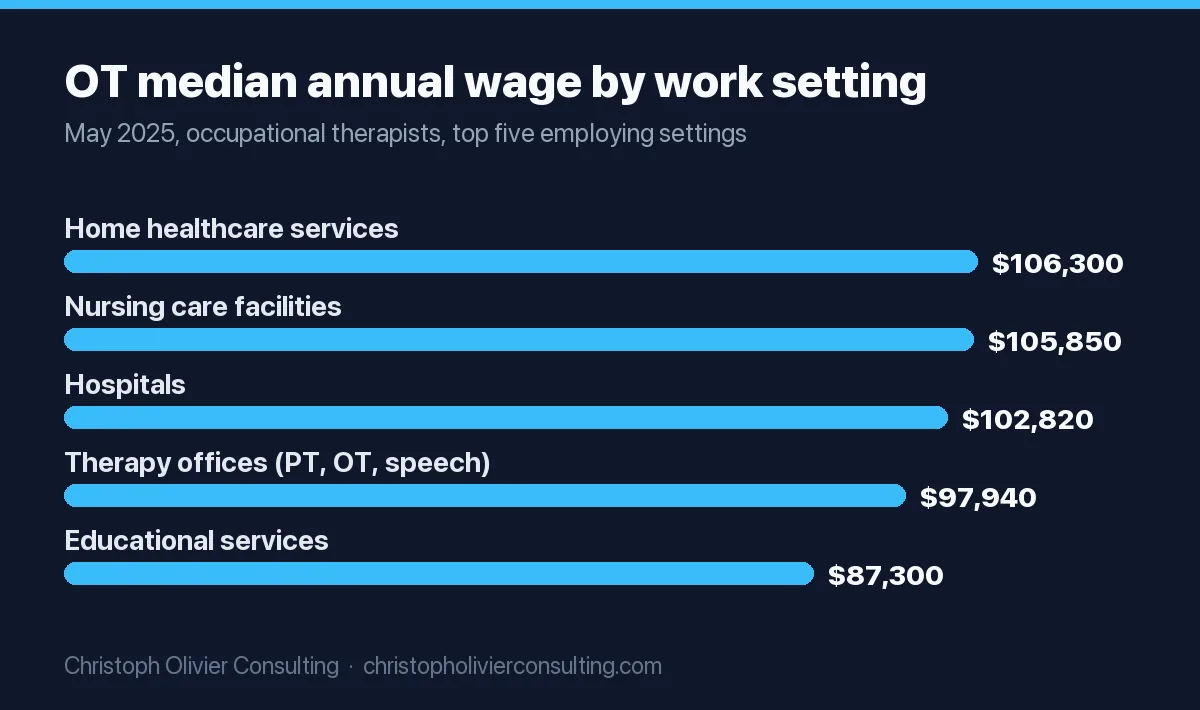
Setting matters for employed OTs. The chart below uses May 2025 median wages from the BLS Occupational Outlook Handbook.
| Work setting | Share of OT jobs, 2025 | Median annual wage, May 2025 |
|---|---|---|
| Home healthcare services | 8% | $106,300 |
| Nursing care facilities (SNFs) | 7% | $105,850 |
| Hospitals | 26% | $102,820 |
| Offices of PT, OT, speech therapists and audiologists | 28% | $97,940 |
| Educational services | 13% | $87,300 |
| All occupational therapists | 169,600 jobs | $100,330 |
Source: BLS Occupational Outlook Handbook, Occupational Therapists.
What is the highest paid OT specialty?
BLS does not publish wages by clinical specialty such as hand therapy or pediatrics. By work setting, home healthcare services had the highest median wage in May 2025 at $106,300, followed by nursing care facilities at $105,850 (BLS). Any specialty salary ranking you see online is a survey or estimate, not federal data.
How to make 200k as an occupational therapist?
Per BLS, the highest-paid 10% of OTs earned more than $131,950 in May 2025, so $200,000 is well above what most wage earners reach. The realistic route is ownership, where income equals collections minus costs. Here is the formula with hypothetical numbers you should replace with your own EOB averages and costs:
- Visits per week x weeks worked x average collected per visit = annual collections. Example: 60 x 48 x $110 = $316,800.
- Annual collections minus rent, staff, billing, software, insurance and marketing = owner earnings. Example: $316,800 minus $150,000 of costs = $166,800.
- To clear $200,000 in this example you need about $33,200 more, which is roughly 302 more visits a year at $110, or about 6 more visits a week across 48 weeks.
A few dependable referring offices can close that gap. If you want help modeling it for your clinic, you can book a consultation.
What are current trends in occupational therapy?
- Demand growth. BLS projects OT employment to grow 15% from 2025 to 2035, about 10,000 openings a year on average, “much faster than the average for all occupations” (BLS).
- A new ethics code. The 2025 AOTA Code adds Standard 3E: “Use of artificial intelligence (AI) in documentation requires acknowledgment of resources.” If you use AI for patient handouts or blog drafts, check how that standard applies to your workflow.
- Rising compliance thresholds. The Stark nonmonetary limit has risen every year since 2017 (from $398 to $535 in the CMS table), which shows the rule is actively maintained, not a dead letter.
Ready to scale your revenue?
Book a free 30-min consultation. We’ll diagnose your growth bottleneck and map out the 3 highest-leverage moves for your business.
Frequently asked questions
Do patients need a physician referral for occupational therapy under Medicare?
No federal Medicare rule requires an order or referral before outpatient OT; 42 CFR 424.24(c)(5) says so directly. The plan of care still must be certified by a physician, NP, CNS or PA, and recertified at least every 90 days. A written referral helps: if one is on file and you send the plan within 30 days of the evaluation, no signature is needed. Private payers and state laws can differ.
What are the best occupational therapy referral sources?
For most OT practices: pediatricians and family physicians, early intervention (IDEA Part C) service coordinators, school special education teams, hand surgeons and orthopedists, neurologists and inpatient rehab units, discharge planners, home health agencies and case managers. Nurse practitioners and physician assistants matter too, because they can certify Medicare therapy plans of care under 42 CFR 424.24.
Can an occupational therapist give gifts to referring doctors?
Be very careful. OT is a designated health service under the Stark law, and gifts to a referring physician must fit an exception. For 2026, CMS caps nonmonetary compensation at $535 per physician, and it cannot reflect the volume or value of referrals or be solicited. The Anti-Kickback Statute separately makes paying for federal program referrals a felony. A thank-you note is the safer choice.
How do I market a pediatric occupational therapy practice?
Enroll as a provider with your state early intervention program, build relationships with pediatricians and preschools, and publish pages written in parents' words with your age range, wait time, insurance list and whether a prescription is needed. Send the pediatrician a short summary after each evaluation. Explain how clinic OT differs from school OT under the IEP without criticizing school therapists.
Can occupational therapists use patient testimonials in marketing?
Only with care. HIPAA requires a written authorization for any use of protected health information for marketing (45 CFR 164.508), with a description of the information, purpose, expiration and signature. AOTA Code Standard 6D bars posting identifying information on social media, and Standard 6F bars misleading claims, so testimonials should not imply guaranteed results.
Can I offer a discount for Google reviews?
No. Google's review policy prohibits offering payment, discounts, free goods or services in exchange for a review, and bans selectively asking only happy patients. Ask every discharged patient the same way, with no incentive. When you reply to reviews, stay general and never confirm that the reviewer was a patient.
Practice marketing ideas