

The best speech therapy marketing ideas start with referral sources, not ads. Most new clients arrive because someone with a professional duty to act on a concern points them to you: a pediatrician screening at the 18 or 24 month visit, an early intervention program, a school team, or a physician who has to sign a Medicare plan of care. Build your marketing around those handoffs first, then add Google, reviews and content on top.
Short answer: Pick one niche, then work the people who are required or advised to refer. The AAP tells pediatricians to screen development at 9, 18 and 30 months and autism at 18 and 24 months. IDEA Part C makes hospitals, physicians and child care programs refer within 7 days of identifying a concern. Medicare needs a physician or NPP to certify your plan of care. Every idea below plugs into one of those rules.
This page gives you 15 ideas scored by cost and ethics risk, a referral-source table, a copy-ready pediatrician letter, the exact ASHA Code and federal rules that limit SLP marketing, and a 90-day plan. Every number links to the primary source it came from.
Speech therapy referral sources: who sends clients and why
A referral source is worth your time when it has a reason to refer that does not depend on liking you. The table below maps each source to the rule or guideline that makes them refer, what to hand them, and what to count.
| Referral source | Why they refer (the rule behind it) | What to give them | What to track |
|---|---|---|---|
| Pediatricians and family physicians | The AAP clinical report recommends standardized developmental screening at the 9, 18 and 30 month visits and autism screening at 18 and 24 months, with concerns followed by screening or direct referral. | One-page “when to refer” sheet, a fax or portal referral form, your wait time this month | Referrals per practice per month; days from referral to evaluation |
| Early intervention (IDEA Part C) | 34 CFR 303.303 requires referral “as soon as possible, but in no case more than seven days” after a child is identified. | Your state EI provider enrollment status, languages spoken, service area map | Service coordinator contacts; authorizations received |
| Child care, preschools, Head Start | “Child care programs and early learning programs” are named primary referral sources in 303.303(c), and the AAP report calls for two-way communication with child care and preschools. | A 20 minute staff talk on red flags by age, parent handout without outcome promises | Talks given; calls that mention the center |
| Schools and IEP teams | Speech or language impairment is the second largest IDEA category, at 19% of the 7.5 million students served in 2022 to 2023. | Summer and after-school availability, consent-based progress sharing with the school SLP | Families who name a school staff member as the source |
| Adult physicians (PCP, neurology, ENT) | Medicare requires a physician or NPP to certify the plan of care and recertify it at least every 90 days. | A pre-filled plan of care that is easy to sign, a turnaround promise you can keep | Days to signed certification; referrals per office |
| Hospitals, SNFs, home health | Hospitals, including prenatal and postnatal care facilities, are the first source listed in 303.303(c) for infants. For adults, discharge teams hand off patients who still need outpatient therapy. | Insurance accepted, home or clinic options, intake phone answered live | Discharges referred; days from discharge to first visit |
| Parents and past clients | “Parents” are also a named primary referral source in 303.303(c). | A clear page explaining your evaluation, prices and wait time | “How did you hear about us?” on every intake |
The referral marketing mechanics are the same as in any service business: make referring easy, close the loop, and thank the referrer in a way that is legal. The difference for SLPs is the rulebook, which is covered further down.
15 speech therapy marketing ideas, scored
Cost and effort are my judgment for a solo or small practice. The “rule” column is the sourced reason the idea works or the line you cannot cross.
| # | Idea | Reaches | Cost | Rule or source | Ethics watch-out |
|---|---|---|---|---|---|
| 1 | Pediatrician visits timed to screening ages | Parents of toddlers | Time only | AAP: screens at 9, 18, 30 months; autism at 18, 24 | No gifts tied to referrals |
| 2 | Close the loop with a written evaluation summary | Referring physicians | Time only | AAP report stresses bidirectional communication | Signed release before sharing PHI |
| 3 | Enroll and stay visible with your Part C program | Infants and toddlers | Paperwork | 303.303: 7 day referral rule | State provider rules vary |
| 4 | Red-flag talks for child care staff | Teachers, then parents | Low | Child care is a named referral source | No “guaranteed” milestones |
| 5 | Summer and after-school slots for IEP students | School families | Low | 19% of IDEA students have a speech or language impairment | Do not undercut the school SLP |
| 6 | Plan of care packet for adult physicians | Medicare adults | Time only | 42 CFR 424.24 certification | Accurate diagnosis and goals |
| 7 | Discharge planner and home health handoffs | Post-stroke, post-surgery adults | Time only | ASHA Code I-B: referral and collaboration | Patient choice of provider |
| 8 | Cross-referral with PT and OT clinics that lack speech | Shared patients | Low | ASHA Code I-B: use “referral and/or interprofessional collaboration” | No fee per referral |
| 9 | ENT and audiology relationships | Voice, swallowing, hearing-related | Time only | ASHA Code IV-A: work with other professions | Disclose any financial ties (III-B) |
| 10 | Guest talks at aphasia, Parkinson’s or stuttering support groups | Adults and caregivers | Free | Education, not solicitation | No outcome promises (I-M) |
| 11 | Google Business Profile plus compliant review requests | “Near me” searchers | Free | Google review policy, FTC 16 CFR 465 | Ask everyone, never gate |
| 12 | One service page per niche (stuttering, AAC, feeding, voice) | Specific searches | Low | ASHA Code III-A: no misstated competence | List only credentials you hold |
| 13 | Telepractice for a defined state service area | Rural and busy families | Low | ASHA: 59% of outpatient clinic SLPs use telepractice | Licensed in the client’s state (I-N) |
| 14 | Parent education content by age | Worried parents | Low | ASHA Code III-E: accurate public statements | No client stories without written authorization |
| 15 | Paid search for “speech therapist near me” | High-intent searchers | Ad spend | Same rules as all advertising (III-F) | No superlatives you cannot prove |
What are some effective marketing ideas for therapists?
For SLPs, the effective ones are ideas 1, 2, 3 and 6, because they attach you to a step a referrer already has to take. A pediatrician who screens a 24 month old and finds a concern has to send that family somewhere today. If your sheet is in the chart room and your wait time is current, you are the easy answer. The same logic runs through the physical therapy marketing playbook, where physician relationships also drive most new patients.
Pediatrician outreach that matches the screening calendar
Do not pitch “speech therapy.” Pitch the visits where the AAP says screening happens. The AAP’s 2020 clinical report (Lipkin and Macias, Pediatrics 145(1)) states that “Screening for ASD is still recommended at the 18- and 24-month visits” and that concerns should be followed by standardized screening “or direct referral to intervention and specialty medical care.” Ask the office manager which providers see the most 18 and 24 month well visits, and bring your sheet to those providers.
Adult and medical speech therapy: make the signature easy
For Medicare outpatient therapy, an SLP can establish the plan of care under 42 CFR 410.61, but a physician, NP, CNS or PA must certify it. Under 42 CFR 424.24(c) the certification “must be obtained as soon as possible after the plan is established” and “Recertification is required at least every 90 days.” That makes physician offices a paperwork partner as much as a referral source. Practices that return clean, short plans of care become the ones staff remember.
Also know the money line before you promise anything about frequency. CMS sets the 2026 KX modifier threshold at “$2,480 for PT and SLP services combined,” and claims above it without the KX modifier are denied. The targeted medical review threshold stays at $3,000. Because the $2,480 is shared with physical therapy, ask new Medicare patients whether they are also in PT this year.
Early intervention and schools
Part C referral sources are listed in the regulation itself. 34 CFR 303.303(c) names hospitals, physicians, parents, child care and early learning programs, LEAs and schools, public health facilities, other clinics, child welfare staff, homeless family shelters, and domestic violence shelters. The state system must provide for referral within 7 days of identification, so your goal is to be a known, enrolled provider in your state’s system rather than a competitor to it. Enrollment rules differ by state, so check with your lead agency.
For school-age children, offer what schools cannot: summer blocks, after-school times and intensive episodes. ASHA’s 2025 survey found 51% of pediatric hospital SLPs and 35% of outpatient clinic SLPs provide episodic care to children, defined as “periods of intensive therapy with breaks for generalization.”
Where SLPs work, and why that shapes your marketing
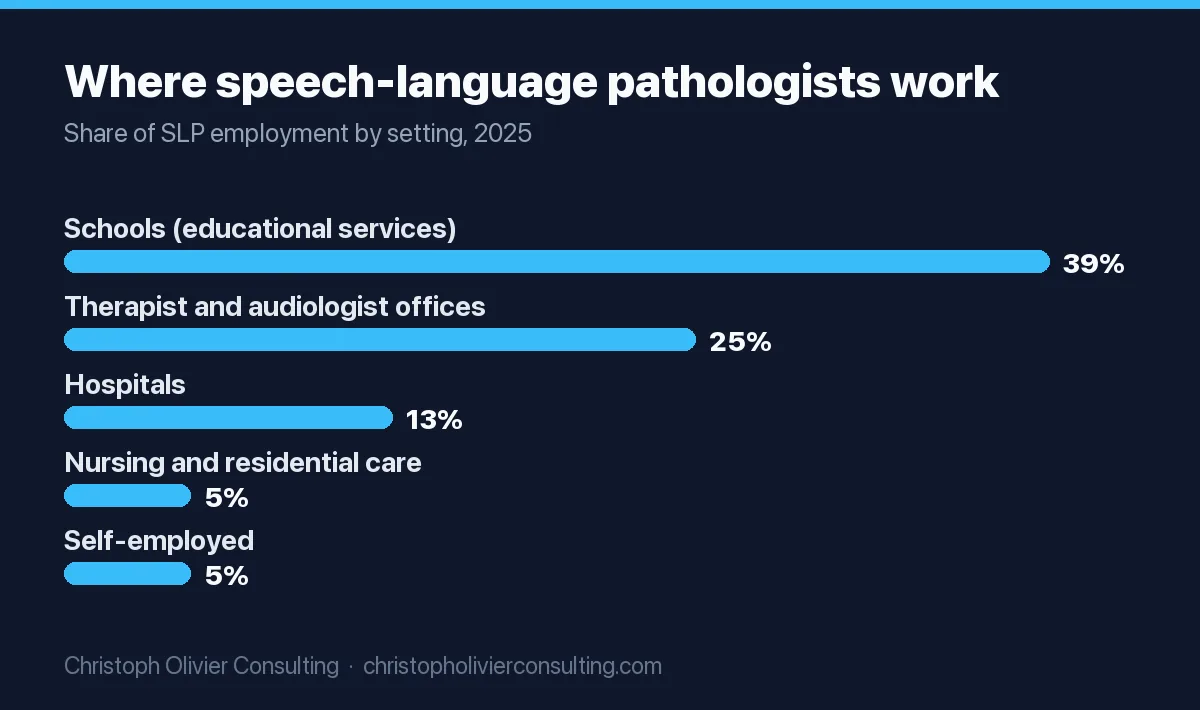
Private practice competes for families with schools and hospitals that already have them. The BLS counts 193,400 SLP jobs in 2025 with a median pay of $97,870, and projects 17% growth from 2025 to 2035. Only 5% of SLPs are self-employed, and 25% work in offices of therapists and audiologists.
| Data point | Value | Source |
|---|---|---|
| SLP jobs, 2025 | 193,400 | BLS OOH |
| Median annual pay, May 2025 | $97,870 | BLS OOH |
| Projected growth, 2025 to 2035 | 17% | BLS OOH |
| Health care SLPs whose work includes private practice | 32% | ASHA 2025 SLP Health Care Survey |
| Outpatient clinic or office SLPs in private practice | 58% | ASHA 2025 |
| Health care SLPs whose caseload grew since January 2024 | 41% | ASHA 2025 |
| Outpatient clinic or office SLPs using telepractice | 59% | ASHA 2025 |
| IDEA students with speech or language impairment, 2022 to 2023 | 19% of 7.5 million | NCES |
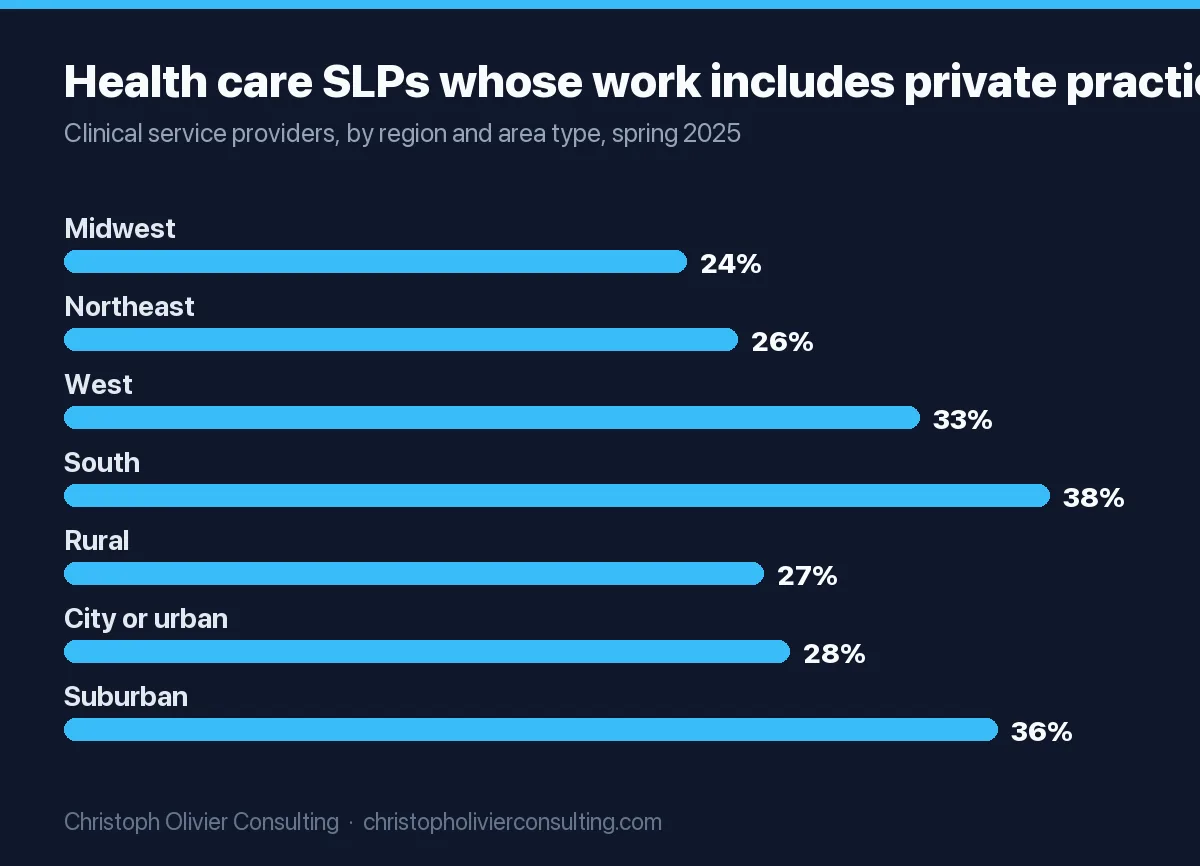
ASHA’s survey also shows where private practice is most common: 38% of health care SLPs in the South include it in their work, against 24% in the Midwest, and 36% in suburban areas against 27% in rural ones. If you practice in a suburban Southern market, expect more competing practices in the map results, and lean harder on niche and referral relationships.
Ethics rules that limit SLP marketing
The ASHA Code of Ethics (effective March 1, 2023) defines advertising broadly: “Any form of communication with the public regarding services, therapies, research, products, or publications.” So your website, posts, flyers and ads all count. The rules that matter most:
| Tactic | OK? | The rule |
|---|---|---|
| “Your child will be talking in 12 weeks” | No | ASHA Principle I, Rule M: you “may make a reasonable statement of prognosis, but they shall not guarantee,” directly or by implication, “the results of any treatment or procedure.” |
| Calling yourself a specialist in an area you have no training in | No | Principle III, Rule A: “shall not misrepresent their credentials, competence, education, training, experience.” |
| Ads that overstate results | No | Principle III, Rule F: statements “shall not contain misrepresentations when advertising, announcing, or promoting their professional services.” |
| Paying a referral source or giving gifts tied to referrals | No when federal program patients are involved | The Anti-Kickback Statute makes it a felony to “knowingly and willfully” offer remuneration to induce referrals, with fines up to $100,000 and up to 10 years in prison. ASHA Principle III, Rule B also requires disclosure of conflicts of interest. |
| Posting a client’s story, photo or video | Only with written authorization | HIPAA requires an authorization for any use of PHI for marketing under 45 CFR 164.508(a)(3). ASHA Principle I, Rule P also protects client confidentiality. |
| Asking only happy families for Google reviews | No | Google’s policy bans efforts to “selectively solicit positive reviews from customers.” |
| A discount for leaving a 5 star review | No | 16 CFR 465.4 bans incentives “conditioned expressly or by implication on” reviews “expressing a particular sentiment,” and Google bans incentives for any review. |
| Staff writing reviews of the practice | No, unless disclosed | 16 CFR 465.5 requires disclosure of an insider’s “material relationship to the business.” |
| Asking every client the same way for a review | Yes | 465.5 exempts “generalized solicitations to purchasers.” |
Two more lines worth knowing. HIPAA’s marketing definition in 45 CFR 164.501 excludes communications “for treatment of an individual,” so a progress note to the referring doctor is not marketing. Telepractice must be “consistent with professional standards and state and federal regulations” under ASHA Principle I, Rule N, which generally means checking licensure rules in the state where the client sits during the session. The mental health marketing guide covers the same HIPAA review and testimonial issues for therapists in more depth.
Copy-ready pediatrician referral letter
Send this with a one-page sheet, then follow up in person. Keep it to one page. Replace the brackets, and do not add outcome claims.
Subject: Speech and language referrals for your 18, 24 and 30 month visits
Dr. [Last name],
I am [Name], CCC-SLP, owner of [Practice] in [Town]. I evaluate and treat toddlers and preschoolers with [late talking, speech sound disorders, stuttering, feeding].
When a developmental or autism screen at a well visit raises a speech or language concern, you can send families to us three ways: fax [number], your EHR referral to [NPI], or have the parent call [number], which a person answers [hours].
Current wait for an evaluation: [X] business days. We accept [insurers], and we can help families start the early intervention referral for children under 3 if that is the better route.
With the parent’s signed release, we send you a one-page evaluation summary within [X] days of the visit, plus a progress note every [X] weeks.
I would like 10 minutes with your team to drop off our referral sheet. Does [day] at [time] work?
[Name], [credentials], [phone], [address]
Why this wording works: it names the screening visits the AAP report recommends, it offers the Part C route instead of competing with it, and it promises a written summary, which serves the “bidirectional communication” the AAP describes. It makes no prognosis, which keeps it inside ASHA Principle I, Rule M.
Your 90-day speech therapy marketing plan
- Days 1 to 10: choose one niche and one referral type. For example, “late talkers aged 18 to 36 months, sourced from pediatricians.” Write your service page and your one-page referral sheet for that niche only.
- Days 1 to 14: fix the front door. Complete your Google Business Profile, add your wait time to the website, and add a required “How did you hear about us?” field to intake. The local SEO playbook walks through the profile setup.
- Days 15 to 30: list 20 referral offices. Pediatric and family practices within your drive radius, plus your Part C lead agency contact. Mail the letter above to all 20.
- Days 30 to 60: visit the 10 that answered or are closest. Bring the sheet, ask who handles referrals, and ask which providers see the most 18 and 24 month visits.
- Days 30 to 90: close every loop. Send a written summary after every evaluation from a referred client, with a signed release.
- Days 45 to 90: start reviews. Use one written request for every discharged or long-term family, sent the same way to everyone. The Google review guide has compliant request wording.
- Day 90: count. Referrals by source, days from referral to evaluation, and evaluations that became plans of care. Drop the sources with zero and double down on the top two.
If you want help building the referral system and tracking it, you can book a consultation.
What are some creative speech therapy ideas?
Creative works when it stays specific and educational. Three ideas that fit the rules above:
- An “is this normal at 2?” night at a library or child care center. Teach red flags by age and hand out your sheet. No screenings that imply a diagnosis.
- A caregiver workshop for an aphasia or Parkinson’s support group. Teach communication strategies families can use at home tonight.
- A short video series answering one parent question each. Film your hands and materials, not clients, so no authorization is needed.
What is the 3:1 rule in speech therapy?
It is a school scheduling model, not a marketing rule. ASHA’s explainer, Understanding the 3:1 Scheduling Model for Service Delivery, says clinicians “conduct direct services for 3 weeks in a row and indirect services and activities during the fourth week,” which “focuses on monitoring, supporting and generalizing skills through therapy planning, creation of resources, consultation, and assessment.” For a private practice, that fourth week is when a school SLP is most available to talk about a shared student, with the parent’s consent.
What is the 3-3-3 rule for marketing?
It is an informal agency heuristic, not a research finding. LYFE Marketing defines it as focusing on “three key messages about your brand, three audience segments, and three marketing channels.” For an SLP practice that might be: three messages (current wait time, insurance accepted, your niche), three audiences (parents, pediatricians, child care directors), and three channels (referral visits, Google Business Profile, a monthly email to referrers).
Why are SLPs leaving the profession?
ASHA does not publish a single “why they leave” figure, but its 2025 SLP Health Care Survey on practice issues (2,693 respondents) shows the pressures. 60% of clinical service providers had a productivity requirement, with a mean of 79% and 92% of SNF clinicians subject to one. 19% did off-the-clock work daily, rising to 37% among those paid per visit. 53% named administrative tasks as a barrier to optimal care, and 37% reported mental health and stress-related concerns as on-the-job safety risks. For a private practice, that is a hiring message as well as a marketing one: if you offer realistic caseloads, say so, with numbers you can back up, when you recruit.
How to market a speech therapy private practice on a small budget
Spend time before money. Ideas 1 to 10 cost time, and ideas 11 to 14 cost little. Add paid search only when you can answer the phone live and have open evaluation slots, and set the budget from the number of new evaluations you can actually take. The Google Ads budget guide shows how to work that number backward. In my view, the single cheapest growth lever for most SLP practices is the written summary back to the referrer, because it turns one referral into a habit.
Ready to scale your revenue?
Book a free 30-min consultation. We’ll diagnose your growth bottleneck and map out the 3 highest-leverage moves for your business.
Frequently asked questions
What are the best speech therapy marketing ideas?
Start with referral sources that already have a reason to refer: pediatricians screening at the 9, 18 and 30 month visits, your state's Part C early intervention program, child care centers and adult physicians who must certify Medicare plans of care. Add a complete Google Business Profile, a compliant review routine, one service page per niche and a written summary back to every referrer.
How do you market a speech therapy private practice?
Choose one niche and one referral type, then build a one-page referral sheet, mail a short letter to about 20 nearby pediatric or physician offices and visit the ones that respond. Fix your website and Google profile, ask every family for a review the same way, track referrals by source on intake, and review the numbers at day 90.
What are the main speech therapy referral sources?
Pediatricians and family physicians, early intervention programs, child care and preschools, schools and IEP teams, adult physicians such as PCPs, neurologists and ENTs, hospital and SNF discharge teams, PT and OT clinics, and parents. Federal rule 34 CFR 303.303(c) lists hospitals, physicians, parents, child care programs, schools and public health agencies as primary referral sources for infants and toddlers.
Can speech therapists ask clients for Google reviews?
Yes, if you ask every client the same way. Google's policy bans selectively soliciting positive reviews and offering incentives for reviews. The FTC rule at 16 CFR 465 bans incentives tied to positive or negative sentiment and requires disclosure when staff or managers write reviews. Never reply to a review in a way that confirms someone is a client.
What is the 3:1 rule in speech therapy?
It is a school scheduling model described by ASHA: clinicians provide direct services for three weeks in a row and indirect services during the fourth week. That fourth week is used for monitoring, generalizing skills, planning, creating resources, consultation and assessment. It is a service delivery model, not a marketing rule.
Can an SLP guarantee results in marketing?
No. ASHA's Code of Ethics, Principle I, Rule M, allows a reasonable statement of prognosis but says certificate holders shall not guarantee the results of any treatment or procedure, directly or by implication. Principle III, Rule F also bars misrepresentations when advertising or promoting professional services, so avoid timelines like talking in 12 weeks.
Why are SLPs leaving the profession?
ASHA does not publish one exit figure, but its 2025 SLP Health Care Survey shows the pressures: 60% of clinical providers had a productivity requirement averaging 79%, 19% did off-the-clock work daily, 53% named administrative tasks as a barrier to care, and 37% reported mental health and stress concerns as a safety risk at work.
Practice marketing ideas