

Sponsoring a Formula 1 team costs anywhere from about $500,000 a year for a technical supplier deal to a reported $110 million a year for the biggest title partnership on the grid. No team or sponsor publishes its fee, so every team-level number below is a reported figure with the outlet named. The one hard number comes from Formula 1’s owner: Liberty Media’s 10-K shows sponsorship made up 21.7% of Formula 1’s $3,873 million revenue in 2025, which works out to roughly $840 million in a single year for the series alone.
Short answer: Reported F1 title sponsorships run about $75 million to $110 million a year at the top teams (Oracle with Red Bull at a reported $110 million, HP with Ferrari at a reported $90 million to $100 million). A new team, Cadillac, reportedly priced the tiers below title at $40 million to $50 million for premium partners, $3 million to $15 million for official partners and from $500,000 for technical suppliers. Add activation on top of the fee.
F1 sponsorship cost by tier: what each level reportedly costs per year
The cleanest public price ladder for an F1 team comes from Black Book Motorsport’s September 19, 2025 summary of Sports Business Journal reporting on Cadillac, which Liberty Media’s 10-K confirms as the eleventh team entering the 2026 championship. It is one team’s asking structure, not a market rate card, but it is the only full ladder that has been reported. The title deals at the top of the table come from RacingNews365’s March 1, 2026 list, which the outlet says was built from conversations with sponsorship experts in the paddock.
| Tier | What you typically get | Reported cost per year | Source of the figure |
|---|---|---|---|
| Title partner, top team | Your name in the team name, prime car and kit surfaces, technology or service integration | $75 million to $110 million (reported) | RacingNews365, 2026 |
| Title partner, new team (asking price) | Full title rights, initial five-year term | $55 million to $70 million (asking, reported) | Black Book Motorsport citing SBJ, 2025 |
| Title partner, midfield team | MoneyGram with Haas | About $20 million (reported) | Black Book Motorsport citing SBJ, 2025 |
| Premium partner (2 to 3 per team) | Large car positions without the team name | $40 million to $50 million (asking, reported) | Black Book Motorsport citing SBJ, 2025 |
| Premium partner (3 to 5 per team) | Same tier, split across more brands | Up to $30 million (asking, reported) | Black Book Motorsport citing SBJ, 2025 |
| Airbox or sidepod position, bigger teams | One of the most visible logo spots on the car | Upwards of $5 million (reported) | Autosport citing SponsorUnited, 2025 |
| Official team partner | Category rights, smaller logo, hospitality, marketing rights | $3 million to $15 million (asking, reported) | Black Book Motorsport citing SBJ, 2025 |
| Technical supplier | Supplier status, usually part paid in product or services | From $500,000 (asking, reported) | Black Book Motorsport citing SBJ, 2025 |
Two things to read into that ladder. First, the gap between title and everything else is huge: the cheapest reported title deal on the list is still several times the top of the official partner band. Second, the prices are per year, and multi-year terms are the norm. Formula 1’s own 2025 10-K says its sponsor contracts “typically have a term of three to five years,” with payments that rise each year by a fixed amount, a fixed percentage or inflation. Plan for the total commitment, not the year one number.
Sponsorship agency estimates sit in the same range. RTR Sports, which sells F1 sponsorship and so has a stake in the answer, puts the entry floor for “meaningful rights” at about $2 million a year with a two-season minimum. Treat that as a seller’s estimate, not market data.
F1 team title sponsor cost: every reported deal for 2026
Title deals are where the searchable numbers are. None of the teams or sponsors below disclosed a fee; the table shows the official announcement, so you can see what was actually confirmed, next to the press estimate.
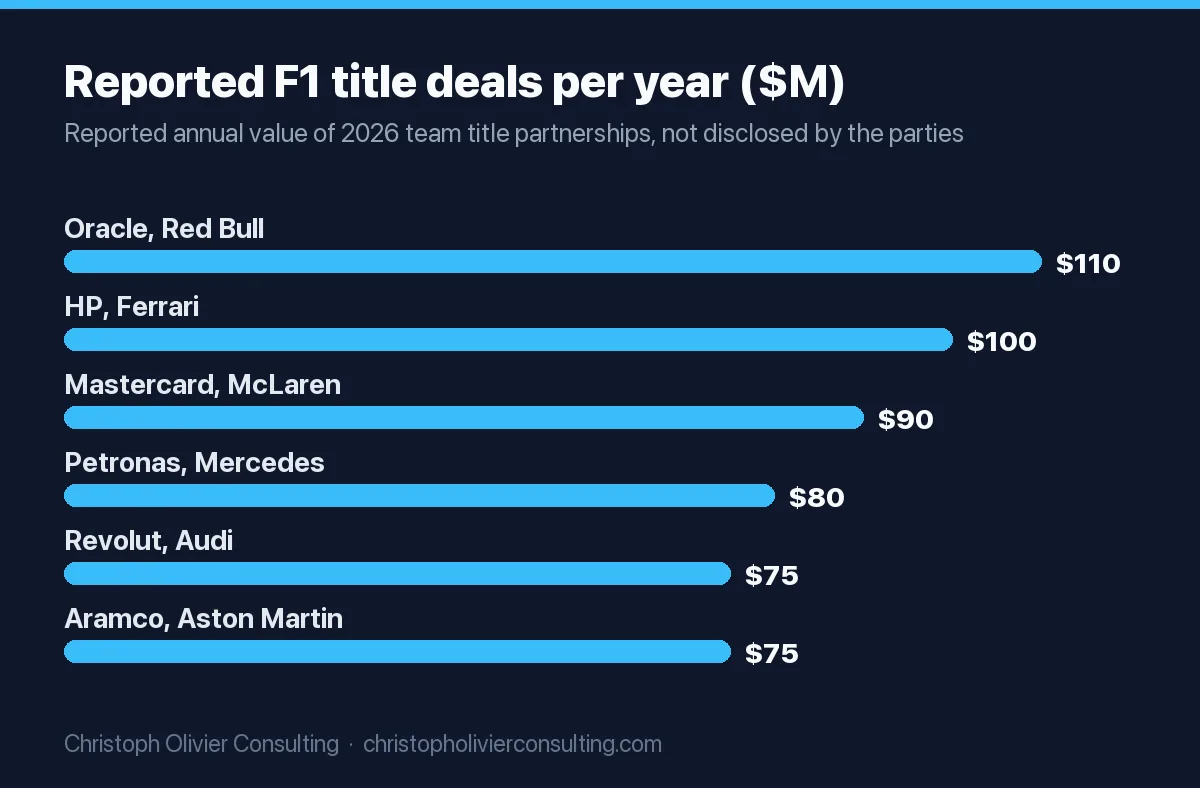
| Team (2026 name) | Sponsor | Confirmed by the parties | Reported value per year | Reported by |
|---|---|---|---|---|
| Oracle Red Bull Racing | Oracle | Multi-year extension, February 26, 2026; no fee | $110 million | RacingNews365, 2026 |
| Scuderia Ferrari HP | HP Inc. | Multi-year title partnership, April 24, 2024; no fee | $100 million (RacingNews365); about $90 million (Will Buxton via PlanetF1, 2024) | RacingNews365, PlanetF1 |
| McLaren Mastercard Formula 1 Team | Mastercard | Naming partner from 2026; no fee | $90 million (RacingNews365); about $100 million (Black Book Motorsport estimate) | RacingNews365, Black Book Motorsport |
| Mercedes | Petronas | Title and technical partner since 2010; no fee | $80 million (RacingNews365); $75 million (Front Office Sports, 2022) | RacingNews365, Front Office Sports |
| Aston Martin Aramco Formula One Team | Aramco | Five-year deal to 2028, announced December 14, 2023; no fee | $75 million | RacingNews365, 2026 |
| Audi Revolut F1 Team | Revolut | Title partner from 2026, announced July 30, 2025; no fee | $75 million | RacingNews365, 2026 |
| Cadillac | None signed for 2026 | Team said in November 2025 it was “not looking for a title partner” for its debut | $55 million to $70 million (asking) | Black Book Motorsport, 2025 |
RacingNews365 notes its figures cover “the complete package” each title sponsor provides, including services, software and technical support. That matters: a share of Oracle’s or HP’s value is delivered as technology, not cash. When outlets disagree, as on HP and Petronas, the table shows both.
How much does it cost to be a title sponsor in F1?
Based on the reported deals, a title sponsorship of a top four team runs about $80 million to $110 million a year, a newer or rebuilding works team about $55 million to $75 million, and a back-of-grid team around $20 million. The history shows how fast that grew: when Oracle first signed with Red Bull in February 2022, an AP source put the deal at $500 million over five years, about $100 million a year, according to PlanetF1.
Formula 1 sponsorship cost per year at series level: F1’s own deals
You can also buy from Formula 1 itself instead of a team. Its 10-K lists what it sells: “trackside advertising and race title sponsorship packages,” plus Global Partner and Official Supplier status. These are the largest league-level deals and what was reported about each.
| Partner | What was confirmed | Reported value | Reported by |
|---|---|---|---|
| LVMH (Louis Vuitton, Moet Hennessy, TAG Heuer) | 10-year Global Partner deal from 2025, announced October 2, 2024; no fee disclosed | About $1 billion over 10 years, roughly $100 million a year | Motorsport.com, via Sports Illustrated, 2024 |
| Aramco | Long-term Global Partner from March 10, 2020, with title rights to three 2020 Grands Prix | $42 million to $51 million a year, more than $450 million over ten years | Motorsport Week, 2020 |
| Heineken | Global Partner since 2016; multi-year renewal announced November 2025 with naming rights to three Grands Prix a season | Original deal about $250 million over seven years; renewal not disclosed | Speedcafe, 2016; renewal via Black Book Motorsport, 2025 |
| Rolex | Official timekeeper for 12 years, replaced by TAG Heuer from 2025 | Not disclosed | Sports Illustrated, 2024 |
How much is Louis Vuitton paying for F1 sponsorship?
Louis Vuitton does not have its own price. It is one of three LVMH houses inside the group deal, and neither LVMH nor Formula 1 disclosed the fee. The figure in circulation is about $1 billion over ten years for the whole LVMH package, reported by Motorsport.com and relayed by Sports Illustrated. What Louis Vuitton visibly gets: title of the season opener (the “Formula 1 Louis Vuitton Australian Grand Prix 2025”), trackside signage and its monogram trophy trunks on the podium, per Formula 1’s January 30, 2025 announcement. For context on what the group spends overall, see our breakdown of LVMH, Hermes and Kering marketing budgets.
How much does F1 make from sponsors? The 10-K numbers
This is the only sponsorship figure in F1 that comes from an audited filing. Liberty Media discloses Formula 1’s total revenue and the share that came from sponsorship. Multiplying the two gives the dollar amount. The table is our own calculation from those filings; Liberty does not print the dollar line itself.
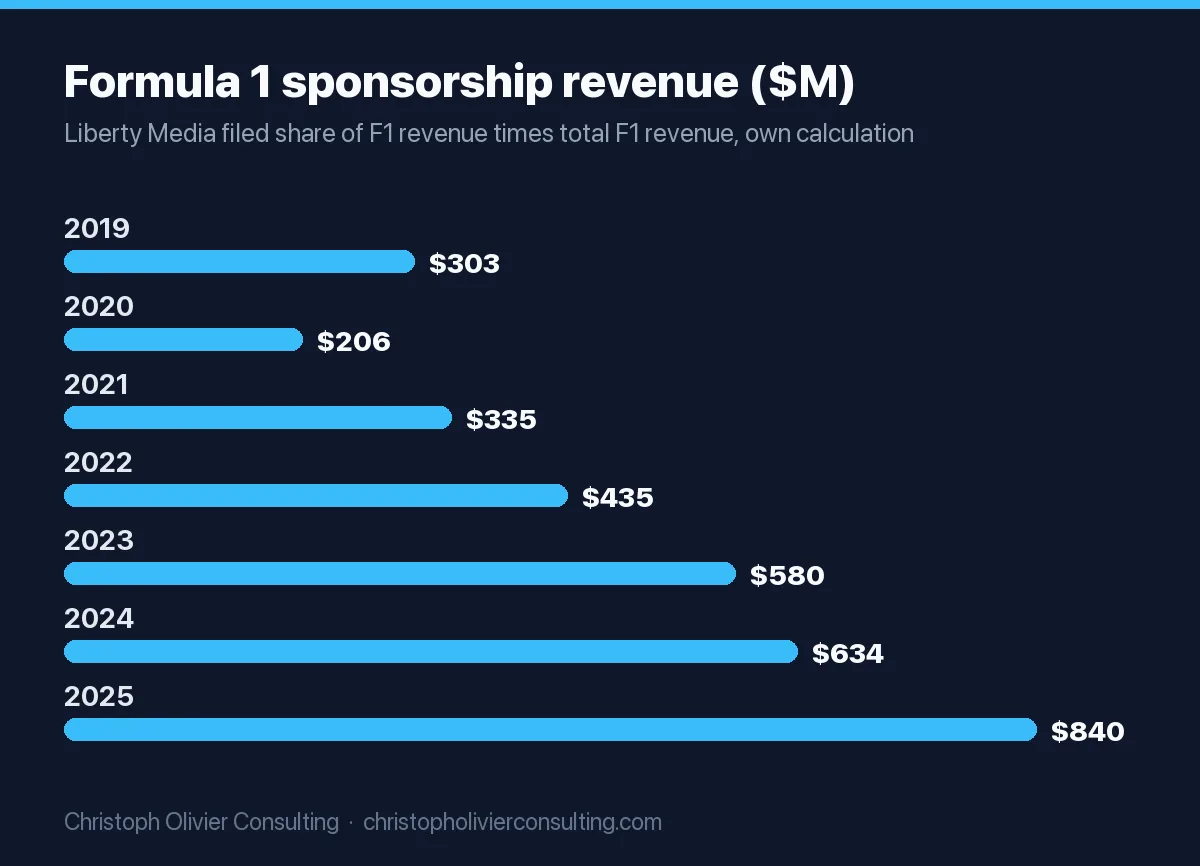
| Year | Total Formula 1 revenue | Sponsorship share (as filed) | Sponsorship revenue (own calculation) | Filing |
|---|---|---|---|---|
| 2019 | $2,022 million | 15% | about $303 million | FY2021 10-K, FY2019 10-K |
| 2020 | $1,145 million | 18% | about $206 million | FY2021 10-K |
| 2021 | $2,136 million | 15.7% | about $335 million | FY2023 10-K |
| 2022 | $2,573 million | 16.9% | about $435 million | FY2023 10-K |
| 2023 | $3,222 million | 18.0% | about $580 million | FY2025 10-K |
| 2024 | $3,411 million | 18.6% | about $634 million | FY2025 10-K |
| 2025 | $3,873 million | 21.7% | about $840 million | FY2025 10-K |
So Formula 1’s own sponsorship income nearly tripled from 2019 to 2025. Liberty’s 10-K credits the 2025 rise to “revenue from new sponsors, contractual increases in revenue from existing sponsors and growth in digital advertising revenue.” The trend continued in 2026: the Q3 2026 10-Q says sponsorship revenue rose in the first nine months “due to contractual increases in fees and revenue from new sponsors,” even though two fewer races were held in that period. The 2020 share looks high only because race promotion revenue collapsed that year.
Teams sell their own sponsorship on top of this. Autosport, citing a SponsorUnited report, put the 2024 total for F1 and its teams at $2.04 billion, with technology brands alone accounting for more than $500 million across the ten teams. Subtracting F1’s own 2024 sponsorship (about $634 million, above) leaves roughly $1.4 billion for the teams. That is a rough own calculation that mixes two methods, so read it as an order of magnitude, not a precise figure.
What is the most expensive sponsor in F1?
At team level, the most expensive reported deal is Oracle with Red Bull at $110 million a year, per RacingNews365. At series level, LVMH’s reported roughly $100 million a year is in the same bracket. Both are estimates. The largest audited sponsorship number belongs to a team, not a deal: Ferrari’s 2025 annual report on Form 20-F shows “sponsorship, commercial and brand” revenue of €820 million in 2025, up 22.4% from €670 million in 2024. That line also includes Ferrari’s share of Formula 1 commercial revenue and its endurance racing deals, so it is not sponsorship alone, but Ferrari says the increase was “primarily attributable to sponsorships and lifestyle activities.”
Why F1 teams need title money: the funding gap (own calculation)
Title fees make sense once you put them next to what a team is allowed to spend. The FIA cost cap is $215 million for 2026, up from $135 million, according to Formula 1’s April 10, 2026 explainer. Driver salaries, the three highest-paid staff and marketing costs sit outside the cap, so real budgets are higher. On the income side, Formula 1 paid teams $1,400 million in 2025 (excluding a $50 million Concorde incentive), per the 2025 10-K. Split across ten teams, that averages $140 million, though the real split is weighted heavily by championship results.
| Reported title deal | Reported value per year | Share of the 2026 cost cap ($215 million) |
|---|---|---|
| Oracle, Red Bull | $110 million | 51% |
| HP, Ferrari | $90 million to $100 million | 42% to 47% |
| Mastercard, McLaren | $90 million | 42% |
| Petronas, Mercedes | $75 million to $80 million | 35% to 37% |
| Aramco, Aston Martin; Revolut, Audi | $75 million | 35% |
| MoneyGram, Haas (2025) | About $20 million | 9% |
Own calculation: reported annual value divided by the $215 million cap. Assumptions: reported values are accurate and paid entirely in cash, which they are not (RacingNews365 says they include services and technology). When Will Buxton estimated HP’s deal in 2024 he described it as two thirds of the then $135 million cap, per PlanetF1. The bigger 2026 cap shrinks that ratio and is one reason teams keep pushing for bigger title fees.
How much does it cost to sponsor an F1 team as a smaller brand?
Most companies asking this question are not shopping for title rights. The reported floor for a team relationship is a technical supplier deal from about $500,000 a year, and official partner rights start around $3 million, per the SBJ figures for Cadillac. The fee is only the right to use the name. You still pay to turn it into something customers notice.
Worked example: all-in cost of an official team partner deal
This is an illustrative model, not a quote. Rights fee: $3 million a year, the bottom of the reported official partner band. Activation: RTR Sports uses a rule of thumb of 0.5 to 1.5 times the contract value; we apply 1.0 times as the midpoint. Escalator: 3% a year, an assumption that reflects the 10-K’s note that F1 contracts usually rise annually. Term: three years, the low end of the 10-K’s “three to five years.”
- Year 1: $3.00 million rights plus $3.00 million activation = $6.00 million.
- Year 2: $3.09 million rights plus $3.09 million activation = $6.18 million.
- Year 3: $3.18 million rights plus $3.18 million activation = $6.37 million.
- Three-year commitment: about $18.5 million. At 0.5 times activation it drops to about $13.9 million; at 1.5 times it rises to about $23.2 million.
Activation is the money for the campaigns, content, hospitality, product tie-ins and staff that use the rights. If you cannot fund it, a smaller rights fee with a full activation budget usually beats a bigger logo with nothing behind it. The same logic shows up in our Super Bowl commercial cost analysis, where the airtime is only part of the bill.
Decision checklist before you pay for F1 rights
| Check | Pass | Fail |
|---|---|---|
| Audience fit | Your buyers watch or follow F1, or the people you need to host do | You are buying it because executives like racing |
| Budget cover | You can fund the full term plus at least 0.5 times the fee in activation | The fee uses the whole budget |
| Category exclusivity | The contract names your category and excludes rivals | Exclusivity is vague or missing |
| Usable rights | You can use team marks, drivers or footage in your own ads and sales material | You only get a logo on the car |
| Hospitality | Paddock or garage passes are counted and tied to named prospects or clients | Passes go to whoever wants a trip |
| Measurement | You set leads, pipeline or sales targets before signing | Success is “brand awareness” with no baseline |
| Exit terms | Escalators, performance clauses and termination rights are written down | You signed a five-year deal you cannot leave |
If two or more rows fail, a smaller sports property is usually the better first step. Our sibling pages on NASCAR sponsorship cost and Olympic sponsorship cost show the price ladders there, and the wider market numbers are in our sports sponsorship statistics.
Is owning a Formula 1 team profitable?
Only one F1 team owner publishes audited results to US investors, and it does not report the team as a separate profit center: Ferrari’s 20-F shows the sponsorship and commercial line (€820 million in 2025) but folds racing costs into group figures. What the filings do show is the structure of team income. Liberty’s 10-K says each team is “responsible for securing its own drivers and funding the costs of competing,” and receives Prize Fund payments plus “sponsorship and advertising revenue from their own partners.” With the cost cap limiting spending and prize money tied to results, sponsorship is the income line a team controls most directly, which is why title rights have risen as fast as they have.
How F1 teams sell sponsorship: watch the business side
CNBC’s documentary segment covers how team principals sell sponsors and work under the cost cap. Note it predates the 2026 cap increase, so its cap figure is the old one.
If you are weighing a sports sponsorship against other ways to spend the same money, start from your marketing budget and work backwards to what a deal has to return. If you want a second opinion on a specific proposal, you can book a consultation and we will pressure-test the numbers with you.
Ready to scale your revenue?
Book a free 30-min consultation. We’ll diagnose your growth bottleneck and map out the 3 highest-leverage moves for your business.
Frequently asked questions
How much does F1 sponsorship cost?
It depends on the tier. Reported title sponsorships of top teams run about $75 million to $110 million a year. For Cadillac's 2026 entry, Sports Business Journal reported asking prices of $40 million to $50 million for premium partners, $3 million to $15 million for official team partners and from $500,000 a year for technical suppliers. Teams and sponsors do not publish fees, so all of these are reported figures.
How much does it cost to sponsor an F1 team for a year?
The reported floor is about $500,000 a year for a technical supplier deal, and official partner rights start around $3 million a year. Contracts usually run three to five years with annual increases, according to Liberty Media's 10-K. Budget for activation too: sponsorship agency RTR Sports uses a rule of thumb of 0.5 to 1.5 times the rights fee.
How much does it cost to be a title sponsor in F1?
RacingNews365 reported in March 2026 that Oracle pays Red Bull about $110 million a year, HP pays Ferrari about $100 million, Mastercard pays McLaren about $90 million, Petronas pays Mercedes about $80 million, and Aramco and Revolut pay Aston Martin and Audi about $75 million each. MoneyGram's 2025 Haas deal was reported at about $20 million. None of these fees were disclosed by the parties.
What is the most expensive sponsor in F1?
The most expensive reported team deal is Oracle's title partnership with Red Bull at about $110 million a year, per RacingNews365. At series level, LVMH's 10-year Global Partner deal from 2025 was reported by Motorsport.com at about $1 billion, or roughly $100 million a year. Both are press estimates; the companies did not disclose the fees.
How much does F1 make from sponsors?
Liberty Media's 10-K says sponsorship made up 21.7% of Formula 1's $3,873 million revenue in 2025, which is about $840 million by our calculation, up from about $303 million in 2019. Teams earn their own sponsorship on top of that; SponsorUnited put the 2024 total for F1 and its teams at $2.04 billion, as reported by Autosport.
How much is Louis Vuitton paying for F1 sponsorship?
Louis Vuitton's fee is not disclosed separately. It is part of LVMH's 10-year Global Partner deal with Formula 1, which runs from 2025 and also covers Moet Hennessy and TAG Heuer. Motorsport.com reported the whole package at about $1 billion over ten years, as relayed by Sports Illustrated. Louis Vuitton was title partner of the 2025 Australian Grand Prix.
What sponsorships cost